VOLUME 37, ARTICLE 36, PAGES 1231
,
1244
PUBLISHED 18 OCTOBER 2017
http://www.demographic-research.org/Volumes/Vol37/36/ DOI: 10.4054/DemRes.2017.37.36
Descriptive Finding
Entry into first marriage in China
Li Ma
Ester Rizzi
© 2017 Li Ma & Ester Rizzi.
This open-access work is published under the terms of the Creative Commons Attribution 3.0 Germany (CC BY 3.0 DE), which permits use, reproduction, and distribution in any medium, provided the original author(s) and source are given credit.
1 Introduction 1232
2 The Chinese contexts 1233
3 Data and methods 1233
4 Results 1236
4.1 Descriptive results 1236
4.2 Estimated results 1238
5 Discussion and conclusion 1241
6 Acknowledgements 1242
Entry into first marriage in China
Li Ma1 Ester Rizzi2
Abstract
BACKGROUND
China has experienced substantial socioeconomic and institutional changes over the past few decades. The literature has documented a variety of demographic changes during this time, including the delay and decline of marriage and the recent prevalence of cohabitation. However, we have little knowledge about how the Chinese enter into marriage.
OBJECTIVE
This study demonstrates the diversification of first marriage entry over time.
METHODS
We applied event-history analysis to longitudinal data from the China Family Panel Studies (2010–2012 waves) and estimated the competing risks of the identified marriage entry types. The observation covered the period from 1960 to 2012.
RESULTS
Our estimations from the competing models demonstrated four notable types of first marriage entry, including a general decline in the traditional ‘direct marriage,’ a rise and decline in ‘conception marriage,’ and two recently increasing innovative practices of ‘cohabitation marriage’ and ‘cohabitation and conception marriage.’ The 1980s marked a turning point when traditional family practices began to decay and innovative family practices began to emerge and spread.
CONCLUSIONS
The diversification of marriage entry in China since the 1980s occurred in tandem with the development of China’s economic reform and ‘opening-up’ policies. This simultaneity exemplifies the notion that socioeconomic changes at the macro level interact with family behavior changes at the individual level.
1 Center for Demographic Research, Université catholique de Louvain, Belgium.
E-Mail:[email protected].
CONTRIBUTION
This study demonstrates an increasingly wide array of marriage entry types over time, reflecting the evolution of marriage behaviors from tradition to modernity in contemporary Chinese society.
1. Introduction
A large body of literature has addressed marriage patterns and trends in China, especially for the economic reform periods after 1978. Earlier studies reflected on the universality of marriage (e.g., Frejka, Jones, and Sardon 2010; Zeng, Vaupel, and Yashin 1985), whereas more recent studies report a delay and decline in marriage rates (e.g., Mu and Xie 2014; Yeung and Hu 2013; Yu and Xie 2015a).
In recent years, cohabitation has drawn public attention as an innovative family behavior. Individuals with greater knowledge of Western societies, primarily highly educated individuals and urbanites, are forerunners in the practice of this behavior (Yu and Xie 2015b). In the Chinese context, however, cohabitation is more akin to a prelude to marriage rather than an alternative (Raymo et al. 2015). Cohabiting couples have a high likelihood of eventually marrying. Of the couples that married between 2010 and 2012, more than 40% cohabited prior to marriage (Yu and Xie 2015b).
Despite the rapid increase of cohabitation and premarital sexual behavior in Chinese society, childbearing outside marriage remains rare (Raymo et al. 2015; Yeung and Hu 2016). Lesthaeghe (2010) explains that in contexts with strong traditional moral codes, the level of extramarital fertility is low, whereas premarital pregnancy and shotgun marriages might not be uncommon. To the best of our knowledge, pregnancy as a pathway to marriage remains a topic that lacks exploration in the context of China.
In this study, we explore the diversification of first marriage entry in China. We identify alternative types of marriage entry beyond traditional direct marriage and demonstrate how this diversity has developed over time. We apply event-history analysis to longitudinal data from the China Family Panel Studies (CFPS, 2010–2012 waves).
However, we have no access to these respondents’ earlier cohabitation relationships that ended in separation, which restricts our ability to demonstrate the complete partnership trajectory prior to first marriage. In addition, no cohabitation information was collected from respondents who were single or non-cohabiting at the time of the interview, which makes it difficult for us to capture whether those who cohabited without eventually marrying their previous cohabiting partners might have a higher likelihood to enter a first marriage through cohabitation. Nonetheless, this limitation will not affect the reliability of our study, in which we apply event-history analysis to examine the types of first marriage entry: Those who were single or non-cohabiting at the time of the interview are included in the population at risk of all types of first marriage entry that we identify.
2. The Chinese contexts
The economic reforms and ‘opening-up’ policies since the late 1970s have yielded remarkable socioeconomic and institutional changes in China. As the regime transformed from a centrally planned economy to a market-based system, China has witnessed rapid economic growth. This growth is accompanied by the expansion of education, which enhances women’s employment opportunities and economic independence (Burnett 2010). Furthermore, China is becoming more open to Western culture, ideas, values, and lifestyles (Yeung and Hu 2013; Yu and Xie 2015b). These changes, and the more permissive attitudes toward cohabitation they inspire, may contribute to the spread of cohabitation and premarital sexual behavior (Yu and Xie 2015b).
In this study, we expect to find a growing diversity in marriage entry behaviors, from direct marriage only to a wider array of marriage types. In particular, we expect that traditional means of marriage formation (direct marriage) weaken over time, whereas nontraditional marriage behaviors (such as marriage preceded by premarital conception, cohabitation, or both) expand accordingly, especially after the economic reform and opening up of Chinese society.
3. Data and methods
survey gathers a wealth of information, including individuals’ life history with regard to educational attainment, employment status, cohabitation, civil status change, and childbearing.
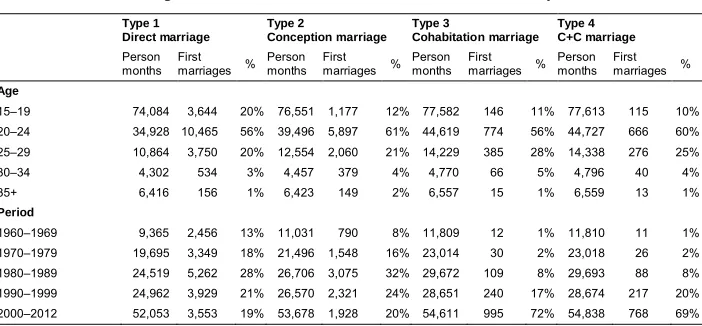
Table 1 shows how we identify traditional and nontraditional first marriage entry based on the CFPS. A marriage without a prior period of cohabitation or a premarital pregnancy with the first spouse is defined as a traditional direct marriage (Type 1). (We subtract nine months from the month of the first live birth to determine the timing of conception.) Otherwise, we identify a nontraditional marriage behavior. A marriage subsequent to pregnancy (without cohabitation) is defined as a conception marriage (Type 2). A marriage preceded by cohabitation (without premarital pregnancy) is specified as a cohabitation marriage (Type 3). A marriage preceded by both pregnancy and cohabitation, regardless of which comes first, is specified as a conception and cohabitation marriage, or a C+C marriage (Type 4). It is unfortunate that we do not have information regarding our respondents’ partnership trajectories prior to first marriage, which would have allowed us to further refine first marriage entry types, such as marriage entry after multiple cohabitations.
Table 1: Identification of traditional and nontraditional first marriage entry
First child conceived prior to marriage
Cohabitation prior to marriage
Entry into
marriage Types
Traditional No No Direct marriage Type 1 Nontraditional Yes No Conception marriage Type 2 No Yes Cohabitation marriage Type 3 Yes Yes C+C marriage Type 4
We apply event-history analysis to study the dynamics of first marriage entry in the Chinese context. Specifically, we estimate the competing risks of the four exclusive types of first marriage by applying four separate hazard regression models. Within each model, when estimating one outcome, we censor the occurrences of the other three. A unique feature of this method is that it allows us to take into account the covariates that change values over time within the observation window, which makes it possible to conduct a more dynamic analysis. Our observation begins when an individual turns 15 and ends in the month when the first marriage occurs. If no marriage event occurs, the observation terminates at the last interview or at age 49, whichever comes first.
time were direct marriages, 31% were conception marriages, 5% were cohabitation marriages, and 4% were C+C marriages.
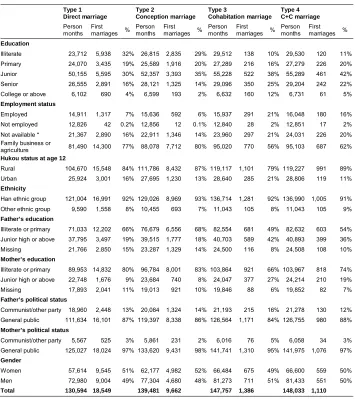
Table 2 presents descriptive statistics for the variables in our analysis in the four separate models. Age, a time-varying variable, is the basic time factor. Time periods, the variable of prime interest in this study, are grouped into five decades from 1960 to 2012. The first two decades represent the periods prior to China’s economic reform, whereas the 1980s, 1990s, and 2000s represent the onset of economic reform and opening up, the period of rapid economic growth, and the period of economic boom.
Our socioeconomic measures rely on two time-varying variables: education and employment. Education is categorized into five levels: illiterate, primary, junior secondary, senior secondary, and college or above. Employment status is classified as employed, not employed, and engaged in other economic activities such as family businesses or agriculture. Given that information on employment history was collected in the 2012 wave, respondents who were interviewed in 2010 but left the study in 2012 are categorized as ‘not available.’ We control for our respondents’ hukou (or rural/urban household registration), ethnicity, parents’ education and political status, and gender. Given that we cannot trace our respondents’ hukou status change prior to the first marriage and given the need to avoid the risk of anticipatory analysis caused by using hukou status at the time of the interview, we use hukou status at age 12 as a time-fixed variable to indicate our respondents’ rural/urban origins.
Table 2: Descriptive statistics for the variables used for analysis
Type 1 Direct marriage Type 2 Conception marriage Type 3 Cohabitation marriage Type 4 C+C marriage Person months First marriages % Person months First marriages % Person months First marriages % Person months First marriages % Age
15–19 74,084 3,644 20% 76,551 1,177 12% 77,582 146 11% 77,613 115 10% 20–24 34,928 10,465 56% 39,496 5,897 61% 44,619 774 56% 44,727 666 60% 25–29 10,864 3,750 20% 12,554 2,060 21% 14,229 385 28% 14,338 276 25% 30–34 4,302 534 3% 4,457 379 4% 4,770 66 5% 4,796 40 4% 35+ 6,416 156 1% 6,423 149 2% 6,557 15 1% 6,559 13 1%
Period
Table 2: (Continued)
Type 1 Direct marriage
Type 2
Conception marriage Type 3
Cohabitation marriage Type 4 C+C marriage
Person
months Firstmarriages % Personmonths Firstmarriages % Personmonths Firstmarriages % Personmonths Firstmarriages %
Education
Illiterate 23,712 5,938 32% 26,815 2,835 29% 29,512 138 10% 29,530 120 11% Primary 24,070 3,435 19% 25,589 1,916 20% 27,289 216 16% 27,279 226 20% Junior 50,155 5,595 30% 52,357 3,393 35% 55,228 522 38% 55,289 461 42% Senior 26,555 2,891 16% 28,121 1,325 14% 29,096 350 25% 29,204 242 22% College or above 6,102 690 4% 6,599 193 2% 6,632 160 12% 6,731 61 5%
Employment status
Employed 14,911 1,317 7% 15,636 592 6% 15,937 291 21% 16,048 180 16% Not employed 12,826 42 0.2% 12,856 12 0.1% 12,840 28 2% 12,851 17 2% Not available * 21,367 2,890 16% 22,911 1,346 14% 23,960 297 21% 24,031 226 20% Family business or
agriculture 81,490 14,300 77% 88,078 7,712 80% 95,020 770 56% 95,103 687 62%
Hukou status at age 12
Rural 104,670 15,548 84% 111,786 8,432 87% 119,117 1,101 79% 119,227 991 89% Urban 25,924 3,001 16% 27,695 1,230 13% 28,640 285 21% 28,806 119 11%
Ethnicity
Han ethnic group 121,004 16,991 92% 129,026 8,969 93% 136,714 1,281 92% 136,990 1,005 91% Other ethnic group 9,590 1,558 8% 10,455 693 7% 11,043 105 8% 11,043 105 9%
Father’s education
Illiterate or primary 71,033 12,202 66% 76,679 6,556 68% 82,554 681 49% 82,632 603 54% Junior high or above 37,795 3,497 19% 39,515 1,777 18% 40,703 589 42% 40,893 399 36% Missing 21,766 2,850 15% 23,287 1,329 14% 24,500 116 8% 24,508 108 10%
Mother’s education
Illiterate or primary 89,953 14,832 80% 96,784 8,001 83% 103,864 921 66% 103,967 818 74% Junior high or above 22,748 1,676 9% 23,684 740 8% 24,047 377 27% 24,214 210 19% Missing 17,893 2,041 11% 19,013 921 10% 19,846 88 6% 19,852 82 7%
Father’s political status
Communist/other party 18,960 2,448 13% 20,084 1,324 14% 21,193 215 16% 21,278 130 12% General public 111,634 16,101 87% 119,397 8,338 86% 126,564 1,171 84% 126,755 980 88%
Mother’s political status
Communist/other party 5,567 525 3% 5,861 231 2% 6,016 76 5% 6,058 34 3% General public 125,027 18,024 97% 133,620 9,431 98% 141,741 1,310 95% 141,975 1,076 97%
Gender
Women 57,614 9,545 51% 62,177 4,982 52% 66,484 675 49% 66,600 559 50% Men 72,980 9,004 49% 77,304 4,680 48% 81,273 711 51% 81,433 551 50%
Total 130,594 18,549 139,481 9,662 147,757 1,386 148,033 1,110
Notes: * “Not available” refers to respondents interviewed in 2010 but not in 2012, when information on employment history was collected.
4. Results
4.1 Descriptive results
Figure 1 displays the distribution of first marriage by entry type during each time period. We can clearly see a growing diversity in marriage behaviors over time. In the 1960s, direct marriage was the predominant family formation behavior, covering approximately 75% of all marriages. However, the share of this traditional marriage behavior notably declined during our observation period. Strikingly, conception marriage was prominent in the 1960s. Its percentage increased from 25% in the 1960s to 36% in the 1980s. However, the rising trend shifted to a marginal decline toward the 1990s and a noticeable decline toward the 2000s. From the 1980s onward, novel marriage behaviors relevant to cohabitation became visible and spread quickly, with cohabitation marriage rising from 1.3% of all marriages in the 1980s to 14% in the 2000s and C+C marriage rising from 1% to 10% over the same period. During the most recent decade (2000–2012), 50% of first marriages were direct marriages, 26% were conception marriages, and the remaining 24% were preceded by cohabitation, regardless of whether a child was conceived in cohabitation.
Figure 1: Distribution of first marriage by entry type during each time period, China
Source: Authors’ own calculation based on CFPS (2010–2012).
0% 10% 20% 30% 40% 50% 60% 70% 80% 90% 100%
1960–1969 1970–1979 1980–1989 1990–1999 2000–2012
Year of entry into first marriage
Type 4 – C+C marriage
Type 3 – Cohabitation marriage
Type 2 – Conception marriage
4.2 Estimated results
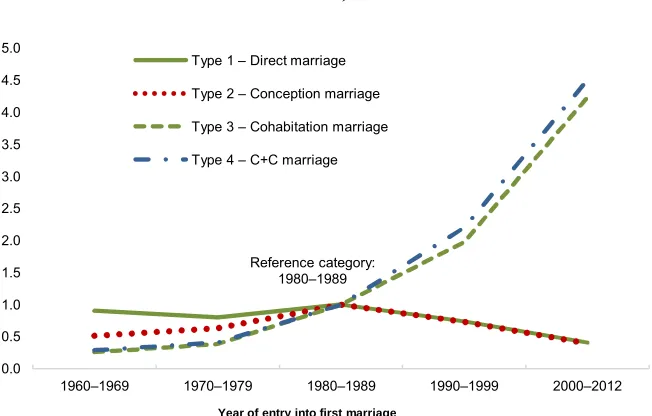
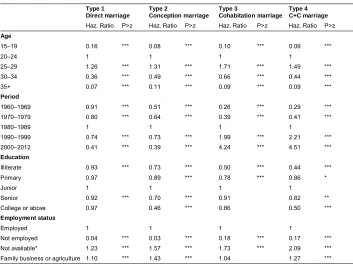
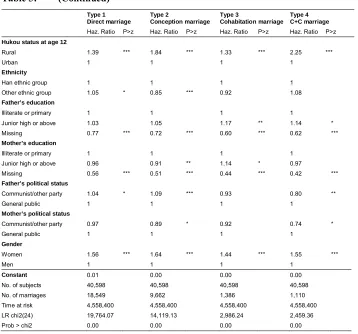
Table 3 demonstrates the competing risks of the four marriage entry types in four hazard regression models. When we estimate one marital outcome, we censor the occurrences of the other three. Figure 2 visualizes the trend variations across time of the four marriage types. The estimated trend developments are in line with our descriptive findings.
The traditional marriage formation behavior – direct marriage (Type 1) – experienced a slight decline during the 1960s and 1970s. It visibly reversed in the 1980s and experienced a new decline in the 1990s and 2000s. The relative risk of conception marriage (Type 2) increased slightly in the 1960s and the 1970s. The trend reached a summit in the 1980s and fell into decay thereafter. During the 1960s and 1970s, cohabitation marriage (Type 3) and C+C marriage (Type 4) were rather uncommon. In the 1980s, these two marriage formation practices started to become prominent routes to marriage.
Figure 2: Estimated competing risks of the four types of first marriage entry by time period, China (1960–2012), standardized for other covariates (separate model for each entry type; reference category: relative risk for all outcomes in 1980–1989)
Source: Authors’ own calculation based on CFPS (2010–2012).
Reference category: 1980‒1989
0.0 0.5 1.0 1.5 2.0 2.5 3.0 3.5 4.0 4.5 5.0
1960–1969 1970–1979 1980–1989 1990–1999 2000–2012
Year of entry into first marriage
Type 1 – Direct marriage
Type 2 – Conception marriage
Type 3 – Cohabitation marriage
The estimations for control variables in the four separate models are compelling (see Table 3). The college-educated have a notably low likelihood of conception marriage and C+C marriage. Entering marriage while unemployed, irrespective of marriage type, is uncommon. Rural-born people have a higher marriage likelihood than do urbanites. Compared to the majority Han ethnic group, other ethnic groups have a relatively higher propensity of direct marriage but a lower propensity of conception marriage. Individuals with more highly educated parents have a higher likelihood than others of entering marriage via cohabitation. The mother’s educational level and political status reduce children’s likelihood of conception marriage. Women’s likelihood of first marriage is much higher than that of men, irrespective of entry type. This gap is partially due to the excess number of men in the marriage market (Poston and Glover 2005) as well as the difficulty experienced by poor and low-educated men in rural areas in finding a marriage partner (Jin, Li, and Feldman 2005).
Table 3: Competing risks of the four types of first marriage entry, China (1960–2012), standardized for other covariates
Type 1 Direct marriage
Type 2
Conception marriage Type 3
Cohabitation marriage Type 4 C+C marriage
Haz. Ratio P>z Haz. Ratio P>z Haz. Ratio P>z Haz. Ratio P>z
Age
15–19 0.16 *** 0.08 *** 0.10 *** 0.09 ***
20–24 1 1 1 1
25–29 1.26 *** 1.31 *** 1.71 *** 1.49 *** 30–34 0.36 *** 0.49 *** 0.66 *** 0.44 *** 35+ 0.07 *** 0.11 *** 0.09 *** 0.09 ***
Period
1960–1969 0.91 *** 0.51 *** 0.26 *** 0.29 *** 1970–1979 0.80 *** 0.64 *** 0.39 *** 0.41 ***
1980–1989 1 1 1 1
1990–1999 0.74 *** 0.73 *** 1.99 *** 2.21 *** 2000–2012 0.41 *** 0.39 *** 4.24 *** 4.51 ***
Education
Illiterate 0.93 *** 0.73 *** 0.50 *** 0.44 *** Primary 0.97 0.89 *** 0.78 *** 0.86 *
Junior 1 1 1 1
Senior 0.92 *** 0.70 *** 0.91 0.82 ** College or above 0.97 0.46 *** 0.86 0.50 ***
Employment status
Employed 1 1 1 1
Table 3: (Continued)
Type 1 Direct marriage
Type 2
Conception marriage Type 3
Cohabitation marriage Type 4 C+C marriage
Haz. Ratio P>z Haz. Ratio P>z Haz. Ratio P>z Haz. Ratio P>z
Hukou status at age 12
Rural 1.39 *** 1.84 *** 1.33 *** 2.25 ***
Urban 1 1 1 1
Ethnicity
Han ethnic group 1 1 1 1
Other ethnic group 1.05 * 0.85 *** 0.92 1.08
Father’s education
Illiterate or primary 1 1 1 1
Junior high or above 1.03 1.05 1.17 ** 1.14 * Missing 0.77 *** 0.72 *** 0.60 *** 0.62 ***
Mother’s education
Illiterate or primary 1 1 1 1 Junior high or above 0.96 0.91 ** 1.14 * 0.97
Missing 0.56 *** 0.51 *** 0.44 *** 0.42 ***
Father’s political status
Communist/other party 1.04 * 1.09 *** 0.93 0.80 **
General public 1 1 1 1
Mother’s political status
Communist/other party 0.97 0.89 * 0.92 0.74 *
General public 1 1 1 1
Gender
Women 1.56 *** 1.64 *** 1.44 *** 1.55 ***
Men 1 1 1 1
Constant 0.01 0.00 0.00 0.00
No. of subjects 40,598 40,598 40,598 40,598 No. of marriages 18,549 9,662 1,386 1,110 Time at risk 4,558,400 4,558,400 4,558,400 4,558,400 LR chi2(24) 19,764.07 14,119.13 2,986.24 2,459.36 Prob > chi2 0.00 0.00 0.00 0.00
Notes: * “Not available” refers to respondents interviewed only in 2010 but not in 2012, when information on employment history was collected. Statistical significance: ***p<.01; ** .01<p<.05; and * .05<p<.10.
Source: Authors’ own calculation based on CFPS (2010–2012).
5. Discussion and conclusion
In this study, we identified four exclusive types of first marriage entry based on the CFPS and estimated the competing models for the four marriage types to demonstrate how the diversification of marriage types has developed over time.
Our estimations from the competing models provided vivid pictures of the diversification of first marriage entry. The prevalence of traditional marriage behavior, direct marriage, has declined over time. Strikingly, conception marriage was vigorously present in the 1960s. The relative risk of conception marriage noticeably increased in the 1970s and 1980s and then declined in the 1990s and 2000s. The likelihood of cohabitation marriage and C+C marriage was rather low during the 1960s and 1970s. However, such marriage behaviors became more prominent in the 1980s. From the 1990s onward, the relative risks of entering into marriage in these two ways substantially increased. In the 2000s, entering marriage via cohabitation or a combination of cohabitation and conception became rather prominent marriage behaviors. In sum, the 1980s acted as a turning point when traditional direct marriage started its decline, the long-existing conception marriage shifted from being on the rise to being on the decline, and novel marriage behaviors relevant to cohabitation emerged and began to spread.
The findings of this study have important implications. First, the diversification of first marriage entry after the 1980s occurred in tandem with the process of China’s economic development and opening up to the Western world. The dominant marriage patterns prior to the 1980s – direct marriage and conception marriage – have gradually lost ground to marriage preceded by cohabitation (either with or without premarital conception) since the 1980s. This simultaneity exemplifies the notion that socioeconomic changes at the macro level interact with family behavior changes at the individual level. The increasingly wide array of first marriage entry types over time reflects an evolution of marriage behaviors from tradition to modernity in contemporary Chinese society.
Second, the findings of this study suggest that the spread of innovative family behaviors may initiate family policy improvement. The term ‘cohabitation’ was first introduced into China’s Marriage Law in its April 2001 amendment. This indicates that the causal pathway from social policies to individual practices can be reversed. Social policies may influence individual practices, and behavioral changes at the individual level may foster social policy adjustment.
pattern of this marriage behavior has become less common since the 1980s, given the rise of cohabitation during the same period, we may argue that conception marriage has partially transformed into and given rise to C+C marriage.
These findings are cause for reflection on the prevalence of shotgun marriages in other Asian societies. Rindfuss and Morgan (1983: 259) define the rise of conception marriage in Korea, Taiwan, and Malaysia as a ‘quiet revolution.’ The shift from arranged marriage toward marriage based on the individual choice of a spouse and romantic love increases couples’ opportunities to date prior to marriage, which arguably contributes to the rise of premarital sex and shotgun marriages. Further, the stable transition from engagements to weddings ensured by families in these societies may also create a favorable context for premarital sex and pregnancy (Rindfuss and Morgan 1983).
The notable existence of conception marriage in China may be understood in similar ways. The first Marriage Law in 1950 forbade arranged marriage and advocated marriage based on love and freedom of choice (Croll 1981). This provided young people with opportunities for courting and dating before marriage, which may have increased their risk of engaging in premarital sex. The ‘later, longer, and fewer’ policies of the 1970s, which encouraged young people to postpone marriage to later ages (Ye 1992), may have further increased young couples’ exposure to premarital sex. In addition, engagement under the negotiations of both families is an indispensable part of the marriage process, especially in rural areas (Cong 2016). This special marriage preparation period may increase couples’ opportunities for premarital sex and their likelihood of marriage entry following a pregnancy.
Finally, we must acknowledge the limitations of this study. We do not have access to our respondents’ unsuccessful cohabitation experiences prior to first marriage. Nor do we have the cohabitation history of those who were single or non-cohabiting at the time of the interview. The lack of data on such partnership trajectories limits the scope of our analysis to the transition to first marriage. We were not able to demonstrate the complete pathways to marriage. Future research may address this issue when such data becomes available.
6. Acknowledgements
References
Burnett, J. (2010). Women’s employment rights in China: Creating harmony for women in the workforce. Indiana Journal of Global Legal Studies 17(2): 289–318.
doi:10.2979/gls.2010.17.2.289.
Cong, X. (2016).Marriage, law and gender in revolutionary China, 1940–1960. New York: Cambridge University Press.doi:10.1017/CBO9781316563021.
Croll, E. (1981). Politics of marriage in contemporary China. New York: Cambridge University Press.
Fine, J.P. and Gray, R.J. (1999). A proportional hazards model for the subdistribution of a competing risk. Journal of the American Statistical Association 94(446): 496–509.doi:10.1080/01621459.1999.10474144.
Frejka, T., Jones, G.W., and Sardon, J.P. (2010). East Asian childbearing patterns and policy developments. Population and Development Review 36(3): 579–606.
doi:10.1111/j.1728-4457.2010.00347.x.
Jin, X., Li, S., and Feldman, M.W. (2005). Marriage form and age at first marriage: A comparative study in three counties in contemporary rural China.
Biodemography and Social Biology 52(1–2): 18–46. doi:10.1080/19485565. 2002.9989097.
Lesthaeghe, R. (2010). The unfolding story of the second demographic transition.
Population and Development Review 36(2): 211–251.doi:10.1111/j.1728-4457. 2010.00328.x.
Mu, Z. and Xie, Y. (2014). Marital age homogamy in China: A reversal of trend in the reform era? Social Science Research 44: 141–157. doi:10.1016/j.ssresearch. 2013.11.005.
Poston, D.L. and Glover, K.S. (2005). Too many males: Marriage market implications of gender imbalances in China.Genus 61(2): 119–140.
Raymo, J.M., Park, H., Xie, Y., and Yeung, W.J. (2015). Marriage and family in East Asia: Continuity and change. Annual Review of Sociology 41(1): 471–492.
doi:10.1146/annurev-soc-073014-112428.
Rindfuss, R.R. and Morgan, S.P. (1983). Marriage, sex, and the first birth interval: The quiet revolution in Asia. Population and Development Review 9(2): 259–278.
Ye, W. (1992). China’s ‘later’ marriage policy and its demographic consequences.
Population Research and Policy Review 11(1): 51–71. doi:10.1007/ BF00136394.
Yeung, W.-J.J. and Hu, S. (2013). Coming of age in times of change: The transition to adulthood in China. Annals of the American Academy of Political and Social Science646(1): 149–171.doi:10.1177/0002716212468667.
Yeung, W.-J.J. and Hu, S. (2016). Paradox in marriage values and behavior in contemporary China. Chinese Journal of Sociology2(3): 447–476.doi:10.1177/ 2057150X16659019.
Yu, J. and Xie, Y. (2015a). Changes in the determinants of marriage entry in post-reform urban China. Demography 52(6): 1869–1892. doi:10.1007/s13524-015-0432-z.
Yu, J. and Xie, Y. (2015b). Cohabitation in China: Trends and determinants.
Population and Development Review 41(4): 607–628.doi:10.1111/j.1728-4457. 2015.00087.x.