VOLUME 37, ARTICLE 51, PAGES 1659
−
1694
PUBLISHED 30 NOVEMBER 2017
http://www.demographic-research.org/Volumes/Vol37/51/ DOI: 10.4054/DemRes.2017.37.51
Research Article
Stepfather or biological father?
Education-specific pathways of postdivorce
fatherhood
Christine Schnor
Sofie Vanassche
Jan Van Bavel
This publication is part of the Special Collection on “The New Roles of Women and Men and Implications for Families and Societies,” organized by Guest Editors Livia Sz. Oláh, Rudolf Richter, and Irena E. Kotowska.
© 2017 Schnor, Vanassche & Van Bavel.
This open-access work is published under the terms of the Creative Commons Attribution 3.0 Germany (CC BY 3.0 DE), which permits use, reproduction, and distribution in any medium, provided the original author(s) and source are given credit.
1 Introduction 1660
2 Previous research 1662
2.1 Educational differences in men’s fertility 1663 2.2 Educational differences in fatherhood positions after divorce 1665 2.3 Hypotheses on education-specific positions of postdivorce
fatherhood
1667
3 Data and methods 1668
3.1 Sample 1668
3.2 Analytical strategy 1669
3.3 Control covariates and sample description 1671
4 Results 1673
4.1 Descriptive results 1673
4.2 Multivariate results 1675
5 Discussion 1679
6 Acknowledgements 1683
References 1684
Stepfather or biological father?
Education-specific pathways of postdivorce fatherhood
Christine Schnor1 Sofie Vanassche2
Jan Van Bavel3
Abstract
OBJECTIVE
Men are commonly assigned the role of economic providers in the family, and education informs about their capacity to fulfil this role. Yet having biological ties to coresident children can determine the man’s willingness to step into the provider role. This study investigates how education is linked to fatherhood after divorce, distinguishing between biological father and stepfather positions.
METHODS
We analysed life course data from 1,111 divorced Belgian men collected in the ‘Divorce in Flanders’ project. We used descriptive methods of sequence analysis to illustrate the pathways of postdivorce fatherhood. In multinomial logistic regressions, we estimated the likelihood of, firstly, being a father with coresident biological children or/and stepchildren and, secondly, repartnering with a mother and fathering children in this union.
RESULTS
The family situations of divorced men are dependent on their educational level. More-educated men are more often in the role of a resident biological father, whereas less-educated men are more often stepfathers. Men’s resident arrangements for first-marriage children, their selection into a new union, and the parental status of their new partner help explain the educational differences in postdivorce father positions. Highly educated men live more often with the children from their first marriage and repartner more frequently, especially with women without own coresident children, which is beneficial for their transition to postdivorce childbearing.
1
Katholieke Universiteit Leuven, Belgium. E-Mail:[email protected].
2
Hogeschool Artevelde Gent, Belgium.
CONTRIBUTION
The findings suggest that both capacity and willingness to support the postdivorce family are lower among the less educated. These education-specific pathways of postdivorce fatherhood are likely to enhance social inequalities.
1. Introduction
Research shows that education works as a clear divider of life course patterns, with the less educated having different family structures than the more educated (Cherlin 2010; McLanahan 2004). Whereas a wide strand of literature has focused on this link from the woman’s point of view, only recently has the man’s perspective been taken up in family research (Goldscheider and Kaufmann 1996; Lappegård and Rønsen 2013; Thomson et al. 2014). Scholars thereby account for the fact that life course patterns may develop differently for men than for women, given existing gender roles, and that men’s education may shape family life differently than what is known for women (Goldscheider and Kaufmann 1996). In particular, the ongoing trend of high divorce rates implies postdivorce family structures that can be quite complex for men (Eggebeen and Knoester 2001). For most men, a divorce means the end of permanent residency with the children from their first marriage. Divorce and repartnering may thus disconnect a man’s fatherhood position at home from that of biological fatherhood. It may lead to multiple paternal positions, in which men have to combine their childrearing obligations towards biological children from their first marriage with new childrearing tasks arising from coresident stepchildren and biological children from the new union (Goldscheider and Sassler 2006). Existing empirical evidence shows that education structures the family life of divorced men: Compared to the more educated, less-educated men rarely live with the children from their first marriage and more often live with stepchildren (Goldscheider and Sassler 2006; Sodermans, Matthjis, and Swicegood 2013; Vanassche et al. 2015). This study expands on current research by drawing a more integral picture of the different – and perhaps multiple – domestic paternal positions that men of different educational levels occupy after separation.
2010). Men’s educational background informs about their capacity to fulfil the provider role in the family, but men’s biological ties to coresident children can affect their willingness to perform this role: Stepfathers have been found to feel less obligation to financially support the family than biological fathers (Hofferth and Anderson 2003; Marsiglio 2004; Sweeney 2010). If stepfathers are less capable and willing to support the family they live with than biological fathers, then education-specific pathways of postdivorce fatherhood are likely to reproduce social inequalities between different types of families.
Over the past several decades, parenting and childrearing practices have changed enormously for men. During large parts of the 20th century, men with children from a dissolved partnership were rarely involved in daily childrearing, as the children lived almost exclusively with the mother. For separated or divorced men, childrearing tasks only came into play if they lived together with the children of their new partner or with children born in the new union. The absence of the actual physical presence of children from dissolved unions in men’s households can be attributed to the gendered specialization in employment, childcare, and household tasks common during the post– Second World War period (Goldscheider, Bernhardt, and Lappegård 2015). Presently, fathers and mothers are approaching equality in their involvement in paid labour, household work, and parenting tasks, which is also reflected in the parental roles that mothers and fathers fulfil after union dissolution. Since the 1990s, after the union dissolution of their parents, children have been increasingly likely to live part-time with their mother and part-time with their father (Bjarnason and Arnarsson 2011). This change in childrearing obligations can mean that men face increasingly complex parental positions in higher-order unions, because they may live together with children from the first marriage, children of the new partner, and children common to the new union. Few studies have investigated this combination of multiple father positions. More specifically, we know little on how the increasing coresidence of fathers with children from previous unions affects the way their postdivorce family life unfolds. How often do men coreside with both their own children and stepchildren? Do men actually have these complex parental roles, or do they rather choose a certain type of fatherhood? And how do parental roles differ according to men’s educational background? Our hypothesis is that highly educated men more commonly than less-educated men have biological ties with coresident children, which means that they are not only more able but also more willing to act as the economic provider.
children, d) living with stepchildren but without own biological children, and e) living with both stepchildren and biological children. To allow for a better understanding of the mechanisms that drive the education-specific positions of fatherhood, we estimate the likelihood of men repartnering and of fertility in the new unions formed. We use three categories of educational level: ‘low’ for up to lower secondary school (ISCED-97 codes 0‒2), ‘medium’ for upper secondary schooling (completed high school in the US system; ISCED-97 codes 3‒4), and ‘high’ for tertiary education (college or university level; ISCED-97 codes 5‒6).
Because, traditionally, mothers have got sole physical custody of children, most stepfamily research has addressed stepfather families rather than stepmother families (which involve the male partner’s children from a previous union). Studies that do consider these stepmother families often face low sample sizes that do not allow firm conclusions (e.g., Buber and Prskawetz 2000). We use data on divorced men living in Flanders, the Dutch-speaking part of Belgium, from the Divorce in Flanders study (Mortelmans et al. 2011). Belgium is an excellent setting in which to study postdivorce fatherhood, as after parental separation quite a large proportion of children live part-time with the father. In 1995 the country implemented joint legal custody and then in 2006 joint physical custody as legal defaults, which created a pathway toward more gender-neutral parenting (Sodermans, Matthijs, and Swicegood 2013). After joint custody had been legally adopted it became more widespread among different groups of parents (see Sodermans, Vanassche, and Matthijs 2013). Whereas before the legislative shifts it had mostly been an arrangement chosen by well-educated parents and parents with low levels of conflict, its association with education has weakened and its link to parental conflict has even disappeared (Sodermans, Vanassche, and Matthijs 2013). It is estimated that more than 33% of Flemish children with parents who divorced between 2006 and 2009 are living in equally shared custody arrangements (Sodermans, Matthijs, and Swicegood 2013). Drawing on the Belgian setting, the study overcomes the issue of insufficient sample sizes of divorced fathers who coreside with their children and the problem of their high selectivity, and addresses the call for more research on the diversity of stepfamilies regarding type and variation across educational groups (Sweeney 2010).
2. Previous research
stepchildren of a new partner, and biological father positions resulting from coresidence with children from a previous union or childbirths within the new union. Figures 1a and Figure 1b illustrate how a divorced man’s education relates to his fertility and his fatherhood position, according to existing literature.
2.1 Educational differences in men’s fertility
In Western countries the large majority of men (around 80%) become biological fathers at some point in their life course (Priskorn et al. 2012; Ravanera and Beaujot 2014; Rotkirch et al. 2015). The educational level of men is positively related to their reproductive outcome, both in terms of having children per se and the number of children (see Figure 1a, black arrow; Fieder and Huber 2007; Goodman and Koupil 2010; Kravdal and Rindfuss 2008; Lappegård and Rønsen 2013; Nisén et al. 2013). There is no clear educational gradient in men’s intended family size, but the association between education and fulfilment of fertility intentions seems to be positive (Berrington and Pattaro 2014).4 It is argued that the positive association of men’s education and fertility acts through different pathways (Figure 1a, grey arrows). First, the association can be interpreted as an income effect, which means that more-educated men can more easily afford more children due to their often higher income levels compared to the less educated (Kravdal and Rindfuss 2008). Kravdal and Rindfuss (2008) relate this to the fact that even in modern dual-earner families, traditional differences between mother and father roles persist and the man’s income is still considered the primary contribution to the family budget and the main source of financial wellbeing. Second, more-educated men are shown to have stronger egalitarian gender-role attitudes and to be more involved in household and childrearing tasks (Goldscheider, Bernhardt, and Lappegård 2014), which is beneficial for a couple’s decision to have another child (Thornton and Young-DeMarco 2001). Third, the positive relationship between socioeconomic status and fertility for men can be driven by the lower likelihood of singlehood among high-status men (Barthold, Myrskylä, and Jones 2012; Fieder and Huber 2007; Fieder, Huber, and Bookstein 2011; Goodman, Koupil, and Lawson 2012; Hopcroft 2015). Union formation is a strong predictor of fertility and more-educated men are shown to have a higher likelihood of entering a partnership (Sweeney 2002; Dykstra and Poortman 2010; Trimarchi and Van Bavel 2015). This might be explained by female mating preferences that rate highly educated men above other potential mates, perhaps not only because of the greater economic security it implies, but also
4
because they are perceived to more likely be a ‘good father’ (Becker 1991; Lappegård and Rønsen 2013; Pasteels, Corijn, and Mortelmans 2012). Lappegård and Rønsen (2013) speculate that highly educated divorced fathers may possess values or preferences that are more child- and family-oriented. Both self-selection into fatherhood by men and the selection of men into fatherhood by women are essential factors in explaining the link between men’s education and fertility (Lappegård and Rønsen 2013; Trimarchi and Van Bavel 2015).
Figure 1a: Links found in the literature between a man’s education and fertility
Figure 1b: Links between a divorced man’s education and biological father’s position discussed in the literature
* = Man holds the position of a biological father at home, but not that of a stepfather.
• Income
• Gender-egalitarian attitude and
behaviour
• Being in partnership
Reproductive outcome Man’s educational level
+
+
+
Divorced man’s
educational level Exclusive resident biologicalfather position*
Repartnering a mother = coresidence with stepchildren
2.2 Educational differences in fatherhood positions after divorce
For men who live in stable unions, biological fatherhood and their father position at home coincide. A separation can disconnect men’s fertility from their paternal position in the home. Once separated, men can face a range of possible father positions. If they live with the biological children from their first marriage or father children within a new union they retain the position of a resident biological father. Men can also enter a father position through repartnering: If men repartner a woman with coresident children from a previous union they are considered as the stepfather of these children. The father position of men living with their biological children but without stepchildren is that of an exclusive resident biological father. The presence in the household of the man’s children from his previous union means that when he starts a new union the female partner enters the role of stepmother. From existing research it is unclear how a man’s education relates to being an exclusive resident biological father. However, a man’s educational level is found to be related to coresidence with children from his first marriage, to repartnering, and to postdivorce fertility (Figure 1b, grey arrows).
1) Biological father position as result of coresidence with children from his first marriage.Highly educated men remain more involved with childrearing than less-educated men, in the sense that there is a greater likelihood that the children from the dissolved marriage live in their household at least some of the time (Bjarnason and Arnasson 2011; Cancian et al. 2014; Vanassche et al. 2015). Explanations for these educational differences have been sought in a higher awareness of alternative custody arrangements, a higher ability to pay the extra costs of shared residence, more child- and family-orientated values or preferences of highly educated men, and their greater involvement in childrearing before union dissolution (e.g., Cancian et al. 2014; Sodermans, Matthijs, and Swicegood 2013).
2) Stepfather position as result of repartnering a mother.Empirical studies have reported a positive relationship between educational level and men’s likelihood of repartnering (De Graaf and Kalmijn 2003; Pasteels, Corijn, and Mortelmans 2012; Poortman 2007; Vanassche et al. 2015; Wu and Schimmele 2005). Studies that include information on the parental status of the new partner have shown that men with higher education levels more frequently repartner a childless woman, whereas less-educated men more frequently repartner a woman with coresident children (Goldschneider and Sassler 2006; Vanassche et al. 2015). Consequently, less-educated divorced men become stepfathers more often than more-educated divorced men.
3) Biological father position as a result of childbirths in a postdivorce union.
separation does not seem to depend on their educational level (Vanassche et al. 2015). When looking at separated fathers (including those who do not start a new union), the link between a man’s education and postdivorce childbearing seems, however, to be positive. The high rate of highly educated men’s multi-partner fertility can be explained by their high level of attractiveness to women as partners and fathers of future children (Lappegård and Rønsen 2013; Thomson et al. 2014), as well as by their high preference for children (Hopcroft 2015). Lappegård and Rønsen (2013) demonstrate that medium-educated men are less likely to have children with several partners than low- or highly educated men. A low level of education is associated with higher union instability and therefore the less-educated are more often exposed to the risk of multi-partner fertility.
4) Multiple father positions. Biological father and stepfather positions may be combined within one household. Men find themselves in the position of being both a biological parent and a stepparent if they start a relationship with a mother and father either children in this union or have their children from the dissolved union living with them. Roles in postdivorce families can be complex when one or both partners bring children from previous relationships into the household and common children are born. Highly educated men might display greater reluctance towards a high degree of complexity within the household in order to maintain high-quality parenting standards. On the other hand, a high level of education is associated with more financial, social, and cultural resources, and therefore might make it easier for higher-educated men to deal with these complex family situations. We found no studies that explore educational differences in the likelihood of combining parental positions. However, selection processes, in terms of coresidence with children from previous unions, the likelihood of union formation with a partner with or without coresident children, and the likelihood of higher-order union childbearing, may translate into educational differences in the combined occurrence of these events.
couples in which only the woman has children or in which both are childless (for France: Beaujouan and Wiles-Portier 2011; Toulemon 1997; for Austria: Buber and Prskawetz 2000; for Sweden: Vikat, Thomson, and Prskawetz 2004). The negative effect of the woman’s children from previous unions on a new couple’s likelihood of childbearing may be related to the fact that women incur greater costs of childbearing and childrearing than men (Vikat, Thomson, and Prskawetz 2004). Women who are already mothers may be less willing to take on additional costs in order to enable the partner to step into a biological parent role than men who are already fathers. This tendency is confirmed by studies that look at individual birth intentions: Women’s preunion children have a stronger negative effect on birth intentions than do men’s children from previous relationships (Thomson 1997; Toulemon 1997; Stewart 2002; Stewart, Manning, Smock 2003). An alternative explanation for the low likelihood of a birth in stepfather families is that childless men entering stepfamilies are disproportionately selected from a population of individuals who would not have had biological children, whether or not they entered a stepfamily (Henz and Thomson 2005). Moreover, men who live with their partner’s children often do not consider themselves to be parents (Marsiglio 1991; Hofferth and Anderson 2003).
2.3 Hypotheses on education-specific positions of postdivorce fatherhood
Divorced men may occupy different kinds of fatherhood positions in a domestic setting, depending on their coresidence with children from their or their partner’s previous unions and with children born within the new union. We derive the following three hypotheses from the previous literature discussion:
H1: Men’s educational level is positively related to being exclusively a resident biological father. We expect that, on the one hand, more-educated fathers live more often with the children from their first marriage and that, on the other hand, they have higher chances of repartnering with a childless woman, which should be beneficial for the transition to a postdivorce birth. In sum, education should increase the likelihood of being exclusively a resident biological father.
H2: Men’s educational level is negatively related to being a stepfather. We expect that less-educated men tend to repartner with women who bring their children into the union, which puts these men in a stepfather position.
H3: Men’s educational level is negatively related to being in no parental position.
than more-educated men, because they more often remain childless and without a new partner. Furthermore, we expect that less-educated men are more likely to be nonresident biological fathers than more-educated men, because children from a previous union are less likely to coreside with low-educated fathers, whereas this is more frequently the case among highly educated fathers.
It is not clear from the literature how men’s education relates to having multiple father positions. As low-educated men tend to more often repartner a mother, they are also more exposed to the risk of combining different paternal positions. Once in a stepfather position, highly educated men may transition more often to a common child, as they have more financial means to care for a larger family. Hypotheses H1‒H3 assume that educational gradient plays a proportional role in the underlying demographic events (the likelihood of coresidence with children from a previous union, repartnering a childless partner or mother, and experiencing a postdivorce birth). However, lower- and higher-educated men’s likelihood of postdivorce union formation and childbearing might be affected in different ways by, for example, either partner’s coresidence with children from a previous union. As there is no existing research on the link between educational background and the interplay of these three dimensions, in this study we will explore the effect of the interaction between men’s educational level and parenthood characteristics on estimating the likelihood of becoming a stepfather, experiencing a (new) birth, or both.
3. Data and methods
3.1 Sample
For our analytical sample we only considered male respondents with a divorce between 1981 and 2005 and for whom full information was available for the first seven years following the date of marital separation (N = 1,377). Marital separation was defined as the date of resident separation from the first marriage partner, not as the date of legal divorce. A substantial period can lie between resident separation and legal divorce, during which persons might already repartner (Bastaits et al. 2011). Partnership and fertility events tend to occur quite quickly after marital dissolution (Buber and Prskawetz 2000; Pasteels, Corijn, and Mortelmans 2012). Earlier work indicates that seven years is an appropriate time frame to observe men’s transition into postdivorce fatherhood roles in our data (Vanassche, Corijn, and Matthijs 2015). We disregarded respondents if information on educational level (N = 5) or the parental status of the new partner (N = 261) was missing. Level of education was defined in three categories:1) ‘low’ for up to lower secondary school (ISCED-97 codes 0‒2), 2) ‘medium’ for upper secondary schooling (completed high school in the US system; ISCED-97 codes 3‒4), and 3) ‘high’ for tertiary education (college or university level; ISCED-97 codes 5‒6) (see Jappens and Van Bavel 2015). The analytical sample comprised 1,111 men. Of those, 29% (N = 324) were low-educated, 43% (N = 474) were medium-educated, and 28% (N = 313) were highly educated.
3.2 Analytical strategy
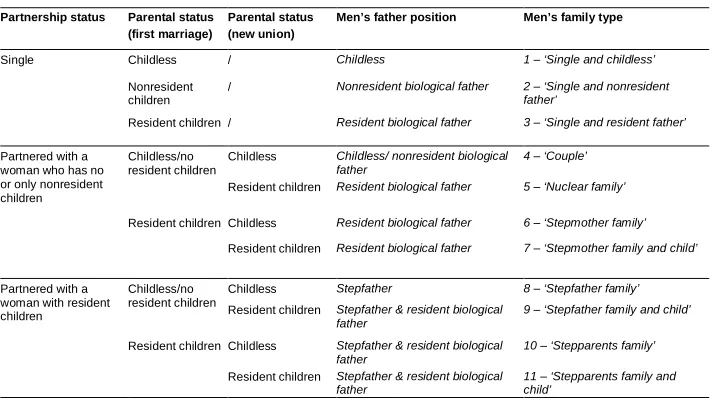
together, because the separate categories were small. A third distinction (third column) was made within the subgroup of repartnered fathers according to the new couples’ fertility. The fourth column in Table 1 shows men’s father status when combining childrearing obligations from the dissolved first marriage and from the postdivorce union. The distribution of the different states at each time unit is shown in Figure 2 as state distribution plots (also known as ‘chronograms’ (Cornwell 2015: 104; Mills 2011: 218). The state distribution plots show the overall patterns of fatherhood for different educational groups while hiding individual continuity. The y-axis refers not to individual cases, as in the case of sequence index plots, but contains the prevalence of each element at each position of the x-axis, which is defined as the time since marital dissolution (Cornwell 2015: 104).
The empirical analysis consists of three parts. First, we analysed how a man’s education is linked to his fatherhood position. For this purpose we estimated in a multinomial logistic regression the likelihood of being/becoming, within the first seven years after the divorce, 1) a childless man, 2) a nonresident biological father, 3) a resident biological father, 4) a stepfather, or 5) both a stepfather and a resident biological father. The reference outcome was being a resident biological father. Men’s educational background was considered as a determinant influencing the outcomes. To allow for a better understanding of the selection processes that drive education-specific positions of fatherhood, we estimated men’s likelihood of repartnering (second part) and of fertility in the newly formed union (third part). In particular, we estimated interaction effects between men’s educational level and parental status on the likelihood of becoming a stepfather, experiencing a (new) birth, or both. In the second empirical part we used a multinomial logistic regression to estimate the effect of men’s education on their likelihood of 1) staying single, 2) repartnering a childless woman, and 3) repartnering a mother. In the third part, the effects of education on men’s likelihood of having (another) child within the first postdivorce union were estimated using a logistic regression.5 This part is modelled for repartnered men only.
To ease interpretation of the model results, they are shown as predicted probabilities. Predicted probabilities are statistics based on a fitted model in which family outcomes for divorced men are compared while keeping the remaining covariates at their average values (Williams 2012). Probabilities were marked with significance levels (*** p<0.01, ** p<0.05, * p<0.1) if the marginal probabilities were significantly different from the reference category. The complete results of the fitted models, given in odds ratios, can be found in the Appendix.
5 Since Henz and Thomson (2005) emphasize the interrelation between stepfamily union stability and birth
Table 1: Classification of divorced men’s parental status and family type Partnership status Parental status
(first marriage)
Parental status (new union)
Men’s father position Men’s family type
Single Childless / Childless 1‒‘Single and childless’
Nonresident children
/ Nonresident biological father 2‒‘Single and nonresident father’
Resident children / Resident biological father 3‒‘Single and resident father’
Partnered with a woman who has no or only nonresident children
Childless/no resident children
Childless Childless/ nonresident biological
father
4‒‘Couple’
Resident children Resident biological father 5‒‘Nuclear family’
Resident children Childless Resident biological father 6‒‘Stepmother family’
Resident children Resident biological father 7‒‘Stepmother family and child’
Partnered with a woman with resident children
Childless/no resident children
Childless Stepfather 8‒‘Stepfather family’
Resident children Stepfather & resident biological father
9‒‘Stepfather family and child’
Resident children Childless Stepfather & resident biological father
10‒‘Stepparents family’
Resident children Stepfather & resident biological father
11‒‘Stepparents family and child’
3.3 Control covariates and sample description
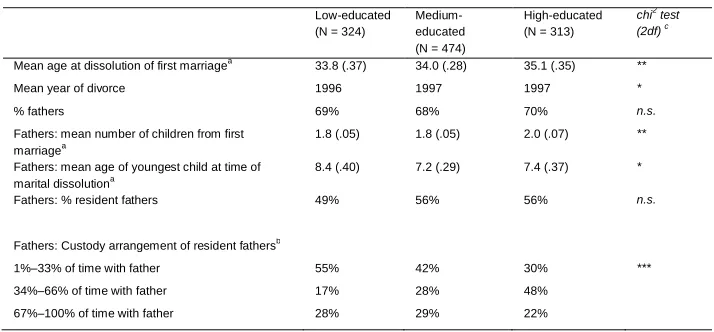
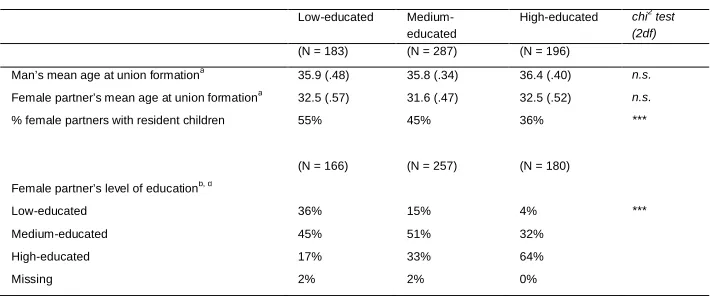
The multivariate analysis of the likelihood of specific fatherhood statuses (empirical part one) and of postdivorce union formation (empirical part two) include a set of covariates that present the situation at time of union dissolution for the complete sample of divorced men. Table 2 presents the descriptive statistics of this set of control variables by men’s level of education. Information referring to the man’s and his partner’s characteristics at the time a postdivorce union is formed enter the analysis of postdivorce fertility (empirical part three); this set of variables is presented in Table 3.
their custody was more often equally shared between the mother and father. Although the small sample sizes did not allow inclusion of this concrete distinction in the analysis, these education-specific coresidence patterns need to be considered in the interpretation of our findings.
In the sample of repartnered men (N = 666), men’s mean age at first postdivorce union formation was 35 (Table 3), while the female partner’s average age was 32. The proportion of women who brought children into the new union varied substantively by the educational level of the man. Highly educated men repartnered less often with a mother than the low educated (36% vs. 55%), confirming prior empirical findings. For a subsample of unions that were intact at the time the survey was conducted (N = 596), we had information on the female partner’s level of education. The information displayed in Table 3 shows that highly and medium-educated men were more often partnered with a similarly educated woman, whereas low-educated men were more often partnered with a more-educated woman.
Table 2: Men’s characteristics at time of first union dissolution by level of education
Low-educated (N = 324)
Medium-educated (N = 474)
High-educated (N = 313)
chi2test (2df)c
Mean age at dissolution of first marriagea 33.8 (.37) 34.0 (.28) 35.1 (.35) **
Mean year of divorce 1996 1997 1997 *
% fathers 69% 68% 70% n.s.
Fathers: mean number of children from first marriagea
1.8 (.05) 1.8 (.05) 2.0 (.07) **
Fathers: mean age of youngest child at time of marital dissolutiona
8.4 (.40) 7.2 (.29) 7.4 (.37) *
Fathers: % resident fathers 49% 56% 56% n.s.
Fathers: Custody arrangement of resident fathersb
1%‒33% of time with father 55% 42% 30% ***
34%‒66% of time with father 17% 28% 48%
67%‒100% of time with father 28% 29% 22%
a Standard errors in brackets;bnot considered in multivariate analysis (due to small category sizes);c Kruskal‒Wallis
equality-of-populations rank test for continuous variables, Pearson chi2 test for categorical variables; *** p<0.01, ** p<0.05, * p<0.1.
Table 3: Men’s and their partner’s characteristics at the start of their first postdivorce union by men’s level of education
Low-educated
Medium-educated
High-educated chi2test
(2df)
(N = 183) (N = 287) (N = 196)
Man’s mean age at union formationa 35.9 (.48) 35.8 (.34) 36.4 (.40) n.s.
Female partner’s mean age at union formationa 32.5 (.57) 31.6 (.47) 32.5 (.52) n.s.
% female partners with resident children 55% 45% 36% ***
(N = 166) (N = 257) (N = 180)
Female partner’s level of educationb, d
Low-educated 36% 15% 4% ***
Medium-educated 45% 51% 32%
High-educated 17% 33% 64%
Missing 2% 2% 0%
a Standard errors in brackets;bnot considered in main multivariate analysis (only available for subsample);d only available if the
partnership was still intact at the time of the survey; *** p<0.01, ** p<0.05, * p<0.1.
Source: Divorce in Flanders study (2009/2010): N = 666 (N = 596 for subsample that contains information on female partner’s level of education).
4. Results
4.1 Descriptive results
Figure 2: Chronogram ‒ resident family arrangements and fatherhood after divorce
Notes: Chronograms (also known as state distribution plots) show overall patterns of fatherhood for different educational groups while hiding individual continuity. The y-axis contains the prevalence of each element at each position of the x-axis, which is defined as the time since marital dissolution.
Source: Divorce in Flanders study (2009/2010): N = 1,111. 0%
20% 40% 60% 80% 100%
0 12 24 36 48 60 72
Time since marital dissolution (months) Low educated
0% 20% 40% 60% 80% 100%
0 12 24 36 48 60 72
Time since marital dissolution (months) Medium educated
0% 20% 40% 60% 80% 100%
0 12 24 36 48 60 72
Time since marital dissolution (months) Highly educated
stepparents f. and child stepparents f.
stepfather f and child stepfather f.
stepmother f. and child stepmother f.
nuclear f. childless couple
single and res. father single and nonres. father
Among the divorced men who remained single throughout the first seven years following first marriage dissolution, the more-educated men lived most often with the children from their first marriage, whereas the less educated were most often nonresident fathers.
4.2 Multivariate results
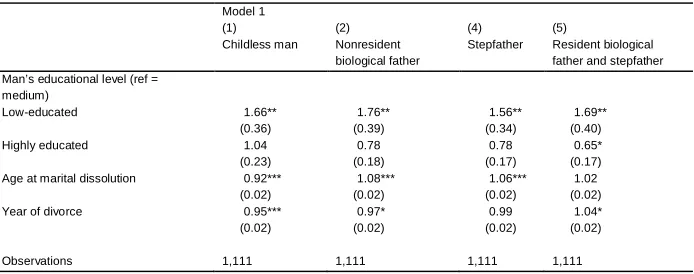
As the first step, we analysed how a man’s education is linked to his fatherhood position in the first seven years after first marriage dissolution. Table 4 presents the predictive probabilities of being 1) childless, 2) a nonresident biological father, 3) a resident biological father, 4) a stepfather, and 5) a resident biological father and a stepfather, for men with average age at separation and year of divorce by educational level, based on the results of a multinomial logistic regression. Low-educated men have a significant 33% lower probability of being exclusively in the resident biological father category than medium- and highly educated men (45% and 51% respectively). The other results show no statistically significant negative educational gradient of childlessness or of nonresident biological fatherhood and stepfatherhood among the divorced men, when the medium educated are taken as the reference category. Changing the reference category to the highly educated group (results marked with a) reveals, however, that the low educated have a significantly higher probability of being nonresident biological fathers (18% vs. 12%) and of combining biological and stepfather positions (15% vs. 9%). No statistically significant difference between highly and low-educated men could be found in their probability of being childless or a stepfather. However, the results show that, at least in the sample studied, the low educated are more often childless men or stepfathers.
Table 4: Results from multinomial logistic regression, predicted probabilities of father position for men by their educational level
Childless man (2) Nonresident biological father
(3) Resident biological father
(4) Stepfather (5) Resident
biological father and stepfather
Low-educated .16 (.02) .18 (.02)a .33 (.03) ***a .17 (.02) .15 (.02)a
Medium-educated
.13 (.02) .14 (.02) .45 (.02) .15 (.02) .12 (.01)
High-educated .15 (.02) .12 (.02) .51 (.03) .13 (.02) .09 (.02)
Notes: Interpretation: row values add up to 1.00. Standard errors in brackets. Age at marital dissolution and year of divorce are fixed to their mean values. All results significantly different (p<0.001) from zero. Probabilities are marked with significance levels (*** p < .01, ** p < .05, * p < .1) if the marginal probabilities were significantly different from the reference category (in italics; here: ‘medium-educated’). Probabilities are marked witha if significantly different (p < .05) from the category of highly educated. Detailed regression results shown in Appendix (Model 1, Table A-1).
To gain more insight into the pathways to different father positions, we estimated the effect of education on repartnering and postdivorce fertility. As the second step, Table 5 presents the predictive probabilities of 1) remaining unpartnered, 2) repartnering a childless woman, and 3) repartnering a mother, for men by their educational level and their coresidence with children, calculated from a multinomial logistic regression, with age at marital dissolution, year of divorce, and number and age of children fixed to their average values. Educational differences were found in men’s probability of remaining unpartnered: Low-educated men have a higher probability of not entering a postdivorce union than the medium- and highly educated. The results show a statistically significant educational gradient in men’s repartnering behaviour when it comes to repartnering a childless woman or a mother. All else being equal, our results predict that 41% of highly educated men enter a union with a childless woman, compared to 32% of the medium-educated and only 22% of the low-educated. The predicted probability of repartnering a woman with resident children is higher for low-educated men (32%) than for medium-low-educated (27%) and highly low-educated men (22%). Having children living in his home reduces a man’s probability of repartnering.
Table 5: Results from multinomial logistic regression, predicted probabilities of repartnering for men by educational level and coresidence with children from first marriage
(1) Remain unpartnered (2) Repartner with childless woman (3) Repartner with mother
Low-educated .45 (.03)a .22 (.03) ***a .32 (.02)a
Medium-educated .41 (.02) .32 (.02) .27 (.02)
High-educated .37 (.03) .41 (.03) *** .22 (.02) *
Man lives without children .37 (.02) .34 (.02) .29 (.02)
Man has coresident children .49 (.03) *** .27 (.03) * .24 (.02)
Note: Interpretation: row values add up to 1.00. Standard errors in brackets. Age at marital dissolution, year of divorce, number and age of children from first marriage are fixed to their mean values. All results significantly different (p<0.001) from zero. Probabilities are marked with significance levels (*** p<0.01, ** p<0.05, * p<0.1) if the marginal probabilities were significantly different from the reference category (in italics). Probabilities for man’s education are marked witha if significantly different (p < .05) from the category of highly educated. Detailed regression results shown in Appendix (Model 2, Table A-2).
Source: Divorce in Flanders study (2009/2010): Sample: N = 1,111.
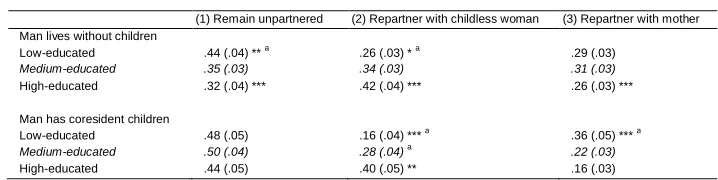
Table 6: Results from multinomial logistic regression, predicted probabilities of repartnering for men by educational level interacted with
coresidence with children
(1) Remain unpartnered (2) Repartner with childless woman (3) Repartner with mother Man lives without children
Low-educated .44 (.04) **a .26 (.03) *a .29 (.03)
Medium-educated .35 (.03) .34 (.03) .31 (.03)
High-educated .32 (.04) *** .42 (.04) *** .26 (.03) ***
Man has coresident children
Low-educated .48 (.05) .16 (.04) ***a .36 (.05) ***a
Medium-educated .50 (.04) .28 (.04)a .22 (.03)
High-educated .44 (.05) .40 (.05) ** .16 (.03)
Note: Interpretation: row values add up to 1.00. Standard errors in brackets. Age at marital dissolution, year of divorce, number and age of children from first marriage are fixed to their mean values. All results significantly different (p<0.001) from zero. Probabilities are marked with significance levels (*** p<0.01, ** p<0.05, * p<0.1) if the marginal probabilities were significantly different from the reference category (in italics). Probabilities for man’s education are marked witha if significantly different (p < .05) from the category of highly educated. Detailed regression results shown in Appendix (Model 3, Table A-2).
Source: Divorce in Flanders study (2009/2010): Sample: N = 1,111.
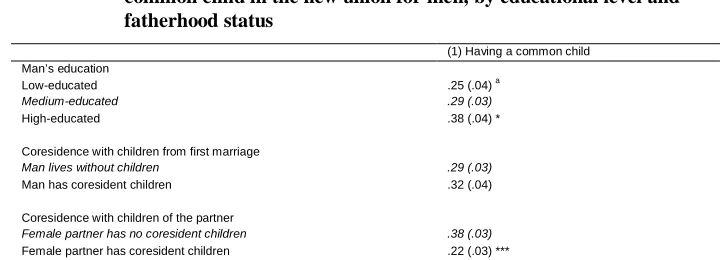
household. We found no statistical significance of this relationship in multivariate analyses (interaction of his and her parental status, results not shown). However, the woman’s parental status affects childbearing probabilities differently for highly and low-educated men. We estimated an interaction effect between woman’s parental status and man’s educational level (displayed as predicted probabilities in Figure 3) and we observe that education had a significant positive impact in the group of men partnered with a childless woman, but not in the group of men partnered with a mother. In the latter group, the probability of a childbirth was about 20%‒25%. By contrast, having no stepchildren at home increased the probability of having a common child to 37% among the medium educated, and even 50% among the highly educated, whereas the probability remained at 25% for low-educated men. Put differently, having no stepchildren at home doubled the probability of a childbirth for highly educated men, but rarely changed anything among low-educated men.
Table 7: Results from logistic regression, predicted probabilities of having a common child in the new union for men, by educational level and fatherhood status
(1) Having a common child Man’s education
Low-educated .25 (.04)a
Medium-educated .29 (.03)
High-educated .38 (.04) *
Coresidence with children from first marriage
Man lives without children .29 (.03)
Man has coresident children .32 (.04)
Coresidence with children of the partner
Female partner has no coresident children .38 (.03)
Female partner has coresident children .22 (.03) ***
Notes: Standard errors in brackets. Age at marital dissolution, year of divorce, number and age of children from first marriage are fixed to their mean values. All results significantly different (p<0.001) from zero. Probabilities are marked with significance levels (*** p<0.01, ** p<0.05, * p<0.1) if the marginal probabilities were significantly different from the reference category (in italics). Probabilities for man’s education are marked witha if significantly different (p < .05) from the category of highly educated. Detailed regression results shown in Appendix (Model 4, Table A-3).
Source: Divorce in Flanders study (2009/2010): N = 666.
reduced sample. In a second step we considered the education of the female partner as an additional factor influencing the couple’s probability of having a common child (Appendix, Table A-4, Model 5.2). Highly educated women partnered with a divorced man had a significantly higher probability of childbirth than medium- or low-educated women. Accounting for this helps but is not sufficient to explain why highly educated men had a higher probability of having a child with a childless woman.
Figure 3: Results from logistic regression, predicted probabilities of having a common child in the new union for men by their educational level interacted with their partner’s parental status
Notes: Predicted probabilities with 95% confidence intervals. Age at marital dissolution, year of divorce, number and age of children from first marriage and man’s residence with first-marriage children are fixed to their mean values. All results significantly different (p<0.001) from zero. Detailed regression results shown in Appendix (Table A-3, Model 5).
Source: Divorce in Flanders study (2009/2010): N = 596.
5. Discussion
In the past, when parents divorced the children mainly lived with their mother, which implied highly gendered parental roles for the divorced parents. More recently,
.1
.2
.3
.4
.5
.6
P
re
d
ic
te
d
p
ro
b
a
b
ili
ty
o
f
a
c
o
m
m
o
n
c
h
il
d
low medium high
Man's education
postdivorce father positions have increased, with more men living part-time with their children from a previous union. This means that new family structures for men have emerged, especially when men introduce a new partner to their first-marriage children and then father other children. Currently, we know very little about how men combine a postdivorce biological father position with the stepparental position that follows from repartnering a mother, or whether postdivorce family life differs for men of higher and lower educational levels. Educational differences can be relevant for several reasons. First, education has been shown to be linked to various life course events (Cherlin 2010; Lappegård and Rønsen 2013; McLanahan 2004; Thomson et al. 2014). Second, educational background has commonly been perceived as a key indicator of socioeconomic resources. These resources not only lead divorced individuals to better cope with economic difficulties created by the divorce but also increase their likelihood of repartnering because they make them more attractive in the mating market. The resulting selectivity in the characteristics of individuals entering postdivorce nuclear families and stepfamilies might have important consequences in terms of the reproduction of social inequality (Sweeney 2010).
Studies report that stepmothers are unwilling to be primarily responsible for household duties (Orchard and Solberg 1999) and experience more difficulty than stepfathers in adapting to their roles as stepparents (MacDonald and DeMaris 1996; Visher and Visher 1979). The stepmother role is more ambiguous than that of the stepfather or biological parent, and as a result may impact the quality of life for stepmothers and their families (Crosbie-Burnett 1989, Weaver and Coleman 2005; Whiting et al. 2007). Highly educated men in stepmother families may be more willing and able to father another child for this reason. Furthermore, common children act as a bond and stabilize the postdivorce union, which also stimulates future union investments (Henz and Thomson 2005).
As we expected (H2), we found an educational gradient in the likelihood of being exclusively a stepfather (that is, being a stepfather but not a biological parent), but this effect lacked statistical significance and therefore cannot be generalized to the population. Nevertheless, we find statistical support for education being linked to combining the position of a biological father with that of a stepfather, as especially low-educated men with resident children repartner a mother. Whom low-low-educated men repartner with may reflect their low attractiveness in the mating market: If low-educated men and single mothers are less attractive as potential partners in the mating market, exchange processes in the partner market may shape their repartnering (Hofferth and Anderson 2003). This can have important implications for the economic situation of stepfamilies. Single mothers have a very high risk of being poor, and repartnering could be a way to improve their living standards because it might give them access to additional income (Sweeney 2010). However, the additional resources that follow repartnering may be very limited if the man has few socioeconomic resources (= low ability to support the family) and if he remains in the – less committed – role of a stepfather (= low willingness to support the family) (Adler-Baeder, Robertson, and Schramm 2010). Furthermore, the postdivorce unions of low-educated men are likely to be more unstable, as the low educated have higher dissolution risks in general and lower union-specific investments such as common children in particular (Henz and Thomson 2005). This suggests that low-educated men follow a pattern of temporary episodes of fatherhood, in which they live with children of their respective partner but not necessarily with their own children. With the end of their partnership, resident ties to those children end. The transitory character of low-educated men’s fatherhood positions is likely to decrease their willingness to invest in the future of the children they live with. It is thus to be expected that these children accumulate disadvantages over their early life course that lead them to occupy a lower socioeconomic position and to have more unstable private relationships in adult life.
fathers more often than highly educated men and thus occupy a father position at their place of residence less often. In our sample we found that low-educated divorced men are also childless more often; however, we lack statistical significance to generalize this finding to the population. The link between education and having no parental position may be weak, because among men without coresident children the low educated remain unpartnered more often, while the highly educated more often repartner with a childless woman. Even if among the latter group of men the probability of a childbirth is high, about half also live in a childless household for the first seven years of their second union. Unlike their more-educated counterparts, low-educated men’s likelihood of repartnering changes little whether or not they live with their first-marriage children. Neither does their likelihood of having a(nother child) increase when they are in a union with a childless woman. It seems that situations that increase more-educated men and fathers’ attractiveness as partners do not have a similar effect for low-educated men. Possibly, low-educated men’s low socioeconomic position makes them unattractive candidates for women to bind with.
This study has some limitations. First, we had no information on the actual performed father roles, but only about divorced men’s household composition. In this sense, our results can be interpreted as divorced men being exposed to certain father roles. How the father positions and performed roles of men from different socioeconomic backgrounds correlate could be a subject for future research. Second, to keep category sizes reasonable, we could not always distinguish between childless men and nonresident fathers. The results show that the low educated are more often nonresidential fathers, which may influence our findings. Additional estimations (not shown) suggest that men with nonresident children resemble childless men when it comes to repartnering: the probability of having a child in the new union ranges between that of childless men and resident fathers. Detailed analysis of how men’s education interacts with having nonresident children is left to future studies. Third, some results lacked statistical significance, a problem that future studies could overcome with larger sample sizes. Fourth, we assumed that fathers’ custody arrangement is exogenous to their repartnering: Other studies question this assumption (Schnor, Pasteels, and Van Bavel 2017). Fifth, we did not account for the involvement in childrearing of the ex-husbands of the new female partners with children, but assumed that men are exposed to a father position if they live with their partner’s children.
is also pronounced when they repartnerered a childless woman. Altogether, our findings suggest a complex interplay of partner market mechanisms in terms of men’s attractiveness to childless women as resident fathers depending on educational level, and men’s preferences in terms of partner characteristics and associated family composition.
6. Acknowledgements
References
Adler-Baeder, F., Robertson, A., and Schramm, D.G. (2010). Conceptual framework for marriage education programs for stepfamily couples with considerations for socioeconomic context.Marriage and Family Review 46(4): 300‒322.doi:10.10 80/01494929.2010.500531.
Augustine, J.M., Nelson, T., and Edin, K. (2009). Why do poor men have children? Fertility intentions among low-income unmarried US fathers. The Annals of the American Academy of Political and Social Science 624(1): 99‒117.doi:10.1177/ 0002716209334694.
Barthold, J.A., Myrskylä, M., and Jones, O.R. (2012). Childlessness drives the sex difference in the association between income and reproductive success of modern Europeans. Evolution and Human Behavior 33(6): 628‒638.doi:10.101 6/j.evolhumbehav.2012.03.003.
Bastaits, K., Peer, V., Alofs, E., Pasteels, I. and Mortelmans, D. (2011). Hoe verloopt een echtscheiding in Vlaanderen? In: Mortelmans, D., Pasteels, I., Bracke, P., Matthijs, K., Van Bavel, J., and Van Peer, C. (eds.). Scheiding in Vlaanderen. The Hague: Acco: 85–112.
Beaujouan, E. and Wiles-Portier, E. (2011). Second-union fertility in France: Partners’ age and other factors.Population 66(2): 239–273.doi:10.3917/pope.1102.0239.
Becker, G.S. (1991). A treatise on the family. Enlarged edition. Cambridge: Harvard University Press.
Berrington, A. and Pattaro, S. (2014). Educational differences in fertility desires, intentions and behaviour: A life course perspective. Advances in Life Course Research 21: 10‒27.doi:10.1016/j.alcr.2013.12.003.
Bjarnason, T. and Arnarsson, A.M. (2011). Joint physical custody and communication with parents: A cross-national study of children in 36 western countries.Journal of Comparative Family Studies 42(6): 871–890.
Buber, I. and Prskawetz, A. (2000). Fertility in second unions in Austria: Findings from the Austrian FFS. Demographic Research 3(2).doi:10.4054/DemRes.2000.3.2
Cancian, M., Meyer, D.R., Brown, P.R., and Cook, S.T. (2014). Who gets custody now? Dramatic changes in children’s living arrangements after divorce.
Cherlin, A.J. (2010). Demographic trends in the United States: A review of research in the 2000s.Journal of Marriage and Family 72(3): 403‒419. doi:10.1111/j.1741-3737.2010.00710.x.
Cornwell, B. (2015).Social sequence analysis: Methods and applications. Cambridge: Cambridge University Press.doi:10.1017/CBO9781316212530.
Crosbie-Burnett, M. (1989). Application of family stress theory to remarriage: A model for assessing and helping stepfamilies. Family Relations 38(3): 323‒331.
doi:10.2307/585060.
De Graaf, P.M. and Kalmijn, M. (2003). Alternative routes in the remarriage market: Competing-risk analyses of union formation after divorce.Social Forces 81(4): 1459‒1498.doi:10.1353/sof.2003.0052.
Dykstra, P.A. and Poortman, A.-R. (2010). Economic resources and remaining single: Trends over time. European Sociological Review 26(3): 277‒290. doi:10.1093/ esr/jcp021.
Eggebeen, D.J. and Knoester, C. (2001). Does fatherhood matter for men? Journal of Marriage and Family 63(2): 381‒393.doi:10.1111/j.1741-3737.2001.00381.x.
Fieder, M. and Huber, S. (2007). The effects of sex and childlessness on the association between status and reproductive output in modern society.Evolution and Human Behavior 28(6): 392‒398.doi:10.1016/j.evolhumbehav.2007.05.004.
Fieder, M., Huber, S., and Bookstein, F.L. (2011). Socioeconomic status, marital status and childlessness in men and women: An analysis of census data from six countries.Journal of Biosocial Science 43(5): 619‒635.doi:10.1017/S00219320 1100023X.
Goldscheider, F., Bernhardt, E., and Lappegård, T. (2014). Studies of men’s involvement in the family: Part 1: Introduction.Journal of Family Issues 35(7): 879‒890.doi:10.1177/0192513X14522237.
Goldscheider, F., Bernhardt, E., and Lappegård, T. (2015). The gender revolution: A framework for understanding changing family and demographic behavior.
Population and Development Review 41(2): 207–239.doi:10.1111/j.1728-4457. 2015.00045.x.
Goldscheider, F.K. and Sassler, S. (2006). Creating stepfamilies: Integrating children into the study of union formation. Journal of Marriage and Family 68(2): 275‒ 291.doi:10.1111/j.1741-3737.2006.00252.x.
Goodman, A. and Koupil, I. (2010). The effect of school performance upon marriage and long-term reproductive success in 10,000 Swedish males and females born 1915–1929.Evolution and Human Behavior 31(6): 425‒435.doi:10.1016/j.evol humbehav.2010.06.002.
Goodman, A., Koupil, I., and Lawson, D.W. (2012). Low fertility increases descendant socioeconomic position but reduces long-term fitness in a modern post-industrial society. Proceedings of the Royal Society of London B: Biological Sciences
279(1746): 4342‒4351.doi:10.1098/rspb.2012.1415.
Henz, U. and Thomson, E. (2005). Union stability and stepfamily fertility in Austria, Finland, France and West Germany. European Journal of Population 21(1): 3– 29.doi:10.1007/s10680-004-7267-4.
Hofferth, S.L. and Anderson, K.G. (2003). Are all dads equal? Biology versus marriage as a basis for paternal investment. Journal of Marriage and Family 65(1): 213‒ 232.doi:10.1111/j.1741-3737.2003.00213.x.
Hopcroft, R.L. (2015). Sex differences in the relationship between status and number of offspring in the contemporary US. Evolution and Human Behavior 36(2): 146‒ 151.doi:10.1016/j.evolhumbehav.2014.10.003.
Ivanova, K., Kalmijn, M., and Uunk, W. (2013). The effect of children on men’s and women’s chances of re-partnering in a European context. European Journal of Population 29(4): 417‒444.doi:10.1007/s10680-013-9294-5.
Ivanova, K., Kalmijn, M., and Uunk, W. (2014). Fertility after repartnering in the Netherlands: Parenthood or commitment?Advances in Life Course Research 21: 101‒112.doi:10.1016/j.alcr.2013.08.003.
Jappens, M. and Van Bavel, J. (2015). Parental divorce, residence arrangements and contact between grandchildren and grandparents. Journal of Marriage and Family 78(2): 451‒467.doi:10.1111/jomf.12275.
Lappegård, T. and Rønsen, M. (2013). Socioeconomic differences in multipartner fertility among Norwegian men. Demography 50(3): 1135‒1153. doi:10.1007/ s13524-012-0165-1.
MacDonald, W. and DeMaris, A. (1996). Parenting stepchildren and biological children: The effects of stepparent’s gender and new biological children.Journal of Family Issues 17: 5‒25.doi:10.1177/019251396017001002.
Marsiglio, W. (1991). Paternal engagement activities with minor children. Journal of Marriage and the Family 53(4): 973‒986.doi:10.2307/353001.
Marsiglio, W. (2004). When stepfathers claim stepchildren: A conceptual analysis.
Journal of Marriage and Family 66(1): 22‒39.doi:10.1111/j.1741-3737.2004. 00002.x.
McLanahan, S. (2004). Diverging destinies: How children are faring under the second demographic transition. Demography 41(4): 607‒627. doi:10.1353/dem.2004. 0033.
Mills, M. (2011).Introducing survival and event history analysis. London: Sage.
doi:10.4135/9781446268360.
Mortelmans, D., Pasteels, I., Bracke, P., Matthijs, K., Van Bavel, J., and Van Peer, C. (2011). Divorce in Flanders: Codebooks and questionnaires [electronic resource].http://www.divorceinflanders.be/.
Nisén, J., Martikainen, P., Kaprio, J., and Silventoinen, K. (2013). Educational differences in completed fertility: A behavioral genetic study of Finnish male and female twins. Demography 50(4): 1399‒1420. doi:10.1007/s13524-012-0186-9.
Orchard, A.L. and Solberg, K.B. (1999). Expectations of the stepmother’s role.Journal of Divorce and Remarriage 31(1‒2): 107‒123.doi:10.1300/J087v31n01_06.
Pasteels, I., Corijn, M., and Mortelmans, D. (2012). Een nieuwe partner na een echtscheiding? Opleidingsverschillen bij mannen en vrouwen in Vlaanderen.
Tijdschrift voor Sociologie 33(3/4): 331‒352.
Poortman, A.R. (2007). The first cut is the deepest? The role of the relationship career for union formation. European Sociological Review 23(5): 585‒598. doi:10.10 93/esr/jcm024.
1980. International Journal of Andrology 35(3): 449‒455. doi:10.1111/j.1365-2605.2012.01265.x.
Ravanera, Z.R. and Beaujot, R. (2014). Childlessness of men in Canada: Result of a waiting game in a changing family context.Canadian Studies in Population 41(1‒2): 38‒60.doi:10.25336/P6J02Q.
Rotkirch, A., Szalma, I., Donno, A., and Tanturri, M.L. (2015). Increasing childlessness in Europe: Time trends and country differences. Stockholm: Stockholm University (FamiliesAndSocieties project, working paper series 33).
Schnor, C., Pasteels, I., and Van Bavel, J. (2017). Sole physical custody and mother’s repartnering after divorce. Journal of Marriage and Family 79(3): 879‒890.
doi:10.1111/jomf.12389.
Sodermans, A.K., Matthijs, K., and Swicegood, G. (2013). Co-parenting over time: The incidence and characteristics of joint physical custody families in Flanders.
Demographic Research 28(29): 821‒848.doi:10.4054/DemRes.2013.28.29.
Sodermans, A.K., Vanassche, S., and Matthijs, K. (2013). Measuring postdivorce living arrangements: Theoretical and empirical validation of the residential calendar.
Journal of Family Issues 35(1): 125‒145.doi:10.1177/0192513X12464947.
Stewart, S.D. (2002). The effect of stepchildren on childbearing intentions and births.
Demography39(1): 181–197.doi:10.1353/dem.2002.0011.
Stewart, S.D., Manning, W.D., and Smock, P.J. (2003). Union formation among men in the US: Does having prior children matter?Journal of Marriage and the Family
65(1): 90–104.doi:10.1111/j.1741-3737.2003.00090.x.
Sweeney, M.M. (2002). Two decades of family change: The shifting economic foundations of marriage. American Sociological Review 67(1): 132‒147.
doi:10.2307/3088937.
Sweeney, M.M. (2010). Remarriage and stepfamilies: Strategic sites for family scholarship in the 21stcentury.Journal of Marriage and Family 72(3): 667‒684.
doi:10.1111/j.1741-3737.2010.00724.x.
Theunis, L., Pasteels, I., and Van Bavel, J. (2015). Educational assortative mating after divorce: Persistence or divergence from first marriages? Journal of Family Research Special issue 10: 183‒204.
Thomson, E., Lappegård, T., Carlson, M., Evans, A., and Gray, E. (2014). Childbearing across partnerships in Australia, the United States, Norway, and Sweden.Demography 51(2): 485‒508.doi:10.1007/s13524-013-0273-6.
Thornton, A. and Young-DeMarco, L. (2001). Four decades of trends in attitudes toward family issues in the United States: The 1960s through the 1990s.Journal of Marriage and Family 63(4): 1009‒1037. doi:10.1111/j.1741-3737.2001.010 09.x.
Toulemon, L. (1997).The fertility of step-families: The impact of childbearing before the current union. Paper for the Annual Meeting of Population Association of America, Washington, D.C., March 1997.
Trimarchi, A. and Van Bavel, J. (2015).Education and the transition to fatherhood in Europe: The role of selection into unions. Paper presented at the Annual Meeting of the Population Association of America, San Diego, CA, April 30– May 2, 2015.
Vanassche, S., Corijn, M., Matthijs, K., and Swicegood, G. (2015). Repartnering and childbearing after divorce: Differences according to parental status and custodial arrangements.Population Research and Policy Review 34(5): 761‒784.
doi:10.1007/s11113-015-9366-9.
Vanassche, S., Corijn, M., and Matthijs, K. (2015). Post-divorce family trajectories of men and women in Flanders.Demographic Research 32(31): 859‒872.
doi:10.4054/DemRes.2015.32.31.
Vikat, A., Thomson, E., and Prskawetz, A. (2004). Childrearing responsibility and stepfamily fertility in Finland and Austria. European Journal of Population
20(1): 1‒21.doi:10.1023/B:EUJP.0000014536.56286.41.
Visher, E.B. and Visher, J.S. (1979).Stepfamilies: A guide to working with stepparents and stepchildren. Levittown: Taylor and Francis.
Weaver, S.E. and Coleman, M. (2005). A mothering but not a mother role: A grounded theory study of the nonresident stepmother role.Journal of Social and Personal Relationships 22(4): 477‒497.doi:10.1177/0265407505054519.
Whiting, J.B., Smith, D.R., Bamett, T., and Grafsky, E.L. (2007). Overcoming the Cinderella myth: A mixed methods study of successful stepmothers. Journal of Divorce and Remarriage 47(1‒2): 95‒109.doi:10.1300/J087v47n01_06.
Appendix
Table A-1: Results from multinomial logistic regression, relative risk ratios of father position (Model 1)
Model 1 (1) Childless man
(2) Nonresident biological father
(4) Stepfather
(5)
Resident biological father and stepfather
Man’s educational level (ref = medium)
Low-educated 1.66** 1.76** 1.56** 1.69**
(0.36) (0.39) (0.34) (0.40)
Highly educated 1.04 0.78 0.78 0.65*
(0.23) (0.18) (0.17) (0.17)
Age at marital dissolution 0.92*** 1.08*** 1.06*** 1.02
(0.02) (0.02) (0.02) (0.02)
Year of divorce 0.95*** 0.97* 0.99 1.04*
(0.02) (0.02) (0.02) (0.02)
Observations 1,111 1,111 1,111 1,111
Multinomial logistic regression; Reference outcome: (3) resident biological father Standard errors in parentheses; *** p<0.01, ** p<0.05, * p<0.1
Table A-2: Results from multinomial logistic regression, relative risk ratios of repartnering (Model 2 and Model 3)
Model 2 Model 3
(2) Repartnering a childless woman
(3) Repartnering a mother
(2) Repartnering a childless woman
(3) Repartnering a mother
Low -educated 0.65** 1.05
(0.12) (0.18)
Highly educated 1.45** 0.89
(0.25) (0.17)
Man’s age at marital dissolution 0.91*** 1.00 0.91*** 1.00
(0.02) (0.02) (0.02) (0.02)
Man lives with children 0.63** 0.64**
(0.12) (0.11)
Number and age of children from first marriage at time of marital dissolution (ref= childless)
One child, 0‒8 years 1.08 1.33 1.09 1.39
(0.25) (0.34) (0.26) (0.36)
One child, older than 8 years 1.05 1.27 1.07 1.28
(0.36) (0.40) (0.37) (0.41)
2+ children, ygst 0‒8 years 0.98 1.15 0.98 1.17
(0.22) (0.27) (0.22) (0.27)
2+ children, ygst older than 8 years 0.97 1.21 0.97 1.21
(0.30) (0.35) (0.30) (0.35)
Year of divorce 1.08 1.33 1.09 1.39
(0.25) (0.34) (0.26) (0.36)
Interaction of education and man’s coresidence with children (ref=medium-ed., no cores. children)
Low-ed., no cores. children 0.62** 0.75
(0.14) (0.17)
Low-ed., cores. children 0.35*** 0.86
(0.12) (0.24)
Medium-ed., cores. children 0.58** 0.49***
(0.15) (0.13)
Highly ed., no cores. children 1.35 0.91
(0.30) (0.22)
Highly ed., cores. children 0.95 0.41***
(0.26) (0.13)
Observations 1,111 1,111 1,111 1,111
Table A-3: Results from multinomial logistic regression, odds ratios of having a child with the new partner (Model 4 and Model 5)
Model 4 Model 5
Common child Common child
Man’s age at union formation 0.91*** 0.91***
(0.02) (0.02)
Female partner’s age at union formation 0.90*** 0.90***
(0.02) (0.02)
Man has coresident children 1.15 1.10
(0.27) (0.26)
Number and age of children from first marriage at time of marital dissolution (ref= childless)
1.13
One child, 0‒8 years 1.13 1.13
(0.33) (0.33)
One child, older than 8 years 2.31* 2.26*
(1.00) (0.98)
2+ children, ygst 0‒8 years 1.05 1.06
(0.29) (0.30)
2+ children, ygst older than 8 years 1.30 1.27
(0.53) (0.52)
Year of divorce 1.06*** 1.13
(0.02) (0.33)
Low-educated 0.80
(0.19)
High-educated 1.50*
(0.33)
Female partner has coresident children 0.45***
(0.10) Interaction of education and parental status of female partner
(ref=medium educated and childless)
Low-educated and childless partner 0.58*
(0.18)
Low-educated and partner is mother 0.56*
(0.20)
Medium educated and partner is mother 0.43***
(0.14)
Highly educated and childless partner 1.74**
(0.47)
Highly educated and partner is mother 0.42**
(0.17)
Observations 666 666
Table A-4: Robustness checks of Model 5 (having a child with the new partner)
Model 5 Model 5.1 Model 5.2
(full sample) (sample: stable unions) (sample: stable unions)
Man’s age at union formation 0.91*** 0.90*** 0.90***
(0.02) (0.02) (0.02)
Female partner’s age at union formation 0.90*** 0.91*** 0.90***
(0.02) (0.02) (0.02)
Resident father 1.10 1.07 1.07
(0.26) (0.27) (0.27)
Number and age of children from first marriage at
time of marital dissolution (ref= childless) 1.17
One child, 0‒8 years 1.13 1.19 1.17
(0.33) (0.37) (0.36)
One child, older than 8 years 2.26* 2.20* 2.16*
(0.98) (1.00) (0.99)
2+ children, ygst 0‒8 years 1.06 1.02 0.98
(0.30) (0.30) (0.29)
2+ children, ygst older than 8 years 1.27 1.22 1.18
(0.52) (0.51) (0.50)
Year of divorce 1.06*** 1.05*** 1.05**
(0.02) (0.02) (0.02)
Female partner low-educated 0.93
(0.29)
Female partner high-educated 1.61**
(0.37)
Female p’s education: missing 1.78
(1.61) Interaction of education and parental status of
female partner (ref=medium-educated and childless)
Low-educated and childless partner 0.58* 0.53** 0.57*
(0.18) (0.17) (0.18)
Low-educated and partner is mother 0.56* 0.53* 0.64
(0.20) (0.19) (0.24)
Medium educated and partner is mother 0.43*** 0.36*** 0.39***
(0.14) (0.12) (0.13)
Highly educated and childless partner 1.74** 1.82** 1.60
(0.47) (0.51) (0.46)
Highly educated and partner is mother 0.42** 0.39** 0.37**
(0.17) (0.16) (0.16)
Observations 666 596 596