VOLUME 37, ARTICLE 43, PAGES 1383
−
1412
PUBLISHED 9 NOVEMBER 2017
http://www.demographic-research.org/Volumes/Vol37/43/ DOI: 10.4054/DemRes.2017.37.43
Research Article
Postmarital residence and child sex selection:
Evidence from northeastern Japan, 1716–1870
Hao Dong
Satomi Kurosu
This publication is part of the Special Collection on “The Power of the Family,” organized by Guest Editors Hilde A.J. Bras and Rebecca Sear.
© 2017 Hao Dong & Satomi Kurosu.
This open-access work is published under the terms of the Creative Commons Attribution 3.0 Germany (CC BY 3.0 DE), which permits use, reproduction, and distribution in any medium, provided the original author(s) and source are given credit.
1 Introduction 1384
2 Background 1387
2.1 Marriage and stem family norms in Tokugawa Japan 1387 2.2 Infanticide and sex preference in Tokugawa Japan 1388 2.3 Settings of our study population 1389
3 Methodology 1391
3.1 Data 1391
3.2 Methods and measures 1391
4 Results 1393
4.1 Descriptive patterns 1393
4.2 Event history analysis 1394
4.2.1 First birth 1394
4.2.2 Second and later births 1398
5 Conclusion and discussion 1402
6 Acknowledgments 1403
References 1404
Postmarital residence and child sex selection:
Evidence from northeastern Japan, 1716–1870
Hao Dong1 Satomi Kurosu2
Abstract
BACKGROUND
Child sex is often ‘selected’ due to parental preference, especially in historical East Asia. Postmarital residence shapes coresident kin availability and conjugal power hierarchies, which may influence the couple’s preference and selection on child sex. Empirical evidence, however, remains limited.
OBJECTIVE
We examine whether postmarital residence influences the sex of births and how such influence interacts with coresident kin, sex composition of surviving children, household landholding, and local economic fluctuation.
METHODS
We analyze annual panel data of 1,045 wives, transcribed from household registers recording the entire population of two villages between 1716 and 1870 in northeastern Japan, where both virilocal and uxorilocal residence were common. We use discrete-time event-history models via binary and multinomial logistic regressions, with either clustered standard errors or random effects at individual level, to examine the effects of selected factors on the probability of having a male, female, or no birth in the next year.
RESULTS
Compared with virilocal marriages, uxorilocal marriages are more likely to have a first birth in the next year, especially a female first birth when the household is wealthy. As for second and later births, uxorilocal marriages are less likely to reproduce males in the next year when surviving children are all females, but more likely to reproduce females when surviving children are all males.
CONCLUSIONS
This study is among the first to provide systemic evidence on how postmarital residence
1
Princeton University, Princeton, USA. E-Mail:[email protected].
shapes child sex selection. Unlike the common perception of ‘missing girls’ in East Asia, shaped by specific reproductive context, both girls and boys can be missing in early modern Japan.
1. Introduction
While, in principle, the chances of having male and female births are about equal in the human population (Fisher 1930), in reality, the sex of children is often ‘selected’ depending on parental preferences for specific parity and sex composition of surviving children (Drixler 2013; Lee and Wang 1999; Lee, Wang, and Campbell 1994; Choe, Hao, and Wang 1995; Smith 1977; Tsuya et al. 2010; Sandström and Vikström 2015; Hank 2007; Anderson et al. 2006; Drixler and Kok 2016; Reher et al. 2017; Manfredini, Breschi, and Fornasin 2013). The observed sex ratio of young children is particularly skewed among many contemporary and historical Asian populations (Zeng et al. 1993; Tsuya et al. 2010; Sen 1992; Das Gupta 1987; Coale and Banister 1996; Park and Cho 1995). With modern contraception and sex detection techniques, child sex selection is primarily prenatal, but in the past it was mostly postnatal, through infanticide and neglect (Hrdy 1987; Lee and Wang 1999; Lynch 2011).
Explanations of the skewed offspring sex ratio from an evolutionary perspective emphasize biased investment of parents in accordance with their conditions, probably best exemplified by the Trivers–Willard hypothesis (Trivers and Willard 1973). When applied to humans, the theoretical expectation is that due to the different reproductive payoffs of sons and daughters, parents of advantageous socioeconomic status and favorable living environment tend to produce boys, while those in poor conditions are prone to produce girls. However, empirical studies of selected human populations provide inconsistent evidence (Kolk and Schnettler 2016; Cronk 2007; Freese and Powell 1999; Gaulin and Robbins 1991). Moreover, sex selection is found across socioeconomic strata (e.g., Lee and Wang 1999). Thus, in addition to general evolutionary and biological mechanisms we may need to consider specific social and cultural contexts.
reproduction may differ between populations (Tsuya et al. 2010). In northwestern Europe, socioeconomic status – often reflected in individual occupation and household property – played a critical role in shaping reproduction. In East Asia, social power – an individual’s position within the family hierarchy and local society – was particularly important.
This paper focuses on how postmarital residence, as an important family context, influences child sex selection and whether its influence varies by other contexts such as coresident kin, household land wealth, sex composition of surviving children, and local economic fluctuations. Virilocal/patrilocal marriages (wife living with husband and his kin), uxorilocal/matrilocal marriages (husband living with wife and her kin), and neolocal marriages (the couple living independently) often differentiate the conjugal power hierarchy of the couple and their social standing in the family and kin group.3 The main reason is that postmarital residence defines not only whether the couple coresides with a natal kin group but also with whose natal kin group they coreside, interact, pool resource, share risks, and fulfill familial obligations. On the one hand, for the husband, although the degree may vary according to local norms, uxorilocal marriage in East Asia often implies ‘status exchange’ (e.g., Davis 1941; Merton 1941). A socioeconomically disadvantaged man marries a woman from a better-off family at the cost of leaving his kin group and giving up the succession of patrilineal family, which is a central familial duty for males in Asian culture. Being ‘selected’ by the wife’s family, he has productive and reproductive obligations to the interests of his in-law family. On the other hand, for the wife, uxorilocal marriage generates empowerment in domestic life and provides support from her natal kin living under the same roof or nearby. In strongly patriarchal societies, uxorilocally married wives are often the first if not the only child, which may imply established acceptance of and preference for girls in the family. This may further shape sex preference and selection in reproducing the next generation. Hence, all else being equal, we expect that uxorilocal marriages are more likely to favor and produce girls than virilocal marriages.
However, little empirical evidence exists in the literature concerning the relationship between postmarital residence and child sex selection, let alone consideration of the confounding roles played by other contexts such as coresident kin, household wealth, sex composition of surviving children, and local economic conditions. This is not surprising considering that in Western populations, where postmarital residence is relatively diverse, sex preference and sex-selective reproduction control are atypical, while in most Asian populations, where son preference and sex-selective reproduction control are common, postmarital residence is
3
predominantly virilocal. To our knowledge, in a historical East Asian context, only Wolf and Huang (1980) and Drixler (2013) discuss marital residence types and their reproduction differentials using quantitative data. From an anthropological perspective and based on tabulations of early-20th-century population registration data from Taiwan, Wolf and Huang find that children’s marriages had much lower fertility levels than uxorilocal and virilocal marriages because “the intimate childhood association aroused a marked, sustained aversion” (1980: 176), resulting in low fertility. However, they neither compare reproduction in virilocal and uxorilocal marriages nor do they study sex selection. Drixler (2013: 95) provides a tabulation based on cross-sectional data from historical population registers, suggesting that Japanese uxorilocal marriages have a greater preference for a daughter as the first child than virilocal marriages, but provides no further explanation nor systematic examination (details are discussed in the next section). In contemporary rural China, Jin, Li, and Feldman (2006) find no difference in fertility between virilocal and uxorilocal marriages, but child sex selection is not the focus of their study.
Tokugawa Japan provides a unique opportunity to compare differences in reproduction between virilocal and uxorilocal marriages. Like other historical East Asian populations, in Tokugawa Japan virilocal marriages dominated, and postnatal sex-selective reproduction control was widely practiced (Drixler 2013; Saito 1992). Meanwhile, the Tokugawa Japanese population included a nontrivial proportion of uxorilocal marriages (more details in the next section). Moreover, individual-level panel data, consisting of annual observations of more than 6,000 individuals living in two northeastern Japanese villages between 1716 and 1870, further allows for a longitudinal analysis of the interaction between child sex selection and selected characteristics of individuals, couples, households, and communities.
Thus, this study provides new empirical evidence of not only differential sex preferences and sex-selective reproduction controls between virilocal and uxorilocal marriages but also their associations with coresident kin and household wealth. Compared with virilocal marriages, we find that uxorilocal marriages are more likely to record a female first birth as opposed to no birth in the next year, especially among wealthy households. Moreover, regarding second and later births, uxorilocal marriages are less likely than virilocal marriages to have an additional male birth in the next year when surviving children are all females but more likely to have an additional female birth in the next year when surviving children are all males.
families and low-status males. If that were the case, given the prevailing patriarchal culture, the wife’s family would want male descendants in the next generation to carry on the family line. Thus, we would expect to observe a similar, if not stronger, son preference in uxorilocal marriages than in virilocal marriages. By contrast, we find uxorilocal marriages tend to favor daughters more than virilocal marriages. Consequently, the next generation of uxorilocal marriages is also more likely to be uxorilocal. In other words, intergenerational transmission of uxorilocal marriage may exist along the matrilineal line. In this regard, uxorilocal marriage represents a long-term strategy for family organization and continuity adopted by a subpopulation, which persistently differs from the virilocal majority in patriarchal societies.
2. Background
2.1 Marriage and stem family norms in Tokugawa Japan
Early modern Japan is known for its regional diversity in population and family patterns. The northeastern region demonstrates a strong adherence to the stem family principle (i.e., only one couple in each generation) (Oto 1996; Cornell 1987). Rural villagers actively controlled household size and sex balance of members via marriage, divorce, remarriage, adoption, service migration, and even infanticide. Marriage was pivotal in recomposing the family. In stem family households, inheriting children brought in the new spouse, and noninheriting siblings left home (Smith 1977; Cornell 1987; Kurosu 1996). This rule kept “the family farm and other property intact from one generation to the next, assuring as nearly as possible that the family would continue in the village” (Smith 1977: 134–135). Moreover, this rule resulted in different life course options and power structures within the family. In both uxorilocal and virilocal marriages, inheriting daughters in the former and inheriting sons in the latter were more autonomous and had easier access to resources in their natal households (e.g., Oto 2001: 367). The husbands and wives who married into their households had to obey the practices and rules of the new marital residence. Divorce occurred frequently in early modern Japan (Kurosu 2011). If couples divorced, husbands and wives who had married in had to leave the marital household, while inheriting daughters and sons stayed in their natal households and often remarried.
upon marriage the husband came to live with the wife’s family.4 Alternatively, this is considered a form of adoption, called ‘adoption of sons-in-law’ (muko-yoshi). This custom is said to have been common in northeastern Japan, where per-capita landholding is large (particularly of rice paddies) and families needed to recruit man-power (or sons-in-law) for labor-intensive field work (Oto 1996: 265). The environment in northeastern Japan was harsh, and mortality was relatively high, making early succession necessary (Hayami 2009: 585–586).
Frequent practice of uxorilocal marriage or son-in-law adoption together with daughter-first preference might facilitate a peasant strategy for swift and successful transition of headship in villages with a high mortality risk (Kurosu 2013). The idea that couples deliberately had daughters in order to find capable sons-in-law is often discussed as a strategy for the families of merchants and medical doctors (Otake, Takeda, and Hasegawa 1988). Similarly, in postwar Japan, Mehrotra et al. (2010) find that such adult adoption strategy makes family firms unusually competitive. For the interest of this study, it is important to note that inheriting women who married uxorilocally generally retained higher social status and power even after marriage (Mori 1999; Maeda 1992: 71–74).5
2.2 Infanticide and sex preference in Tokugawa Japan
Infanticide has been a central topic in the discussion of recorded low fertility and population stagnation in 18th-century Japan. Findings are mixed as to whether poor peasants practiced infanticide due to economic hardship, as suggested by conventional prewar historians, or, regardless of social status, used infanticide as a form of postpartum birth control or family planning to limit family size and improve household income (e.g., Hanley 1972; Smith 1977). While most historical demographers agree that it was a practice embedded deeply in cultural and historical contexts, its regional variation, persistence, and spread and its importance to population patterns and other demographic behaviors are yet to be fully examined. Some studies claim that what appears as infanticide could be attributed to miscarriages induced by overwork and
4 Whileane-katoku is the equivalent of primogeniture (succession by the eldest child), succession by the
eldest daughter is emphasized here, as succession by the eldest son was the majority and common pattern in early modern Tokugawa (Yamamoto 2006).
5 Two pieces of evidence point to the fact that sons-in-law were fairly powerless in uxorilocal marriages and
sexually transmitted disease (Tomobe 2001). Other factors related to exposure to the risk of conception (e.g., age at marriage, sexual networking, spousal separation, breastfeeding) need to be investigated, making infanticide only one of “multiple components of demography” (Cornell 1996: 44). Recent studies try to place infanticide in the wider context of the history of parenting, childhood, and reproduction, as well as astrology and cultural beliefs (Ota 2007; Sawayama 2005; Kawaguchi 2002).
Existing literature also suggests a complicated relationship between infanticide and sex preference in Tokugawa Japan. Drixler’s work (2013), based on large cross-sectional data collected from Eastern Japan, brings infanticide back to the center as an explanation of population changes in early modern Japan. Based on the own-children method of backward projection of fertility, Drixler places the proportion of infanticides and abortions close to 40% during the decades when they were most frequent (2013: 18). While the precise estimate may be debatable, his work empirically supports the wider use of infanticide among peasants and, more importantly, shows that, “unlike other systems of infanticide, eastern Japan’s logic of infant selection did not consistently reject baby girls” (Drixler 2013: 91). This is in line with studies that show that sex-balanced offspring were desired in Tokugawa society in order to ensure the family line and for gendered labor (Ota 1991). The number of surviving siblings and their sequence influenced infanticide choices (Drixler 2013: 92). Tsuya and Kurosu (2010) argue that the preference for a daughter (especially having a daughter first) prevailed particularly in the eastern part of Japan, as a daughter could help the mother by looking after her younger sibling(s) (Hanley and Yamamura 1975; Skinner 1987). In addition, the girl–boy(s) sequence served the interests of fathers (and mothers) who married at a young age by reducing the potential for intergenerational power conflicts between the father as household head and his eldest son as heir presumptive (Skinner 1988). Regarding our study, another finding of Drixler (2013: 92) is especially worth noting: The male-to-female sex ratio of children appeared to be lower among uxorilocal marriages than among virilocal marriages. This finding is based on a tabulation that does not account for confounding factors and is not accompanied by detailed explanation, but it is nevertheless in line with our findings, reported later.
2.3 Settings of our study population
had less severe winter weather (Narimatsu 1992: 4–6) but was vulnerable to frequent flooding. In other words, the two villages were often at the mercy of fluctuations in agricultural output.
Despite or partly due to the environmental hardship,6 the peasants appear to have actively adjusted household size and composition for the integrity and continuity of the family (Kurosu 2013). Studies based on the same village records as this study reveal survival strategies of the farm households based upon economic and demographic constraints, including using marriage (Tsuya and Kurosu 2014), adoption (Kurosu 2013), divorce (Kurosu 2011), and remarriage (Kurosu 2007), and controlling the timing of siblings’ departures in relation to the heir’s marriage and first birth (Kurosu 1996). Being the head or an immediate member of the stem family reduced mortality risk (Tsuya and Kurosu 2004). Thus, the individual life course was tightly bound to and stratified by stem family rules (Saito 2000). Tsuya and Kurosu (2004, 2010) suggest that the mortality level of the two villages was at the higher end and the fertility level was at the extremely low end of the distribution observed for villages of the same period. Strong reproductive control was prevalent, not only through parity-specific efforts (stopping) but also from behaviors not related to limitation of family size, such as birth spacing and spousal separation due to frequent labor migration. While women married very young, they did not start to have children until three to four years after marriage, had the next child five years after the previous one, and stopped having children by age 33 to 34. The mean number of births recorded was one of the lowest ever observed in 18th- and 19th-century rural Japan. There is clear indication of extensive and sophisticated use of sex-selective and parity-specific infanticide with the aim of achieving a relatively small and sex-balanced offspring set (a daughter was preferred first). This confirms the normative understanding of the general sex preference and infanticide practices in historical Japanese populations. Our study develops these previous works further by examining the relationship between postmarital residence and reproduction.
6 The population trends of the two villages reflect the economic hardship of peasant life. At the beginning of
3. Methodology
3.1 Data
This study takes advantage of individual-level panel data from the local population registers –ninbetsu-aratame-cho – in Shimomoriya and Niita (NAC-SN). These NAC records cover a period of about 150 years, 1716–1869 for Shimomoriya and 1720–1870 for Niita, with only a small number of intermittent years missing. The registers record vital events, including birth, death, marriage, and migration, for all individuals residing in the villages. In addition, exits from and entry to the household, including movements within and outside the village, were recorded in detail. Exits for unknown reasons were rare, accounting for less than 1% of all recorded exits in the NAC registers in both villages. Thus, their quality and length make these NAC registers some of the best documentation of historical populations in Japan, and possibly in East Asia (Tsuya and Kurosu 2004; Dong et al. 2015).
To compare marital reproduction in virilocal and uxorilocal marriages, we define our population at risk as currently married females aged 10–49. Unlike in many other East Asian populations, in the past divorce and remarriage were relatively common in Japanese populations. We therefore further restrict our analysis to those who are recorded as getting married in the NAC and have neither own children ever recorded nor coresiding children resulting from their husbands’ previous marriages or adoptions. By so doing, although we have no information on women’s marriage and reproductive histories outside the village, if any, we assure that all observed births and their parities are exactly measured for each marriage under study. Only observations linked to another observation of the same individual in the following year are eligible for analysis. This restriction ensures that our estimated coefficients represent the effect on the probability of having a birth in the next year. Attrition is not a substantial concern in the NAC-SN data since the average rate of linking individual observations between registers is around 95%, the highest among comparable historical population panel data in East Asia (Dong et al. 2015). After the above-mentioned data restrictions, our analytical sample comprises 13,888 annual observations of 1,045 wives, of whom 978 have a first birth and 700 have second and later births.
3.2 Methods and measures
We begin by applying logit models and examine effects of selected factors on the overall probability of having a recorded birth in the next year, regardless of the child’s sex. We then apply multinomial logit models and distinguish the differential probability of three mutually exclusive competing outcomes: male, female, or no birth.7 In addition, considering possible unobserved heterogeneity among wives or couples, we employ two methods to confirm the findings. One is a multinomial logit model with clustered standard errors at the individual level to account for possibly correlated errors of observations of the same individual. The other is a two-level random intercept (or, in other words, random-effect) multinomial logit model, with observations as the first level and unique individuals as the second level, which takes account of time-invariant unobserved characteristics that have consequences for reproduction, like fecundity, health, and other reproductive traits (Campbell and Lee 2010).
We study first births and later births separately. As discussed before, sex preference in Japanese culture varies by parity and sex composition of surviving children. It is therefore important to differentiate the pattern by parity, and to include measures for previous births and surviving children when studying later births.
We have two outcome variables. The first is a dummy variable indicating whether the woman has a new recorded birth in the next year, which serves to estimate the overall probability of reproduction. The second is a categorical variable indicating whether the woman has no, a male, or a female birth(s) in the next year, which concerns the differential probability of reproduction by child’s sex. We find no women with both male and female births recorded in the same year. Thus, the three categories are mutually exclusive.
Our key explanatory variable is an indicator of the type of postmarital residence: virilocal or uxorilocal. We also include variables for wife’s age and its squared term, wife’s age at the current marriage, and whether the current marriage is a remarriage. In addition, following previous research (Tsuya et al. 2010; Skinner 1993), we include a measure for conjugal power hierarchy, that is, the age difference between wife and husband – whether the husband is six and more years older, zero to five years older, or younger than the wife. To study later births we include three measures regarding characteristics of previous births: years from last birth, cumulative number of recorded
7
births up to the current year, and whether there are no surviving children, only males, only females, or both males and females.
For coresident kin and other household- and community-level contexts, we first have a categorical variable measuring the presence or absence of parents or parents-in-law in the household: no parents, only mother, only father, both parents. We also have a set of dummy variables indicating the sibling or sibling-in-law coresidence of older brothers, older sisters, younger brothers, and younger sisters. To measure the size effect of household we have not only the number of kin but also the number of non-kin in the household. The number of coresident kin allows us to examine the scale effect of coresident kin, be it negative due to elevated resource competition or positive because of increased domestic help. Because the non-kin in the household are predominantly servants and laborers, the number of coresident non-kin further enables us to examine the beneficial effect of extra labor provided by those not competing for household resources. Moreover, we have detailed annual household landholding information, measured by household land taxation, koku, a rare and valuable kind of time-variant household socioeconomic information for historical demographic research. We include annual rice prices to measure the short-term economic fluctuations of the village, lagged by one year and in logarithm. Finally, to account for time-invariant unobserved characteristics of specific villages and periods, although not reported in our result tables, we follow previous studies (Tsuya et al. 2010) and control for the fixed effects of the two villages and four periods: 1716–1759, 1760–1779, 1780–1839, and 1840– 1870.
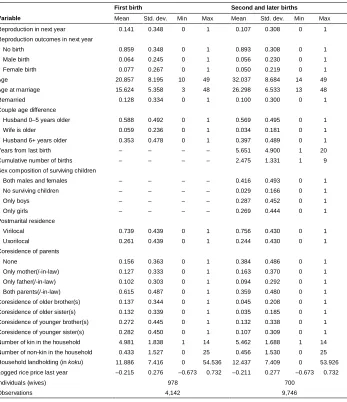
We report the descriptive statistics of the variables mentioned above in our analytical sample in the Appendix, Table A-1.
4. Results
4.1 Descriptive patterns
and uxorilocal marriages are similar, at around 109. While the absolute levels of sex ratios may be subject to specific data, region, and period, the patterns observed here are in line with Drixler’s (2013) finding based on concurrent Japanese population cross-sectional data with a much broader geographic coverage.
Table 1: Reproductive age patterns and male-to-female sex ratio of recorded births by parity in virilocal and uxorilocal families
Wife’s age First birth Second birth Third and later births
Marital residence First marriage First birth Sex ratio N Sex ratio N Sex ratio N
Virilocal 15.5 19.9 94.0 487 123.3 364 109.0 489
Uxorilocal 13.9 19.1 68.1 190 116.4 132 109.9 170
To sum up, if we assume that the biological probability of giving birth to either sex is about equal, what we observe reflects deliberate sex selection.8 However, unlike other East Asian historical populations in which ‘missing girls’ were predominant, the Japanese population under study has not only ‘missing girls’ but also ‘missing boys.’ Also, Table 1 suggests that the extent of child sex selection may differ between types of postmarital residence, which we will study further in the next section.
4.2 Event history analysis 4.2.1 First birth
Overall, uxorilocal marriages have a higher probability of recording a first birth in the next year than virilocal marriages. As suggested by Model 1 of Table 2, the odds of uxorilocal marriages having a first birth in the next year are 47% more than the odds for virilocal marriages. Models 2 and 3 yield similar results concerning the differential probability of having a male or female first birth by postmarital residence type.
8 These patterns are unlikely to be an artifact of household registration. Our Japanese annual registers omit
Table 2: Effects of marital residence, kin coresidence, household landholding and other selected factors on the probability of having a recorded male or female first birth in the next year
(1) Logit model, clustered SE
(2) Multinomial logit model, clustered SE (ref.: no birth)
(3) Two-level random-intercept multinomial logit model (ref.: no birth)
Either sex birth Male birth Female birth Male birth Female birth
Variable exp(b) p exp(b) p exp(b) p exp(b) p exp(b) P
Age 3.436 0.000 3.538 0.000 3.381 0.000 4.429 0.000 4.159 0.000
Age^2 0.972 0.000 0.972 0.000 0.973 0.000 0.969 0.000 0.970 0.000
Age at marriage 1.033 0.075 1.048 0.066 1.018 0.440 0.999 0.984 0.971 0.383
Remarried 0.746 0.094 0.468 0.004 1.033 0.874 0.510 0.018 1.112 0.646
Couple age difference (ref.: husband 0–5 yrs older)
Wife is older 0.737 0.178 0.843 0.589 0.651 0.158 0.745 0.399 0.605 0.144
Husband 6+ yrs older 1.123 0.274 1.109 0.484 1.132 0.354 1.091 0.597 1.117 0.467
Postmarital residence (ref.: virilocal)
Uxorilocal 1.470 0.002 1.409 0.039 1.518 0.005 1.600 0.013 1.711 0.002
Coresidence of parents (ref.: none)
Only mother(/-in-law) 1.038 0.830 0.956 0.843 1.112 0.654 1.042 0.877 1.194 0.505
Only father(/-in-law) 0.704 0.113 0.497 0.021 0.929 0.789 0.537 0.054 1.017 0.954
Both parents(/-in-law) 0.866 0.354 0.650 0.045 1.108 0.619 0.673 0.109 1.135 0.602
Coresidence of older brother(s)0.946 0.785 0.840 0.564 1.038 0.885 0.807 0.533 1.010 0.973
Coresidence of older sister(s) 0.920 0.686 0.741 0.349 1.074 0.776 0.719 0.353 1.021 0.947
Coresidence of younger
brother(s) 0.863 0.250 0.940 0.725 0.802 0.190 0.902 0.597 0.765 0.149
Coresidence of younger
sister(s) 0.719 0.013 0.784 0.188 0.666 0.022 0.716 0.103 0.612 0.011
Number of kin in the household1.003 0.950 1.029 0.684 0.985 0.818 1.042 0.592 0.997 0.966 Number of non-kin in the
household 0.985 0.630 1.008 0.848 0.958 0.384 1.002 0.971 0.950 0.340
Household landholding (in
koku) 1.010 0.204 1.012 0.267 1.008 0.438 1.012 0.290 1.008 0.498
Logged rice price last year 0.850 0.334 0.709 0.171 0.981 0.929 0.670 0.134 0.933 0.773
Village fixed effects Yes Yes Yes Yes Yes
Period fixed effects Yes Yes Yes Yes Yes
Constant 0.000 0.000 0.000 0.000 0.000 0.000 0.000 0.000 0.000 0.000
Level-2 (individual-level) parameters
b – – 1 (constrained)
Variance (s.e.) – – 0.674 (0.350)
Log (pseudo)likelihood –1,493.876 –1,879.477 –1,875.817
Individuals 978 978 978
Observations 4,142 4,142 4,142
Postmarital residence having been taken into account, we find other selected marriage characteristics, including the conventional conjugal power hierarchy measure, (i.e., the age difference of the couple), are not associated with the probability of having a first birth in the next year. The only exception is that remarried wives are around 50% less likely to have a male first birth than wives in their first marriage, but there is no difference regarding female first births.9 However, while not reported in detail due to limited space, we find no interaction effect between the wife’s remarriage status and postmarital residence, suggesting similar behavioral patterns of remarried wives in virilocal and uxorilocal marriages. Moreover, the influence of postmarital residence on having a first birth remains if we only study wives in their first marriage.
Nor does strong evidence exist for the effects of coresident kin, except that living with at least one younger sister or sister-in-law lowers the probability of having a female birth. The negative association implies a substitution effect – both a young sister and a first-born daughter could meet the need for a young female member in the household who may later help care for the elderly and children.
However, interestingly, we find that the favoring effect of uxorilocal marriages on female first births varies by household socioeconomic status, measured by landholding. We estimate a model specified the same as Model 2 in Table 2 but with an additional interaction term of postmarital residence and household landholding. We plot in Figure 1 the average marginal effect (with 95% confidence interval) of uxorilocal versus virilocal marriages on the probability of having no birth, a male first birth, and a female first birth, in the next year, along with change in household landholdings. When household landholding increases, uxorilocal and virilocal marriages do not differ in the predicted probability of having a male first birth in the next year, but uxorilocal marriages are less likely to have no birth and more likely to have a female birth in the next year. In other words, instead of resuming virilocal marriages in the next generation by preferring a son, land-rich uxorilocally married couples have a particularly strong preference to have a daughter as the first child.
9
Figure 1: Average marginal effects of uxorilocal vs. virilocal postmarital residence, along with change in household landholding, on the predicted probability of having no first birth (a), a male first birth (b), and a female first birth (c) in the next year
Note: Black dashed lines indicate 95% confidence intervals. The solid black line indicates the predicted probability for uxorilocal marriages. The red dashed reference line (y = 0) indicates the predicted probability for virilocal marriages.
We also find no direct effect of logged rice price in the previous year or of its interaction with postmarital residence. This suggests that the influence of postmarital residence is independent of local economic fluctuations. Together with the above finding regarding household landholding, we find no support for the Trivers–Willard hypothesis (Trivers and Willard 1973); otherwise, we should see that the selection favoring girl births reduces when the household is land-rich or the local rice price is low due to harvest.
4.2.2 Second and later births
the wife has, the more likely she is to have another male birth in the next year. However, it makes no difference to having female births in the next year.
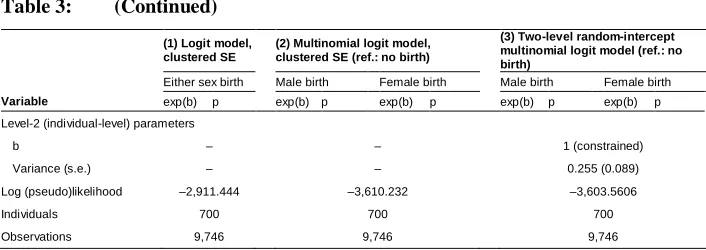
Table 3: Effects of marital residence, kin coresidence, household landholding and other selected factors on the probability of having a recorded male or female second or later birth in the next year
(1) Logit model, clustered SE
(2) Multinomial logit model, clustered SE (ref.: no birth)
(3) Two-level random-intercept multinomial logit model (ref.: no birth)
Either sex birth Male birth Female birth Male birth Female birth
Variable exp(b) p exp(b) p exp(b) p exp(b) p exp(b) p
Age 1.100 0.755 1.359 0.319 0.655 0.478 1.440 0.203 0.693 0.637
Age^2 0.990 0.000 0.989 0.000 0.990 0.000 0.988 0.000 0.989 0.000
Age at marriage 1.571 0.130 1.287 0.391 2.645 0.098 1.281 0.359 2.643 0.206
Remarried 0.950 0.658 1.130 0.413 0.779 0.133 1.119 0.533 0.754 0.157
Couple age difference (ref.: Husband 0–5 yrs older)
Wife is older 1.178 0.312 1.282 0.361 1.088 0.694 1.291 0.337 1.089 0.760
Husband 6+ yrs older 0.845 0.040 0.842 0.109 0.851 0.136 0.819 0.085 0.829 0.118
Years from last birth 1.780 0.055 1.509 0.162 2.893 0.071 1.557 0.104 2.985 0.156
Cumulative number of births 1.180 0.003 1.262 0.001 1.110 0.165 1.178 0.027 1.034 0.644
Sex composition of surviving children (ref.: males and females)
No surviving children 7.011 0.000 6.282 0.000 7.843 0.000 8.264 0.000 10.311 0.000
Only males 1.960 0.000 1.790 0.000 2.172 0.000 1.980 0.000 2.380 0.000
Only females 2.163 0.000 2.376 0.000 1.923 0.000 2.694 0.000 2.158 0.000
Postmarital residence (ref.: virilocal)
Uxorilocal 1.062 0.473 0.947 0.648 1.201 0.080 0.941 0.633 1.203 0.154
Coresidence of parents (ref.: none)
Only mother(/-in-law) 1.482 0.001 1.298 0.074 1.717 0.001 1.342 0.072 1.785 0.000
Only father(/-in-law) 1.224 0.141 1.078 0.703 1.401 0.056 1.045 0.818 1.361 0.110
Both parents(/-in-law) 1.471 0.001 1.378 0.037 1.592 0.004 1.429 0.031 1.663 0.004
Cores. of older brother(s) 1.376 0.033 1.259 0.326 1.519 0.091 1.357 0.243 1.650 0.059
Cores. of older sister(s) 0.998 0.992 0.990 0.971 1.011 0.972 0.949 0.856 0.981 0.950
Cores. of younger brother(s) 1.030 0.770 0.947 0.698 1.122 0.380 0.958 0.781 1.138 0.417
Cores. of younger sister(s) 1.413 0.003 1.266 0.119 1.593 0.004 1.275 0.137 1.592 0.005
Number of kin in the
household 0.897 0.008 0.924 0.143 0.867 0.005 0.909 0.076 0.850 0.004
Number of non-kin in the
household 1.094 0.000 1.100 0.001 1.087 0.003 1.105 0.002 1.092 0.008
Household landholding (in
koku) 0.996 0.496 0.996 0.615 0.996 0.625 0.996 0.604 0.996 0.621
Logged rice price last year 1.100 0.409 1.248 0.139 0.954 0.781 1.252 0.168 0.957 0.804
Village fixed effects Yes Yes Yes Yes Yes
Period fixed effects Yes Yes Yes Yes Yes
Table 3: (Continued) (1) Logit model, clustered SE
(2) Multinomial logit model, clustered SE (ref.: no birth)
(3) Two-level random-intercept multinomial logit model (ref.: no birth)
Either sex birth Male birth Female birth Male birth Female birth
Variable exp(b) p exp(b) p exp(b) p exp(b) p exp(b) p Level-2 (individual-level) parameters
b – – 1 (constrained)
Variance (s.e.) – – 0.255 (0.089)
Log (pseudo)likelihood –2,911.444 –3,610.232 –3,603.5606
Individuals 700 700 700
Observations 9,746 9,746 9,746
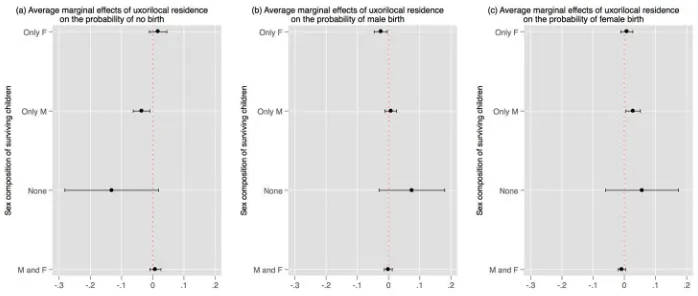
Figure 2: Average marginal effects of uxorilocal vs. virilocal postmarital residence, by sex composition of surviving children, on the predicted probability of having no additional birth (a), an additional male birth (b), and a female additional birth (c) in the next year
Note: The dots with error bars indicate the predicted probability with 95% confidence intervals for uxorilocal marriages. The red dashed reference line (x = 0) indicates the predicted probability for virilocal marriages.
Returning to results reported in Table 3, coresident kin also influence producing second and later births. Living with either only mother(-in-law) or both parents(-in-law) is positively correlated with the probability of having a new birth of either sex. This, in line with the ‘grandmother hypothesis’ (Hawkes 2004; Jamison et al. 2002), suggests a positive helping effect of coresident mother or mother-in-law. Coresident older brothers(-in-law) and younger sisters(-in-law) have the same effect. But extra support from these coresident siblings only improves the chances of having a female birth. In other words, to produce a girl at later births is relatively subject to the household context and potential coresident caregivers. We find no evidence for an interaction effect between marital residence and parental coresidence, suggesting again that the effects of biological and in-law parents do not differ substantially, conditional on postmarital residence.
daughters than sons. By contrast, the number of non-kin in the household measures support from servants, who are not competing for household resources, and has a helping effect on having additional births regardless of their sex.
We find no statistically significant effect of household landholding and rice price on the probability of having a second or later birth in the next year.
5. Conclusion and discussion
Taking advantage of individual-level panel data from two Japanese villages in 1716– 1870, this study provides new empirical evidence that postmarital residence influences child sex selection. As demonstrated by different reproduction patterns, uxorilocal marriages may have stronger girl preference than virilocal marriages. For first births, uxorilocal marriages are more likely than virilocal marriages to register a girl as opposed to no birth in the next year, especially when the household is wealthy. For second and later births, uxorilocal marriages have a lower probability of producing a boy in the next year when surviving children are all girls, but a higher probability of producing a girl when surviving children are all boys.
Favoring girls in certain family contexts reflects the matrilineality of Japanese uxorilocal marriages. Limited by small sample size, this study cannot directly examine how the observed daughter preference results in the intergenerational transmission of uxorilocal marriages. However, such a tendency is likely to exist, since otherwise, given the dominant patriarchal culture, we would expect to find that uxorilocal marriages have a greater son preference than virilocal marriages to shape the next generation. As the construction of similar data, transcribed from Japanese historical population registers and other East Asian sources, is underway (Dong et al. 2015), soon we will have further evidence.
daughter preference in stem family populations. Between 1900 and 1950 in the Netherlands and Sweden, where the Western European stem family system was typical, parents with no surviving female children substantially increased their birth intensities, suggesting an increasing preference for girls (Reher et al. 2017). Daughter preference at third birth and above has also been found in late-20th-century Danish, Norwegian, and Swedish populations (Anderson et al. 2006). However, such daughter preference does not appear in the Spanish population (Reher et al. 2017), where family organization is relatively complex and familial ties are strong (Reher 1998).
Overall, our study adds to the accumulating literature on sex preference and deliberate birth control in premodern populations and highlights complex human agency in reproduction, especially in relation to the dynamics of power and property in the family.
6. Acknowledgments
References
Andersson, G., Hank, K., Rønsen, M., and Vikat, A. (2006). Gendering family composition: Sex preferences for children and childbearing behavior in the Nordic countries.Demography 43(2): 255–267.doi:10.1353/dem.2006.0010.
Campbell, C. and Lee, J.Z. (2010). Fertility control in historical China revisited: New methods for an old debate. History of the Family 15(4): 370–385.doi:10.1016/ j.hisfam.2010.09.003.
Chen, S., Lee, J.Z., and Campbell, C. (2010). Wealth stratification and reproduction in Northeast China, 1866–1907. History of the Family 15(4): 386–412. doi:10. 1016/j.hisfam.2010.10.001.
Choe, M.K., Hao, H., and Wang, F. (1995). Effects of gender, birth order, and other correlates on childhood mortality in China. Social Biology 42(1–2): 50–64.
doi:10.1080/19485565.1995.9988887.
Coale, A.J. and Banister, J. (1996). Five decades of missing females in China.
Proceedings of the American Philosophical Society 140(4): 421–450.
Cornell, L.L. (1987). Hajnal and the household in Asia: A comparativist history of the family in preindustrial Japan, 1600–1870. Journal of Family History 12(1–3): 143–162.doi:10.1177/036319908701200108.
Cornell, L.L. (1996). Infanticide in early modern Japan? Demography, culture and population growth. Journal of Asian Studies 55(1): 22–50. doi:10.2307/ 2943635.
Cronk, L. (2007). Boy or girl: Gender preferences from a Darwinian point of view.
Reproductive Biomedicine Online 15(S2): 23–32.doi:10.1016/S1472-6483(10) 60546-9.
Das Gupta, M. (1987). Selective discrimination against female children in rural Punjab, India. Population and Development Review 13(1): 77–100. doi:10.2307/ 1972121.
Davis, K. (1941). Intermarriage in caste societies.American Anthropologist 43(3): 376– 395.doi:10.1525/aa.1941.43.3.02a00030.
Dong, H., Campbell, C., Kurosu, S., Yang, W., and Lee, J.Z. (2015). New sources for comparative social sciences: Historical population panel data from East Asia.
Dong, H., Manfredini, M., Kurosu, S., Yang, W., and Lee, J.Z. (2017). Kin and birth order effects on male child mortality: Three East Asian populations, 1716–1945.
Evolution and Human Behavior 38(2): 208–216. doi:10.1016/j.evolhumbehav. 2016.10.001.
Drixler, F.F. (2013). Infanticide and population growth in eastern Japan, 1660–1950. Oakland: University of California Press.doi:10.1525/california/9780520272439. 001.0001.
Drixler, F.F. and Kok, J. (2016). A lost family-planning regime in eighteenth-century Ceylon. Population Studies 70(1): 93–114. doi:10.1080/00324728.2015. 1133842.
Fisher, R.A. (1930). The genetical theory of natural selection: A complete variorum edition. Oxford: Oxford University Press.doi:10.5962/bhl.title.27468.
Freese, J. and Powell, B. (1999). Sociobiology, status, and parental investment in sons and daughters: Testing the Trivers–Willard hypothesis. American Journal of Sociology 104(6): 1704–1743.doi.org/10.1086/210221.
Gaulin, S.J. and Robbins, C.J. (1991). Trivers–Willard effect in contemporary North American society. American Journal of Physical Anthropology 85(1): 61–69.
doi:10.1002/ajpa.1330850108.
Hank, K. (2007). Parental gender preferences and reproductive behaviour: A review of the recent literature.Journal of Biosocial Science39(5): 759–767.doi:10.1017/ S0021932006001787.
Hanley, S. (1972). Toward an analysis of demographic and economic change in Tokugawa Japan: A village study. Journal of Asian Studies 31(3): 515–537.
doi:10.2307/2052232.
Hanley, S. and Yamamura, K. (1975). Ichi hime, ni taro: Educational aspirations and the decline in fertility in postwar Japan. Journal of Japanese Studies 2(1): 83– 125.doi:10.2307/132040.
Hawkes, K. (2004). Human longevity: The grandmother effect.Nature428(6979): 128– 129.doi:10.1038/428128a.
Hayami, A. (2009). Rekishi Jinkogaku Kenkyu: Atarashii Kinse Nihonzou (Historical Demography of Early Modern Japan). Tokyo: Fujiwara-shoten.
Lancaster, J.B. (eds.). Child abuse and neglect: Biosocial dimensions. New York: De Gruyter: 97–147.
Jamison, C.S., Cornell, L.L., Jamison, P.L., and Nakazato, H. (2002). Are all grandmothers equal? A review and a preliminary test of the ‘grandmother hypothesis’ in Tokugawa Japan. American Journal of Physical Anthropology
119(1): 67–76.doi:10.1002/ajpa.10070.
Jin, X., Li, S., and Feldman, M. (2006). Marriage form and fertility in rural China: An investigation in three counties. Population Research and Policy Review 25(2): 141–156.doi:10.1007/s11113-006-0001-7.
Kawaguchi, H. (2002). Jyuhasseiki-shoto no Aizu-Minamiyamaokurairi-ryo niokeru Kogaeshi (Infanticide in 18th-century Minamiyama-okurairi-ryo, Aizu). In: Akira, H. (ed.). Kindai-ikoki no jinko to rekishi (Population and history during the transitional period of modernization). Kyoto: Mineruva-shobo: 45–71.
Kolk, M. and Schnettler, S. (2016) Socioeconomic status and sex ratios at birth in Sweden: No evidence for a Trivers–Willard effect for a wide range of status indicators. American Journal of Human Biology 28(1): 67–73.
doi:10.1002/ajhb.22756.
Kurosu, S. (1996). Leaving home in a stem family system: Departures of heirs and non-heirs. History of the Family 1(3): 329–352. doi:10.1016/S1081-602X(96) 90027-5.
Kurosu, S. (1998). Long way to headship, short way to retirement: Adopted sons in a northeastern village in pre-industrial Japan.History of the Family 3(4): 393–410.
doi:10.1016/S1081-602X(99)80254-1.
Kurosu, S. (2007). Remarriage in a stem family system in early modern Japan.
Continuity and Change 22(3): 429–458.doi:10.1017/S026841600700642X.
Kurosu, S. (2011). Divorce in early modern rural Japan: Household and individual life course in northeastern villages, 1716–1870. Journal of Family History 36(2): 118–141.doi:10.1177/0363199011398428.
Kurosu, S. (2013). Adoption and family reproduction in early modern Japan. The Economic Review 64(1): 1–12.
Lee, J.Z., Wang, F., and Campbell, C. (1994). Infant and child mortality among the Qing nobility: Implications for two types of positive check. Population Studies
48(3): 395–411.doi:10.1080/0032472031000147936.
Low, B.S. (1990). Occupational status, landownership, and reproductive behavior in 19th-century Sweden: Tuna parish. American Anthropologist 92(2): 457–468.
doi:10.1525/aa.1990.92.2.02a00130.
Lynch, K.A. (2011). Why weren’t (many) European women ‘missing’?History of the Family16(3): 250–266.doi:10.1016/j.hisfam.2011.02.001.
Maeda, T. (1976).Ane-katoku (Eldest daughter succession). Osaka: Kansai University Press.
Maeda, T. (1992). Onna ga ie wo tsugutoki (When women succeed ie). Osaka: Kansai University Press.
Manfredini, M., Breschi, M., and Fornasin, A. (2013). Son preference in a sharecropping society: Gender composition in a pre-transitional Italian community. Paper presented at the Social Science History Association Meeting, Chicago, November 21–24, 2013.
Mehrotra, V., Morck, R., Shim, J., and Wiwattanakantang, Y. (2010). Adoptive expectations: Rising sons in Japanese family firms. Cambridge: National Bureau of Economic Research (NBER Working Paper Series 16874).
Merton, R.K. (1941). Intermarriage and the social structure.Psychiatry 4(3): 361–374.
doi:10.1080/00332747.1941.11022354.
Mori, K. (1999). Ane-katoku (Eldest daughter inheritance). In: Fukuta, A. (ed.).Nihon minzoku daijiten, jyo (Dictionary of Japanese folklore, Volume 1). Tokyo: Yoshikawa-kobunkan: 33–34.
Narimatsu, S. (1985).Kinsei tohoku noson no hitobito: Oshu Asaka-gun Shimomoriya-mura (People in a northeastern agricultural village in early modern Japan: The village of Shimomoriya, Asaka County, Ou Region). Kyoto: Mineruva-shobo.
Narimatsu, S. (1992). Edo-jidai no tohoku noson: Nihonmatsu-han Niita-mura (Agricultural villages in northeastern Tokugawa Japan: The village of Niita in Nihonmatsu domain). Tokyo: Dobunkan.
Ota, M. (1991). Shoshika to kinsei-shakai no kosodate: Mabiki no shakai-shi (Fertility decline and childrearing: Social history of infanticide). In: Editorial Committee on the changing family (ed.).Kazoku no shakai-shi (Social history of the family). Tokyo: Iwanami-shoten: 163–179.
Ota, M. (2007). Kodakara to kogaeshi: Kinseinoson no kazokuseikatsu to kosodate (Family and child-rearing in early modern Japan). Tokyo: Fujiwara-shoten.
Otake, H., Takeda, W., and Hasegawa, Z. (1988).Yoshi: Giseisareta oyako (Adoption: Fictional relationships of parent and child). Tokyo: Sanseido.
Oto, O. (1996).Kinsei-nomin to ie, mura, kokka (Peasants and Ie village-state in the early modern era). Tokyo: Yoshikawa-kobunkan.
Oto, O. (2001).Kinsei no mura to seikatsu bunka (Villages and life culture in the early modern period). Tokyo: Yoshikawa-kobunkan.
Park, C.B. and Cho, N.-H. (1995). Consequences of son preference in a low-fertility society: Imbalance of the sex ratio at birth in Korea. Population and Development Review21(1): 59–84.doi:10.2307/2137413.
Reher, D.S. (1998). Family ties in western Europe: Persistent contrasts.Population and Development Review 24(2): 203–234.doi:10.2307/2807972.
Reher, D.S., Sandström, G., Sanz-Gimeno, A., and van Poppel, F. (2017). Agency in fertility decisions in western Europe during the demographic transition: A comparative perspective. Demography 54(1): 3–22. doi:10.1007/s13524-016-0536-0.
Saito, O. (1992). Infanticide, fertility and ‘population stagnation’: The state of Tokugawa historical demography. Japan Forum 4(2): 369–382. doi:10.1080/ 09555809208721469.
Saito, O. (1998). Two kinds of stem-family system? Traditional Japan and Europe compared. Continuity and Change 13(1): 167–186. doi:10.1017/ S0268416098003087.
Saito, O. (2000). Marriage, family labour and the stem family household: Traditional Japan in a comparative perspective. Continuity and Change 15(1): 17–45.
doi:10.1017/S026841609900346X.
Sawayama, M. (2005). Sei to seishoku no kinsei (Sex and reproduction in the early modern period). Tokyo: Keiso-shobo.
Sear, R. and Coall, D. (2011). How much does family matter? Cooperative breeding and the demographic transition. Population and Development Review 37(S1): 81–112.doi:10.1111/j.1728-4457.2011.00379.x.
Sen, A. (1992). Missing women. British Medical Journal 304(6827): 587–588.
doi:10.1136/bmj.304.6827.587.
Skinner, G.W. (1988).Reproductive strategies, the domestic cycle and fertility among Japanese villagers, 1717–1869. Paper presented at the Rockefeller Foundation Workshop on Women’s Status in Relation to Fertility and Mortality, Bellagio, June 6–10, 1988.
Skinner, G.W. (1987). Infanticide and reproductive strategies in two Nobi plain villages, 1717–1869. Paper presented to the Workshop on Population Change and Socioeconomic Development in the Nobi Region, Stanford, California, March 15–18, 1987.
Skinner, G.W. (1993). Conjugal power in Tokugawa Japanese families: A matter of life or death. In: Miller, B.D. (ed.). Sex and gender hierarchies. Cambridge: Cambridge University Press: 236–270.
Smith, T.C. (1977).Nakahara: Family farming and population in a Japanese village, 1717–1830. Stanford: Stanford University Press.
Tomobe, K. (2001). The level of marital fertility in Tokugawa and Early Meiji Japan, c. 1800s–1930s: A preliminary analysis of the Hutterite indices. In: Liu, T.-J., Lee, J.Z., Reher, D.S., Saito, O., and Wang, F. (eds.). Asian population history. Oxford: Oxford University Press: 138–151.
Trivers, R.L. and Willard, D.E. (1973). Natural selection of parental ability to vary the sex ratio of offspring. Science 179(4068): 90–92. doi:10.1126/science.179. 4068.90.
Tsuya, N.O. and Kurosu, S. (2004). Mortality and household in two Ou villages, 1716– 1870. In: Bengtsson, T., Campbell, C., Lee, J.Z. et al. Life under pressure: Mortality and living conditions in Europe and Asia, 1700–1900. Cambridge: MIT Press: 253–292.
Lee, J.Z. et al. Prudence and pressure: Reproduction and human agency in Europe and Asia, 1700–1900. Cambridge: MIT Press: 67–95.
Tsuya, N.O. and Kurosu, S. (2014). Economic and household factors of first marriage in two northeastern Japanese villages, 1716–1870. In: Lundh, C., Kurosu, S. et al. Similarity in difference: Marriage in Europe and Asia, 1700–1900. Cambridge: MIT Press: 349–391.
Tsuya, N.O., Wang, F., Alter, G., Lee, J.Z. et al. (2010). Prudence and pressure: Reproduction and human agency in Europe and Asia, 1700–1900. Cambridge: The MIT Press.
Voland, E. (1984). Human sex-ratio manipulation: Historical data from a German parish. Journal of Human Evolution 13(1): 99–107. doi:10.1016/S0047-2484(84)80080-9.
Wolf, A.P. and Huang, C. (1980). Marriage and adoption in China, 1845–1945. Stanford: Stanford University Press.
Yamamoto, J. (2006). Jinkogakuteki sokumen kara mita ane-katok: Hitachi-no-kuni Ibaraki-gun Ariga-mura wo jireitoshite (Ane-katoku viewed from the demographic perspective: A case study of Ariga village, Ibaraki, Hitachi). In: Ochiai, E. (ed.). Tokugawa-Nihon no raifu ko-su: Tokugawa jinkougaku tono taiwa (Life course in Tokugawa Japan: Dialogue with Tokugawa demography). Kyoto: Mineruva-shobo: 255–282.
Appendix
Table A-1: Descriptive statistics of variables
First birth Second and later births Variable Mean Std. dev. Min Max Mean Std. dev. Min Max
Reproduction in next year 0.141 0.348 0 1 0.107 0.308 0 1
Reproduction outcomes in next year
No birth 0.859 0.348 0 1 0.893 0.308 0 1
Male birth 0.064 0.245 0 1 0.056 0.230 0 1
Female birth 0.077 0.267 0 1 0.050 0.219 0 1
Age 20.857 8.195 10 49 32.037 8.684 14 49
Age at marriage 15.624 5.358 3 48 26.298 6.533 13 48
Remarried 0.128 0.334 0 1 0.100 0.300 0 1
Couple age difference
Husband 0–5 years older 0.588 0.492 0 1 0.569 0.495 0 1
Wife is older 0.059 0.236 0 1 0.034 0.181 0 1
Husband 6+ years older 0.353 0.478 0 1 0.397 0.489 0 1
Years from last birth – – – – 5.651 4.900 1 20
Cumulative number of births – – – – 2.475 1.331 1 9
Sex composition of surviving children
Both males and females – – – – 0.416 0.493 0 1
No surviving children – – – – 0.029 0.166 0 1
Only boys – – – – 0.287 0.452 0 1
Only girls – – – – 0.269 0.444 0 1
Postmarital residence
Virilocal 0.739 0.439 0 1 0.756 0.430 0 1
Uxorilocal 0.261 0.439 0 1 0.244 0.430 0 1
Coresidence of parents
None 0.156 0.363 0 1 0.384 0.486 0 1
Only mother(/-in-law) 0.127 0.333 0 1 0.163 0.370 0 1
Only father(/-in-law) 0.102 0.303 0 1 0.094 0.292 0 1
Both parents(/-in-law) 0.615 0.487 0 1 0.359 0.480 0 1
Coresidence of older brother(s) 0.137 0.344 0 1 0.045 0.208 0 1
Coresidence of older sister(s) 0.132 0.339 0 1 0.035 0.185 0 1
Coresidence of younger brother(s) 0.272 0.445 0 1 0.132 0.338 0 1
Coresidence of younger sister(s) 0.282 0.450 0 1 0.107 0.309 0 1
Number of kin in the household 4.981 1.838 1 14 5.462 1.688 1 14
Number of non-kin in the household 0.433 1.527 0 25 0.456 1.530 0 25
Household landholding (inkoku) 11.886 7.416 0 54.536 12.437 7.409 0 53.926
Logged rice price last year –0.215 0.276 –0.673 0.732 –0.211 0.277 –0.673 0.732
Individuals (wives) 978 700
Observations 4,142 9,746