O P I N I O N
Open Access
Aging and DNA methylation
Marc Jung
1*and Gerd P Pfeifer
2*Abstract
In this Opinion article, we summarize how changes in DNA methylation occur during aging in mammals and discuss examples of how such events may contribute to the aging process. We explore mechanisms that could facilitate DNA methylation changes in a site-specific manner and highlight a model in which region-specific DNA hypermethylation during aging is facilitated in a competitive manner by destabilization of the Polycomb repressive complex.
Introduction
Aging can be described as a slow, time-dependent decline of a set of multiple biological functions. In some biological pathways, functional decline can be defined in a mono-causal way, such as the decline of resting metabolism, whereas in other pathways the scope of the decline is rather broad and elusive, such as that for re-duced stability of epigenetic patterns. Although epigen-etic patterns change dramatically during development, these early events are biologically programmed and ne-cessary, whereas alterations of the epigenome in adult somatic tissue may reflect aging-associated deleterious events. Efforts have been made to encapsulate processes of aging into well-defined categories. These range from accumulation of genomic damage that leads to chromo-somal instability and telomere shortening, reactive oxy-gen species-induced damage to mitochondrial functions and reduced energy production, stem cell depletion, ac-cumulation of damaged proteins via loss of proteostasis, processes leading to senescence and changes in intercel-lular communications, age-related effects of the insulin and IGF-1 signaling pathways and, lastly, alterations of the epigenome. Many of these altered pathways are thought to be the prime components of age-related dis-eases including cancer, neurodegenerative disdis-eases, ath-erosclerosis and inflammation. A detailed description of these categories can be found in the review by López-Otín
* Correspondence:[email protected];[email protected] 1
Beckman Research Institute, Duarte, CA 91010, USA 2Van Andel Research Institute, Grand Rapids, MI 49525, USA
et al. [1], which defined these categories as the‘hallmarks’ of aging. It is expected that there is extensive crosstalk be-tween categories and because epigenetic changes are often regulatory events and can lead to altered gene expression, they can impact other hallmarks of aging, such as by silencing of DNA repair genes or anti-inflammatory genes. Here, we would like to focus on the epigenetic contribu-tions to aging. More specifically, we will discuss the rela-tionship between aging and changes in DNA methylation. DNA methylation patterns are shaped by two opposing processes of adding and removing a methyl group at pos-ition five of cytosine in DNA. The first functions of DNA methylation to be discovered were related to gene regula-tion and cell differentiaregula-tion [2]. Selective maintenance of DNA methylation at specific loci is essential for control-ling differential expression of the paternal and maternal alleles in mammals [3], known as genomic imprinting. In particular, X-chromosome inactivation is an often-cited example where DNA methylation is required for long-term silencing of a locus [4]. After the developmental phase, the genome of somatic cells will consist of roughly 1% methylated DNA cytosines, mostly affecting CpG dinucleotides [5]. While there exists great variability be-tween the established patterns of DNA methylation, there is a consistent landmark in the form of CpG islands, which are unmethylated GC-rich regions with high densities of CpGs and often correlated with promoter regions [6]. After DNA methylation patterns have been established during embryogenesis, key questions in the field are how regulatory mechanisms define and maintain them in specific tissues, how the environment can facilitate changes in methylation patterns during a lifespan and what the impacts of these changes are.
Predictability of DNA methylation during aging The earliest studies, which related DNA methylation changes to the aging process, were investigating different organs and life stages of humpback salmon [7] and found that 5-methylcytosine (5mC) levels during ontogenesis were significantly decreasing. Attesting to the evolutionary importance of DNA methylation, these results could be later extended to mammals [8]. The highest amount of
5mC was observed in embryos and then followed a seem-ingly gradual decrease. In rodents it was shown that the decrease of 5mC was inversely related to lifespan [9]. A link between global DNA hypomethylation and senes-cence could be further strengthened by experiments with fibroblast cultures [10] and by the observation that the DNA methylation inhibitor 5-aza-2′-deoxycytidine sub-stantially shortened the lifespan of cells [11]. A compari-son between the DNA methylomes of CD4+ T cells of newborns and centenarians, using whole genome bisulfite sequencing, verified the overall hypomethylation as a func-tion of age. Newborn CpG methylafunc-tion was more homo-geneous compared to the centenarian methylomes, indicating a scattered demethylation over a lifetime [12]. However, these data were based on cross-sectional studies (groups of different individuals of different age). Longitu-dinal studies (same individuals at two or more time points) are rare. One such longitudinal study examining global levels of methylation in white blood cells found roughly the same number of participants with a decrease in methylation as with an increase [13]. Such substantial intra-individual change in opposite directions would likely be missed by age-specific cross-sectional analysis.
Global DNA hypomethylation also does not mean that individual sites become hypomethylated during aging. The gene encoding the estrogen receptor (ER) was the first gene shown to become hypermethylated in colon with increasing age [14]. These findings led to genomic studies addressing the question of whether at a genome-wide level the methylation patterns of a specific set of genes could be used to predict the age of individuals. The continuous accumulation of genome methylation data in the form of Infinium HumanMethylation Bead-Chip assays (Illumina) enabled a systematic evaluation of this question. In one case, Florathet al. [15] could iden-tify from 962 whole blood DNA samples a set of 162 CpG sites that were predictive for the age of the donors. While the general concept of an epigenetic clock was already established [16], a breakthrough in the data ana-lysis was the work of Horvarth [17], who used not only one specific tissue but a collection of different tissues from 8,000 samples. Indeed, he was able to identify a tissue-independent set of 393 CpG sites that could pre-dict the age of the donors with a correlation of 0.96 and an error of 3.6 years remarkably well. More recently, at least for blood DNA, the number of CpG sites needed for age prediction could be reduced to just three [18], establishing that only a very few selected CpG sites are sufficient for reliable age prediction. Thus, there is substantial evidence for an‘epigenetic clock’model.
On a functional level, we have to note that the com-mon canon that increasing DNA methylation in a pro-moter leads to decreased gene expression and vice versa cannot be generalized. For example, in human peripheral
blood mononuclear cells (PBMCs), the overall correl-ation of gene expression and DNA methylcorrel-ation changes was weak, arguing against a model where age-related DNA methylation changes would generally exert a bio-logical role via gene expression changes [19].
Another challenge when studying aging via DNA methylation changes is confounding effects, which affect DNA methylation over a long time period as well. As such it is known that type 2 diabetes and associated obesity have an effect on the methylome [20,21]. The quality of air we breathe could have an impact on the overall methylation pattern [22] as well as more specific toxic exposures over a longer time period [23]. Also life style decisions, as diverse as exercise and aspirin usage [24] or smoking [25], can have significant effects. Even physical environmental parameters have been shown to have an effect on DNA methylation [26]. Although it is not unreasonable to expect associations between envir-onmental factors or exposures and DNA methylation patterns, reproducing such effects in independent stud-ies will be required before any firm conclusions that they are confounders can be reached. Often, information about the lifestyle, eating habits, air quality, body mass index, recorded diseases, and living conditions is lacking from age-related DNA methylation studies. Apart from the ‘clock-specific’age signatures, without this informa-tion it is impossible to attribute changes in DNA methy-lation over time to intrinsic age-specific effects.
Mechanisms of DNA methylation changes during aging
involved in regulating PcG accessibility and vice versa. Further evidence for Polycomb targeting to CpG islands comes from a Dnmt3a/b−/− mouse embryonic stem cell model, suggesting that a high density of unmethylated CpG dinucleotides is sufficient for PcG recruitment [41].
One study, investigating genome-wide DNA methylation changes by comparing C57BL/6 mice at 3 months of age to mice at 35 months of age, found that Polycomb target genes and various tumor suppressor genes were enriched among the age-dependently hypermethylated genes [42]. There is substantial crosstalk between DNA methylation and the Polycomb mark. Recent studies showed that increased H3K27me3 occupancy occurred at regions of the genome that are normally highly DNA-methylated and then become demethylated after inhibition of DNA methy-lation by 5-aza-2′-deoxycytidine (5-aza-dC) [43]. One spe-cific mechanism by which the Polycomb complexes recognize unmethylated DNA regions is via the protein KDM2B, which recruits PRC1 and PRC2 [44].
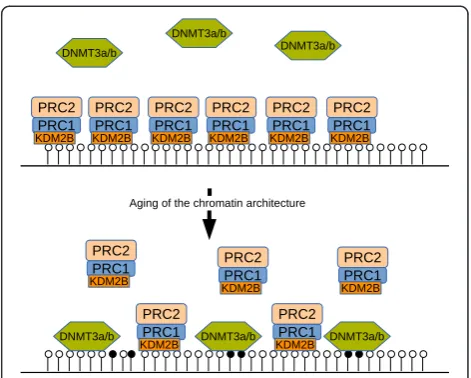
How can unmethylated regions bound by the Poly-comb complex become methylated in an age-dependent manner? One theory of abnormal methylation during aging involves the recruitment of de novoDNA methyl-transferases by the Polycomb complex [45]. We propose an alternative theory where the targeting of the PcG machinery to unmethylated CpG-rich target sequences erodes with age, allowing DNA methylation at PcG target genes to increase slowly over time. This would suggest a competitive model where unmethylated DNA regions are protected by PRC1 and PRC2 complexes and as these get continuously degraded during aging, becom-ing more and more accessible for the DNA methyltrans-ferases DNMT3A and/or DNMT3B, which facilitate de novoDNA methylation (model in Figure 1). The replace-ment of the Polycomb mark with DNA methylation also occurs in cancer and has been referred to as Polycomb switching [46]. The main outcome of this switch is a loss of plasticity inasmuch as DNA methylation is considered a much more stable modification associated with in-active chromatin.
Age-specific DNA methylation changes and age-related diseases
While there are undeniable facts that DNA methylation patterns change over time, not many of those have been thought to play a role in age-related diseases. The number one age-related disease is cancer and indeed one of the best predictors of tumors is the age of patients [47]. In most cancer types, global DNA hypomethylation can be observed [48,49], which is a potential causal factor in redu-cing genome stability and increasing chromosomal aberra-tions. There is evidence that this can be at least partially attributed to the specific hypomethylation of repetitive regions and the resulting reactivation of retrotransposons
[50]. But not only global DNA hypomethylation can con-tribute to early events in neoplastic cell transformation. For some genes, site-specific hypermethylation of promoter regions are found in both aging and tumorigenesis, which makes thembona fidecandidates for increased cancer sus-ceptibility. Examples include insulin-like growth factor-II (IGFII), hypermethylated in cancer 1 (HIC1), caspase-8 (CASP8), glutathione S-transferase pi (GSTP1), suppressor of cytokine signaling 1 (SOCS1), RAS association domain family 1A (RASSF1A), p16/CDKN2A, adenomatosis polyp-osis coli (APC) and the aforementioned estrogen receptor 1 (ESR1) [51-58]. DNA hypermethylation of these genes was identified in not one but several tumor types. Also DNA hypermethylation inHOXgenes or in certain genes encoding lineage-specific transcription factors identified in small cell lung cancer could represent an epigenetic com-ponent of an age-related process, pushing cell fate towards transformation [39].
Not only cancer but also inflammatory diseases show an age-related increase of DNA methylation. Inflamma-tion is often associated with DNA hypermethylaInflamma-tion of specific genes as initially reported for ulcerative colitis [59]. DNA hypermethylation in inflamed tissues is also strongly targeted to genes recognized by the Polycomb complex [38]. As inflammatory processes increase with age, it is expected that DNA methylation changes would
be accelerated in affected tissues. A more causal connec-tion between DNA hypomethylaconnec-tion and atherosclerosis could be established by the use of atherosclerosis-prone
Apoe−/− mice [60]. Also, promoter-related hypomethyla-tion linked to transcriphypomethyla-tional upregulahypomethyla-tion of key enzymes was linked to atherosclerosis. Furthermore, the gradual decrease of methylation in promoter fragments of the tumor necrosis factor alpha (TNFα) gene, which is import-ant for inflammatory reactions, could be a main factor in the onset of chronic inflammatory conditions with older age [61]. Another age-associated disease is type 2 diabetes. And indeed, a change of DNA methylation patterns can lead to perturbed glucagon and insulin secretion [62]. Fi-nally, neurodegenerative diseases like Alzheimer’s disease, which is correlated with age, show support for an un-derlying mechanism based on reduced levels of DNA methylation. The amyloid precursor protein (APP) gene in the Alzheimer’s disease brain showed gradual hypomethy-lation in the promoter [63]. Age-dependent changes of methylation for the presenilin 1 (PS1) gene, which is es-sential for the formation of the γ-secretase complex, also imply gene expression changes [64,65]. In summary, DNA methylation changes are becoming a factor increasingly linked to our understanding of age-related pathologies.
Age-specific DNA methylation changes and metabolism
Models that try to explain the global reduction of DNA methylation during a lifetime are inevitably bound to in-clude metabolic changes. Resting metabolic rates have been shown to decrease during aging [66] and those pro-cesses involved in DNA methylation and de-methylation are embedded in the one-carbon metabolism, which is re-quired for methionine biosynthesis and cellular methyla-tion reacmethyla-tions [67,68]. The methyl groups needed for DNA methylation are added from S-adenosylmethionine (SAM), the primary universal donor of methyl groups in mammals derived from methionine [69]. One mechanism explaining a potential decrease of 5-methylcytosine seems to work through specific hypomethylation caused by increased levels of homocysteine and S-adenosylhomocysteine (SAH), which leads to inhibition of cellular methylation re-actions [70]. In general, the one-carbon metabolic pathway can be impaired by genetic or external variation, more spe-cifically by nutritional habits. And as such, it is currently assumed that regular intake of nutrients involved in the metabolism of the methyl group, like folic acid or vitamin B12, can slow down the gradual hypomethylation observed during the aging process [71,72]. However, the relationship between folate status and DNA methylation levels is complex and is likely influenced by folate availability [73].
Not only one-carbon metabolism-related processes lead to global hypomethylation: global hypomethylation can also occur via a peroxisome proliferator-induced
mechanism [74]. Also, there are some hints based on cell culture experiments that altered DNA methylation events are correlated to Sirt1 expression levels, which may play a pivotal role in the beneficial effects of dietary restriction, which itself is believed to extend lifespan [75]. The enzymes, which transfer a methyl group from SAM to DNA producing 5-methylcytosine, are the family of DNA methyltransferases (DNMTs) that include DNMT1, DNMT3A, DNM3B and DNMT3L [76]. DNMT1 plays an important role in maintaining genomic methylation pat-terns [77]. How is DNMT1 linked to aging? The activity of DNMT1 seems to decrease significantly during aging [78,79], and this is seen as a viable model to explain the global decrease of DNA methylation observed during aging. Furthermore, the study of aDnmt1+/−mouse model observed a lower DNA methylation level, which led to impaired learning and memory functions in an age-dependent manner [80]. The reduction in DNMT1 can in theory be explained by an age-related decrease of growth hormone as there is evidence that the expression of Dmnt1 and Dmnt3a is influenced by growth hormone, establishing a link between DNA methylation and the IGF-1/FOXO pathway, which plays a profound role in the aging process and was first discovered in Caenorhabditis elegans[81].
Another potential mechanism for DNA demethylation during aging is by enzymatic DNA demethylation cata-lyzed by the 5mC dioxygenases Ten-eleven translocation 1, 2, and 3 (TET1/2/3) [82,83]. But while the function of TET proteins has been linked to reprogramming in early development and to cancer, their role in aging has remained elusive [84]. In summary, metabolic processes, orchestrating the homeostasis between SAM, SAH and the key DNMT enzymes and potentially TET proteins, may have a long-term impact on the specific rate of aging, but more definitive causal connections still remain to be established.
Tissue specificity of age-related DNA methylation changes
muscle showed the strongest links to tissue-specifically expressed genes and proximity to CTCF binding sites. An-other study, based on blood DNA, also implied no predict-ive power for other tissues [88].
Stem cell aging
When analyzing tissues composed of multiple cell types, it is important to take into account stem cell sub-populations, which might represent a signature specific for stem cell functions. Accumulated abnormal DNA methylation during a lifespan is believed to have an im-pact on the behavior and functionality of stem cells [89]. It was shown that DNA methylation and inactivation of myeloerythroid genes protects hematopoietic stem cells (HSCs) from premature differentiation, suggesting a link to tissue homeostasis [90]. Deterioration of stem cell function is one of the hallmarks of aging that is thought to lead to several types of age-associated pathologies, in-cluding various degenerative diseases and dysfunction and malignancies in the hematopoietic system. While the mechanisms of hematopoietic stem cell decline with age are complex, epigenetic alterations are likely in-volved. A recent study analyzing DNA methylation changes in HSCs from old versus young mice identified small but significant changes in cytosine methylation patterns [91]. These authors found that alterations of DNA methylation occurred at genomic regions associ-ated with hematopoietic lineage potential and selectively targeted genes expressed in downstream progenitor and effector cells. The observed hypermethylation events have the potential to restrict access to chromatin regions of lineage-regulating factors and contribute to the de-cline of erythroid and lymphoid cell populations during HSC aging. This study also found that many of the hypermethylated regions were Polycomb targets and ob-served diminished expression of Polycomb regulators (for example,Ezh2) during HSC aging, which is in agree-ment with our model (Figure 1). Another recent study analyzing the methylome in HSCs from 4-month old versus 24-month-old mice using whole genome bisulfite sequencing also found a small increase in DNA methyla-tion in older stem cells (84.6 versus 83.5%) [92]. This study found that HSC-specific genes such as Gata2 and Hmga2 are hypomethylated and upregulated in old mice and that binding sites of transcription factors associated with differentiation, such as Pu.1, tend to become hyper-methylated. Such changes will reinforce self-renewal of HSCs and diminish differentiation as one phenotype of aging. Furthermore, this study showed that old HSCs exhibited broader H3K4me3 peaks across HSC identity genes. An increase in H3K4me3 should be associated with reduced DNA methylation since this histone modi-fication blocks methylation of DNA by the DNMT3A/ DNMT3L complex [93].
Conclusions
DNA methylation has become a hallmark of aging, though there is so far no proof that a change in specific DNA methylation patterns can extend lifespan [1]. Nonetheless, there is a growing body of literature that supports an specific drift of methylation patterns. Not only are age-dependent methylation patterns surprisingly predictive for age within a range of two to four years [17], but such signatures could also be observed in aging mice and in patients with progeroid syndrome, a disease that has many features in common with aging [94].
The age-specific drift in DNA methylation can be di-vided into global hypomethylation and local hypermethy-lation. Global hypomethylation events are enriched for repetitive sequences and thought to be responsible for the reactivation of retrotransposon elements during age, as one mechanism leading to a higher incidence of cancer. The nature of local hypermethylation changes is complex, but it has been shown that some of them co-occur near tumor suppressor genes, with possible functional effects that might be linked to cell transformation events. This is probably also true for the correlation of age-related hyper-methylation and the set of Polycomb target genes, which can also be observed in various cancer types.
While certain age-specific methylation patterns can be established, the rate of age-specific DNA methy-lation changes does not seem to be fixed and is dependent on an array of conditions, including tissue inflammation, environmental exposures and life style influences. Especially nutrition-based decisions, includ-ing intake of essential nutrients (methionine, choline, folic acid, and vitamin B12) involved in the metabolism of methyl groups, are believed to be key factors in delaying the progressive deterioration of DNA methyla-tion patterns. As such, the continuous maintenance of a proper one-carbon metabolism may be important for healthy aging and may slow the development of age-related pathologies [71,95].
The current challenges in age-related DNA methylation research are at least two-fold: (i) to find the precise mech-anism rather than observing correlative associations and (ii) to identify the most important genes and pathways for which altered methylation patterns contribute to age-related functional decline. Our current model of de novo
Competing interests
The authors declare that they have no competing interests.
Acknowledgements
Work of the authors was supported by NIH grants AG036041 and CA084469 to GPP.
References
1. López-Otín C, Blasco MA, Partridge L, Serrano M, Kroemer G. The hallmarks of aging. Cell. 2013;153:1194–217.
2. Holliday R, Pugh JE. DNA modification mechanisms and gene activity during development. Science. 1975;187:226–32.
3. Li E, Beard C, Jaenisch R. Role for DNA methylation in genomic imprinting. Nature. 1993;366:362–5.
4. Riggs AD, Pfeifer GP. X-chromosome inactivation and cell memory. Trends Genet. 1992;8:169–74.
5. Ehrlich M, Gama-Sosa MA, Huang L-H, Midgett RM, Kuo KC, McCune RA, et al. Amount and distribution of 5-methylcytosine in human DNA from different types of tissues or cells. Nucleic Acids Res. 1982;10:2709–21. 6. Deaton AM, Bird A. CpG islands and the regulation of transcription. Genes
Dev. 2011;25:1010–22.
7. Berdishev MT, Korotaev GK, Boiarskikh GV, Vanyushin BF. Nucleotide composition of DNA and RNA from somatic tissues of humpback salmon and its changes during spawning. Biokhimiia. 1967;38:988–93. 8. Romanov GA, Vanyushin BF. Methylation of reiterated sequences in
mammalian DNAs. Effects of the tissue type, age, malignancy and hormonal induction. Biochim Biophys Acta. 1981;653:204–18.
9. Wilson VL, Smith RA, Ma S, Cutler RG. Genomic 5-methyldeoxycytidine decreases with age. J Biol Chem. 1987;262:9948–51.
10. Wilson VL, Jones PA. DNA methylation decreases in aging but not in immortal cells. Science. 1983;220:1055–7.
11. Fairweather DS, Fox M, Margison GP. The in vitro lifespan of MRC-5 cells is shortened by 5-azacytidine-induced demethylation. Exp Cell Res. 1987;168:153–9.
12. Heyn H, Li N, Ferreira HJ, Moran S, Pisano DG, Gomez A, et al. Distinct DNA methylomes of newborns and centenarians. Proc Natl Acad Sci U S A. 2012;109:10522–7.
13. Bjornsson HT, Sigursson MI, Fallin MD, Irizarry RA, Aspelund T, Cui H, et al. Intra-individual change over time in DNA methylation with familial clustering. JAMA. 2008;299:2877–83.
14. Issa J-PJ, Ottaviano YL, Celano P, Hamilton SR, Davidson NE, Baylin SB. Methylation of the oestrogen receptor CpG island links ageing and neopla-sia in human colon. Nat Genet. 1994;7:536–40.
15. Florath I, Butterbach K, Müller H, Bewerunge-Hudler M, Brenner H. Cross-sectional and longitudinal changes in DNA methylation with age: an epigenome-wide analysis revealing over 60 novel age-associated CpG sites. Hum Mol Genet. 2014;23:1186–201.
16. Bocklandt S, Lin W, Sehl ME, Sánchez FJ, Sinsheimer JS, Horvath S, et al. Epigenetic predictor of age. PLoS One. 2011;6:e14821.
17. Horvath S. DNA methylation age of human tissues and cell types. Genome Biol. 2013;14:R115.
18. Weidner CI, Lin Q, Koch CM, Eisele L, Beier F, Ziegler P, et al. Aging of blood can be tracked by DNA methylation changes at just three CpG sites. Genome Biol. 2014;15:R24.
19. Steegenga WT, Boekschoten MV, Lute C, Hooiveld GJ, de Groot PJ, Morris TJ, et al. Genome-wide age-related changes in DNA methylation and gene expression in human PBMCs. Age (Dordr). 2014;36:9648.
20. Almén MS, Nilsson EK, Jacobsson JA, Kalnina I, Klovins J, Fredriksson R, et al. Genome-wide analysis reveals DNA methylation markers that vary with both age and obesity. Gene. 2014;548:61–7.
21. De Mello VDF, Pulkkinen L, Lalli M, Kolehmainen M, Pihlajamäki J, Uusitupa M. DNA methylation in obesity and type 2 diabetes. Ann Med. 2014;46:103–13. 22. Bind M-A, Lepeule J, Zanobetti A, Gasparrini A, Baccarelli A, Coull BA, et al.
Air pollution and gene-specific methylation in the Normative Aging Study: association, effect modification, and mediation analysis. Epigenetics. 2014;9:448–58.
23. Lambrou A, Baccarelli A, Wright RO, Weisskopf M, Bollati V,
Amarasiriwardena C, et al. Arsenic exposure and DNA methylation among elderly men. Epidemiology. 2012;23:668–76.
24. Noreen F, Röösli M, Gaj P, Pietrzak J, Weis S, Urfer P, et al. Modulation of age- and cancer-associated DNA methylation change in the healthy colon by aspirin and lifestyle. J Natl Cancer Inst. 2014;106:dju161.
25. Besingi W, Johansson Å. Smoke related DNA methylation changes in the etiology of human disease. Hum Mol Genet. 2013;23:2290–7.
26. Bind M-A, Zanobetti A, Gasparrini A, Peters A, Coull B, Baccarelli A, et al. Effects of temperature and relative humidity on DNA methylation. Epidemiology. 2014;25:561–9.
27. Bernstein BE, Mikkelsen TS, Xie X, Kamal M, Huebert DJ, Cuff J, et al. A bivalent chromatin structure marks key developmental genes in embryonic stem cells. Cell. 2006;125:315–26.
28. Boyer LA, Plath K, Zeitlinger J, Brambrink T, Medeiros LA, Lee TI, et al. Polycomb complexes repress developmental regulators in murine embryonic stem cells. Nature. 2006;441:349–53.
29. Bracken AP, Dietrich N, Pasini D, Hansen KH, Helin K. Genome-wide mapping of Polycomb target genes unravels their roles in cell fate transitions. Genes Dev. 2006;20:1123–36.
30. Lee TI, Jenner RG, Boyer LA, Guenther MG, Levine SS, Kumar RM, et al. Control of developmental regulators by Polycomb in human embryonic stem cells. Cell. 2006;125:301–13.
31. Margueron R, Reinberg D. The Polycomb complex PRC2 and its mark in life. Nature. 2011;469:343–9.
32. Eskeland R, Leeb M, Grimes GR, Kress C, Boyle S, Sproul D, et al. Ring1B compacts chromatin structure and represses gene expression independent of histone ubiquitination. Mol Cell. 2010;38:452–64.
33. Francis NJ, Kingston RE, Woodcock CL. Chromatin compaction by a Polycomb group protein complex. Science. 2004;306:1574–7. 34. Rauch T, Li H, Wu X, Pfeifer GP. MIRA-assisted microarray analysis, a new
technology for the determination of DNA methylation patterns, identifies frequent methylation of homeodomain-containing genes in lung cancer cells. Cancer Res. 2006;66:7939–47.
35. Schlesinger Y, Straussman R, Keshet I, Farkash S, Hecht M, Zimmerman J, et al. Polycomb-mediated methylation on Lys27 of histone H3 pre-marks genes for de novo methylation in cancer. Nat Genet. 2007;39:232–6. 36. Ohm JE, McGarvey KM, Yu X, Cheng L, Schuebel KE, Cope L, et al.
A stem cell-like chromatin pattern may predispose tumor suppressor genes to DNA hypermethylation and heritable silencing. Nat Genet. 2007;39:237–42.
37. Widschwendter M, Fiegl H, Egle D, Mueller-Holzner E, Spizzo G, Marth C, et al. Epigenetic stem cell signature in cancer. Nat Genet. 2007;39:157–8. 38. Hahn MA, Hahn T, Lee D-H, Esworthy RS, Kim B-W, Riggs AD, et al.
Methylation of polycomb target genes in intestinal cancer is mediated by inflammation. Cancer Res. 2008;68:10280–9.
39. Kalari S, Jung M, Kernstine KH, Takahashi T, Pfeifer GP. The DNA methylation landscape of small cell lung cancer suggests a differentiation defect of neuroendocrine cells. Oncogene. 2013;32:3559–68.
40. Johnson KC, Koestler DC, Cheng C, Christensen BC. Age-related DNA methylation in normal breast tissue and its relationship with invasive breast tumor methylation. Epigenetics. 2014;9:268–75.
41. Lynch MD, Smith AJH, De Gobbi M, Flenley M, Hughes JR, Vernimmen D, et al. An interspecies analysis reveals a key role for unmethylated CpG dinucleotides in vertebrate Polycomb complex recruitment. EMBO J. 2012;31:317–29.
42. Maegawa S, Hinkal G, Kim HS, Shen L, Zhang L, Zhang J, et al. Widespread and tissue specific age-related DNA methylation changes in mice. Genome Res. 2010;20:332–40.
43. Reddington JP, Perricone SM, Nestor CE, Reichmann J, Youngson NA, Suzuki M, et al. Redistribution of H3K27me3 upon DNA hypomethylation results in de-repression of Polycomb target genes. Genome Biol. 2013;14:R25. 44. Blackledge NP, Farcas AM, Kondo T, King HW, McGouran JF, Hanssen LLP,
et al. Variant PRC1 complex-dependent H2A ubiquitylation drives PRC2 recruitment and Polycomb domain formation. Cell. 2014;157:1445–59. 45. Cedar H, Bergman Y. Programming of DNA methylation patterns. Annu Rev
Biochem. 2012;81:97–117.
46. Gal-Yam EN, Egger G, Iniguez L, Holster H, Einarsson S, Zhang X, et al. Frequent switching of Polycomb repressive marks and DNA
47. Finkel T, Serrano M, Blasco MA. The common biology of cancer and ageing. Nature. 2007;448:767–74.
48. Wilson AS, Power BE, Molloy PL. DNA hypomethylation and human diseases. Biochim Biophys Acta. 2007;1775:138–62.
49. Berman BP, Weisenberger DJ, Aman JF, Hinoue T, Ramjan Z, Liu Y, et al. Regions of focal DNA hypermethylation and long-range hypomethylation in colorectal cancer coincide with nuclear lamina-associated domains. Nat Genet. 2012;44:40–6.
50. Howard G, Eiges R, Gaudet F, Jaenisch R, Eden A. Activation and transposition of endogenous retroviral elements in hypomethylation induced tumors in mice. Oncogene. 2008;27:404–8.
51. Vidal AC, Henry NM, Murphy SK, Oneko O, Nye M, Bartlett JA, et al. PEG1/MEST and IGF2 DNA methylation in CIN and in cervical cancer. Clin Transl Oncol. 2014;16:266–72.
52. Fujii H, Biel MA, Zhou W, Weitzman SA, Baylin SB, Gabrielson E. Methylation of the HIC-1 candidate tumor suppressor gene in human breast cancer. Oncogene. 1998;16:2159–64.
53. Yuan Y, Qian ZR, Sano T, Asa SL, Yamada S, Kagawa N, et al. Reduction of GSTP1 expression by DNA methylation correlates with clinicopathological features in pituitary adenomas. Mod Pathol. 2008;21:856–65.
54. Sutherland KD, Lindeman GJ, Choong DYH, Wittlin S, Brentzell L, Phillips W, et al. Differential hypermethylation of SOCS genes in ovarian and breast carcinomas. Oncogene. 2004;23:7726–33.
55. Dammann R, Li C, Yoon JH, Chin PL, Bates S, Pfeifer GP. Epigenetic inactivation of a RAS association domain family protein from the lung tumour suppressor locus 3p21.3. Nat Genet. 2000;25:315–9.
56. Cody DT, Huang Y, Darby CJ, Johnson GK, Domann FE. Differential DNA methylation of the p16 INK4A/CDKN2A promoter in human oral cancer cells and normal human oral keratinocytes. Oral Oncol. 1999;35:516–22. 57. Virmani AK, Rathi A, Sathyanarayana UG, Padar A, Huang CX, Cunnigham
HT, et al. Aberrant methylation of the adenomatous polyposis coli (APC) gene promoter 1A in breast and lung carcinomas. Clin Cancer Res. 2001;7:1998–2004.
58. Gaudet MM, Campan M, Figueroa JD, Yang XR, Lissowska J, Peplonska B, et al. DNA hypermethylation of ESR1 and PGR in breast cancer: pathologic and epidemiologic associations. Cancer Epidemiol Biomarkers Prev. 2009;18:3036–43.
59. Issa JP, Ahuja N, Toyota M, Bronner MP, Brentnall TA. Accelerated age-related CpG island methylation in ulcerative colitis. Cancer Res. 2001;61:3573–7.
60. Lund G, Andersson L, Lauria M, Lindholm M, Fraga MF, Villar-Garea A, et al. DNA methylation polymorphisms precede any histological sign of atherosclerosis in mice lacking apolipoprotein E. J Biol Chem. 2004;279:29147–54.
61. Gowers IR, Walters K, Kiss-Toth E, Read RC, Duff GW, Wilson AG. Age-related loss of CpG methylation in the tumour necrosis factor promoter. Cytokine. 2011;56:792–7.
62. Dayeh T, Volkov P, Salö S, Hall E, Nilsson E, Olsson AH, et al. Genome-wide DNA methylation analysis of human pancreatic islets from type 2 diabetic and non-diabetic donors identifies candidate genes that influence insulin secretion. PLoS Genet. 2014;10:e1004160.
63. Tohgi H, Utsugisawa K, Nagane Y, Yoshimura M, Genda Y, Ukitsu M. Reduction with age in methylcytosine in the promoter region−224 approximately−101 of the amyloid precursor protein gene in autopsy human cortex. Brain Res Mol Brain Res. 1999;70:288–92.
64. Fuso A, Seminara L, Cavallaro RA, D’Anselmi F, Scarpa S. S-adenosylmethionine/ homocysteine cycle alterations modify DNA methylation status with consequent deregulation of PS1 and BACE and beta-amyloid production. Mol Cell Neurosci. 2005;28:195–204.
65. Fuso A, Cavallaro RA, Zampelli A, D’Anselmi F, Piscopo P, Confaloni A, et al. gamma-Secretase is differentially modulated by alterations of homocysteine cycle in neuroblastoma and glioblastoma cells. J Alzheimers Dis.
2007;11:275–90.
66. Schrack JA, Knuth ND, Simonsick EM, Ferrucci L.“IDEAL”aging Is associated with lower resting metabolic rate: The Baltimore Longitudinal Study of Aging. J Am Geriatr Soc. 2014;62:667–72.
67. Mason JB. Biomarkers of nutrient exposure and status in one-carbon (methyl) metabolism. J Nutr. 2003;133:941S–7S.
68. Ulrey CL, Liu L, Andrews LG, Tollefsbol TO. The impact of metabolism on DNA methylation. Hum Mol Genet. 2005;14 Spec No 1:R139-47. 69. Chiang PK, Gordon RK, Tal J, Zeng GC, Doctor BP, Pardhasaradhi K, et al.
S-adenosylmethionine and methylation. FASEB J. 1996;10:471–80.
70. James SJ, Melnyk S, Pogribna M, Pogribny IP, Caudill MA. Elevation in S-adenosylhomocysteine and DNA hypomethylation: potential epigenetic mechanism for homocysteine-related pathology. J Nutr. 2002;132:2361S–6S.
71. Choi S-W, Claycombe KJ, Martinez JA, Friso S, Schalinske KL. Nutritional epigenomics: a portal to disease prevention. Adv Nutr. 2013;4:530–2. 72. Kuo H-K, Sorond FA, Chen J-H, Hashmi A, Milberg WP, Lipsitz LA. The role of
homocysteine in multisystem age-related problems: a systematic review. J Gerontol A Biol Sci Med Sci. 2005;60:1190–201.
73. Bae S, Ulrich CM, Bailey LB, Malysheva O, Brown EC, Maneval DR, et al. Impact of folic acid fortification on global DNA methylation and one-carbon biomarkers in the Women’s Health Initiative Observational Study cohort. Epigenetics. 2014;9:396–403.
74. Pogribny IP, Tryndyak VP, Boureiko A, Melnyk S, Bagnyukova TV, Montgomery B, et al. Mechanisms of peroxisome proliferator-induced DNA hypomethylation in rat liver. Mutat Res. 2008;644:17–23.
75. Ions LJ, Wakeling LA, Bosomworth HJ, Hardyman JEJ, Escolme SM, Swan DC, et al. Effects of Sirt1 on DNA methylation and expression of genes affected by dietary restriction. Age (Dordr). 2013;35:1835–49.
76. Denis H, Ndlovu’Matladi N, Fuks F. Regulation of mammalian DNA methyltransferases: a route to new mechanisms. EMBO Rep. 2011;12:647–56.
77. Bestor TH. The DNA, methyltransferases of mammals. Hum Mol Genet. 2000;9:2395–402.
78. Casillas Jr MA, Lopatina N, Andrews LG, Tollefsbol TO. Transcriptional control of the DNA methyltransferases is altered in aging and neoplastically-transformed human fibroblasts. Mol Cell Biochem. 2003;252:33–43.
79. Lopatina N, Haskell JF, Andrews LG, Poole JC, Saldanha S, Tollefsbol T. Differential maintenance and de novo methylating activity by three DNA methyltransferases in aging and immortalized fibroblasts. J Cell Biochem. 2002;84:324–34.
80. Liu L, van Groen T, Kadish I, Li Y, Wang D, James SR, et al. Insufficient DNA methylation affects healthy aging and promotes age-related health problems. Clin Epigenetics. 2011;2:349–60.
81. Armstrong VL, Rakoczy S, Rojanathammanee L, Brown-Borg HM. Expression of DNA methyltransferases is influenced by growth hormone in the long-living ames dwarf mouse in vivo and in vitro. J Gerontol A Biol Sci Med Sci. 2014;69:923–33.
82. Hahn MA, Qiu R, Wu X, Li AX, Zhang H, Wang J, et al. Dynamics of 5-hydroxymethylcytosine and chromatin marks in Mammalian neurogenesis. Cell Rep. 2013;3:291–300.
83. Tahiliani M, Koh KP, Shen Y, Pastor WA, Bandukwala H, Brudno Y, et al. Conversion of 5-methylcytosine to 5-hydroxymethylcytosine in mammalian DNA by MLL partner TET1. Science. 2009;324:930–5.
84. Tan L, Shi YG. Tet family proteins and 5-hydroxymethylcytosine in development and disease. Development. 2012;139:1895–902.
85. Horvath S, Zhang Y, Langfelder P, Kahn RS, Boks MP, Van Eijk K, et al. Aging effects on DNA methylation modules in human brain and blood tissue. Genome Biol. 2012;13:R97.
86. Issa J-P. Age-related epigenetic changes and the immune system. Clin Immunol. 2003;109:103–8.
87. Day K, Waite LL, Thalacker-Mercer A, West A, Bamman MM, Brooks JD, et al. Differential DNA methylation with age displays both common and dynamic features across human tissues that are influenced by CpG landscape. Genome Biol. 2013;14:R102.
88. Hannum G, Guinney J, Zhao L, Zhang L, Hughes G, Sadda S, et al. Genome-wide methylation profiles reveal quantitative views of human aging rates. Mol Cell. 2013;49:359–67.
89. Pollina EA, Brunet A. Epigenetic regulation of aging stem cells. Oncogene. 2011;30:3105–26.
90. Bröske A-M, Vockentanz L, Kharazi S, Huska MR, Mancini E, Scheller M, et al. DNA methylation protects hematopoietic stem cell multipotency from myeloerythroid restriction. Nat Genet. 2009;41:1207–15.
91. Beerman I, Bock C, Garrison BS, Smith ZD, Gu H, Meissner A, et al. Proliferation-dependent alterations of the DNA methylation landscape underlie hematopoietic stem cell aging. Cell Stem Cell. 2013;12:413–25.
93. Ooi SK, Qiu C, Bernstein E, Li K, Jia D, Yang Z, et al. DNMT3L connects unmethylated lysine 4 of histone H3 to de novo methylation of DNA. Nature. 2007;448:714–7.
94. Osorio FG, Varela I, Lara E, Puente XS, Espada J, Santoro R, et al. Nuclear envelope alterations generate an aging-like epigenetic pattern in mice deficient in Zmpste24 metalloprotease. Aging Cell. 2010;9:947–57. 95. Oommen AM, Griffin JB, Sarath G, Zempleni J. Roles for nutrients in