University of New Orleans University of New Orleans
ScholarWorks@UNO
ScholarWorks@UNO
University of New Orleans Theses and
Dissertations Dissertations and Theses
Spring 5-19-2017
Perspective
Perspective
Karie D. Cooper
University of New Orleans, [email protected]
Follow this and additional works at: https://scholarworks.uno.edu/td
Part of the Art Practice Commons, and the Fine Arts Commons
Recommended Citation Recommended Citation
Cooper, Karie D., "Perspective" (2017). University of New Orleans Theses and Dissertations. 2309. https://scholarworks.uno.edu/td/2309
This Thesis is protected by copyright and/or related rights. It has been brought to you by ScholarWorks@UNO with permission from the rights-holder(s). You are free to use this Thesis in any way that is permitted by the copyright and related rights legislation that applies to your use. For other uses you need to obtain permission from the rights-holder(s) directly, unless additional rights are indicated by a Creative Commons license in the record and/or on the work itself.
Perspective
A Thesis
Submitted to the Graduate Faculty of the University of New Orleans
In partial fulfillment of the requirements for the degree of
Master of Fine Arts Department of Fine Arts University of New Orleans
By
Karie Cooper
Spokane Community College, 2011 Eastern Washington University, 2014
ii
T
ABLE OFC
ONTENTSList of Illustrations ………. iii
Acknowledgements ………. iv
Abstract ………. v
Introduction ……….. 1
The Struggle Is Real ………... 5
Could I Walk Away from Omelas? ……… 12
Putting The Land in Landscape and The Motion in the Ocean ………. 20
Conclusions ………... 30
Bibliography ……….. 32
Appendix ………... 34
iii
LIST OF ILLUSTRATIONS
Number Page
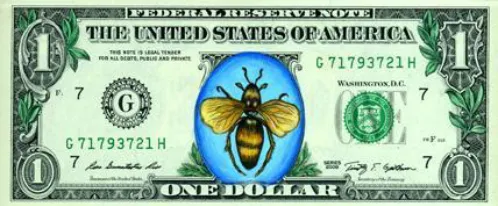
1. Bee Dollar, Acrylic on dollar bill, 2015 ……… 8
2. Fiona Hall, Leaf Litter, Gouache on currency, 2000-2002 ……….. 8
3. God is in the Details, 2015 ………... 9
4. Untitled, 2015 ……… 10
5. Nest, Mixed media, 2015 ………... 10
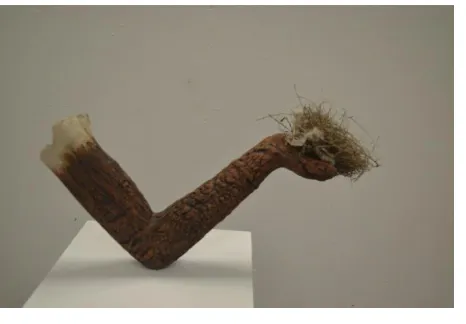
6. Balance, Recycled paper, way, oil pastel, found nest, 2016 ………. 13
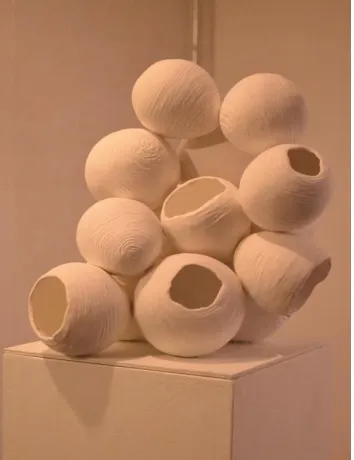
7. Undulations, Recycled, cast paper, 2015 ………. 13
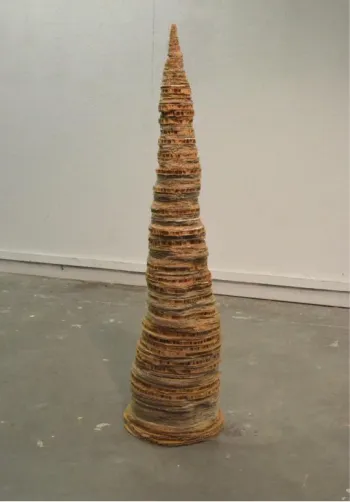
8. Tower of Shame, Cardboard, 2016 ……… 16
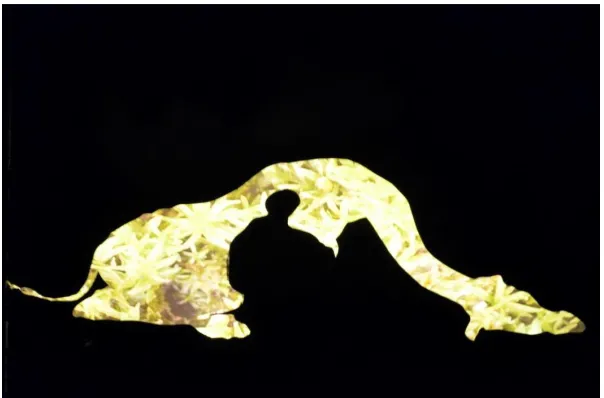
9. Untitled, Collage Light Box, 2016 ……… 17
10. Flux, Watercolor, 2016/2017 ………. 21
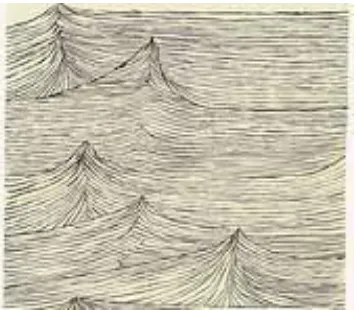
11. Louise Bourgeois, Insomnia Drawing, Waves, 1994-1995 ………... 21
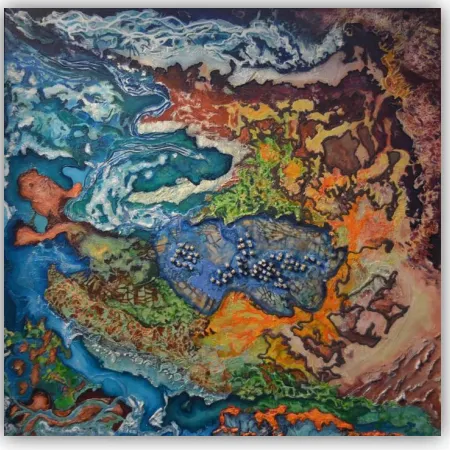
12. Tide, Mixed media on canvas, 2016 ……… 23
13. Stanley Boxer, Fealtyofbelief, 1995……….. 23
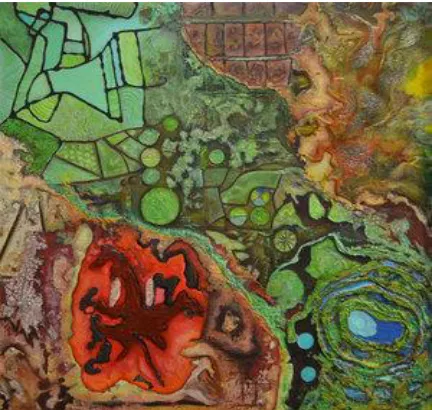
14. ReapSow, Mixed Media on Canvas, 2016 ………. 27
15. Edward Burtynsky, Pivot Irrigation #14, 2011 ………... 27
iv
ACKNOWLEDGEMENTS
v ABSTRACT
As an artist, I am interested in understanding how and why humans interact with the natural world. I examine my own individual behaviors and practices and research impacts made on nature by humans as a whole. I am drawn to nature for a multitude of reasons, including aesthetic beauty, psychological wellness, unraveling the mysteries of the universe and trying to understand the origins of life. As an artist I explore the dialectic relationship between everything we perceive outside of ourselves as the environment, and the way we think of ourselves in relation to that environment. I believe in the interconnectedness of all living things and I am interested in understanding why humans are the only species which act against their best interests in preserving the habitat that is necessary for survival. These questions bring me to address the issues of greed, consumption, and control over resources in my art practice.
1
INTRODUCTION
Humankind has not woven the web of life. We are but one thread within it. Whatever we do to the web, we do to ourselves. All things connect.
-Chief Seattle1
I first made art about nature because of its boundless source of wonder and inspiration.
Aesthetically, I am attracted to patterns, rhythms and repetitions that occur in the natural world –
that part of the planet that I believe will go on living whether the human species continues to exist
or not. I have always been curious about the mirror between the microcosms found in the building
blocks of life and the macrocosm of the planet, the cosmos and beyond. I have always wondered
why the branching of the human circulatory system, leaves, and river systems all follow similar
patterns. I have spent significant time researching the repeated patterns created by the Fibonacci
sequence and the presence of its spiral pattern in many natural formations, from the smallest
organisms on earth to the largest structures in space. I am certainly not the first artist to have these
thoughts and interests. Art historian Nina Amstutz speculates that romantic landscape Caspar David
Friedrich made the same inquiries in his paintings. In her essay, “Casper David Friedrich and the
Anatomy of Nature”, Amstultz proposes that Friedrich’s tree paintings “reflect a search in nature
for those structures and principles common to all life, an effort to bridge the inner and outer worlds
and witness the inner-self within nature’s universal forms.”2 In an area somewhere between
1Dr. Henry A. Smith. “Chief Seattle's Treaty Orientation 1854.” Version 1 as it was published in the Seattle Sunday Star, October
29, 1887, by Dr. Henry A. Smith.
2 Nina Amstutz, “Caspar David Friedrich and the Anatomy of Nature.” Art History, June 2014, pgs. 454-481. Association of Art
2
metaphysical and epistemological inquisition, I am ceaselessly curious about these connections and
what they represent. As a former psychology major, I am also interested in the perception by
humans that the earth is our dominion, when, as Chief Seattle so eloquently put it, “we are but one
thread.”3
My curiosity about the natural world most likely developed very early in my life, perhaps
beginning even further back than memories can take me. I spent the majority of my childhood
growing up and exploring the Pacific Northwest. My stepfather was an avid outdoorsman and I
spent my formative years camping, hunting, fishing and boating. Although we shared these activities
as part of the same family, I would say our experiences were quite different. While I explored and
wondered at the vast offerings of the natural world, my stepfather reveled in killing parts of it
through hunting and fishing. I remember his first attempt to get me to shoot a squirrel, with the
enticement of getting to keep the tail as a souvenir. I remember thinking, even at 6 or 7 years old,
“why on earth would I want to carry around the tail of a thing I murdered?” So, while I pressed
leaves and flowers into a scrapbook and hunted for fossils and beautiful rocks, he killed animals and
filled our basement with taxidermy pheasants, rodents and the occasional small game. I found their
presence both fascinating and hauntingly creepy, a feeling which persists to this day as I explore why
hunting and fishing have evolved from serving the purpose of supplying food to that which is
deemed “sport.” This fascination was triggered when I first moved into my studio space and found a
taxidermy catalog which became the catalyst for one of my first works entitled Mannequins.
As a child, I was greatly influenced by my Grandmother, who did arts and crafts with me
3
throughout most of my childhood. She was a painter and explored porcelain and pottery, flower
arranging and Cloisonné. During the summer when I turned 8, I underwent surgery on both legs
which left me bed-bound for 4 months. I occupied myself with all manner of art making and
materials, and I have persisted in making “arts and crafts” my whole life. Pursuing an education has
introduced me to the formal language and ideology of fine art, but my foundational experiences in
making art knew no distinction. I believe this is why I use such a variety of materials in my work and
crossover materials between painting and sculpture. I am interested in the history contained in found
materials and byproducts of consumption, the textures of organic mediums such as wax and sand in
combination with modern art materials, and the materials used by humans to construct their
habitats.
My choices in materials reflect my investigations into the similarities and differences
concerning the construction of environments. I am always looking at nature’s elegant way of
constructing life and ecosystems which use balance through time to reach the goal of survival and
cyclical regeneration. Humans, on the other hand, seem to hastily construct environments in ways
that appear rational and organized (the grid) but rely on destruction and over-consuming resources
without concern for the future generations. I am interested in the relationships nature builds into
ecosystems, both symbiotic and parasitic, and how those relationships are mirrored in human
relationships with the environment as a whole. Using a combination of natural and manmade
materials reinforces my investigation into both the imbalance and harmonious aspects of the
man/nature relationship. My practice is driven by curiosity and a need to explore ways in which the
relationship between the human species and the natural environment is dynamic in its constant
4
perception of how our human actions affect the web of life. After all, I am part of this system and
partake in normal human activities. While I try to be aware and educated, I cannot separate myself
from the systems of modern society completely.
My thesis will discuss my journey through my graduate studio practice and the explorations
and discoveries I made along the way. Starting with a brief connection to my undergraduate studies,
and concluding with how I chose to represent my journey in my April, 2017 thesis show. This thesis
examines how I have grown as an artist during my graduate career and how my work represents the
5
THE STRUGGLE IS REAL
Coming from the Pacific Northwest to study in New Orleans, my first time ever in the south, has
created a shift in how I see many things. The flora, fauna and climate are different here as well as the
culture and customs. I came with an open mind, ready to just experiment and take the guidance of
those around me. I have used many media in the creative process in the past, but entered the
program primarily as a painter. I feel most connected to gestural mark making and the power of
color and imagery.
In choosing a minor, I wanted to challenge myself with a medium I had been less familiar with,
so I chose sculpture. I felt that the mental process of thinking and creating three-dimensionally
would take me out of my imagery and color-centered painting practice and open up new ways of
seeing. I remained open to changing my minor, but stayed with sculpture because I enjoyed the
challenges it poses and how it makes me think and create differently than I do with painting. I also
have overcome my fear of delving into video-based art and enjoy what this medium brings to
expressing my connection with the natural world.
A struggle which exists regardless of my location or which medium I use is one regarding the
subject matter and how it is represented. Making work about the environment necessarily means
making work that has some political context and can become didactic, one-sided, or too obvious. It
has been a constant struggle throughout both my undergraduate and my graduate studies to find a
balance between being too direct and too ambiguous with my work.
Because my main interest has to do with nature and human activity, and internet algorithms now
6
“news feed” about changes occurring on the planet because of human actions. Being barraged by
headlines saying that 40% of the bee populations has died because of human activity (Appendix A,
1-3), or that the ice caps are melting exponentially faster than predicted (Appendix A, 4-7) are daily
occurrences. Being exposed to new information about the demise of the environment daily tends to
affect my thought process during my art making practice and I am constantly examining how to find
an appropriate level of directness while keeping the work open to many interpretations and viewer
ideas. In my dollar bill painting, Bee Dollar, (Fig. 1) I took a very direct approach by asking how we
assign value to the depletion of some natural resources in order to generate profits from other
resources. My first painting on a dollar bill (Fig. 1) was created after seeing the headline about the
severe decline in bee populations, due in large part to viruses being created due to pesticides –
particularly the brands made by Monsanto (Appendix A, 3).
Fiona Hall has painted on currency to address issues about globalization and consumption and
the effects they have on our planet. In her series, Leaf Litter (Fig. 2), Hall uses imagery of plants
painted on currency in a layered response to the commodification of the plants themselves. Hall’s
paintings on foreign currency were included in the Australian pavilion at the 56th annual Venice Art
Biennale. When asked about her work displayed at the Biennale, Hall says that her “three main
agendas were global conflict, global finances, and the environment.”4 One layer is the fact that the
currency is a direct product of plants, and it is then used in its money state to purchase other goods
also made from plants. Another layer to Hall’s work is that it addresses the commodification of land
7
worldwide which prioritizes profits over sustainable farming and has high environmental costs.5
Similar to my dollar bill paintings, Hall’s series of Leaf Litter are fairly literal with their message.
Seeing the imagery of representations of nature painted directly on the currency makes immediate
ties and conclusions inevitable, which some could argue diminishes certain enigmatic and mysterious
qualities that viewers may desire when viewing art. In reference to this viewpoint, I received a mixed
response to these works. Some believed that my dollar bill paintings were too didactic and
“one-note,” while others appreciated the directness of connections revealed by the combined imagery as
well as the intimate quality of the small scale. I realized through the process that I enjoyed painting
small scale, incorporating meticulous detail into the painting which required using a magnifying light.
Receiving this critique, I struggled with how to address this issue moving forward. I certainly didn’t
want to make didactic work, but I still wanted to communicate certain connections and questions I
have about the commodification of natural resources and the real costs of human’s activity to
exploit those resources.
I continued the process another semester, producing more dollar bill paintings as well as a series
of small wood panels entitled “God is in The Details,” (Fig. 3.). I continued to enjoy the process of
painting small and detailed imagery of things representative of nature. Zooming into the details of
and patterns of plants and animals in these paintings made me think of the sublime; a common
5 Fiona Hall, “National Gallery of Australia.” Federation Australian Art Society 1901-2001, Accessed Nov. 21, 2016,
8 Fig. 1. Bee Dollar, 2015.
Fig. 2, Leaf Litter, 200-2002.
theme represented throughout art history. While artists such as JMW Turner and Casper David
Friedrich expressed the feeling of the sublime and the power of nature through impressionistic
9
power of nature in the infinite combinations of color, shape and pattern which nature produces in
life forms.
I moved on to other approaches when I realized these smaller formats may be limiting my
expression of ideas. Moving forward I wanted to find other ways to communicate that could be
more encompassing and open to wider interpretation by viewers. The consensus, through both
faculty and peer critiques as well as studio visits, was that my sculptural work communicated the
feelings of what I was trying to say without directing the viewer to specific messages. Therefore, I
concentrated on expressing myself through other means and took a break from painting.
Fig. 3, God is in the Details, 2015
The dollar bill paintings represent one end of the spectrum, that of more direct activism about
the environment, while my sculptural work embraces the more ambiguous end of the spectrum. I
began working in sculpture to experiment with materials, thinking mainly about how non-human
animals interact with their environments compared to humans. I looked at many insect and animal
10
nests and how they function within their ecosystems. In figures 4 and 5, I experimented with
construction materials such as joint compound (Fig. 4) and spray foam insulation (Fig. 5) to create
forms which are organic in origin but not specific representations. Both early experiments posed
construction challenges and I enjoyed struggling through the process of building three dimensional
objects. This work challenged me to think about my art and the ideas I tried to express in a totally
different way than painting. Neither piece is archival, but temporality is one of the ideas I explore in
looking at the characteristics of nature. As I moved forward with sculpture I also had to
acknowledge the source and toxicity of some of the materials I was using. While I discontinued use
of some toxic construction materials, I remained interested in gypsum (the base material in joint
compound) and continue to manipulate this compound to create more fluid and ambiguous forms.
11
I abandoned using Styrofoam and insulation in my practice because of the toxicity and
commercial access to the material which made me a part of the cycle of commodification. This is
not to say I have been able to completely eliminate any harmful or synthetic materials from my
practice. I use cardboard, both from my own consumption and from boxes discarded by others,
which I recycle into organic forms. I also use gypsum, which is a natural compound, but has been
mined and refined by humans to use in the construction of our habitats. Textural components in my
mixed media works often come from art stores and are synthetic and somewhat toxic in nature. I
use these materials in conjunction with organic materials, such as sand and wax. Making materials
choices is yet another struggle in making work about the issues of human activity as it pertains to the
environment.
Through the years of evolving through the graduate program, I have made choices based on my
own footprint and responsible consumption practices and struggled to find a balance which
incorporates the least harmful materials which are sourced in a responsible way. I have learned that
balance is the key when thinking about the issues that I am confronting in my work. I have come to
realize that the human existence and lifestyle cannot be completely free of impact on the world
which surrounds us, but it can be lived in more sustainable ways which cause less harm. As I moved
forward into my second year I realized that the struggle would continue, probably throughout the
duration of my art practice. The struggle is in finding balance; balance in making art that is accessible
and communicative without being pontifical, and balance in the use of materials which fit into
parameters which can hold meaning and significance without being cavalier about the issues I am
12
COULD I WALK AWAY FROM OMELAS?
During the second year of graduate research, I realized that if I was going to make work about how human actions affect the environment then I had to examine my own actions and my own consumption. I was also still weighing the idea about how direct or ambiguous I would be with the artworks. I knew that if I were to take the more direct approach and create activist driven art, like Barbara Kruger did in support of second-wave feminism, then I would have to be accountable for every material and every process used in the creation of the work. I could not, for instance, take a stand on non-biodegradable substances such as Styrofoam while using those materials in my work. I needed to think about how I was living and working on every level while thinking about the most effective way to communicate through the work.
To this end, all through the second year I saved and sorted my own garbage and analyzed the products I consumed. I researched ways that I could consume less and create less waste. I watched documentaries, read books and found reliable websites to research how other people were facing the challenges of leaving a smaller footprint. Throughout this process, I kept thinking of a short story I had read as an undergraduate student by Ursula K. LeGuin called, The Ones Who Walk Away From Omelas.6In the story, a beautiful little town named Omelas owes its utopian circumstance to the horrible suffering of one little girl. At the age of maturity, each citizen of Omelas must make a journey to a cold, dank basement to see the girl and the suffering she must endure so that the remainder of the town can live a pleasant and harmonious life. In the end, not all can live with this reality and so they decide to leave the town and venture into the unknown beyond its borders. I thought of this story often, especially when, for instance, I watched Food, Inc.7 and saw how animals
such as chickens and cows are raised in the corporate farming system, and how they are slaughtered.
6 Ursula K. Le Guin, "The Ones Who Walk Away From Omelas." The Wascana Anthology of Short Fiction. Eds. Ken Mitchell, Thomas
Chase, and Michael Trussler. Regina: Canadian Plans Research, 1999. 273-77.
7 Kenner, Robert, Pearce, Richard, Schlosser, Eric, Robledo, Melissa, et. Al: Food, Inc. Magnolia Home Entertainment, 2009. Los
13
I had already given up red meat, but now each time I went to the store and bought chicken, I could not get these images out of my head. I thought of what I would do if I lived in Omelas – would I stay or walk away?
While delving deeper and deeper into the life I am living as a modern human, I started examining everything I did and used in the course of the day to day life. Where does my food come from, how is it packaged, what will happen to the packaging once I consume it? Who is really making my clothes and what kind of life do they lead in their country? How does the corporate structure of these companies producing all these consumable products function in terms of resourcing materials and what do they really contribute to society in relation to what they take from it? All these
questions became part of my practice as I saved my paper waste and began to break it down to recycle it. I began making my own paper from recycling this paper waste and then incorporated this process into making sculptural works. I cast some of the paper on mannequin parts to make
figurative works (Fig. 6) and other paper castings remained more ambiguous, referencing organic undulating forms similar to those I had been creating with the gypsum materials (Fig 7).
Fig. 6, Balance, 2016 Fig. 7, Undulations, 2016
14
nest precariously balances in the hand. I filled the hollow vessel of the upper arm with metallic gold and silver flake, representing commodity, while the piece as a whole represents the delicate balance between man and nature. Undulations, (Fig. 7)on the other hand, makes no representational
connections through imagery, but instead seeks to capture the essence of things found in nature like the perpetual movement of water and air. Some connections were made in critiques to a human presence, such as possible reference to folds in fabric or ruffled bedsheets.
It was very interesting to me the juxtaposition that these two works received during critique.
Undulations received a better response, as it is very ambiguous while still invoking an organic feeling and containing the raw look and feel of the recycled paper. Balance, on the other hand, received mixed reviews, generally in the negative, repeating the familiar sentiment of being too obvious and didactic. The very familiar struggle continued. While the technique of achieving the illusion of bark on the figurative arm and revealing the cast paper seemed to be appreciated, the presence of a literal arm and actual birds’ nest seemed to push the message too aggressively. In Undulations, viewers made the connections between nature and human realms without being directly led there, and the feeling was that this was a more effective use of the materials. I reflected about all the critiques and advice I had received about my work thus far and my own experiences in making the work in my practice. In the context of where my thoughts were during that time, the story about Omelas kept circulating through my thoughts. An obvious correlation revealed itself between the imagery I was using receiving negative feedback and the use of abstract, formal elements to express my ideas receiving more positive feedback. Just as I do not want to think of chickens getting their beaks cut off in a cruel assembly line while I’m buying my groceries, people don’t want to be confronted with
problems such as climate change while viewing art. I can completely understand the uncomfortable feelings which accompany being asked to look at the consequences of our actions because I spent a good deal of the year in self-examination, which led to many unpleasant feelings about my
15
I confronted these issues again when I created Tower of Shame (Fig. 8). This piece came from
working out my consumption issues because of my own guilt in placing so many mail orders
through Amazon.com. I always saved my boxes, because I have always been good about recycling
things like that, but my research was revealing many more problems with sourcing goods from
Amazon than the cardboard boxes. The issues revolving around fossil fuels used to transport the
goods, the employment practices of the companies creating the goods, and the fact that they were
supporting far away economies instead of local ones all became factors in my decision to order
goods online. I noticed how many boxes I had accumulated and felt guilty about how much I
myself had contributed to these problems. I began to break down these boxes to recycle them into
art. Thinking of the monument, and the organic nesting forms I had been making, I started cutting
circular forms and stacking them up to make a Brancusi-type monolithic form. This piece became an
important symbol of my own complicity in the system of commodification and waste, hence the
title. I am still making these shapes and continue to use cardboard in my work as a reminder to
myself of the repercussions of my own consumption. It reminds me to strive to make better
decisions when making purchasing decisions. I no longer limit the cardboard used to my own waste,
16 Fig. 8, Tower of Shame, 2016
During this time painting became difficult for me. As much as my own consumption was
weighing as a burden on my conscience, ideas for imagery that I felt compelled to paint were not
forthcoming. Due to the previous semester’s critique about being too obvious with imagery, I was
over analyzing every idea that came into my head. I did continue with a few more dollar bill
paintings, and expanded my small, wood paintings from 4 to 9 panels, but I was still not reaching a
breakthrough or finding a way to be more ambiguous with painted images. As the halfway point
came and went, I felt encouraged about the sculptural work I was making, but lost as a painter.
I began working in collage and returned to some ideas I had been working with during my first
year concerning the hunting and trophy making of wild animals. I became fascinated with this
17
subsequently seem to take great care and ritual in creating pictures with their fresh kills, which
inevitably end up on the internet. I began working with these images to see what I could mine from
this ritual of posing the dead animals and photographing hunter and prey. I ended up making
silhouettes from the scenes, filling the shape of the animal with images of organic matter and placing
them in light boxes. For example, in Figure 9, there is a dead giraffe that has been twisted around in
a very unnatural pose to accommodate the framing of the photography while the hunter sits proudly
in front of his kill. However, when the animal is replaced with the image of green undergrowth and
the hunter and background are in silhouette, removing all details from the original scene, the viewer
is left confused by the image. It now appears the human form is somehow inside the organic shape
which takes some time to identify as a distorted giraffe. In this way the act of hunting is left
ambiguous, while the viewer is forced to think about what relationship the human form has with the
rest of the image.
18
At the end of this second year, I decided that I am not one who could walk away from Omelas. I
also realized that this really prohibits me from becoming an effective activist artist. I realized that to
take on that mantle of environmentalist artist requires a full-time lifestyle change. To truly walk away
and do no harm would mean leaving this modern life and going off grid, into an unfamiliar world,
and dedicating my time to telling others how to live. I could not see myself becoming that kind of
artist or living that kind of lifestyle. Ultimately, I found, again, during this year of self-analysis that
for me personally it all comes down to balance. I found that there were things I could easily do, such
as getting a Brita water pitcher and using a reusable water bottle, using a cloth bag while grocery
shopping and minimizing the processed convenience foods that use a lot of packaging and instead,
buying and cooking fresh foods that are locally sourced. These were things I could fairly easily
transition to, while others compromises and sacrifices I found I was unable to accomplish. I could
not stop eating meat all together, despite my knowledge of how it comes to my table. My
compromise is reducing my consumption to free-range chicken and wild-caught fish only, and
limiting those meals to only about 5 meat dishes a week. Other sacrifices I found too great, such as
parking my car to bike around town.
As I learned what my own limitations were, I also began to realize that the natural world has its
own checks and balances in place. While I was researching animals, such as the Golden Tamarind
Monkey and several species of tree frogs that were being added to the endangered list (both of
which were represented in one of my dollar bill paintings), I learned about many new species that
were discovered in 2015 (Appendix A, 8). I have created boards on Pinterest that are full of
incredible insects and animals that look like they come from another planet and are largely unknown.
19
miraculous solutions to problems that had been invented by everyday people in countries around the
world and about new species of incredible animals being discovered. The theme of balance and
perspective continued to be solidified during my practice and my everyday life. Each time I work in
the studio I seek to find a balance in the work, and with my thesis show I strive to show a balance of
work which contains a spectrum from the ambiguous to more direct. I believe that when viewed
together, these different perspectives can give the viewer many ways to enter and think about the
20
P
UTTING THE LAND IN LANDSCAPE AND THE MOTION IN THE OCEANDuring the spring semester of my second year, I suffered the sudden and unexpected death of
someone close to me. The semester was just beginning as I went through the stages of grief, and as a
non-religious person I turned to nature with a whole new perspective and set of questions. I
rediscovered this primordial sense of connection that I have always had with large bodies of water as
I sat by Lake Pontchartrain meditating on nature’s cycles of birth, decay, death and renewal. I had
previously done a small watercolor of water over the summer, just for my own amusement and to
explore the medium. My daily visits to the lake compelled me to revisit the process of building up
the patterns in the water with layers upon layers of watercolor. Somehow, I was so compelled by this
idea that I bought an entire roll of watercolor paper and began covering a large section simply
making circles, ovals, and undulating curvatures in repetitive gestures, over and over, for hours on
end (Fig 10). This reminded me of Louise Bourgeois and her insomnia drawings. Bourgeois spoke of
how she used to draw repetitive shapes through the night pictures, such as lines which became
waves in bodies of water (Fig 11). My times away from the actual lake were spent creating the ever
fluid movement through the repetitive gesturing of painting water. Just as Louise Bourgeois spent
hour upon hour working through her insomnia at her drawing table, I worked my way through my
grief making those gestures in my studio. I found my way back to painting that spring semester, and
21
Fig. 10, Flux Fig. 11, Waves, Louise Bourgeois
Over the summer, and into the third year, I came out of my grief to re-examine my relationship to painting. Thanks to the watercolor painting, I had enjoyed feeling the brush in my hand again, and I did a lot of soul searching about what I wanted to say with painting. Looking at some work I did during the first year, I realized I had connected to the textural elements that I had added to early paintings, and decided to revisit mixed media with a new intention. I wanted to continue to explore the connections between the manmade world and the organic order of things and examine how human actions are changing the environment by creating textural environments of my own. I began looking at satellite imagery and immediately became engaged with the birds-eye view of the land. At the recommendation of my mentor and some faculty members I discovered Edward Burtynsky and his photographic works which depict the collisions and intersections between the natural and human worlds. His work invokes a feeling of the sublime as it is able to capture large swaths of land that have been manipulated by man’s actions of both building up and excavating and removing resources, while also capturing the raw beauty of the topography.
The patterns and the colors which emerge when seeing the earth from miles above it are very
painterly and could be mistaken for an abstract art work. A new perception of the interaction
22
perspective. I discovered a book by Benjamin Grant called Overview which centers on this effect as
described by astronauts when seeing the earth from above. I began incorporating and abstracting
some of this imagery in my paintings, along with incorporating imagined terrain. The photographs
became an important inclusion in my practice as they represent the reality of what is happening on,
and to, the planet.
11111After a few practice runs, I created Tide (Fig. 12) and ReapSow as well as a few smaller works
on paper with similar composition and materials. At last I began to feel comfortable in my painter’s
skin and felt engaged in the process of painting. I began using the square very deliberately, seeking
to stay away from the traditional “landscape” orientation and rectangle associated with landscape
painting. The square to me represents a scientific sample, a hector, a parcel, and a part of the grid. I
am approaching landscape painting in a different way, seeking to represent the actual land from a
bird's-eye view which reveals interconnected relationships and ecosystems which happen beyond the
human vantage point. Instead of the romanticized horizon, I am revealing how our land looks
beyond the daily gaze. For instance, Tide is a completely imagined and abstracted landscape based
first on a composition of the yin and yang symbol. As I was creating it, I couldn’t help but think
about how land meeting water has significance to New Orleans. I incorporated the presence of
humans in this piece by creating a faux city out of found Mardi Gras beads. The “city” has found
itself in at the mercy of the natural world, and is partially under water. The tops of the buildings
were treated with gold leaf, to represent the commodification of the land.
23
Fig. 12, Tide
24
In the work of Stanley Boxer, there are similar textures and build-up of materials used to create a
very topographical and tactile surface (Fig. 13). Boxer didn’t align himself with any particular
painting movement. Some critics tried to label him a field painter or abstract expressionist, but
Boxer disagreed. Critic, Grace Glueck said “the abstract painter Stanley Boxer was a superb
manipulator of surfaces, intensely bonding texture and color."8 I am attracted to Boxer’s use of
texture to create sensual surfaces and construct paintings using an abstract painter’s eye, not
focusing on representation at all. When I look at his works, because of my own interests, I see
topographical elements and feel I am flying over far away landscapes. Though my paintings are using
reference to both real and imagined places, I am also abstracting shapes and colors to open the work
up to a bit of fantasy as well. Like Boxer, I am very interested in the sensual quality of the surface.
To further expand on the idea of putting the actual land into the landscape, I also include found
objects into the surface of the paintings. These are often times, but not always, man-made items that
have been discarded as waste and are a symbol of our modern human life. As mentioned before, in
Tide, the allusion to cityscape is created from found Mardi Gras beads from Harrah’s Casino which
were originally shaped as dice. In other paintings, I have used objects I find on nature walks which
include discarded credit cards, a faceplate from an old push button phone, and circuitry from a
remote control.
Many modern painters have added organic materials to their paints and canvases to achieve
texture. Jasper Johns used wax and sand, Julian Schnabel glues household items to his canvases and
Anselm Kiefer has used sand, dirt and straw to build up the textures in his paintings. Kiefer also
25
performs destructive actions on his canvases during his process, such as sanding and burning parts
of them to achieve a certain aesthetic which belies the darkness of his subject matter. I am not
comparing my explorations into the issues surrounding the environment to Kiefer’s works about the
horrors of the Third Reich or Germany’s historical pitfalls by any means. However, I do feel some
connections to his work in terms of materiality, aesthetic qualities brought about by the sensual
nature of the surface, and the conscious attempt to balance a problematic subject matter with works
which can be open to the viewer. A German professor, Andreas Huyssen, wrote of Kiefer’s
paintings: “whether to read these paintings as a melancholy fixation on the dreamlike ruins of
fascism that locks the viewer into complicity, or, instead, as a critique of the spectator, who is caught
up in a complex web of melancholy, fascination, and repression.”9 If I remove the context of
fascism from Huyssen’s statement and replace it with the issue of climate change and apply it to my
work, I feel a connection with this struggle of balancing the content with the aesthetic. As the artist,
I am admitting my complicity – most obviously by using resources to create another object to add to
a world in little need of more objects. I am highlighting an issue that makes most of humanity my
accomplice, yet I am asking the viewer to engage with the image without feeling attacked by any
implications of the content. I would much prefer that the viewer engage with the surface and see
references to the natural world which they can projects their own feelings onto about their
experiences with nature.
During the process of creating these mixed media works, I lay down texture and then respond to
26
the results by sanding away some parts and adding others until I can visualize an ecosystem
developing. I then add color, and materials that contribute color, such as charcoal sand in this case,
to further develop the landscape. In the process of creating Tide, the process of creating the give
and take between land masses and water groups came from an original composition of the yin and
yang symbol. The cityscape emerged as I was working on the piece, almost of its own volition.
Given the history of my new home of New Orleans, it may have made its way out of my
subconscious into existence. In previous texture paintings, as far back as my undergraduate years, I
had always left traces of a human presence, like abstracted hieroglyphs or bar codes from food
packaging. These traces represent a human presence, but place that presence in an insignificant role
to that of the natural world. In the natural order of things, we could be just a blip in the history of
the world – only time will tell.
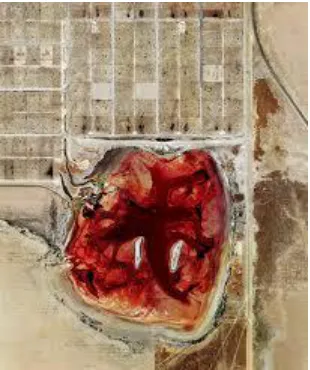
The next painting I created, ReapSow, (Fig. 14)began to incorporate imagery taken from actual
satellite photographs depicting industrial farming (Fig. 15, 16) and mining, as well as more
sustainable practices such as terrace farming. I was struck by the imagery of the corporate farming
and mining and how the actions taken on the earth looked like wounds from overhead. I am also
fascinated with the imagery from this perspective, which can be both beautiful and disturbing at the
same time. In ReapSow, I stitched together images from Edward Burtynsky (Fig. 15) and Mishka
Henner (Fig 16) as well as inventing other topographical areas throughout the use of various textural
components and paint. In combining real and imagined imagery, I am seeking a balance of the
aesthetic with the content, leaving the paintings more open and a bit abstracted. In the satellite
27
implications that goes along with that reality. In my paintings, I am trying to create a liminal place
between reality and fantasy where the viewer can have the feeling of a topographical view but still be
free to project their own ideas and experiences concerning the environment onto the work.
Fig. 14, ReapSow, 2016
28 Fig. 16, Feedlots, Mishka Henner, 2013
ReapSow was originally inspired by Feedlots, by Mishka Henner, who made a series of work by
stitching together high resolution satellite photos of industrial farming. Like Henner, I am stitching
together pieces of imagery from the real landscape to make a complete image, but I am taking
liberties with the images as well by infusing them with my painterly abstractions. The photographs
themselves are important, as they reveal the beautiful, yet horrifying effects human actions are
having in the natural world. Photographs are documentations, and I find it important in my practice
to view them and incorporate them into my work. However, when they are translated to canvas,
wood or paper, I allow these images some space to be beautiful and complicated objects first and
representations second. Another area of my practice I have had to come to terms with is my
complicity in adding more objects to the world which has enough “stuff” in it already. I can’t seem
to resist the urge to keep creating the objects, so incorporating recycled and found materials into
29
I hear quite often in critique that there is “a lot going on” in my paintings. I have come to
realize and accept that this is part of who I am as a painter. The process of adding and subtracting in
order to build the surface creates many areas of interest as opposed to a few; there is usually no one
focal point in my work. When experiencing the actual “land” in landscape, it is full of textures and
details, it is not just a pretty sunset over a beautiful mountain range. When viewed from above, the
“overview” landscape becomes even more sublime in its details and complexity, and these are the
qualities I am trying to capture in my paintings. When I am painting and imagining the sense of
place and how man fits into that place, I envision many characteristics of the landscape: hills and
valleys, mountain ranges, lakes, waterfalls and fields to list a few. It is my hope that viewers will also
lose themselves in these places, perhaps imagining themselves as a part of the landscape as they
explore the lay of the land. Perhaps the viewer can imagine themselves traversing the various hills,
valleys, waterways and man-made spaces as their eyes travel across the canvas and relate the imagery
30 CONCLUSION
The struggle is still real. I have accepted that finding harmony and balance between having a
discernable voice and being ambiguous in my work will be a lifelong challenge because of the subject
matter I am passionate about exploring. I cannot walk away from living in the modern world, and so
I must also find balance in my own actions and temper my complicity by making the best choices I
can, and by expressing myself through my work. Entering a new era, where we find ourselves in the
position of having a president who does not believe in climate change, my work may become more
direct in response. I believe we are living in a post-factual society where beliefs and alternatives to
the truth are considered reality by many, and for others, false stories posted to further agendas are
taken for fact. As I prepare to enter the world as a graduate of this program to become a
professional artist, I wonder what the responsibility of the artist is to address the important issues
surrounding climate change and the stewardship of our planet. Art of the 20th century was very
engaged with many political issues including anti-war protests, civil rights and feminism. First
admitting there is a problem sustaining our human consumption, and then finding solutions is a hot
topic issue we are facing in the 21st century, and I believe that as an artist I should use my passion
for the issue, combined with my chosen trade, to make work relevant to the current state of affairs.
Some could argue that there are more pressing issues plaguing society today. However, I would
31
My thesis show will represent a spectrum of work. From the directness contained in the dollar
bill paintings, to the middle ground of material and formally driven sculpture and the open and
ambiguous work such as the video, Heal Me. I believe some directness can be a good thing when in
balance, and when the importance of the issue warrants it. For example, since creating the Bee Dollar
painting in 2015, 7 species of bees have been to the endangered species list (Appendix A, 11).
Specific issues such as this, which require awareness and action, may deserve a more straight forward
artwork. Others, like expressing the connection of the human experiences we share in nature, are
better represented by more open works such as Heal Me.
After floating other options, I chose Perspective as one word that could encompass all the things I
have been talking about in this document, and in my work. Not only is perspective the
phenomenological way that our eyes perceive our surroundings, but it also refers to our world views
which have been shaped by our own experiences. It addresses our interpretations and opinions
about our engagement with the natural world. It refers to both our literal and figurative point of
view, whether it is how we see our surrounding versus how a bird sees them, or how we view the
challenges we face as human being inhabiting the world. Hopefully, if art is good, it can enhance, or
32 BIBLIOGRAPHY
Amstutz, Nina. “Caspar David Friedrich and the Anatomy of Nature.” Art History, June 2014, pgs.
11111454-481. Association of Art Historians, 2014.
Birnbaum, Daniel. Defining Contemporary Art: 25 Years in 200 Pivotal Artworks. New York:1Phaidon,
111112011.
Emerling, Jae. Theory for Art History. New York: Routledge, 2005.
Galperina, “Aerial Views of Industrial Farming Are Horrifying, Beautiful.” Sept 18, 2013.
11111http://animalnewyork.com/2013/aerial-views-of-industrial-farming-are-horrifying-beautiful
Glueck, Grace. "Stanley R. Boxer". Stanleyrboxer.com. Quoted from The New York Times, April 23, 2004.
Grant, Benjamin. Overview. New York: Crown Publishing, 2016.
Hall, Fiona. "Q&A WITH FIONA HALL." Modern Painters 27, no. 5: 74-77.
Hurst, Rachel. 2015. "FIONA HALL: WRONG WAY TIME." Architecture Australia 104, no. 4:
28-1111130
Jones, Amelia, Ed. A Companion to Contemporary Art since 1945. Oxford: Blackwell Publishing,
111112006.
Jung, C. G. The Earth Has a Soul. Edited by Meredith Sabini. Berkeley: North Atlantic Books,
33
Kenner, Robert, Pearce, Richard, Schlosser, Eric, Robledo, Melissa, et. Al: Food, Inc. Magnolia Home
11111Entertainment, 2009. Los Angeles, CA. DVD video:NTSC color broadcast system: English.
11111WorldCat.
Klein, Naomi. This Changes Everything: Capitalism vs. The Climate. New York: Schuster & Schuster,
111112014.
Kolbert, Elizabeth. The Sixth Extinction: An Unnatural History. New York: Henry Holt, 2014.
Le Guin, Ursula K. "The Ones Who Walk Away From Omelas." The Wascana Anthology of
11111Short Fiction. Eds. Ken Mitchell, Thomas Chase, and Michael Trussler. Regina:
11111Canadian Plans Research, 1999. 273-77.
National Gallery of Australia. http://nga.gov.au/federation/Detail.cfm?WorkID=26201. Accessed
N November 21, 2016.
Robertson, Jean. Themes of Contemporary Art: Visual Art After 1980. New York: Oxford University
11111Press, 2010.
Stiles, Kristine and Selz, Peter. Theories and Documents of Contemporary Art. Berkeley: University of
11111California Press, 1996.
34 APPENDIX A
Internet Sources and Research Data
1. http://www.globalresearch.ca/death-and-extinction-of-the-bees/5375684
Since 2006 beekeepers have been noticing their honeybee populations have been dying off at increasingly rapid rates. Subsequently researchers have been scrambling to come up with an accurate explanation and an effective strategy to save the bees and in turn save us homo sapiens from extinction. Recent harsh winters that stay freezing cold well into spring have been instrumental in decimating the honeybee population in Iowa by up to 70% as well as the other historically high yielding honey states – the Dakotas, Montana, Minnesota.
Honeybee Colony Collapse Disorder (CCD) as this loss of bee phenomenon has been called is currently recognized as such an urgent crisis that a month ago Newsweek ran an article outlining the U.S. Department of Agriculture (USDA)
announcement that it will provide a $3 million subsidy in order to help the one animal on the planet that will either make or break food prices. According to the latest USDA industry survey, this emergency plan assistance comes after nearly a third of commercial honeybees died last winter, a whopping increase of 42% from the previous year.
2. http://www.wallstreetdaily.com/2015/06/01/u-s-honeybee-dying-off/
Beekeepers in the United States first noticed that their bee colonies were dying off in 2006. Since then, scientists have been desperately trying to figure out what’s causing the collapse. Now, if you think this doesn’t concern you, think again! The honeybee plays the mostsignificant role in our ability to produce the basis of our diet: fruits and vegetables. In fact, Albert Einstein once prophetically remarked, “Mankind will not survive the honeybees’ disappearance for more than five years.” Joachim Hagopian from the Center for Research on Globalization reports that “in the last half decade alone… 30% of the national bee population has disappeared, and nearly a third of all bee colonies in the United States have perished.”
3. http://e360.yale.edu/feature/declining_bee_populations_pose_a_threat_to_global_agriculture/264
For much of the past 10 years, beekeepers, primarily in the United States and Europe, have been reporting annual hive losses of 30 percent or higher, substantially more than is considered normal or sustainable. But this winter, many U.S. beekeepers experienced losses of 40 to 50 percent or more, just as commercial bee operations prepared to transport their hives for the country’s largest pollinator event: the fertilizing of California’s almond trees.
The gravity of the situation was underscored on Monday, when the European Commission (EC) said it intended to impose a two-year ban on a class of pesticides known as neonicotinoids, now the world’s most widely used type of insecticide. Neonicotinoids are one of the leading suspected causes of colony collapse disorder, and the European Commission announced its controversial decision three months after the European Food Safety Agency concluded that the pesticides represented a “high acute risk” to honeybees and other pollinators.
4. http://www.ucsusa.org/global_warming
Last week brought news of yet another alarming season for sea ice in the Arctic. The National Snow and Ice Data Center
announced the Arctic sea ice coverage for winter was the fifth lowest maximum on record. The extent of ice was more than 280,000 square miles below the 30-year average for 1981-2010. That’s an area just bigger than the size of Texas missing.
Sea ice – the frozen crust of the ocean that grows to about 3 feet thick in a season – begins to grow in the autumn and peaks in early spring. Now, I’ve written earlier blogs about why summer sea ice decline should be front page news and the
role of the Arctic in climate. So what’s up with winter? The peak this year was low again, despite a late season surge of growth in March. In fact, winter sea ice extent in the Arctic has been below average every winter for at least the last decade, as you can see on this interactive graph.
35
5. http://www.climate.nasa.gov
This was a website I used for research about climate change, specifically Arctic ice melt and record breaking temperature trends. However, since Trump took office in January of 2017, this website has been removed from the internet.
6. http://www.noaa.gov/arctic-set-for-record-breaking-melt
The record heat that is baking Alaska is poised to smash a host of climate records in 2016, including the earliest snowmelt date at NOAA’s Barrow Observatory, the northernmost point in the nation. Staff at the
observatory reported snowmelt occurred May 13, the earliest snowmelt date in 73 years of record-keeping, beating the previous mark set in 2002 by a full 10 days. The early melting follows a record-setting winter that saw temperatures average more than 11 degrees above normal for the 49th State, shattering the previous record set in 2015. At 320 miles north of the Arctic Circle, Barrow is usually one of the last places in the United States to lose snow cover.
7. http://www.earthobservatory.nasa.gov
36
8. http://news.nationalgeographic.com/2016/12/new-species-mekong-snakes-bats/
A new report published by World Wildlife Fund unveiled 163 new Mekong species to the world—all of which were found in 2015 alone. One of the most species-rich spots on Earth, the Mekong and its river encompass parts of Laos, Cambodia, Thailand, Myanmar, and Vietnam. Over the last 20 years, biologists have discovered nearly 2,500 new species in its mountains and rain forests.
9. http://www.ucsusa.org/global_warming
Wild bees, for example, are important for their role in crop pollination, and may become more so if we can’t reverse problems that are decimating domestic honeybees raised by beekeepers. A recent study estimated that in California alone,wild bees are responsible for providing up to $2.4 billion worth of food products per year. A good reason for the saying, “busy as a bee!” Alfalfa, our fourth biggest crop, and critical as feed for dairy cows (think of hay), depends heavily on wild leafcutter bees for pollination in many parts of the country. Wild bees have to come from somewhere. There must be habitat not poisoned by insecticides, and with various kinds of plants that allow them to flourish so they can do their thing for our crops. Landscapes of uninterrupted, seemingly endless rows of crops found in many parts of the country provide less habitat for wild bees, or the many other beneficial insects that make farming possible in the long run. (for more about pollinators, check out the Xerces Society
)
10. http://www.sciencealert.com/seven-species-of-bees-have-been-added-to-the-endangered-species-list
The US government has announced that seven species of Hawaiian yellow-faced bees have officially been added to the
endangered species list, which means there now the first US bee species to earn federal protection under the Endangered Species Act. The US Fish and Wildlife Service's decision will hopefully put in place systems that will help these affected populations rebound, saving some of the state's biggest pollinators from extinction.
37 VITA
The author was born in Glendale, California and received her undergraduate Bachelors of Fine Arts
from Eastern Washington University in Cheney, Washington in 2014. She joined the University of
New Orleans Fine Arts Department in 2015 to pursue a Master’s Degree in Fine Arts. She was
mentored by Kathy Rodriguez. In addition to Ms. Rodriguez, her committee also includes professor