S H O R T R E P O R T
Open Access
A BioBrick
™
-Compatible Vector for Allelic
Replacement Using the
XylE
Gene as
Selection Marker
Michela Casanova
1,2, Lorenzo Pasotti
1,2, Susanna Zucca
1,2, Nicolò Politi
1,2, Ilaria Massaiu
1,2, Cinzia Calvio
3,2,
Maria Gabriella Cusella De Angelis
2and Paolo Magni
1,2*Abstract
Background:Circular plasmid-mediated homologous recombination is commonly used for marker-less allelic replacement, exploiting the endogenous recombination machinery of the host. Common limitations of existing methods include high false positive rates due to mutations in counter-selection genes, and limited applicability to specific strains or growth media. Finally, solutions compatible with physical standards, such as the BioBrick™, are not currently available, although they proved to be successful in the design of other replicative or integrative plasmids.
Findings:We illustrate pBBknock, a novel BioBrick™-compatible vector for allelic replacement inEscherichia coli. It includes a temperature-sensitive replication origin and enables marker-less genome engineering via two homologous recombination events. Chloramphenicol resistance allows positive selection of clones after the first event, whereas a colorimetric assay based on thexylEgene provides a simple way to screen clones in which the second recombination event occurs. Here we successfully use pBBknock to delete the lactate dehydrogenase gene inE. coliW, a popular host used in metabolic engineering.
Conclusions:Compared with other plasmid-based solutions, pBBknock has a broader application range, not being limited to specific strains or media. We expect that pBBknock will represent a versatile solution both for practitioners, also among the iGEM competition teams, and for research laboratories that use BioBrick™-based assembly procedures.
Keywords:Allelic replacement, BioBrick, Knockout, Standard vector,XylE
Background
A large number of methods, recently reviewed by Song et al. [1], are available for the efficient genome engineer-ing of Escherichia coliand other bacteria. Among them, circular plasmid-mediated homologous recombination is commonly used for marker-less allelic replacement, exploiting the endogenous recombination machinery of the host. In such method, a mutated version of the target locus is cloned in a conditional-replication plasmid, together with the two DNA sequences flanking it. Upon transformation, a first cross-over event integrates the
plasmid in the target chromosomal region and a second one excises the integrated plasmid, leaving the allele with the desired modifications without any plasmid DNA sequences. While clones in which the first cross-over successfully occurs are easily selected via antibiotic resistance, the second cross-over is a rare event and clones that have lost the plasmid are usually screened via a selection method [1]. Finally, the counter-selected clones, which have the same theoretical prob-ability (50 %) to contain the desired modified allele or to maintain the original state, need to be screened by PCR [2]. The counter-selection gene most widely used in this type of plasmids is sacB, which converts sucrose into a toxic product, thus enabling the selection of clones in growth media containing this sugar [3]. Apart from the requirement of specific media, a reported
* Correspondence:[email protected]
1
Department of Electrical, Computer and Biomedical Engineering, Laboratory of Bioinformatics, Mathematical Modelling and Synthetic Biology, University of Pavia, 27100 Pavia, Italy
2Centre for Health Technologies, University of Pavia, 27100 Pavia, Italy Full list of author information is available at the end of the article
drawback of such popular method is the spontaneous mutation that can occur insacB, resulting in false posi-tive clones [4]. Other counter-selection methods available, such as those based on therpsL,galK,thyA,tetAandtolC
genes, also present strong strain and/or medium limita-tions [5, 6]. The I-SceI counter-selection system has been proposed to overcome such issues [7], but false positive clones due to mutations can still occur at high frequency [8]. This is a common feature of synthetic kill switches implemented via toxic genes [9], although combination of multiple counter-selection systems has been reported to decrease the false positive rate [6]. Methods have been proposed that use temperature-sensitive vectors without toxic genes, exploiting the integrated replication origin to stimulate the second recombination event in permissive (replicative) conditions [10]. This strategy, coupled with a
lacZ gene-mediated blue/white screening, is successfully used in Gram positive bacteria [11], although its use in
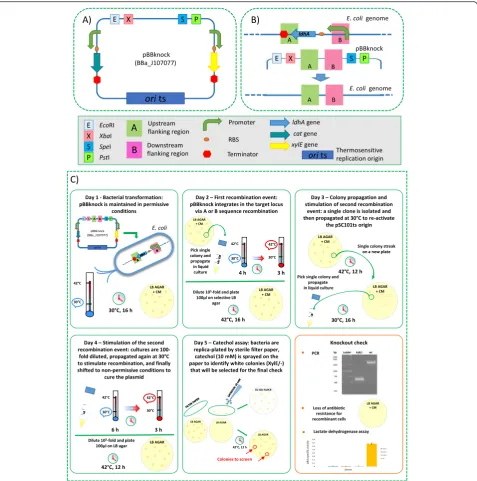
E. coliwould be limited to specificlacZ-mutant strains. In this work, we propose a new vector (pBBknock, see Fig. 1a) for allelic replacement in E. coli that exploits a temperature-sensitive replication origin and thexylEgene from Pseudomonas putida, coding for the catechol 2,3-dioxygenase enzyme [12]. This enzyme is not toxic forE. coli(data not shown) and converts the colourless substrate catechol into the yellow product 2-hydroxymuconic semi-aldehyde within seconds, resulting in a cheap and fast colorimetric assay to identify clones in which the second recombination event, i.e., plasmid excision, has not oc-curred. Although thexylEgene has previously been used as a reporter for gene expression in different microorgan-isms, such as Bacillus subtilis, Actinosynnema pretiosum
andStreptomyces spp [12–14], its application as selection marker in marker-less genome engineering protocols for
E. coli represents a novel aspect of this work. XylE is encoded by a single 0.9-kbp gene and its activity can be detected without the requirement of specific strains or media. It was preferred over other available reporter sys-tems for coloured product formation because the latter have less attractive features for pBBknock: violacein and carotenoid pathways are encoded by large multi-genic constructs [15]; the single gene for melanin production requires specific medium formulation [16]. Finally, fluor-escent reporters can be hard to detect when expressed from low or single DNA copies.
Since the development of standard genetic tools is one of the hallmarks of synthetic biology, strongly facilitating and speeding up the recombinant strain construction process [17, 18], we designed a vector that is compatible with commonly used BioBrick™standards (RFC10, RFC12 and RFC23) [19]. This novel plasmid for allelic replace-ment represents an advanced genetic tool in the ready-to-use BioBrick™-compatible vectors for genome engineering that have been recently proposed by our group [20],
which, although enabling marker-less genome engineer-ing, still introduce plasmid-derived sequences surrounding the target locus.
Results
The pBBknock vector includes a pSC101ts temperature-sensitive origin (BBa_J107112) derived from pAH123 [21] [GenBank: AY048726] (see Additional file 1: Details about pBBknock thermosensitive sequence design). The vector also carries a chloramphenicol resistance cassette (BBa_P1004) including the cat gene with its own pro-moter and ribosome binding site (RBS) and the xylE
gene with its own RBS (BBa_J33204) under the control of the BBa_J23101 constitutive promoter [19]. BBa_J23101 is a medium-strength promoter that is widely used in synthetic biology studies and often serves as a stand-ard reference in promoter characterization experiments [20, 22–24]. We used BBa_J23101 to drive the xylE ex-pression in preliminary experiments in different strains and plasmid copy numbers and, according to catechol plate assay, the resulting expression cassette was func-tional and did not significantly reduce bacterial growth rate (data not shown). The L3S2P42 and L3S3P22 synthetic transcriptional terminators [25] are used downstream of the cat and xylE cassette, respectively. Properly-placed unique EcoRI, XbaI, SpeI andPstI restriction sites consti-tute the BioBrick™-compatible cloning site. The vector was fully constructed via the GenScript (Piscataway, NJ, USA) gene synthesis service.
The design specifications described above, including heterologous and synthetic components, allowed us to obtain a BioBrick™-compatible vector with a signifi-cantly low level of similarity to the E. coli genome, thus minimizing the off-target integration probability. The pBBknock sequence (see Fig. 1a) can be accessed as BBa_J107077 in the Registry of Standard Biological Parts [19] and its DNA is available upon request.
As expected, the resulting vector replicates in E. coli at 30 °C and not at 42 °C. The copy number of pBBknock is very similar to the one of pSB4C5, dem-onstrating that in permissive conditions the pSC101ts origin is maintained at a copy number comparable with the one of a vector with the non-ts pSC101 low-copy number origin (see Additional file 1: Copy num-ber characterization).
The process followed to achieve the gene knockout, inspired by Hamilton et al. [10] and Arnaud et al. [11], is described in Fig. 1c. Among 6 independent experiments, white colonies (i.e., with successful vector excision) ranged from 1 % to 11 % of the total colonies, with a 4 % mean occurrence. Ten white clones were screened by colony PCR: three of them were successful knockout strains, while the others maintained the original allele (see
Fig. 1c). Gene deletion was also confirmed by the absence of lactate dehydrogenase activity in the threeldhA-strains (see Fig. 1c).
Discussion
This work develops a novel allelic replacement vector, merging physical standardization concepts and a screen-ing procedure based on a simple colorimetric assay, never
Fig. 1Description of the pBBknock vector, knockout experimental design and protocol.aVector description; all the elements are described in the box below the panel.bThe AB DNA sequence is assembled in the pBBknock vector and the resulting plasmid is used to carry out chromosomal gene deletion via two successive recombination events, described in panelc. After the two recombination events, the resulting genomic target sequence is shown: it has about 50 % probability to be successfully modified or to revert to the wild type state (not shown).
applied before in marker-less allelic replacement methods for E. coli, that can be virtually used with any growth medium and host. The false positive rate is expected to be lower than in counter-selection systems based on toxic genes, which can frequently mutate (see Additional file 1: Notes on protocol development). However, allelic replace-ment efficiency may vary in different strains and experi-ments, according to the host recombination capability, allele-dependent fitness, and flanking sequence length and homology [27]. Homologous sequences can be retrieved from a specific collection of BioBrick™parts [20] or can be easily constructed via PCR (as it was carried out in this work). BioBrick™parts can also be assembled between the two homologous DNA regions to be integrated in the target locus. Since pBBknock is replicated at low copy, it is particularly suited to deliver difficult parts (toxic when present in high copy) in the chromosome, for which other plasmid-based methods, e.g., the ones using the condi-tional R6K origin which is replicated at medium or high copy, may not be successful [5, 21]. Although novel prom-ising techniques for large-scale genome editing have been developed [1], the modification of a single gene via the plasmid-basedsacBmethod is still commonly carried out in many laboratories [28–30]. Efficient one-step methods based on linear DNA are also commonly used [1, 31], but they require a helper plasmid expressing specific recombi-nases and are applicable only to limited bacterial strains, since others might suffer from poor transformation effi-ciency with linear fragments.
In this view, we expect that pBBknock will represent a versatile solution both for practitioners, also among the iGEM competition teams, and for research laboratories that use BioBrick™-based assembly procedures.
Materials and Methods
E. coliStrains, Reagents and Cloning
TOP10 (Invitrogen) were used for cloning according to manufacturer's instructions. For gene knockout experi-ments, the W strain (ATCC 9637) was transformed by a standard heat shock protocol [32]. Strains were routinely grown in LB medium; chloramphenicol (12.5 mg/l) or ampicillin (100 mg/l) were added as required. Catechol (C9510, Sigma Aldrich) was dissolved in deionized water to obtain a 10 mM stock that was prepared fresh every day. Primers used in this work are listed in Additional file 1: Table S1.
The pBBknock vector was specialized to delete the
ldhAgene ofE. coliW by assembling the ldhAflanking DNA fragments (A and B, both 0.9 kbp-long, see Fig. 1b) in the cloning site. A and B regions were separately amplified from the genome of E. coli W with primer pairs PAtail_F/PAtail_R and PBtail_F/PBtail_R, respect-ively, with Phusion Hot Start Flex polymerase (New England Biolabs). Each PCR product was purified
(NucleoSpin Extract II, Macherey-Nagel), digested with
EcoRI andPstI (Roche), purified again, and finally individu-ally ligated (T4 ligase, Roche) into the EcoRI-PstI-digested pSB1A2 vector [19]. Each construct was sequence-verified with standard BioBrick™primers VF2 and VR. The A and B fragments in pSB1A2 were then digested with SpeI-PstI and XbaI-PstI, respectively, and ligated according to the BioBrick™Standard Assembly to yield the AB construct (in pSB1A2), which was sequence-verified and, upon Eco
RI-PstI digestion, finally ligated into pBBknock.
Lactate Dehydrogenase Assay
The assay was performed as described by Massaiu et al. [23]. Cultures grown to saturation at 37 °C at 220 rpm in 2 ml of LB with 100 mM phosphate buffer and 40 g/l glucose, were 100-fold diluted in 9 ml of the same medium and grown for 4 h. One ml of culture was centri-fuged (13,000 rpm, 1 min), washed with 1 ml of 100 mM Tris-HCl pH 7.3 and the pellet was resuspended with 0.4 ml of CelLytic B (Sigma Aldrich), supplemented with a protease inhibitor cocktail, to lyse the cells. After 10 min at room temperature, cell debris were removed by centrifuga-tion (13,000 rpm, 5 min) and the supernatant was assayed. Reaction mix (180μl), containing 100 mM Tris-HCl pH 7.3, 0.4 mM NADH and 10 mM sodium pyruvate, was mixed with 20μl of lysate and absorbance at 340 nm (OD340) was
monitored at 25 °C every 5 min in an Infinite F200 (Tecan) microplate reader. The slope of the absorbance time series, proportional to enzymatic activity of the sample, was computed via linear regression. Protein quantification in the lysate was obtained via Micro BCA Protein Assay Kit (Thermo Scientific). Specific enzymatic activity was calcu-lated by dividing the total enzymatic activity by protein level and expressed as 104*OD340/min/μg of cell protein.
Copy Number Estimation for pBBknock
The copy number of pBBknock was estimated by com-paring it to the one of pSB4C5 [19], which carries a non-ts pSC101 origin. To this aim, the BBa_J107029 part containing a constitutive promoter driving the Red Fluorescent Protein (RFP) expression, was assembled in both vectors upon EcoRI-PstI digestion. Transformed TOP10 cells were assayed both in selective LB and M9 supplemented medium (11.28 g/l M9 salts - M6030, Sigma Aldrich, 2 mM MgSO4, 0.1 mM CaCl2, 2 g/l
casamino acids, 1 mM thiamine hydrochloride and 4 ml/l glycerol) as previously reported [20], except that cultures were always incubated at 30 °C. RFP synthesis rate per cell (Scell), expressed in arbitrary units (AU), was computed
and assumed to be proportional to the plasmid copy num-ber. Scelland cell growth rate were computed as previously
described [20]. Results were expressed as average Scell
Additional File
Additional file 1: Supplementary notes, results, figures and tables.Figure S1.Growth curves for TOP10 strain bearing pBBknock or a control vector (pSB4C5) with pSC101 replication origin.Figure S2.
Probability of finding at least one illegal BioBrick™restriction site in a nucleotide window of variable length in the genome ofE. coli W.Table S1.Primers used in this study.(DOCX 70 kb)
Competing Interests
The authors declare that they have no competing interests.
Authors' Contributions
LP, SZ and PM conceived the study. LP, SZ, NP, CC and PM designed the vector. LP, SZ, PM and CC designed the experiments. MC and IM performed the experiments and analyzed the data. MC, LP, CC, MGCDA and PM wrote the manuscript. All authors read and approved the final manuscript.
Acknowledgements
The authors want to thank Dr. Chris French (University of Edinburgh) for his help on XylE assay and Prof. Mariarosa Polimeni, Dr. Laura Benedetti and Dr. Gabriele Ceccarelli (University of Pavia) for helpful advice on screening protocols.
This work was partially supported by Fondazione Cariplo through the grant 2015-0397“Conversion of industrial bio-waste into biofuels and bioproducts through synthetic biology”.
Author details
1Department of Electrical, Computer and Biomedical Engineering, Laboratory of Bioinformatics, Mathematical Modelling and Synthetic Biology, University of Pavia, 27100 Pavia, Italy.2Centre for Health Technologies, University of Pavia, 27100 Pavia, Italy.3Department of Biology and Biotechnology, University of Pavia, 27100 Pavia, Italy.
Received: 25 September 2015 Accepted: 8 February 2016
References
1. Song CW, Lee J, Lee SY. Genome engineering and gene expression control for bacterial strain development. Biotechnol J. 2015;10(1):56–68.
2. Link AJ, Phillips D, Church GM. Methods for generating precise deletions and insertions in the genome of wild-type Escherichia coli: application to open reading frame characterization. J Bacteriol. 1997;179(20):6228–37. 3. Blomfield IC, Vaughn V, Rest RF, Eisenstein BI. Allelic exchange in Escherichia
coli using the Bacillus subtilis sacB gene and a temperature-sensitive pSC101 replicon. Mol Microbiol. 1991;5(6):1447–57.
4. Heermann R, Zeppenfeld T, Jung K. Simple generation of site-directed point mutations in the Escherichia coli chromosome using Red(R)/ET(R) Recombination. Microb Cell Fact. 2008;7:14.
5. Philippe N, Alcaraz JP, Coursange E, Geiselmann J, Schneider D. Improvement of pCVD442, a suicide plasmid for gene allele exchange in bacteria. Plasmid. 2004;51(3):246–55.
6. Li XT, Thomason LC, Sawitzke JA, Costantino N, Court DL. Positive and negative selection using the tetA-sacB cassette: recombineering and P1 transduction in Escherichia coli. Nucleic Acids Res. 2013;41(22), e204. 7. Posfai G, Kolisnychenko V, Bereczki Z, Blattner FR. Markerless gene
replacement in Escherichia coli stimulated by a double-strand break in the chromosome. Nucleic Acids Res. 1999;27(22):4409–15.
8. Warming S, Costantino N, Court DL, Jenkins NA, Copeland NG. Simple and highly efficient BAC recombineering using galK selection. Nucleic Acids Res. 2005;33(4):e36.
9. Mandell DJ, Lajoie MJ, Mee MT, Takeuchi R, et al. Biocontainment of genetically modified organisms by synthetic protein design. Nature. 2015;518:55–60.
10. Hamilton CM, Aldea M, Washburn BK, Babitzke P, Kushner SR. New method for generating deletions and gene replacements in Escherichia coli. J Bacteriol. 1989;171(9):4617–22.
11. Arnaud M, Chastanet A, Debarbouille M. New vector for efficient allelic replacement in naturally nontransformable, low-GC-content, gram-positive bacteria. Appl Environ Microbiol. 2004;70(11):6887–91.
12. French CE, de Mora K, Joshi N, Elfick A, Haseloff J, Ajioka J. Synthetic biology and the art of biosensor design. In: Choffnes ER, Relman DA, Pray L, editors. Institute of Medicine (US) Forum on Microbial Threats. The Science and Applications of Synthetic and Systems Biology: Workshop Summary, appendix A5. Washington, DC: National Academies Press; 2011. Available at: http://www.ncbi.nlm.nih.gov/books/NBK84465/.
13. Goh S, Camattari A, Ng D, Song R, Madden K, Westpheling J, Wong VV. An integrative expression vector for Actinosynnema pretiosum. BMC Biotechnol. 2007;7:72.
14. Ingram C, Brawner M, Youngman P, Westpheling J. xylE functions as an efficient reporter gene in Streptomyces spp.: use for the study of galP1, a catabolite-controlled promoter. J Bacteriol. 1989;171(12):6617–24. 15. Cambridge 2009 iGEM Team. http://2009.igem.org/Team:Cambridge. 16. Santos CNS, Stephanopoulos G. Melanin-based high-throughput screen for
l-tyrosine production in Escherichia coli. Appl Environ Microbiol. 2008;74(4):1190–7. 17. Pasotti L, Zucca S. Advances and computational tools towards predictable
design in biological engineering. Comput Math Methods Med. 2014;2014: 369681. doi:10.1155/2014/369681.
18. Porcar M, Danchin A, de Lorenzo V. Confidence, tolerance, and allowance in biological engineering: the nuts and bolts of living things. Bioessays. 2015;37(1):95–102.
19. MIT: Registry of Standard Biological Parts. http://partsregistry.org. 20. Zucca S, Pasotti L, Politi N, Cusella De Angelis MG, Magni P. A standard
vector for the chromosomal integration and characterization of BioBrick™ parts in Escherichia coli. J Biol Eng. 2013;7(1):12.
21. Haldimann A, Wanner BL. Conditional-replication, integration, excision, and retrieval plasmid-host systems for gene structure-function studies of bacteria. J Bacteriol. 2001;183(21):6384–93.
22. Kelly JR, Rubin AJ, Davis JH, Ajo-Franklin CM, Cumbers J, Czar MJ, de Mora K, Glieberman AL, Monie DD, Endy D. Measuring the activity of BioBrick promoters using an in vivo reference standard. J Biol Eng. 2009;3:4. 23. Massaiu I, Pasotti L, Casanova M, Politi N, Zucca S, Cusella De Angelis MG,
Magni P. Quantification of the gene silencing performances of rationally-designed synthetic small RNAs. Syst Synth Biol. 2015;9(3):107–23. 24. Zucca S, Pasotti L, Politi N, Casanova M, Mazzini G, Cusella De Angelis MG,
Magni P. Multi-faceted characterization of a novel LuxR-repressible promoter library for Escherichia coli. PLoS One. 2015;10(5):e0126264. 25. Chen YJ, Liu P, Nielsen AA, Brophy JA, et al. Characterization of 582 natural
and synthetic terminators and quantification of their design constraints. Nat Methods. 2013;10(7):659–64.
26. Archer CT, Kim JF, Jeong H, Park JH, et al. The genome sequence of E. coli W (ATCC 9637): comparative genome analysis and an improved genome-scale reconstruction of E. coli. BMC Genomics. 2011;12:9.
27. Emmerson JR, Gally DL, Roe AJ. Generation of gene deletions and gene replacements in Escherichia coli O157:H7 using a temperature sensitive allelic exchange system. Biol Proced Online. 2006;8:153–62.
28. Horiyama T, Nishino K. AcrB, AcrD, and MdtABC multidrug efflux systems are involved in enterobactin export in Escherichia coli. PLoS One. 2014;9(9), e108642.
29. Mahalik S, Sharma AK, Mukherjee KJ. Genome engineering for improved recombinant protein expression in Escherichia coli. Microb Cell Fact. 2014;13:177. 30. Ginesy M, Belotserkovsky J, Enman J, Isaksson L, Rova U. Metabolic
engineering of Escherichia coli for enhanced arginine biosynthesis. Microb Cell Fact. 2015;14:29.
31. Datsenko KA, Wanner BL. One-step inactivation of chromosomal genes in Escherichia coli K-12 using PCR products. PNAS. 2000;97:6640–5. 32. Sambrook J, Fritsch EF, Maniatis T. Molecular cloning: a laboratory manual.