UNDERSTANDING OF FUNCTIONS
by
Martha Ottelia Dinkelman
A thesis
submitted in partial fulfillment of the requirements for the degree of Master of Science in Mathematics Education
Boise State University
© 2013
BOISE STATE UNIVERSITY GRADUATE COLLEGE
DEFENSE COMMITTEE AND FINAL READING APPROVALS
of the thesis submitted by
Martha Ottelia Dinkelman
Thesis Title: Using Learner-Generated Examples to Support Student Understanding of Functions
Date of Final Oral Examination: 28 February 2013
The following individuals read and discussed the thesis submitted by student Martha Ottelia Dinkelman, and they evaluated her presentation and response to questions during the final oral examination. They found that the student passed the final oral examination. Laurie O. Cavey, Ph.D. Chair, Supervisory Committee
Margaret T. Kinzel, Ph.D. Member, Supervisory Committee
Sasha Wang, Ph.D. Member, Supervisory Committee
iv
v
ACKNOWLEDGEMENTS
vi ABSTRACT
The introduction of Common Core State Standards motivated K-12 teachers to look for ways to engage students in thinking differently about mathematics. Asking students to generate their own examples is one strategy that has proven to be beneficial to student learning for students in advanced math courses. This study was designed to determine if asking students to generate their own examples would be beneficial to student learning for high school students in a slower paced second year Algebra course.
This study occurred during a two week unit of instruction focused on the concept of function. The participants were Juniors and Seniors in a course designed for lower achieving students. The unit was designed to address specific learning goals associated with the concept of function and the use of different representations. A pre-/post-test and example generation tasks were designed to align with the unit goals. Example generation tasks were used on a daily basis as part of the course.
Results of the pre-/post-test indicate that student performance on functions-related tasks improved by the end of the unit. Analysis of student examples revealed patterns in the types of representations of functions students used when asked to generate an
example. At the beginning of the unit, students primarily used one form of
vii
TABLE OF CONTENTS
ACKNOWLEDGEMENTS ... v
ABSTRACT ... vi
LIST OF TABLES ... ix
LIST OF FIGURES ... x
LIST OF ABBREVIATIONS ... xi
CHAPTER ONE: INTRODUCTION ... 1
CHAPTER TWO: LITERATURE REVIEW ... 4
LGEs and Example Space ... 5
What Is the role of LGEs? ... 7
General LGE Tasks ... 10
Relating the use of LGEs to the Common Core State Standards ... 13
The Teaching of Functions ... 14
Expectations for the Learning of Functions ... 17
Summary of Research ... 19
CHAPTER THREE: METHODOLOGY ... 21
Participants ... 21
Unit Design ... 23
Pre/Post-Test Design ... 27
viii
CHAPTER FOUR: RESULTS ... 33
Pre-Test ... 33
Post-Test ... 34
Performance on LGE Tasks ... 36
Example Spaces ... 40
CHAPTER FIVE: DISCUSSION ... 46
Thoughts as a Classroom Teacher ... 46
Limitations ... 48
Conclusions ... 49
REFERENCES ... 51
APPENDIX A ... 53
Functions Unit LGE Tasks... 53
APPENDIX B ... 57
ix
LIST OF TABLES
Table 1 Mathematical Thinking Emerging from Example Generation ... 7
Table 2 Summary of Example Generation Strategies ... 10
Table 3 Definitions of Function ... 15
Table 4 Relating LGE Tasks to Unit Goals ... 26
Table 5 Pre-/Post-test Goals and Questions ... 28
Table 6 Pre-Test Question Results ... 34
Table 7 Post-Test Question Results ... 35
Table 8 Success with LGE Tasks ... 36
x
LIST OF FIGURES
Figure 1 Example of LGE Task Scoring ... 32
Figure 2 LGE Task #8 Student Work ... 38
Figure 3 Student 1 LGE Tasks #4, #8 & #13 ... 42
Figure 4 Student 2 LGE Tasks #4, #8 & #13 ... 43
Figure 5 Student 3 LGE Tasks #4, #8 & #13 ... 44
xi
LIST OF ABBREVIATIONS
LGEs Learner-Generated Examples LGE Tasks Learner-Generated Example Tasks
CHAPTER ONE: INTRODUCTION
The curriculum and standards for mathematics are in the midst of changing for many states, including Idaho. Because of the Common Core State Standards for
Mathematics (CCSS-M), the manner in which students must think about mathematics is going to have to change too. How exactly are teachers supposed to get students to think about and grapple with mathematics? One possible strategy involves using Learner-Generated Examples (LGEs). LGEs are examples that students are asked to create. Asking students to generate their own examples can help students enjoy a greater role in their own learning and can also reveal, to both student and teacher, what they do or do not understand. The use of LGEs can be a motivating tool or just a new way to try to engage learners while deepening their understanding of familiar topics (Watson & Mason, 2002a).
Teachers are already trying their best to plan lessons that help their students develop the skills included in the CCSS-M. The extent to which the standards will require students to think and reason will be a significant change from what students and teachers are used to with current state testing. Adding the development of these thinking and reasoning skills to their already bursting curriculum may seem completely
impossible. Teachers need strategies to support their students in meeting the
encourage their students to think differently and reason with mathematics while still working on the curriculum pieces they are required to teach.
During the Spring of 2011, I was asked to complete a set of tasks in a graduate course in which I was required to generate examples about Calculus. I had never been asked to think in that way before and, even though I have taught the subject for several years, I learned a great deal in completing the assignment. After completing the
assignment, I began to think about the benefits of this type of task for my students; those in Calculus and other courses. My gifted students would certainly be challenged to think in different ways and, for my lower achieving students, it might just be a strategy to get them to think deeper about mathematics without frustrating them. In my experience, it has been a struggle to get students to think independently about mathematics; they are not always required nor are they used to thinking in that way.
Later, in the Summer of 2011, I had the opportunity to work with my district on the CCSS-M and really started to think about how this shift in thinking was going to affect my teaching and the learning of my students. I began to think about how using LGEs might be one strategy to help me and my students make this shift. I wondered if using LGEs might make my students be more engaged in doing mathematics rather than just memorizing procedures. Later, during the school year, CCSS-M started to become more of a reality. My school was chosen to pilot the common core curriculum for the 2012-2013 school year.
helping students grasp the idea. And, in our collaborations, we often talked about the ways we should be teaching functions to our students. I began to wonder if using LGEs could be among the strategies the district might choose to implement.
Anne Watson conducted a significant amount of research on the topic of using LGEs. In most cases, she studied people who willingly practiced mathematics or who were gifted in mathematics. In one particular study (2008), she and Steve Shipman tried this strategy with lower achieving students and found that using LGEs to introduce concepts to this group of students worked well. My goal was to possibly extend this work by designing a unit of instruction that fully integrated the use of LGEs in a slower paced second year Algebra course. I designed a pre-/post-test to assess student
knowledge of functions and a series of tasks used to engage students in generating examples on a daily basis. The following questions were used to guide my research:
1. How did student ideas about functions at the end of the instructional unit incorporating LGEs compare with their ideas prior to the start of the unit? 2. How did student success with generating examples of functions change
CHAPTER TWO: LITERATURE REVIEW
Watson and Mason (2005) define example to be “anything from which a learner might generalize” (p. 3). This broad definition of example suggests that examples can be used to illustrate concepts as a replacement for definitions and theorems, can be thought of as worked examples or textbook problems, and may represent classes of concepts or special cases.
In most mathematics classrooms, the teacher usually provides “worked
teacher (Watson & Mason, 2002b). Unfortunately some students use examples as a “practice of actions” rather than as a way to demonstrate a concept (Bills et al., 2006, p. 3). Some students will just try to repeat the steps the teacher performs on the provided examples rather than trying to think about how the process applies to the examples. In students’ classroom experiences, there is rarely a need for generalizing from a specific example. Teachers do not usually require students to do the generalization piece, either because of time constraints or curriculum restraints. A teaching strategy that could address this problem involves the use of Learner-Generated Examples (LGEs). This strategy can be used during discussion, notes, and/or homework assignments to support any concept.
LGEs and Example Space
Humans are classifying and identifying all the time, but students are not often required to use this skill in mathematics classrooms. In general, learners are not given the opportunity nor are they encouraged to construct examples of their own (Koichu, 2008). Generating examples is a shift in classroom teaching, without a complete change in curriculum and/or procedures. Teachers can ask students to generate examples during discussions, as part of notes, notebooks, or journals, or even instead of or with the traditional homework assignments. With this strategy, students are not just learning from
examples, but by working with examples.
experiences. The number and variety of examples in an example space depends on a student’s familiarity with the particular topic. Some examples within an example space can also be more prominent than others either because of practice with a particular example or a lack of diversity with that particular topic. When students are asked to generate or think of an example, the availability of that example depends on the organization of the example space.
While working with examples, students can further develop their “example spaces.” The more examples students have seen or worked with, the more likely they will be able to apply what they know to different problems; even those that are not exactly like the type they have seen before. It is impossible for a teacher to know how many and what examples will work best for each student, but when students generate their own examples it can lead away from possible limited perceptions that could develop if teachers are always giving the examples. Students are also required to make links between examples and concepts in their memory.
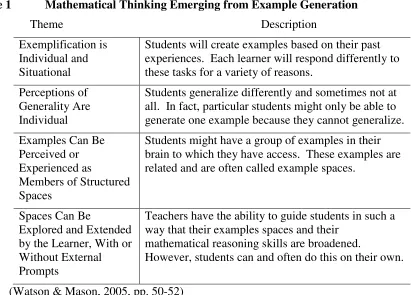
In their analysis of the examples students generated and in discussions with students involved in the tasks, Watson and Mason (2005) noticed several themes. Table 1 describes these themes along with their explanations. Learners have different
generalize can also be hindered by that example space. And, in some cases, students will begin to think about other examples, beyond what the task asked of them. In requiring students to generate examples teachers may learn more about their students and how and what they learn.
Table 1 Mathematical Thinking Emerging from Example Generation
Theme Description
Exemplification is Individual and Situational
Students will create examples based on their past experiences. Each learner will respond differently to these tasks for a variety of reasons.
Perceptions of Generality Are Individual
Students generalize differently and sometimes not at all. In fact, particular students might only be able to generate one example because they cannot generalize. Examples Can Be
Perceived or Experienced as
Members of Structured Spaces
Students might have a group of examples in their brain to which they have access. These examples are related and are often called example spaces.
Spaces Can Be
Explored and Extended by the Learner, With or Without External Prompts
Teachers have the ability to guide students in such a way that their examples spaces and their
mathematical reasoning skills are broadened.
However, students can and often do this on their own. (Watson & Mason, 2005, pp. 50-52)
What Is the role of LGEs?
1998). Generating examples is an act of problem-solving, but students get to choose a strategy rather than the teacher. Students are encouraged to think in their own way and in their own direction without searching for “the” correct answer.
LGEs can be used for assessment and to motivate interest (Watson & Mason, 2002a). Most educators agree that students are more successful and more motivated when they discover things for themselves or are studying something of interest to them. Being able to generate their own examples allows students some choice and
empowerment with mathematics. Encouraging students to find examples of their own can motivate them and improve their understanding at the same time.
Students are used to the teacher giving them an algorithm they have to memorize and performing that process over and over again. Having to generate one’s own
examples requires a different level of thought; it forces students to generalize and organize what they already know. By the nature of the tasks, students are reviewing the material while trying to generate the example. “Examples are generated by further knowledge rather than by mere recall” (Peled & Zaslavsky, 1996, p. 77). In other words, students are required to work with a familiar concept in an unfamiliar way.
Watson and Shipman (2008) also found that this strategy can be used to introduce new concepts. This particular use of LGEs was presented to students in a lower
As students go through this process of generating their own examples, some construct examples from the meaning or mathematical definitions, while others reflect on a range of possibilities that fit a particular set (Mason & Watson, 2005). Many of the researchers interested in this topic have noted that asking students to generate their own examples will make them better at solving problems. In Watson and Mason’s research (2002a), they noticed that students who generate their own examples show clear and effective gains on problem solving. They also suggest that if a student is able to create an example unlike the examples the teacher provides, it is powerful evidence of
mathematical learning. In this study, the Watson and Mason (2002a) observed a shift in students’ example spaces, that these students were able to explain better, and their example spaces were much broader. Therefore, having students generate their own examples serves as an effective means of assessing student understanding.
representations (Watson & Mason, 2005). And, being able to illustrate mathematical ideas “in multiple representations and multiple perspectives is likely to increase one’s effectiveness as a mathematician” (Watson & Mason, 2005, p. 42).
General LGE Tasks
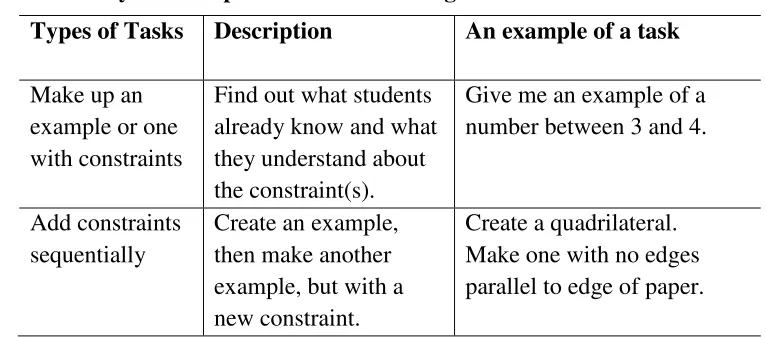
Most students are not used to generating their own examples; they are rarely asked to perform such a task, however some already generate examples on their own (Watson & Mason, 2005). Coming up with prompts that encourage students to generate examples does not have to be a daunting task. Watson and Mason (2005) offer
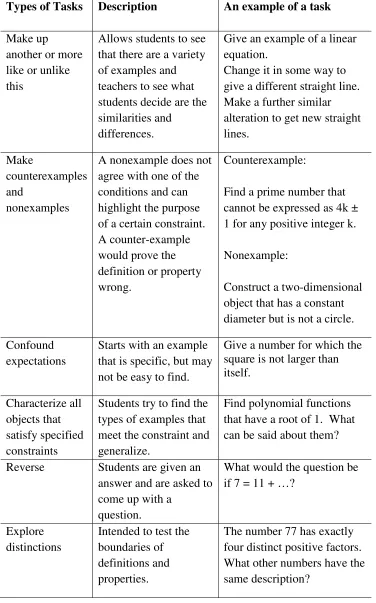
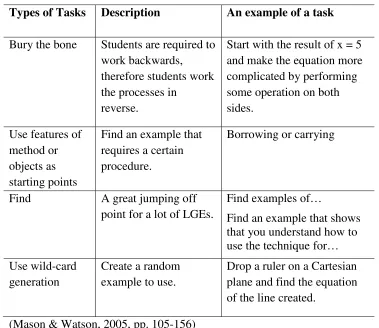
suggestions of different ways to create tasks that require students to generate examples. The different task styles range from direct prompts that may get a quick response to tasks that require students to take more time to think. The list Watson and Mason (2005) provide is certainly not meant to be extensive or limiting, but can be a starting point for teachers to create prompts for generating examples for any topic (see Table 2).
Table 2 Summary of Example Generation Strategies
Types of Tasks Description An example of a task
Make up an example or one with constraints
Find out what students already know and what they understand about the constraint(s).
Give me an example of a number between 3 and 4.
Add constraints sequentially
Create an example, then make another example, but with a new constraint.
Table 2 (cont.) Summary of Example Generation Strategies
Types of Tasks Description An example of a task
Make up
another or more like or unlike this
Allows students to see that there are a variety of examples and teachers to see what students decide are the similarities and
differences.
Give an example of a linear equation.
Change it in some way to give a different straight line. Make a further similar alteration to get new straight lines.
Make
counterexamples and
nonexamples
A nonexample does not agree with one of the conditions and can highlight the purpose of a certain constraint. A counter-example would prove the definition or property wrong.
Counterexample:
Find a prime number that cannot be expressed as 4k ± 1 for any positive integer k. Nonexample:
Construct a two-dimensional object that has a constant diameter but is not a circle. Confound
expectations
Starts with an example that is specific, but may not be easy to find.
Give a number for which the square is not larger than itself.
Characterize all objects that satisfy specified constraints
Students try to find the types of examples that meet the constraint and generalize.
Find polynomial functions that have a root of 1. What can be said about them? Reverse Students are given an
answer and are asked to come up with a
question.
What would the question be if 7 = 11 + …?
Explore distinctions
Intended to test the boundaries of definitions and properties.
Table 2 (cont.) Summary of Example Generation Strategies
Types of Tasks Description An example of a task
Bury the bone Students are required to work backwards, therefore students work the processes in
reverse.
Start with the result of x = 5 and make the equation more complicated by performing some operation on both sides.
Use features of method or objects as starting points
Find an example that requires a certain procedure.
Borrowing or carrying
Find A great jumping off point for a lot of LGEs.
Find examples of… Find an example that shows that you understand how to use the technique for… Use wild-card
generation
Create a random example to use.
Drop a ruler on a Cartesian plane and find the equation of the line created.
(Mason & Watson, 2005, pp. 105-156)
In some cases, it may also be beneficial to engage students in a discussion about how they came up with their examples. Discussion can help validate some students’ ideas while making others re-think their example. Another benefit to discussion is giving students the opportunity to speak and argue mathematically. Waywood (1992)
Relating the Use of LGEs to the Common Core State Standards
There are eight “Standards for Mathematical Practice” in the Common Core State Standards for Mathematics (2011), some of which are taken directly from the suggestions of the National Council of the Teachers of Mathematics (NCTM). These standards of practice are: 1. Make sense of a problem and persevere in solving them, 2. Reason abstractly and quantitatively, 3. Construct viable arguments and critique the reasoning of others, 4. Model with mathematics, 5. Use appropriate tools strategically, 6. Attend to precision, 7. Look for and make use of structure, and 8. Look for and express regularity in repeated reasoning.
By incorporating the use of LGEs, teachers can attend to several of these
standards. For instance, some LGE tasks ask students to work with constraints or special cases specifically while others require students to look for patterns or similarities to other examples. These types of LGE tasks meet the requirements for several of the standards for mathematical practice. When generating examples, students need to (1) “make sense of problems and persevere in solving them.” To be able to generate an example, students need to make sense of the task and what it is asking. And, persevering can be a necessary skill with certain tasks students face. In the description of this standard, students are required to look at givens, unknowns, constraints, relationships, special cases, different representations (verbal, analytical, graphical, numerical), patterns, etc. Then, they have to be able to recall from their memory, or example space, what types of examples fit the task or (7) “look for and make use of structure.”
understand the importance of the specific details. These types of tasks definitely require students to (6) “attend to precision.” And, the examples students generate may lead to (3) “constructing viable arguments and critiquing the reasoning of others.”
If students are required to generate an example and then generate more and more like it, then they are being required to (8) “look for repeated reasoning.” And, in the description for (3) “model with mathematics,” students are required to analyze
relationships to make conclusions. This is exactly what students are doing when they are generating several examples under a certain set of constraints.
One LGE task may not meet the requirements of all the Standards for
Mathematics Practice, but the tasks can certainly be created with these practices in mind. Furthermore, the task itself might just be a means to begin discussions, mathematical arguments, and written/verbal reasoning.
The Teaching of Functions
properties of functions is fluid and is applicable to any representation. The goal of teachers is to help student obtain both the action view and process view (Oehrtman et al., 2008).
Why do mathematicians put such an emphasis on functions? The function
concept is a central piece of the secondary mathematics curriculum and, one might argue, the most important. The concept of function not only ties branches of mathematics together, it is central to science and many other related fields as well. Even though it is so critical, many students do not graduate from high school with a good understanding of the concept of function. Students’ difficulties with learning functions could be one of the main reasons they choose not to further their math education (Oehrtman et al., 2008).
The difficulties some students have with functions can be caused by many factors. One of the issues is that teaching functions is and has been a challenge for many teachers in the past. Just trying to present the concept to students in an understandable way is quite perplexing. Teachers formally or informally share a definition of function, but those definitions can vary depending on the objective(s) of the unit. Some examples of these differing definitions are provided in Table 3.
Table 3 Definitions of Function
A function is a relationship between input and output. In a function, the output depends on the input. There is exactly one output for each input.
A function is a relation in which each element of the domain is paired with
exactly one element of the range.
Table 3 (cont.) Definitions of Function
A real-valued function f defined on a set D of real numbers is a rule that assigns to each number x in D exactly one real number, denoted by f(x).
A function is a mapping or correspondence between one set called the domain and a second set called the range such that for every member of the domain there corresponds exactly one member in the range.
(Cooney, Beckmann, & Lloyd, 2010, p. 13)
Even though these definitions are different, they are all written in an attempt to help students understand more about a particular property of functions. And, depending on the unit, each one serves its own purpose. Even though it is a challenge to teach, the concept of function is a major topic throughout CCSS-M and one that the NCTM argues students will need “to succeed in courses that build on quantitative thinking and
relationships” (Cooney et al., 2010, p. 1).
A function “is not a single concept by itself but has a considerable number of subconcepts associated with it” (Dreyfus & Eisenberg, 1982, p. 361). Because of all the subconcepts, deciding what aspect of functions should be introduced first is another concern teachers face. There is no consensus, neither among experts in the fields of mathematics nor experts in teaching mathematics, as to the best way to introduce
functions to students. Some researchers suggest students should first encounter functions as models of relationships and others recommend students need to have a good
1998, p. 23). Students have to be able to evaluate, graph, define, and model with functions. Quite often, students start by learning the definition of function and then identifying what is and is not a function. This may be the only time students see a mapping as a representation of a function, partly because this is the only time students work with finite data sets.
Typically, high school algebra textbooks emphasize linear, quadratic, and polynomial functions. Some square root, exponential, and logarithm functions might be in the book also. Because of their limited experience with functions, students often have a hard time with constant and piece-wise functions. In fact, most students believe that constant and piece-wise functions do not meet the criteria for a function. Because of this, students’ example spaces are very limited when it comes to functions.
In some textbooks, students encounter an equation that they are required to graph in the coordinate plane. Rarely do they see different representations except if they use a t-table to establish the graph, but the t-table is not necessarily required. “Representing functions in multiple ways and analyzing functions from different perspectives are critical aspects of learning functions” (Cooney et al., 2010, p. 78). And, understanding functions in one representation does not necessarily constitute understanding in another representation (Cooney et al., 2010).
Expectations for the Learning of Functions
et al., 2010). The mathematical focus of this study is on the first and fifth big idea; the function concept and multiple representations of functions. Each of these big ideas are associated with essential understandings, which are somewhat like learning objectives. Under the function concept, the essential understandings are:
1. Functions are single-valued mappings from one set- the domain of the function- to another- its range.
2. Functions apply to a wider range of situations. They do not have to be described by any specific expressions or follow a regular pattern.
3. The domain and range of functions do not have to be numbers.
(Cooney et al, 2010, pp. 8)
These essential understandings for the function concepts align with the CCSS-M: “F-IF.1. Understand that a function from one set (called the domain) to another set (called the range) assigns to each element of the domain exactly one element of the range (Common Core, 2011). Another standard that relates to this study is “F-IF.5. Relate the domain of a function to its graph and, where applicable, to the quantitative relationship it describes” (Common Core, 2011).
In NCTM’s “Developing Essential Understanding of Functions” under multiple representations of functions, the essential understandings are:
2. Changing the way that a function is represented does not change the function, although different representations highlight different characteristics, and some may show only part of the function.
3. Links between algebraic and graphical representations of functions are especially important in studying relationships and change.
(Cooney et al., 2010, pp. 10)
The first essential understanding requires that students be able to see the connections between a situation that is modeled by an equation, the graph of that equation, and a list of data points. Students will also be able to determine if data
represented in one of those ways is a function or not. The CCSS-M that aligns with this big idea is “F-IF.9. Compare properties of two functions each represented in a different way (algebraically, graphically, numerically in tables, or by verbal descriptions)” (Common Core, 2011).
Summary of Research
opportunity for students to demonstrate what they know and a good opportunity for teachers to give them feedback. LGEs can also be a tool for students to see what is possible and will help them take ownership for their own understanding. Cooney et al. (2010) claim this as something students really need to deepen their understanding of function. Discussing and sharing ideas about LGEs could help students see that they can produce something just as appropriate or sophisticated as their fellow classmates and maybe even mathematicians. This, as some researchers suggest, could be much more influential than the teacher-provided examples. Furthermore, using LGEs can be an effective means to assess student understanding.
CHAPTER THREE: METHODOLOGY
This study was designed to explore the impact of using LGEs on student
performance in mathematics, specifically in the area of functions. I gathered data during a two-week unit focused on functions. The following questions guided my research:
1. How did student ideas about functions at the end of the instructional unit incorporating LGEs compare with their ideas prior to the start of the unit? 2. How did student success with generating examples of functions change
throughout the unit?
The first question is of a summative nature to measure students’ mastery of the concept of function as indicated on the pre-/post-test. The second question is formative and allowed me to assess students’ thinking during our unit. Looking at student success with LGE tasks helped me see the progression in their thinking about functions and allowed me to analyze their learning.
Participants
designed to introduce most, but not all, of the concepts in the regular Algebra II course. Teachers of this course were able to take more time making sure students understood a concept before “moving on” to the next concept. This course and the Algebra II course shared the same book, however, I often created my own worksheets tailored to my students’ skill level. This was another difference between my course and the Algebra II course, students were not assigned the more difficult problems that are placed toward the end of each section. For instance, when Completing the Square in the course I teach, students will only encounter quadratics with a leading coefficient of 1 or where a greatest common factor exists.
In the past, students who have passed this class with a very high A sometimes enroll in our Pre-Calculus class. The success rate of these students in that Pre-Calculus class is approximately 50%. Many students have enrolled in Advanced Math Topics after passing this course. Advanced Math Topics is a class intended for students who were not quite ready for Pre-Calculus, but still had decent algebra skills. Others have taken
The fifty-two students who were enrolled in my class at the beginning of my study included twenty-seven males and twenty-five females. Of my two classes, 57.7% were seniors and the rest were juniors. Of the students who chose to participate in my study, 44.8% were seniors and the rest were juniors. This school year was the first year seniors were required by state law to take and pass a math class as a requirement for graduation. For our school, this meant a lot more seniors enrolled in math classes as compared to the year before. This was also another cause of the movement of students between classes. Because seniors needed to pass, the school counselors were very proactive with moving students to classes that would fit their ability level. A little over 17% of the students were on an IEP (Individualized Education Program) or 504 plan (requires schools to provide support to any student who qualifies under Section 504 of the Rehabilitation Act of 1973) and 5.8% were part of our ELL (English Language Learners) program.
Of the fifty-two students, thirty-two agreed to participate in the study. Because of absences three students were not able to complete the pre-test so their data was not included in the study. Of the group of twenty-nine who completed the pre-test and post-test, fifteen were female and fourteen were male. The classes were on a modified block schedule. The classes met for 59 minutes on Monday, Tuesday, and Friday. There was also a block period on either Wednesday or Thursday for 117 minutes.
Unit Design
Again, the only time students might encounter a different representation of a function might be when they are first learning what constitutes a function.
Some students struggle with functions because they find it difficult to see where they can apply the idea in “real life.” Some textbooks provide a motivating scenario to try to help the students understand why a particular concept in mathematics is useful. And, in the functions unit, there might be a problem in which a function can model certain real-world phenomena. But, unless a student can experience functions for themselves, these examples might not be very helpful. This particular skill set will be a change for students since the CCSS-M requires students to model with functions. Modeling will no longer be an afterthought a teacher presents to defend the ultimate “When am I ever going to need this?” question.
1. Students will be able to determine if a relation is a function.
2. Students will be able to recognize the existence and importance of multiple representations of functions and determine which representation(s) are most useful for a particular situation.
3. Students will be able to determine the domain and range for a functional relationship between two quantities.
4. Students will be able to determine if a graph (picture) is a good representation of a data set (story).
5. Students will be able to determine if a function is linear.
I designed LGE Tasks for the unit to supplement the material I would normally use. This was the first time I had taught this unit in this manner. As mentioned earlier, this unit was not taken directly from the textbook. Last year was my first year teaching this course and after teaching it the first time I had to spend more days throughout the year going back to the idea of function. During this school year, my method of
conveying the material to students was via PowerPoint presentations. The slides I created had definitions, pictures, and examples and prompts (my district called them language objectives) to check their understanding. After providing this information, I would normally ask students to begin a worksheet with the same material as practice. If there was an activity that supplemented the current topic, we would take time, usually the next day, to engage in the activity. Also, at the beginning of each period, I typically require students to engage in a “warm-up” task where they worked on review problems or answered a question pertaining to something we had learned the previous day. These procedures stayed the same during the functions unit.
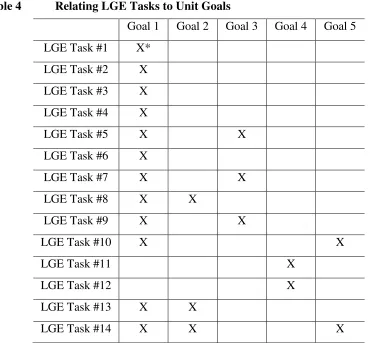
goals in mind (Table 4). Some LGE Tasks were adapted from examples I had read previously. Other LGE tasks were created using prompts suggested by Watson and Mason (1998).
Table 4 Relating LGE Tasks to Unit Goals
Goal 1 Goal 2 Goal 3 Goal 4 Goal 5 LGE Task #1 X*
LGE Task #2 X LGE Task #3 X LGE Task #4 X
LGE Task #5 X X
LGE Task #6 X
LGE Task #7 X X
LGE Task #8 X X
LGE Task #9 X X
LGE Task #10 X X
LGE Task #11 X
LGE Task #12 X
LGE Task #13 X X
LGE Task #14 X X X
their LGEs in a spiral notebook I provided for them. These notebooks were kept in the classroom during the unit.
Pre/Post-Test Design
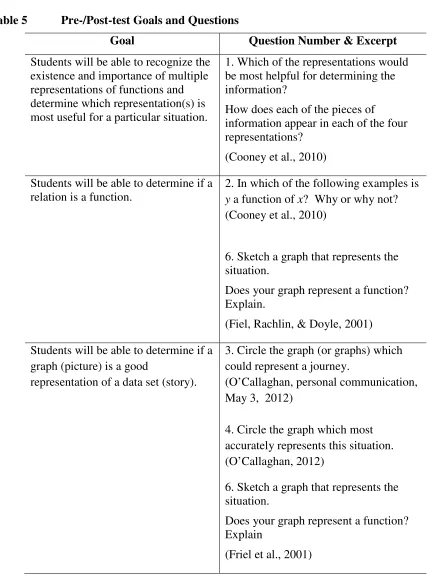
To answer my first research question I designed a pre-test on functions (Appendix B) that was given prior to the start of the instructional unit. The design of the experiment was a one-group pre-test-post-test design. Both classes received the treatment of asking students to generate their own examples along with my typical approach to teaching, which included notes via PowerPoint presentation, worksheets/assignments, and activities. Students completed the post-test at the end of the unit.
Table 5 Pre-/Post-test Goals and Questions
Goal Question Number & Excerpt
Students will be able to recognize the existence and importance of multiple representations of functions and determine which representation(s) is most useful for a particular situation.
1. Which of the representations would be most helpful for determining the information?
How does each of the pieces of information appear in each of the four representations?
(Cooney et al., 2010) Students will be able to determine if a
relation is a function.
2. In which of the following examples is
y a function of x? Why or why not? (Cooney et al., 2010)
6. Sketch a graph that represents the situation.
Does your graph represent a function? Explain.
(Fiel, Rachlin, & Doyle, 2001) Students will be able to determine if a
graph (picture) is a good
representation of a data set (story).
3. Circle the graph (or graphs) which could represent a journey.
(O’Callaghan, personal communication, May 3, 2012)
4. Circle the graph which most accurately represents this situation. (O’Callaghan, 2012)
6. Sketch a graph that represents the situation.
Does your graph represent a function? Explain
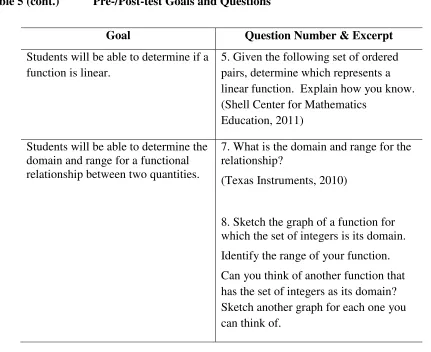
Table 5 (cont.) Pre-/Post-test Goals and Questions
Goal Question Number & Excerpt
Students will be able to determine if a function is linear.
5. Given the following set of ordered pairs, determine which represents a linear function. Explain how you know. (Shell Center for Mathematics
Education, 2011) Students will be able to determine the
domain and range for a functional relationship between two quantities.
7. What is the domain and range for the relationship?
(Texas Instruments, 2010)
8. Sketch the graph of a function for which the set of integers is its domain. Identify the range of your function. Can you think of another function that has the set of integers as its domain? Sketch another graph for each one you can think of.
In creating the last question (#8), I had a secondary goal in mind. This question was designed specifically to analyze students’ progress in generating examples. One might also be interested in why I chose not to use O’Callaghan’s Function Test in its entirety. For this study and this group of students, the test covered too many topics relating to functions. O’Callaghan’s Function Test would be a great instrument for me to use at the end of the school year to see what gains students experienced from the
Data Collection and Analysis
I generated a key for the pre-/post-test prior to the start of the unit. I took the test myself and awarded points for what I deemed correct answers and/or correct
mathematical statements. By doing so, I calculated a possible forty-two points for the test. The numbers of points per question varied depending on how many items students had to answer in that one question. For instance, on question 2, where students had to identify if something was a function and then explain why, each sub-question was worth two points: one for the correct answer (yes or no) and one for a correct explanation. While grading the test, I awarded an extra point on the descriptions for problems three and six because students included information I had not originally thought about while creating the key, but were, however, mathematically appropriate. After the results were gathered, I performed a t-test for statistical significant differences between scores on each question.
During the course of the study, students were required to generate examples in a notebook I provided for them. The notebook was necessary for me to analyze the examples students generated and to make sure students were involved in the task. I evaluated their success by the analyzing the correctness, variation, and/or reasoning for the examples they generated.
Correctness of the example was measured based on how well the example met the criteria set for that particular task. In some tasks, such as:
Write down an example of a function…Represent that same function in a different
the variation of the examples students used helped me determine if students grasped the idea of multiple representations of a function and also revealed what types of representations were dominant in their example spaces. Consequently, variation had to be a part of my analysis of student work. Reasoning and/or mathematical explanation was also another important feature of some of the example tasks I used. Consider the following task.
Change something about the given function to make it a non-function.
In response to this task, some students only had one example and thus measuring variation was not appropriate. However, some students’ explanation revealed
information about their understanding of functions. For this task and others, it was more appropriate to measure correctness and reasoning, but not variation.
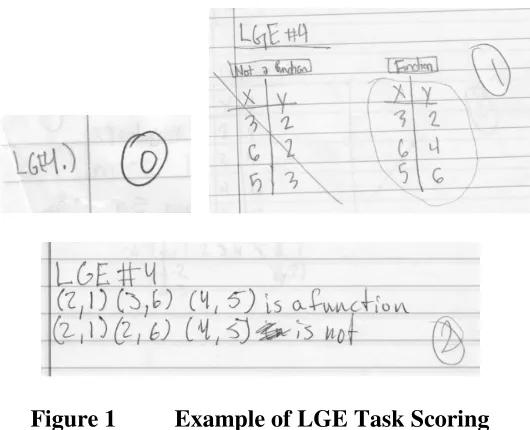
Figure 1 Example of LGE Task Scoring
CHAPTER FOUR: RESULTS
Results of the pre-/post-test were analyzed to answer my first research question, which was intended to determine how students’ performance on function-related tasks prior to the unit compared to students’ performance at the end of the unit. The examples students generated were analyzed to answer my second research question, which aimed to determine if there were any changes in students’ success in generating examples about function.
Pre-Test
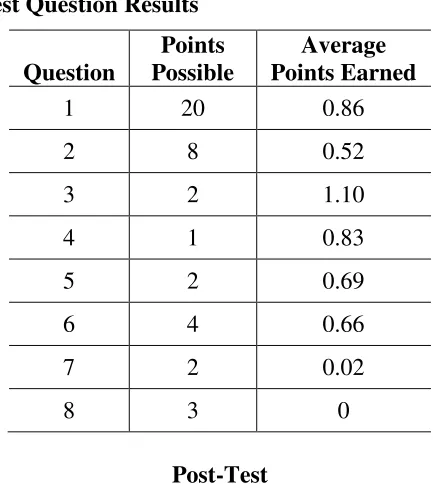
The average score on the pre-test was 4.74 points with scores ranging from 0-14.5 points out of 42 possible. Recall, students were awarded points for correct
Table 6 Pre-Test Question Results
Question
Points Possible
Average Points Earned
1 20 0.86
2 8 0.52
3 2 1.10
4 1 0.83
5 2 0.69
6 4 0.66
7 2 0.02
8 3 0
Post-Test
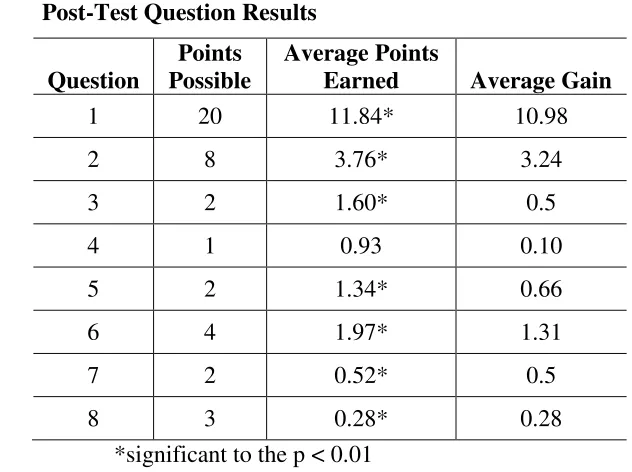
Table 7 Post-Test Question Results
Question
Points Possible
Average Points
Earned Average Gain
1 20 11.84* 10.98
2 8 3.76* 3.24
3 2 1.60* 0.5
4 1 0.93 0.10
5 2 1.34* 0.66
6 4 1.97* 1.31
7 2 0.52* 0.5
8 3 0.28* 0.28
*significant to the p < 0.01
Performance on LGE Tasks
As mentioned previously, I used a three point scale to do the initial analysis of student performance on the LGE tasks: 0 was awarded for no attempt, 1 was awarded for an incorrect attempt, and 2 was awarded for a correct attempt. The results of these scores are found in Table 8. Because of absences, I also included the number of students who were present to attempt the LGE task.
Table 8 Success with LGE Tasks
LGE Task # n 2 1 0
1 29 89.7% 10.3% 0%
2 29 75.9% 13.8% 10.3%
3 26 53.8% 34.6% 11.5%*
4 25 72% 20% 8%
5a 26 84.6% 11.5% 3.8%*
5b 26 34.6% 23.1% 42.3%
5c 26 30.8% 26.9% 42.3%
6 28 75% 7.1% 17.9%
7 28 0% 60.7% 39.3%
8 28 42.9% 53.6% 3.6%*
9 27 48.1% 29.7% 22.2%
10 28 39.3% 46.4% 14.3%
11 27 7.4% 74.1% 18.5%
12 26 30.8% 65.4% 3.8%
14 27 3.7% 33.3% 63.0%
*indicates the results to not add up to 100% because of rounding
While analyzing students’ ability to generate examples based on the three point scale, I noticed some interesting trends. For instance, some students did a very good job of generating an example of a function in LGE Task #8, but could not quite think of four ways to represent it. In that case, the student earned a 1 on the task, but I felt like more analysis might produce more revealing information. I was also interested in seeing whether students generated functions successfully and what types of representations they used (if they had a choice).
Figure 2 LGE Task #8 Student Work
Over half of the students (56.5%) gave their initial function in tabular form. This is not too surprising since the students encountered functions in table form more often than any other form by the time they attempted LGE Task #8. Every student used a numeric representation of a function, which I believe speaks to the fact that their example space is very limited when it comes to functions. I thought representing the function in algebraic form would be the most challenging for students since, in this unit, we did not focus on creating equations from a different form. However, 65.2% created either an equation or expression from their data.
prompts became harder as the unit progressed, but many of the questions involved
students being able to generate a function. Because of that, I was able to analyze whether students became more successful in generating examples of functions in particular. LGE Tasks #2, #4, #6, #8, and #13 all required students to generate an example of a function. Some of these required more information, but in analysis of success in this case, I only looked at the generation of a function. Students who successfully generated an example of a function were awarded 2 points, those who attempted to generate an example, but failed to generate an example of a function were awarded 1 point, and those who did not attempt the problem were awarded 0 points. Table 9 displays the results of these LGE Tasks.
Table 9 Generating Functions
LGE Task # n 2 1 0
2 29 75.9% 13.8% 10.3%
4 25 72% 20% 8%
6 28 75% 7.1% 17.9%
8 28 96.4% 0% 3.6%
13 29 93.1% 3.4% 3.4%
Example Spaces
When I looked at the types of examples students provided, there was a noticeable trend. On tasks where students were required to generate a function, more often than not they used a table to represent their function. On LGE Task #4, students were required to give an example of a function and non-function. Over 80% of students gave their example in tabular form and over 90% used some type of numerical format (tables or ordered pairs) to represent their function. On LGE Task #8, where students were required to generate an example of a function and then give more representations,
students often used the table as their first representation. Approximately 63% of students generated a table first and 75% gave a numerical representation (a table or ordered pairs) as their first response. Since students rarely represented their functions in any form but numerical form, it seems that their example spaces were either limited to that
representation or there was a heavy emphasis on numerical representations in their example space.
To analyze any potential changes in students’ example spaces, I examined the examples that students generated for similar LGE Tasks. I especially wanted to see if those students who seemed to only have access to functions in table or ordered pair form would eventually demonstrate that other representations were now part of their example spaces. LGE Tasks #4, #8, and #13 all required students to generate examples of functions without dictating which representation they had to use.
LGE Task #4: Write down an example of something that is a function and
LGE Task #8: Write down an example of a function, Represent that same function
in a different way, Represent that function in another way, Again
LGE Task #13: Give an example of a function. Write that function using two
different representations which both reveal the rate of change of the function.
LGE Task #4 occurred early in the unit after the class had learned about the definition of function. Students encountered LGE Task #8 near the middle of the unit after we had reviewed the different types of representations. LGE Task #13 occurred toward the end of the unit. A sample student work is included to illustrate how students’ examples progressed to include a greater number of types of representations by the end of the unit.
Figure 3 Student 1 LGE Tasks #4, #8 & #13
Student 2 (Figure 4) used tables to represent a function in the first task. In response to LGE Task #8, he was able to use more representations in generating an example of a function. This suggests that this student had access to all types of
student tried to name each type of representation in response to LGE Task #13, but did not quite have the vocabulary correct.
Figure 4 Student 2 LGE Tasks #4, #8 & #13
Figure 5 Student 3 LGE Tasks #4, #8 & #13
were accessible even though he could not make the functions equivalent throughout those representations.
Figure 6 Student 4 LGE Tasks #4, #8 & #13
The examples these particular students generated illustrate how teachers can use LGEs to analyze what their students know and if their knowledge, of a certain topic, has increased throughout a unit. These students used particularly interesting methods of generating examples and are good representatives of what occurred with the entire class during the unit. By analyzing these tasks, it can be inferred that students’ example spaces extended during the unit. Either these representations of functions were new to their example spaces or the concepts became clearer, which made the ideas more accessible as students were trying to create examples.
LGE Task #4
LGE Task #8
CHAPTER FIVE: DISCUSSION
Based on the pre-/post-test results, students’ knowledge about functions showed clear gains. Their ability to generate examples about functions also improved. Through my analysis, I could see a change in their example spaces because some representations were more accessible by the end of the unit. Looking through students’ responses to the LGE tasks, it was clear that they were becoming more comfortable generating their own examples.
Thoughts as a Classroom Teacher
During this unit of research, I observed some interesting things occurring in the classroom. My reflection on the unit revealed some challenges as well as some benefits.
from my point of view. They finally were having mathematical discussions and were verbally struggling with mathematics. As the year progressed (and as the unit
progressed), I found myself having to coach them a lot less.
Getting students to write mathematically was a challenge. In any task that asked for writing, many students either chose not to write or did not know how or what to write. In LGE Task #3, students were asked to write down everything they knew about
functions. Some students just could not explain what they knew even though when asked to give examples of functions and non-functions students were able to give an appropriate example. It seemed that writing with a mathematical purpose was a new skill for them. It also made me realize how important that type of task is for my students. Although it was a struggle at first, this became easier for my students throughout the year. And, using LGE Tasks to get students to write is not only effective, but takes very little planning time on my part.
Coming up with these tasks did not take long once I had my unit goals decided. Of course, I was meticulous about the tasks I chose because they were part of a study. Normally a teacher could just try a task related to the topic and see what and how the students do. Many of the tasks I used are very versatile and can be easily changed based on the current unit. Giving examples and non-examples was a quick way to see if students could work with a definition. Changing a given non-example really took more attention from the students than I originally thought. Students have to figure out why or how it is a non-example and then how to change it to an example. It really is quite complicated for being such a quick task to create. Just those two tasks can be changed for a variety of concepts and levels.
Limitations
Conclusions
Overall the evidence showed that using LGE Tasks is a great way to get students to think mathematically or at least differently about mathematics than they have had to before. Shifting students’ thinking the way CCSS-M is asking is going to be difficult for teachers to require and for students to achieve. I found that the examples I was asking the students to generate were very challenging at first, but that students eventually became more comfortable completing these types of tasks. Students who are not confident in their abilities in math may need a little scaffolding as they begin the process of generating their own examples. However, once they feel comfortable then it is a great way to see how students are thinking about a concept and whether they really grasp the idea.
I found my students had difficulty writing about mathematics, which was not a surprise. However, I found that asking students to generate examples and write about them was a great way to begin supporting students as writers. Also, asking students to write about what they know, as a task itself, can be a good step for students to begin the mathematical writing process. These LGE Tasks were also a great way to begin a class discussion, which I find to be hard to encourage with traditional methods of teaching.
Specifically to my study, using LGE Tasks helped students develop a better understanding of the concept of function. And, along the way students were able to illustrate what they knew without having the constraints of a specific test or quiz questions. Even though students were unsure about generating their own examples at first, they were much more comfortable by the end of the unit.
achieving students to engage in mathematics. I also know, from my own experience, that LGE Tasks can get people who are generally comfortable with mathematics thinking about concepts in a new way. These LGE Tasks are a great way of bringing discussions and writing into a mathematics classroom. LGE Tasks are effective and quite easy to create.
Watson and Shipman (2008) performed a study on one group of low achieving students in England. The teacher, Shipman, used LGE Tasks to introduce a new concept to these students. The conclusion of their research is that LGE Tasks can be used to introduce topics to lower achieving students. My research supports what they concluded. Selden and Selden’s (1998) research also suggests these “give an example” type
REFERENCES
Bills, L., Dreyfus, T., Mason, J., Pessia, T., Watson, A., & Zaslavsky, O. (2006). Exemplification in mathematics education. In J. Novotna (Ed.), Proceedings of the 30th Conference of the International Group for the Psychology of Mathematics Education. Prague, Czech Republic: PME.
Common Core State Standards. (2011). Mathematics: Standards for mathematics practice. Retrieved from www.corestandards.org/Math/Practice
Cooney, T., Beckmann, S., & Lloyd, G. (2010). Developing essential understanding of functions. Reston, VA: National Council of Teachers of Mathematics.
Dreyfus, T. & Eisenberg, T. (1982). Intuitive functional concepts: A baseline study on intuitions. Journal for Research in Mathematics Education, 13, 360-380.
Friel, S., Rachlin,S. & Doyle, D. (2001). Navigation through algebra in grades 6-8.
Reston, VA: National Council of Teachers of Mathematics.
Holliday, B., Luchin, B., Marks, D., Day, R., Ceuvas, G., Carter, J.,…Hayek, L. (2008).
Algebra 2. Columbus, OH: McGraw Hill.
Koichu, B. (2008). If not, what yes? International Journal of Mathematical Education in Science and Technology, 39, 443-454. Doi: 10.1080/00207390701753754 Leinhardt, G., Zaslavksy, O., & Stein, M. (1990). Functions, Graphs, and Graphing
Tasks. Review of Educational Research, 60, 1-64
Meehan, M. (2007). Student generated examples and the transition to advanced mathematical thinking. European Research in Mathematics Education V: Proceedings of the Fifth Congress of the European Society for Research in Mathematics Education. Larnaca, Cyprus.
O’Callaghan, B. (1998). Computer-intensive algebra and students' conceptual
knowledge of functions. Journal for Research in Mathematics Education, 29, 21-40. Oehrtman, M., Carlson, M., & Thompson, P. W. (2008). Foundational reasoning
abilities that promote coherence in students’ function understanding. In M. Carlson & C. Rasmussen (Eds.), Making the connection: Research and practice in
Peled, I., & Zaslavsky, O. (1996). Inhibiting factors in generating examples by mathematics teachers and student teachers: The case of binary operation. Journal for Research in Mathematics Education, 27, 67-79.
Selden, A., & Selden, J. (1998). The role of examples in learning mathematics, research sampler 5. Mathematical Association of American Online. Retrieved from
www.maa.org/t_and_l/sampler/rs_5.html
Shell Center for Mathematical Education. Mathematics assessment program college and career readiness mathematics. 2011 MARS University of Nottingham. Retrieved from: http://map.mathshell.org/materials/download.php?fileid=844
Texas Instruments. (2010) Applications of domain and range. Retrieved from:
http://education.ti.com/xchange/US/Math/AlgebraII/16811/AppDomainRange_Teac her.pdf
Watson, A., & Mason, J. (1998). Questions & Prompts for Mathematical Thinking. Derby, England: Association of Teachers of Mathematics.
Watson, A., & Mason, J. (2002a). Extending example spaces as a teaching/learning strategy in mathematics. PME Conference, 4, 378-385.
Watson, A., & Mason, J. (2002b). Student-generated examples in the learning of mathematics. Canadian Journal of Science, Mathematics and Technology Education, 2, 237-249.
Watson, A., & Mason, J. (2005). Mathematicsas a constructive activity: Learners generating examples. New York, NY: Routledge.
Watson, A., & Shipman, S. (2008). Using learner generated examples to introduce new concepts. Educational Studies in Mathematics, 69, 97-109. doi: 10.1007/s10649-008-9142-4
APPENDIX A
LGE Task #1: Write down two quantities (in “real life”) Example: time spent studying and grades on tests Now describe how they are related
Example: For the most part, the more time spent studying a particular
better grade you will get. Of course, if you study too much and don’t get sleep that relationship will decline.
LGE Task #2: Change something about this function that would make it a non (Given a table of values)
LGE Task #3: Tell me everything you know about functions.
LGE Task #4: Write down an example of something that is a function and something that is not a function.
LGE Task #5:a) In the given coordinate system, draw a graph of a function that connects the two given points.
b) What is the domain of your function?
c) What is the range of your function?
Functions Unit LGE Tasks
Write down two quantities (in “real life”) that are related in any way : time spent studying and grades on tests
Now describe how they are related
: For the most part, the more time spent studying a particular
better grade you will get. Of course, if you study too much and don’t get sleep that relationship will decline.
Change something about this function that would make it a non (Given a table of values)
e everything you know about functions.
Write down an example of something that is a function and something that
In the given coordinate system, draw a graph of a function that connects
What is the domain of your function? What is the range of your function?
that are related in any way
: For the most part, the more time spent studying a particular subject, the better grade you will get. Of course, if you study too much and don’t get sleep
Change something about this function that would make it a non-function.
Write down an example of something that is a function and something that
LGE Task #6: What must be removed or changed in order to make {(0,1), (2,3) (4,7) (5,7)(2,6)} a function?
LGE Task #7: Find an example of a function whose domain is -2 ≤ x ≤ 5 and whose range is -6 ≤ y ≤ 7
LGE Task #8: Write down an example of a function Represent that same function in a different way Represent that function in another way
Again
LGE Task #9: Draw a relation that is a function for x > 0, but not for all Real numbers. LGE Task #10: Change the following in some way so that it is a linear function
x y
-1 10
0 13
3 19
LGE Task #11:
(Leinhardt, Zaslavsky, & Stein, 1990, p. 39)
LGE Task #12: Tell me a story which could be represented by
LGE Task #13: Give an example of a function. Write that function using two different representations which both reveal the rate of change of the function.
LGE Task #14: Can you find an example of a function that when looking at one representation there is som
looks linear in one, but not the other?) (Leinhardt, Zaslavsky, & Stein, 1990, p. 39)
Tell me a story which could be represented by
Give an example of a function. Write that function using two different representations which both reveal the rate of change of the function.
Can you find an example of a function that when looking at one
representation there is something misleading, but it is not in the other. (Possibly looks linear in one, but not the other?)
Give an example of a function. Write that function using two different representations which both reveal the rate of change of the function.
Can you find an example of a function that when looking at one
APPENDIX B
Pre-/Post-Test for Study
1. In a movie theater, the relationship between the number of tickets sold (T) and profit (P, in dollars) is represented in four different ways below.
Representation A
A movie theater has operating costs of $1025 per day. Tickets cost $7.50 each. The movie theater’s profit each day depends on the number of tickets sold.
Representation C
Representation B
P = 7.5T – 1025
Representation D
T P
0 -$1025
50 -$650
100 -$275
150 $100
200 $475
250 $850
a. How does each of the pieces of information appear in each of the four representations?
Representation A Representation B Representation C Representation D
Daily operating costs for the theater
Number of tickets that must be sold for the theater to have a profit of $500 Daily “break-even point” for the movie theater
The rate of change in the relationship
b. Check which of the representations above would be most helpful for determining the following information? Defend your answer.
Representation
A B C D Defense
Daily operating costs for the theater
Daily “break-even point” for the movie theater
The rate of change in the relationship
2. In which of the following examples is y a function of x? Why or why not?
a. 3 22 2 2 b. The set of all points in the graph
shown below
.
c. The set of all points on the graph d. shown below.
3. Circle the graph (or graphs) which could represent a journey. (d is the distance at time t).
Graph A Graph B Graph C
Describe the journey represented by the graph you chose.
4. A skydiver jumps from a plane, free falls for a while then opens his parachute, and floats to the ground. Circle the graph which most accurately represents this situation. (h is the height of the skydiver at time t).
Graph A Graph B Graph C
5. Given the following set of ordered pairs, determine which represents a linear function. Explain how you know.
x y
1 6 2 9 3 12 4 15
x y
1 56 2 28 3 14 4 7
x y
6. You are mowing the lawn. As you mow, the amount of grass to be cut decreases. You mow at the same rate until about half the grass has been cut. Then you take a break for a while. Then, mowing at the same rate as before, you finish cutting the grass.
a. Sketch a graph that shows how much uncut grass is left as you mow, take your break and finish mowing.
b. Does your graph represent a function? Explain. .
7. Jessie is parking in a garage for a concert. It costs $6 for the first 2 hours plus another $3 for each additional hour or fraction of an hour, with a maximum charge of $24 for a day.
What is the domain and range for the relationship between hours and cost for parking in this garage?
8. Sketch the graph of a function for which the set of integers is its domain. a. Identify the range of your function.