40
INTERNATIONAL JOURNAL OF ADVANCES IN ENGINEERING RESEARCH
OPTIMIZATION OF DAY LIGHTING IN HIGH RISE
BUILDING THROUGHDECLINATION ANGLE AND
REFLECTING DEVICE
B.Srinivasan, Dr.Meenambal,
Department of Civil Engineering, Karpagam University, Coimbatore, Tamil Nadu, India.
ABSTRACT
Improving daylighting strategy is a mandatory pace to achieve visual pleasure and energy reduction in buildings. Daylighting optimization make surethat indoor healthier rooms, reduceselectric light consumption as well as cuts the risk of glare. Natural light is irreplaceable ever since it is a fullspectrumlights, it changes during the day in addition to differ every day of the year. A variableillumination all through the day, in terms of intensityas well as colour temperature, creates dynamic indoorenvironments so as toare more pleasant meant forhuman being.To improve the qualityof light, of visual comfort advanced daylightingsystems along with external shadings using.Architect can design in favour of their building alone. If nearbyan additional building located means that angle as well as distance will affect our building neither we cannot predict or control that. Consequently in this research, reflecting angles setup designed in different point of view by means of Artificial Neural Networks.
KEYWORDS: Artificial Neural Networks (ANN), Shading device, Energy saving, Illuminance (lux), Latitude, Daylight
INTRODUCTION
According to the most recent policies, towards promoting lowcarbon solutions, Green Building, Eco Friendlyas well as to avoid the depletion of naturalresources, in case of new buildings as well as inrefurbishment action, one of the most significantstrategies is towards considering daylight as a mean to maximizethe entry of sunlight.It is also well known that maximizing the sunlight penetration in indoor spaces can be extremely effective interms of energy savings, to cut off electricityconsumption along with in terms of thermal loads reduction,particularly in Mediterranean regions.Even though the design as well as constructive premises areclearly oriented towards the definition ofmultidisciplinary strategies to assist saving energy, themajor issue to deal by means of is succeeding in an efficientas well as green integration of daylighting strategies in everydesign step, involving retro commissioning actions.
41
INTERNATIONAL JOURNAL OF ADVANCES IN ENGINEERING RESEARCH
aseconomical requirements. Therefore, computer simulations have been developed to save time and try dissimilar design options towards accelerating optimization of daylighting along with lighting design whereas providing scientifically realistic evaluations. Energy saving methods meant for technical design in buildings are more as well as more widely used. For instance, the use of shading devices has led towards practical applications for improving energy performance. Shading and daylight mustall the time be optimized in order to consider both the energy saving as well as environmental aspects of design. In this research new as well as economic plan implemented for adjustable, interlinked as well as shading device meant for high rise buildings.
OBJECTIVES:
To evaluate the impact of shading devices on the illuminance levels of inside the investigated rooms.
According to latitude find out the varies parameters to optimize day light.
To evaluate the lighting efficiency commencing from day lighting by means ofa few types of lighting control systems.
To evaluate the energy efficiency as well as sustainability through some dynamic day light metrics.
DESIGN CONSIDERATION
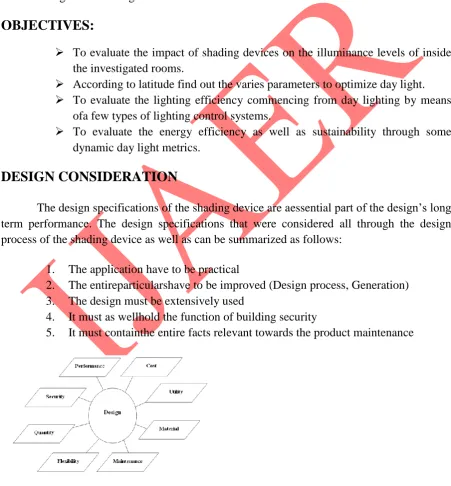
The design specifications of the shading device are aessential part of the design’s long term performance. The design specifications that were considered all through the design process of the shading device as well as can be summarized as follows:
1. The application have to be practical
2. The entireparticularshave to be improved (Design process, Generation) 3. The design must be extensively used
4. It must as wellhold the function of building security
5. It must containthe entire facts relevant towards the product maintenance
42
INTERNATIONAL JOURNAL OF ADVANCES IN ENGINEERING RESEARCH Daylight Factor (DF):
External shading devices encompass always been a simple as well as lowcost device used towards controling the heating effect of natural light. In the earlier period, a variety of studies have suggested so as to use of shading devices might represent a way towards improving energy consumption as well as increase user comfort in buildings. The current challenge is to develop integrated approaches meant for the implementation as well as control of such devices, whereas considering both visual comfort as well as energy performance in the design. The majority of these tools have been developed towards optimizing the function of external shading devices commencing from different viewpoints.
Movement of Earth:
One of the significant characteristics of the Earth is its movement. Seeing the Sun travel through the sky is a consequence of the fact so as to the Earth rotates on its axis. As by means ofthe entire planets in our Solar System, the Earth orbits or else moves around the Sun. The Earth's axis is to some extent tilted by means of respect to its orbit around the Sun, resultant in the transformation of seasons. The Earth as well follows the Sun in its motion all the way through space. A variety of motions result in days, seasons and years.
Calculating Solar Angles
These equations have to be used keeping the entire of the angles in radians though by means ofa few of the equations it does not matter whether degrees or else radians are used.
Declination Angle
The equation used towards calculating the declination angle in radians on any given day is:
Where: δ = declination angle (rads); n = the day number, such that n = 1 on the 1st
43
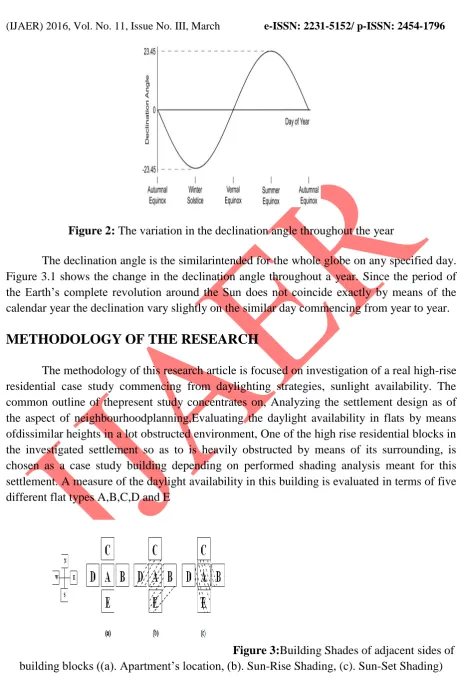
INTERNATIONAL JOURNAL OF ADVANCES IN ENGINEERING RESEARCH Figure 2: The variation in the declination angle throughout the year
The declination angle is the similarintended for the whole globe on any specified day. Figure 3.1 shows the change in the declination angle throughout a year. Since the period of the Earth’s complete revolution around the Sun does not coincide exactly by means of the calendar year the declination vary slightly on the similar day commencing from year to year.
METHODOLOGY OF THE RESEARCH
The methodology of this research article is focused on investigation of a real high-rise residential case study commencing from daylighting strategies, sunlight availability. The common outline of thepresent study concentrates on, Analyzing the settlement design as of the aspect of neighbourhoodplanning,Evaluating the daylight availability in flats by means ofdissimilar heights in a lot obstructed environment, One of the high rise residential blocks in the investigated settlement so as to is heavily obstructed by means of its surrounding, is chosen as a case study building depending on performed shading analysis meant for this settlement. A measure of the daylight availability in this building is evaluated in terms of five different flat types A,B,C,D and E
44
INTERNATIONAL JOURNAL OF ADVANCES IN ENGINEERING RESEARCH
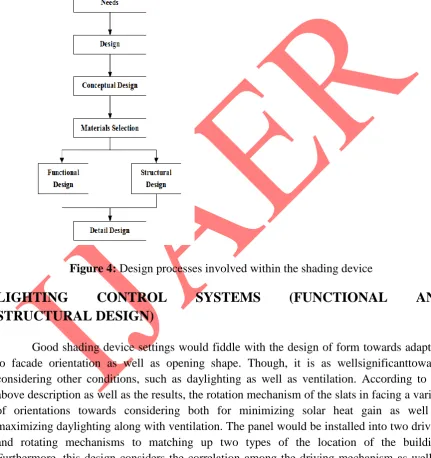
The case building is divided into 5 main zones due towards the height of the selected floors for daylighting analyses as well as the daylight levels are calculated for particular representative days as well as hours. All design process comprised of distinct stages so as torepresented a complete sequence of design activities based on perceived user requirements. The configuration of the shading device was the consequence of a variety of design processes so as toare shown in Figure. 4.
Figure 4: Design processes involved within the shading device
LIGHTING
CONTROL
SYSTEMS
(FUNCTIONAL
AND
STRUCTURAL DESIGN)
45
INTERNATIONAL JOURNAL OF ADVANCES IN ENGINEERING RESEARCH
supported the rotating mechanism, the outline frame as well as rotating members were the most significant structural part of the new external shading device. The external shading device comprises of three parts: the outline frame, drive device as well as floatingprovided liquid compartment. The frame is equipped by means of sun shading panels so as to turn by means of the upward force of the floating boards as well as provide the appropriate amount of shade according towardsdissimilar sunshine angles.
Materials Selection:
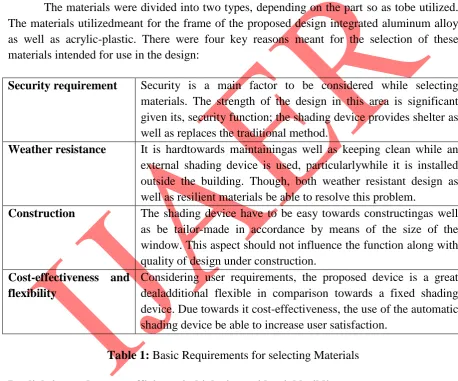
The materials were divided into two types, depending on the part so as tobe utilized. The materials utilizedmeant for the frame of the proposed design integrated aluminum alloy as well as acrylic-plastic. There were four key reasons meant for the selection of these materials intended for use in the design:
Security requirement Security is a main factor to be considered while selecting materials. The strength of the design in this area is significant given its, security function; the shading device provides shelter as well as replaces the traditional method.
Weather resistance It is hardtowards maintainingas well as keeping clean while an external shading device is used, particularlywhile it is installed outside the building. Though, both weather resistant design as well as resilient materials be able to resolve this problem.
Construction The shading device have to be easy towards constructingas well
as be tailor-made in accordance by means of the size of the window. This aspect should not influence the function along with quality of design under construction.
Cost-effectiveness and flexibility
Considering user requirements, the proposed device is a great dealadditional flexible in comparison towards a fixed shading device. Due towards it cost-effectiveness, the use of the automatic shading device be able to increase user satisfaction.
Table 1: Basic Requirements for selecting Materials
Daylighting and energy efficiency in high rise residential buildings:
Optimum usage of natural light in buildings as well as integrating it by means of electric lighting systems be able todecrease the energy consumption intended for lighting in buildings. For optimum daylighting systems, buildings have to be designed by means of taking into account natural as well as physical design parameters which are stated below,
Light distribution as well as brightness of sky
46
INTERNATIONAL JOURNAL OF ADVANCES IN ENGINEERING RESEARCH Light reflection of the ground
Dimensions, locations along with light reflection of exterior natural or else artificial obstructing
Orientation of the windows
Dimensions, geometry, location furthermore material of the windows
Room geometry moreover internal material selection
In high rise buildings, the effects caused by means of these parameters differ depending on the storey height. The position of the sun, density of the natural as well as artificial surrounding environment, light reflections of outdoor surfaces, window dimensions with glazing materials have an effect on the amount of daylight penetration keen on the space. Dissimilarity in the angular relationship by means of the surrounding buildings reason both different shadow situations as well as differentiated lighting levels intended for the rooms which are on unlike storeys. Since of the difference of design parameters depending on storey height; light transmittance of glazings, dimensions of shading devices as well as interior surface colors have to be defined particularlydesigned forevery room.
Daylight requirements as well as viewing-out needs in the rooms are important on the orientation of the buildings. Daylight is usually admitted towards the interior through vertical openings as it might not be effective to use horizontal openings akin to skylight, clerestory or else roof monitor in high-rise residential buildings. Therefore, the significance of orientation, building geometry as well as window design in this type of buildings additional increases. Building envelope have to be designed cautiouslyin sequencetowards avoiding
47
INTERNATIONAL JOURNAL OF ADVANCES IN ENGINEERING RESEARCH Figure 5: Shade affecting in nearby building in high rise residential buildings
SHADING ANALYSIS OF THE SETTLEMENT DESIGN
Glossy Reflection and Glossy Transmission:Diffuse Reflection off a baffle:
The glossy reflection component is alikeheaded for the
mia_material reflection shading, this glossy reflection
component adopts the use of roughness, rather than glossiness used through the mia_material. In particular, provide a easy specular reflection component separately below meant for perfectly smooth surface components requiring mirror-like reflections.
Translucent surfaces can both reflect in addition to transmit light. Light is pread in a lot of direction in opposite site.
48
INTERNATIONAL JOURNAL OF ADVANCES IN ENGINEERING RESEARCH Illuminance in the work planes:
The amount of light coming as of a light source is luminous flux (lumens), the amount of light falling on a surface is illuminance (lux), as well as the amount of light reflected off a surface is luminance (cd/m2). These quantities are dissimilar since the beyond a surface is from a light source the less light so as to falls on the surface as well as the darker a surface is, the fewer incident light it reflects. This is since light follows the inverse square law. In this reflecting device architecture, Glossy Reflection & Glossy Transmission (combin and fix), Diffuse Reflection off a baffle.
Figure 6:Architecture for shading and sun light reflection
CONCLUSION
Daylight availability have to be taken into account in architectural design of high-rise residential buildings appeared in dense settlements. Daylight is present at a particular location, towards some degree, whenever the sun is on top of the horizon at that location. However, this study gave a economic implementation architecture meant for utilize sun light sourceamong other high rise residential building.
Nth Floor
N-1 Floor
N-2 Floor
2nd Floor
1st Floor
49
INTERNATIONAL JOURNAL OF ADVANCES IN ENGINEERING RESEARCH
REFERENCE
[1] D.R.G. Hunt, Improved daylight data for predictingenergy savings from photoelectric controls, LightingResearch and Technology 11 (1979) 19-23.
[2] J. Mardaljevic, Examples of climate-based daylightmodeling, in: CIBSE National Conference 2006Engineering the Future, London, 2006.
[3] J. Mardaljevic, L. Heschong, E. Lee, Daylight metricsand energy saving, Lighting Research and Technology 41(3) (2009) 261-283.
[4] C.F. Reinhart, J. Mardaljevic, Z. Rogers, Dynamicdaylight performance metrics for sustainable buildingdesign, Leukos 3 (1) (2006) 1-25.
[5] W.L. Carroll, R.J. Hitchcock, Delight2 daylightinganalysis in energy plus: Integration and preliminary userresults, in: International IBPSA Conference-BS 2005,Montreal, Canada, 2005, pp. 139-142.
[6] K. Shaw, Daylight: An energy saving resource, in: Lightsof India Conference, Goa, India, 2010.
[7] K. Carrier, M.S. Ubbelohde, The role of daylighting inLEED certification: A comparative evaluation ofdocumentation methods, in: Proceedings of the 2005Solar World Conference, Orlando, 2005.
[8] US Green Building Council, LEEDTM Reference Guideversion 2.0., Paladino Consulting LLC, 2006,www.usgbc.org [accessed June 1, 2013].