16 INTERNATIONAL JOURNAL OF ADVANCES IN ENGINEERING RESEARCH
A REVIEW:ANALYSIS AND FORECASTING OF
EXCHANGE RATE BY USING ANN
1
Sanjeev Kumar,2Pency Juneja
1School of Computer Science &Engineering
Lovely Professional University, Jalandhar, India
2
Department of Computer science & Engineering Lovely Professional University, Jalandhar, India
ABSTRACT
Prediction of exchange rate with large amount data set of attributes values using artificial neural network is more preferable than other techniques. The information processing system of artificial neural network is similar to the biological nervous system of brain like process information. This research is going to make one level ahead prediction of US dollar/ Indian rupee exchange rate. Artificial Neural Network (ANN) is an efficient model to do such kind of Forecasting which works with the Neurons. Basically these Neurons have Learning ability. Artificial neural network have the capability of abstract major useful from huge set of data attributes. This paper brings some type of traditional methods for analysis and forecast currency exchange rate. A methodology is proposed for forecasting US dollar/ Indian rupee exchange rate. In this paper currency exchange rate is going to predict by choosing data of longer period of some parameters whose change in values highly impact the exchange rate and also compare the RMSE, MAPE and MAE values.
Keywords: Artificial Neural Network (ANN);Currency Exchange rate; Forecasting; Time series; Foreign exchange rate; Time series forecasting.
1. INTRODUCTION
A currency exchange rate is determined by the proportion of a unit of currency of any country to a unit of the currency of other country at the time of the buy or sells transaction. Exchange rate forecasting is a challenging and important task in terms of business purpose and academic researchers. For each currency, there is a supply and demand. This comes from the trade flows of each country.Exchange rates are generally intimated to four places after decimal value whereas for currency of yen they are measure to two places after thedecimal. Exchange rates can be categorized as a fix rates or floated exchange rates. Exchange rates can also be defined in terms of spot rate which the current rate and forward rate uses to adjust the ups and downs in interest rate.
17 INTERNATIONAL JOURNAL OF ADVANCES IN ENGINEERING RESEARCH network is created for the processing of the elements that has capability of storing some important knowledge by creating it and making available for use and it acts like brain as knowledge obtained by the network from environment through the learning process and there are many connections between the neurons.
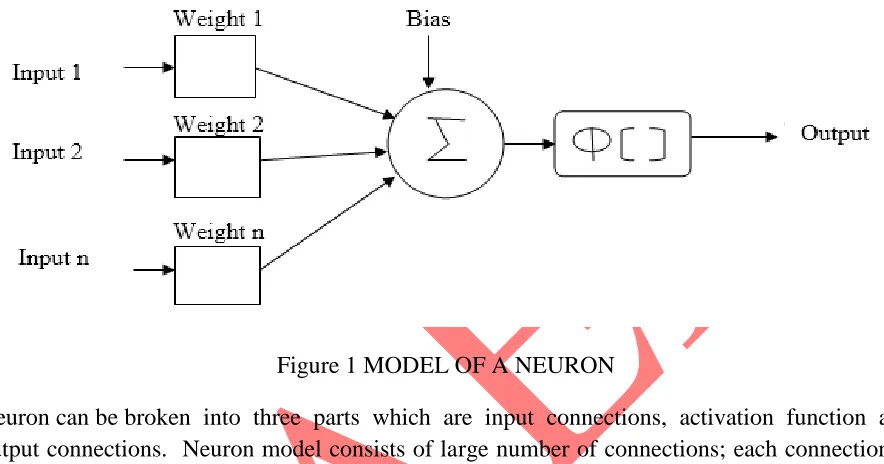
Figure 1 MODEL OF A NEURON
Neuron can be broken into three parts which are input connections, activation function and output connections. Neuron model consists of large number of connections; each connection is characterized by a synaptic weight value and contains the value of the input multiplied by the synaptic weight value.Adder or Summing Junction used to add all input signals. Activation Function is used to make in limit or within range to the output by doing amplitude of the output. Synaptic weight values and bias value is used as free parameter in artificial neural network. Synaptic weights are uses for learning to the neurons by doing change in weight. Bias is any external factor which affect to the output of a neural network.
2.FORECASTING
MODEL
OF
ARTIFICIAL
NEURAL
NETWORK
18 INTERNATIONAL JOURNAL OF ADVANCES IN ENGINEERING RESEARCH
Figure 2LAYERS OF ARTIFICIAL NEURAL NETWORK
3. LITERATURE SURVEY:
Adnan Haider and Muhammad Nadeem Hanif (2009):Author describe the artificial neural network (ANN) is persuaded by biological nervous system like process information and brain. The Researcher compares the model with conventional univariate time series forecasting models and ARIMA model and determines that root mean square error (RMSE) of ANN is very less than RMSE of ARIMA models. In research feed-forward artificial neural network model used twelve hidden layers and feed forward with back propagation concept with steps of input variable selection, input data processing, network training and forecast accuracy is used. The researcher compare RMSE based on actual inflation, forecast by artificial neural network and forecast by ARIMA modal in monthly wise and calculate the average of that RMSE value. The research defined the error minimization in the out-of-sample forecast based on root mean square value.
S.S.Gill, Amanjot Kaur Gill and Naveen Goel(2010): in this paper uses artificial neural network as traditional time series analysis for handling enormous data and predicting currency exchange rate proven to be difficult. Author defines that neural network technique is for complex data which may be time consuming and difficult using deterministic techniques. Due to some features like learning ability, inherent parallelism, inherent contextual information and fault tolerance processing make neural network suitable for many complex applications. Three factors used as input which are rate of USD, gold and crude oil. These factors used for prediction of ten weeks ahead price of USD with neural network modal.
19 INTERNATIONAL JOURNAL OF ADVANCES IN ENGINEERING RESEARCH nodes and changes in hidden nodes and takes the size of training sample on the both out-of-sample and in-out-of-sample performance. Paper determines the effect of some useful neural network factors in themodel fitting and forecast the behavior. The experimental factors are number of input value and hidden nodes and effects of in-sample fitting and out-of-sample fitting are examined with forecast horizons. By the results author clears that neural network give better outcomes than random walk models for all the three measures across the three time horizons.
4.
PROPOSED
RESEARCH
METHODOLOGY
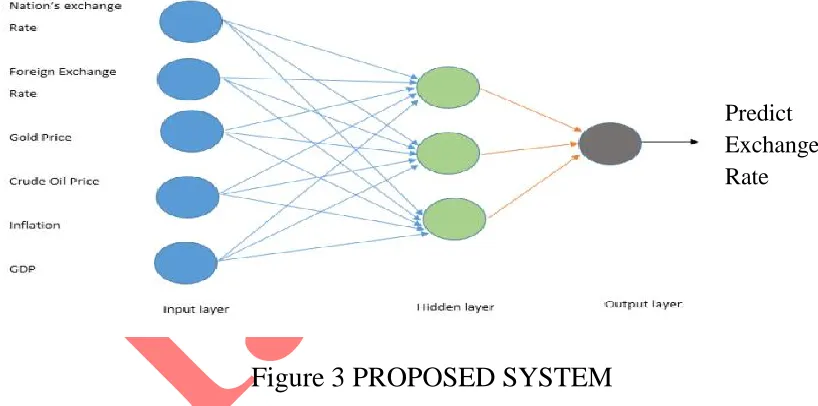
In data collection data from a specific duration to longer time period market data is collected from the change the behavior of exchange rate is affected. After analysis that database some variables are selected which act as attribute value of input to the artificial neural network architecture. By choosing previous monthly wise data of longer period of that attributes in which include forex exchange rate, gold price, crude oil price, inflation and domestic growth price (GDP) and put that data into some artificial neural network architecture. Some learning rate parameter is use whose value is between of 0 to 1. Membership function defines the impact value of attributes which acts as inputs to network to obtain the desire label.
Figure 3 PROPOSED SYSTEM
The proposed algorithm for the research work is:
Step 1: Initialize parameters.
Step 2: Select attributes which is longer period data of gold price, crude oil price, domestic growth product (GDP), consumer price index (CPI),foreign institutional investors (FIIs) as input attributes.
Step 3: Provide Target label which is longer period data of foreign exchange rate with respect to attributes used for training and testing our results.
20 INTERNATIONAL JOURNAL OF ADVANCES IN ENGINEERING RESEARCH Step 4: Start adaptive network based fuzzy inference systemtraining using initial inferences.
Step 5: Every node generates the membership function of linguistic label.
A generalised bell function example of a membership function is
Where {j, k, l} is the attribute set. With change in values of attribute sets the shape varies of bell-shaped function.
Step 6: The firing strength of each node is calculated using the min or prod operator. Normally any of fuzzy operation like AND can be used.
Step 7: The ratios of the rule’s firing strength calculated by nodes to the summation of all the rules firing strength. Theresult is in form of a normalized firing strength.
Step 8: The nodes compute a parameter function on the layer output. Parameters on output layer called the consequent parameters.
Step 9: Normally the summation of all incoming signals are calculated in a single node.
Step 10: Calculate the root mean square error (RMSE), mean absolute error (MAE), Mean Absolute Percent Error (MAPE)using the given label in testing dataset.
Step 11: If the error is within acceptable limit go to Step 12 or else go to step 4.
Step 12: Test the results.
5. CONCLUSION
21 INTERNATIONAL JOURNAL OF ADVANCES IN ENGINEERING RESEARCH methodology wills very much effective as very less computations needed and large dataset can be easily processed.
6. REFERENCES
[1] P. Tenti, “Forecasting Foreign Exchange Rates Using Recurrent Neural Networks,” Applied
Artificial Intelligence,Vol.10,1996,pp.567581.doi:10.1080/088395196118434.
[2] Zhang Gioqinang and Hu Michael Y. (1998), “Neural Network Forecasting of the
British Pound/US Dollar Exchange Rate”,Omega, Int. J. Mgmt Sci. Vol. 26, No. 4,
pp.495±506, Atlanta, USA.
[3] Yao Jingtao and Tan Chew Lim (2000),“A case study on using neural networks to perform
technical forecasting of forex”, Neuro computing 34 (2000) 79}98, Palmerston
North, New Zealand.
[4] Chen An-Sing and Leung Mark T.(2004),“Regression neural network for error
correction in foreign exchange forecasting and trading”,Computers & Operations
Research 31 (2004) 1049–1068,San Antonio,USA.
[5] Panda Chakradhara and Narasimhan V. (2007), “Forecasting exchange rate better with
artificial neural network”, Journal of Policy Modeling 29 (2007) 227–236, Hyderabad,India.
[6] Leigh William, Hightower Ross, Modani Naval (2005), “Forecasting the New York stock
exchange composite index with past price and interest rate on condition of volume
spike”,Expert Systems with Applications 28 (2005) 1–8, Orlando, USA.
[7] Yu Lean, Lai Kin Keung, Wang Shouyang (2008), “Multistage RBF neural network
ensemble learning for exchange rates forecasting”, Neuro computing 71 (2008) 3295–
3302, Beijing, China.
[8] Leu Yungho, Lee Chien-Pang, Jou Yie-Zu (2009) , “A distance-based fuzzy time
series model for exchange rates forecasting”, Expert Systems with Applications 36
(2009)8107–8114, Taipei, Taiwan, ROC.
[9] Anastasakis Leonidas and Mort Neil (2009), “Exchange rate forecasting using a
combined parametric and nonparametric self-organising modelling approach”, Expert
22 INTERNATIONAL JOURNAL OF ADVANCES IN ENGINEERING RESEARCH [10] Kumar Rajesh and Pradhan Rudra P. (2010), “Forecasting Exchange Rate in India:An
Application of Artificial Neural Network Model”Journal of Mathematics Research Vol.
2, No. 4; November 2010, West Bengal, India.
[11] S.S.GILL, Gill Amanjot Kaur , Goel Naveen (2010), “Indian Currency Exchange
Rate Forecasting Using Neural Networks”,2010 IEEE,Ludhiana,India.
[12] Pacelli Vincenzo, Bevilacqua Vitoantonio, Azzollini Michele (2011), “An Artificial
Neural Network Model to Forecast Exchange Rates”,Journal of Intelligent Learning
Systems and Applications, 2011, 3, 57-69, San Severo, Italy.
[13] Perwej Yusuf and Perwej Asif (2012) ,” Forecasting of Indian Rupee (INR) / US
Dollar (USD) Currency Exchange Rate Using Artificial Neural Network”, International
Journal of Computer Science, Engineering and Applications (IJCSEA) Vol.2, No.2, April
2012, Jazan, Kingdom of Saudi Arabia (KSA).
[14] Sermpinis Georgios, Dunis Christian, Laws Jason, Stasinakis Charalampos (2012),
“Forecasting and trading the EUR/USD exchange rate with stochastic Neural Network
Combination and time-varying leverage”, Decision Support Systems 54 (2012) 316–329,
Liverpool, United Kingdom.
[15] Rehman Mehreen, Khan Gul Muhammad, Mahmud Sahibzada Ali (2014), “ Foreign
currency exchange rates using CGP and Recurrent Neural Network”, 2014 International
Conference on Future Information Engineering, IERI 10 ( 2014 ) 239 – 244, Procedia.
[16] Haykin Simon (2009) Neural Networks and Learning machines PHI learning private