ISSN: 2373-2156 (Print), 2373-2164 (Online) Copyright © The Author(s). 2014. All Rights Reserved. Published by American Research Institute for Policy Development
Effect of Twelve Weeks Behaviour Modification Programme on Obesity
Surajit Majumder1
Abstract
The aim of this study was to finding out the effect of 12 weeks behavior modification programme on Obesity. Forty subjects were selected from two different schools at Ashokenagar, West Bengal, India. All the subjects were randomized by www.randomizer.org into two groups: Experimental Group (N = 20) and Control Group (N = 20). The Experimental Group received 12 weeks behavior modification (BM) programme. The Behavior-modification programme consisted of two components, namely a Physical activity component and a Nutrition education component. Control Group did not receive any treatment. The Body Mass Index (BMI), Body Composition and Abdominal Adiposity were selected as variables. The collected data were analyzed by using ANCOVA. The results showed that there were significant effect on BMI, Body Composition and Abdominal Adiposity. This finding strongly supports that behavior modification programme reduced BMI, Body Composition and Abdominal Adiposity significantly.
Keywords: Obesity, BMI, Body Composition, Behavior Modification
1. Introduction
The World Health Organization (WHO) defines overweight and obesity as “abnormal or excessive fat accumulation that may impair health” (World Health
Organization, 2006).Obesity represents the most common chronic illness of children
and adolescents.
1 Research Scholar, Department of Physical Education, University of Kalyani, Village- Banipur (Near
The World Health Organization has declared obesity as a “worldwide epidemic” since the pattern has been repeated in developing countries combined with the increase in more developed nations (WHO, June 1997). Childhood obesity has been called “one of the most serious public health challenges of the 21st century”, (WHO, 2012). Obesity can harm nearly every system in a child’s body—heart and lungs, muscles and bones, kidneys and digestive tract, as well as the hormones that control blood sugar and puberty and can also take a heavy social and emotional toll (Ebbeling et al., 2002).
Obesity treatment programmes for children and adolescents include Drugs, Surgery, Physical activity, Diet Management and Behavior Modification. Behavior Modification is the systematic approach to change behavior. Young et al. (2004) investigate the effect of behavior modification on body image, depression and body fat in obese elementary children. The experimental group received 60-70 minutes of behavior modification, once a week, for 8 weeks. The result indicates a significance improvement of body image and a reduction in the increase rate of body fat for the experimental group. This finding strongly supports the theory that behavior modification can be used as an effective strategy in the treatment of obese children. There were many other studies that support the findings of Young et al., 2004 (Raheleh et al., 2008; Hitomi et al., 2009; Mak et al., 2010; Meghan et al., 2011; Tahereh et al., 2012; Toulabi et al., 2012).
Very little effort had been made so far in the area of obesity management through behavior modification of obese school boys. Furthermore no such evidence was found which evaluating the treatment containing a behavior modification programme on Indian obese population. Thus the researcher was interested to investigate in this area.
2. Methods
Abdominal Adiposity was measured by measuring Waist circumference of the subjects through steel tape (M/s. Fremans Ltd.).
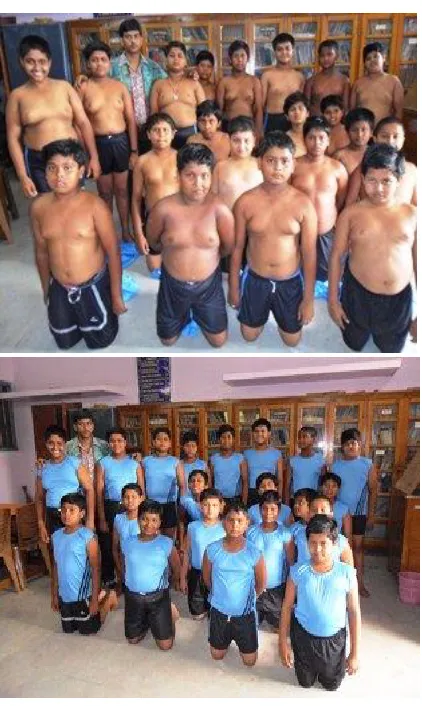
Figure 1 & 2: Subjects
2.1 Study Design
2.2 Behavior Modification Training Programme
The duration of the behavior-modification programme was 12 weeks and took place five times a week after school hours. It consisted of two components, namely a Physical activity component that was offered four days a week and a Nutrition education component which took place once a week.
2.2.1 Physical Activity Component
Table 1: 12 Weeks Specific Physical Activity Programme
Week Training In Minutes
Warm Up 10 Minutes (Jogging, stretching, rotation and bending exercise) First two weeks Walking 5 Minutes and Running 5 Minutes
Third and forth weeks Walking 10 Minutes and Running 5 Minutes Fifth and sixth weeks Walking 10 Minutes and Running 10 Minutes Seventh and eighth Walking 15 Minutes and Running 10 Minutes Ninth and tenth Walking 15 Minutes and Running 15 Minutes Eleventh and twelfth Walking 20 Minutes and Running 15 Minutes
Recreational activity 15 Minutes (Modified football, hand ball, basket ball, tunnel ball relay, under and over relay and various tag games)
Cool down 5 Minutes (slow jogging, light stretching and slow rotation exercises)
2.2.2 Nutrition Education Component
The nutrition education component, with the aim of adapting the healthy lifestyle of the subjects, took place over a period of three months, generally from month of February to May. There are twelve lessons each lesson should last about 30 minutes and last five minutes of each lesson was interactive. The purpose of the program is to influence obese children to think about what they are eating and to make wise choices. The children are introduced to the concepts of major components of food (proteins, fats and carbohydrates), to the food pyramid and a balanced diet and to the relationship of exercise to health. It also consisted of lessons on healthy eating habits, nutrition choices, self-perception, methods to increase physical activity and addressing physical activity goals.
2.3 Statistical Procedure
3. Results and Discussion
3.1 Results
The statistical analysis comparing the initial and final means of experimental group and control group on Body Mass Index is presented in table 2.
Table 2: Computation of Analysis of Covariance on Body Mass Index (Scores in kg / m2)
Test Exp.
Group Control Group Source of Variance Sum of Squares
df Mean Squares
Obtained F Pre-Test
Mean ± SD
24.805 ±01.230
24.460 ±01.237
Between 1.1902 1 1.1902 0.7826
Within 57.797 38 1.521
Post Test Mean ± SD
22.110 ±01.254
24.295 ±01.214
Between 47.742 1 47.742 *31.34
Within 57.888 38 1.5234
Adjusted Mean 21.950 24.455 Between 61.5 1 61.5 *282.34
Within 8.06 37 0.218
*Table value of ‘F’ Indicates Significant at 0.05 level of confidence for df (1, 38) = 04.10 and for df (1, 37) = 04.11
The statistical analysis comparing the initial and final means of experimental group and control group on Body Composition is presented in table 3.
Table 3: Computation of Analysis of Covariance on Body Composition (Scores in Percentage)
Test Exp.
Group Control Group Source of Variance Sum of Squares
df Mean
Squares
Obtained F
Pre-Test Mean ± SD
28.365 ±02.318
28.235 ±02.444
Between 0.169 1 0.169 0.0298
Within 215.55 38 5.6724
Post Test Mean ± SD
26.440 ±02.221
28.590 ±02.445
Between 2.445167 1 46.225 *8.4716
Within 207.35 38 5.4565
Adjusted Mean 26.378 28.652 Between 51.71 1 51.71 *219.37
Within 8.72 37 0.236
The statistical analysis comparing the initial and final means of experimental group and control group on Abdominal Adiposity is presented in table 4.
Table 4: Computation of Analysis of Covariance on Abdominal Adiposity (Scores in Centimeters)
Test Exp.
Group Control Group Source of Variance Sum of Squares
df Mean
Squares
Obtained F
Pre-Test Mean ± SD
88.525 ±05.130
88.365 ±05.725
Between 0.256 1 0.256 0.0087
Within 1122.8 38 29.548
Post Test Mean ± SD
86.005 ±05.130
88.850 ±05.781
Between 80.94 1 80.94 2.7098
Within 1135 38 29.869
Adjusted Mean 85.925 88.930 Between 90.27 1 90.27 *246.74
Within 13.54 37 0.366
*Table value of ‘F’ Indicates Significant at 0.05 level of confidence for df (1, 38) = 04.10 and for df (1, 37) = 04.11
3.2 Discussions
4. Conclusions
Within the limitations of the study, the following conclusions were drawn:
i. Twelve weeks behavior-modification programs significantly reduced Body Mass Index.
ii. Twelve weeks behavior-modification programs resulted significantly decreases Body Composition.
iii. Participation in twelve weeks of behavior-modification programs resulted significantly decreases Abdominal Adiposity.
References
Ebbeling, C.B., Pawlak, D.B., & Ludwig, D.S. (2002). Childhood obesity: public-health crisis, common sense cure. The Lancet, 360(9331), 473-482.
Lobstein, T., Bau,r L., & Uauy, R. (2004). Obesity in children and young people: a crisis in public health. Obesity Review, 5(1), 4-85.
World Health Organization. (1997). Obesity: Preventing and Managing a Global Epidemic. Retrieved from
http://www.who.int/nutrition/publications/obesity/WHO_TRS_894/en/index.ht ml
World Health Organization. (2006). Obesity and overweight. Retrieved from http://www.who.int/mediacentre/factsheets/fs311/en
World Health Organization. (2012). Prioritizing areas for action in the field of population-based prevention of Childhood Obesity. Retrieved from
http://www.who.int/dietphysicalactivity/childhood/Childhood_obesity_Tool.pdf Young, I.M., Ho, R.P., Hyun, y. K., & Hyo, S.K. (2004). Effect of behavior modification on
body image, depression and body fat in obese Korean elementary school children. Yonsei Medical Journal, 45(1), 61-67.
Raheleh, S.S., Marziye, K., Mohamad-Hossein, K., & Hamidreza, T. (2008). The Effect of Dietary Behavior Modification on Anthropometric Indices in Obese Adolescent Female Students. Iranian Journal of Pediatrics, 18(1), 71-76.
Hitomi, S., Yutaka, K., Sawako, T., Nana, T., Akinori, N., Takanobu, B., & Suguru, S. (2009). Psychological factors that promote behavior modification by obese patients. Bio Psycho Social Medicine, 3, 3:9. doi: 10.1186/1751-0759-3-9.
Mak, KK., Ho, SY., Lo, WS., Thomas, GN., McManus, AM., Day, JR., & Lam, TH. (2010). Health-related physical fitness and weight status in Hong Kong adolescents. Retrieved from http://www.ncbi.nlm.nih.gov/pubmed/20178615
Meghan, L.R., Kate, A.H., Todd, B., & Nancy, F. (2011). Outcomes of a Family Based Pediatric Obesity Program - Preliminary Results. International Journal of Exercise Science, 4(4), 217-228.
Bharati, DR., Deshmukh, PR., & Garg, BS. (2008, Jun). Correlates of overweight and obesity among school going children of Wardha city. Indian Journal Med Res., 127(6), 539-543.
Tahereh, T., Fariba, A., Hedayat, N., & Mahnaz, M. (2012, March). The influence of a behavior modification interventional program on body mass index in obese adolescents. Journal of the Formosan Medical Association, 111(3), 153-159.