40 International Journal of Recent Research and Applied Studies, Volume 4, Issue 10 (5) October 2017
Correlations of Biomechanical Characteristics with Ball Speed in Penalty Corner Push-In
Review on Analytical and Iterative Reconstruction Algorithms for Computerized Tomography
M.Saraswathi1 & L.Leelavathy2
1Associate Professor, Sri Meenakshi Vidiyal College of arts and Science, Tiruchirappalli, Tamilnadu, India. 2Assistant Professor, Sri Meenakshi Vidiyal College of arts and Science, Tiruchirappalli, Tamilnadu, India.
Received 5th September 2017, Accepted 1st October 2017
Abstract
The 2D and 3D Images are reconstructed using several imaging modalities like SPCET, PET and CT, there are several reconstruction algorithms are exists. The image reconstruction algorithms play an important role in the successful applications like medicine, non destructive testing/evaluation, astronomy etc. In computerized tomography (CT), various image reconstruction algorithms have been used. Hence this paper mainly focuses on the review and discussion of recent developments in CT image reconstruction algorithms.
Keywords: Computerized tomography, SPECT, PET.
© Copy Right, IJRRAS, 2017. All Rights Reserved.
Introduction
The first practical CT instrument was developed in 1971 by Hounsfield in England. Computed tomographic images are reconstructed from a large number of measurements of X-ray transmission through the patient. (called projection data) The resulting images are tomographic “maps” of the x-ray linear attenuation coefficient. Since the CT technology developed dramatically, Projection data are typically acquired in approximately 1 second, and the image is reconstructed in 3 to 5 seconds.
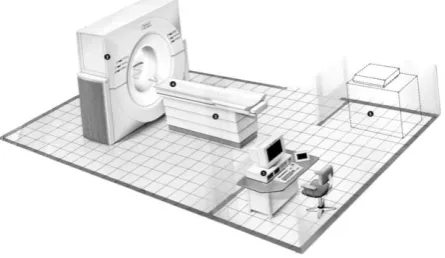
Figure I
Schematic drawing of a typical CT Scanner
Correspondence
M.Saraswathi
E-mail: [email protected], Ph. +9194435 94140
Projections data can be acquired in one of the several described geometries are Scanning configuration, scanning motions, and detector arrangement. The reconstruction algorithm used based on type of projection measured. The paper is organized as follows. Section 2, describes the image reconstruction techniques. Section 3, the analytical reconstruction methods are briefly discussed. Section 4, represents iterative reconstruction method. Section 5, provides the recent developments in CT.
Image reconstruction Techniques
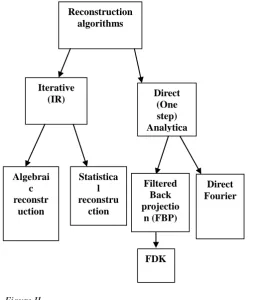
The main aim of computed tomography (CT) is to reconstruct an image from a set of measured projection. The projection data is acquired at various angles from 0 to 360 degrees. It applies only to obtain cross-sectional images of patient body. In CT, an image must be reconstructed from projections of an object. Two major categories of method are exists, analytical and iterative reconstruction.
ISSN: 2349 - 4891
International
Saraswathi et al. 2017 ISSN: 2349 – 4891
Figure II
Types of reconstruction methods
Analytical Reconstruction Algorithms
Analytical methods are very efficient and elegant, because currently used on clinical CT scanner. Analytical image reconstruction methods are important when the computation time is so limited that an approximate solution is acceptable.
Filtered back projection method (FBP)
The most commonly used algorithm for tomographic reconstruction is filtered back projection.[6] The name implies, it consists of two steps, the projection data are first filtered then the filtered data is linearly smeared back along ray paths to form image pixels. The filtered back projection is one of the fastest reconstruction method .But always has artifacts in the
image. The reconstructed image function is
mathematically expressed by
f(x,y)=
𝑄
𝜃
(
𝜋
0
𝑥𝑐𝑜𝑠𝜃 + 𝑦𝑠𝑖𝑛𝜃) 𝑑𝜃
where
𝑄
𝜃𝑡 =
∞𝑆
𝜃(𝑤) 𝑤 𝑒
𝑗 2𝜋𝑤𝑡−∞
𝑑𝑤
Figure III
Flow process of image construction
The steps described in the above diagram
1. Measurement or Scan data: Data arises from detectors. This data needs to be preprocessed to eliminate artifacts.
2. Raw data: It is the result of scan data being preprocessed.
3. Convolved data: Filtered back projection is the algorithm used by modern CT. It requires filtering and then back projection raw data is filtered using mathematical filter or kernel.
4. Image or reconstructed data: Convolved data that have been back projected into the image matrix to create CT images displayed on the monitor.
Fourier transforms (FT)
Fourier transform is one of the important concepts in image processing tool which is used to decompose an image into its sine and cosine components. The output of the transformation represents the image in the Fourier or frequency domain, while the input image is the spatial domain equivalent. It is used in a wide range of applications like image analysis, image filtering, image reconstruction and image compression.
Fourier space image space
Reconstruction algorithms
Iterative
(IR) Direct
(One step) Analytica l Algebrai c reconstr uction Statistica l reconstru ction Filtered Back projectio n (FBP) Direct Fourier FDK
Detectors
Scan
Data
DAT
A
Preproce
ssing
Raw
Data
Convolution
Back
Projection
Convolved
Data
Image
Data
42 International Journal of Recent Research and Applied Studies, Volume 4, Issue 10 (5) October 2017
The two dimensional Fourier transforms is given by F(u,v)=F[f(x,y)]=
𝑓(𝑥, 𝑦)𝑒
−𝑗 2𝜋(𝑢𝑥 +𝑣𝑦 )𝑑𝑥𝑑𝑦
∞ −∞ ∞
−∞
The inverse Fourier transform is given by f(x,y)=F-1[F(u,v)]=
𝐹(𝑢, 𝑣)𝑒
𝑗 2𝜋(𝑢𝑥 +𝑣𝑦 )𝑑𝑢𝑑𝑣
∞ −∞ ∞ −∞
Iterative Reconstruction Algorithms
To Iterative algorithms has several advantages than the analytical method. This method is mainly applied in emission tomography modalities like SPECT and PET. It can reduce image artifacts, because this approach get correct solution using multiple iterative steps, allows to obtain a better reconstruction at higher computational time. Iterative algorithms approach to include improved insensitivity to noise and capability of reconstructing an image in the case of incomplete data. Some of the factors more incorporated such as focal spot and detector geometry, photon statistics, x-ray beam spectrum and scattering which yields lower image noise and higher spatial resolution.
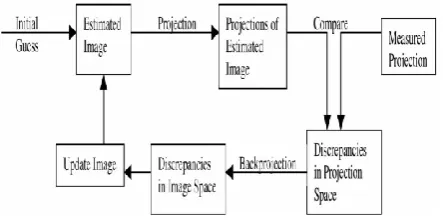
Figure IV
Flow chart of iterative image Reconstruction scheme
Algebraic reconstruction method (ART)
ART is an iterative algorithm for the reconstruction of images from a series of angular projections. It consists of three steps. First one is the make an some initial guess at the solution. The second one is the computes projection based on guess and the third one is the refining the guess depends on the weighted difference between the actual projection and the desired projection.
Statistical Reconstruction (SR)
This method is mainly used in SPECT and PET.
It is relatively fast reconstruction and reducing image noise. Statistical reconstruction is broadly classified into Gradient & conjugate gradient (CG), Maximum likelihood expectation maximization (MLEM), Ordered
subsets expectation maximization (OSEM) and
Maximum a Posteriori(MAP).
Recent developments in CT
It is a multiline scanning technique, which
offers detailed internal structure of the body with fast scanning speeds. There are two categories, one is sequential CT and the second one is spiral CT. The use of spiral CT has significantly shortened scan time than the sequential CT. The modern clinical CT offered the capabilities:
Complete coverage of organs in a single respiratory position.
Short scan times (resulting in fewer motion artifacts and a lower contrast medium requirement).
Additional diagnostic information due to improved resolution (thinner slices) and 3D visualization in routine operation.
Special cost-effective applications based on spiral CT.
There are several examples are CT examined: head, neck, thorax, spine, abdomen and extremities.
Conclusion
The focus of this study is to familiarize various image reconstruction algorithms. There are multiple mechanisms comes under image reconstruction has been explored, through this review. This work also points out pros and cons of those techniques. Further, this literature study identifies that the iterative approach on image reconstruction methodology has an edge over analytical approach.
References
1. Yuchuan Wei, Ge Wang, and Jiang Hsieh. Relation between the Filtered Back projection Algorithm and the Back projection Algorithm in CT. IEEE Signal Processing Letters, 12 (9), 2005.
2. Lee W. Goldman “Principles of CT and CT Technology”. Journal of Nuclear Medicine Technology. 35 (3), 2007.
3. Maria Lyra and Agapi Ploussi. Filtering in SPECT Image Reconstruction. International Journal of Biomedical Imaging, 2011(10):1–14, 2011.
4. M. S. M. Yusoff. et. al Image reconstruction Of
Computed Tomography Using Fan-Beam
Technique , Int. J. Eng ,CS & Tech, 5, 06 – 11, 2012.
5. G. L. Zeng. Image reconstruction, a tutorial. Computerized Medical Imaging and Graphics, 25(2):97–103, 2001.
6. S. Basu and Y. Bresler, O(N2 log2 N) filtered backprojection reconstruction algorithm for tomography, IEEE Trans. on Image Processing, 9, 1760–1772, 2000.
7. Zoubeida Messali, Nabil Chetih, Amina Serir, and Abdelwahhab Boudjelal “A Comparative Study of Analytical, Iterative and Bayesian Reconstruction
Algorithms in Computed Tomography”
International Journal of Computer and
Communication Engineering, Vol. 1,No. 3, 2012. 8. S.Asif Hussain P. Raghavendra Prasad “Efficient
Saraswathi et al. 2017 ISSN: 2349 – 4891
structure”,VSRD international journal of Electrical ,Electronics & communication Engineering, vol 2(9), 2012.
9. Payal Aggarwal Rajesh Mehra, High Speed CT Image Reconstruction using FPGA, International Journal of Computer Applications (0975 – 8887) Volume 22– No.4, May 2011.
10. Ni, Jun; Li, Xiang; He, Tao; Wang, Ge, Review of Parallel Computing Techniques for Computed
Tomography Image Reconstruction, Current
Medical Imaging Reviews, 2(4), 405-414(10),
2006.
DOI: https://doi.org/10.2174/157340506778777097 11. J. L. Herraiz, S. Espana, J. M. Udías, J. J. Vaquero, M. Desco, Statistical reconstruction Methods in PET: Resolution Limit, Noise, Edge Artifacts and considerations for the design of better scanners,
2005 IEEE Nuclear Science Symposium
Conference Record.
12. Adam Alessio, PhD and Paul Kinahan, Ph.D “PET
Image Reconstruction “Nuclear Medicine 2nd Ed.