Vol. 6, No. 2, 2015, 187-195
ISSN: 2320 –3242 (P), 2320 –3250 (online) Published on 22 January 2015
www.researchmathsci.org
187
International Journal of
An Optimized Strategy for Data Allocation in
Peer-To-Peer Distributed Databases
D.I.George Amalarethinam 1 and C.Balakrishnan 2
1
Department of Computer Science, Jamal Mohamed College (Autonomous) Tiruchirappalli, India. e-mail: [email protected]
Corresponding Author
2
Software DevelopmentSkill Development Centre, Alagappa University, Karaikudi India. e-mail: [email protected]
Received 4 November 2014; accepted 4 December 2014
Abstract. Better accessibility and availability of data are the evergreen aspects to be focussed during the design phase of Distributed Database environments. The accessibility is achieved by means of optimal allocation of fragments into the sites whereas, the high degree of availability attained with better replication strategies. However, the Data Allocation Problem (DAP) incorporates the both Allocation and Replication methodologies. This paper proposes a methodology for Reallocation and Replication of fragments in Peer-to-Peer Distributed Database environment using Ant Colony Optimization (ACO) principle, namely, Ant Colony Optimization based Data Allocation Strategy (ACODAS). ACO algorithm is a meta-heuristic, works with swarm intelligence technique. The experimental results show that ACO based reallocation and replication methodology improves the ratio of successful queries than the initial allocation of fragments.
Keywords: Ant colony optimization algorithm, accessibility, availability, data allocation problem, peer-to-peer distributed databases, reallocation, replication
1. Introduction
188
transactions tried to access the particular fragment from the particular site is considered as the performance analysis data of initial allocation. The main objective of this paper is to propose a methodology using Ant Colony Optimization (ACO) for deriving Data Allocation Strategy focusing on reallocation and replication, namely, ' Ant Colony Optimization based Data Allocation Strategy' (ACODAS). The simulation result, that isincreased number of successful transactions than initial allocation, justifies the effectiveness of ACODAS based reallocation and replication.
2. Literature review
189
performance assumptions and actual environments in real workloads.Xhafa et al. [6] proposed a replication methodology for documents structured as XML files in Peer-to-Peer systems.
3. Initial allocation strategy
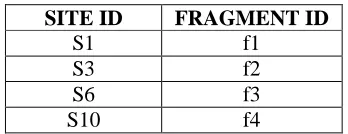
The following ‘Accounts’ relation [4] is taken for the initial allocation of fragments to the sites of the Clusters [4]. Table 1 depicts the initial allocation to sites of four clusters [4].
Table 1: Initial allocation to sites in clusters
The Table 2 explains the allocation of fragments in the initial stage in cluster1, this allocation is done based on assumption.
Table 2: Initial allocation of fragments to cluster 1
Cluster 1 consisting of four sites [4] hence four fragments are derived and allocated subsequently.
3.1. Criteria for using heuristic algorithms to solve dap
The performance of any DDBS environment is directly proportional to the efficiency of the way the data are allocated to the sites. Hence, the data allocation problem can be categorized within resource allocation problems which are defined as 'optimization problems with constraints' [10]. Therefore, in order to achieve a suitable solution for the allocation problem within an acceptable computation time, the most of the related proposed algorithms [12,14] are concerned with the usage of heuristic algorithm and evolutionary algorithm such as, ACO and Genetic algorithm for solving DAP.
ACCOUNT NO
CATEGOR Y
CUSTOME R ID
DATE BALANC E
REGION SIT E
CLUST ER
1 A C1 11/1/14 21000 R1 1 1
10 A C10 9/4/14 78000 R1 1 1
3 B C3 2/2/14 18000 R1 3 1
6 C C6 15/3/14 52000 R1 6 1
8 D C8 28/3/14 11500 R1 10 1
2 B C2 21/1/14 13500 R2 2 2
12 B C12 18/4/14 11800 R2 2 2
7 E C7 18/3/14 38000 R2 5 2
4 C C4 8/2/14 22000 R3 4 3
9 A C9 4/4/14 16800 R3 7 3
5 D C5 24/2/14 3200 R4 8 4
11 B C11 11/4/14 23000 R4 9 4
SITE ID FRAGMENT ID
S1 f1
S3 f2
S6 f3
190
Most of the existing heuristic algorithms are greedy ones, and only recently, the stochastic algorithms such as genetic algorithms [12] and swarm intelligence [14] have been widely usedfor solving DAP. One of the most significant advantages of stochastic algorithms is their scalability. After analysing most of the heuristic approaches, we find that, the Swarm intelligence technique is possessing the characteristics to solve DAP. In particular, due to the scalability nature and ability to produce near optimal solution, the ant behaviour based algorithm [5] isthe most desirable candidate to solve DAP than genetic algorithms.
3.2.Problem definition of acodas
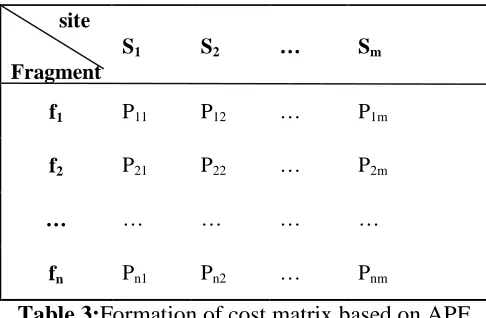
The facts gained from the earlier sections of this paper have given motivation to use ACO for solving DAP. ACO is a meta-heuristic inspired by the behaviour of real ants that cooperate through self-organization [5]. For using ACO, a very important aspect called Artificial Pheromone Factor (APF) to be formulated. This Pheromone factor is actually inherited from the behaviour of real ants. A substance called Pheromone is deposited on the ground while ants are foraging. Pheromone trails are formed on the ground by this way which also reduces stochastic fluctuations at the initial phases of search. The shorter trails will be used more frequently by ants and they gain more pheromone.A two-dimensional cost matrix is to be formulated for implementing the ACO to find optimal places for fragment reallocation. For which, this paper considers, the number of frequent transactions tried to access the particular fragment from the particular site as a Pheromone substance.
To determine the APF, the following probabilistic function [9] as in equation 1 is
used, 1 1
( )
( )
h n n
m ij
h
i j m
S K
P
S K
= =
+ =
+
∑∑
∑
(1)where m = 1 ... n and K, h are constants, S indicatesthe sites When applying the equation 1, it is possible to measure the number of transactions trying to access a fragment from a site, the resultant value can be considered as the cost for constructing the cost matrix. For example, P21 indicates the APF (i.e., total
number of frequent transactions tried to access the particular fragment from the site) of site 1 on fragment 2. The following Table 3 shows the structure of a cost matrix.
site
Fragment
S1 S2 … Sm
f1 P11 P12 … P1m
f2 P21 P22 … P2m
… … … … …
fn Pn1 Pn2 … Pnm
Table 3:Formation of cost matrix based on APF
191
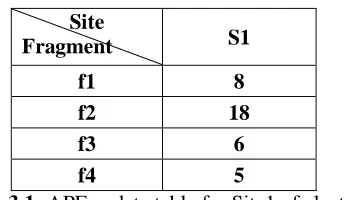
that site for a particular fragment. The table 3.1 shows the model of APF update table for one site and four fragments stored in four different sites of a cluster,
Site
Fragment S1
f1 8
f2 18
f3 6
f4 5
Table 3.1: APF update table for Site1 of cluster 1
This paper also derives another formula for measuring the ratio of successful queries, as indicated in Equation 2,
Ratio of successful queries = ( ) ( )
s CT
T
∑
∑
(2)where
∑
(CTs) = Sum of cost of successfultransactions,
∑
( )T = Total number of transactions3.3. Experimental results and findings of acodas
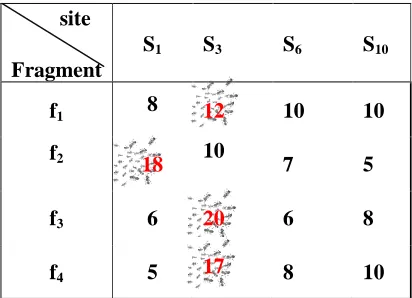
This section describes the experimental results and findings on reallocation and replication of fragments by using ACODAS. This paper takes Cluster1 [4] with four fragments and four sites. Here the total transactions measured are 160. The table 4 shows the cost matrix of cluster 1.
site
Fragment
S1 S3 S6 S10
f1 8 12 10 10
f2 18 10 7 5
f3 6 20 6 8
f4 5 17 8 10
Table 4: Cost matrix of Cluster 1
In Table 4, the value 17 indicates the APF value of site S3 for fragment f4, which means
that there were 17 transactions tried to access fragment f4 from the site S3 and this can be
considered as the cost to form the cost matrix.
Fragment
Table 5: Initial allocation and successful transactions ofCluster 1
Applying ACODAS into the Table 4, the Table 6 shows the suggestions of ACODAS for reallocation of fragments.
Fragment
Table 6: ACODAS suggestions for reallocation of fragments and respective successful
The principle of ACODAS suggests that to reallocate the fragments into the places which are having high APF value. Applying the Equation 2 on the selected costs of Table 6, the Equation 4 narrates the success ratio with optimized reallocation based on ACODAS.
Success ratio of Reallocation =
Replication is done to improve the performance by means of strengthening the availability of data. This paper utilizes the selective replication mechanism, which is highly appreciated in non
192 site
Fragment
S1 S3 S6 S10
f1 8 12 10 10
f2
18 10 7 5
f3 6 20 6 8
f4 5 17 8 10
Initial allocation and successful transactions ofCluster 1
Success ratio = 160
34
= 21.25 % = 21%
(Initial allocation)
Applying ACODAS into the Table 4, the Table 6 shows the suggestions of ACODAS for reallocation of fragments.
site
Fragment
S1 S3 S6 S10
f1 8 12 10 10
f2 18 10 7 5
f3 6 20 6 8
f4 5 17 8 10
suggestions for reallocation of fragments and respective successful transactions incluster 1
The principle of ACODAS suggests that to reallocate the fragments into the places which are having high APF value. Applying the Equation 2 on the selected costs f Table 6, the Equation 4 narrates the success ratio with optimized reallocation based on
Success ratio of Reallocation =
160
67 = 41.87 % = 42%
(Based on ACODAS)
Replication is done to improve the performance by means of strengthening the availability of data. This paper utilizes the selective replication mechanism, which is highly appreciated in non-redundant data allocation methodologies. Replication process
Initial allocation and successful transactions ofCluster 1
= 21.25 % = 21% (3)
Applying ACODAS into the Table 4, the Table 6 shows the suggestions of
suggestions for reallocation of fragments and respective successful
The principle of ACODAS suggests that to reallocate the fragments into the places which are having high APF value. Applying the Equation 2 on the selected costs f Table 6, the Equation 4 narrates the success ratio with optimized reallocation based on
(4)
considers the both places, that is the places of initial allocation and suggested places of ACODAS. The Table 7 depicts the optimized places for replication of fragments.
Fragment
Table 7: ACODAS suggestions for optimized replication and respective successful
Applying the Equation 2 on the selected costs of Table 7, the Equation 5 describes the success ratio with optimized replication using
Success ratio of Replication =
(Based on ACODAS)
3.3.1. Interpretations
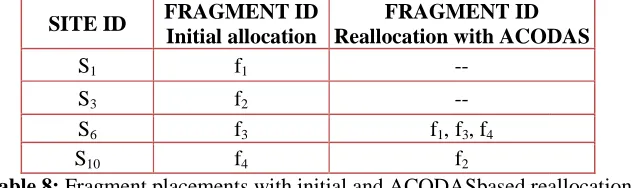
In the following section, the QoS parameters such as, Success ratio, Resource utilization, Load balancing and Scalability are analyzed based on the placements of fragments listed in Table 8 and the findings as given in Equations (3) (4) and (5). The following Table 8 is showing the placements of fragments in both initial allocation and ACODAS based optimized reallocation.
SITE ID
S1
S3
S6
S10
Table 8: Fragment placements with initial and ACODASbased reallocation By analysing the Equations (3)
ratio than initial allocation. From Table 8, it is found that, the ACODAS leaves certain sites without assigning the fragments. Hence, the ACODAS gives unsatisfactory results against the QoS parameters, such
scalability of the proposed methodology is studied by conducting various experiments and the results are explained in the following Table 9.
193
iders the both places, that is the places of initial allocation and suggested places of ACODAS. The Table 7 depicts the optimized places for replication of fragments.
site
Fragment S1
S3
S6 S10
f1 8 12 10 10
f2 18
10 7 5
f3 6
20
6 8
f4 5 17 8 10
ACODAS suggestions for optimized replication and respective successful transactions incluster 1
Applying the Equation 2 on the selected costs of Table 7, the Equation 5 describes the success ratio with optimized replication using ACODAS.
Success ratio of Replication =
160
101 = 63.12% = 63%
(Based on ACODAS)
In the following section, the QoS parameters such as, Success ratio, Resource utilization, balancing and Scalability are analyzed based on the placements of fragments listed in Table 8 and the findings as given in Equations (3) (4) and (5). The following Table 8 is showing the placements of fragments in both initial allocation and ACODAS based
FRAGMENT ID Initial allocation
FRAGMENT ID Reallocation with ACODAS
f1 --
f2 --
f3 f1, f3, f4
f4 f2
Fragment placements with initial and ACODASbased reallocation By analysing the Equations (3) (4) and (5), the ACODAS produces better success ratio than initial allocation. From Table 8, it is found that, the ACODAS leaves certain sites without assigning the fragments. Hence, the ACODAS gives unsatisfactory results against the QoS parameters, such as, Resource utilization and Load Balancing.The scalability of the proposed methodology is studied by conducting various experiments and the results are explained in the following Table 9.
iders the both places, that is the places of initial allocation and suggested places of ACODAS. The Table 7 depicts the optimized places for replication of fragments.
ACODAS suggestions for optimized replication and respective successful
Applying the Equation 2 on the selected costs of Table 7, the Equation 5
(5)
In the following section, the QoS parameters such as, Success ratio, Resource utilization, balancing and Scalability are analyzed based on the placements of fragments listed in Table 8 and the findings as given in Equations (3) (4) and (5). The following Table 8 is showing the placements of fragments in both initial allocation and ACODAS based
Reallocation with ACODAS
Number of Fragments & Sites Total number of Transactions
5 30
10 80
15 120
25 180
30 200
Table 9: Experimental results to test the Scalability of ACODAS
The results displayed for ACODAS based
clearly explained the scalability nature of ACODAS. The results show the ability of the ACODAS to produce consistency upon the various experimentations ranges from 30 transactions to 200 transactions. The Figure 2 c
ACODAS.
4. Conclusion
This paper concentrated on the issues of data availability and data accessibility in P2P Distributed databases. This is an optimized model for reallocation and replication of fragments. This methodology is proposed using Ant Colony Optimization algorithm, namely, ACODAS.The process of finding APF to formulate cost matrix using APF update table is explained. Based on the principles of ACO, the reallocation and replication procedure explained. The investigation of QoS parameters against
and the results are tabulated and graphically represented. The
results in success ratio and scalability, but, the results for resource utilization and load balancing are not satisfactory. Due to the meta
to produce only near optimal solution.
The future work may consider this issue and resolve by proposing another Data Allocation Strategy using proven optimization techniques.
1. A.Correia, J.Luís Rodrigues, N. replication, Replication,
642-11294-2_13 Springer
194 Total number
of Transactions
Success ratio (%) Initial allocation ACODAS Reallocation ACODAS Replication
30 18 39
80 20 45
120 21 35
180 30 62
200 40 59
Experimental results to test the Scalability of ACODAS
The results displayed for ACODAS based reallocation and replication in Table 9 clearly explained the scalability nature of ACODAS. The results show the ability of the ACODAS to produce consistency upon the various experimentations ranges from 30 transactions to 200 transactions. The Figure 2 clearly explained the scalability nature of
Figure 2: Scalability of ACODAS
This paper concentrated on the issues of data availability and data accessibility in P2P Distributed databases. This is an optimized model for reallocation and replication of fragments. This methodology is proposed using Ant Colony Optimization algorithm, .The process of finding APF to formulate cost matrix using APF update table is explained. Based on the principles of ACO, the reallocation and replication procedure explained. The investigation of QoS parameters against ACODAS
d the results are tabulated and graphically represented. The ACODAS
results in success ratio and scalability, but, the results for resource utilization and load balancing are not satisfactory. Due to the meta-heuristic nature of ACO, ACODAS to produce only near optimal solution.
The future work may consider this issue and resolve by proposing another Data Allocation Strategy using proven optimization techniques.
REFERENCES
.Luís Rodrigues, N.Carvalho and R.Oliveira, Practical Replication, LNCS, vol. 5959/2010, pp.253-285, DOI: 10.1007/978 2_13 Springer-Verlag, Jan. 2010.
0 50 100
1 2 3 4 5
S u c c e s s R a t io i n %
ACODAS - Scalability
ACODAS Replication 65 78 68 88 88 Experimental results to test the Scalability of ACODAS
reallocation and replication in Table 9 clearly explained the scalability nature of ACODAS. The results show the ability of the ACODAS to produce consistency upon the various experimentations ranges from 30 learly explained the scalability nature of
This paper concentrated on the issues of data availability and data accessibility in P2P Distributed databases. This is an optimized model for reallocation and replication of fragments. This methodology is proposed using Ant Colony Optimization algorithm, .The process of finding APF to formulate cost matrix using APF update table is explained. Based on the principles of ACO, the reallocation and replication ACODAS are analysed ACODAS gives good results in success ratio and scalability, but, the results for resource utilization and load ACODAS is able The future work may consider this issue and resolve by proposing another Data
10.1007/978-3-195
2. A.A.Amer, H.I.Abdalla, A heuristic approach to re-allocate data fragments in DDBSs, In. International Conference on Information Technology and e-Services (ICITeS), 2012.
3. B.Kemme, Gustavo alonso, database replication: a tale of research across communities, in Proc. VLDB Endowment, 3(1-2) (2010) 5-12.
4. D.I.George Amalarethinam and C.Balakrishnan, A study on performance evaluation of peer-to-peer distributed databases, IOSR Journal of Engineering, 2(5) (2012) 1168-1176.
5. M.Dorigo, M.Birattari and T.Stützle, Ant colony optimization, Technical Report 2006-023, UniversitéLibre de Bruxelles, Belgium, 2006
6. F.Xhafa, A.Diana Potlog, E.Spaho, F.Pop, V.Cristea and L.Barolli, Evaluation of intra-group optimistic data replication in P2P groupware systems, in Concurrency and Computation: Practice and Experience, Ed. Geoffrey C. Fox and Luc Moreau: John Wiley & Sons, Ltd., 2012
7. H.I.Abdalla, A new data re-allocation model for distributed database systems, International Journal of Database Theory and Application, 5(2)(2012) 45-60. 8. J.O.Hauglid, N.H.Ryeng and K.Nørvåg, DYFRAM: dynamic fragmentation and
replica Management in distributed database systems,Distributed and Parallel Databases, 28 (2-3) (2010) 157-185.
9. J.-L.Deneubourg, S.Aron, S.Goss and J.M.Pasteels, The self-organizing exploratory pattern of the argentine, Ant, Journal of lnsectBehavior, 3(2) (1990) 159-168. 10. Z.Lee, S.Su and C.Lee, A heuristic genetic algorithm for solving resource allocation
problems, Knowledge Information Systems, 5(4) (2003) 503–511.
11. M.T.Ozsu and P.Valduriez, Principles of Distributed Database Systems, 3rd ed., Springer, 2011.
12. R.S.Virk and G.Singh, Optimizing access strategies for a distributed database design using genetic fragmentation, International Journal of Computer Science and Network Security, 11(6) (2011) 180-183.
13. R.Basseda, M.Rahgozar and C.Lucas, Fuzzy neighborhood allocation (FNA): a fuzzy approach to improve near neighborhood allocation in DDB,Advances in Computer Science and Engineering Communications in Computer and Information Science, 6(2) (2009) 834-837.
14. R.K.Adl and S. Mohammad, T.R.Rankoohi, A new ant colony optimization based algorithm for data allocation problem in distributed database, Knowledge and Information Systems, 20(3) (2009) 349—373.
15. U.Tosun, T.Dokeroglu and A.Cosar, Heuristic algorithms for fragment allocation in a distributed database system, In. 27th International Symposium on Computer and Information Sciences, Paris, 2012.