Volume 7
Issue 4 Fall 2019 Article 5
October 2019
Use of the STAR PROCESS for Children with Sensory Processing
Use of the STAR PROCESS for Children with Sensory Processing
Challenges
Challenges
Sarah A. Schoen
STAR Institute for Sensory Processing Disorder - USA, [email protected]
Lucy Jane Miller
STAR Institute for Sensory Processing Disorder - USA, [email protected]
Stephen Camarata
Vanderbilt University - USA, [email protected]
Andrea Valdez
STAR Institute for Sensory Processing Disorder - USA, [email protected]
Follow this and additional works at: https://scholarworks.wmich.edu/ojot
Part of the Occupational Therapy Commons
Recommended Citation Recommended Citation
Schoen, S. A., Miller, L. J., Camarata, S., & Valdez, A. (2019). Use of the STAR PROCESS for Children with Sensory Processing Challenges. The Open Journal of Occupational Therapy, 7(4), 1-17. https://doi.org/ 10.15453/2168-6408.1596
This document has been accepted for inclusion in The Open Journal of Occupational Therapy by the editors. Free, open access is provided by ScholarWorks at WMU. For more information, please contact
Background: This study examined the effectiveness of the STAR PROCESS, an intensive, short-term intervention that combines principles of sensory integration, relationship-based therapy, and parental-therapist collaboration for children with sensory processing challenges.
Method: A nonconcurrent multiple baseline, repeated measures design was used. Four boys, aged 5 years 0 months to 7 years 9 months, participated in this study. The mean length of intervention was 22
sessions delivered 3 to 5 times per week. A behavioral coding system was used to measure change in four areas: play level, positive affect, joint attention, and novel use of equipment. The theory of change reflects the use of multisensory experiences in combination with parent participation to impact outcomes.
Results: Improvement was noted in play level in all of the participants. Multisensory experiences and parent participation were associated with these changes in two participants.
Discussion: The study results suggest a feasible methodology to study occupational therapy
interventions. The behavioral coding system was sensitive to change. Play abilities changed in all four children. Preliminary support was provided for the theory of change combining multisensory experiences with parent participation.
Conclusion: A targeted treatment approach that emphasizes parents as play partners in a multisensory environment shows promise in remediating these deficits.
Comments
The authors report that they have no conflicts of interest to disclose.
Keywords Keywords
sensory processing, intervention effectiveness, play, multisensory experiences, parent participation
Credentials Display
Sarah A Schoen, PhD, OTR; Lucy Jane Miller, PhD, OTR; Stephen Camarata, PhD, SLP; Andrea Valdez
Copyright transfer agreements are not obtained by The Open Journal of Occupational Therapy (OJOT). Reprint permission for this Applied Research should be obtained from the
corresponding author(s). Click here to view our open access statement regarding user rights and distribution of this Applied Research.
DOI: 10.15453/2168-6408.1596
social, and emotional areas that negatively impact participation in daily life activities and routines (Bar-Shalita, Vatine, & Parush, 2008). A child’s motor skills (Cosbey, Johnston, Dunn, & Bauman, 2012), play abilities (Watts, Stagnitti, & Brown, 2014), and social participation (Matsushima & Kato, 2013) are often affected. Limitations are reported in children’s abilities to take advantage of learning opportunities in the natural environment, including on a playground, which results in further social isolation and a lack of development of age appropriate play skills (Cosbey et al., 2012).
Play has long been discussed in the occupational literature as a key occupation of childhood. As such, it serves as a mechanism for the development of physical, social, emotional, and cognitive abilities (Nijhof et al., 2018). However, children with sensory processing challenges often show deficits in their play skills (Cosbey et al., 2012) with resultant problems in social interaction abilities (Cosbey et al., 2012). Children with sensory processing challenges tend to engage in more nonsocial play activities and use simpler play schemes (Cosbey et al., 2012). In addition, they tend to engage in more solitary play and have fewer opportunities to socialize with their peers.
Intervention for children with sensory processing challenges usually involves a sensory-based approach grounded in the principles of sensory integration set forth by A. Jean Ayres (Schaaf & Mailloux, 2015). Sensory integration is a play-based, individualized approach that evaluates and treats the underlying sensory-motor issues affecting a child’s participation in daily life (Schaaf & Mailloux, 2015). Unlike sensory strategies that are largely adult-directed protocols and passive in nature, sensory integration takes place during play, includes active participation, and emphasizes the creation of successful interactions in the environment. A key feature is the use of clinical reasoning in the ongoing evaluation of the child’s participation that allows for continual adjustments to the program (Schaaf & Mailloux, 2015).
Other interventions that are popular for children with sensory processing challenges, because of concomitant social (Cosbey et al., 2012) and emotional impairments (O'Donnell, Deitz, Kartin, Nalty, & Dawson, 2012), include relationship-based programs, such as Developmental, Individual Differences, Relationship-Based Approach/Floortime (DIR/Floortime; Greenspan & Wieder, 2007), Relationship Development Interaction (RDI; Gutstein, 2009), and the Social Communication/Emotional
Regulation/Transactional Supports model (SCERTS; Prizant, Wetherby, Rubin, Laurent, & Rydell, 2005). These approaches focus on supporting social-emotional development by establishing mutually responsive, supportive relationships and bidirectional engagement in the family (Greenspan & Wieder, 2007). Tapping the caregiver-child relationship in the therapeutic process supports the caregivers in the role of co-regulator and helps to improve the child’s ability to participate in daily life occupations, such as play (Whitcomb, Carrasco, Neuman, & Kloos, 2015).
The STAR PROCESS is a unique approach that combines principles from all three of these interventions. The approach was developed over years of research (Miller, Schoen, & Spielmann, 2019) and refined though interaction and feedback from various teams of occupational therapists. This short-term, intensive treatment addresses sensory symptoms affecting performance in daily life, particularly in the area of play, because of its profound impact on the child and the family’s quality of life (Nijhof et al., 2018). Individualized treatment has four primary components: (a) principles of sensory integration to address sensory and motor deficits, (b) relationship-based strategies designed to capitalize on features of the parent-child relationship to enhance development, (c) social-emotional attunement to ensure that parents and children are co-regulated, and (d) parent participation and parent coaching to enhance the parent’s sense of competence and carry over to home. Little has been written about the effectiveness of this approach.
Outcome Measurements in Occupational Therapy
The issueof measuring outcomes of sensory-based occupational therapy has been a problem repeatedly cited in the literature (Schaaf et al., 2014). Few standardized measures are sensitive to the changes observed following sensory integration therapy and, as a result, the literature has been criticized for reliance on parent report (Weitlauf et al., 2014). In addition, there has been a call for more
participation-related outcomes that are sensitive and meaningful to the families and children served (Schaaf et al., 2014). Thus, more objective outcome measures are needed that reflect the participation priorities of families, e.g., social participation (Cohn, Kramer, Schub, & May-Benson, 2014) and play (Miller-Kuhaneck, Tanta, Coombs, & Pannone, 2013).
In a similar way, the occupational therapy literature has been criticized for lacking large scale studies of treatment effectiveness (Weitlauf et al., 2014). Single subject research designs (SSRDs) are more widely used in other professions (Richards, 2018) and are considered an empirically strong alternative methodology to large scale, expensive randomized controlled trials. This methodology is more easily integrated into clinical practice, and outcomes can be measured in real-world contexts (Bulkeley, Bundy, Roberts, & Einfeld, 2013). SSRDs are lower cost and more flexible than group designs requiring homogenous sample groups and global outcome measures. Advocates of SSRDs suggest these robust design options better capture the varying responsiveness of individuals to different interventions and are useful for studying the variability in populations with control and scientific rigor (Romeiser-Logan, Slaughter, & Hickman, 2017).
This study addresses identified gaps in the literature. There is insufficient evidence on the use of single subject research designs in occupational therapy; consequently, this study was designed to demonstrate the value and feasibility of a single subject study of treatment effectiveness for children with sensory processing challenges. There is also insufficient use of objective participation outcome measures. Therefore, an objective participation measure that included social interaction and play was systematically applied to quantify changes in children receiving therapy (Miller et al., 2017).
Assumptions about the theory of change for pediatric interventions exist; however, few studies report data showing the relationship between hypothesized active ingredients of the intervention and outcomes obtained. Exploration of one theory of change was explored in this study.
Thus, there were three specific aims:
2. To evaluate a behavioral coding scheme designed for measuring outcomes in the natural environment of the playground;
3. To explore the theory of change of the STAR PROCESS.
Method Design
Feasibility. A nonconcurrent multiple baseline, repeated measures design was used to examine social interaction, play, and motor skill outcomes in four children participating in a STAR PROCESS occupational therapy intervention program. Treatment was initiated after the collection of three baseline data points. In keeping with nonconcurrent multiple baseline studies, baseline data were gathered using a preplanned schedule. We did not randomly assign participants to differing lengths of the baseline phase, and we did not increase the length of the baseline condition because of a prior commitment to parents to begin treatment. This study was approved by the Rocky Mountain University of Health Professions Institutional Review Board.
Participants
The participants were four children enrolled in an intensive therapy program at STAR Institute for SPD in Greenwood Village, Colorado. Inclusion was based on two criteria: (a) the presence of a sensory processing challenge and (b) parental concern regarding play and social participation.
Identification of a sensory processing challenge was based on the comprehensive occupational therapy evaluation that routinely includes a standardized assessment of motor functioning, sensory processing, behavior problems, and adaptive behavior. The participants were excluded if they had a genetic, orthopedic, or neurological disorder. Participants 1 and 4 were administered the Miller Function and Participation Scales (MFUN; Miller, 2006), Participant 2 was administered the Bruininks-Oseretsky Test of Motor Proficiency (BOT2; Bruininks & Bruininks, 2005), and Participant 3 was administered the Sensory Integration and Praxis Test (SIPT; Ayres, 1989). Three out of the four participants were
administered a sensory specific scale currently in the standardization phase of development, the Sensory Processing Three Dimensions Assessment (SP3D; Miller, Schoen, & Mulligan, 2018). No standard scores were available for the sensory specific scale at the time of participation in this study. The parent report measures completed for all of the participants were the Adaptive Behavior Assessment System (ABAS; Harrison & Oakland, 2003), the Behavior Assessment System for Children (BASC2; Reynolds & Kamphaus, 2003), the Short Sensory Profile (SSP; McIntosh, Miller, Shyu, & Dunn, 1999) and the SP3D Inventory (Miller et al., 2018). No formal play assessment was administered; parent report of challenges in play behavior were confirmed by questions on the leisure subscale of the ABAS in combination with structured and unstructured observations in the STAR Institute occupational therapy gym.
Behavioral Coding Scheme Dependent measures.
and sequence. The parents were instructed in each session to play with their child at the sand and water table for 5 min and at the roller slide for 5 min.
Coded variables. There were six sets of coded outcome categories of interest in this study: sensory, parent participation, social interaction, play complexity, emotion regulation, and motor skills. The behavioral coding scheme used in this study was developed by Dr. Stephen Camarata of Vanderbilt University and Drs. Miller and Schoen of the STAR Institute (Miller et al., 2017). The full coding scheme is available for reference in a separate publication (Miller et al., 2017); reliability and validity testing is reported in two previous studies (Miller et al., 2017). Coded variables for this study were based on hypothesized areas of change for the participants and in each case an evaluation of baseline data was conducted prior to initiating treatment.
Operational definitions of the variables are as follows.
Multisensory experiences. The child engages in an activity that enhances sensory experiences from a combination of two or more of the following sensory domains. Tactile: stimulation to the skin; proprioception: stimulation to the muscles and joints; and vestibular: stimulation to movement receptors (e.g., acceleration and deceleration or changes in position of the head).
Parent participation. The parent is a play partner. He or she physically and emotionally joins in and engages in the play by sharing toys, conversing with the child, helping to coordinate the activity and/or working together.
Play level. The child engages in associative or cooperative play and is interested in the people playing. In associative play, the child may share toys and talk but the parent and child are independent players. In cooperative play, there is coordination of activities between the parent and the child playing and they have assigned roles.
Positive affect. Child expresses joy and excitement during the play.
Joint attention. Child initiates or responds to joint attention. Joint attention refers to behavior of referencing an object or activity or behavior that is contingent on a child’s eye gaze following a verbal reference.
Novel use. The child engages in nontraditional use of equipment, e.g., uses equipment in a novel way.
Self-esteem.Any verbalization or behavior showing pride after an activity or task.
Motor planning. A skilled nonhabitual movement used to complete a multistep task.
Verbalization.The child initiates or responds to conversation with communicative intent. Behaviors were coded every 15 s over the 10-min period for 40 observations. The percent of intervals each behavior was observed was then computed and reported. The 5 hr of videotape collected took approximately 15 hr to code. Variables without a stable or declining baseline were not included as an outcome in the study.
Inter-observer agreement.
This is considered a high reliability level indicating that behaviors can be observed and coded with sufficient reliability to conduct single subject research.
Theory of Change
Description of the intervention.
The STAR PROCESS is a short-term, intensive, play-based program. The intervention uses a combined approach including principles from sensory integration therapy (Ayres, 1972) and
DIR/Floortime (Greenspan & Wieder, 2007) as well as emphasizing parent education, parent collaboration, and parent coaching. The parents are active participants in each treatment session and attend five or six parent-only meeting sessions. The parent component focuses on use of the clinical reasoning model of ASECRET (Bialer & Miller, 2011) for addressing challenges at home and school. Therapy sessions were 50 min in duration, scheduled three to five times a week. The manual used for training clinicians in this approach appears in several publications (Miller et al., 2019). Treatment sessions included (a) sensory integration activities to address arousal regulation and sensory-motor deficits; (b) relationship-based methods to enhance interpersonal connections, attunement, and quality of life; combined with (c) parent collaboration and coaching. Clinicians delivering the intervention had a master’s degree in occupational therapy, a minimum of 7 years of experience, STAR mentorship training, and were certified in DIR/Floortime. Intervention fidelity was ensured through weekly individual supervision and peer case review of participating clients. Videotaped segments of treatment were reviewed using the STAR frame of reference fidelity checklist (Miller et al., 2019).
Assumptions of the intervention.
The theory of change for the STAR PROCESS is based on the assumption that underlying relational and sensory processing strategies can impact the child’s ability to participate in daily life activities and routines. Therefore, treatment engages the parent and child in increasingly complex sensory-motor play, while addressing social-emotional challenges as well as the use of enhanced tactile, proprioceptive, and vestibular experiences to address underlying deficits in sensory modulation and sensory discrimination. Measuring parent participation as well as the multisensory experiences of the play allowed for hypothesized relations to be explored. It is important to note that the STAR PROCESS combines sensory-based intervention with parent interaction, so that the relative contribution of each of these elements to outcomes cannot be disambiguated.
Procedures
Baseline. Data were collected while each child had play time with his or her parent in the natural environment of the playground at the STAR Institute. The play environment was an inviting,
nonthreatening sensory friendly playground. The children were videotaped on two pieces of equipment selected by the researchers based on their popularity among clients at the center: (a) the sand and water table, which is a circular structure that contains dry sand and a water nozzle that emits a short burst of water and (b) the roller slide, which is an incline surface made of rolling segments. The parents were instructed to play with their child on each piece of equipment for 5 min (timed and videotaped by a research assistant) followed by free play for the child that was not videotaped or coded as data.
Baseline data were collected on three occasions (day of initial evaluation, day of parent meeting with therapist, day of first treatment before the session) because of the time constraints between initial evaluation and the start of treatment.
data were collected once a week over the course of treatment. Most observations were made on the same day of the week immediately before the treatment session on that day.
Data Analysis
To evaluate theory of change, outcomes were explored. Although not a primary aim of the study, we report data on outcomes for each participant so that associations between variables could be
investigated.
In keeping with single subject design procedures, data analysis consisted of the visual inspection of graphs for baseline and intervention phases on each of the dependent variables for all four participants. Values on the y-axis represent the percent time a coded variable was observed across the observation period. In addition to visual analysis, the following analyses were conducted for baseline and
intervention phases: (a) mean level and range of scores, (b) slope of change using ordinary least squares regression, (c) percent nonoverlapping data (PND), and (d) Wilcoxon signed rank test to estimate the difference in mean levels between phases.
Multisensory experiences and parent participation were plotted along with behavioral codes related to play level, affect, joint attention, and novel use to explore components of our theory of change.
Results Participants
The age range of the participants was 5 to 7.9 years of age and all were males. The mean age was 6.9 years of age. The mean length of treatment was 22 sessions (range 20 to 23). Specific sensory
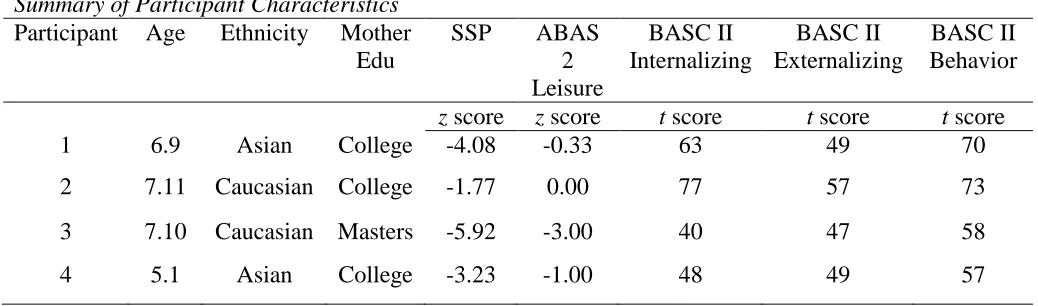
processing challenges, presenting problems, and program parameters are described below (see Table 1).
Table 1
Summary of Participant Characteristics
Participant Age Ethnicity Mother Edu
SSP ABAS
2 Leisure
BASC II Internalizing
BASC II Externalizing
BASC II Behavior
z score z score t score t score t score
1 6.9 Asian College -4.08 -0.33 63 49 70
2 7.11 Caucasian College -1.77 0.00 77 57 73
3 7.10 Caucasian Masters -5.92 -3.00 40 47 58
4 5.1 Asian College -3.23 -1.00 48 49 57
Participant 1. CI is a 6-year, 9-month-old male with significant sensory processing challenges that interfered with daily life function. He was sensitive to touch, sound, movement, and visual stimuli and had decreased vestibular and proprioceptive discrimination. He was reported to be clumsy with poor motor planning, ideation, and sequencing, and to have difficulty making friends and engaging in play.
range, specific questions related to play were identified by the parents as problem areas, such as tends to play alone, does not organize games with friends, or does not invite others to play.
CI received 22 treatment sessions; he was seen every day and sometimes twice a day over a 3-week period.
Participant 2. TH is a 7-year, 11-month old male who did not have any known diagnoses. He was sensitive to sound, movement, smell, and touch, and craved visual stimuli. Motor planning and postural challenges were noted with below average standard score in body coordination (SS = 38, z = -1.25) on the BOT-2. Scores on the SSP were also below average and there was clinically significant internalizing behavior as well as behavioral problems on the BASC. Decreased social interaction with peers and immature play skills are attributed to his sensory over responsivity and motor challenges. His score on the leisure subscale of the ABAS was in the average range; however, specific questions related to social interaction were identified by his parents as problem areas, such as difficulty with turn taking, initiation of play scenarios, and engaging in community activities with others.
TH received 22 treatment sessions; he was seen three times per week for 5 weeks, with a 2-week break, and then resumed therapy twice a week for the remaining seven sessions.
Participant 3. CC is a 7-year, 10-month old male with a diagnosis of attention deficit and hyperactivity disorder. He was sensitive to sound, touch, and smell, and had decreased tactile, proprioceptive, and vestibular discrimination. He had poor posture, poor motor planning, decreased bilateral coordination, and poor ideation. This was evidenced by clinically significant sensory symptoms on the SSP as well as motor impairments as measured by the SIPT (Praxis on verbal command, -3.0; Design copying, -2.43; Postural praxis, -1.49; Oral praxis, -3.0; Sequencing praxis, -3.0; Bilateral motor coordination -2.28; Standing walking balance, -3.0; Motor accuracy, -2.33). Clinical observation
confirmed delayed gross motor skills, difficulty following directions, difficulty with social interactions, and immature play skills. Score on the leisure subscale of the ABAS was in the clinically significant range.
CC had 20 treatment sessions; he was seen twice a week for 7 weeks, had a 2-week break, and then was seen once a week for the remaining six sessions.
Participant 4. OS is a 5-year, 1-month old male without a formal diagnosis. He was sensitive to sound, touch, food textures, and movement, and he was reportedly under responsive to interoceptive stimuli. He had motor impairments that included poor posture, poor motor planning, decreased bilateral coordination, and problems sequencing motor tasks.
Scores were in the clinically significant range for sensory symptoms on the SSP. Visual motor, fine motor, and gross motor impairments were noted on the MFUN (SS = 4, z = -2.00; SS = 5, z = -1.67; SS = 1, z = -3.00, respectively) with below average adaptive behaviors on the ABAS. These motor and sensory symptoms were linked to reported difficulty making friends and engaging in social interactions, especially during play. His score on the leisure subscale of the ABAS was in the below average range.
OS received 32 treatment sessions; 23 of those sessions were during participation in the study. He was seen three times a week for 6 weeks, followed by a 5-week break before returning for the remaining five sessions.
Feasibility
scheduling challenges. Thus, conclusions made about the effectiveness of the intervention must be considered tentative.
Behavioral Coding Scheme
The behavioral coding scheme was sensitive to measuring outcomes in the natural environment of the playground. Changes in performance were quantified with respect to the frequency of occurrence of each behavior. Variables related to play and social participation (e.g., parent joining and joint
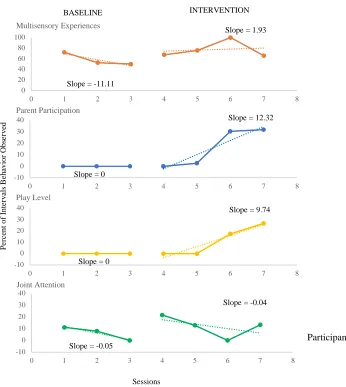
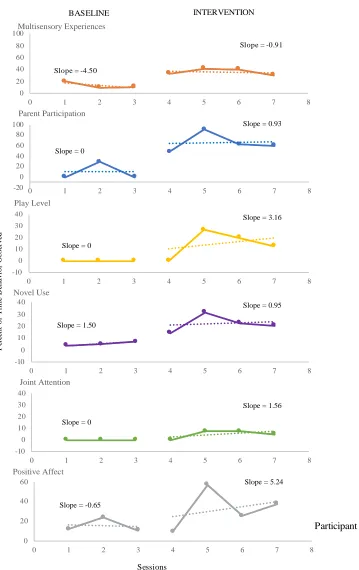
attention) were observed, scored, and plotted on graphs for all four participants. Figures 1 through 4 display data for each participant’s dependent variables using this behavioral coding scheme.
All variables were coded and evaluated for inclusion. The following variables met the inclusion criteria by having a relatively stable or declining baseline: multisensory experiences
(tactile/proprioception or tactile/proprioception/vestibular), parent participation (parent joins or parent engaged), play level (cooperative or associative), joint attention (initiates or responds),positive affect, andnovel use. Self-esteem, motor planning, and verbalizations did not meet inclusion criteria for any participant. Three baseline data points were collected for each variable in keeping with single-subject design procedures.
The basic procedure was to visually inspect a graph and to compare baseline levels with
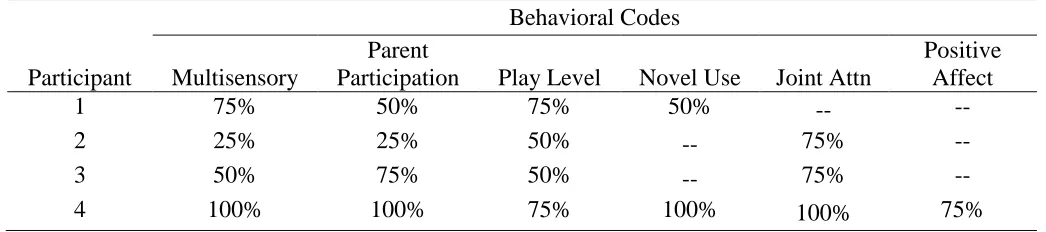
intervention conditions levels. To illustrate different intervention effects noted in a single subject design, there are examples of no effects, weak effects, moderate effects, and strong effects in the following graphs. This determination was based on the calculation of percentage of nonoverlapping data (PND), which is a widely accepted method for evaluating treatment effectiveness (Olive & Franco, 2008). The recommended interpretation is as follows: scores below 50 are considered to reflect no effect, scores between 50 and 70 are considered weak effects, scores between 70 and 90 are considered moderate effects, and scores above 90 are considered strong effects. See Table 2 for summary of the PND data.
Table 2
Percent Nonoverlapping Data (PND)
Behavioral Codes
Participant Multisensory
Parent
Participation Play Level Novel Use Joint Attn
Positive Affect
1 75% 50% 75% 50% -- --
2 25% 25% 50% -- 75% --
3 50% 75% 50% -- 75% --
4 100% 100% 75% 100% 100% 75%
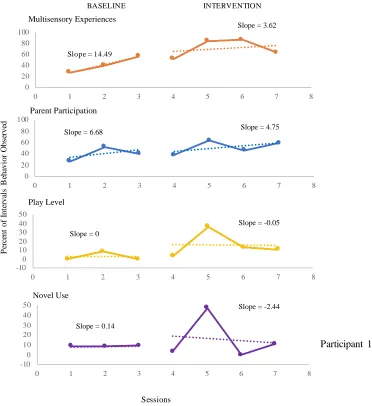
The graphs for Participant 1 show moderate effects for play level and weak effects for novel use.
This conclusion is based onintervention level being slightly higher than the baseline level and the PND data. It is noteworthy that baseline was relatively stable for both of these conditions. In contrast,
multisensory experiences and parent participationhad weak effects based on the PND. There was a slightly ascending baseline for multisensory experience and greater overlap between baseline and intervention data points for parent participation.
Neither positive affect nor joint attention had stable baselines; therefore they are not shown. The percent of time in play level increased from a baseline average of 2.9 (range = 0 to 8.7) to an
baseline mean of 9.05 (range = 8.70 to 9.38) to an intervention mean of 15.48. (range = 0 to 47.37) (see Figure 1). This is considered moderate effects for play level and weak effects for novel use.
Figure 1. Percent of intervals behavior was observed for Participant 1.
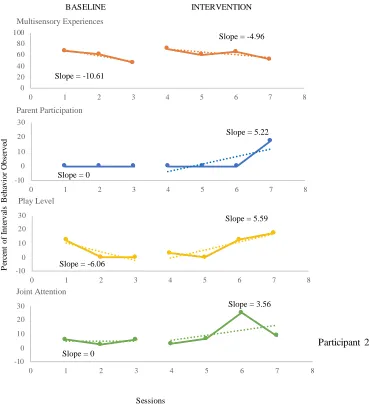
Participant 2 had also had weak to moderate effects. There was a descending baseline for play level but a moderate degree of overlap between baseline and intervention based on the PND. Joint attention had some variability during baseline but the baseline was relatively flat and there was little overlap between baseline and intervention phases (see Table 2). Positive affect and novel use showed excessive variability with an increasing baseline phase and overlap in data points from baseline to intervention; therefore, they were not included.
Play level increased from a baseline mean of 4.04 (range = 0 to 12.12) to an intervention mean of 8.21 (range = 0 to 17.39). Joint attention increased from baseline mean of 4.85 (range = 2.44 - .06) to an intervention mean of 10.83 (range = 2.94 to 25) (see Figure 2).
0 20 40 60 80 100
0 1 2 3 4 5 6 7 8
Multisensory Experiences
Slope = 3.62
0 20 40 60 80 100
0 1 2 3 4 5 6 7 8
Parent Participation
Slope = 6.68 Slope = 4.75
-10 0 10 20 30 40 50
0 1 2 3 4 5 6 7 8
Play Level
Slope = 0
Slope = -0.05
-10 0 10 20 30 40 50
0 1 2 3 4 5 6 7 8
Novel Use
Slope = 0.14
Slope = -2.44 BASELINE INTERVENTION
P
er
ce
n
t
o
f
In
te
rv
al
s
B
eh
av
io
r
O
b
se
rv
ed
Participant 1
Sessions
Figure 2. Percent of intervals behavior was observed for Participant 2.
These are considered weak effects for play level and moderate effects for joint attention. Multisensory experiences and parent participationhad no effects based on the percent overlap (PND) between the baseline and intervention phases.
The graphs for Participants 3 and 4 showed both moderate and strong intervention effects (see Figures 3 and 4). This is supported by the PND showing minimal overlap of intervention data with the baseline data and evidence of growth following the introduction of intervention (e.g., moderate effects) or no overlap between baseline and intervention data and evidence of accelerated growth following intervention (e.g., strong effects).
Participant 3 had a stable baseline for play level. There was a decrease in novel use during intervention, so this variable was also not included. Play level increased from a baseline mean of 0 (range = 0) to an intervention mean of 11.01 (range = 0 to 26.67). However, because of the overlap between baseline and intervention data, this was considered a weak effect. Joint attention increased from a baseline mean of 6.33 (range = 0 to 11.11) to an intervention mean of 11.94 (range = 0 to 21.62). Effects are considered moderate based on the PND score. Moderate intervention effects are noted for parent participation and weak effects for multisensory experiences (see Figure 3 and Table 2).
0 20 40 60 80 100
0 1 2 3 4 5 6 7 8
Multisensory Experiences
Slope = -10.61
Slope = -4.96
-10 0 10 20 30
0 1 2 3 4 5 6 7 8
Parent Participation
Slope = 0
Slope = 5.22
-10 0 10 20 30
0 1 2 3 4 5 6 7 8
Play Level
Slope = -6.06
Slope = 5.59
-10 0 10 20 30
0 1 2 3 4 5 6 7 8
Joint Attention
Slope = 0
Slope = 3.56
BASELINE INTERVENTION
P
er
ce
n
t
o
f
In
te
rv
al
s
B
eh
av
io
r
O
b
se
rv
ed
Sessions
Figure 3. Percent of intervals behavior was observed for Participant 3.
Participant 4 had a stable or declining baseline for all variables studied. Improvements were reflected in play level, positive affect, joint attention, and novel use. Play levelincreased from a baseline mean of 0 (range = 0) to an intervention mean of 12.94 (range = 7.14 to 21.95 Novel use had a baseline mean of 5.33 (range = 4 to 7) and an intervention mean of 22.25 (range = 14.29 to 31.71). Joint attention had a baseline mean of 0 (range = 0) and an intervention mean of 4.99 (range = 0 to 7.5). Positive affect had a mean baseline level of 15.51 (range = 10.71 to 23.81) and a mean intervention level of 32.45 (range = 9.52 to 57.14). These are considered strong effects for multisensory experiences, parent participation, positive affect, and novel use. Moderate effects are seen for play level and joint attention (see Figure 4).
0 20 40 60 80 100
0 1 2 3 4 5 6 7 8
Multisensory Experiences
Slope = -11.11
Slope = 1.93
-10 0 10 20 30 40
0 1 2 3 4 5 6 7 8
Parent Participation
Slope = 0
Slope = 12.32
-10 0 10 20 30 40
0 1 2 3 4 5 6 7 8
Play Level
Slope = 0
Slope = 9.74
-10 0 10 20 30 40
0 1 2 3 4 5 6 7 8
Joint Attention
Slope = -0.05
Slope = -0.04
BASELINE INTERVENTION
P
e
rc
en
t
o
f
In
te
rv
a
ls
B
e
h
av
io
r
O
b
se
rv
ed
Sessions
Figure 4. Percent of intervals behavior was observed for Participant 4.
Theory of Change
Variables were plotted in relation to sensory features and parent participation to explore the theory of change for this intervention. Neither Participant 1 nor Participant 2 showed a consistent treatment effect for multisensory experiencesorparent participation, so that it is unclear what contribution to change these variables had for these two participants.
0 20 40 60 80 100
0 1 2 3 4 5 6 7 8
Multisensory Experiences -20 0 20 40 60 80 100
0 1 2 3 4 5 6 7 8
Parent Participation
Slope = 0
Slope = 0.93
-10 0 10 20 30 40
0 1 2 3 4 5 6 7 8
Play Level
Slope = 0
Slope = 3.16
-10 0 10 20 30 40
0 1 2 3 4 5 6 7 8
Novel Use
Slope = 1.50
Slope = 0.95
-10 0 10 20 30 40
0 1 2 3 4 5 6 7 8
Joint Attention
Slope = 0
Slope = 1.56
0 20 40 60
0 1 2 3 4 5 6 7 8
Positive Affect
Slope = -0.65
Slope = 5.24
BASELINE INTERVENTION
P er ce n t o f T im e B eh av io r O b se rv ed
Slope = -4.50
Slope = -0.91
Sessions
Data from Participants 3 and 4 partially support the theory of change of the STAR PROCESS. For Participant 3, increases in bothparent participation and multisensory experiences suggest an association with play level. That is, improvements noted in play leveltended to parallelparent
participation and multisensory experiences. For Participant 4, data suggest that increases in bothparent participationand multisensory experienceswere associated with gains in play level, positive affect, and novel use.
Wilcoxon signed ranks test showed the means of play level, multisensory experiences, and parent participation were not significant (p = .068 for all) but changed in the expected direction.
Discussion Feasibility
The results of this study suggest that a single subject research design (SSRD) was a feasible methodology for studying behavioral changes in this population. Each participant showed gains in play level and parent participation in play. These are two important aims of the STAR PROCESS and they were reliably measured using a SSRD.
Some outcomes, however, might have been constrained based on the unique features of the equipment selected. The sand and water table is an open sandbox where the parent and child had room to play together, which potentially invited more associative, cooperative, or symbolic play. Although the roller slide can support a child and an adult at the same time, two of the parents were reluctant to play on the slide with their child because of perceived size restrictions, or because they assumed it was only for children. Those parents tended to stand next to the slide, encouraging their child to play rather than fully joining in the play.
There were also some challenges based on the time frame for collecting baseline data and parents adjusting their schedules to come for observations during intervention. For nonconcurrent SSRDs, baseline data is typically collected until the probe is stable, at which point intervention is introduced. The caregivers in this study could only come in three times before intervention started (e.g., at the initial evaluation, goal setting session, and first day of treatment). This meant that only three baseline data points could be gathered, which may account for some of the unstable baseline measures obtained. During the treatment phase of data collection, we asked the parents to bring their children in 15 min early to a session once a week. Some appointments, however, were sometimes unintentionally missed and had to be rescheduled, thus reducing the amount of data collected during intervention to only four sessions. Therefore, conclusions regarding treatment effectiveness must be considered tentative. A greater number of data points is suggested for future studies.
For in vivo clinical studies, it is not uncommon for practical considerations to preclude idealized implementation of SSRD. In such cases, as herein, fixed baselines can be used in nonconcurrent multiple baseline designs. The data can, nonetheless, be evaluated for intervention effects. In this study,
additional intervention data would have been collected for those showing weak effects because some of the latter data points may have continued to increase over time. One of the challenges of conducting clinical studies, particularly a nonconcurrent multiple baseline, repeated measures design, is that the study design may be dictated by external factors as they were here, such as the need to start intervention or reduced opportunities to collect intervention data.
that is seen in the results of this study. Each participant in this study had at least one variable that showed a moderate to strong effect: Participant 1 showed gains in play level; Participant 2 had gains in joint attention; Participant 3 had gains in joint attention; and Participant 4 had gains in parent
participation, play level, and novel use. This kind of differential effect was also reported in a study of speech intervention and Down syndrome, for which different variables showed different levels of response by the participant, including no effects, weak effects, moderate effects, and strong effects (Camarata, Yoder, & Camarata, 2006). We hypothesize this variability may have been because of a shift in the focus of intervention for two of the participants, which was revealed in the therapists’ treatment notes. English was not the first language for Participant 1, and culturally his mother was not as
comfortable being a play partner to her son. Treatment priorities shifted during his program to areas related to self-care and handwriting. A similar shift occurred for Participant 2, whose treatment program was modified to school performance. Of interest is that the therapist reported at the end of treatment that both parents reported changes in their child’s social interaction abilities with peers, even though play with the parent did not reflect change.
Behavioral Coding Scheme
In general, the behavioral coding scheme was sensitive to the change from participation in the STAR PROCESS intervention. The STAR PROCESS led to an increase in play level across all four participants. Two of the participants showed gains in novel use of the equipment, which is related to praxis and ideation, and one of those participants also showed gains in positive affect. Two of the participants showed improvement in joint attention, thought to be associated with improvements in play level. The codes that were used captured the multisensory features of the interactions, as well as parent level of participation, both central to our theory of change.
Codes related to pride, motor planning, and verbalization did not meet the criteria for inclusion as outcomes for this study primarily because of unstable baselines. A solution to this is to conduct follow-up studies using concurrent idealized designs with longer multiple baselines. It is possible that this was dictated by the equipment selected for data collection and the characteristics of the participants in this study. For example, the sand and water table and the roller slide did not require a high degree of motor planning and may not have been enough of a motor challenge to have elicited prideful behavior (e.g., behavior reflecting a sense of accomplishment, self-confidence, or self-esteem). In addition, the children in this study were highly verbal and did not have goals associated with improving spontaneous or elicited verbalizations.
Theory of Change
This study offers tentative support for the theory of change of the STAR PROCESS.
Multisensory experiences and parent participation were associated with changes in behavior in two of the four participants. Evidence from these participants showed increases in play level that paralleled parent participation while showing concurrent increases in multisensory experiences on the playground equipment. For these participants, we hypothesize that parent coaching was an effective tool to help their child problem-solve solutions in the natural environment of home, school, or the community. Changes in play level could have occurred because the parent was a more effective play partner and was able to support the child in higher level play skills.
for those two participants. The inclusion of the sand and water table as well as the roller slide ensured that the body-centered senses were targeted.
For the two participants whose data did not support the theory of change, we hypothesize that the shift in therapeutic priorities toward self-care and school performance may have affected our ability to evaluate associations between variables. Future study of the STAR PROCESS will help address this question.
One area that shows promise for inclusion in future studies of the STAR PROCESS is play. We propose that through parent participation, not only were parents able to promote gains in their child’s play skills, but also, as active play partners, to support their child’s social development. We submit that caregivers can provide the scaffolding and support for their children to develop optimal skills through guided play experiences; experiences where adults supplement the child-led exploration of the
environment. Further evidence is needed to validate the premise that supporting caregivers in therapeutic ways to play with their child is an important component of intervention for children with sensory
processing and integration challenges.
Lessons Learned
This study provided the opportunity to learn about the benefits and challenges of conducting clinical research and the use of a repeated measures, multiple baseline design. The biggest challenge faced was in the collection of baseline data. Multiple factors contributed to this challenge: (a) parents did not want to come to the center if their child did not have a therapy appointment, (b) parents did not want to put off the start of treatment for the collection of baseline data, and (c) parents did not have time to attend additional appointments for the collection of more intervention data points. As a result, there were only three baseline observations for each participant, as this coincided with appointments that were part of the STAR procedures prior to the intervention beginning.
The parents were also somewhat inconvenienced by having to come to therapy appointments 15 min early to collect probe data during the intervention phase of the study. On several occasions, they either were not able or forgot to come early and sessions were missed or had to be rescheduled.
The playground was an effective setting for the collection of data, but it also had unique challenges. When there was inclement weather, observation sessions needed to be rescheduled. In addition, the children may have had limited sensory and motor opportunities because of our choice of equipment. In the future, choice of equipment could be individualized based on the child’s preferences. Of interest might also be to see how behaviors may vary from play with the parent to play with a peer.
Conclusion
This study used a single subject research design to study the effectiveness of the STAR
challenges and their ability to engage in physical and social interactions with peers. Thus, this study continues to build the body of literature on the importance of enhancing play abilities and demonstrates play as a consistent outcome in sensory-based clinical practice.
References
Ayres, A. J. (1972). Sensory integration and learning disorders. Los Angeles, CA: Western Psychological Services.
Ayres, A. J. (1989). Sensory integration and praxis tests (SIPT). Los Angeles, CA: Western
Psychological Services.
Bar-Shalita, T., Vatine, J.-J., & Parush, S. (2008). Sensory modulation disorder: A risk factor for
participation in daily life activities.
Developmental Medicine & Child Neurology, 50(12), 932-937. https://doi.org/10.1111/j.1469-8749.2008.03095.x
Bialer, D. S., & Miller, L. J. (2011). No longer a secret: Unique common sense strategies for children with sensory or motor challenges. Arlington, TX: Sensory World.
Bruininks, R. H., & Bruininks, B. D. (2005). Bruininks-Oseretsky test of motor proficiency, (BOT-2) (vol. 2). Minneapolis, MN: Pearson Assessment. Bulkeley, K., Bundy, A., Roberts, J., & Einfeld, S. (2013).
ASD intervention research in real world contexts: Refining single case designs. Research in Autism Spectrum Disorders, 7(10), 1257-1264.
https://doi.org/10.1016/j.rasd.2013.07.014 Bulkeley, K., Bundy, A. C., Roberts, J., & Einfeld, S.
(2016). Family-centered management of sensory challenges of children with autism: Single-case experimental design. American Journal of Occupational Therapy, 70(5),
7005220040p7005220041-7005220040p7005220048.
https://doi.org/10.5014/ajot.2016.017822 Camarata, S., Yoder, P., & Camarata, M. (2006).
Simultaneous treatment of grammatical and speech-comprehensibility deficits in children with Down syndrome. Down Syndrome Research and Practice, 11(1), 9-17.
https://doi.org/10.3104/reports.314
Cohn, E. S., Kramer, J., Schub, J. A., & May-Benson, T. (2014). Parents’ explanatory models and hopes for outcomes of occupational therapy using a sensory integration approach. American Journal of Occupational Therapy, 68(4), 454-462. https://doi.org/10.5014/ajot.2014.010843 Cosbey, J., Johnston, S. S., Dunn, M. L., & Bauman, M.
(2012). Playground behaviors of children with and without sensory processing disorders. Occupational Therapy Journal of Research: Occupation, Participation, and Health, 32(2), 39-47. https://doi.org/10.3928/15394492-20110930-01
Dunn, W., Cox, J., Foster, L., Mische-Lawson, L., & Tanquary, J. (2012). Impact of a contextual intervention on child participation and parent competence among children with autism spectrum disorders: A pretest-posttest repeated-measures design. The American Journal of Occupational Therapy, 66(5), 520-528. https://doi.org/10.5014/ajot.2012.004119 Dunstan, E., & Griffiths, S. (2008). Sensory strategies:
Practical support to empower families. New Zealand Journal of Occupational Therapy, 55(1), 5-13.
Graham, A., & Fitzgerald, R. (2010). Exploring the promises and possibilities for children's participation in family relationship centres. Family Matters, 84.
Greenspan, S. I., & Wieder, S. (2007). The developmental individual-difference, relationship-based
(DIR/Floortime) model approach to autism spectrum disorders. In E. Hollander & E. Anagnostou (Eds.), Clinical manual for the treatment of autism (pp. 179-209). Arlington, VA: American Psychiatric Publishing, Inc. Gutstein, S. E. (2009). The RDI book: Forging new
pathways for autism, Asperger's and PDD with the relationship development intervention program. Houston, TX: Connections Center Publishing.
Harrison, P., & Oakland, T. (2003). Adaptive behavior assessment system-II (ABAS-II). San Antonio, TX: Psychological Corporation.
Matsushima, K., & Kato, T. (2013). Social interaction and atypical sensory processing in children with autism spectrum disorders. Hong Kong Journal of Occupational Therapy, 23(2), 89-96. https://doi.org/10.1016/j.hkjot.2013.11.003 McIntosh, D. N., Miller, L. J., Shyu, V., & Dunn, W.
(1999). Overview of the short sensory profile (SSP). In W. Dunn (Ed.), The sensory profile user's manual (pp. 59-73). San Antonio, TX: The Psychological Corporation.
Miller, L. J. (2006). Miller function and participation (MFUN) scales manual. San Antonio, TX: Pearson Assessment.
Miller, L. J., Schoen, S. A., Camarata, S. M., McConkey, J., Kanics, I. M., Valdez, A., & Hampton, S. (2017). Play in natural environments: A pilot study quantifying the behavior of children on playground equipment. Journal of Occupational Therapy, Schools, & Early Intervention, 10(3), 213-231.
Miller, L. J., Schoen, S. A., & Mulligan, S. (2018). Sensory processing three dimentions scale (SP3D). Unpublished manuscript.
Miller, L. J., Schoen, S. A., & Spielmann, V. A. (2019). A frame of reference for sensory processing difficulties: Sensory therapies and research (STAR). In P. Kramer, J. Hinojosa, & T.-H Howe (Eds.), Frames of reference for pediatric occupational therapy (4th ed.). Philadelphia: Wolters Kluwer.
Miller-Kuhaneck, H., Tanta, K. J., Coombs, A. K., & Pannone, H. (2013). A survey of pediatric occupational therapists’ use of play. Journal of Occupational Therapy, Schools, & Early Intervention, 6(3), 213-227.
https://doi.org/10.1080/19411243.2013.850940 Nijhof, S. L., Vinkers, C. H., van Geelen, S. M., Duijff, S.
N., Achterberg, E. M., van der Net, J., . . . Lesscher, H. M. (2018). Healthy play, better coping: The importance of play for the development of children in health and disease. Neuroscience and Biobehavioral Reviews, 95, 421-429.
https://doi.org/10.1016/j.neubiorev.2018.09.024 O'Donnell, S., Deitz, J., Kartin, D., Nalty, T., & Dawson,
N. G. (2012). Sensory processing, problem behavior, adaptive behavior, and cognition in preschool children with autism spectrum disorders. American Journal of Occupational Therapy, 66(5), 586-594.
https://doi.org/10.5014/ajot.2012.004168 Olive, M. L., & Franco, J. H. (2008). (Effect) size matters:
And so does the calculation. The Behavior Analyst Today, 9(1),5-10.
https://doi.org/10.1037/h0100642
Prizant, B. M., Wetherby, A. M., Rubin, E., Laurent, A. C., & Rydell, P. J. (2005). The SCERTS [TM] model: A comprehensive educational approach for children with autism spectrum disorders. Baltimore, MD: Brookes Publishing Company. Reynolds, C. R., & Kamphaus, R. W. (2003). Behavior
assessment system for children (BASC-2) (2nd ed.). Circle Pines, MN: AGS Publishing. Richards, S. B. (2018). Single subject research:
Applications in educational settings (vol. 3). Boston, MA: Cengage Learning.
Romeiser‐Logan, L., Slaughter, R., & Hickman, R. (2017). Single‐subject research designs in pediatric rehabilitation: A valuable step towards knowledge translation. Developmental Medicine & Child Neurology, 59(6), 574-580.
https://doi.org/10.1111/dmcn.13405
Schaaf, R. C., Burke, J. P., Cohn, E., May-Benson, T. A., Schoen, S. A., Roley, S. S., . . . Mailloux, Z. (2014). State of measurement in occupational therapy using sensory integration. American Journal of Occupational Therapy, 68(5), e149-e153. https://doi.org/10.5014/ajot.2014.012526
Schaaf, R., & Mailloux, Z. (2015). Clinician's guide for implementing Ayres sensory integration:
Promoting participation for children with autism. Bethesda, MD: AOTA Press.
Watts, T., Stagnitti, K., & Brown, T. (2014). Relationship between play and sensory processing: A
systematic review. American Journal of Occupational Therapy, 68(2), e37-e46. https://doi.org/10.5014/ajot.2014.009787 Weitlauf, A. S., McPheeters, M. L., Peters, B., Sathe, N.,
Travis, R., Aiello, R., . . . Warren, Z. (2014). Therapies for children with autism spectrum disorder. Comparative Effectiveness Review,137. Whitcomb, D. A., Carrasco, R. C., Neuman, A., & Kloos,
H. (2015). Correlational research to examine the relation between attachment and sensory
modulation in young children. American Journal of Occupational Therapy, 69(4), 6904220020p1. https://doi.org/10.5014/ajot.2015.015503 Wilkes-Gillan, S., Bundy, A., Cordier, R., & Lincoln, M.
(2014). Evaluation of a pilot parent-delivered play-based intervention for children with attention deficit hyperactivity disorder. The American Journal of Occupational Therapy, 68(6), 700.