San Diego Law Review
Volume 28 | Issue 2 Article 4
5-1-1991
Antitrust and Professional Rules: A Framework for
Analysis
John E. Lopatka
Follow this and additional works at:https://digital.sandiego.edu/sdlr
Part of theLaw Commons
This Article is brought to you for free and open access by the Law School Journals at Digital USD. It has been accepted for inclusion inSan Diego Law Reviewby an authorized editor of Digital USD. For more information, please [email protected].
Recommended Citation
Antitrust and Professional Rules: A
Framework for Analysis
JOHN E. LOPATKA*
TABLE OF CONTENTS
I. INTRODUCTION ... 301
II. THE NATURE OF PROFESSIONAL RULES ... 305
III. ANTICOMPETITIVE THEORIES OF PROFESSIONAL RULES ... 311
A. Fixing Price Above Marginal Cost ... 311
B. Increasing Consumers' Search Costs ... 317
C. Increasing the Marginal Costs of Marginal Suppliers ... 323
D. Raising the Marginal Costs of All Suppliers ... 326
E. Raising the Fixed Costs of New Entrants ... 332
F. Collusively Manipulating Demand ... 333
IV. WELFARE-ENHANCING THEORIES OF PROFESSIONAL RULES ... 336
A. Lowering the Marginal Costs of Supply ... 337
B. Increasing Demand ... 342
V. APPLICATION OF THEORIES TO FACTS ... 359
A. Possible Antitrust Rules ... 360
1. Categoric illegality ... 360
2. M ass. Board review ... 375
3. Flexible rule of reason ... 379
B. Analytical Guidelines ... 381
VI. CONCLUSION ... 385
I. INTRODUCTION
To be a professional society is to have rules.' What distinguishes a group of professionals from mere purveyors, merchants, and
* Professor of Law, University of South Carolina. I thank Joe Kattan and William H. Page for thoughtful comments. I also acknowledge a special debt of gratitue to Joseph Simons. Many of the ideas contained in the article emerged from long and occasionally arduous discussions we had while analyzing cases at the Federal Trade Commission. I am, of course, solely responsible for the views expressed here.
tradespeople is a perception among the group, which can be exported to consumers of their services, that they adhere to standards of ad-mission and behavior that somehow separate them from non-profes-sionals. At the least, a professional association would like to believe that its members conform to some norms that set them apart from others.
Two still recent strains in the evolving economic analysis of behav-ior bear upon the proper approach to professional rules. They not only bear upon it, they run head long into each other. First, the firmly established economic capture theory of regulation posits that government regulation is a good that is provided in accordance with the fundamental laws of supply and demand.' A group of suppliers, including suppliers of professional services, may attempt to obtain regulation from the government to serve their economic interests at the expense of others, usually consumers. An extension of this theory is that subgroups of suppliers may demand regulation that benefits them at the expense of other suppliers, as well as consumers.
The capture theory began as an explanation of government action, whereas professional codes can be adopted by private associations. However, public and private action tend to blend in the realm of ethical norms. A code may begin as the child of an association and be adopted by a government entity, thereafter claiming legitimacy from both sources and growing old under the influence of both. In-deed, professional societies sometimes attempt to attract members by stressing that they lobby government officials for regulation favorable to the profession.3 In the last few years, some scholars have advanced the idea that suppliers of a product or service can act privately to raise the costs of supply to increase their rents at the expense of consumers.4 This theory does not depend upon govern-ment action, and given the right circumstances, a professional code can be explained as a device manipulated to achieve the desired result.
associations").
2. See generally Stigler, THE THEORY OF EcONOMIc REGULATION, 2 BELL J. ECON. & MGMT. Sci. 3 (1971); Posnei, Theories of Economic Regulation, 5 BELL J.
ECON. & MGMT. Sci. 335 (1974); Stewart, The Reformation of American
Administra-tive Law, 88 HARV. L. REV. 1667 (1975); Peltzman, Toward a More General Theory of Regulation, 19 J. L. & ECON. 211 (1976). The possibility of economic capture has led one commentator to suggest a state action doctrine of antitrust immunity that distin-guishes between anticompetitive state acts that are the product of capture and those that are not. See Wiley, A Capture Theory of Antitrust Federalism, 99 HARv. L. REV. 713
(1986).
3. On the evolution of lobbying efforts by professional associations, see C. GILB, HIDDEN HIERARCHIES: THE PROFESSIONS AND GOVERNMENT 143-51 (1966).
4. See, e.g., Krattenmaker & Salop, Anticompetitive Exclusion Raising Rivals'
Costs to Achieve Power Over Price, 96 YALE L.J. 209 (1986) [hereinafter Krattenmaker
[VOL. 28: 301, 199"1] Antitrust
SAN DIEGO LAW REVIEW
The economic capture theory fits snugly, both historically and con-ceptually, into a legal and economic tradition that was hostile to hor-izontal agreements,5 even if it fits into other traditions as well. The classic manifestation of that tradition was Adam Smith's paranoia over intercourse among competitors, even meetings for "merriment and diversion."6 Someone suspicious of all horizontal cooperation and particularly that supported by government regulation is likely to view codes of professional associations as an inviting antitrust target. However, professional rules may also be considered in light of the economic theory of property rights, a theory that is as well respected among proponents of economic analysis as is the capture theory.7 The property theory rests on the premise that social value can in-crease through private investment. However, the investment will not be made unless investors can expect to recoup their economic costs, which means appropriating at least some of the enhanced value. In short, investors have to suppress rampant free riding. In theory, in-vestors could agree with all potential free riders that they will not free ride, and to the extent the agreements are enforceable, obtain a sufficient measure of private security. But the transaction costs asso-ciated with a contractual approach to property rights are likely to make such a strategy economically unfeasible. Hence, the state steps in to define property rights when externalities frustrate value maxi-mizing investments and cannot efficiently be eliminated through pri-vate arrangements.
Thus, the economic essence of a property system is to induce value-increasing investments by discouraging free riding. Profession-als may invest in cultivating a demand for their services by increas-ing at least the perceived quality of those services. When information is costly to acquire, some professionals may be able to appropriate the value of the enhanced demand without providing the quality of services that generated the greater demand. In the long run, all of the members of the profession as well as consumers will suffer as the value of the services erodes. A code of ethics may represent a private
5. For references to manifestations of the "inhospitality tradition of antitrust," a phrase attributed to Donald Turner, see Easterbrook, The Limits of Antitrust, 63 TEx. L. REV. 1, 4 (1984).
6. A. SMITH, THE WEALTH OF NATIONS 128 (Modern Library 1937) ("People of the same trade seldom meet together, even for merriment and diversion, but the conver-sation ends in ... some contrivance to raise prices.").
7. See generally R. POSNER, ECONOMIC ANALYSIS OF LAW 29-75 (3rd ed. 1986);
EcONOMIc FOUNDATIONS OF PROPERTY LAW (B. Ackerman ed. 1975); R. COOTER & T.
ULEN. LAW AND ECONOMIcS 88-210 (1988); De Alessi, The Economics of Property
agreement among professionals that they will not free ride on each other's investments in increasing the value of their services. If the value lost on account of free riding is not sufficient to justify the administrative cost of the state defining property rights, a private arrangement may be the only efficient method of stimulating produc-tive investments.
The fact that the association may enlist the aid of the state, per-haps by persuading the government to adopt its code as a regulatory scheme, does not necessarily mean that the association is attempting to secure anticompetitive rents. A code that enhances efficiency as a private response to free riding still needs to be enforced. A
profes-sional society may want to avoid the private costs of enforcement by persuading the government to assume those costs. Moreover, the power of a private association to prevent -free riding is limited. If a member violates an ethical rule, he or she may be expelled. How-ever, if membership signals quality, non-members who do not invest in providing services of the same quality will have an incentive to pass themselves off as members. To the extent that identifying mem-bership is costly for consumers, non-members may be able to free ride on the investments of members, and increase the association's costs of educating consumers. After all, the association cannot expel someone who does not belong to it.
Therefore, the association may turn to the state to suppress free riding more effectively than it can. One method of protecting mem-bers' investments is to have the state protect the association's trade-mark. The efficacy of this approach depends upon consumer recogni-tion of the trademark and their willingness to distinguish between "certified" and "uncertified" professionals. This approach also, at least partially, depends upon the investment the association makes in promoting the trademark.
Another way the state might suppress free riding is to force all suppliers to provide high quality services. Of course, to the extent that low quality service substitutes for high quality service, the de-mand for high quality service and the profits of high quality provid-ers will increase if low quality service is eliminated. Therefore, an association's attempt to persuade the state to eliminate competing services may represent anticompetitive rent-seeking behavior or ef-forts to deter welfare-reducing free riding.
[VOL. 28: 301. 1991] Antitrust
SAN DIEGO LAW REVIEW
working a partial integration of economic functions."
-It is ironic that disciples of economic analysis can resort to precepts of equal stature in either attacking or defending the ethical codes of professional associations. Government involvement in a sys-tem of ethics does not necessarily indicate whether the association's activities increase or decrease welfare. Scholars who disavow an effi-ciency model of antitrust interpretation are likely to be suspicious of private codes of ethics. They are also likely to subscribe to a public interest theory of regulation. These individuals would tend to prefer a state's code of professional behavior to one that is strictly the prod-uct of private agreement. Curiously enough, efficiency-based scholars who fear capture, though they too would be suspicious of ethical codes, would prefer a strictly private arrangement to one adopted by the government. Economic scholars who are concerned about free riding would find government involvement ambiguous.
In the end, we cannot simply declare that all professional codes are either efficiency-enhancing or efficiency-reducing, turn off the lights, and go home. This Article will first sketch the background of the legal and economic problem. It will next set out the anticompeti-tive theories of professional rules, and then the procompetianticompeti-tive, or welfare-enhancing explanations. The last section of the Article de-rives principles from this discussion and uses them to suggest a method of analysis for distinguishing anticompetitive rules from procompetitive ones.
II. THE NATURE OF PROFESSIONAL RULES
No definition of the term "profession" has ever been universally accepted, and this Article does not attempt to offer one.9 One scholar wrote, "To define 'profession' is to invite controversy."10 Part of the reason for the lack of a common definition is that many disciplines
8. One could summarize the last twenty years of antitrust evolution as follows, without doing too much damage to reality: All agreements were suspect. Chicago-school scholars argued that vertical arrangements were good and horizontal arrangements were bad. Another group of economists, to the cheers of traditional antitrust lawyers, argued that vertical arrangements really are bad. The Chicago-school then said horizontal ar-rangements may be good too. The war now rages on two fronts - what vertical arrange-ments are bad, and what horizontal arrangearrange-ments are good?
9. One commentator concluded, "There is a rather extensive literature of defini-tions of profession. Research into these writings reveals no general agreement on any 'authoritative' statement." Cogan, The Problem of Defining a Profession, 297 ANUALS Am. ACAD. POL. AND Soc. Sci., ETHICAL STANDARDS AND PROF. CONDUCT 105 (B.
Lan-dis ed. 1955) [hereinafter ETHICAL STANDARDS].
have studied the phenomenon of a profession, including philosophy, sociology, political science, history, and economics. The emerging definitions naturally reflect the distinct perspectives and purposes of the particular discipline. One commentator ventured the following definition in 1926: "A profession consists of a limited and clearly marked group of men who are trained by education and experience to perform certain functions better than their fellowmen."' In 1915, a social scientist proposed six criteria that identify a profession: "(1) intellectual operations coupled with large individual responsibilities, (2) raw materials drawn from science and learning, (3) practical ap-plication, (4) an educationally communicable technique, (5) ten-dency toward self-organization, and (6) increasingly altruistic motivation."'2
If one cannot successfully define what a profession is, one will not easily be able to describe what it is not. In particular, acclaim will not greet any effort to distinguish a profession from a trade.3 Cer-tainly at one time, the term profession was commonly associated only with the "learned" professions, such as law and medicine, occu-pations that require formal, post-secondary education.14 Though not similar in all important respects, in many respects that economists find important, lawyers and physicians are indistinguishable from barbers, opticians, and watchmakers.1"
11. C. TAEUSCH, PROFESSIONAL AND BUSINESS ETHICS 13 (1926).
12. Flexner, Is Social Work a Profession?, 1 Sch. & Soc'y 904 (1915), quoted in Cogan, supra note 9, at 106. For a description of attempts by British commentators to define "profession" and an attempt at synthesizing them, see G. MILLERSON, THE QUALI-FYING ASSOCIATIONS: A STUDY IN PROFESSIONALIZATION 1-13 (1964).
13. The Supreme Court once observed that the "classic basis traditionally ad-vanced to distinguish professions from trades, businesses, and other occupations" is that "enhancing profit is not the goal of professional activities; the goal is to provide services necessary to the community." Goldfarb v. Virginia State Bar, 421 U.S. 773, 786 (1975).
14. One scholar has explained that in England, before the industrial age, young men in the upper classes were not likely to enter the trades, by becoming a blacksmith, carpenter, tailor, or shopkeeper, because commercial morality was not high and because
those occupations did not pay enough. W. READER, PROFESSIONAL MEN: THE RISE OF
THE PROFESSIONAL CLASSES IN NINETEENTH-CENTURY ENGLAND 6 (1966). Rather, the occupations considered suitable for most "gentlemen" were
the 'liberal professions', and of those there were only three: divinity, physic, and law.
'Profession', by itself, was a word that could be used of any 'calling, voca-tion, known employment' . . . and it frequently turns up in the phrase
'mechanical professions', meaning the trades of skilled workmen. The force of much that later came to be absorbed into the word 'profession' was carried in the adjective 'liberal', which meant that the essential qualification for entry into any of these three occupations, which were sometimes also called the 'learned' professions, was a liberal education: that is, the education of a gen-tleman, not of a trader or an artisan.
Id. at 9-10.
15. The problem of distinguishing professions from other occupations is noted by one scholar in a recent economic survey of government regulation of occupations in the
(VOL. 28: 301, 1991] Antitrust SAN DIEGO LAW REVIEW
Fortunately, the analysis in this Article does not require a precise
definition. The analysis contemplates that a profession generally has
the following attributes: Practitioners provide a service, rather than
supply a product. They usually provide their service directly to
con-sumers, at least the demand side of the market is atomistic. The
ability to provide the service, as well as the manner in which it is provided, are commonly regulated by the government, but entry into the occupation by legally-qualified individuals is otherwise rather easy. Finally, the individual is often the economic entity supplying the service, though individuals also combine to form firms. In any event, the supply side of the market is also atomistic. As is clear
from this list, the term "profession" is used in this Article to denote
what are commonly considered professions and some less traditional
professionals.16
Professionals tend to form associations. These private associations establish rules that prescribe requirements for initial membership, or eligibility requirements. This Article addresses only those
associa-tions comprised primarily of members of the profession, that is, those
that are made up of competitors. The eligibility requirements of any
such association implicitly incorporate any qualifications imposed by
law for engaging in the profession. In theory, the association need
AMERICA 1-4 (1987). He chose to use the terms "profession" and "occupation" inter-changeably to avoid obscuring "the true economic forces at work in the regulation of occupational activity." Id. at 4.
16. In their papers explaining an anticompetitive theory of association rules, dis-cussed infra at notes 80-88 and accompanying text, Langenfeld and Morris assert that their analysis is applicable to any horizontal agreement. See Langenfeld & Morris, Rent
Increasing Costs: The Antitrust Implications from a Paradox in Value Theory, Bureau
of Econ., Fed. Trade Commission, Working Paper No. 182 (Nov. 1990) [hereinafter Langenfeld & Morris, Rent Increase Costs:]; Langenfeld & Morris, Analyzing
Agree-ments Among Competitors: What Does the Future Hold?, (Paper presented at the
Con-temporary Policy Session of the Western Economic Association's 65th Annual Confer-ence, San Diego, California) (June 1990) [hereinafter Langenfeld & Morris, Analyzing
Agreements]. Whether the mode of analysis suggested in this Article could be extended
to any horizontal agreement, has not been carefully considered herein. However, as a general matter, national trade associations consisting of firms with relatively high fixed costs selling tangible products tend not to have sufficient power to force members to comply with a code of conduct. These associations typically have not secured government adoption of their rules. And membership in the association has not been significant enough commercially that a firm would be economically compelled to adhere to the asso-ciation's code. Thus, a firm that could profit by engaging in conduct prohibited by such an association's code would likely leave the group.
not impose any additional eligibility requirement, though virtually all associations at least require the payment of an initiation fee or dues. However, an association may establish eligibility requirements that far exceed legal mandates. An association may constitute a very large or very small percentage of a profession. Accordingly, the pro-portion of any relevant market consisting of members may be large or small.
The rules of professional associations also typically contain restric-tions on the conduct of members, commonly called rules of ethics, but the nature, scope, and detail of these conduct restrictions vary enormously among associations.17 Codes of ethics can range from lit-tle more than a declaration that members will discharge their "du-ties with accuracy, thoughtfulness, and care,"' 8 to elaborate state-ments of principles and conduct imperatives, supported by case hypotheticals and commentary.19 Thus, ethical rules can command, prohibit, allow, encourage, exhort, or discourage behavior. They can specify obligations that are also imposed by statute, administrative regulation, or the common law. Indeed, they can simply state explic-itly that members will comply with the law.20 An association may
establish rules that are later adopted by a government authority,
17. One scholar, after surveying a variety of ethics codes, defined the following four types:
(1) The code which is a collection of specific rules of conduct, worded so as to apply with definiteness to situations faced by the members of the profession.... (2) One which is a collection of two types of articles - precise definitions of situations and what may be termed general principles or remote ideals. . . .(3) One which is a collection solely of general principles which set no standards and which cannot be classified as specific rules. (4) One which consists of general principles which are constantly applied to situa-tions through the rulings of a practice committee that attempts to accumulate precedents or a body of common law.
B. LANDIS, PROFESSIONAL CODES: A SOCIOLOGICAL ANALYSIS TO DETERMINE APPLICA-TIONS TO THE EDUCATIONAL PROFESSION 87-88 (Contributions to Education No. 267, 1927).
18. See, Code of Ethics of the American Society of Medical Technology, reprinted
in J. CLAPP, PROFESSIONAL ETHICS AND INSIGNIA 439 (1974). The principle provisions of
another code, adopted in 1921, enjoined the association's members, inter alia, to develop "in business the spirit of the Golden Rule," to "establish the spoken word on the basis of the written bond," and tor "assist liberally and sympathetically all that seeks to elevate humanity by charity of action and thought and by justice to all men through the 'Square Deal'." I could not resist contriving some excuse to mention that organization, which was made up of lumbermen, because of its name - the Concatenated Order of Hoe-Hoo.
See E. HEERMANCE, CODES OF ETHICS: A HANDBOOK 311-12 (1924). My only fear is
that the reference will inspire the reader to sum up this Article as some other assemblage of hoo-hoo.
19. See, e.g., the Code of Professional Responsibility of the American Bar Associa-tion or the Code of Professional Practice of the American Society of Landscape Archi-tects, the 1962 version of which is reported in J. CLAPP, supra note 18, at 396-402.
[VOL. 28: 301, 1991] Antitrust SAN DIEGO LAW REVIEW
then rescind or retain them. Conversely it may adopt a state's prior
restrictions or adopt restrictions simultaneously with the state.1
Cer-tainly the restrictions may specify obligations that are not founded
on any requirement of law. Indeed, the purpose of this Article is to
identify restrictions that violate the antitrust laws.
Associations vary in the extent to which they enforce their rules.
Some associations specify conduct restrictions but create no formal enforcement mechanism.2 "Obligations" that are not enforced have
little relevance to an analysis of the antitrust implications of profes-sional rules. 3 For agreements among competitors to be exclusionary, they must be enforced against the disadvantaged rivals. As Judge Easterbrook has written, "There can be no restraint of trade without
a restraint. ' 24 Collusive agreements, those designed to raise price
merely by consensual action of the parties to them, may be
at-tempted without an enforcement provision, but they are likely to be
short-lived. The incentive to cheat either by shading price or
avoid-ing costly business practices will become irresistible. In any event, it
is unlikely that a group of competitors would attempt to effectuate a
cartel agreement through an association and not enforce the pact.25
Therefore, the following discussion only covers rules that are
forced. A private association may use a variety of sanctions to
en-force its rules, including reprimand or suspension,26 but the ultimate and decisive club that an association wields is dismissal from
mem-bership. If private sanctions are not effective, the association may
turn to the state for help.
Conduct restrictions contained in a code of ethics need not be
en-forced according to their terms. A particular rule may be
competi-21. The term "state" is used throughout this Article as a synonym for any govern-ment authority. As a matter of fact, the regulation of professions in this country is gener-ally the province of state government, accomplished through legislation and administra-tive regulation, rather than federal government.
22. See, e.g., the American Personnel and Guidance Association, discussed in J. CLAPP, supra note 18, at 202-03; the American Society of Chartered Life Underwriters,
id. at 374; and the National Funeral Directors Association, id. at 314.
23. See generally, W. Moore, supra note 1, at 119 ("[w]ithout review and enforce-ment mechanisms, professional codes may be little more than window dressing, perhaps more designed to give false comfort to the laity than to guide the practitioner.").
24. Schachar v. Am. Academy of Ophthalmology, Inc., 870 F.2d 397, 397 (7th Cir. 1989).
25. For a discussion of private methods of enforcing cartel agreements, see Lopatka, The Case for Legal Enforcement of Price Fixing Agreements, 38 EMORY L. J. 1, 8-24 (1989).
26. See, e.g., the National Society of Interior Designers, discussed in J. CLAPP,
tively ambiguous, but enforced in an anticompetitive way. At the ex-treme, an association can enforce an obligation that is not found in a written code or even one that directly contradicts a written rule. For
antitrust purposes, the restriction is that which is enforced. The rules
examined in this Article are contained in association codes, however the reader must bear in mind that welfare-enhancing written obliga-tions do not necessarily increase welfare in practice.
This article concerns rules of private professional associations which govern eligibility and subsequent conduct when enforced.17 The object is to formulate a method of determining what rules de-crease economic welfare and are therefore good candidates for anti-trust condemnation. To do this, this Article will also assess the wel-fare-enhancing potential of these rules. First, the anticompetitive theories.
27. Throughout the Article, actual written rules of associations are used to illus-trate points. Association codes are normally revised over time, and the rules identified are taken from codes of various eras. For purposes of this analysis, early codes, especially those in force prior to 1950 or so, can be more illuminating than older ones. Rules adopted before associations perceived that they could violate the antitrust laws are likely to tell more about whether they should violate those laws, whether the rules were effi-cient. Today an association might avoid adopting an efficient rule, or adopt a less efficient alternative, only because it fears antitrust liability. In 1950, the Supreme Court held that price fixing by real estate brokers was a per se antitrust violation. United States v. Na-tional Ass'n of Real Estate Boards, 339 U.S. 485, 492 (1950). In 1975, the Court held that price fixing by attorneys violated the antitrust laws. Goldfarb v. Va. State Bar, 421 U.S. 773, 788 (1975). Yet in Goldfarb, the Court acknowledged that "until the present case, it is clear that we have not attempted to decide whether the practice of a learned profession falls within § 1 of the Sherman Act." Id. at 786 n.15. At least associations of "learned" professionals, then, were not sure that their rules could violate the antitrust laws until 1975, though they and other professional societies should have been concerned by 1950.
Clearly the associations of learned professionals in this country had codes long before 1950. The first code of the American Medical Association was adopted in 1848. See B. Landis, supra note 17, at 41. The American Bar Association adopted cannons of ethics in 1908. Id. at 26. The American Society of Civil Engineers was founded in 1852 and adopted a code. See C. TAEUSCH, supra note 11 at 100. The American Association of Engineers followed and adopted a code in 1915. See B. LANDIS, supra note 17, at 54. The
American Institute of Architects adopted canons of ethics in 1909. See Cummings,
Stan-dards of Professional Practice in Architecture, in ETHICAL STANDARDS, supra note 9, at
12. Many trade associations, however, appear to have adopted codes of conduct in the twenties. The impetus for these codes has been attributed to the Federal Trade Commis-sion, which in November of 1918 began to invite members of entire industries to submit in concrete form their conclusions about competitive practices they considered unfair.
[VOL. 28: 301, 1991] Antitrust SAN DIEGO LAW REVIEW
III. ANTICOMPETITIVE THEORIES OF PROFESSIONAL RULES
A number of anticompetitive theories have been offered either to explain or because they have clear application to horizontal restric-tions on either the conduct of professionals or their ability to prac-tice. As used here, the term "anticompetitive" refers to a decrease, in economic welfare, or the total of consumer and producer surplus,
that results from a restraint. It is possible for economic welfare to
shrink even when consumer welfare is unchanged. It is also possible
to hypothesize that competitors have a profit incentive to effectuate a
.restraint that reduces producer welfare but does not affect consumer surplus,2 8 though all the theories described below predict a loss of consumer welfare.
This article begins its discussion of anticompetitive theories with the most traditional. No attempt is made in this section, or the next, to assess whether a. theory is a viable explanation for all common ethical rules. Rather, common restrictions are selected to illustrate the applicability of each theory based upon their most obvious ef-fects. Some restraints will appear to have little to do with some theo-ries; conversely, some theories could apply to the same restraint. The importance of identifying the most likely explanation for a
restric-tion is discussed in Secrestric-tion V.
A. Fixing Price Above Marginal Cost
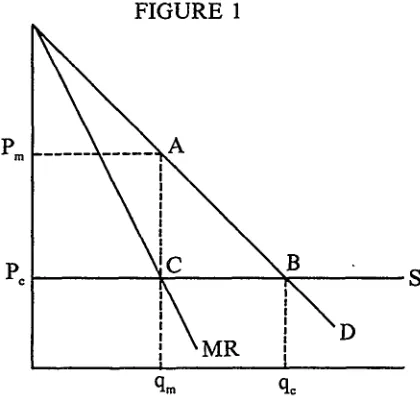
The classic explanation for a horizontal restraint on competition is that it enables suppliers to raise prices above marginal cost and re-duce output, ideally to supply the quantity identified by the intersec-tion of marginal cost and marginal revenue and to charge the corre-sponding price.29 The result is illustrated in Figure 1.30 The
28. A restraint conceivably could increase the profits of a particular supplier or group of suppliers yet reduce the profits of the remaining suppliers more than an offset-ting amount. If the changes in these profits are caused by changes in marginal costs while the price and quality-adjusted output of the industry remain unaffected, producer but not consumer welfare would decline. The restraint would not be in the interests of suppliers as a group, but the suppliers that would stand to gain may be able to secure the restraint against the opposition of the other suppliers. This postulate is essentially a vari-ant of the raising rivals' costs theory discussed below, in that under both hypotheses a restraint causes some suppliers to gain and others to lose. The difference is that the conventional raising rivals' costs explanation predicts a loss of consumer welfare.
29. Any microeconomics or industrial organization textbook will provide an analy-sis of the cartel model. See, e.g., D. CARLTON & J. PERLOFF, MODERN INDUSTRIAL OR-GANIZATION 209-11 (1990); H. KOHLER, INTERMEDIATE MICROECONOMIcs: THEORY AND
restriction does not affect the industry demand curve but does cause price to increase from Pc to Pro, and quantity to decrease from qe to
qm. This change produces the familiar deadweight loss represented by triangle ABC and a transfer of wealth from consumers to produc-ers represented by rectangle PmACPc. Suppliers have an incentive to engage in such a restriction because of the resulting economic rents.
FIGURE 1
PC S
N
MRqm qo
An obvious example of this kind of restriction is an agreement to fix the price of some service, such as an agreement among attorneys to charge specified fees for title searches and other common legal services. In essence, this was the allegation in Goldfarb v. Virginia State Bar.31 Similarly, United States v. National Association of Real Estate Boards32 involved an alleged agreement among real es-tate brokers to charge specified commissions for brokerage services. For this theory to work, the professional association that adopts the restraint must have market power vis-a-vis non-member profes-sionals.33 In other words, the association members must face a
down-30. The supply curve in Figure 1 is drawn as a horizontal line at p,. The analysis of this anticompetitive theory would not be affected if the supply curve sloped upward.
31. Goldfarb v. Va. State Bar, 421 U.S. 773, 775-76 (1975) (County bar associa-tion published a schedule of recommended minimum prices for common legal services, including 1 percent of the value of the property involved for a title examination).
[VOL. 28: 301, 1991] Antitrust SAN DIEGO LAW REVIEW
ward sloping demand curve; the more steeply sloped the demand
curve, the greater the potential monopoly profits, and the stronger
the incentive to collude.34 If non-members of the association can
eas-ily expand output in response to a curtailment by the members, and
assuming that consumers are adequately informed about fees, the
members will not be able to raise price. Consumers will simply switch to non-members if members raise price. In effect, the mem-bers will face a horizontal demand curve at the competitive price. This requisite market power in the association also implies that members cannot inexpensively leave the association to escape the ethical rule fixing price and compete against remaining members.
Adherence to a set of ethical restrictions may be mandated by law. This might be accomplished by a legal requirement that all pro-fessionals belong to a particular association, which then imposes a code of ethics on its members. For example, in states with integrated
bars, attorneys must belong to the state bar association in order to
practice law. The bar has its own set of ethical restrictions, and there
are no competing non-members.
Alternatively, a private association may convince a government to impose, legislatively or administratively, a set of restrictions as a condition for offering professional services. For instance, a society of
accountants may persuade a state board of accountancy to prescribe
a set of restrictions for all accountants in the state. In effect, the
association persuades the government authority to adopt its code of
ethics as the standard for the industry; professionals gain no compet-itive advantage in refusing to join, or by dropping out of the association. 5
example, if consumers are indifferent between financial planning offered by tax attorneys and that offered by tax accountants, the lawyers will have no market power even if all attorneys must belong to the bar association. One could view the two professions as pro-viding the same service, with non-members (accountants) competing with members (law-yers). Or one could view the services as distinct but interchangeable. With respect to professional services, a particular service often can be provided only by members of a single profession, and so it is usually more comfortable to use the concept of a single service offered by members or non-members of the association in conducting antitrust analysis.
34. See, e.g., D. CARLTON & J. PERLOFF, supra note 29, at 217.
35. This paper is concerned with theories of economic harm and benefit of ethical restrictions and the antitrust treatment that would therefore be appropriate. It does not focus on the application of legal doctrines that are based essentially on non-economic considerations. The Noerr-Pennington doctrine would most likely insulate a society from antitrust liability for persuading a government entity to adopt anticompetitive regula-tions. See Eastern R.R. Pres. Conf. v. Noerr Motor Freight, 365 U.S. 127 (1961); United Mine Workers v. Pennington, 381 U.S. 657 (1965). See generally 1 P. AREEDA
Membership in an association can also be an economic necessity.38
It may reduce the costs of providing professional services so that non-members cannot compete. This is the classic, though disputed, "essential facilities" doctrine.3 For instance, suppose participation in
a multiple listing service reduces the cost of facilitating real estate sales, so that non-participants cannot economically offer brokerage services. As long as the group did not set a price so high that non-members could survive in the market, a real estate broker would have to join the multiple listing service and adhere to its set of rules.38
Even if a professional association has market power, or has in-duced a government entity to ratify its ethical rules, the standard cartel explanation for ethical restrictions may be problematic. First, prices for heterogeneous services cannot easily be set by a cartel, and professional services are often heterogeneous.3 9 As the number of
variables in the value of a service increases, the process of fixing prices and of policing a cartel agreement become increasingly com-plex. The members cannot be capable of competing away the availa-ble profits on unrestricted dimensions of the service that make the service more valuable to consumers. If this theory applies, one would expect to see explicit price restrictions only on services that are fairly
protect the association from complying with the rules imposed. See supra note 2. This paper addresses only in passing the appropriate application of those doctrines.
36. Of course, an association with neither legal clout nor economic power can nonetheless declare that its mandates must be observed by the profession. The American Chiropractic Association, in its 1971 Code of Ethics, proclaimed, "The honor and dignity of the chiropractic profession may best be upheld, its sphere of influence expanded, and its science advanced through the association of all chiropractors in state and national organizations. Hence it is the duty of each chiropractor to associate himself with such bodies." See J. CLAPP. supra note 18, at 160.
37. The doctrine typically is traced back to United States v. Terminal R.R. Ass'n, 224 U.S. 383 (1912) (railroads that owned access to'the only means of crossing the Mississippi River at St. Louis were required to allow competing railroads to become joint owners). It has been applied subsequently to cooperation among news gatherers (Associ-ated Press v. United States, 326 U.S. 1 (1945)), among stockbrokers (Silver v. New York Stock Exch., 373 U.S. 341 (1963)), and, though the Court explicitly disclaimed reliance on it, between operators of ski lifts (Aspen Skiing Co. v. Aspen Highlands Ski-ing Corp., 472 U.S. 585 (1985)). The doctrine has recently been challenged in Reiffen & Kleit, Terminal Railroad Revisited: Foreclosure of an Essential Facility or Simple
Hor-izontal Monopoly?, 33 J. L. & EcoN. 419 (1990).
38. To distinguish clearly the cartel anticompetitive theory discussed in this sub-section from the theories discussed later, the reduction in cost brought about by member-ship must be unrelated to the ethical restriction at issue. For example, if the efficiencies offered by a multiple listing service do not require that participants set brokerage fees, a fee-setting agreement could be condemned without any loss in static efficiency. See infra note 95. If the restriction under investigation itself reduces cost, then it will not be an-ticompetitive. Theories of anticompetitive harm, described later, postulate that the re-striction increases cost and thereby reduces economic welfare.
39. See, e.g., R. POSNER. ANTITRUST LAW: AN ECONOMIC PERSPECTIVE 59-60 (1976); D. CARLTON & J. PERLOFF, supra note 29, at 221-22; F. SCHERER & D. Ross,
[VOL 28: 301. 1991] Antitrust SAN DIEGO LAW REVIEW
homogenous and invariant to quality. Indeed, the restrictions on at-torneys' fees in Goldfarb apparently applied only to rather mundane activities, such as title searches.4 0
Second, the number of suppliers of professional services in a geo-graphic market is likely to be quite large. As the number of suppliers increases, the costs of coordination and policing also increase.4 1 Any restraint that increases price above marginal cost invites cheating. Depending on the legal and economic setting involved, the ease of detecting and determining cheating will vary. At the extreme, expul-sion from an association may mean expulexpul-sion from the profesexpul-sion. However, even if expulsion is used as the ultimate sanction, the transgression first has to be discovered. A professional is not likely to risk expulsion cavalierly, yet chiseling on the price of professional services is not intrinsically apt to be discovered.
Even if an association with market power can raise prices for some services above marginal cost and keep cheating to tolerable levels at an acceptable cost, the association will still have to expect to profit from the endeavor before the members will engage in it. If the re-striction generates economic rents, it will attract entry. That entry will dissipate what otherwise would have been monopoly profits.
This forecast poses the following question: Why would a group of suppliers agree to a restriction that will reduce output but will not generate rents? The answer usually offered is that entry will not be immediate, and so the restriction can generate rents in the interim, or transitional rents. Assuming that competition from rivals charging lower prices can be prevented, the restriction is retained even after entry has eliminated the rents, for if the restriction were dropped, suppliers would incur the costs of excess capacity, and some would be squeezed out of the market. Of course, if the members of the association are unwilling to rescind a restriction due to the costs they might incur, they will need to be confident that they can maintain the restriction before imposing it in the first place. If the market power of the group or the efficacy of the restriction depends upon government action, which will never be wholly within the control of the association's members, significant uncertainty about continuing government support will make them hesitant to adopt the restraint. In other words, the diminishing stream of expected transitional rents,
40. See Goldfarb, 421 U.S. at 776 (fee schedules provided recommended minimum prices for common legal services).
41. See, e.g., R. POSNER, supra note 39, at 55-56; D. CARLTON & J. PERLOFF,
discounted to present value, will have to exceed the discounted ex-pected costs.
Perhaps because the characteristics of most professional markets are not conducive to cartel pricing, few association codes have been found with explicit restrictions on price or output. A code might ad-monish members to charge customary fees, and an association could have some ancillary method of announcing specific prices and a
pol-icy of enforcing strict adherence to them. In addition, restrictions that do not explicitly set price or output could conceivably result in the cartel solution. The restrictions could also facilitate a cartel agreement that is not embodied in the code. It would be surprising to find explicit price restrictions in formal ethical codes after Gold-farb42 and National Association of Real Estate Boards.43 In
Gold-farb, the Supreme Court held that price fixing by professionals who are not immunized by state action violates the antitrust laws. How-ever, given the difficulties inherent in setting prices and policing the agreement, a professional rule would have to be plain and specific to function as a cartel device. Broad directives to charge prices that cover costs,44 or that take into account the prices of competitors,45
are likely to be mere exercises in wishful thinking. Whether ex-pressed in imperative or encouraging language, they have, and are ruefully expected to have, no market impact.46
42. See supra note 31. 43. See supra note 32.
44. See, e.g., the 1922 Code of Ethics of the American Pharmaceutical Associa-tion, reported in E. HEERMANCE, supra note 18, at 421 (fees "should take into account
the time consumed and the great responsibility involved as well as the cost of the ingredi-ents"); the 1923 Code of the Photographers' Association of America, id. at 432 ("we cannot reasonably be giving true service unless we know what it costs us to sell and unless we sell at a price which will give us a return proportionate to our skill and to our expense"); the 1891 Code of the United Typothetae of America, id. at 439 ("we should never forget that there must be as surely levied on each particular job as its labor cost").
45. See, e.g., the 1971 Code of Ethics of the National Society of Professional
Engi-neers, reported in J. CLAPP, supra note 18, at 255 (the engineer "will not undertake work
at a fee or salary below the accepted standards of the profession in the area"); the 1963 Ethical Standards of the American Psychological Association, id. at 631 (in establishing rates, "the psychologist considers carefully ... the charges made by other professional persons engaged in comparable work"); the 1972 Ethical Standards of the American Personnel and Guidance Association, id. at 206 (in establishing fees, the member "shall.
.. take careful account of the charges made for comparable services by other professional
persons"). In its 1904 Code, the American Osteopathic Association stated that local groups of doctors should fix prices: "Some general rules should be adopted by the physi-cians in every town or district relative to the minimum pecuniary acknowledgment from their patients; and it should be deemed a point of honor to adhere to these rules with as much uniformity as varying circumstances will admit." E. HEERMANCE, supra note 18, at 354. Such an admonition is no more likely to have an anticompetitive effect than the examples above.
[VOL. 28: 301, 1991] Antitrust SAN DIEGO LAW REVIEW
Although the act of setting prices above marginal cost while de-mand remains constant, cannot be dismissed as an impossible expla-nation for ethical restrictions, it is not an especially promising the-ory. It cannot explain the bulk of common ethical restraints. Consequently, economists have offered other anticompetitive expla-nations, the most prominent of which follow.
B. Increasing Consumers' Search Costs
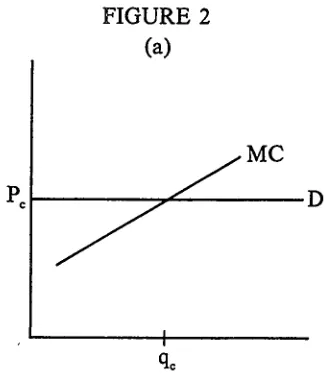
Perfect competition requires a large number of sellers and perfect information on the part of buyers.4 If a seller raised price above the market level, all buyers who would otherwise have purchased from the seller would immediately switch to another supplier because they know that a lower price is available elsewhere. Because the would-be price raiser's output, even at the competitive price, constitutes an insignificant proportion of total industry output, the other sellers would easily be able to absorb the additional sales volume without experiencing an increase in costs. Therefore, no single supplier has power to affect price. This situation is illustrated in Figure 2(a). From the standpoint of any firm, the demand curve is a horizontal line at pc. The firm can supply as much product as it wants at that price, but will not sell any product above that price. It will set output where its marginal cost intersects with demand, at qc.
services or assistance without fair and just compensation commensurate with the services rendered." See J. CLAPP, supra note 18, at 747-48.
FIGURE 2 (a)
MC
qo
Suppose, however, that consumers do not have a costless supply of price information. They cannot immediately switch away from the deviant firm because they do not know where a lower-price seller can be found. They would have to search one out, and that search is costly.4 A firm can set price above its marginal cost, secure in the
knowledge that its customers will not be economically able to switch to an alternative seller.4 9 If all buyers incur the same significant
search costs, the market will move toward a single price equilibrium at the monopoly level.50
However, consumers of professional services are not likely to have identical search costs, no matter what sellers might do to increase them. The main cost incurred in the search for the lowest price for professional services is likely to be time, which consumers value dif-ferently. Thus if search cost is viewed as an opportunity cost, the
48. For an excellent discussion of the effects of imperfect information in markets, see D. CARLTON & J. PERLOFF, supra note 29, at 554-88. For a more technical
presenta-tion, see L. PHLipS, THE ECONOMICS OF IMPERFECT INFORMATION (1988). An interesting
article written for lawyers that applies the economics of information to the enforcement of contracts is Schwartz & Wilde, Intervening in Markets on the Basis of Imperfect
Information: A Legal and Economic Analysis, 127 U. PA. L. REV. 630 (1979). 49. The information deficiency necessary to permit suppliers to raise price need not be complete. Consumers may know the initial distribution of prices in a market, but if they do not know which firm charges which price, and must incur costs to find that out, they may pay a price that they know exceeds the average. Consequently, prices in the market will gravitate toward the monopoly level.
50. See Scitovsky, Ignorance as a Source of Oligopoly Power, 40 Am. ECON. RV. 48 (1950); Diamond, A Model of Price Adjustment, 3 J. EcoN. THEORY 156 (1971). For surveys of the relevant literature, see Salop, Information and Monopolistic Competition, 66 AM. ECON. REV. 240 (1976); Stiglitz, Equilibrium in Product Markets with
[VOL 28: 301, 1991] Antitrust SAN DIEGO LAW REVIEW
amount of time spent searching will result in different costs to differ-ent consumers, depending on the alternative uses of their time. For example, if price advertising for televisions were suddenly elimi-nated, consumers would be forced to spend more time searching, or shopping, for the best price. However, that shopping would impose higher costs on some consumers than on others.5
When a market consists of some informed consumers (those with low search costs) and some uninformed consumers (those with high search costs), it may nevertheless produce a single price equilibrium at marginal cost, which is the outcome of perfect competition.52 For
instance, if a seller raised price, the seller could continue to sell to all of the uninformed consumers that happened to come into the busi-ness, but would lose all informed consumers. If the proportion of un-informed consumers is sufficiently small, the seller will not find it profitable to sell only to uninformed buyers.
However, if the proportion of uninformed consumers is large, a market may result in which some suppliers charge prices above mar-ginal cost and others charge prices at marmar-ginal cost. Depending on the severity of the assumptions, the market may produce a two price equilibrium, one price at marginal cost and the other at the monop-oly level, or an array of prices.3 For example, the hypothetical seller
may raise prices and lose all informed buyers, but still profit by charging the monopoly price to its share of uninformed buyers. An-other firm may find it profitable to charge a lower price and capture informed consumers, as well as its share of uninformed consumers.
Just how large the proportion of informed consumers in the mar-ket must be in order to produce the results of perfect competition, depends on the shape of the average total cost curves of the firms in the industry and the amount above marginal cost that consumers are willing to pay.54 As fixed costs in an industry decrease, the
propor-51. Indeed, increasing the time spent searching can impose negative costs on a consumer. Searching for a better price is another way to describe shopping, and consum-ers may derive positive utility from the act of shopping. However, shopping for bargains in professional services is not likely to be a popular pastime.
52. For a non-technical explanation of this result, see D. CARLTON & J. PERLOFF,
supra note 29, at 573-74.
53. See generally Butters, Equilibrium Distribution of Sales and Advertising
Prices, 44 REV. ECON. STUD. 465 (1977); Rothschild, Models of Market Organization
with Imperfect Information" A Survey, 82 J. POL. ECON. 1283 (1974); Stigler, The
Eco-nomics of Information, 69 J. POL ECON. 213 (1961); Salop & Stiglitz, Bargains and
Ripoffs: A Model of Monopolistically Competitive Price Dispersion, 44 REV. ECON. STUD. 493 (1977).
tion of informed consumers necessary to produce a market price at marginal cost increases. This is because less revenue is needed to cover total costs when fixed costs decrease; a firm may find it profita-ble to do a small volume of business with uninformed buyers. As the price that consumers are willing to pay rises above marginal cost, the profit is greater on each sale, and the minimum profitable sales vol-ume is lower. Thus, as the demand curve net of search costs becomes more steeply sloped, a greater proportion of informed consumers is needed to produce the competitive result.
The effect of changing a market from one in which all consumers have perfect information to one in which some consumers are unin-formed is to change the residual demand curve facing each firm from a horizontal line to a downward sloping one. Depending on the slope of the demand curve and its average total cost curve, a firm may be able to set price above marginal cost and earn economic rents. However, if entry into the market by qualified suppliers is un-limited, the rents will attract entry. As new firms enter, the residual demand curve facing each firm will shift to the left until no firm is earning profits.5 5 This, in essence, is a model of monopolistic competition. 6
The process is illustrated in Figure 2(b). When all consumers are perfectly informed, the seller faces the horizontal demand curve in Figure 2(a). If the market suddenly changes so that a large propor-tion of consumers are uninformed, the demand curve facing the firm becomes downward sloping, taking the shape D1 in Figure 2(b).
Now the firm equates marginal cost with the new marginal revenue curve associated with the new demand, MR1. The firm raises price
to pl, sells q, units, and earns profits represented by rectangle pjABC. The profits are the difference between total revenue, mea-sured by price times output, and total costs, meamea-sured by average total cost times output. These profits attract new firms, and as they enter, the residual demand curve facing the firm shifts to the left. Eventually, demand shifts to D2, where it is tangent to the average
total cost curve, generating the new marginal revenue curve MR2.
The firm now equates marginal cost and marginal revenue, sets price at P2, sells q2 units, and earns zero profits.
55. If some firms in the market find it profitable to charge a low price in order to
capture informed consumers, entry will force that price down to marginal cost and dissi-pate any profits.
[VOL. 28: 301. 1991]
P1
P2 C
Antitrust
SAN DIEGO LAW REVIEW
MR2
Several implications of this model should be emphasized. First, the event that increases search costs does not have to affect the costs borne by the firms. Their costs could increase or decrease, but the model depends on a change in demand, not a change in the costs of the supplies. Further, the model does not require increasing marginal costs. A market in which all firms have the same constant marginal costs can produce the same result, so long as firms have some fixed costs.
The welfare effects of monopolistic competition, though generally ambiguous, are typically negative.57 Where the industry supplies an
undifferentiated, or homogenous product, welfare is reduced because price exceeds marginal cost. If marginal costs are constant, the econ-omy will incur excessive fixed costs. That is, the number of firms will be supra-optimal. Where the industry supplies differentiated prod-ucts, price again exceeds marginal cost, but the industry may pro-duce too much or too little variety. There may be too many or too few firms.
If an association of professionals can effectuate a restraint that increases consumer search costs, its members may profit, at least in
the short-run, and economic welfare may suffer. For example, sup-pose professionals at one time engage in extensive price advertising, and consumers are consequently fully informed about price at no cost to themselves.58 The association then manages to suppress price
advertising, so consumers are forced to seek out low-price suppliers through various search activities, perhaps by telephoning various providers. Sonfe consumers will find these search activities prohibi-tively costly, and will be content to pay any price up to their reserva-tion prices for the service.59 If enough consumers react this way,
each professional may be able to profitably raise the price above marginal cost.
Although the result is the same as in the previously discussed car-tel model, this model does not require any agreement on price among the suppliers. However, like the previous model, it implicitly requires that the members of the association have the power, collectively to affect price, thereby increasing consumer search costs. For example, if a single professional refused to advertise price, consumers would simply patronize those professionals who advertise. The association would have to account for a large percentage of the professionals in the market, though perhaps not as large of a percentage as is re-quired to raise price by limiting output, and this implies a legal or economic requirement of membership. Further, the association would have to enforce the restriction among its members. Again, like the cartel model, the search cost theory is only plausible if the ex-pected short run profits earned before entry exceed any exex-pected losses.
In both the cartel and search cost models, suppliers profit by charging a price in excess of marginal cost, and market price exceeds the industry marginal cost at the output supplied. In the cartel model, the association produces the result by restricting the prices offered, a process that affects neither the shape of the demand curve
58. This analysis assumes that search costs decrease as the volume of costless in-formation increases. In fact, to be perfectly informed, consumers must mentally process the raw information received, and this process, because it takes time, imposes costs. As a result, more information can theoretically make consumers less well informed. A study of physician services concluded that an increase in the number of providers resulted in an increase in consumer search costs and an increase in average prices. Pauly & Satter-thwaite, The Pricing of Primary Care Physicians' Services: A Test of the Role of
Con-sumer Information, 12 BELL J. ECON. 488 (1981).
[VOL. 28: 301. 1991] Antitrust SAN DIEGO LAW REVIEW
nor the shape of the supply curve. In the search cost model, the asso-ciation generates the result by a restraint that affects the shape of the demand curve, but does not necessarily affect the shape of the supply curve.0 In the following two models, anticompetitive effects are predicted to result from restraints that affect the shape of the supply curve but not necessarily that of the demand curve. What's more, neither depends on a market price that exceeds marginal cost.
C: Increasing the Marginal Costs of Marginal Suppliers
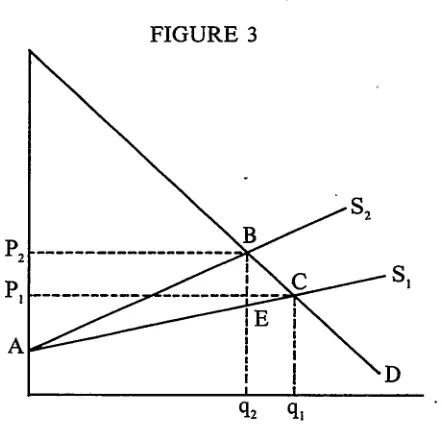
The recent literature on "raising rivals' costs" has achieved notori-ety principally as a theory of anticompetitive harm flowing from ver-tical transactions. Associated primarily with Steven Salop, David Scheffman, and Thomas Krattenmaker, the theory postulates that a firm in a competitive output market can profitably raise the marginal costs of its rivals by restricting the supply of a vital input and thereby increase output pricey.6 The firm incurs a fixed cost in secur-ing the restriction, for example, by paysecur-ing input suppliers not to sell to its rivals. The reduced input supply forces up the price of the remaining input available to the predator's rivals, which increases the rivals' marginal costs. This increase in the disadvantaged firms' marginal costs causes the industry supply curve in the output market to rotate in a counterclockwise direction from its origin. Market price is still set at the intersection of supply and demand, but now price is higher and output is lower. Thus, economic welfare is re-duced. But the economic rents captured by producers can increase, depending on the elasticities of demand and supply, and so the predator profits, and in some circumstances, even the predator's competitors gain.
The raising rivals' costs approach to antitrust analysis is open to serious objection. Some critics charge that it fails to identify an-ticompetitive practices that would escape condemnation under
con-60. Both of these models predict inefficiently great entry, and that will increase fixed costs in the industry. But fixed costs are not reflected in the short-run industry supply curves.
61. The "raising rivals' costs" analysis has evolved through a number of articles.
See Salop & Scheffman, Raising Rivals' Costs, 73 AMER. ECON. REV. 267 (1983); Krat-tenmaker & Salop, Anticompetitive Exclusion:, supra note 4. KratKrat-tenmaker & Salop,
Competition and Cooperation in the Market for Exclusionary Rights, 76 AMER. EcON. REV. 109 (1986); Krattenmaker & Salop, Analyzing Anticompetitive Exclusion, 56
AN-TITRUST L. J. 71 (1987); Salop & Scheffman, Cost Raising Strategies, 36 J. INDUS. ECON. 19 (1987); Ordover, Saloner, & Salop, Equilibrium Vertical Foreclosure, 80 AMER. ECON. REv. 127 (1990). The simplest introduction to the analysis is Krattenmaker
& Salop, Exclusion and Antitrust, I1 REG. 34 (1987).