SHARED AUTHENTICATION SCHEME FOR IOT
APPLICATION
Akshata Rahul Pathak
Dempo Higher Secondary School of Science, Pace
ABSTRACT
Internet of Things (IoT) is the following rising procedure wherein every single thing on the planet is getting associated with the web by methods for different correspondence systems. By utilizing the procedure of multicasting, these things speak with one another to move the information. So there is a need of a confirmation plot so as to counteract the information structure getting debased while transmitting. As we probably aware trillions of gadgets are associated with IoT, a protected correspondence ought to be actualized for the equivalent. So a light weight confirmation ought to be accommodated IoT. IoT comprise of numerous items, the articles may by cell phones, fridge, air cooler and so forth alongside sensors, actuators, base stations. The items are for the most part associated with sensors so as to recover information from every one of them. Since sensor system is adhoc systems and the computational power expended of sensor systems are likewise low. Henceforth in the Wireless Sensor Network (WSN) numerous sensors are associated with at least one base station. The base station in remote sensor system deals with all the sensor hubs with the assistance of processor and memory. Since we are changing from remote sensor systems to IoT, the items are associated with web by giving location to individual article. Thus, the base station not having the competent to give a safe correspondence between the items alongside sensors and web. In this paper, we propose another validation plot by methods for two unique approaches. Since IoT contains numerous quantities of items, we interface certain articles which are in same region and give a database to that item. The information identified with specific hub is put away and refreshed as often as possible in the database and kept up by Data Base Management System (DBMS) and it is associated with web. Whenever a client needs to get to the information, the confirmation is furnished by methods for login id with hashing secret key or with the assistance of MAC passwords. These two confirmation plan give better when contrasted with existing technique which are appeared in results. The measurements that estimates the presentation of the proposed methodology are the obstruction against hub bargain, calculation overhead, correspondence overhead, heartiness to parcel misfortune and message entropy. Applications: This principle use of common verification plot for IoT is to give a validation between the end client and the sensor organize information. This strategy is additionally reasonable for keen house application where the client can safely get to the information from anyplace on the planet.
1. INTRODUCTION
into the basic piece of web are given a one of a kind character. By this personality, the client can undoubtedly get to the articles and discover the status of the item. Web of Things (IoT) was named by Kevin Ashton in the year 2009. IoT has advanced from the attributes of remote advances, Micro-Electrochemical Systems (MEMS) and the web. It is obvious that web of things has making upheaval as of late because of the improvement of IPV61. It is so on the grounds that IPV6 has immense location space where a great many items can be incorporated and tended to. The Internet of Things is additionally called as "Future Internet". The "things" in the IoT point of view incorporates various types of physical components. The physical components might be the contraptions that we use in our everyday life, for example, PDAs, tablets and advanced cameras. This additionally incorporates the articles in the home which can likewise be brought under the idea of a web of things2-4. These components are associated with a huge database where the data is gathered and prepared. By the utilization, IoT network can be improved which includes the utilization of proclamation "whenever, wherever" for "any-one"5-9. We additionally utilize the idea of Database Management Systems (DBMS) to store the data of each article. DBMS is characterized as an accumulation of projects that empowers the client to store, alter and extricate data from a database. There are various types of DBMSs, which bound from a little framework that takes a shot at PC to gigantic frameworks that keep running on centralized computers. A different database is kept up for every one of the articles, at whatever point the client demands the status of item it reactions by bringing the data on the database on which the data is put away. The information-gathering will assist the client in modifying if necessary. In light of this data demand from the client, there is have to verify the getting to of physical articles. A mix of every one of these things will make the Internet of Things10. The Internet of Things offers the extraordinary potential to buyers, makers, and firms. Be that as it may, there is trouble in commercialization in light of the fact that the thought must be created from certain article conduct. With this idea, persistent checking can be utilized with no human intercessions. We present a strategy to confirm every one of these physical components which are associated with the web and these systems are clarified in the procedure area.
2. LIGHT WEIGHT AUTHENTICATION SCHEME
the road between the sensor systems and IoT. So the sensor systems associated with the web by means of a base station and there is no immediate association between sensor systems and IoT. In the second reconciliation strategy, the base station goes about as a passage comparably as the application layer, so it changes over the lower information from sensor systems into higher information on the web and the other way around. In the third combination strategy, the sensor hub uses the TCP/IP suite to speak with the web. So the base station forward or course the bundle from sensor hub to web or the other way around. Here both are conveying straightforwardly. The verification plan isn't utilized by the over three techniques, since there is no validation in IoT, the information may get ruined and numerous assaults are conceivable. So a lightweight validation plan ought to be utilized in IoT. We proposed another approach so as to defeat the verification issues13. The approach is to give verification to IoT and give a protected correspondence between remote sensor systems and the web.
3. PROPOSED METHODOLOGY
The IoT comprises of numerous hubs and every hub is exceptionally tended to. In the proposed methodology, a specific number of hubs that are available in a similar region are usually associated with one information base. The information base is associated with Data Base Management System (DBMS) which goes about as a server and deals with an unapproved get to. The verification is given by methods for two different ways. In the primary methodology, the MAC address of framework which has incessant access to the information base is put away in DBMS. So at whatever point the clients get to the information from a specific database and if the macintosh address of the client is as of now put away in a database, the client can undoubtedly get to the information without login the page. The server gets the macintosh address by utilizing the ARP convention from the IP address. Since the macintosh address isn't transformed, it gives superior security when contrasted with the existing strategy. In the subsequent methodology, at whatever point the clients get to the database from some other gadget, the client must log in so as to get the information from the database. The username is given to a specific client and the secret key is acquired by hashing procedure. At whatever point the client enters the username, the onetime secret phrase is produced in the server and the server hashes the secret key by exponential capacity and sent to the clients. The secret phrase is hashed by a client by hashing capacity and the server additionally utilizes the equivalent hashing capacity to hash the onetime exponential secret word. The hashing capacity is shared uniquely between the server and the customer. At long last, if both the hashed passwords are the same, the server enables the client to get to the information.
4. ARCHITECTURE
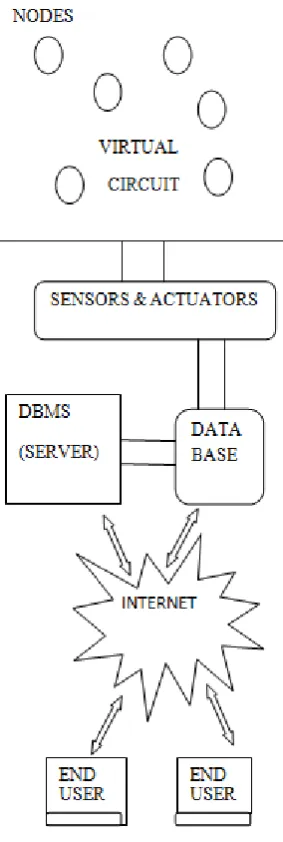
information of specific hubs effectively. The sensors and actuators are associated with every hub so as to get the information from the physical world. The information base keeps up the data of each hub, so every one of the information identified with a specific hub is accessible in the information base. The database of a specific hub is associated with a single Database administration framework which deals with the database and furthermore anticipates unapproved get to. The fundamental vision of IoT is each item on the planet got to from anyplace of the world. So as to accomplish this vision, the DBMS is associated with the web and gave every hub is tended to by utilizing IPv4 tending to conspire. The end clients get to the information of any hub by means of the web. Here the hubs might be a cell phone, fridge, air cooler, TV, and so forth.
5. WORKING PROCEDURE
Figure 1. Proposed architecture.
6. AUTHENTICATION SCHEME
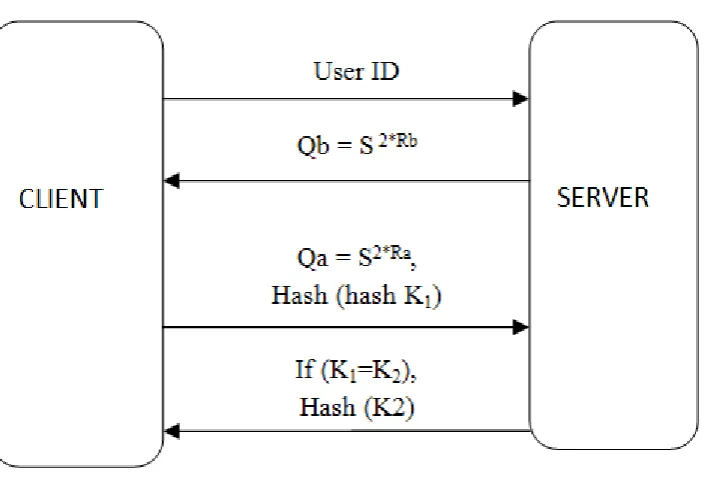
login page one time hashing secret word procedure. At the point when the client demands the information from the assets, at that point, the server produces an arbitrary number in an exponential structure and sends the specific exponential number to the client. The key produced at the server-side is a onetime key (Qb) with any Random Number (Rb) and Hashing Function (S), it is given in Equation (1).
Qb = S2* Rb (1)
In the wake of getting the one-time key from the server, the customer additionally creates the key with another irregular number. The key Qa is created at the customer in an exponential structure with another Random Number (Ra). At that point the customer sends the one-time Password to the server, after that, a hashing capacity is utilized dependent on both the arbitrary key since both sender and recipient know both the irregular number and utilizing the equivalent hashing capacity, they produce the equivalent hashing information which is given by K1 and K2. This K (K=K1=K2) is utilized as a one-time hashing secret key by the client. The server checks the K esteem from customer and K worth produced at a server, on the off chance that the hashing secret phrase coordinate with the server hashing secret key, at that point the server enables the client to get to the information from the information base. The key (Qa) delivered at the client-side by utilizing another arbitrary number (Ra) is given in Equation (2).
Qa = S2*Ra (2)
Figure 2. Authentication scheme.
Figure 2 clarifies the confirmation system between the client and the DBMS. The server gives certain client id to the normal client, at whatever point the client enters the client id in the login page the server makes the hashing secret word. On the off chance that the client isn't approved with the server, at that point the server ever makes the hashing secret key for that specific client. The subsequent methodology likewise has more preferred position contrasted with the principal approach yet it requires some investment to validate the client.
7. RESULTS AND DISCUSSION
The following property is quick validation, which likewise fulfilled by our first approach and giving information to the client without login page by putting away the physical location of the framework in the database. The last property to talk about is high message entropy which is additionally fulfilled by this methodology.