D
D
I
I
S
S
C
C
O
O
V
V
E
E
R
R
S
S
E
E
Q
Q
U
U
E
E
N
N
T
T
I
I
A
A
L
L
T
T
R
R
A
A
N
N
S
S
I
I
T
T
I
I
O
O
N
N
A
A
L
L
P
P
A
A
T
T
T
T
E
E
R
R
N
N
S
S
F
F
R
R
O
O
M
M
T
T
R
R
A
A
N
N
S
S
A
A
C
C
T
T
I
I
O
O
N
N
A
A
L
L
D
D
A
A
T
T
A
A
B
B
A
A
S
S
E
E
S
S
S
Su
uj
ja
at
th
h
a
a
D
Da
an
n
du
d
u
Aurora’s Technological and Research Institute, Department of Computer Science, Hyderabad
D
D
e
e
e
e
k
k
s
s
h
h
a
a
t
t
u
u
l
l
u
u
B
B
.
.
L
L
.
.
Distinguished Fellow, IDRBT, Hyderabad
P
P
ri
r
it
ti
i
C
Ch
ha
an
nd
dr
r
a
a
Scientist, Advanced System Laboratory, Hyderabad
ABSTRACT: Transaction databases have been extensively mined for patterns of different kinds ranging from frequent patterns to maximal patterns and emerging patterns. Recent studies have extended the research in pattern mining to include the time stamp of each transaction resulting in the discovery of transitional patterns whose frequencies change significantly over time. This paper focuses on generating interesting sequences of transitional patterns. Transaction databases are divided into lists of transactions belonging to specific sequences. A sequence could be a set of transactions belonging to a customer in a retail store or a set of page visits by a specific user. Transitional Patterns are generated on each sequence and assigned unique ids so they can be treated like items and itemsets. The sequence database thus created can be input to any standard algorithm like GSP and PrefixSpan to generate sequences of transitional patterns. We have designed a new algorithm called the sequential TP-Mine by combining the steps of transitional pattern generation and sequence generation and conducted experiments by running this algorithm on multiple standard datasets.
KEYWORDS: Frequent Patterns, Sequential Patterns, Transitional Patterns, Association Rules.
1.
INTRODUCTIONFrequent Patterns are widely applied in retail, medical and many other fields for knowledge discovery and aiding decision making. Many algorithms have been introduced to mine frequent patterns such as Apriori [AS94] and FP-Growth [H+04]. The results of these algorithms were numerous frequent patterns that made usefu l knowledge discovery like association rule mining difficult. This led to further research in the area of pattern mining with the discovery of new patterns such as closed frequent itemsets [P+99], indirect associations [WA06, B+99] and emerging patterns [BMR02].
Closed Frequent Itemsets a lgorithm generates only the largest frequent itemsets that have no supersets which are of same or higher frequency. Indirect associations focus on identifying rare item pairs that are expected to be frequently found. Emerging patterns are frequent patterns whose frequency increases dramatically from one dataset to another. None of the patterns mentioned above take into account the timing of transactions even though they all deal with transactional databases. Thus they do not take into account the distribution of item frequencies in a time series. This is important because a pattern may look frequent just by counting how many times it occurs in a database it is worthwhile to see if this support is evenly distributed or there is a sudden spurt or waning of support at any point of time.
A new frequent pattern called Transitional Pattern was introduced in [WA09, WA07] to do exactly that. A Transitional Pattern is a frequent pattern whose support experiences swings at specific points of time. A Transitional Pattern could be positive if its frequency increases significantly at a point of time and it is termed negative if its frequency decreases significantly at any point of time in the span of the database.
Growth [P+04] and GSP [AS96] have been written to discover sequential patterns.
When transitional patterns are discovered for specific sequences of data such as retail transactions belonging to each shopper at the store or page clicks belonging to each user of a web portal sequences of transitional patterns can be built. The aim of this paper is to identify such sequences for both positive and negative transitional patterns and analyze their potential for useful knowledge discovery.
2. TERMS AND DEFINITIONS
2.1 Definition o f Sequential Positive Transitional Pattern (SPTP)
A sequential positive transitional pattern is a set of transitional patterns arranged in ascending order of their significant frequenc y ascending milestones (SFAM) [WA09] whose SFAMs occur within a predefined window or time interval.
2.2 Definition o f Sequential Negative Transitional Pattern (SNTP)
A sequential negative transitional pattern is a set of transitional patterns arranged in ascending order of their significant frequency descending milestones (SFDM) [WA09] whose SFDMs occur within a predefined window or time interval.
3. SEQUENTIAL TRANSITIONAL PATTERNS
3.1 Sample Transaction Database
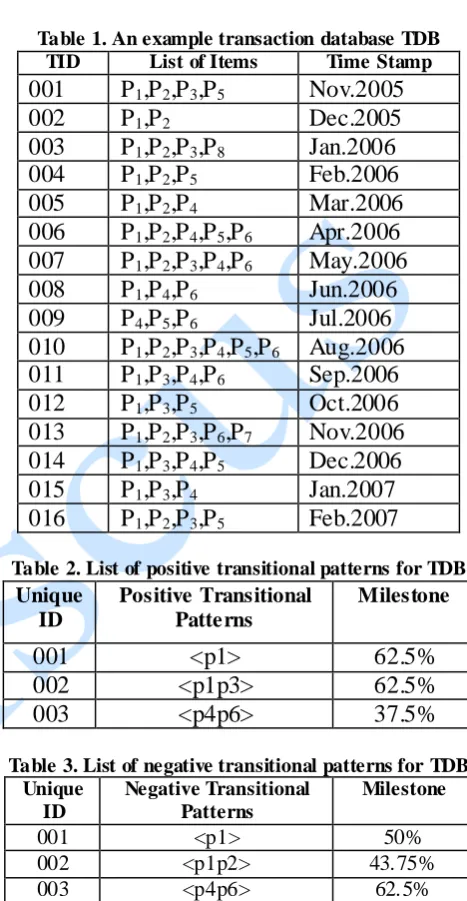
Consider an example transaction database TDB shown in Table 1. It has 16 transactions belonging to a particular customer over a 14 month period. There are 8 unique items numbered P1 through P8 that have been purchased by the customer during this period. This database has been adopted from [WA09] where it was used to demonstrate transitional patterns.
3.2 Generation of transitional patterns fro m TDB
Transitional patterns generated from this database based on the algorithm in [WA06] are listed in Table 2 and Table 3. Each of the transitional patterns is assigned a unique ID to allow these patterns to be treated like frequent itemsets and a sequence refers to the IDs of all transitional patterns that achieve their significant frequency ascending(or descending) milestone within a predefined interval like an hour, a day or a week. The sequence database consists of such sequences of positive or negative transitional patterns.
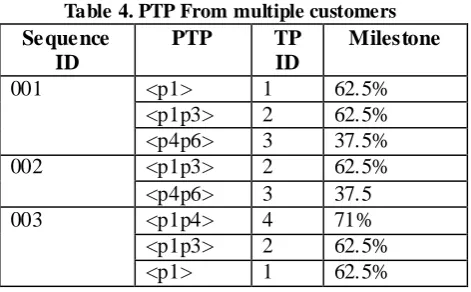
For instance < P1 > and < P1P3 > in Table 4 are a sequence of transitional patterns that achieve their significant frequency ascending milestones in August 2006.
Table 1. An example transaction database TDB
TID List of Items Time Stamp
001
P
1,P
2,P
3,P
5Nov.2005
002
P
1,P
2Dec.2005
003
P
1,P
2,P
3,P
8Jan.2006
004
P
1,P
2,P
5Feb.2006
005
P
1,P
2,P
4Mar.2006
006
P
1,P
2,P
4,P
5,P
6Apr.2006
007
P
1,P
2,P
3,P
4,P
6May.2006
008
P
1,P
4,P
6Jun.2006
009
P
4,P
5,P
6Jul.2006
010
P
1,P
2,P
3,P
4,P
5,P
6Aug.2006
011
P
1,P
3,P
4,P
6Sep.2006
012
P
1,P
3,P
5Oct.2006
013
P
1,P
2,P
3,P
6,P
7Nov.2006
014
P
1,P
3,P
4,P
5Dec.2006
015
P
1,P
3,P
4Jan.2007
016
P
1,P
2,P
3,P
5Feb.2007
Table 2. List of positive transitional patterns for TDB
Unique ID
Positive Transitional Patterns
Milestone
001
<p1>
62.5%
002
<p1p3>
62.5%
003
<p4p6>
37.5%
Table 3. List of negative transitional patterns for TDB Unique
ID
Negative Transitional Patterns
Milestone
001 <p1> 50%
002 <p1p2> 43.75%
003 <p4p6> 62.5%
3.3 Transitional patterns fro m multiple sequences
< P1 > and < P1P3 > in IDs 1 and 3 of 4 form of a sequence of positive transitional patterns since their transitions happen during the same milestone of 62.5%. Such sets are found for each sequence to build Table 4.
Table 4. PTP From multiple customers
Sequence ID
PTP TP
ID
Milestone
001 <p1> 1 62.5%
<p1p3> 2 62.5% <p4p6> 3 37.5%
002 <p1p3> 2 62.5%
<p4p6> 3 37.5
003 <p1p4> 4 71%
<p1p3> 2 62.5% <p1> 1 62.5%
Transitional patterns in Table 4 for Sequence IDs 2 and 3 are for illustrating the creation of a sequence database and have not been generated from any real or sample transactional database.
Table 5. Sequence database of positive transitional patterns
Sequence ID SPTP
001 <(3)(12)> 002 <(2)(3)> 003 <(4)(12)>
When a sequence generation algorithm like GSP is run on the sequence database in Table 5 we can finally generate a list of frequent sequences based on a user defined support level. For instance our example with a desired support level of 25% leads to discovery of sequential positive transitional patterns (SPTP) < P1 > and < P1P3 >.
The same procedure of generating Tables 4 and 5 can be repeated for negative transitional patterns to generate sequential negative transitional patterns (SNTP).
3.4 Sequential TP-Mine Algorithm
Algorithm 1 Sequential TP-Mine Algorithm
Require: A transaction database containing several sets of transactions over a specified period of time, each belonging to a sequence. The database should be sorted by sequence ids and by the timestamp of transactions within a sequence.
Ensure: A transaction database containing several sets of transactions over a specified period of time, each belonging to a sequence.
1. Sort all transactions on ascending order of sequence and ascending order of timestamp within each sequence.
2. HashPTP=0, HashNTP=0, SeqPTP=0, SeqNTP=0 3. while not at end of all sequences do
4. Generate Transitional Patterns for the sequence of transactions resulting in the set of pos-itive transitional patterns S(PTP) and negative transitional patterns N(PTP) using the TP-Mine Algorithm defined in [QA09]
5. for each TP in the S(PTP) do do 6. if TP not in HashPTP then 7. assign unique id to TP
8. add TP to HashPTP along with its unique id
9. end if 10. end for
11. Sort all TPs in S(PTP) in the descending order of their Milestones
12. for each TP in the S(PTP) do do
13. if (milestone(TP) - sequence Milestone) <
window then
14. add TP to sequence 15. else
16. write sequence to SeqPTP
17. initialize new sequence, store sequence Milestone
18. add TP to new sequence 19. end if
20. end for
21. for each TP in the S(NTP) do do 22. if TP not in HashNTP then 23. assign unique id to TP
24. add TP to HashNTP along with its unique id
25. end if 26. end for
27. Sort all TPs in S(NTP) in the descending order of their Milestones
28. for each TP in the S(NTP) do do
29. if (milestone(TP) - sequence Milestone) <
window then
30. add TP to sequence 31. else
32. write sequence to SeqNTP
33. initialize new sequence, store sequence Milestone
34. add TP to new sequence 35. end if
36. end for 37. end while
38. Generate Frequent Sequential Positive Transitional Patterns using SeqPTP as the input database to the Prefix Span A lgorithm defined 39. Generate Frequent Sequential Negative
Transitional Patterns using SeqNTP as the input database to the Prefix Span Algorithm defined
sequences and within each sequence on the order of the timestamp of each transaction. These sets of transactions are all processed in a loop where transitional patterns area generated for each set of transactions which includes frequent pattern generation using Apriori Algorithm defined in [WA06], positive transitional patterns generation and computation of their significant frequency ascending milestones and negative transitional patterns generation and computation of their significant frequency descending milestones.
The second phase involves creation of a sequence database using the Positive transitional patterns from the previous phase. During this phase each positive TP is assigned a unique ID. Steps 5 through 17 of the algorithm define this phase. HashPTP is a hash table that contains a mapping between the positive transitional pattern and the unique ID assigned to it. All PTPs are sorted in the descending order of their milestones and sequentially read. PTPs whose milestones fall within a user defined window are grouped together as an itemset as defined in [AS95] and referred by their unique IDs. The final output set is SeqPTP that contains a sequence database of positive transitional patterns.
The third phase is the creation of a sequence database using the Negative transitional patterns from the previous phase. During this phase each negative TP is assigned a unique ID. Steps 18 through 30 of the algorithm define this phase. HashNTP is a hash table that contains a mapping between the negative transitional pattern and the unique ID assigned to it. All NTPs are sorted in the descending order of their milestones and sequentially read. NTPs whose milestones fall within a user defined window are grouped together as an itemset as defined in [AS95] and referred by their unique IDs. The final output set is SeqNTP that contains a sequence database of positive transitional patterns.
In the final phase the prefix span algorithm defined in [WA07] is used to generate Sequential P ositive Transitional Patterns in Step 32 from the sequence database produced in steps 5 through 17. Similarly, in Step 33 the prefix span algorithm defined in [WA07] is used to generate Sequential Negative Transitional Patterns from the sequence database produced in steps 18 through 30.
3.5 Database scan and time complexity
As per [WA09] the time complexity of the TP-Mine algorithm is O(/D/ + nX/T/) where /D/ is the number of transactions in D, n is the number of frequent patterns in D and /T/ is the maximum number of milestones in a ll of the transitional patterns P(k) in D. As per [H+00] the time complexity of the Prefix Span algorithm is O((N) L) where N is the number items in
D and L is the maximum length of all transactions in D in terms of the number of items in a transaction. The Sequential TP-Mine algorithm combines both TP- Mine and Prefix Span algorithms by repeating the TP cycle for many sequences of transactions and performing a Prefix Span on the resulting database of transitional patterns. In addition it also has the step of creating a sequence database where Transitiona l Patterns from each sequence are sorted in the descending order of their milestones and sequentially read to group them into sequences. Since Mergesort is used for this step the complexity of this step is o f the order TotTPLog(TotTP ) where TotTP is the tota l number of transitional patterns generated in all sequences. Therefore its time complexity can be defined as follows - O(/Dmax/ + nmaxX/Tmax/) +
O(TotTPLog(TotTP )) + O((N)L) where Dmax is the
maximum number of transactions in all sequences, nmax is the maximum number frequent patterns in all sequences and Tmax is the maximum number of milestones in all sequences and N is the number of transitional patterns discovered in all sequences and L is the maximum length of a transitional pattern in terms of the number of items in it.
4. EXPERIMENTAL SETUP
To evaluate the efficiency of the Sequential TP-Mine Algorithm and prove the utility of sequentia l transitional patterns, two sets of experiments have been performed, each using a dataset from the real world. These are retail market basket and T10I4D100K dataset [***b].
4.1 Data preparation
Both datasets mentioned did not associate transactions with specific customers, so there was no customer ID in each transaction. To overcome this constraint, the methodology outlined in [AS95] was followed where customer sequences were assumed to have a distribution, and transactions were assigned to a fixed number of customers such that some customers may get many transactions. Some may get very few while the rest would follow the distribution. To test the consistency of our model a user-defined mean number of transactions per customer was used as an input parameter to a distribution method to assign transactions to customers.
4.2 Retail market basket data
customers using a Poisson distribution. For example in one run there were about 3000 customers who were assigned these transactions at an average of 30 transactions. Outliers were introduced in the data with about 5% of customers being assigned 10 times the average number of transactions and another 5% were assigned one tenth the average number of transactions.
The parameters used to run the experiments were pattern support threshold, number of customers assigned to the transactions and the average number of transactions assigned to each customer. Pattern support threshold is kept at 05%, 10% and 15% to generate 3 series of runs that discover sequentia l transitional patterns. Each of these 3 series has 4 different runs generated by random distributions 2000 customers assigned an average of 45 transactions, 3000 customer assigned an average of 30 transactions, 4000 customers assigned an average of 25 transactions and 5000 customers assigned an average of 20 transactions.
The sequence support threshold was held constant at 20% for all experiments. The result in terms of sequences of transitional patterns was consistent generated by all experiments. Table 6 shows the positive transitional patterns for a few customer Ids along with their significant milestones from the run with 2000 customers for a support threshold of 5%. This is the result of the first phase of the algorithm. Similar transitional patterns were obtained for other runs even though the milestones were different because of the different distribution parameters used.
Table 6 shows the sequence database for positive
transitional patterns generated by this run.
Table 6. PTP by Sequence for Retail Market Basket Data
Sequence ID TP Item ids in Sequence
001 <(1 3 30 10)(80)(6 16)> 002 <(1 296)(17 10)(18 3)(6 9
13)(16)>
004 <(3 10)(540 80 15)(16)> 006 <(3 10)(540 80 15) (16)> 008 <(3 10)(540 80 15) (16)> 113 <(10)(3 1)(30 15)(16)>
1829 <(10)(46 12
13)(136)(3)(1)(190)> 1879 <(50 17)(1)(16)(10)> 1997 <(1 2 3)(5)(4)>
Table 7 shows the mapping of each positive transitional pattern to a unique ID assigned to it by the algorithm. This ID is referenced in 6 when building the positive sequence database. Item ID 1 mapped to PTP < 48 > is found in sequences 1,113,1829,1997 while Item ID 16 mapped to < 41 >
is found in sequences 4,6,8,113,1829 and Item ID 18
mapped to < 39 41 > is found in
sequence 2.
Table 7. Item ids for positive transitional patterns
Item ID PTP
001 <48> 002 <38 48> 003 <39 48> 004 <39 65> 011 <39 225> 016 <41> 018 <39 41> 031 <39 2238> 103 <48 1872> 211 <41 101> 806 <910 956>
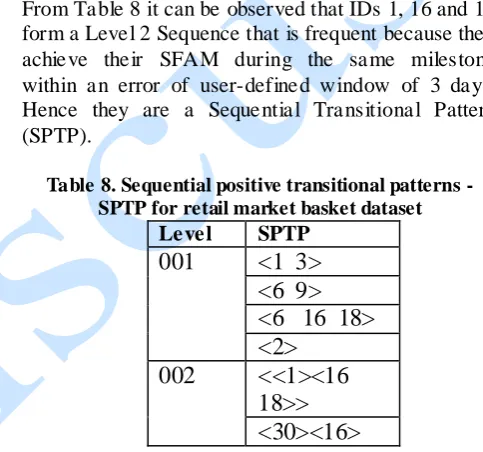
From Table 8 it can be observed that IDs 1, 16 and 18 form a Level 2 Sequence that is frequent because they achieve their SFAM during the same milestone within an error of user-defined window of 3 days. Hence they are a Sequential Transitional Pattern (SPTP).
Table 8. Sequential positive transitional patterns - SPTP for retail market basket dataset
Level SPTP
001
<1 3>
<6 9>
<6 16 18>
<2>
002
<<1><16
18>>
<30><16>
4.3 D10I4100K Dataset
The D10I4100K dataset was obtained from the IBM data generator of the Almaden research group. It contains 100000 transactions with 870 unique items in these trans-actions. These transactions are divided using a Poisson distribution similar to that of retail dataset. The parameters used to run experiments were also similar to that of retail dataset.
each.
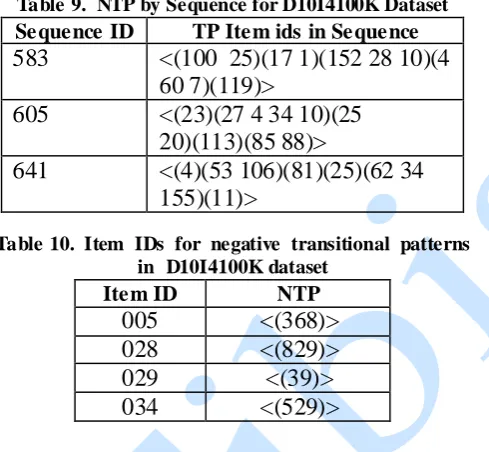
The sequence support threshold was held constant at 20% for all experiments. The result in terms of sequences of transitional patterns was consistent generated by all experiments. Table 9 shows the negative transitional patterns for a few customer Ids along with their significant milestones from the run with 1000 customers for a support threshold of 5%. This is the result of the first phase of the algorithm. Similar transitional patterns were obtained for other runs even though the milestones were different because of the different distribution parameters. Table 9 shows the sequence database of Negative transitional patterns for a few sequences along with their significant milestones. The sequences 605 and 641 have 2 Transitional Patterns with IDs 28 and 34 in them. The actual patterns for these IDs can be found in the Table 10 below.
Table 9. NTP by Sequence for D10I4100K Dataset
Sequence ID TP Item ids in Sequence
583
<(100 25)(17 1)(152 28 10)(4
60 7)(119)>
605
<(23)(27 4 34 10)(25
20)(113)(85 88)>
641
<(4)(53 106)(81)(25)(62 34
155)(11)>
Table 10. Item IDs for negative transitional patterns in D10I4100K dataset
Item ID NTP
005
<(368)>
028
<(829)>
029
<(39)>
034
<(529)>
Table 10 shows the mapping of each negative transitiona l pattern to a unique ID assigned to it by the algorithm. This id is referenced in Table 9 when building the negative TP sequence database. Item ID 28 belongs to the negative transitional pattern (NTP) (829) and Item ID 34 belongs to the NTP (529).
Table 11. Sequential negative transitional patterns - SNTP for D10I4100K dataset
Level SNTP
002
<(5)(34)>
<(5)(28)>
<(28)(5)>
<(28) (34)>
<(34) (5)>
The table 11 shows that < (28) (34) > is an interesting sequence which means NTPs < (829) (529) > is an interesting negative sequentia l transitional pattern where frequent patterns (829) and (529) observe a dip in their support levels at the same milestone within a user-defined error window which in our case is 3 days. Similar inferences can be drawn about the other Level 2 sequential negative transitional patterns in this table.
4.4 Evaluation o f scalability
The results of different runs on each of the datasets have been plotted in terms of the running time and graphs generated. These graphs indicate linear scalability for the sequential TP-Mine algorithm for increasing number of sequences (indicated by number of customers) and decreasing support threshold. On the X-axis of these graphs is the average number of customers and the Y-axis shows the runtime of the algorithm in milliseconds. There are 3 lines plotted one each for a frequency support of 5%, 10% and 15% respectively
In the runs for both datasets it was observed that Frequency Support threshold had an inverse relationship with response time. This is because there is an increase in the number of frequent patterns to be found and tested for transitions. Both FP growth and Apriori were used to generate frequent patterns and FP growth was found to be faster so the final results shown are from FP growth.
CONCLUSIONS
One of the goals outlined in [ WA09] was about research in the area of sequential transitional patterns. In this paper we undertook the research and defined two kinds of sequential-transitional patterns. SPTP or Sequential Positive transitional patterns are an ordered set of positive transitional patterns that follow their predecessor’s SFAM or significant frequency ascending milestone. SNTP or Sequentia l Negative transitional patterns are an ordered set of negative transitional patterns that follow their predecessor’s SFDM or significant frequency descending milestone. To discover these patterns we presented the Sequential TP-Mine algorithm. Our Algorithm generates transitional patterns for each sequence of transactions defined in the database in the first phase. In the next phase it divides the transitional patterns into positive and negative sets. On each of these sets unique Ids are assigned to each transitional pattern and a sequence database is built using these Ids. Finally SPTPs and NPTPs are
generated from the positive and negative sequence databases using the PrefixSpan Algorithm. Our experimental results show the algorithm is reasonably scalable. In our experimental study we used two retail datasets to demonstrate the utility of the algorithm in the real world of retailing.
ACKNOWLEDGEMENTS
REFERENCES
[AS94] R. Agrawal, R. Srikant - Fast Algorithms for Mining Association
Rules, Proc. 1994 Intl Conf. Very Large
Data Bases (VLDB 94), pp.487-499, Sept. 1994.
[AS95] R. Agrawal, R. Srik ant - Mining
Sequential Patterns, Proc. 11th Intl
Conf. Data Eng., pp.3-14, 1995.
[AS96] R. Agrawal, R. Srikant – Mining Sequential Patterns: Generalizations
and Performance Improvements, Proc.
Fifth Intl Conf. Extending Database Technology (EDBT 96), 1996.
[BMR02] T. Bailey, T. Manoukian, K. Ramamohanarao - Fast Algorithms for
Mining Emerging Patterns, Proc. Sixth
European Conf. Principles of Data
Mining and Knowledge
Discovery(PKDD 02), pp. 39-50, 2002.
[B+99] T. Brijs, G. Swinnen, K. Vanhoo f, G.
Wets - The use of association rules for
product assortment decisions: a case
study, in Proceedings of the Fifth
International Conference on Knowledge Discovery and Data Mining, San Diego, 1999.
[H+00] J. Han, J. Pei, B. Mortazavi-Asl, Q. Chen, U. Dayal, M.-C. Hsu -
FreeSpan: Frequent Pattern-Projected
Sequential Pattern Mining, Proc. 2000
ACM SIGKDD Intl Conf. Knowledge Discovery in Databases (KDD 00), pp. 355-359, Aug. 2000.
[H+04] J.-W. Han, J. Pei, Y.-W. Yin, R.-Y. Mao - Mining Frequent Patterns without Candidate Generation: A Frequent-
Pattern Tree Approach, Data Mining
and Knowledge Discovery, vol.8, no. 1, pp. 53-87, 2004.
[P+04] J. Pei, J. Han, B. Mortazavi-Asl, J.-Y. Wang, H. Pinto, Q.-M. Chen, U. Dayal, M.-C. Hsu - Mining Sequential
Patterns by Pattern-Growth: The
Prefixspan Approach, IEEE
Trans.Knowledge and Data Eng., vol. 16, no. 11, pp. 1424-1440, Nov. 2004.
[P+99] N. Pasquier, Y. Bastide, R. Taouil, L. Lakhal - Discovering Frequent Closed
Itemsets for Association Rules, Proc.
Seventh Intl Conf. Database Theory (ICDT 99), pp. 398-416, 1999.
[WA06] Q. Wan, A.-J. An - An Efficient
Approach to Mining Indirect
Associations, J. Intelligent Information
Systems, vol. 27, no. 2, pp. 135-158, 2006.
[WA07] Q. Wan, A. An - Transitional Patterns
and Their Significant Milestones, Proc.
Seventh IEEE Intl Conf. Data Mining, 2007.
[WA09] Qian Wan, Aijun An - Discovering
Transitional Patterns and their
Significant Milestones in Transaction
Databases, IEEE Transactions on
Knowledge and Data Engineering, pp. 1692-1707, 2009.
[***a] http://www.philippe-fournier-viger.com/spmf/
is an open-source data mining mining platform written in Java. It is distributed under the GPL v3 license
[***b] http://fimi.ua.ac.be/data/