C
C
L
L
O
O
N
N
A
A
L
L
S
S
E
E
L
L
E
E
C
C
T
T
I
I
O
O
N
N
A
A
L
L
G
G
O
O
R
R
I
I
T
T
H
H
M
M
F
F
O
O
R
R
F
F
E
E
A
A
T
T
U
U
R
R
E
E
L
L
E
E
V
V
E
E
L
L
F
F
U
U
S
S
I
I
O
O
N
N
O
O
F
F
M
M
U
U
L
L
T
T
I
I
B
B
I
I
O
O
M
M
E
E
T
T
R
R
I
I
C
C
S
S
Y
Y
S
S
T
T
E
E
M
M
S
S
O
Ol
lu
uy
yi
in
nk
ka
a
T
T.
.
A
Ad
de
ed
de
ej
ji
i,
,
A
Ad
de
el
le
ey
ye
e
S
S.
.
F
Fa
al
lo
oh
hu
un
n,
,
O
Ol
lu
uw
wa
as
se
eu
un
n
M
M.
.
A
Al
la
ad
de
e,
,
E
El
li
ij
ja
ah
h
O
O.
.
O
Om
mi
id
di
io
or
ra
a,
,
S
St
te
ep
ph
he
en
n.
.
O
O.
.
O
Ol
la
ab
bi
iy
yi
is
si
i
Department of Computer Science and Engineering, Ladoke Akintola University of Technology, Ogbomoso, Nigeria
Corresponding Author: Oluwaseun M. Alade, [email protected] ABSTRACT: Multimodal biometric makes use of two or
more biometric modalities to overcome some of the limitations of unimodal biometric system. Feature level fusion has been shown to provide a more secured recognition system with higher performance accuracy. However, associated with feature level fusion is the problem of high dimensionality of the combined feature, therefore in this paper, Discrete Wavelet Transform (DWT) is used for feature extraction while fusion is performed at the feature selection phase using Clonal Selection Algorithm (CSA). The performances of the bimodal systems indicate increase in recognition accuracy comparedto their unimodal counterparts.
KEYWORD: Biometrics, Fusion, Multimodal, Discrete Wavelet Transform, Clonal Selection Algorithm.
1. INTRODUCTION
The term biometrics can be seen as a scientific discipline which measure unique characteristics of individuals. Biometrics is the science of establishing the identity of an individual based on the physical, chemical or behavioural attributes of the person [KA12]. Physical characteristics include features like fingerprints, face, iris, and they are the most common used traits for human identification. A biometric system is essentially a pattern-recognition system that recognizes a person based on these characteristics [VK14]. Biometric systems are advantageous because they do not require a person to carry cards or remember information unlike conventional authentication systems, which are either possession-based or knowledge-based [Omi06, K+12]. These conventional methods are unreliable because keys and cards can be lost or stolen, likewise passwords can be compromised, forged or hacked [Fal06]. Therefore, biometric system has been adopted in many applications [K+12]. However, these systems still have to contend with a variety of problems such as noisy data, inter-class similarities, intra-class variations to mention a few. Also, research has shown that unimodal biometric system has difficulties in eliminating spoof attacks by the impostor which
could results in poor performance [RJ04]. It is therefore apparent that unibiometrics is not sufficient to achieve the desired performance in real world applications especially those that demands strong authentication [SJ13]. For higher security requirement system, where the limitations of unimodal biometrics are unacceptable, multimodal biometrics present an alternative solution [A+13]. The design of Multimodal biometric systems can be in two ways; serial and parallel architecture. For serial architecture, the different modalities are processed sequentially. In this way, the output of the first modalities affects the processing of the other trait. As such the system can be much faster compared to the parallel design in a case when the first modality provides a high level of confidence output such that the second is disregarded. However, the design is considered as less secured as there is a possibility of it being dependent on only one biometric trait. In parallel architecture on the other hand, all the inputs from the biometric traits are processed simultaneously. The output from the processing are then fused at a certain level. Therefore, the system accuracy depends on the performances of all the traits. This makes parallel architecture a preferable choice where higher security identification is required.
about the image, thus it is believed to contribute to better recognition accuracy of the system.
2. RELATED WORKS
Unimodal biometric systems that are based on utilizing a single biometric trait often face practical limitations that negatively influence their overall performance. This is expected due to a variety of reasons such as noisy data, intra-class variability, low distinctiveness, non-universality and unacceptable error rates due the nature of the biometric traits. Multibiometrics, that is the integration of more than one sources of biometric information for accurate authentication, is often seen as a way to solve some of the aforementioned limitations. In this direction, many researchers have worked on different fusion approaches both at the pre-mapping stage and post-mapping stage.
[F+04] combined face and palmprint for recognition, which are both image based by concatenating the features extracted using Principle Component Analysis (PCA) and Independent Component Analysis (ICA) with the nearest neighbor classifier (NNC) and support vector machine (SVM) as the classifier. [W+09] proposed complex vector as the fusion technique of face and iris after the implementation of z-score normalization whereby classifier is Fisher Discriminant Analysis (FDA) with Equal Error Rate (EER) of 0.07% and 2.9% for Olivetti Research Laboratory (ORL) and Yale’s database respectively.
[R+06] implemented face and fingerprint bimodal system with Scale Invariant Feature Transform Features (SIFT) applied for face feature extraction and minutiae matching technique for fingerprint. The features are fused by simple concatenation while Delaunay triangulation technique is applied as the matching algorithm with an accuracy of 97.41%. [K+12] presented a multimodal framework based on face and ear modalities. The features were extracted using Haar wavelet and Scale Invariant Feature Transform (SIFT). Integration of their ranks was done with modified Borda count and Logistic regression method. According to their report, logistic regression gave a better result. [NP13] developed a multimodal biometric system using iris and ear, features were extracted from both modalities using Principal Component Analysis and the features were normalized and concatenated. The system showed an improvement over unimodal systems, attaining 93% success rate. [K+12] proposed a multimodal biometric system that combines the recognition of the face and both irises to enhance the performance based on Support Vector Machine. Their results showed that the proposed
isolation, and it was also discovered that both irises differ in their performances; hence, could be treated as different biometrics. Intramodal feature level fusion of texture and line features of palmprint was carried by Krishneswari and Arumugam [KA12] using PSO based technique. The resulting feature vector was further reduced via PCA. Experimental results illustrated that the feature level fusion improves the recognition accuracy significantly. A modified GA was employed by [A+13] to maintain feature balance in the feature fusion of face and signature.
III. RESEARCH METHODOLOGY
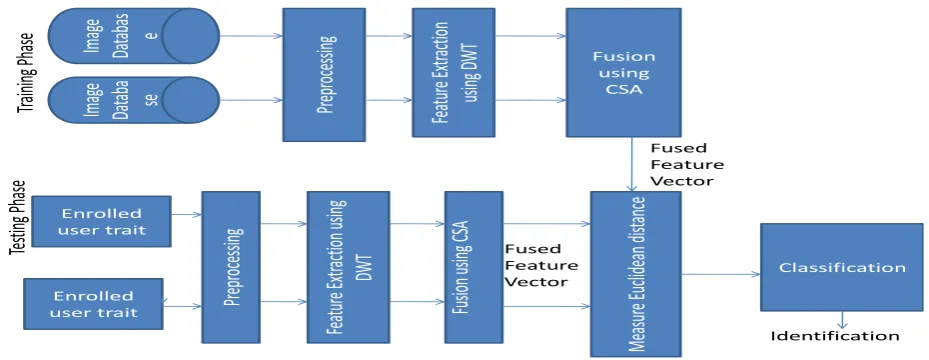
The process flow of the bimodal system is shown in Figure 1. The process flow shows the training and testing phases. In the training phase, there are two biometric image databases which store the two biometric templates to be used in the recognition process. The next component is the preprocessing component where each of the traits is preprocessed to improve the image quality and at the same time, normalize the images for uniformity. The preprocessed image is then fed into the feature extraction component where discriminating features are extracted using DWT. The DWT coefficient from each image is then converted to feature vectors for fusion in the next component using CSA. The fused features are afterwards saved for comparison. On the other hand, the testing phase involves the enrollment of the user where the desired biometric traits are acquired. The acquired traits were preprocessed independently. Features were extracted and fused as explained above. The fused feature vector is then compared with the fused feature vector in the training database by measuring the Euclidean distance between the two vectors in a component connecting the training and testing phase.
A. Data Acquisition
chimeric multimodal dataset. The images were captured though in the software laboratory of the Department of Computer Science and Engineering but not under a controlled environment. The acquisition of faces and eye images was done with CMITECH iris camera while fingerprints were
acquired using digital persona fingerprint scanner. There are 6 different images per biometric trait per subject. The facial images were all taken in frontal position with little variations in expression and illumination. However, there are variations in the distance between the subject and the camera.
29
Imag
e
Da
tab
as
e
Pre
pro
ce
ssi
ng
Fe
atu
re
Ex
trac
tio
n
us
ing
DW
T
Enrolled user traitPre
pro
ce
ssi
ng
Fe
atu
re
Ex
trac
tio
n u
sin
g
DW
T
Me
asu
re
Eu
clid
ean
di
stan
ce
Classification Fused Feature VectorTrain
ing
Phas
e
Te
sti
ng
Phas
e
Imag
e
Da
tab
a
se
Fusion using CSA Enrolleduser trait
Fu
sio
n u
sin
g CS
A
Fused Feature Vector IdentificationFigure 1: Process flow of a bimodal biometric system
B. Image Preprocessing
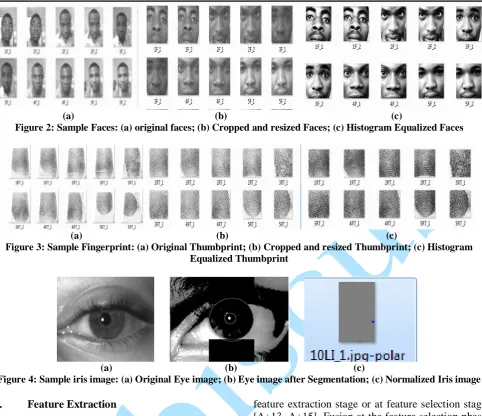
The image preprocessing involves enhancement of the image. However, before preprocessing, all images were converted to JPEG format using Microsoft Picture Manager. This is done to compress the image so as to reduce the memory consumption during experiments. After conversion, each face image was 57.4Kb, iris was 41Kb and thumbprint was 34.6Kb but the image resolution still remains the same. After this, geometric normalization was done to convert the images to the same resolution since they have different resolution. For face images, the images were first automatically cropped from original size of 720x960 to a reduced size using the Adaboost algorithm. The cropping was done to retain only the face region with the extinction of areas such as ear and fore-head without distortion. The images were then resized to 100x100 pixels for uniformity. Meanwhile for iris and thumbprint images, they were only resized to 100x100 pixel level.
Second, photometric normalization was carried out on the entire image database to eliminate illumination effects, improve contrast, and enhance visual quality and to obtain a uniform histogram of the images. This was done by adopting histogram
equalization which enhances the image contrast by transforming the values in an intensity image so that the histogram of the output image matches a specified histogram during normalization [Fal12]. Iris Preprocessing
(a) (b) (c)
Figure 2: Sample Faces: (a) original faces; (b) Cropped and resized Faces; (c) Histogram Equalized Faces
(a) (b) (c)
Figure 3: Sample Fingerprint: (a) Original Thumbprint; (b) Cropped and resized Thumbprint; (c) Histogram Equalized Thumbprint
(a) (b) (c)
Figure 4: Sample iris image: (a) Original Eye image; (b) Eye image after Segmentation; (c) Normalized Iris image
C. Feature Extraction
Feature extraction is a special form of dimensionality reduction which contains more information about the original image. This stage describes the extraction of unique characteristics which can represent an image. The goal of feature extraction is to extract a set of features, which can maximize the recognition rate with the least number of elements. Discrete Wavelet Transform (DWT) was adopted for a transformation based feature extraction. A two level decomposition was performed on the preprocessed images. The DWT coefficient matrices extracted forms an efficient representation of the images in a lower dimension space. The output of DWT was converted to feature vector which serves as input to the fusion stage of the multimodal systems.
D. Feature level Fusion
Biometric fusion is the term used to describe the mechanism for integrating data from two or more traits. It refers to the consolidating of information or evidences presented by multiple biometric sources
feature extraction stage or at feature selection stage [A+13, A+15]. Fusion at the feature selection phase deals with the selection and combination of features to remove redundant and irrelevant features, the objective is to reduce the computational burden of feature concatenation by choosing optimal subsets of features from the original features extracted from each modality. This paper presents an example of feature selection stage fusion using Clonal Selection Algorithm (CSA).
antibodies are then selected for cloning. The cloned antibodies are mutated to increase the diversity in the population, afterwards, their affinities are measured to evolve the next generation. The algorithm is given as follows:
Step 1: Initialize the antibody population. Step2: Evaluate the affinity of all individuals. Step 3: Select the best candidates from population
(a) Sort the antibodies by their affinity values
(b) Select the best antibodies. Step 4: Clone the best antibodies.
Step 5: Mutate the clones and produce a new population.
Step 6: Evaluate the affinity of each antibody in the new
population.
Step 7: Repeat steps 3 through 6 until the stopping criteria is
met. Affinity function
The affinity function is associated with each antibody and it represents the quality of the solution. The goal of multimodal system is to reduce inter-class similarities and increase intra-inter-class similarities. Therefore, the affinity function used in this paper was adopted from the work of Aly, Onsi, Salama and Mahmoud [A+13]. The main objectives of the affinity function are:
(i) Maximize the between-class scatter (Sb) among the different classes.
(ii) Minimize the within-class scatter (Sw) in the same class.
(iii) Improve the recognition rate of the system. Suppose there are C classes, yi is the ith vector, Mi the number of samples within class i, where i = 1, 2, …C. µi the mean vector of class I, and µ be the total mean vector of samples. The within-class scatter matrix is represented as:
(1)
While the between-class matrix is given as:
(2)
Where
Finally, the affinity function is computed by maximizing the between-class scatter matrix while minimizing the within-class scatter and is performed by:
Affinity function = maximize
(3)
This CSA based fusion technique combines the two feature vectors into a single feature without concatenation. Therefore, rather than adding up of dimensions from the two feature sets which results by concatenation, this technique combines them to reduce the feature space. The reduced vector is classified using Euclidean distance measure and Nearest neighbor classifier.
The bimodal systems presented in this paper was developed, trained and tested using MATLAB version 12 with a system specification of 1.80GHz processor, 500GB of HDD (hard disk drive), 4GB of RAM, and 64 bit operating system on window 7 platforms.
IV. EXPERIMENTAL RESULTS AND DISCUSSIONS
Three bimodal biometric systems were developed in this work, they are Iris-Fingerprint (IR-FI), Face-Iris (FA-IR) and Face-Fingerprint (FA-FI) biometric systems. Features were extracted separately from each of the biometric traits and fusion of the features was done using CSA. The performance metrics employed for evaluation are Recognition Accuracy, Average training time and average recognition time. Each of the systems was trained with a total of eight hundred (800) images while four hundred (400) images were used for testing which implies that 60% of the dataset were used for training.. The summary of results obtained is shown in Table 1.
Table 1: Summary of Experimental Results
Biometric System Recognition Accuracy (%)
Average Training Time (s)
Average Recognition Time (s)
IR-FI 89.50 5.35 3.81
FA-IR 89.63 10.08 4.91
FA-FI 88.25 8.39 4.07
The results of the experiments carried out are summarized as shown in Table 1. The second column of the table shows the recognition accuracy of the systems. Face-Iris bimodal system has the
discriminating features contained in iris, when combined with features from other biometric traits will enhance the recognition accuracy of the system than face and fingerprint.
The results for the average training time indicate that Iris-Fingerprint (IR-FI) bimodal system has the least training time while the highest training time was recorded with the Face-Iris (FA-IR) system. This is
an indication that face contains more features to be trained followed by iris. Similarly, the average recognition time follows the same trend.
Lastly, the accuracies of the systems are then compared with their unimodal counterparts under the same condition as reported in [A+18]. The comparison is given in Table 2.
Table 2: Comparison with unimodal systems
Biometric System Recognition Accuracy (%)
Average Training Time (s)
Average Recognition Time (s)
Face 83.33 5.84 5.11
Iris 85.50 3.65 3.05
Fingerprint 82.75 1.27 1.28
IR-FI 89.50 5.35 3.81
FA-IR 89.63 10.08 4.91
FA-FI 88.25 8.39 4.07
From table 2, the accuracy of Face is 83.33%, Iris is 85.50% and 82.75% for fingerprint recognition system. The comparison with unimodal is done in order to see how important the implementation of multimodal biometric system as an alternative to overcome the limitations of unimodal systems. From the results, it is observed that all the bimodal systems have higher recognition accuracy compared to their respective unimodal counterparts. This implies that combining two or more modalities can improve the performance of a biometric system. CONCLUSION
In this work, a parallel multimodal biometric system was proposed. The purpose of the research is to overcome the limitations in unimodal biometric system by combining face, iris and fingerprint at feature level. Thus, making it difficult for impostor to fool two different traits at the same time.DWT was used both to reduce the dimension of the images and at the same time extract discriminating features to represent the traits while the features were fused at the feature selection phase using CSA. Fusing at this stage helps in preventing information loss and also ensures that only the most significant information from the modalities are used for classification. The results obtained shows that multimodal biometrics are more efficient than unimodal ones. Future works may be geared towards investigating the effect of training dataset size on recognition accuracy of multimodal systems. Also feature level fusion of multiple instance of the same biometric trait may be researched to see whether the same system performance with multimodal may be achieved.
REFERENCES
[A+12] Adedeji O. T., Omidiora E. O., Olabiyisi O. S., Adigun A. A. -
Performance Evaluation of Optimised PCA and Projection Combined PCA
methods in Facial Images. Journal of
Computations & Modelling, 2(3), 17-29, 2012.
[A+13] Awang S., Yusof R., Zamzuri M. F., Arfa R. - Feature Level Fusion of Face and Signature using a Modified Feature
Selection Technique, International
Conference on Signal-Image Technology and Internet-Based Systems, (IEEE-Computer Society): 706-713, 2013.
[A+15] Adedeji O. T., Falohun A. S., Alade O. M., Omidiora E. O., Olabiyisi S.
O. - Development of a Modified Clonal
Selection Algorithm for Feature Level
Fusion of Multibiometric System,
LAUTECH Journal of Engineering and Technology, 9(2):80-85, 2015.
[A+16] Ali M. M. H., Mahale V. H., Yannawar P., Gaikwad A. T. -
Overview of Fingerprint Recognition
Systems, International Conference on
Electrical, Electronics and Optimization Techniques, 2016.
[A+18] Adedeji O. T., Falohun A. S., Alade O. M., Omidiora E. O., Olabiyisi S.
World Journal of Engineering Research and Technology (WJERT). 4(4): 160-167, 2018.
[Fal12] Falohun A. - Development of a Feature Extraction Method for Iris Recognition using Enhanced Inverse Analytical
Fourier-Mellin Transform.
Unpublished Ph. D. Thesis. Ladoke Akintola University of Technology, Ogbomoso, Nigeria, 2012.
[F+04] Feng G., Dong K., Hu D., Zhang D. -
When Faces are combined with palmprints: A novel Biometric fusion
Strategy, In proceedings of First
International conference, ICBA 2004, Springer:701-707, 2004.
[JR04] Jain A. K., Ross A. - Multibiometric
systems, Communications of the ACM,
Special issue on Multimodal Interfaces, 47(1):34-40, 2004.
[KA12] Krishneswari K., Arumugam S. -
Intramodal feature fusion based on
PSO for palmprint authentication. Int
Journal on Image and Video Proc, 2(4), 435-440, 2012.
[KZ12] Kumar A., Zhang D. - Combining fingerprint, palmprint and hand-shape
for user authentication, In Pattern
Recognition 18th International conference (IEEE). 4(1): 549-552, 2006.
[K+12] Kim Y. G., Shin K. Y., Lee E. C., Park K. R. - Multimodal Biometric Sytem based on the Recognition of
faces and Both Irises, International
Journal of Advanced Robotic Systems, 9(65):1-6, 2012.
[NP13] Nahdeen F. M., Poornima S. -
Feature Level Fusion in Multimodal
Biometric Authentication System,
International Journal of Computer Applications, 69(18): 36 – 40.
[Omi06] Omidiora E. O. - A Prototype of Knowledge-based System for Black
Face Recognition System using
Principal Component Analysis and
Fisher Discriminant Algorithms,
Unpublished Ph. D. Thesis, Ladoke Akintola University of Technology, Ogbomoso, Nigeria, 2006.
[RJ04] Ross A., Jain A. K. - Multimodal
Biometrics: An Overview, Proceedings
of 12th European Signal Processing Conference (EUSIPCO), (Vienna, Austria): 1221-1224, 2004.
[R+07] Rattani A., Kisku D. R., Bicego M., Tistarelli M. - Feature Level Fusion of
Face and Fingerprint Biometrics, First
IEEE International Conference on Biometrics: Theory, Applications and Systems, 2007.
[SP13] Sanjeka P. S., Patil J. B. - An overview
of multimodal Biometrics, Signal and
Image Processing: An International Journal (SIPIJ), 4(1):57-64, 2013. [VK14] Valavan T. T., Kalaivani R. -
Biometric Authentication System Using
Fingervein, International Journal of
Computer Science and Mobile Applications, 2(1): 50-55, 2014.
[W+09] Wang Z., Han Q., Niu X., Busch C. -
Feature Level Fusion of Iris and Face
for Personal identification, Proceeding