ORIGINAL ARTICLE
IJPHY
ABSTRACT
Background and Purpose: Postmenopausal hypertension is the most common risk factor of cardiovascular morbidity and mortality. As the exercises training conveys benefits of the setting of secondary prevention of hypertension. High intensity interval training (HIIT) emerged as a new form of physical training and presents as therapeutic alternative to patients and health care professionals. This study aimed to investigate the effect of high intensity interval training on endothelial function in postmenopausal hypertension.
Methods: Forty six mildly hypertensive postmenopausal women, their ages ranged from (45-55) years old, were ran-domly allocated to two groups: HIIT group (group-I; n=23) performed a high intensity interval training 3 times a week for 10 weeks at an intensity of (80-85% HR max ) for 40 minutes and control group (group-II; n=23) remains sedentary during this period. Serum nitric oxide (NO), vascular endothelial growth factor levels (VEGF) and blood pressures were measured before and after intervention.
Results: A significant reduction in both systolic and diastolic blood pressure values by 9.5% and 7 % respectively, was seen after high intensity interval training which was accompanied by increase in NO and VEGF levels by 43.3% and 15.2 % respectively, while no significant change observed in the control group.
Conclusion: High intensity interval training had obvious benefits in improving plasma NO, VEGF concentrations and controlling hypertension in postmenopausal women.
Keywords: Interval training, Endothelial function, Atherosclerosis, Post menopause, hypertension, prevention.
Received 11th December 2015, revised 23rd December 2015, accepted 22nd January 2016
www.ijphy.org
10.15621/ijphy/2016/v3i1/88908
CORRESPONDING AUTHOR
Int J Physiother. Vol 3(1), 39-44, February (2016) ISSN: 2348 - 8336
EFFECT OF HIGH INTENSITY INTERVAL TRAINING ON
ENDOTHELIAL FUNCTION IN POSTMENOPAUSAL
HY-PERTENSIVE PATIENTS: RANDOMIZED CONTROLLED
TRIAL
*1
Mona Mohamed Taha
²Marwa Abd El-Rahman Mohamed
³Marwa Esmael Hasanin
*1Mona Mohamed Taha
Lecturer of Physical Therapy in Department of Cardiovascular/ Respiratory Disorder and Geriatrics, Faculty of Physical Therapy,
Cairo University, Egypt. ²Lecturer of Physical Therapy in
Department of Obstetrics and Gynecology, Faculty of Physical Therapy,
Cairo University, Egypt.
³Lecturer of Physical Therapy in
Department of Obstetrics and Gynecology, Faculty of Physical Therapy,
INTRODUCTION
Essential arterial hypertension is the widest risk factor of cardiovascular complication and mortality, influencing roughly one billion people around the world, and is ac-companied with high health care expenditure [1]. The high prevalence of cardiovascular disease (CVD) starts with blood pressure (BP) levels as low as 115/75 mmHg, and duplicates for every 20/10 mmHg increment in systolic/ diastolic BP[2].
Epidemiological studies have demonstrated that life span of women is greater than men by eight-year, but after post menopause, the prevalence of cardiovascular disease in-creases gradually, for example, each year women die more than men due to coronary heart disease and are double as likely as men to die within the first year after a heart attack. Arterial hypertension, diabetes mellitus, dyslipidemia, physical inactivity and overweight are the main risk fac-tors of coronary heart disease [3]. Physical inactivity has been involved as the main cause of obesity especially the abdominal obesity in postmenopausal women [4].
The cause of postmenopausal hypertension is complicated and multifactorial. A decline in estrogen output with the subsequent change in estrogen/androgen ratio is a criti-cal factor [5]. Estrogen is especially vital for its powerful and valuable effect on endothelial function by increasing secretion and declining degradation of NO [6]. Other risk factors of postmenopausal hypertension are endothelial dysfunction, sympathetic nervous system overtone and rennin-angiotensin-aldosterone system, oxidative stress, body mass index and sedentary life[7,8].
With the developing knowledge of the endothelial function significance, the endothelium has turned into a real focus for therapeutic interference. Aside from pharmacologi-cal interference with ACE inhibitors and statins, physipharmacologi-cal activity has developed as an acknowledged treatment to enhance endothelial function. The outcomes demonstrate that just standard moderate exercise training enhances the antioxidant and maintains the endothelial function. In this manner, activity may have a helpful impact on the improvement of cardiovascular disease through protecting endothelial function [9].
Endothelial cells of the blood vessels secrete nitric oxide which is a lipid soluble gas composed from the amino-acid L-arginine, by the action of endothelial nitric oxide syn-thase [10]. Nitric oxide is the main organizer of the cardio-vascular system acting on cardio-vascular basal tone, preventing platelet collection and smooth muscle propagation [11]. The secretion of NO regulated by NO synthase enzyme (NOS) which is stimulated by humoral (hormones, auta-coids) and physical activity (shear stress) [12]. Physical activity is a strong stimulus to enhance blood flow in vas-cular beds and thus the useful effects of physical training on cardiovascular diseases are strongly depended on the increase in NO production and/or its bioavailability either in human or laboratory animals [13,14]. Additionally, En-durance activity is considered as a helpful method for the
enhancement of vascular angiogenesis in different organs [15] because of the stimulation of angiopoietin and vascu-lar endothelial growth factor [16].
High intensity training can give comparable or better ef-fects than continuous physical activity, but in a shorter length of time in light of the fact that it is more time-effi-cient [17]. It was demonstrated, that high intensity training is not only a valuable method in elite sports, but also in the health prevention and rehabilitation [18].
However, only a limited work focused on endothelial func-tion, activafunc-tion, and adaptations in response to high in-tensity interval training, but its effectiveness remains to be demonstrated in postmenopausal hypertensive patients.
METHODS
Forty six mild hypertensive postmenopausal women vol-unteered for this study recruited from Kaser El-Aini Hos-pital, Cairo-Egypt.. Inclusion criteria were: age 45 to 55 years, sedentary , non smoking, non diabetic , no more than one antihypertensive medication is taken, not taking hormone replacement therapy or medications that affect cardiovascular hemodynamics and no history or evidence of CVD, renal disease, or orthopedic conditions that affect the ability to participate in exercise program. Patients with uncontrolled hypertension (systolic blood pressure (SBP) <140 mmHg and/or diastolic blood pressure (DBP) <90 mmHg) at baseline in any session were excluded.
Randomization was performed simply by asking the pa-tient to randomly choose a piece of paper which (A) or (B) letter. So participants were randomly assigned into one of the two groups; interval training group (group-I; n=23) received high intensity interval training 3 sessions per week for 10 weeks or a control group (group- II; n=23) remained sedentary during this period. The aim and pro-cedures of the study were informed to eligible patients and signed a written informed consent and the study approved by an ethical Committee of faculty of physical therapy, Cai-ro University.
Evaluation:
Every patient was assessed by a physician to select eligi-ble patients. Before patient inclusion in this study, a com-plete medical history, drug history and physical training history questionnaires were used for the patients. .All tests were performed before the (pre-) and after (post-) training period for each participants including demographic data, blood pressure assessment and laboratory analysis for se-rum NO and VEGF. To control the acute effects of exer-cise on hemodynamic and biochemical variables , all final testing was measured at least 24 to 36 hours after the last exercise session.
Anthropometric and cardiovascular parameters
Be-fore blood pressure measurement, exercise outside of the laboratory should be avoided and after seated quiet rest for 15 minutes, blood pressure was measured at the same time to avoid diurnal variations using aneroid sphygmo-manometer (made in Japan ) .Office blood pressure mea-surements were measured according to the Seventh Report of the Joint National Committee on Prevention, Detection, Evaluation, and Treatment of High Blood Pressure (JNC 7) guidelines[19]. Resting heart rate was identified after 5 minutes position using a pulse oximeter.
Plasma endothelial function markers
Blood samples were drawn into EDTA tubes in the morn-ing followmorn-ing a 12-hour overnight fast. Total NO was de-termined spectrophotometrically by using kits (Total Ni-tric Oxide kit used in ELISA, R & D systems, Minneapolis, USA), concentration was given in µmol/L. Serum levels of VEGF protein (pg/mL) determined by using human ELI-SA kits for VEGF (Human VEGF Quantikine ELIELI-SA Kit (Catalog Number DVE00) R&D Systems, Inc. USA. Treatment:
High intensity interval training (HIIT).
Electronic treadmill (Vegamax , made in Taiwan) was used for training. HIIT consisted of walking/running on a treadmill 3 sessions/week for 10 weeks. HIIT duration consisted of warm-up for 10 min at 70% of maximal heart rate (HRmax) and 4x4 min intervals at 80-85% of HRmax, with 3-min active recovery at 70% of HRmax between inter-vals, and finally 5min cool-down period. The total exercise time was 40 min. Maximum heart rate is estimated accord-ing to the followaccord-ing formula: HRmax = 206 – 0.88*age. A heart rate and the Borg scale of perceived exertion were monitored during the interval training to ensure that all subjects were exercising on their corresponding intensity of exercise . Continuous adjustment of the speed of the treadmill was used to avoid training adaptations to ensure training at the desired heart rate along the whole 10-week training program.
Statistical analysis
Statistical analysis was performed using SPSS software, version 16.0 (SPSS, Inc., Chicago, IL). Data were expressed
as mean ± standard deviation (SD). The results were ana-lyzed by using the Student’s t-test . Statistical significance was set at P<.05.
RESULTS
A total of 46 mildly hypertensive postmenopausal women were recruited, including 23 in group I (study group) and 23 in group II (control group). Subjects in the group I ad-hered to the 10-weeks high intensity interval training pro-gram very well .Table 1 shows the baseline characteristics of the subjects at the beginning of the study. There were no significant differences in age, BMI, Blood pressure, plasma nitric oxide and vascular endothelial growth factor among the two groups.
Table 1: The baseline characteristics of the two groups (pre- study).
Character HIIT group(I)
Control group (II) t-
Value ValueP- Mean ± SD Mean ± SD
Age (Ys) 48.17 ± 2.20 47.78± 2.59 .551 .584 BMI (kg/m2) 32.78 ± 1.46 32.63 ± 1.62 .325 .747
SBP(mmHg) 137.17± 3.63 136 ± 3.8 1.07 .925 DBP(mmHg) 89.27± 4.68 89.52 ± 4.29 -.189 .778 NO(µmol/L) 22.94 ± 1.75 23.4 ± 1.12 -1.067 .292 VEGF(pg/ml) 97.31 ± 24.28 94.21 ± 19.48 .479 .634
Data presented as mean± standard deviation ; *p < 0.05; SBP = Systolic blood pressure; DBP = Diastolic blood pres-sure; NO = Nitric oxide ; VEGF= Vascular endothelial growth factor
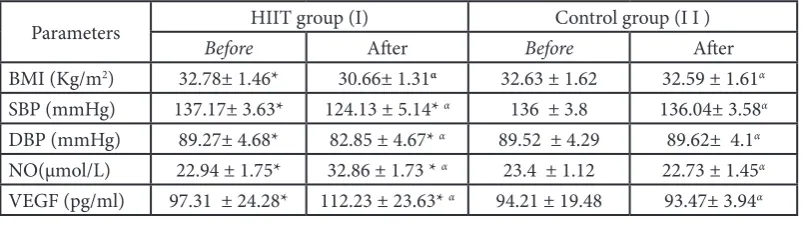
Table 2 shows that high intensity interval training program resulted in significant decrease in systolic and diastolic blood pressure when comparing pre- and post-training values. Plasma nitric oxide concentration increased sig-nificantly by 9.92± 1.77 µmol/L after high intensity interval training while no significant change in the control group was observed. Plasma vascular endothelial growth factor increased significantly by 14.92 pg/ml in response to high intensity interval training while the changes in the control group were not statistically significant.
Table 2. Physiological characteristics of the subjects before and after 10 weeks.
Parameters HIIT group (I) Control group (I I )
Before After Before After
BMI (Kg/m2) 32.78± 1.46* 30.66± 1.31α 32.63 ± 1.62 32.59 ± 1.61α
SBP (mmHg) 137.17± 3.63* 124.13 ± 5.14* α 136 ± 3.8 136.04± 3.58α
DBP (mmHg) 89.27± 4.68* 82.85 ± 4.67* α 89.52 ± 4.29 89.62± 4.1α
NO(µmol/L) 22.94 ± 1.75* 32.86 ± 1.73 * α 23.4 ± 1.12 22.73 ± 1.45α
VEGF (pg/ml) 97.31 ± 24.28* 112.23 ± 23.63* α 94.21 ± 19.48 93.47± 3.94α
Data presented as mean± standard deviation; p < 0.05;
*Significantly different from before training; α significantly different between two groups.
DISCUSSION
A recent study has demonstrated that estradiol inadequacy has a tendency to have a negative impact on NO-cGMP pathway in menopausal women, hence change in way of life by physical activity is an essential way to decrease inci-dence of cardiovascular complication in this people [20]. As the exercise training was established to have useful ef-fect on cardiovascular system which has been accompanied with an improvement of the vasculature NO-cGMP path-way in both vivo and vitro studies. So, exercise training is a vital nonpharmacological method in arterial hypertension and atherosclerotic process management [13].
The following potential mechanisms may clarify the useful effects of exercise on endothelial function. First, exercise improves NO availability due to promoted expression/ stabilization of endothelial nitric oxide synthase enzyme (eNOS) or decreased inhibition/ degradation of NO by free radicals [21]. Second, continuous exercise stimulates expression of the antioxidant enzymes, superoxide dis-mutase, glutathione peroxidase and catalases and so pro-motes the antioxidant capacity [22]. In addition, exercise decreases expression of the oxidant enzymes, nicotinamide adenine dinucleotide phosphate oxidase and xanthine oxi-dase [23]. Third, exercise has an anti-inflammatory effects through decreased expression of pro-inflammatory mark-ers as interleukins, adhesion molecules, C-reactive protein and selectin [24]. The fourth, exercise increases the num-ber of endothelial progenitor cells which may help in vas-cular regeneration and angiogenesis[25].
This study shows that 10 weeks of high intensity interval training was effective in decreasing both systolic and di-astolic blood pressure and increasing the serum levels of NO and VEGF concentrations, our results supported by previous studies . Padilla et al., demonstrated that there is a significant dose–response relationship between aerobic exercise intensity and Flow-mediated dilation which may be because of the more release of NO due to the higher exercise intensity caused greater shear stress on the endo-thelium [26]. These results support the new evidence that high-intensity exercise training can be more useful for cardiovascular health than low-intensity exercise train-ing [27]. The American College of Sports Medicine pub-lished the physical activity guidelines that emphasize the advantage of high-intensity exercise training for preserv-ing and promotpreserv-ing cardiovascular health [28]. For each MET increment in exercise intensity, cardiovascular and all-cause mortality are diminished by 8–17 % [29]. Fur-thermore, high-intensity exercise training was better than moderate-intensity exercise in improving cardiorespira-tory fitness [30]. Moreover, it could be suggested that the higher exercise intensity could have produced changes in BMI which result in a greater improvement in microvas-cular function [31]. MacDonald and Currie, observed that light, moderate and vigorous intensities of aerobic exercise improve endothelial function significantly and there was a dose–response relationship between relative/
absolute exercise intensities and endothelial function. For each 2-MET increment in absolute exercise intensity was accompanied with nearly 1 % unit increase in Flow-me-diated dilation . So higher intensive exercise may have a more CVD benefits and thus the focus should be on such intervention which improves compliance with the exercise training [32]. Poelkens et al., noticed the increased bio-availability of NO after aerobic interval training , but not continuous moderate exercise [33]. Recent studies suggest that HIIT caused more blood flow and consequently shear stress which is better in improving most cardio-metabolic diseases including NO bioavailability , endothelial func-tion, insulin sensitivity, glucose metabolism, high-densi-ty lipoproteins, oxidized low-densihigh-densi-ty lipoproteins and left ventricular dysfunction and enhances compliance[34-36]. Vascular endothelial growth factor (VEGF) is a possible regulator of angiogenesis in the peripheral and central vascular systems. Angiogenesis happens in the presence of VEGF, however without VEGF, the capillaries experience apoptotic regression [37].
Interestingly, it appears that high intensities are necessary to improve angiogenic growth factors (e.g. VEGF) [38] and to build capillarization and endothelial cell expansion [39] .
There are conflicting results concerning the VEGF re-sponse to exercise. But, by summing up these results, it appears that the VEGF response is determined by the ex-ercise intensity. High-volume low-intensity exex-ercise causes no progressions or a diminishing in circulating VEGF level and the higher intensities cause an increase in VEGF [18]. But, Morici et al., showed larger increases of (+28%) after all out rowing, compared to the all-out exercise used in his study [40].
It can be suggested, that the significant stimuli for a VEGF production/synthesis (shear stress and hypoxia) is more present during higher intensities of exercise training. More-over, previous research speculated that microenvironment signals as acidosis and lactate assume a major part in the regulation of VEGF production, and subsequently in regu-lation of angiogenesis [41].
Future researches are warranted to address this long-term effect of the interval training and the effect of different in-terval training protocols should be investigated. Also, ad-ditional studies are required to show the different age pop-ulation responses to interval training.
CONCLUSION
Abbreviations:
HIIT: High intensity interval training NO: Serum nitric oxide
VEGF: vascular endothelial growth factor levels
ACKNOWLEDGMENTS
We are grateful for the support and cooperation of all pa-tients who participated in this study.
Disclosure Statement
No competing financial interests exist.
REFERENCES
[1] Lawes CM, Vander Hoorn S, Rodgers A. Global bur-den of blood pressure-related disease. 2001. Lancet 2008; 371(9623): 1513-1518.
[2] Lewington S, Clarke R, Qizilbash N, Peto R, Collins R. Age-specific relevance of usual blood pressure to vascular mortality: a meta-analysis of individual data for one million adults in 61 prospective studies. Lancet 2002; 360(9349):1903-1913.
[3] Harrison-Bernard LM and Raij L. Postmenopausal hy-pertension. Curr Hypertens Rep. 2000; 2(2):202-207.
[4] Simkin-Silverman L, Wing RR, Hansen DH, et al. Prevention of cardiovascular risk factor elevations in healthy premenopausal women. Preventive Medicine.
1995; 24(5):509-517.
[5] Reckelhoff JF. Basic research into the mechanisms re-sponsible for postmenopausal hypertension. Interna-tional journal of clinical practice 2004; 139: 13-9.
[6] Colditz GA, Willett WC, Stampfer MJ, Rosner B, Speizer FE, Hennekens CH. Menopause and the risk of coronary heart disease in women. N Engl J Med1987; 316:1105–10.
[7] Posnik-Urbanska A and Kawecka-Jaszcz K. Hyperten-sion in postmenopausal women--selected pathomech-anisms. Przeglad lekarski. 2006; 63(12):1313-7.
[8] Vincent HK, Vincent KR, Bourguignon C , Braith RW. Obesity and postexercise oxidative stress in older women. Medicine and science in sports and exercise 2005; 37(2):213-9.
[9] Di Francescomarino S, Sciartilli A, Di Valerio V, Di Bal-dassarre A,Gallina S. The effect of physical exercise on endothelial function. Sports Med 2009; 39(10): 797-812.
[10] Versari D, Daghini E, Virdis A, Ghiadoni L, Taddei S.
Endothelial dysfunction as a target for prevention of cardiovascular disease. Diabetes care. 2009; 32: 314-21.
[11] Murad F: Cellular signaling with nitric oxide and
cy-clic GMP. Braz J Med Biol Res. 1999;32(11):1317-1327.
[12] Vanhoutte PM. Endothelial control of vasomotor
func-tion. Cir Res 2003;67(7):572-575.
[13] Kingwell BA. Nitric oxide-mediated metabolic
reg-ulation during exercise: effects of training in health and cardiovascular disease. FASEB JOURNAL 2000; 14(12):1685-1696.
[14] De Moraes C, Davel AP, Rossoni LV, Antunes E,
Zane-sco A. Exercise training improves relaxation response
and SOD-1 expression in aortic and mesenteric rings from high caloric diet-fed rats. BMC Physiol 2008; 8:12.
[15] Viboolvorakul S., Niimi H., Wongeak-in N.,
Eksakulk-la S., and Patumraj S. Increased capilEksakulk-lary vascuEksakulk-larity in the femur of aged rats by exercise training. Microvas-cular Research 2009; 78(3): 459–463.
[16] Lloyd P.G., Prior B.M., Yang H.T. , Terjung R.L.
Angio-genic growth factor expression in rat skeletal muscle in response to exercise training,” American Journal of Physiology—Heart and Circulatory Physiology 2003; 284(5): H1668–H1678.
[17] Hatle H, Støbakk PK, Mølmen HE, et al. Effect of 24
sessions of high-intensity aerobic interval training car-ried out at either high or moderate frequency, a ran-domized trial. PLoS One. 2014; 9(2): e88375.
[18] Wahl P, Jansen F, Achtzehn S, et al. Effects of high
intensity training and high volume training on endo-thelial micro particles and angiogenic growth factors. PLoS One. 2014 Apr 25;9(4):e96024.
[19] Chobanian AV, Bakris GL, Black HR, et al. The seventh
report of the Joint National Committee on Prevention, Detection, Evaluation, and Treatment of High Blood Pressure: the JNC 7 report. JAMA.2003;289:2560– 2572.
[20] Salhotra S, Arora S, Trived SS, Bhattacharjee J.
Influ-ence of menopause on biochemical markers of endo-thelial dysfunction-A case-control pilot study in North Indian population. Maturitas. 2009; 62(2):166-170.
[21] Belardinelli R, Lacalaprice F, Faccenda E, Purcaro
A and Perna G. Effects of short term moderate ex-ercise training on sexual function in male patients with chronic stable heart failure. Int J Cardiol. 2005; 101(1):83–90.
[22] Gielen S, Schuler G, Adams V. Cardiovascular effects
of exercise training: molecular mechanisms. Circula-tion. 2010; 122(12): 1221–38.
[23] Newcomer SC, Thijssen DH, Green DJ. Effects of
exer-cise on endothelium and endothelium/smooth muscle cross talk: role of exercise-induced hemodynamics. J Appl Physiol (1985); 2011;111(1):311–20.
[24] Ribeiro F, Alves AJ, Duarte JA , Oliveira J. Is exercise
training an effective therapy targeting endothelial dys-function and vascular wall inflammation? Int J Cardi-ol. 2010;141(3):214–21.
[25] Ribeiro F, Ribeiro IP, Alves AJ, et al. Effects of exercise training on endothelial progenitor cells in cardiovas-cular disease: a systematic review. Am J Phys Med Re-habil. 2013;92(11):1020–30.
[26] Padilla J, Harris RA, Rink LD, et al. Characterization of the brachial artery shear stress following walking exer-cise. Vasc Med. 2008;13(2):105–11.
[27] Whyte LJ, Ferguson C, Wilson J, et al. Effects of
sin-gle bout of very high-intensity exercise on metabol-ic health biomarkers in overweight/obese sedentary men. Metabolism. 2013;62(2):212–9.
[28] Haskell WL, Lee IM, Pate RR, et al. Physical activity
from the American College of Sports Medicine and the American Heart Association. Med Sci Sports Exerc. 2007;39(8):1423–34.
[29] Swain DP and Franklin BA. Comparison of
cardio-protective benefits of vigorous versus moderate inten-sity aerobic exercise. Am J Cardiol. 2006;97(1):141–7. doi:10.1016/j.amjcard.2005.07.130.
[30] Smart NA, Dieberg G, Giallauria F. Intermittent versus
continuous exercise training in chronic heart failure: a meta-analysis. Int J Cardiol. 2013;166(2):352–8.
[31] Sprung VS, Cuthbertson DJ, Pugh CJ, et al.
Nitric ox-ide mediated cutaneous microvascular function is impaired in polycystic ovary sydrome but can be im-proved by exercise training. J Physiol. 2013 Mar 15;591(Pt 6):1475-87.
[32] MacDonald MJ, Currie KD. Interval exercise is a
path to good health, but how much, how often and for whom? Clin Sci (Lond). 2009;116(4):315–6. doi:10.1042/cs20080632.
[33] Poelkens F, Hopman MT, Tack CC. Aerobic interval
training versus continuous moderate exercise as a treatment for the metabolic syndrome: a pilot study”. Circulation. 2009 Mar 3;119(8):e225; author reply e226.
[34] Gibala MJ, Little JP, Macdonald MJ & Hawley JA .
Physiological adaptations to low-volume, high-inten-sity interval training in health and disease. J Physiol
.2012; 590(pt5):1077-1084.
[35] Shepherd SO, Cocks M, Tipton KD, et al. Sprint
in-terval and traditional endurance training increase net intramuscular triglyceride breakdown and expression of perilipin 2 and 5. J Physiol .2013; 591(pt3): 657-675.
[36] Tjonna AE, Lee SJ, Rognmo O, et al. Aerobic
inter-val training versus continuous moderate exercise as a treatment for the metabolic syndrome: a pilot study. Circulation. 2008;118(4):346–54.
[37] Dore-Duffy P. and LaManna J.C. Physiologic
angiody-namics in the brain Antioxidants and Redox Signaling
2007; 9(9):1363–1371.
[38] Wahl P, Zinner C, Achtzehn S, Behringer M, Bloch W
and Mester J. Effects of acid-base balance and high or low intensity exercise on VEGF and bFGF Eur J Appl Physiol .2011; 111(7):1405-1413.
[39] Jensen L, Bangsbo J, Hellsten Y. Effect of high intensity training on capillarization and presence of angiogenic factors in human skeletal muscle. J Physiol. 2004; 557 (Pt2): 571–582.
[40] Morici G, Zangla D, Santoro A, et al. Supramaximal
exercise mobilizes hematopoietic progenitors and reticulocytes in athletes. Am J Physiol Regul Integr Comp Physiol .2005; 289: R1496–R1503.
[41] Fukumura D, Xu L, Chen Y, Gohongi T, Seed B, Jain
RK. Hypoxia and acidosis independently up-regulate vascular endothelial growth factor transcription in brain tumors in vivo. Cancer Res. 2001; 61(16):6020– 6024.
Citation