doi:10.4236/jmp.2010.16056 Published Online December 2010 (http://www.SciRP.org/journal/jmp)
On Gaugino Dominated Dark Matter
Salah Eddine Ennadifi1, El Hassan Saidi1,2
1
Laboratory of High Energy Physics, Modeling and Simulation, Faculty of Sciences, Rabat, Morocco 2
Centre of Physics and Mathematics, CPM-CNESTEN, Rabat, Morocco E-mail: [email protected], [email protected]
Received July 20, 2010; revised October 10, 2010; accepted October 25, 2010
Abstract
Using the neutral gauginos of SUL 2 UY 1 and hybridization ideas below the GUT scale, we approach the Dark Matter particle within the Minimal Supersymmetric Standard Model. In the energy range
GUT Z
M M where supergravity effects can be ignored, it is proposed that such DM particle could be inter- preted in terms of a mixture of Bino and Wino states with a lower bound mass MDM 65GeV not far above the electroweak scale to account for the observed Dark Matter density. We establish the theoretical origin of this particle and study as well its compositeness and its mass bound.
Keywords:Minimal Supersymmetric Standard Model, Gauginos, Dark Matter
1. Introduction
Precision cosmology data identify Dark Matter (DM) as the main building block for all structures in the Universe [1-3]; however they do not discriminate among the sev-eral candidates discussed in the literature namely MA-CHO’s [4], Axions [5], gluinos [6,7], the lightest sneu-trino [8,9], which some of them have been excluded ex-perimentally [10,11], and weakly interacting massive particles (WIMP’s) [12]. Although alternative explana- tions in terms of modified gravity (MOND) [13,14] can- not be ignored, they can hardly be reconciled with the most recent astrophysical observations [15,16] without requiring additional matter beyond the observed baryons [17].
Solving this puzzle is one of the greatest challenges in modern physics. This problem, long regarded in astro- physics and cosmology, is now deeply rooted in high energy physics since it is in the context of theories be- yond the Standard Model (SM) of elementary particles [18] where the brightest candidates for DM arise. New weakly interacting massive particles [19] are well moti- vated by particle physics theory opening the door for particle physics beyond the SM. The Minimal Super- symmetric Standard Model (MSSM), the best motivated extension of the SM, provides a good candidate for the DM component of the Universe in terms of Lightest Su- persymmetric Particle (LSP) if R-parity RP is con-
served [20]. In simple realistic supersymmetric models, where supersymmetry is broken at the weak scale all SM
particles must have superpartners with masses 1TeV. These sparticles, existed in the early universe in thermal equilibrium with the ordinary SM particles. As the uni- verse cooled and expanded, the heavier sparticles could no longer be produced, and they eventually annihilated or decayed into LSP’s. Some of the LSP’s pair-annihi- lated into final states not containing sparticles.
Given the outstanding advances in DM detection ex- periments, as well as the forthcoming onset of the LHC experiments, an exciting near future can be anticipated in which this enigma might start being unveiled. In this paper, we develop an approach to the DM weakly inter- acting massive particle by using the pure gaugino sector of MSSM and a hypothesis on hybridization of the wave functions of the abelian gauginos of the MSSM gauge group. Guided by LHC experiments, we will mainly fo- cus on the SUC 3 UI 1 UY1 Yang-Mills sector
of MSSM although a full picture should include super- gravity since, along with gauginos, it is a potential can- didate for DM through the gravitino sector. To proceed, we first recall briefly the main evidence for DM. Then, restricting to the gaugino sector of MSSM and using wave function language, we present our proposal for DM particle in terms of hybridization of the Bino B and the Wino W fields, the supersymmetric partners of the
B and W gauge particles mediating the UI 1
1
Y
U gauge interaction sector of the SM. Next, we
one, then we deduce the lower bound of DM particle mass DM by translation into the electroweak scale.
We end this study by some comments and concluding remarks.
M
Uni
2. The Problematic
Historically the observational evidence for the existence of DM came only from galactic dynamics. Presence of DM can be inferred from gravitational effects on visible matter. According to present observations of universe structures larger than galaxies as well as Big Bang cos- mology inspired models, DM accounts for the vast ma- jority of mass in the observable universe [21],
70%
25% 5%verseDE DM SM
(1) where DM stands for non baryonic dark matter and DE for dark energy. Although the microscopic composition of DM remains a mystery, it is clear that it cannot consist of any elementary particles which have been discovered so far. Since this exotic matter strongly exists in the form of non-baryonic matter, the MSSM is therefore expected to provide a good candidate for the DM component of the Universe, thanks to the RP conservation. The cur- rent largely adopted view on DM implies that it is mostly made of WIMP’s [12]. Although these are hypothetical massive particles that scarcely interact with regular mat- ter, making them very hard to detect, a huge effort has been made to discover them on a global scale. DM com- ponent must be then an undiscovered, massive, stable or long lived particle. So we envisage that is, as it is almost widely accepted, supersymmetric, light, electrically neu- tral
Qem 0
and non-colored C0. This limits our work to the following abelian dark sector 1 em 0 n
C Q Dark
G U (2)
If weak-scale supersymmetry is realized in nature, the LSP plays a special role in the search for supersymmetry at colliders. All heavier particles rapidly cascade decay to the LSP, since this occurs in all supersymmetric events, the nature of the LSP and its behavior are deci- sive for all supersymmetric signatures at the LHC. In the MSSM, the most widely studied candidate the lightest neutralino , which is a very promising DM candidate [22] in large region of the parameter space, and, if one of its mass parameter contents is much lighter than the oth- ers, the LSP will be predominately of this form.
N
For the remainder of this paper, we will restrict our- selves to the case of gaugino dominated LSP, especially a typical Bino-like content B as it often emerges from
minimal supergravity boundary conditions on the soft parameters which tend to require it in order to get correct
electroweak symmetry breaking. Although Bino DM generally gives higher DM density, it could be decreased by considering just enough Wino Wo content allow-
ing for natural cold DM in accordance with astrophysical datas.
Below, in the MSSM framework, we develop an ap- proach to DM through the idea of the evolution of the abelian gaugino hybrids state with the scale energy down to the electroweak scale where the Higgsino sector con- tributes
H
to DM state. Using specific properties
where gauge quantum numbers captured by matter in adjoint representations take trivial values makes the de- tection of their interactions a complicated task and where LHC experiments are expected to bring more insight.
3. Dark Matter Building
Restriction to the neutral gauginos sector of MSSM as the first source of DM makes the derivation of DM parti- cle more tractable,
1
Dark I
G U UY 1 . (3) In fact, besides their masses generated by supersym- metry breaking, the abelian gauginos
a, a
(4D Majorana fermions) have the same quantum num- bers under SU 3 U 1 U 1
0
0
: 1,1 : 1,
C I Y ; they belong to un-
charged (real) representations of the gauge symmetry. Restricting to the abelian subgroup (3,1), we have:
1 Bino B Wino W
(4)
In absence of supergravity, the Bino B and the Wino W of the U 1 U 1
2 1 U
I Y subsymmetry and
eventually the two gluinos in the Cartan sector of the
3
C
SU color symmetry, are good candidates to dominate the DM brick. Focusing on these two massive particles in the Dark gauge sector of MSSM, we have
to deal with the two particle states, G
0, . C Q em0 B
em
C Q
B W
(5)
In this description, the field particles and W are Majorana spinors standing respectively for the wave functions associated with the gauginos
a a and
, B B
W Wa, a
. In addition to the fact that experimentally arehardly distinguishable, the trivial quantum numbers of the B and W states let understand that gauge in- variance and supersymmetry do not prevent the existence of mixed states of these “twin sparticles” in the linear
combination form,
f g ,
f g
N B
N B W
W
1
even before the electroweak symmetry breaking
where the two Higgsinos compete after getting the appropriate gauge quantum numbers
2 1
L Y em
SU U U
0
em
C Q
H (7)
Since N are still eigenstates of the Dark gauge
invariance and that Majorana condition still holds pro- vided that the coefficients f and g are real which more- over obey the normalization condition
G
2 2
f g 1 0. N N N N , (8)
On the other hand seen that the hybridization property (6) as well as the normalization condition (8) should hold for the energy band where MSSM is supposed to govern the dynamics of the universe evolution, we will assume moreover that the real coefficients and g depend somehow on the scale energy
f
, that is:
f f , g (9) with belonging more a less to the range MGUT MZ
and where it plays a similar role as in the renormalization group equation for gauge coupling constants. In this pic- ture, the DM component we are looking for depends on the scale energy and other extra moduli fixed by dimen- sional arguments; one of them, denoted τ, will be in- ferred in a moment; see Equation (12). Within this view, let us now focus on the explicit building of the states (6) in terms of the scale energy. A priori, there are infinitely many solutions for the normalization condition (8) since the 2 × 2 rotation matrix is orthogonal, having a family of one parameter solution. But here we need to solve the constraint relation (8) in an explicitly energy dependent manner that could somehow describe a quasi-realistic model. Therefore seen that the involved coefficients solve the orthogonality condition of the rota-tion symmetry in the space generated by their associated wave functions,
2,R
SO
f g2, , g f
R SO
R
0,
(10)
and taking into account the recurring feature that DM particle is actually a Bino in the major portion of the constrained MSSM parameter space
fMZ 1, gMZ (11)
we assume for reasons of simplicity, although more complicated versions of the energy dependent solutions are possible, that the gaugino state has the following ex- plicit form
2
1
Z Z
M M
N e B e W
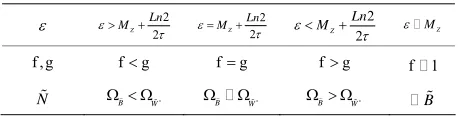
The scenario driven through this exponential behave- iour1 permits to monitor continuously the system at dif- ferent energy stages and thus a possible physical picture of the DM state evolution. To make contact with the property (8), it is enough to parameterize f cos and g sin and solve to get the relation be-tween the involved angle and the scale energy ; later on this angle will be interpreted as the Weinberg mixing angle w. The parameter 0 is homogenous to time
(inverse of energy) which in general could be used to characterize the different state configurations. When varying the scale energy and keeping it fixed, we delimit the dominating areas of each component:
In this view, the DM particle lies near the electroweak scale or at least above a neighboring superparticle mass scale MS with MSMZ refers to the fine gap
between the two scales.
4. Low Energy Constraints
To make this approach more predictive at weak mass scale, we use the fixed GUT relationship between the gauginos masses B 2
W
as expected from renor-
malization group Equations [23] implying
M M
50
B
M GeV.
The phenomenological importance of this translation will be enhanced in what follows: the mixed state, defined as a hybridization of Bino and Wino, evolves at low energy towards the Bino, interpreted as the effective DM brick at low mass scales, with a remaining Wino content and eventually a Higgsino contribution to acount for the cor- rect observed DM density,
2 2 f , g , 1 . Z Z M B M W B H W (13)Near this scale, the resulting DM state takes the form
1 2 .
H
N B W (14) Accepting at this stage the compositeness could be treated in terms of the Weinberg mixing angle
Z
M w
, using the parametrization: f 2 cos
Z
M w
[image:3.595.309.538.641.703.2] ,
Table 1. The DM compositeness evolution with the scale energy.
Z 22
Ln M
2
2 Z Ln M
2
2 Z Ln M
MZ
f ,g fg fg fg f 1
N B W B W B W B
.
(12)
and g 2 sin
Z
M w
, we deduce the DM co positeness
di the neglig
m inclu ible Higgsino additional amount
2 Hng
(15)
in such approximation when addressing DM as a pure gaugino mixture to make the analysis more economical. Straightforward calculations lead to the hybridization:
In this vision, ignoring the Higgsino content and using the Casimir energy momentum operator 2
P as well as the relationship between gaugino masses expected from renormalization group equations, we can express the mass of the DM particle (14) in terms of mass eigen- states as follows
2
1 3sin w N
M MB (16) where it depends mainly on the Bi
no mass. Generally, the right DM abundance (by equilibrium freeze-out) is approached by a WIMP particle lying near the elec- troweak scale. Indeed, such suggestion is clearly shown in this proposal where the lower bound of DM particle mass could go down till
65
N
M GeV (17) This remarkable prediction strong
pa
ly suggests that such rticle is tied to the electroweak scale and then should produced at the LHC. This is an interesting result for a relatively heavy elementary particle so that the previous accelerator experiments did not have enough energy to create them, whereas the Big Bang did once have energy to make them.
If Bino-like particles really make up the cold DM, with a local mass density of the order of that suspected in our neighborhood to explain the dynamics of our own galaxy, they should be distributed in a halo surrounding our galaxy with a typical speed of 103
v c [24] and would coherently scatter off nuclei in terrestrial detectors [25]. The detection of this kind of particles may be indi- rectly via their self-annihilation products search
NN qq or directly by studying their interac- tion within the detector, the tiny shocks with its atomic nuclei, with a mean energy of tens of KeV as re- cently shown by the Cryogenic Dark Matter Search ex- periment (CDMS II) data [26]. According to our ap- proach, such energy is expected to be in the range
32.5 KeVEN MeV (18)
It’s a tiny energy deposit (recoiling ve
energy) that is ry hard to pick up against background from naturel radioactivity which is typically of MeV. Direct search experiments seek recoil signatures of these interactions and have achieved the sensitivity to begin testing the most interesting classes of WIMP’s models [27-30]. This would let place for another unspecified DM candi-
B
H
W
[image:4.595.317.531.77.257.2]
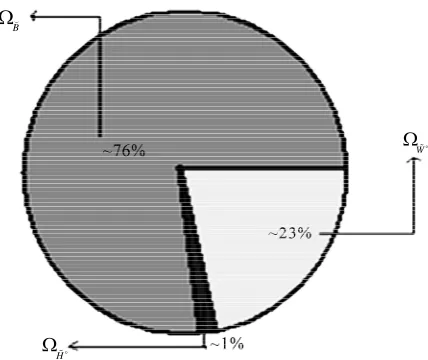
Figure 1. The hybridization invloves greatly around 3/4 of Binos and 1/4 of Winos.
cle might be some particle that uch Bino-like particle decays into. One possibility be-
economical models for persymmetry at the TeV scale can be used as conven-
the idea of compositeness in terms of ga
date. Or, the DM parti s
yond the MSSM remains the gravitino [31-33]. Of course there is much to do in this path and thereby it would be important to go deeper to derive more refined results.
5. Concluding Comments
We have seen that sensitive and su
ient templates for experimental searches. The simplest possibility is the MSSM, the popular extension of the SM fulfilling aesthetically their gaps, is recently recog- nized deserving to be tested experimentally. The meas- urements of Sparticle masses, production cross-sections, and decay modes will rule out some models for Susy breaking and lend credence to others. These measure- ments will be able to test the principle of R-parity con- servation, the idea that Susy has something to do with the DM, and possibly make connections to other aspects of cosmology including baryogenesis and inflation. Perhaps it is not a coincidence that such particles which may solve crucial problems in particle physics also solve the DM problem. An important remark is that, from the par- ticle physics point of view, DM may naturally be com- posite offering then an extra issue for interesting phe- nomenology.
The approach developed in this paper realizes in a simple manner
uginos wave functions hybridization. Although com- positeness at high energies is somehow unlikely, nature might be kind enough to carry out small ideas such as the hybridization described in this study. Within the MSSM in the rage MGUTMZ and the analysis of Section 3
ays exist
o referees for their valua ggestions for the improvement of the paper.
Hooper and J. Silk, “Particle Dark Matter: dates and Constraintes,” Physics Reports,
ns: Determination
CHOs in Galaxy Clusters,” The Astrophysical
. 1-2, 1987,
ics Letters B, Vol. 422, No. 1-4, 1998, pp
st Supersymmetric Particle,” Physical Review
iggs Bosons with Right Scalar
Sneutrino LSP at Hadron
, 2003, pp. 183-189.
kly Interacting Massive
odel (MOG) Proposed by Moffat: Using the
als and Their
on
n
“A Direct
hysics Beyond the Standard Model,” Physics
903, 2007,
ral R-parity Conservation,” Physical Review D,
t Supernovae,” The Astro-
pp.
and Detection of New Hadronic States
axy: II. Derivation of the
cience, Vol. 54, 2004,
eriment,” The CDMS Collaboration, 2009.
MP Search Using Ge Cryogenic Detectors
enon Nuclear Recoils Below
eview Letters,
should be alw abundantly to explain the large missing mass in the universe.
6. Acknowledgements
We are very much grateful t ble su
7. References
[1] G. Bertone, D. Evidence, Candi
Empi
Vol. 405, No. 5-6, 2005, pp. 279-390.
[2] D. N. Spergel et al., “First Year Wilkinson Microwave
Anisotropy Probe (WMAP) Observatio
Repo
of Cosmological Parameters,” The Astrophysical Journal Supplement Series, Vol. 148, No. 1, 2003, pp. 175-194.
[3] M. Tegmark et al., “Cosmological Parameters from
SDSS and WMAP,” Physical Review D, Vol. 69, No. 10, Vol
2004.
[4] G. F. Lewis, R. A. Ibata and J. S. B. Wyithe, “Searching for MA
Journal, Vol. 542, No. 1, 2000, pp. L9-L12.
[5] J. E. Kim, “Light Pseudoscalars, Particle Physics and Cosmology,” Physics Reports, Vol. 150, No
pp. 1-177.
[6] S. Raby, “Gauge-mediated SUSY Breaking with a Gluino
LSP,” Phys . As
158-162.
[7] H. Baer, K. Cheung and J. F Gunion, “A Heavy Gluino as the Lighte
D, Vol. 59, No. 7, 1999.
[8] C. L. Chou, H. L. Lai and C. P. Yuan, “New Production Mechanism of Neutral H
Mode
Tau Neutrino as the LSP,” Physics Letters B, Vol. 489,
No. 1-2, 2000, pp. 163-170.
[9] A. D. Gouvea, S. Gopalakrishna and W. Porod, “Stop
Decay into Right-handed [27]
Colliders,” JHEP0611: 050, 2006.
[10] P. Janot, “The Light Gluino Mass Window Revisited,”
Physics Letters B, Vol. 564, No. 3-4
[11] T. Hebbeker, “Can the Sneutrino be the Lightest Supersymmetric Particle,” Physics Letters B, Vol. 470,
Cryo
No. 1-4, 1999, pp. 259-262.
[12] G. Steigman and M. S. Turner, “Cosmological Cons- traints on the Properties of Wea
Particles,” Nuclear Physics B, Vol. 253, No. 2, 1985, pp. 375-386.
[13] L. Iorio. “Observational Constraints on the Modified Gravity M
Magellanic System,” Astronomische Nachrichten, Vol.
330, No. 8, 2009, pp. 857-862.
[14] X. Hernandez, S. Mendoza, T. Suarez and T. Bernal, “Understanding Local Dwarf Spheroid
Phys
Scaling Relations under MOND,” arXiv: 0904.1434.
[15] L. Bergstrom, “Non-Baryonic Dark Matter : Observa- tional Evidence and Detection Methods,” Reports Progress in Physics, Vol. 63, No. 5, 2000, pp. 793-841.
[16] C. Munoz, “Dark Matter Detection in the Light of Recent Experimental Results,” International Journal of Moder Physics A, Vol. 19, No. 19, 2004, 3093-3169.
[17] D. Clowe, M. Bradac, A. H. Gonzalez, M. Markevitch, S. W. Randall, C. Jones and D. Zaritsky,
rical Proof of the Existence of Dark Matter,”
Astrophysical Journal Letters, Vol. 648, 2006, pp.
109-113.
[18] Haber and G.L. Kane, “The Search for Supersymmetry: Probing P
rts, Vol. 117, No. 2-4, 1985, pp. 75-263.
[19] R. W. Schnee, “Status of Direct Searches for WIMP Dark Matter,” AIP Conference Proceedings, Vol.
pp. 8-15.
[20] S. P. Martin, “Implications of Supersymmetric Models with Natu
. 54, 1996, pp. 2340-2348.
[21] S. Perlmutter et al., “Measurements of Omega and
Lambda from 42 High-Redshif
physical Journal, Vol. 517, No. 2, 1999, pp. 565-586.
[22] H. Goldberg, “Constraint on the Photino Mass from Cosmology,” Physical Review Letters, Vol. 50, 1983, 1419-1422.
[23] G.R. Farrar and P. Fayet, “Phenomenology of the Production, Decay
sociated with Supersymmetry,” Physics Letters B, Vol.
76, No. 5, 1978, pp. 575-579.
[24] D. Méra, G. Chabrier and R. Schaeffer, “Towards a Consistent Model of the Gal
l,” astro-ph/9801050, 1998.
[25] R. J. Gaitskell, “Direct detection of Dark Matter,” Annual Review of Nuclear and Particle S
pp. 315-359.
[26] Z. Ahmed, et al., “Results from the Final Exposure of the CDMS II Exp
Z. Ahmed, et al., “Search for Weakly Interacting Massive
Particles with the First Five-Tower Data from the genic Dark Matter Search at the Soudan Under- ground Laboratory,” Physical Review Letters, Vol. 102,
No. 1, 2009.
[28] E. Armengaud et al., “First Results of the EDEL
WEISS-II WI
with Interleaved Electrodes,” Physics Letters B, Vol. 687,
No. 4-5, 2010, pp. 294-298.
[29] E. Aprile et al., “New Measurment of the Relative
Scintillation Efficiency of X
10 keV,” Physical Review C, Vol. 79, No. 4, 2009.
[30] V. N. Lebedenko et al., “Results from the First Science
Run of the Zeplin-III Dark Matter Search Experiment,”
ical Review D, Vol. 80, No. 5, 2009.
[31] J. L. Feng, A. Rajaraman and F. Takayama, “Superweakly Interacting Massive Particles,” Physical R
r in the CMSSM,” Physics Le
. Takayama, “SuperWIMP [32] J. R. Ellis, K. A. Olive, Y. Santoso and V. C. Spanos,
“Gravitino Dark Matte tters Gravitino Dark Matter from Slepton and Sneutrino
Decays,” Physical Review D, Vol. 70, No. 6, 2004. B, Vol. 588, 2004, pp. 7-16.