doi:10.4236/am.2011.22028 Published Online February 2011 (http://www.SciRP.org/journal/am)
Matrix Padé-Type Method for Computing the Matrix
Exponential
Chunjing Li1, Xiaojing Zhu1, Chuanqing Gu2
1
Department of Mathematics, Tongji University, Shanghai, China 2
Department of Mathematics, Shanghai University, Shanghai, China E-mail: [email protected]
Received October 31, 2010; revised December 23, 2010; accepted December 28, 2010
Abstract
Matrix Padéapproximation is a widely used method for computing matrix functions. In this paper, we apply matrix Padé-type approximation instead of typical Padé approximation to computing the matrix exponential. In our approach the scaling and squaring method is also used to make the approximant more accurate. We present two algorithms for computing eA and for computing eAt with many t0 respectively. Numeri-cal experiments comparing the proposed method with other existing methods which are MATLAB’s func-tions expm and funm show that our approach is also very effective and reliable for computing the matrix ex-ponential eA. Moreover, there are two main advantages of our approach. One is that there is no inverse of a matrix required in this method. The other is that this method is more convenient when computing eAt for a fixed matrix A with many t0.
Keywords: Matrix PadÉ-Type Approximation, Matrix Exponential, Scaling and Squaring, Backward Error
1. Introduction
The matrix exponential is the most studied and the most widely used matrix function. It plays a fundamental role in the solution of differential equations in many applica- tion problems such as nuclear magnetic resonance spec- troscopy, Markov models, and Control theory. These problems often require the computation of eAt for a fixed matrix and many t0
For example, with some suitable assumptions on the smooth of a function f , the solution to the inhomoge- neous system
, , 0 , n, n n,dy
Ay f t y y c y A
dt
is
0 , .
t A t s At
y t e c
e f s y dsA great number of methods for computing the matrix exponential have been proposed in the past decades. Moler and Van Loan’s classic papers [1,2], studied nine- teen dubious methods for computing the matrix expo- nential. Higham [3] which improved the traditional scal- ing and squaring method by a new backward error analy- sis is by far one of the most effective methods for
com-puting the matrix exponential and his method has been implemented in MATLAB’s expm function. A revisited version can be seen in [4]. In Higham’s method and many other methods, Padé approximation is used to eva-luate the matrix exponential because of its high accu- racy.
In this paper we present a new approach to compute the matrix exponential. On one hand, we use the matrix Padé-type approximation given by Gu [5] instead of the typical Padé approximation to evaluate the matrix expo- nential. Padé-type approximation was first proposed by Brezinski [6,7] in the scalar case. Draux [8] explored this method for the case of matrix-valued function and pro- posed a matrix Padé-type approximation. On the other hand, the powerful scaling and squaring method is also applied in our approach. This method exploits the rela-
tion
2 2
s s
A A
e
e
. Thus we need to evaluate 2 s Ae
atfirst and then take squarings for s times to obtain the evaluation of eA
. In the spirit of [3], the scaling number s is determined by backward error analysis. Besides, the problem of overscaling is also considered in our ap- proach.
Then we develop a specific analysis for our approach in Section 3. In Section 4, two algorithms and some nu-merical experiments compared with other existing me-thods are presented. Conclusions are made in Section 5.
2. Matrix Padé-Type Approximation
In this section, we give a brief introduction about Matrix Padé-type approximation or MPTA for short. There are various definitions for MPTA. We are concerned with those based on Brezinski [6,7] and Gu [5].
Let f z( ) be a given power series with n n ma- trix coefficients, i.e.,
0 , , .i n n
i i
i
f z
C z C zLet :Pn n
be a generalized linear function on a polynomial space P, defined by
l , 0,1, lx C l
Let vmbe a scalar polynomial of degree m
0
( ) m j
m j j
v z
b z (2.1) and assume that the coefficient bm1. Then we define
1
1
,k m k m
m m
k
x v x z v z
W z
x z
(2.2)
1 , mm m
v z z v z (2.3)
1.
k
k k
W z z W z (2.4)
Definition 1 Let Wk
z and vm
z be defined by(2.4) and (2.3) respectively. Then
km k m
R z W z v z
is called a matrix Padé-type approximation to f z
and is denoted by
.f
k m z
The approximant
k m
f z .satisfies the error for- mula
1 .k f
f z k m z O z (2.5)
In fact, from (2.1)-(2.4), we have
0m m j
m j j
v z
b z (2.6)and
0 0
0 0 .
m k m j k m j i i
k j j i
m k m j k m j i
j i
j i
W z b x z
b C z
(2.7)Then
0 00 0 .
m k m j m j i k j j i i
m m j k m j i
j i
j i
W z b C z
b z C z
(2.8)
It follows from (2.6)-(2.8) that
11
0 0 .
m k i
m i j j k m j i
v z f z W z
b C z (2.9) Under the normalization conditionvm
0 bm 1, we obtain (2.5). Note that the numerator Wk
z is a ma-trix-valued polynomial and the denominator vm
z is a scalar polynomial. For more theories on matrix Padé approximation and matrix Padé-type approximation see [5-10].3. MPTA for the Matrix Exponential
Let f be a function having the Taylor series expansion with the radius of convergence r of the form,
( )
0 ! , .
i i i
f z
f i z z r (3.1)It follows from Higham [11] that for any An n
and z with (Az)r , where represents the spectral radius of a matrix,
( )
0 ! .
i i
i
f Az
f i AzAccording to (2.8) and (2.9) in the previous section, the [k/m] matrix Padé-type approximant to f Az( ) can be expressed by the form
km km km
R Az P Az q Az ,
where
0
, 1,m m j
km j j km m
q Az
b z q z b (3.2) and
( )
0 0 ! .
i
m m j k m j i
km j j i
P Az
b z
f i Az (3.3) In fact, the difference between the matrix Padé-type approximants and the typical matrix Padé approximants is that the denominator of the former is a scalar polyno- mial, as denoted by qkm
z in (3.2).In the case of the matrix exponential, eAt can be de- fined as follows
2 2 2!
At A
e I At t
By (3.2) and (3.3), we immediately obtain the [k/m] matrix Padé-type approximant to eAtas follows,
,km km km
R At P At q t
where
0 , 1,m m j
km j j m
249 and
0
0 ( !)
.m m j k m j i i km j j i
P At
b t
t i A (3.5)Now we give an error expression in the following theorem.
Theorem 1 Let qkm and Pkm be expressed as (3.4) and (3.5) respectively, then
1 1 0 0 . 1 !k m k m i j km At i
j i j km km
P At t A
e t b
q t q t k m i j
(3.6)Proof: Take Ci A ii !in (2.9).
So far, the coefficients of the denominator qkm are
arbitrary. These coefficients may affect the accuracy of the approximant. Sidi [12] proposed three procedures to choose these coefficients in the case of vector-valued rational approximation. We can generalize his proce- dures to the matrix case. We only introduce one proce- dure, which is called SMPE based on minimal polyno- mial extrapolation. In the spirit of SMPE in [12], we aim to minimize the norm of the coefficient of the first term of the numerator, i.e., the i0 term in the error ex- pression (3.6). Since this term can be viewed as the ma- jor part of the error. Under the condition bm1, other coefficients of qkmare the solution to the following
mi-nimization problem
0 1 , , 0 min , 1 ! mk m j m j b b j A b
k m j
(3.7)
where we choose the Frobenius norm. The corresponding inner product of two matrices A and B is defined by
,
1 1 .n n
H
ji ji
i j
A B tr A B
A B (3.8) The next lemma can transform the minimization prob- lem (3.7) into the solution of a linear system.Lemma 1 The minimization problem (3.7) is equiva- lent to the following linear system
1 1 1 0 1 1 ,, , 0, , 1,
m
k m i k m j j
j
k m i k
D D b
D D i m
(3.9)
whereDl A ll !.
Proof: See Sidi [12].
Different from the series form error expression in (3.6), we present another form of error bound based on Taylor series truncation error in the following theorem.
Theorem 2 Suppose f has the Taylor series expansion of the form as in (3.1) with radius of convergence r. Let
km km km
R Az P Az q z be the matrix Padé-type
approximant to f Az( ), where An n , z with
(Az) r
and qkm and Pkmhave the form (3.2) and
(3.3) respectively. If qkm is a real coefficient polynomial
and
1 0
1 mj b zj m j 0,
then for any matrix norm, it follows that
1 1 1 0 0 ( ) ( ) 1 ! , 1 kmk m j
k m k m j
j j
j
m m j j j
f Az R Az
A
z b f Az
k m j
b z
(3.10)where j,j0,,m are some real constants in (0,1).
Proof: The result follows from a similar analysis used in [13].
Corollary 1 Let Rkm
Az Pkm
Az qkm
z be thematrix Padé-type approximant to the matrix exponential At
e , where An n ,t and qkm and Pkm have the form (3.4) and (3.5) respectively and qkm is a real coefficient polynomial. If
1 0
1 m m j 0,
j j b z
then
1 1 0 0 1 ! , 1 j At kmk m j
k m At
j j
m m j j j
e R At
A
t b e
k m j
b t
(3.11)where j,j0,,m are some real constants in (0,1).
Proof: The result follows directly from Theorem 2. The result of corollary 1 shows that the MPTA to
At
e is feasible. In fact, we do not have to worry about the denominator of the right side in (3.11) since our numeri- cal experiments in the next section show that all bj are
much smaller than 1.
Now we turn to the implementation of the scaling and squaring method of our approach. If the norm of the ma- trix At is not small enough, we use the scaling and squaring technique which computes the matrix exponent- tial indirectly. We want to reduce the norm of At to a sufficiently small number because the function can be well approximated near the origin. Thus we need to compute
2s
km
R At and then take
22 .
s
At s
km
e R At
The scaling and squaring method goes back at least to Lawson [14].
give the following lemma.
Lemma 2 If the approximant Rkm satisfies
2
2 ,
sAt s
km
e R At I G
where G 1 and the norm is any consistent matrix norm, then
22 ,
s
s At E km
R At e
where E commutes with A and
log 1 . 2 s
G E
At At
(3.12)
Proof: See the proof in [3].
The result of (3.12) shows, as Higham [3] points out, that the truncation error E in the approximant to eAt as equivalent to a perturbation in the original matrix At. So it is a backward error analysis. If we define
22 s sAt,
km
R At e
then Ge2sAt. In order to obtain a clear error analy- sis for the perturbation E, we should give a practical es- timation for . Though (3.11) gives an upper bound for
, it is a rough estimation for us rather than a practical one. Let
20 2 !
s
i
k s At
T i
A
At i ebe the Taylor series truncation error of 2sAt
e . In terms of [11] or [13], the norm of T is bounded by the
in-equality
1 2 2
. 1 !
s
k At s
T
At e
k
(3.13)
Actually, according to the choice of bjaccording to
the minimization problem (3.7), we can assume that
.
T
It therefore follows from (3.13) that
1
2 1
2 2 (2 )
. 1 !
s
s At sAt s k At
T
At e
G e e
k
(3.14) We want to choose such s that the backward relative error E At does not exceed 16
1.1 10
u , which is the unit roundoff in IEEE double precision arithmetic. To this end, in accordance with (3.12), we require the following inequality hold,
log 1 G 2sAt u,
that is,
2
1.
sAt u
G e (3.15) Then (3.14) implies that
1
1 2
2 2
1 1 !
s
s
k At s
At u
At e
e k
(3.16)
is a sufficient condition for (3.15).
If we denote 2s At , then (3.16) can be rewrit-ten as follows
1 2
1. 1 !
k
u
e e k
Sinceeu 1 u
, finally we obtain
: 2 .1 !
k k
e
g u
k
(3.17)
Then we define this value max
:gk
u
.Thus E u At if s satisfies 2 maxs
At
, which means we choose
2 max
log .
s At (3.18)
However, in practice, the choice of s in (3.18) may lead to overscaling, so we need to take measures to re- duce the effect caused by overscaling. Therefore the me-thod in Al-Mohy and Higham [15] can be applied.
Lemma 3 Define ( ) j
l j l j
h x
a x with the radius of convergence r and
jl j l j
h x
a xand suppose
A randp. Then if l p p
1
,
1 11 ( 1)
max p p, p p .
l l
h A h A A
Proof: See [15]. Note that
2
.
! 1 !
j k j k j k
g x
j k k
Then according to lemma 3, we haveg16
g16
,where
4 1 4
31 3
5 1 5max 2 sAt , min 2 sAt , 2 sAt .
(3.19) So s is chosen so that max 0.744.
251 good choice and correspondingly havemax 0.744.
Since if k is too small, a large s is required which is po- tentially dangerous and if k is too large, evaluating ma- trix multiplications may require excessive computations and storages.
Now we need to consider the total computational cost. The computation of choosing bj consists of two parts.
One part is computing the inner products in the above linear system (3.9). It needs k matrix multiplications to obtain Ak m 1,,Ak1 and m m
1
computations of those inner products. Each inner product defined by (3.8) costs 2n2 flops. So the cost of computing inner prod- ucts is 2m m
1
n2 flops. We choose mn1/ 2 to make the cost do not exceed O n
3 . The other part is solving the m m linear system (3.9) to obtain the co- efficients bj. It costs3
2m flops which is not expensive since m is much smaller than n. When we evaluate
km
P At , we rewrite (3.5) as the following form
0 max ,0
, !
j k m
m i j
km i
j i j k m
t
P At b t A
j
(3.20)where the powers of A have already been obtained in the previous steps. So there are no extra matrix multipli- cations. Finally, we should take s matrix multiplications for squaring which costs 2sn3 flops.
4. Algorithms and Numerical Experiments
Based on the analysis above, we present the following algorithm for computing the matrix Padé-type approxi- mation to the matrix exponential.
Algorithm 1This algorithm evaluates the matrix ex- ponential using Padé-type approximation together with scaling and squaring method. The algorithm is intended for IEEE double precision arithmetic.
1) Compute and StoreA A2, 3,,A17.
2) Repeat scaling AA 2s until ssatisfies 0.744,
where is defined by (3.19) with 1-norm.
3) Set mmin
m0,n1/ 2
.4) Compute the inner products in (3.9) via (3.8). 5) Solve (3.9) to obtain the coefficients of qkm.
6) Compute qkm via (3.4).
7) Compute Pkm via (3.20).
8) Rkm Pkm qkm .
9)
2 skm km
R R .
Note that the m m linear system in (3.9) maybe ill-conditioned. To avoid this difficulty, we can use a fast and stable iterative method to solve it. The iteration will stop if it fails to converge after the maximum number of iterations. We can also modify the algorithm by resetting
j
b or choosing bm1, bj 0, j0,,m1, when the
system is ill-conditioned. The latter case is actually a truncated Taylor series.
Now we present some numerical experiments that compare the accuracy of three methods for computing the matrix exponential.
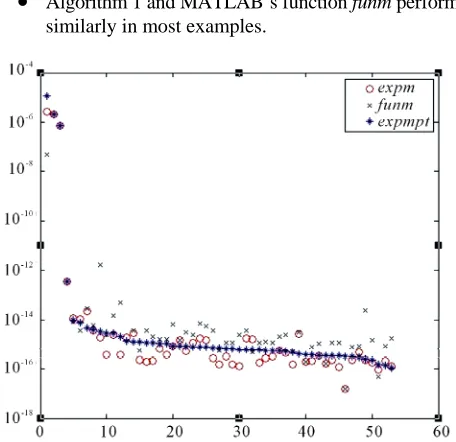
First we took 53 test matrices obtained from MAT- LAB R2009b’s gallery function in the Matrix Computa- tion Toolbox and most of them are real and 88. Fig- ure 1 shows the relative error in the Frobenius-norm of
expmpt (Algorithm 1) and MATLAB R2009b’s functions
expm and funm. For details about expm and funm or other algorithms for computing the matrix exponential see [12]. The exact matrix exponential eA is obtained by compu-ting a 150 order Taylor polynomial using MATLAB’s Symbolic Math Toolbox. We can make the observations from Figure 1 as follows.
MATLAB’s function expm is still the best code in general.
The proposed algorithm expmpt is also very effect- tive. Precisely, expmpt is more accurate than expmin 16 examples.
Both expm and expmpt are more reliable than funmin general.
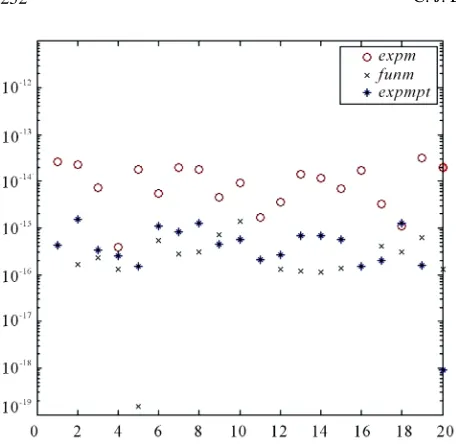
Second we concentrate on a class of 22 matrix of the following form
, 0
a b
A
c
where a, c is generated randomly from (–1, –0.5) and b is generated randomly from (–1000, –500). We tested 20 matrices of this form and plotted the results in Figure 2. We can make the observations from Figure 2 as follows.
[image:5.595.309.537.464.685.2]
Algorithm 1 and MATLAB’s function funm perform similarly in most examples.Figure 2. Normwise relative errors for MATLAB’s expm, funm and Algorithm 1 on testing 2/times 2 matrices descri- bed above.
MATLAB’s function expm is less reliable than the other two methods.Therefore we can conclude from our experiments that the proposed method has certain value in practice.
Compared with typical Padé approximation which is used in traditional methods for the matrix exponential, Padé-type approximation we used in this paper has both some advantages and disadvantages.
Recall that the [k/m] Padé approximation, denoted by
km km km
r x p x q x , to the function f is defined by the properties that that pkm and qkm are polynomials
of degreesk and m, respectively, and that
1
.
k m km
f x r x O x
Replacing x withA, we have
1
.
k m km
f A r A O A (4.1) So Padé-type approximation requires a polynomial of higher degree to achieve the same accuracy as Padé ap- proximation does. Another disadvantage of our approach is that each Aj,j2,,k has to be evaluated in our approach because we need them to determine the coeffi- cients bj. In [10], Paterson-Stockmeyer (PS) method
was used to evaluate the matrix polynomials. For exam- ple, a the matrix polynomial such as
1515 15 1 0 ,
p A b A b A b I (4.2) can be evaluated by only 7 matrix multiplications. There- fore, our approach costs more than expm if we only com- pute At
e for one or few t.
But in another point of view, our method has some
advantages. Real problems usually requireeAtfor many 0
t , where t represents time. For example, theset are
0,1 ,
1, , ,i
t i r where r is not a small number. We should first divide theset into different intervals accord- ing to the criterion that points in the same interval have the same scaling integer. According to (3.20), when computing Pkm
At for t in the same interval, we onlyevaluate Aj,j2,,k for one time. However, using PS method to evaluate a matrix polynomial such asp15(At) needs to update these powers of matrix At
2 4 6 8, , , ,
At At At At At and take three extra ma-
trix multiplications for each t. Therefore, when the num- ber of t is very large, PS method may be worthless. Moreover, in our method qkm is a scalar polynomial and
therefore no matrix division is required except for solv- ing the m m linear system with m much smaller than
n. Nevertheless, Padé approximation requires the matrix division qkm1
At pkm
At
for each t. Matrix division with large dimension is not what we expect.
In the end of this section, we present a modified ver- sion of Algorithm 1 to compute eAt for many t0. Note that in the following algorithm, we preprocessed the given matrix A by the Schur decomposition to reduce the computational cost since only triangle matrices are involved after the decomposition.
Algorithm 2 This algorithm based on Algorithm 1
evaluates eAt for 0 t1 tr. The algorithm is in-tended for IEEE double precision arithmetic.
1) Schur decomposition:AQTQH, where Q is un-itary and T is upper triangular.
2) Compute and store T T2, 3,,T17.
3) Divide all of the points ti into several intervals which are U U0, 1,,Uw. The corresponding scaling integer is
s
i.4) Set mmin
m0,n1/ 2
with some positive in-tegerm0.5) For i0 :w
2si
T T .
Compute inner products in (3.9) via (3.8). Solve (3.9) to obtain the coefficient of qkm.
For tjUi
Compute qkmvia (3.4).
Compute Pkm via (3.20) where A is re-placed by T.
km km km
R P q .
2
( )si
km km
R R .
H km km
R QR Q .
end end
Note that the purposes of algorithm 1 and of algorithm 2 are different. Algorithm 2 aims to computing eAt for many different t and algorithm 1 is designed to compute
A
253 algorithm uses the same approach as algorithm 1 to com-
pute eacheAt. In addition, only Schur decomposition is added at the beginning of the algorithm to reduce the computational cost when the number t is very much. Therefore, we do not present any numerical results of al- gorithm 2.
5. Conclusions
In this paper, we develop a new approach based on ma- trix Padé-type approximation mixed with the scaling and squaring method to compute the matrix exponential in- stead of typical Padé approximation. Two numerical al- gorithms for computing eA and for eAt with many
0
t respectively are proposed. Our approach is estab- lished closely relative to the backward error analysis and computational considerations. Numerical results com- paring the proposed algorithm with existing functions
expm and funm in MATLAB have shown the proposed algorithm is effective and reliable for computing the ma- trix exponential. Compared with typical Padé approxi- mation, the most significant advantages of matrix Padé- type approximation lie in two aspects. One is the con-venience for computing eAt for a large amount of t. The other is its avoiding nn matrix divisions, where n is the size of the given matrix A.
6. Acknowledgements
The authors gratefully acknowledge the fund support from Applied Mathematics.
7. References
[1] C. B. Moler and C. F. Van Loan, “Nineteen Dubious Ways to Compute the Exponential of a Matrix,” SIAM Review, Vol. 20, No. 4, 1978, pp. 801-836.
doi:10.1137/1020098
[2] C. B. Moler and C. F. Van Loan, “Nineteen Dubious Ways to Compute the Exponential of a Matrix,Twenty- Five Years Later,” SIAM Review, Vol. 45, No. 1, 2003, pp. 3-49. doi:10.1137/S00361445024180
[3] N. J. Higham, “The Scaling and Squaring Method for the Matrix Exponential Revisited,” SIAM Journal on Matrix
Analysis and Application, Vol. 26, No. 4, 2005, pp. 1179- 1193. doi:10.1137/04061101X
[4] N. J. Higham, “The Scaling and Squaring Method for the Matrix Exponential Revisited,” SIAM Review, Vol. 51, No. 4, 2009, pp. 747-764. doi:10.1137/090768539 [5] C. Gu, “Matrix Padé-Type Approximant and Directional
Matrix Padé Approximant in the Inner Product Space,”
Journal of Computational and Applied Mathematics, Vol. 164-165, No. 1, 2004, pp. 365-385.
doi:10.1016/S0377-0427(03)00487-4
[6] C. Brezinski, “Rational Approximation to Formal Power Series,” Journal of Approximation Theory, Vol. 25, No. 4, 1979, pp. 295-317. doi:10.1016/0021-9045(79)90019-4 [7] C. Brezinski, “Padé-Type Approximation and General
Orthogonal Polynomials,” Birkh Äauser-Verlag, Basel, 1980.
[8] A. Draux, “Approximants de Type Padé et de Table,”
Little: Publication A, University of Lille, Lille, No. 96, 1983.
[9] C. Gu, “Generalized Inverse Matrix Padé Approximation on the Basis of Scalar Products,” Linear Algebra and Its Applications, Vol. 322, No. 1-3, 2001, pp. 141-167. doi:10.1016/S0024-3795(00)00230-5
[10] C. Gu, “A Practical Two-Dimensional Thiele-Type Ma-trix Padé Approximation,” IEEE Transactions on Auto-matic Control, Vol. 48, No. 12, 2003, pp. 2259-2263. doi:10.1109/TAC.2003.820163
[11] N. J. Higham, “Functions of Matrices: Theory and Com-putation,” SIAM Publisher, Philadelphia, 2008. doi:10.1137/1.9780898717778
[12] A. Sidi, “Rational Approximations from Power Series of Vector-Valued Meromorphic Functions,” Journal of Ap-proximation Theory, Vol. 77, No. 1, 1994, pp. 89-111. doi:10.1006/jath.1994.1036
[13] R. Mathias, “Approximation of Matrix-Valued Functions,”
SIAM Journal on Matrix Analysis and Application, Vol. 14, No. 4, 1993, pp. 1061-1063. doi:10.1137/0614070 [14] J. D. Lawson, “Generalized Runge-Kutta Processes for
Stable Systems with Large Lipschitz Constants,” SIAM Journal on Numerical Analysis, Vol. 4, No. 3, 1967, pp. 372-380. doi:10.1137/0704033