doi:10.4236/w
An A
To
DepaAbstract
Topology-tr throughput modify the the cover-fr Second, we squashed ou all of its red put can be transparent mission del Keywords:1. Introdu
Recently, ma monitoring a on Mobile A ties have gre sion through guaranteed Q cations.Since MA and is the ba guaranteed Q pensible [1]. MAC prot One is the co known Carri ance (CSMA its possibilit wireless coll other one is a time frame
*This research i dation of China Basic Discipline leum(Beijing) u
wsn.2010.21009
Algorith
opology
rtment of Com Re
ransparent M guarantee, a cover-free s ree set is pro e prove that
ut. Our algor dundant slots guaranteed i node schedu ay can be go
MAC Sched
ction
any multimed and voice reco Ad hoc Netwo eat relationship hput and trans QoS on MAN
AC layer is dir sis of all othe QoS, guarante
tocols in wire ontention-base
ier Sense Mu A/CA) protoco
ty of infinite isions, it cann the schedulin e is divided int
is supported in p a (NSFC) under es Research Fou under grant No.(JC
96Published On
hm for
y-Trans
mputer Scienc eceived June 5
MAC schedu a cover-free
et so that be oposed and f any subset o rithm choose s, and then de if the squash uling strateg otten by just u
duling, Qos, C
dia application ording, are su orks (MANET
p with the gua smission dela NET is require
rectly above t r protocols, fo ed QoS on M
eless network ed MAC proto ultiple Access ol as its repre
transmission not provide Qo ng-based MAC to multiple tim
part by National N grant No.(6100 undation of Chin CXK-2010-01).
nline October 2
r Impro
sparent
C e and Techno
Email: xu
5, 2010; revise
uling strategi set is output etter throughp
found to hav of a cover-fr es the subset esignates it a hed subset is y, both the i using our alg
Combinatori
ns, such as v uggested to de T). Their feasi aranteed trans ay. In other w ed by these ap
the physical l or a MANET MAC layer is in
are of two ty col, with the w /Collision Av esentative. Du delay caused oS guarantee. C protocol, w me slots, and
Natural Science 3307, 60803159 na University of
010 (http://www
oving T
t MAC
Chaonong X logy, China U uchaonong@c ed July 12, 20
ies nowaday t as scheduli put can be gu ve negative in ree set is sti
which has th as the networ s adopted as increased mi gorithm as an
ial Design, S
video eploy ibili- smis-word, ppli-layer with ndis- ypes. well- void-ue to d by The where each nod slot who mis be e S gori den the less eith nod dep of c mob pare of n app T prot per, N prot clud thog Foun-), and Petro-w.SciRP.org/jo
hrough
C Sched
XuUniversity of P cup.edu.cn
010; accepted
s are all bas ng strategy o uaranteed. A nfluence on ll a cover-fr he maximal rk scheduling
network sch inimal throu n extra acces
uperimposed
de is assigned ts [2]. We tak ose topology sions into dif eliminated eff Scheduling-ba ized into two nt and the top topology-depe s collisions, a her in every no de in centralize endent MAC constantly cha bility of node ent MAC sch network topol lications depl The scheduled
tocols can be , we focus on Nowadays, all tocols are all ding the multi gonal array [8
ournal/wsn/).
hput Gu
duling S
Petroleum-Beij August 17, 20
sed on comb of network. At the first st the minimal ree set after number of r g strategy. T heduling stra ghput and d ssory.
d Code, Cove
the transmittin ke Figure 1 f
is known, by fferent time sl ficiently.
sed MAC pro subcategories pology-transpa endent MAC p uniform topol ode in distribu ed manner [3]
protocols are anged topolog
[4]. On the co heduling proto logy and may oyed on MAN
object of the either wirele node scheduli l topology-tra based on com inomial theor 8], latin square
uarant
Strategy
ijing, Beijing,
010
binatorial de In this paper tep, the redun l guaranteed
its redundan redundant slo Therefore, bet ategy. For an ecreased ma
er-Free Set
ng right at som for example, f y arranging co lots, wireless
otocols can be s, i.e., the top arent MAC p protocols, to m logy graph ha uted manner, ]. Obviously, unfit for MA gy which is c ontrary, the to ocols are fully y be promisin NET.
topology-tran ss link or nod ing. ansparent nod mbinatorial de ry in Galois fi es [9], balance
ee of
y*
China
sign. To get r, we aim to ndant slot of d throughput. nt slots were ots, squashes tter through-ny topology-aximal
trans-me given titrans-me for a network olliding trans-collision can
e further cate- pology-depen-protocols. For minimize wire-as to be set up or in the sink the topology-ANET because caused by the opology-trans-y independent ng choices for
nsparent MAC de. In this
block [10,11] and superimposed code[12-14]. The aim of them is same, that is, to give birth to a cover-free set as MAC scheduling codes, which is the key to QoS guaran-tee. Of course, the sets generated by different strategies are distinct even if they are feed with same parameters.
Due to the existence of combinatorial designs, the car-dinal of the cover-free set is no less than the node num-ber of network [5]. Therefore, the problem of how to se- lect an appropriate subset comes into being, for every no- de has to be uniquely associated with one element of the cover-free set. In other word, if the node number of a network is N, and the cardinal of the set is M, then there are M
N
optional subsets which can be assigned as the
MAC scheduling tragedy of network. Obviously, random selection is not a considerate policy, although it is ado- pted by all of the topology-transparent MAC scheduling protocols nowadays. Which subset can provide the best throughput guarantee? Further, can the selected subset be optimized further? This paper tries to answer the ques-tions.
We propose the definition of the redundant slot of the cover-free set, and prove that the redundant slot has neg-ative influence on throughput guarantee. Further, we pro- ve that any subset of a cover-free set is still a cover-free set after any of its redundant slots is squashed out. There- fore, the more minimal throughput and the less maximal delay can be guaranteed. Our algorithm therefore picks the subset which has the maximal number of redundant slots, squashes all redundant slots of the subset, and then designates it as node scheduling strategy of network. Therefore, for any topology-transparent node scheduling strategy, both the increased minimal throughput and de-creased maximal transmission delay can be gotten by just using our algorithm as an extra accessory.
2. Network Model
Wireless network is modeled by a directed graph G = (V, E), where V is the set of nodes and E is the set of directed links. If node w is within the transmission range of node
u, then a directed edge connecting these two nodes is denoted by (u, w)E, with u being a neighbor of w. The degree of a node w, i.e.,D w( ) | { | ( , ) u u w E u w V, , } |
is defined as the number of its neighbors. We assume that the maximum nodal degree Dmax, i.e.,maxw V D w( ), remains constant when network operates. Of course, Dmax > 0 is necessary for keeping connectivity.
In this paper, we assume that the transmission channel is error-free and a reception failure is caused only by packet collisions. A packet transmitted from a neighbor
of a node, is successfully received by the node only if no packet is transmitted from other neighbor nodes simul-taneously. All nodes are homogeneous. We also assume that the transceiver at each node is half-duplex. As a re-sult, a node cannot transmit and receive concurrently.
Time is assumed to be synchronized over the network. Furthermore, time is slotted and slots are grouped into time frame. For example, a time frame consists of four time slots in Figure 1. In other word, a frame F = {S1,
S2, …, Sb} consists of b consecutive slots. A slot assign-ment is given by a set S w( )F for every node w, where S(w) consists of time slots in which node w has the transmitting right in a frame.
3. Redundant Slot and QoS Guarantee
3.1. Redundant Slot
Definition 1. Assume [k] = {0, 1, …, k-1}, a set A = {A0,
A1, …, AM-1} of subsets of the [T] is a (s, M, T) cover-free
set if for any proper subset I of [M] such that |I| = s (|I| is the cardinal of set I), and any integer j[M]I, we
have {Aj}{ }Ai .s is called the intensity of the co-
ver-free set.
Cover-free set is equivalent with the d-disjunct matrix [15] and the superimposed code.
A (s, M, T) cover-free set A can be represented by a T
× M matrix A where
1
0 1, 0 1
0
j ij
j
if i A
A i T j M
if i A
The matrix is referred as the scheduling matrix. For convenience, the jth column vector and the ith row vec-tor of the scheduling matrix A are denoted as A*j and Ai*respectively.Besides, for a T × M scheduling matrix, ATj is the MSB (Most Significant Bit) of A*j and A0j is the LSB (Least Significant Bit) of A*j.
Definition 2. For two vectors X = (x1, x2, …, xm)T and Y = (y1, y2, …, ym)T, the sum of X and Y is
1 1 2 2
( , ,..., m m)T
X Y x y x y x y . If X + Y = X, then
Y is covered by X.
Obviously, for the scheduling matrix of a (s, M, T) cover-free set, any column vector is not covered by any other s column vectors.
Lemma 1. Any L (s L M ) elements in a (s, M, T)
cover-free set form a (s, L, T) cover-free set.
Proof: For the scheduling matrix of a (s, M, T) cov-er-free set, any one column vector will not be covered by any other s column vectors. So it will not be covered by any other L column vectors since L < s. Therefore, it is a (s, L, T) cover-free family.
Definition 3. Assume the scheduling matrix of a (s, M, T) cover-free set is denoted as A, for some integer i
(0 i T 1) and any integer j(0 j M1), if Aij = 0
or Aij = 1, then i is a redundant slot of A.
Theorem 1. Assume the scheduling matrix of a (s, M, T) cover-free set is denoted as A, a (T 1) M matrix
which is generated by removing (deleting, or squashing) redundant slot of A is a (s, M, T-1) cover-free set.
Proof: For any s + 1 column vectors of A, without loss of generality, assume them to be A*0, A*1, …, A*s. Ob-viously, A*s is not covered by A*0 + A*1 + … + A*(s-1) . In
other word, there exist at least one integer k
(0 k T 1), which satisfies
[ 1]
( ks 1) ( { ki} {0})
i s
A A true
. Therefore, k is not a
redundant slot of A.
Assume a (T 1) M matrix B is generated by squashing any one redundant slot of A, and A*0, A*1, …,
A*s are turned into B*0, B*1, …, B*s correspondingly. Since k is not a redundant slot of A, Ak*is still kept in B. Thus, B*s is not covered by B*0 + B*1 + … + B*(s-1).
Con-sidering the generality of choosing A*0, A*1, …, and A*s, the set of all column vectors in B is a (s, M, T-1) cov-er-free set.
Redundant slot results in less throughput guarantee. Assume the scheduling matrix of a (s, M, T) cover-free set to be A and i is one of its redundant slot. If
0 1
{ ij} {0}
j M
A
, none of nodes will transmit at slot i. On the other hand, if 0 1{ ij} {1}
j M
A
, all nodes will transmit at slot i and no any packets can be received cor-rectly due to the half-duplex transceiver. In a word, the throughput of redundant slots is wasted in both cases.
3.2. Redundant Slot and QoS Guarantee
Definition 4. The minimal guaranteed throughput Gmin is defined as the ratio of the number of guaranteed suc-cessful transmissions in one frame to frame length.
Definition 5. The transmission delay under the worst traffic condition is called the maximal transmission de-lay, and it is defined as the ratio of frame length to the minimal number of successful transmission slots in one frame.
Theorem 2. For a (s, M, T) cover-free set A and a (s, M, T-1) cover-free set A’ which is generated by squash-ing one redundant slot of A, if the minimal guaranteed
throughput and the maximal transmission delay are Gmin and DTmax, and
' min
G and '
max
DT respectively when A
and A’ are adopted respectively as node scheduling codes, thenGmin' /Gmin T/ (T1), and
'
max / max ( 1) /
DT DT T T .
Proof:For any node, assume there are at least k exclu-sive transmission slots can be guaranteed if A is adop- ted as the MAC scheduling codes of network, based on the definition of the minimal guaranteed throughput,
min
k G
T
. Similarly, if A’ is adopted, min'
1
k G
T
.
Therefore, Gmin' /Gmin T/ (T1).
Since the maximal transmission delay is the reciprocal of the minimal guaranteed throughput,
'
max / max ( 1) /
DT DT T T .
4. Algorithm and Performance Analysis
4.1. Algorithm
For selecting N scheduling codes from M candidates, there are M
N
optional subsets in total. Based on Theorem 2,
QoS guarantee can be enhanced if a redundant slot is squashed. So our algorithm chooses the subset which has the maximal number of redundant slots, squashes all re- dundant slots of the subset, and then designates it as the node scheduling strategy.
4.2. Performance Analysis
Theorem 3. Assume the scheduling matrix of a (s, M, T) cover-free set to be ATM, if its row vectors have equal weight w, then the algorithm can squash at least i redun-dant slots if the node number N satisfies
( 1)
M i w NM i w ( 0 i M 1
w
, and i is
an integer).
Proof: We prove it using mathematical induction. 1) If M w NM, i.e., i = 0, Theorem 3 is ob-viously correct.
2) Assume when M (k 1) w N M k w, at least k redundant slots can be squashed.
3) If M (k2) w N M(k 1) w , since
( 1)
M k w N w M k w, for N + w nodes, at least k redundant slots can be squashed from ATM based on the assumption 2). If the scheduling matrix af-ter the k redundant slots are squashed from ATM is notated
( )
( )( )
k T k N w
A . Since the row weight of ATM is w, there are at most w column vectors whose MSBs are 1 in (( ) )( )
k T k N w A .
MSBs are 0 in (( ) )( )
k T k N w A .
If we select any N column vectors whose MSBs are all 0 as the node scheduling codes of network, then the MSB
slot is obviously a redundant slot. Therefore, at least k + 1 redundant slots can be founded and squashed.
Corollary 1. For the scheduling matrix A of a (s, M, T) cover-free set, if its row vectors have equal weight M-w, then if the node number N satisfies
( 1)
M i w NM i w(0 i M 1
w
, and i is
an integer), the algorithm can squash at least i redundant slots.
Proof: Since the scheduling matrix is just the com-plementary matrix of that in Theorem 3, the proof is ob-vious.
5. Apply into Popular Topology-Transparent
Node Scheduling Strategies
Based on Theorem 3, the performance of our algorithm can be estimated if the row vectors in scheduling matrix have equal weight. Therefore, to show its universality, we prove that the most popular topology-transparent no- de scheduling strategies generate scheduling matrix with equal weight.
5.1. Strategy Based on the Multinomial Theory in Galois Field
Both Chlamtac’s and Ju’s algorithm are based on the multinomial theory in Galois field. Based on two input parameters, the node number N and the maximal node degree Dmax, two parameters q and k are get based on a sufficient condition of forming a cover-free set. Further, based on q and k, every node is associated with a unique vector (ak, ak-1, …, a0), where ai[ ] (q i0,1,..., )k . In other word, every node is associated with a unique
mul-tinomial 1 1 ... 1 0
k k
k k
a x ax a xa .
To map from the multinomial to scheduling matrix, a frame is divided into q subframes and a subframe is fur-ther divided into q slots. Every node has transmission right only at one slot during a subframe. For example, for the subframe i, i[ ]q , node which is associated with
the vector (ak, ak-1, …, a0) has transmission right only at
the (( 1 1 ... 1 0) mod )
k k
k k
a i ai a ia q th slot in
the subframe i.
Theorem 4. For scheduling matrix generated by strategy based on the multinomial theory in Galois field with parameters q and k, its row vectors have equal weight qk.
Proof: Based on the principle of the algorithm, the weight of the jth row vector in scheduling matrix is the
number of node which has transmission right at the jth slot. For the slot j in subframe i, it is the number of vec-tor (ak, ak-1, …, a0) which satisfies
1
1 1 0
( k k ... ) mod
k k
a i ai a ia q j.
Assume 1
1 ... 1
k k
k k
a i ai a imqz ,0 z q 1
where m is an integer. For every z, there is a unique
0 ( ) mod
a jz q which satisfies
1
1 1 0
( k k ... ) mod
k k
a i ai a ia q j , i.e., a0 is
determined by (ak, ak-1, …, a1). In other word, there are k
independent variables in (ak, ak-1, …, a0). So, the number
of (ak,ak-1,…,a0) which satisfies 1
1 1 0
(a ik k ak ik ... a i a) mod q j
is qk, i.e., the row vectors of scheduling matrix have equal weight
qk.
5.2. Strategy Based on the Orthogonal Array
Definition 5. A OA(k, t, v) is a k
t v matrix with en-tries from [v], 0 k t, if for any k
k v submatrix, each of its vkcolumn vectors is unique.
A OA(k, t, v) can be mapped into a k
vt v schedul-ing matrix. A frame is composed of vt slots. Each node is assigned a unique column vector of orthogonal array as its scheduling code. For example, if a node is assigned a column vector (0, 3, 1), its scheduling code is 000110000010.
Theorem 6. For scheduling matrix generated by stra- tegy based on OA(k, t, v), its row vectors have equal weight vk-1.
Proof: For any k row vectors in OA(k, t, v), they form
a k
k v matrix. Since every column vector in the k
k v matrix is unique, there are vk different k-tuples. Since every entry in [v] appears equal times in any row vector, every entry appears vk-1 times in any row vector.
Based on the mapping from orthogonal array to schedul-ing matrix, every row vector of schedulschedul-ing matrix has equal weight vk-1.
5.3. Strategy Based on Orthogonal Latin
Square
Definition 7. A orthogonal latin square with order p is a
pp matrix, with every row and every column to be a
full permutation of [p].
Definition 8. Two different n n latin squares A = (ai, j), B = (bi,j), ,i j{1, 2, ..., }n is orthogonal if all 2-tuples (ai,j, bi,j) are different. As a generalization, r
n n latin squares A(1)
,A(2),…,A(r) form a latin squares family with order (r, n) if they are different and ortho-gonal between any two of them. Especially, if r = n-1,
A complete orthogonal latin squares family with order
n can be mapped into a n2n n( 1) scheduling matrix. For all n(n-1) column vectors in the family, each of them can be associated to a node as its scheduling code.
Theorem 6. If n is a prime or prime power, for sche-duling matrix generated by strategy based on a complete orthogonal latin squares family with order n, its row vectors have equal weight n-1.
Proof: Since a complete orthogonal latin squares fam-ily with order n consists of n-1 latin squares if n is a prime or prime power. For each latin square, every ele-ment appears just once in any column and row. So, the weight of the scheduling matrix is n-1 based on the map-ping from latin square to scheduling matrix.
6. Experiments
We take the Chlamtac algorithm for examples to test the effect of the redundant slot squashing algorithm.
Based on the principle of Chlamtac algorithm, given the node number N and the maximum nodal degree Dmax, the two parameters, q and k, can be get. For example, if
N = 120,Dmax= 5, then q = 11,k = 2. That is, we have qk+1 = 1331 candidate node scheduling codes for 120 nodes. In fact, there are at least 11 redundant slots can be squashed. Figure 2 illustrates the relationship among
qk+1/N, N and Dmax generated by Chlamtac algorithm. Obviously, the larger the qk+1/N is, the more redundant slots can be anticipated.
Seen from Figure 2, qk+1/N increases quickly with N
or Dmax. So it can be easily anticipated that our algorithm performs better in network with more nodes or larger no- de degree.
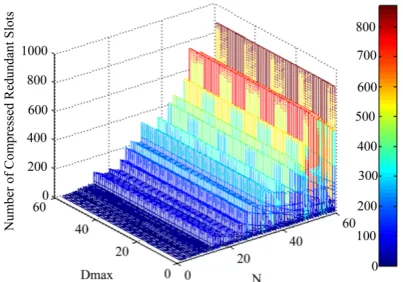
We now begin to test the effect of our algorithm under various values of N and Dmax for Chlamtac algorithm. The range of N is 2~60, and that of the maximal node degree is 1~N-1, i.e., all possibilities of maximal node degree are tested. Figure 3 illustrates the effect of our algorithm. The three coordinates are the node number N, the maximal node degree Dmax and the number of redun-dant slot. It can be found from Figure 3 that there always exist redundant slots in any case. The larger the N or
Dmax is, the more redundant slots can be squashed, which is consistent with our anticipation.
7. Conclusions
[image:5.595.319.534.75.226.2]The topology-transparent node scheduling strategy is suit- able for MANET because it can provide guaranteed QoS and be independent of network topology. In this paper, to improve QoS guarantee, we present a universal algo-rithm which can be realized as an accessory of any to-pology-transparent node scheduling strategy nowadays.
Figure 2. The relationship among qk+1/N, N and Dmax
gener-ated by the Chlmatac algorithm.
Figure 3. The effect of redundant slot squashing algorithm for the Chlamtac algorithm.
Node scheduling codes generated by each topology- transparent node scheduling algorithm nowadays form a cover-free set. We propose the redundant slot of the cov-er-free set, and prove that the redundant slot has negative influence on the minimal guaranteed throughput. Further, we prove that any subset of a cover-free set is still a cov-er-free set after any of its redundant slots is squashed. Our algorithm chooses the subset which has the maximal number of redundant slots, squashes all redundant slots of the subset, and then designates it as the node schedul-ing strategy of wireless network. Both theoretical analy-sis and experiments prove that the increased minimal throughput and decreased maximal transmission delay are guaranteed. Simulation results reveal that the larger the network node number or the maximal node degree, the better QoS can be guaranteed by employing our algorithm.
8. References
[image:5.595.323.525.272.413.2]No. 2, 2006, pp. 302-315.
[2] R. Nelson and L. Kleinrock, “Spatial TDMA - A Colli-sion-Free Multihop Channel Access Protocol,” IEEE Tran-
sactions on Communications. Vol. 33, No. 9, 1985, pp.
934-944.
[3] T. Moscibroda, R. Wattenhofer and Y. Weber, “Protocol Design Beyond Graph-based Models,” Proceedings of the
ACM 5th Workshop Hot Topics in Networks, Pisa, 2006,
pp. 25-30.
[4] A. Behzad and I. Rubin, “On the Performance of Graph- Based Scheduling Algorithms for Packet Radio Networks,”
Proceedings of the IEEE Global Telecommunications Con- ference, San Francisco, 2003, pp. 3432-3436.
[5] A. Shen, “Combinatorial Theory,” Shanghai Jiao Tong Uni- versity Press, Shanghai, 2008.
[6] I. Chlamtac and A. Farago, “Making Transmission Sche-dules Immune to Topology Changes in Multi-Hop Packet Radio Networks,” IEEE/ACM Transactions on Network-ing, Vol. 2, No. 1, 1994, pp. 23-29.
[7] J. Ju and V. O. K. Li, “An Optimal Topology-Transparent Scheduling Method in Multihop Packet Radio Networks,”
IEEE/ACM Transactions on Networking, Vol. 6, No. 3,
1998, pp. 298-306.
[8] V. R. Syrotiuk, C. J. Colbourn and A. C. H. Ling, “To-pology-Transparent Scheduling for MANETs Using Or-thogonal Arrays,” Proceedings of the 9th Annual
Interna-tional Conference on Mobile Computing and Networking,
San Diego, 2003, pp. 43-49.
[9] J. Ju and V. O. K. Li, “TDMA Scheduling Design of Multihop Packet Radio Networks Based on Latin Squares,”
IEEE Journal on Selected Areas in Communications, Vol.
17, No. 8, 1999, pp. 1345-1352.
[10] B. Xiang and Y. M. Mao, “Balanced Incomplete Block Designs Based Scheduling Scheme for Multi-Hop Ad Hoc Networks,” Proceedings of IEEE International
Con-ference on Communications, Circuits and Systems,
Xia-men, 2008, pp. 388-393.
[11] A. Dey, “Theory of Block Designs,” John Wiley & Sons, New York, 1986.
[12] P. C. Li, G. H. J. Van Rees and R. Wei, “Constructions of 2-Cover-Fee Families and Related Separating Hash Fam-ilies,” Journal of Combinatorial Designs, Vol. 14, No. 6, 2006, pp. 423-440.
[13] H. K. Kim and V. Lebedev, “On Optimal Superimposed Codes,” Journal of Combinatorial Designs, Vol. 12, No. 2, 2004, pp. 79-91.
[14] W. H. Kautz and R. C. Singleton, “Nonrandom Binary Superimposed Codes,” IEEE Transaction on Information Theory, Vol. 10, No. 4, pp. 363-377, 1964.