Learning to Map Dependency Parses to Abstract Meaning
Representations
Wei-Te Chen
Department of Computer Science University of Colorado at Boulder
Abstract
Abstract Meaning Representation (AMR) is a semantic representation language used to capture the meaning of English sen-tences. In this work, we propose an AMR parser based on dependency parse rewrite rules. This approach transfers dependency parses into AMRs by integrating the syn-tactic dependencies, semantic arguments, named entity and co-reference informa-tion. A dependency parse to AMR graph aligner is also introduced as a preliminary step for designing the parser.
1 Introduction
Abstract Meaning Representation (AMR) (Ba-narescu et al., 2013) is a semantic formalism that expresses the logical meanings of English sen-tences in the form of a directed, acyclic graph. AMR focuses on the semantic concepts (nodes on the graph), and relations (labeled edges on the graph) between those concepts. AMR relies heav-ily on predicate-argument structures defined in the PropBank (PB) (Palmer et al., 2005). The repre-sentation encodes rich information, including se-mantic roles, named entities, and co-reference in-formation. Fig. 1 shows an example AMR.
[image:1.595.328.513.203.282.2]In this proposal, we focus on the design of an automatic AMR parser in a supervised fashion from dependency parses. In contrast with recent semantic parsing algorithms, we start the parsing process from the dependency parses rather than the sentences. A dependency parse provides both the semantic dependency information for the sen-tence, and the structure of the relations between the head word and their dependencies. These can provide strong features for semantic parsing. By using a binary-branching bottom-up shift-reduced algorithm, the statistical model for the rewrite rules can be learned discriminatively. Although
Figure 1: The AMR annotation of sentence “Pierre Vinken, 61 years old, will join the board as a nonexecutive director Nov. 29.”
the AMR parser is my thesis topic, in this proposal we will pay more attention to preliminary work -the AMR -Dependency Parse aligner.
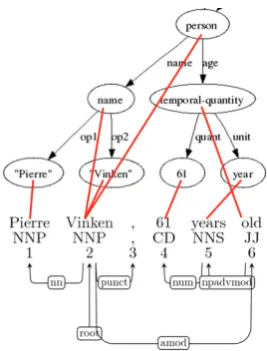
To extract the rewrite rules and the statistical model, we need the links between AMR con-cepts and the word nodes within the dependency parse. An example alignment is shown in Fig. 2. Alignment between an AMR concept and de-pendency node is needed because 1) it represents the meaning of the sub-graph of the concept and its child concepts corresponding to the phrase of the head word node, and 2) the dependency node contains sufficient information for the extraction of rewrite rules. For example, the word node “Vinken” on the dependency parse side in Fig. 2 links to the lexical concept “Vinken” and, further-more, links to the “p2/name” and the “p/person” concepts since “Vinken” is the head of the named entity (NE) “Pierre Vinken” and the head of the noun phrase “Pierre Vinken, 61 years old.” The secondary aim of this proposal is to design an alignment model between AMR concepts and de-pendency parses. We use EM to search the hidden derivations by combining the features of lexical form, relation label, NE, semantic role, etc. Af-ter EM processing, both the alignments and all the feature probabilities can be estimated.
The design of a rewrite-based AMR parser is described in Sec. 2, and the aligner is in Sec. 3. Our preliminary experiments and results are
Figure 2: The alignment between an AMR sub-graph and a dependency parse. A red line links the corresponding concept and dependency node.
sented in Sec. 4, followed by future work.
2 Rewrite Based AMR Parser
AMR is a rooted, directed, acyclic graph. For ex-ample, the concept join-01 in Fig. 1 is the root meaning of the sentence, which links to the child conceptsArg0,Arg1, andtime. AMR adheres to the following principles (Banarescu et al., 2013):
• AMRs are rooted acyclic graphs with labels (re-lations) on edges. These labels indicate the di-rected relation between two concepts.
• AMRs abstract away from syntactic idiosyncra-cies of a language, and instead attempt to capture only the core meaning of a sentence.
• AMRs use the PB framesets as relation la-bels (Palmer et al., 2005). For example, the rela-tion labels (i.e., ARG0, ARG1) of “join-01” con-cept in Fig. 1 correspond to the roles of the PB frame “join-v.”
• AMRs combine multiple layers of linguistic an-notation, like coreference, NE, semantic role, etc., in a single structure.
The above basic characteristics make the parsing of AMRs a difficult task. First, because AMR abstracts away from syntactic idiosyncrasies, we need a model to link the AMR concepts to words in the original sentence, in order to obtain exter-nal lexical, syntactic and semantic features. Sec-ondly, the parser should learn the different feature transformation probabilities jointly since AMRs combine several linguistic annotations. Moreover,
[image:2.595.335.501.61.121.2](x)/NP→:op(x) -r1 (x)nn(y)→:name (name(x, y)) -r2 (x)/CD→:quant(x) -r3 (x)/NNS→:unit(x) -r4 npadvmod(x)(y)→temporal-quanity(x, y) -r5 old/JJ(x)→:age(x) -r6 NE PERSON(x)(y)→person(x, y) -r7
Table 1: Sample Rewrite Rules
AMR uses graph variables and reentrancy to ex-press coreference (e.g., “p” variable in Fig 1 ap-pears twice – in:ARG0 ofjoin-01and:ARG0 of
have-org-role-91). The reentrancy prevents the AMR graph from begin a tree structure. Dur-ing parsDur-ing decodDur-ing, a polynomial time algorithm should be replaced by alternative algorithms, like beam search, to avoid an exponential running time. JAMR (Flanigan et al., 2014) is the first sys-tem for AMR parsing, which identifies the con-cepts, and then searches for a maximum span-ning connected subgraph (MSCG) on a fully nected graph to identify the relations between con-cepts. The search algorithm is similar to the maxi-mum spanning tree algorithms. To assure the fi-nal connected graph conforms to linguistic con-straints, JAMR uses Lagrangian relaxation (Geof-frion, 2010) to supplement the MSCG algorithm. JAMR reaches a 58% Smatch score (Cai and Knight, 2013) on automatic concept and relation identification data, and 80% on gold concept and automatic relation identification data.
2.1 Our Shift-Reduce Rewrite Rule Parser
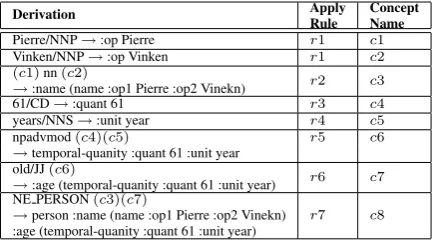
Rewrite rule based parser is a bottom-up converter from dependency parses to AMRs. The process starts from the leaf word node on the dependency parse. By applying rewrite-rules to each word node, we obtain and assemble the sub-graphs of our target AMR. Sample rewrite rules are listed in Table 1. In these rules, the left hand side contains the dependency information (e.g. word lemma, POS, relation label, NE tag, etc). The right hand side is the AMR concept and its template for filling variables from previous parsing steps. The sample derivation steps are listed in Table 2. For every step, it shows the derivation rule applied (in Table 1), and the concept name,c1-c8.
Derivation ApplyRule ConceptName
Pierre/NNP→:op Pierre r1 c1 Vinken/NNP→:op Vinken r1 c2 (c1)nn(c2)
→:name (name :op1 Pierre :op2 Vinekn) r2 c3 61/CD→:quant 61 r3 c4 years/NNS→:unit year r4 c5 npadvmod(c4)(c5) r5 c6
→temporal-quanity :quant 61 :unit year old/JJ(c6)
→:age (temporal-quanity :quant 61 :unit year) r6 c7 NE PERSON(c3)(c7)
→person :name (name :op1 Pierre :op2 Vinekn)
:age (temporal-quanity :quant 61 :unit year) r7 c8
Table 2: The derivation for parsing “Pierre Vinken, 61 years old” from dep. parse to AMR
• ShiftRemove the dependency word fromL, ap-ply the rules, and push the new concept toS. • ReduceMove the two top sub-concepts fromS,
apply the rules, and push it back toS.
• UnaryMove the top sub-concept fromS, apply the rules, and push it back toS.
• FinishIf no more dependency words are in the list, and one concept is inS, then return.
The final AMR concept would be stored at the top of the stack. It is guaranteed that all the AMR expressions can be derived from the dependency parses by using the shift-reduce algorithm.
3 Dependency Parses to AMR Aligner
A preliminary step for our rewrite-based parser is the alignment between the AMR and the depen-dency parse. JAMR (Flanigan et al., 2014) pro-vides a heuristic aligner between an AMR concept and the word or phrase of a sentence. They use a set of aligner rules, like NE, fuzzy NE, data en-tity, etc., with a greedy strategy to match the align-ments. This aligner achieves a 90% F1 score on hand aligned AMR-sentence pairs. On the other hand, Pourdamghani et al. (2014) present a gen-erative model to align from AMR graphs to sen-tence strings. They raises concerns about the lack of sufficient data for learning derivation rules. In-stead, they propose a string-to-string alignment model, which transfers the AMR expression to a linearized string representation. Then they use several IBM word alignment models (Brown et al., 1993) on this task. IBM Model-4 with a sym-metric method reaches the highest F1 score of 83.1%. Separately analyzing the alignments of roles and non-roles (lexical leaf on AMR), theF1 scores are 49.3% and 89.8%, respectively.
In comparison to previous work, our aligner es-timates the alignments by learning the
transforma-tion probability of lexical form, relatransforma-tions, named entities and semantic roles features jointly. Both the alignment and transformation probabilities are initialized for the training of parser.
3.1 Our Aligner Model with EM Algorithm
Our approach, based on the existing IBM Model (Brown et al., 1993), is an AMR-to-Dependency parse aligner, which represents one AMR as a list of Concepts C = hc1, c2, . . . , c|C|i, and the
cor-responding dependency parse as a list of depen-dency word nodes D = hd1, d2, . . . , d|D|i. The
alignmentAis a set of mapping functionsa, which link Conceptcj to dependency word nodedi, a :
cj → di. Our model adopts an asymmetric EM approach, instead of the standard symmetric one. We can always find the dependency label path be-tween any pair of dependency word nodes. How-ever, the number of concept relation label paths is not deterministic. Thus, we select the alignment direction of AMR to dependency parse only, and one-to-one mapping, in our model.
The objective function is to learn the parameter θin the AMR-to-Dependency Parse of EM:
θ= argmaxLθ(AMR|DEP)
Lθ(AMR|DEP) =
|S|
X
k=1 X
A
P(C(k), A|D(k);t, q)
where Lθ is the likelihood that we would like to maximize, S is the training data set. We will explain the transformation probability t and the alignment probabilityqbelow.
Expectation-Step
The E-Step estimates the likelihood of the input AMR and dependency parse by giving the trans-formation probabilitytand alignment probability q. The likelihood can be calculated using:
P(A|C, D) = |C|
Y
j=1
P(cj|a(cj))
[image:3.595.73.291.62.183.2]• Prel(Label(cj, cpj)|RelP athdep(a(cj), a(cpj))): the relation probability is the probability of the relation label betweenci and its parent concept cpi, given the relation path between the depen-dency word nodes a(ci) and a(cpi). e.g., the relation probability ofcj =61anda(cj) = 61
in Fig. 2 isP(quant|npadvmod↓num↓). • PNE(Name(cj)|T ypeNE(a(cj))): the NE
probability is the probability of the name ofcj, given the NE type (e.g., PERSON, DATE, ORG, etc.) contained bya(cj)).
• PSR(Label(cj, cpj)|P red(a(cpj)), Arg(a(cj))): the semantic role probability is the probability of relation label between cj and its parent cpj, conditioned on the predicate word ofa(cpj) and argument type of a(cj) if a(cj) is semantic argument of predicatea(cpj).
On the other hand, the alignment probability q(Dist(a(cj), a(cpj))|cj,|C|,|D|) can be inter-preted as the probability of the distance between a(cj) and a(cpj) on dependency parse D, condi-tioned oncj, the lengths ofDandC.
Maximization-Step
In the M-Step, the parameter θr is updated from the previous round ofθr−1, in order to maximize the likelihoodLθ(AMR|DEP):
t(C|D;AMR, DEP) =
P
(AMR,DEP)cnt(C|D;AMR, DEP) P
CP(AMR,DEP)cnt(C|D;AMR, DEP) q(D|C;AMR, DEP) =
P
(AMR,DEP)cnt(D|C;AMR, DEP) P
DP(AMR,DEP)cnt(D|C;AMR, DEP) wherecntis the normalized count that is collected from the accumulating probability of all possible alignment from the E-step. EM iterates the E-step and M-step until convergence.
Initialization
Before iterating, the transformation probabilityt and alignment probability q must be initialized. We use these steps to initialize the parameters: 1. Assign a fixed value, say 0.9, to Plemma(cj|di)
if the concept name ofcj is identical or a partial match to the dependency word node di. Other-wise, initialize it uniformly;
2. Run the EM algorithm with the initialized Plemma only (Similar to IBM Model 1, which is only concerned with translation probability);
3. Initialize all the other parameters, i.e., Prel, PNE,PSR, andqwith the development data; 4. Run the completed EM algorithm with the
Plemmawe obtained from Step 2 and other prob-abilities from Step 3.
The extra EM for the initialization ofPlemmais to estimate a more reasonablePlemma, and to speed up the convergence of the second round of EM.
Decoding
To find the alignment of hC, Di, we define the search for alignments as follows:
argmax
A P(A|C, D)
= argmax
A
|C|
Y
j=1
t(cj|a(cj))∗q(a(cj)|cj,|C|,|D|)
This decoding problem finds the alignmentAwith the maximum likelihood. A dynamic program-ming (DP) algorithm is designed to extract the tar-get alignment without exhaustively searching all candidate alignments, which will takeO(|D||C|).
This DP algorithm starts from the leaf concepts and then walks through parent concepts. Incj, we need to produce the following likelihoods: 1. Accumulated likelihood for aligning to any di
from all the child concepts ofcj 2. Likelihood ofPlemmaandPNE
3. Likelihood of Prel and PSR for parent concept cpj aligned to any dependency word nodedl. In step (3), we need to find thedl, aligned bycpj, that maximizes the likelihood. The accumulated likelihood is then stored in a list with size=|D|. We can trace back and find the most likely alignments in the end. The running time of this algorithm is O(|C||D|2). This algorithm does not include reentrancy cases. One solution to be explored in future work is to use a beam-search algorithm in-stead.
4 Preliminary Experiments and Results
Here, we describe a preliminary experiment for the AMR-Dependency Parse aligner, including the data description, experimental setup, and results.
4.1 Data
The LDC AMR release 1.0 consists of 13,051 AMR-English sentence pairs1. To match an AMR
1LDC AMR release 1.0, Release date: June 16, 2014
Split Sent. Tokens # ofNE # ofPred. # ofArgs Train 1,000 19,923 1,510 4,231 7,739
Dev. 100 2,328 239 235 526
[image:5.595.78.284.62.112.2]Test 100 1,672 80 199 445
Table 3: The data split of train/dev./test set. “# of NE”, “# of Pred.” and “# of Args” stand for the number of named entities, predicate and argument annotations in the data set, respectively.
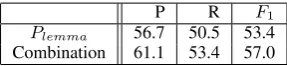
P R F1
Plemma 56.7 50.5 53.4 Combination 61.1 53.4 57.0
Table 4: Experiment Results
with its corresponding dependency parse, we se-lect the sentences which appear in the OntoNotes 5.0 release2as well, then randomly select 1,000 of
them as our training set. The OntoNotes data con-tains TreeBank, PB, and NE annotations. Statis-tics about the AMR and OntoNotes corpus and the train/dev./test splits are given in Table 3. We man-ually align the AMR concepts and dependency word nodes in the dev. and test sets. We initial-izePrel,PNE, andPSRwith the dev. set.
4.2 Results
We run our first round of EM (Step 2 in Initializa-tion of Sec. 3.1) for 100 iteraInitializa-tions, then use the second round (Step 4 in Initialization of Sec. 3.1) for another 100 iterations. We run our decoding al-gorithm and evaluation on the test set after the first and second round of EM. Due to time constraints, we did not train theqhere.
The experimental results are listed in Table 4. We evaluate the performance on the precision, re-call, andF1score. Using just thePlemma(a simi-lar approach to (Pourdamghani et al., 2014)), we achieve 53.4% F1 score on the test set. On the other hand, our aligner reaches 57.0% F1 score with the full aligner.
5 Conclusion and Future Work
In this research, we briefly introduce AMR. We describe the design principles and characteristics of AMR, and show how the AMR parser task is important, yet difficult. We present the basic idea for a proposed AMR parser, based on the shift-reduce algorithm. We also present an AMR-Dependency Parse aligner, because such an aligner
2LDC OntoNotes Release 5.0, Release date: October 16,
2013 https://catalog.ldc.upenn.edu/LDC2013T19
will be a necessary first step before parsing. The alignment and the estimated feature probabilities are obtained by running the EM algorithm, which could be use directly for the AMR parser.
In the future, we will be following these steps to develop the proposed rewrite-based parser:
Implemention of our rewrite-based AMR parser: We would like to implement the proposed rewrite-based AMR parser. In comparison to the parser of Flanigan (2014) , we believe our parser could perform better on the runtime. We also plan to experiment with the data generated by an auto-matic dependency parser.
Expand the experimental data of aligner: One problem discovered in our preliminary ex-periments was that of data sparsity, especially for Plemma. The LDC AMR Release contains 18,779 AMR/English sentences, and 8,996 of them are contained in the OntoNotes release as well. Thefore, increasing the training data size from the re-lease is one solution to improve the performance of our aligner from the unsatisfactory results. Us-ing external lexical resources, like WordNet, is an-other promissing solution to extend to snyonyms.
Evaluation of the aligner with existing parser: Since our aligner provides the align-ment between the dependency word node and both the AMR leaf concept and role concept, we as-sume that our aligner could improve not only our rewrite-based parser but other parsers as well. To verify this, we hope to submit our improved align-ment results to a state-of-the-art AMR parser, and evaluate the parsing results.
Acknowledgments
[image:5.595.109.253.186.219.2]References
Laura Banarescu, Claire Bonial, Shu Cai, Madalina Georgescu, Kira Griffitt, Ulf Hermjakob, Kevin Knight, Philipp Koehn, Martha Palmer, and Nathan Schneider. 2013. Abstract meaning representation for sembanking.
Peter F. Brown, Vincent J. Della Pietra, Stephen A. Della Pietra, and Robert L. Mercer. 1993. The mathematics of statistical machine translation: Pa-rameter estimation. Comput. Linguist., 19(2):263– 311, June.
Shu Cai and Kevin Knight. 2013. Smatch: an evalua-tion metric for semantic feature structures. In Pro-ceedings of the 51st Annual Meeting of the Associa-tion for ComputaAssocia-tional Linguistics (Volume 2: Short Papers), pages 748–752. Association for Computa-tional Linguistics.
J. Flanigan, S. Thomson, J. Carbonell, C. Dyer, and N. A. Smith. 2014. A discriminative graph-based parser for the abstract meaning representation. In
Proc. of ACL, Baltimore, Maryland, June. Associa-tion for ComputaAssocia-tional Linguistics.
ArthurM. Geoffrion. 2010. Lagrangian relaxation for integer programming. In Michael Jnger, Thomas M. Liebling, Denis Naddef, George L. Nemhauser, William R. Pulleyblank, Gerhard Reinelt, Giovanni Rinaldi, and Laurence A. Wolsey, editors,50 Years of Integer Programming 1958-2008, pages 243–281. Springer Berlin Heidelberg.
Martha Palmer, Dan Guildea, and Paul Kingsbury. 2005. The Proposition Bank: An annotated cor-pus of semantic roles. Computational Linguistics, 31(1):71–105, March.
Nima Pourdamghani, Yang Gao, Ulf Hermjakob, and Kevin Knight. 2014. Aligning english strings with abstract meaning representation graphs. In Proceed-ings of the 2014 Conference on Empirical Methods in Natural Language Processing (EMNLP), pages 425–429. Association for Computational Linguis-tics.