Semi-Stacking for Semi-supervised Sentiment Classification
Shoushan Li
†‡,
Lei Huang
†,
Jingjing Wang
†,
Guodong Zhou
†*†
Natural Language Processing Lab, Soochow University, China
‡
Collaborative Innovation Center of Novel Software Technology and Industrialization
{shoushan.li, lei.huang2013, djingwang}@gmail.com, [email protected]
Abstract
In this paper, we address semi-supervised sentiment learning via semi-stacking, which integrates two or more semi-supervised learning algorithms from an ensemble learn-ing perspective. Specifically, we apply meta-learning to predict the unlabeled data given the outputs from the member algorithms and propose N-fold cross validation to guarantee a suitable size of the data for training the meta-classifier. Evaluation on four domains shows that such a semi-stacking strategy per-forms consistently better than its member al-gorithms.
1
Introduction
The past decade has witnessed a huge exploding interest in sentiment analysis from the natural lan-guage processing and data mining communities due to its inherent challenges and wide applica-tions (Pang et al., 2008; Liu, 2012). One funda-mental task in sentiment analysis is sentiment classification, which aims to determine the senti-mental orientation a piece of text expresses (Pang et al., 2002). For instance, the sentence "I abso-lutely love this product." is supposed to be deter-mined as a positive expression in sentimental ori-entation.
While early studies focus on supervised learn-ing, where only labeled data are required to train the classification model (Pang et al., 2002), recent studies devote more and more to reduce the heavy dependence on the large amount of labeled data by exploiting semi-supervised learning ap-proaches, such as co-training (Wan, 2009; Li et al., 2011), label propagation (Sindhwani and Melville, 2008), and deep learning (Zhou et al., 2013), to sentiment classification. Empirical evaluation on various domains demonstrates the effectiveness of the unlabeled data in enhancing the performance
* Corresponding author
of sentiment classification. However, semi-super-vised sentiment classification remains challeng-ing due to the followchalleng-ing reason.
Although various semi-supervised learning al-gorithms are now available and have been shown to be successful in exploiting unlabeled data to improve the performance in sentiment classifica-tion, each algorithm has its own characteristic with different pros and cons. It is rather difficult to tell which performs best in general. Therefore, it remains difficult to pick a suitable algorithm for a specific domain. For example, as shown in Li et al. (2013), the co-training algorithm with personal and impersonal views yields better performances in two product domains: Book and Kitchen, while the label propagation algorithm yields better per-formances in other two product domains: DVD and Electronic.
In this paper, we overcome the above challenge above by combining two or more algorithms in-stead of picking one of them to perform semi-su-pervised learning. The basic idea of our algorithm ensemble approach is to apply meta-learning to re-predict the labels of the unlabeled data after ob-taining their results from the member algorithms. First, a small portion of labeled samples in the in-itial labeled data, namely meta-samples, are picked as unlabeled samples and added into the initial unlabeled data to form a new unlabeled data. Second, we use the remaining labeled data as the new labeled data to perform semi-supervised learning with each member algorithm. Third, we collect the meta-samples’ probability results from all member algorithms to train a meta-learning classifier (called meta-classifier). Forth and fi-nally, we utilize the meta-classifier to re-predict the unlabeled samples as new automatically-beled samples. Due to the limited number of la-beled data in semi-supervised learning, we use N -fold cross validation to obtain more meta-samples for better learning the meta-classifier. In principle, the above ensemble learning approach could be
seen as an extension of the famous stacking ap-proach (Džeroski and Ženko, 2004) to semi-su-pervised learning. For convenience, we call it semi-stacking.
The remainder of this paper is organized as fol-lows. Section 2 overviews the related work on semi-supervised sentiment classification. Section 3 proposes our semi-stacking strategy to semi-su-pervised sentiment classification. Section 4 pro-poses the data filtering approach to filter low-con-fident unlabeled samples. Section 5 evaluates our approach with a benchmark dataset. Finally, Sec-tion 6 gives the conclusion and future work.
2
Related Work
Early studies on sentiment classification mainly focus on supervised learning methods with algo-rithm designing and feature engineering (Pang et al., 2002; Cui et al., 2006; Riloff et al., 2006; Li et al., 2009). Recently, most studies on sentiment classification aim to improve the performance by exploiting unlabeled data in two main aspects: semi-supervised learning (Dasgupta and Ng, 2009; Wan, 2009; Li et al., 2010) and cross-domain learning (Blitzer et al. 2007; He et al. 2011; Li et al., 2013). Specifically, existing approaches to semi-supervised sentiment classification could be categorized into two main groups: bootstrapping-style and graph-based.
As for bootstrapping-style approaches, Wan (2009) considers two different languages as two views and applies co-training to conduct semi-su-pervised sentiment classification. Similarly, Li et al. (2010) propose two views, named personal and impersonal views, and apply co-training to use un-labeled data in a monolingual corpus. More re-cently, Gao et al. (2014) propose a feature sub-space-based self-training to semi-supervised sen-timent classification. Empirical evaluation demonstrates that subspace-based self-training outperforms co-training with personal and imper-sonal views.
As for graph-based approaches, Sindhwani and Melville (2008) first construct a document-word bipartite graph to describe the relationship among the labeled and unlabeled samples and then apply label propagation to get the labels of the unlabeled samples.
Unlike above studies, our research on semi-su-pervised sentiment classification does not merely focus on one single semi-supervised learning al-gorithm but on two or more semi-supervised learning algorithms with ensemble learning. To the best of our knowledge, this is the first attempt
to combine two or more semi-supervised learning algorithms in semi-supervised sentiment classifi-cation.
3
Semi-Stacking for Semi-supervised
Sentiment Classification
In semi-supervised sentiment classification, the learning algorithm aims to learn a classifier from a small scale of labeled samples, named initial la-beled data, with a large number of unlala-beled sam-ples. In the sequel, we refer the labeled data as
1
{( , )}nL
i i i
L x y where xiRd is the d
dimen-sional input vector, and yiis its output label. The unlabeled data in the target domain is denoted as
1
{( )}nU
k k
U x . Suppose lsemi is a semi-supervised learning algorithm. The inputs of lsemi are
L and
U, and the output is ' {( , )}nU1
k k k
U x y which
de-notes the unlabeled data with automatically as-signed labels. Besides the labeled results, it is al-ways possible to obtain the probability results, de-noted as PU
, which contains the posterior proba-bilities belonging to the positive and negative cat-egories of each unlabeled sample, i.e., <
( | ), (k | )k
p pos x p neg x >. For clarity, some
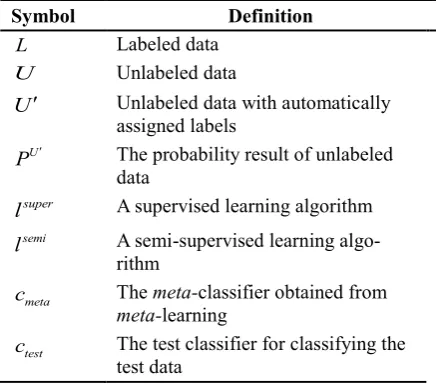
[image:2.595.306.525.441.633.2]im-portant symbols are listed in Table 1.
Table 1: Symbol definition
Symbol Definition
L Labeled data
U Unlabeled data
U Unlabeled data with automatically assigned labels
U
P The probability result of unlabeled data
super
l A supervised learning algorithm
semi
l A semi-supervised learning algo-rithm
meta
c The meta-classifier obtained from meta-learning
test
c The test classifier for classifying the test data
3.1 Framework Overview
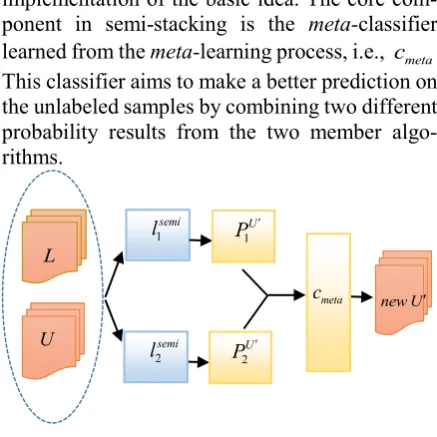
In our approach, two member semi-supervised learning algorithm are involved, namely, l1semiand
2 semi
implementation of the basic idea. The core com-ponent in semi-stacking is the meta-classifier learned from the meta-learning process, i.e., cmeta. This classifier aims to make a better prediction on the unlabeled samples by combining two different probability results from the two member algo-rithms.
Figure 1: The framework of semi-stacking
3.2 Meta-learning
As shown above, meta-classifier is the core com-ponent in semi-stacking, trained through the meta-learning process. Here, meta- means the learning samples are not represented by traditional descrip-tive features, e.g., bag-of-words features, but by the result features generated from member algo-rithms. In our approach, the learning samples in meta-learning are represented by the posterior probabilities of the unlabeled samples belonging to the positive and negative categories from mem-ber algorithms, i.e.,
(1) Where p pos x1( | )k and p neg x1( | )k are the pos-terior probabilities from the first semi-supervised learning algorithm while p pos x2( | )k and
2( | )k
p neg x are the posterior probabilities from the second semi-supervised learning algorithm.
The framework of the meta-learning process is shown in Figure 2. In detail, we first split the ini-tial labeled data into two partitions, Lnew and Lun where Lnew is used as the new initial labeled data while Lun is merged into the unlabeled data U to form a new set of unlabeled data LunU. Then, two semi-supervised algorithms are performed with the labeled data Lnew and the unlabeled data
un
[image:3.595.307.525.80.208.2]L U. Third and finally, the probability results of Lun, together with their real labels are used as meta-learning samples to train the meta-classifier. The feature representation of each meta-sample is defined in Formula (1).
Figure 2: The framework of meta-learning
3.3 Meta-learning with N-fold Cross
Valida-tion
Input: Labeled data L, Unlabeled data U
Output: The meta-classifier cmeta
Procedure:
(a) Initialize the meta-sample set Smeta (b) Split L into N folds, i.e.,
1 2 N
L L L L (c) For i in 1:N:
c1) Lnew L Li, LunLi c2) Perform 1
semi
l on Lnew and LunU c3) Perform 2
semi
l on Lnew and LunU c4) Generate the meta-samples, i
meta
S , from the probability results of Lun in the above two steps.
c5) i
meta meta meta
S S S
(d) Train the meta-classifier cmetawith Smeta and lsuper
Figure 3: The algorithm description of meta-learning with N-fold cross validation
One problem of meta-learning is that the data size of Lun might be too small to learn a good meta-classifier. To better use the labeled samples in the initial labeled data, we employ N-fold cross vali-dation to generate more meta- samples. Specifi-cally, we first split L into N folds. Then, we se-lect one of them as Lun and consider the others as
new
L and generate the meta-learning samples as described in Section 3.2; Third and finally, we re-peat the above step N1 times by selecting a dif-ferent fold as Lun in each time. In this way, we can obtain the meta-learning samples with the same size as the initial labeled data. Figure 3 presents the algorithm description of meta-learning with N-fold cross validation. In our implementation, we set Nto be 10.
1( | ), (1 | ), (2 | ), (2 | ) meta
k k k k
x p pos x p neg x p pos x p neg x
L
U
1 semi l
2 semi l
1 U
P
2 U
P
meta
c new U
un
L U
1un L
P
1 semi l
2 semi l
2un L
P
meta
c
super
l
new
[image:3.595.313.517.268.513.2]Figure 4: Performance comparison of baseline and three semi-supervised learning approaches
4
Experimentation
Dataset: The dataset contains product reviews from four different domains: Book, DVD, Elec-tronics and Kitchen appliances (Blitzer et al., 2007), each of which contains 1000 positive and 1000 negative labeled reviews. We randomly se-lect 100 instances as labeled data, 400 instances are used as test data and remaining 1500 instances as unlabeled data.
Features: Each review text is treated as a bag-of-words and transformed into binary vectors encod-ing the presence or absence of word unigrams and bigrams.
Supervised learning algorithm: The maximum entropy (ME) classifier implemented with the public tool, Mallet Toolkits (http://mal-let.cs.umass.edu/), where probability outputs are provided.
Semi-supervised learning algorithms: (1) The first member algorithm is called self-trainingFS, proposed by Gao et al. (2014). This approach can be seen as a special case of self-training. Different from the traditional self-training, self-trainingFS use the feature-subspace classifier to make the prediction on the unlabeled samples instead of us-ing the whole-space classifier. In our implementa-tion, we use four random feature subspaces. (2) The second member algorithm is called label propagation, a graph-based semi-supervised learning approach, proposed by Zhu and Ghah-ramani (2002). In our implementation, the docu-ment-word bipartite graph is adopted to build the document-document graph (Sindhwani and Mel-ville, 2008).
Significance testing: We perform t-test to evalu-ate the significance of the performance difference
between two systems with different approaches (Yang and Liu, 1999)
Figure 4 compares the performances of the baseline approach and three semi-supervised learning approaches. Here, the baseline approach is the supervised learning approach by using only the initial labeled data (i.e. no unlabeled data is used). From the figure, we can see that both Self-trainingFS and label propagation are successful in exploiting unlabeled data to improve the perfor-mances. Self-trainingFS outperforms label propa-gation in three domains including Book, DVD, and Kitchen but it performs worse in Electronic. Our approach (semi-stacking) performs much bet-ter than baseline with an impressive improvement of 4.95% on average. Compared to the two mem-ber algorithms, semi-stacking always yield a bet-ter performance, although the improvement over the better-performed member algorithm is slight, only around 1%-2%. Significance test shows that our approach performs significantly better than
worse-performed member algorithm (
p-value<0.01) in all domains and it also performs significantly better than better-performed member algorithm (p-value<0.05) in three domains, i.e., Book, DVD, and Kitchen.
5
Conclusion
In this paper, we present a novel ensemble learn-ing approach named semi-stacklearn-ing to semi-super-vised sentiment classification. Semi-stacking is implemented by re-predicting the labels of the un-labeled samples with meta-learning after two or more member semi-supervised learning ap-proaches have been performed. Experimental evaluation in four domains demonstrates that semi-stacking outperforms both member algo-rithms.
0.68
0.655
0.71
0.673 0.705
0.683
0.718
0.75
0.673
0.663
0.73 0.735
0.715
0.703
0.738
0.76
0.64 0.66 0.68 0.7 0.72 0.74 0.76 0.78
Book DVD Electronic Kitchen
A
cc
ur
ac
y
Using 100 labeled samples
[image:4.595.74.529.70.243.2]Acknowledgments
This research work has been partially supported
by three NSFC grants, No.61273320,
No.61375073, No.61331011, and Collaborative Innovation Center of Novel Software Technology and Industrialization.
References
Blitzer J., M. Dredze and F. Pereira. 2007. Biographies, Bollywood, Boom-boxes and Blenders: Domain Adaptation for Sentiment Classification. In Pro-ceedings of ACL-07, pp.440-447.
Blum A. and T. Mitchell. 1998. Combining Labeled and Unlabeled Data with Co-training. In Proceed-ings of COLT-98,pp. 92-100.
Cui H., V. Mittal and M. Datar. 2006. Comparative Ex-periments on Sentiment Classification for Online Product Reviews. In Proceedings of AAAI-06, pp.1265-1270.
Dasgupta S. and V. Ng. 2009. Mine the Easy, Classify the Hard: A Semi-Supervised Approach to Auto-matic Sentiment Classification. In Proceedings of ACL-IJCNLP-09, pp.701-709, 2009.
Džeroski S. and B. Ženko. 2004. Is Combining Classi-fiers with Stacking Better than Selecting the Best One? Machine Learning, vol.54(3), pp.255-273, 2004.
Gao W., S. Li, Y. Xue, M. Wang, and G. Zhou. 2014. Semi-supervised Sentiment Classification with Self-training on Feature Subspaces. In Proceedings of CLSW-14, pp.231-239.
He Y., C. Lin and H. Alani. 2011. Automatically Ex-tracting Polarity-Bearing Topics for Cross-Domain Sentiment Classification. In Proceedings of ACL-11, pp.123-131.
Li S., C. Huang, G. Zhou and S. Lee. 2010. Employing Personal/Impersonal Views in Supervised and Semi-supervised Sentiment Classification. In Pro-ceedings of ACL-10, pp.414-423.
Li S., R. Xia, C. Zong, and C. Huang. 2009. A Frame-work of Feature Selection Methods for Text Catego-rization. In Proceedings of ACL-IJCNLP-09, pp.692-700.
Li S., Y. Xue, Z. Wang, and G. Zhou. 2013. Active Learning for Cross-Domain Sentiment Classifica-tion. In Proceedings of IJCAI-13, pp.2127-2133. Li S., Z. Wang, G. Zhou and S. Lee. 2011.
Semi-super-vised Learning for Imbalanced Sentiment Classifi-cation. In Proceedings of IJCAI-11, pp.1826-1831. Liu B. 2012. Sentiment Analysis and Opinion Mining
(Introduction and Survey). Morgan & Claypool Publishers, May 2012.
Pang B. and L. Lee. 2008. Opinion Mining and Senti-ment Analysis: Foundations and Trends. Infor-mation Retrieval, vol.2(12), pp.1-135.
Pang B., L. Lee, and S. Vaithyanathan. 2002. Thumbs up? Sentiment Classification using Machine Learn-ing Techniques. In Proceedings of EMNLP-02, pp.79-86.
Riloff E., S. Patwardhan and J. Wiebe. 2006. Feature Subsumption for Opinion Analysis. In Proceedings of EMNLP-06, pp.440-448.
Sindhwani V. and P. Melville. 2008. Document-Word Co-Regularization for Semi-supervised Sentiment Analysis. In Proceedings of ICDM-08, pp.1025-1030.
Wan X. 2009. Co-Training for Cross-Lingual Senti-ment Classification. In Proceedings of ACL-IJCNLP-09, pp.235-243.
Yang Y. and X. Liu. 1999. A Re-Examination of Text Categorization Methods. In Proceedings of SIGIR-99.