Proceedings of the 7th Workshop on Balto-Slavic Natural Language Processing, pages 89–93, 89
Tuning Multilingual Transformers for Named Entity Recognition on
Slavic Languages
Mikhail Arkhipov*,1Maria Trofimova*,2Yuri Kuratov*,3Alexey Sorokin*,,4
*Neural Networks and Deep Learning Laboratory, Moscow Institute of Physics and Technology Faculty of Mathematics and Mechanics, Moscow State University
1[email protected] 2[email protected] 3[email protected]
Abstract
Our paper addresses the problem of multilin-gual named entity recognition on the mate-rial of4languages: Russian, Bulgarian, Czech and Polish. We solve this task using the BERT model. We use a hundred languages multilingual model as base for transfer to the mentioned Slavic languages. Unsupervised pre-training of the BERT model on these 4
languages allows to significantly outperform baseline neural approaches and multilingual BERT. Additional improvement is achieved by extending BERT with a word-level CRF layer. Our system was submitted to BSNLP 2019 Shared Task on Multilingual Named Entity Recognition and took the1st place in3 compe-tition metrics out of4we participated in. We open-sourced NER models and BERT model pre-trained on the four Slavic languages.
1 Introduction
Named Entity Recognition (further, NER) is a task of recognizing named entities in running text, as well as detecting their type. For example, in the sentenceAsia Bibi is from Pakistan, the following NER classes can be detected: [Asia Bibi]PER is from [Pakistan]LOC. The commonly used
BIO-annotation for this sentence is shown in Figure1. The recognizer of named entities can be trained on a single target task dataset as any other se-quence tagging model. However, it often benefits from additional data from a different source, either labeled or unlabeled, which is known as transfer learning. To enrich the model one can either train it on several tasks simultaneously (Collobert et al.,
2011), which makes its word representations more flexible and robust, or pretrain on large amounts of unlabeled data to utilize unlimited sources avail-able in the Web and then fine-tune them on a spe-cific task (Dai and Le, 2015;Howard and Ruder,
2018).
One of the most powerful unsupervised mod-els is BERT (Devlin et al., 2018), which is a multi-layer Transformer trained on the objective of masked words recovery and on the task of next sentence prediction (known also as Natural Lan-guage Inference (NLI) task). The original model was trained on vast amounts of data for more than 104 languages which makes its representa-tions useful for almost any task. Our contribu-tion is three-fold: first, multilingual BERT embed-dings with a dense layer on the top clearly beat BiLSTM-CRF over FastText embeddings trained on the four target languages. Second, language-specific BERT, trained only on the target lan-guages from Wikipedia and news dump, signifi-cantly outperforms the multilingual BERT. Third, we adapt a CRF layer as a a top module over the outputs of the BERT-based model and demonstrate that it improves performance even further.
2 Model Architecture
Our model extends the recently introduced BERT (Devlin et al.,2018) model. BERT itself is a mul-tilayer transformer (Vaswani et al., 2017) which takes as input a sequence of subtokens, obtained using WordPiece tokenization (Wu et al., 2016), and produces a sequence of context-based embed-dings of these subtokens. When a word-level task, such as NER, is being solved, the embeddings of word-initial subtokens are passed through a dense layer with softmax activation to produce a proba-bility distribution over output labels. We refer the reader to the original paper, see also Figure2.
dis-Asia Bibi is from Pakistan .
B-PER I-PER O O B-LOC O
Figure 1: An example of BIO-annotation for tokens.
tributions, however, each prediction depends not only on the current input, but also from the previ-ous one.
3 Transfer from Multilingual Language Model
There are two basic options for building multilin-gual system: to train a separate model for each lan-guage or to use a single multilingual model for all languages. We follow the second approach since it enriches the model with the data from related lan-guages, which was shown to be beneficial in recent studies (Mulcaire et al.,2018).
The original BERT embedder itself is essen-tially multilingual since it was trained on 104 lan-guages with largest Wikipedias1. However, for our four Slavic languages (Polish, Czech, Rus-sian, and Bulgarian) we do not need the full in-ventory of multilingual subtokens. Moreover, the original WordPiece tokenization may lack Slavic-specific ngrams, which makes the input sequence longer and the training process more problematic and computationally expensive.
Hence we retrain the Slavic BERT on stratified Wikipedia data for Czech, Polish and Bulgarian and News data for Russian. Our main innova-tion is the training procedure: training BERT from scratch is extremely expensive computationally so we initialize our model with the multilingual one. We rebuild the vocabulary of subword tokens us-ing subword-nmt2. When a single Slavic ken may consist of multiple multilingual subto-kens, we initilalize it as an average of their vectors, resembling (Bojanowski et al.,2016). All weights of transformer layers are initialized using the mul-tilingual weights.
4 Experiment Details
4.1 Target Task and Dataset
The 2019 edition of the Balto-Slavic Natural Language Processing (BSNLP) (Piskorski et al.,
1
https://github.com/google-research/ bert
2https://github.com/rsennrich/
subword-nmt
2019) shared task aims at recognizing mentions of named entities in web documents in Slavic lan-guages. The input text collection consists of sets of news articles from online media, each collec-tion revolving around a certain entity or an event. The corpus was obtained by crawling the web and parsing the HTML of relevant documents. The 2019 edition of the shared task covers4languages (Bulgarian, Czech, Polish, Russian) and focuses on recognition of five types of named entities in-cluding persons (PER), locations (LOC), organiza-tions (ORG), events (EVT) and products (PRO).
The dataset consists of pairs of files: news text and a file with mentions of entities with corre-sponding tags. There are two groups of documents in the train part of the dataset. Namely, news about Asia Bibi and Brexit. Brexit part is substantially bigger, therefore, we used it for training and Asia Bibi for validation.
4.2 Pre- and Post-processing
We use NLTK (Loper and Bird,2002) sentence to-kenizers for Bulgarian, Polish, and Czech. Due to the absence of Bulgarian sentence tokenizer we apply the English NLTK one instead. For Russian language we use DeepMIPT sentence tokenizer3. We replace all UTF separators and space char-acters with regular spaces. Due to mismatch of BSNLP 2019 data format and common format for tagging tasks we first convert the dataset to BIO format to obtain training data. After getting pre-dictions in BIO format we transform them back to the labeling scheme proposed by Shared Task organizers. This step probably causes extra errors, so we partially correct them using post-processing. We found that sometimes the model predicts a single opening quote without closing one. So we filter out all single quotation marks in the pre-dicted entities. At the prediction stage we perform inference for a sliding window of two sentences with overlaps to reduce sentence tokenization er-rors.
The Shared Task also included the entity nor-malization subtask: for example, the phrase
3https://github.com/deepmipt/ru_
Figure 2: In the figure,EsandRsrepresent the input embedding and the contextual representation of subtoken
s,[CLS]is the special symbol to get full input representation, and[SEP]is the special symbol to separate non-consecutive token sequences.
“Верховным судом Пакистана” (Supreme+Ins Court+Ins of Pakistan+Gen) should be “Верхов-ный суд Пакистана”. We used the UDPipe 2.3 (Straka et al., 2016) lemmatizers whose output was corrected using language-specific rules. For example, “Пакистана” (Pakistan+Gen) should not be lemmatized because in Russian noun mod-ifiers remain in Genitive.
4.3 Model Parameters
See below parameters of transferring multilingual BERT from to Slavic languages. The training took 9 days with DGX-1 comprising of eight P-100 16Gb GPUs. We train BERT in two stages: train full BERT on sequences with 128 subtokens length and then train only positional embeddings on 512 length sequences. We found that both ini-tialization from multilingual BERT and reassem-bling of embeddings speed up convergence of the model.
• Batch size:256
• Learning rate:2e-5
• Iterations of full BERT training:1M
• Iterations of positional embeddings train-ing:300k
Parameters of all BERT-based NER models are:
• Batch size:16
• BERT layers learning rate:1e-5
• Top layers learning rate:3e-4
• Optimizer:AdamOptimizer
• Epochs:3
In contrast to original BERT paper (Devlin et al., 2018), we use different learning rates for the task-specific top layers and BERT layers when training BERT-based NER models. We found that this modification leads to faster convergence and higher scores.
We evaluate the model every 10 batches on the whole validation set and chose the one that per-formed best on it. Despite this strategy being very time consuming, we found it crucial to get extra couple of points. For all experiments we used the spanF1score for validation.
Our best model used CRF layer and performed moving averages of variables by employing an ex-ponential decay to model parameters.
5 Results
We evaluated Slavic BERT NER model on the BSNLP 2019 Shared Task dataset. The model is compared with two baselines: Bi-LSTM-CRF (Lample et al., 2016) and NER model based on multilingual BERT. For Bi-LSTM-CRF we use FastText word embeddings trained on the same data as Slavic BERT.
Table1presents the scores of our model on de-velopment set (Asia Bibi documents) when train-ing on Brexit documents. We report a standard span-level F1-score based on the CONLL-2003 evaluation script (Sang and De Meulder, 2003) and three official evaluation metrics(Piskorski et al.,2019)4: Relaxed Partial Matching (RPM), Relaxed Exact Matching (REM), and Strict
4http://bsnlp.cs.helsinki.fi/
Matching (SM). Our system showed top perfor-mance in multilingual setting for all mentioned metrics except RPM.
Even without CRF the multilingual BERT model significantly outperforms Bi-LSTM-CRF model. Adding a CRF layer strongly increases performance both for multilingual and Slavic BERT models. Slavic BERT is the top perform-ing model. The error rate of Slavic BERT-CRF is more than one third less than the one of Multilin-gual BERT baseline.
We experimented with transfer learning from other NER corpora. We used three corpora as source for transfer: Russian NER corpus (Mozharova and Loukachevitch, 2016), Bulgar-ian BulTreeBank (Simov et al., 2004; Georgiev et al., 2009), and BSNLP 2017 Shared Task dataset(Piskorski et al.,2017)6 with Czech, Rus-sian, and Polish data. For pre-training we use stratified sample from the concatenated dataset. The set of tags for the task-specific layer includes all tags that occur in at least one dataset. Af-ter pre-training we replace the task-specific layer with the one suited for the BSNLP 2019 dataset and train until convergence. We find this approach to be beneficial for models without CRF, however, the CRF-enhanced model without NER pretrain-ing demonstrates slightly higher scores.
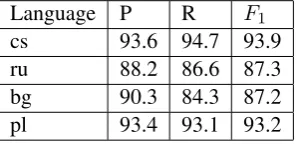
Table 2 presents a detailed evaluation report across4 languages for the top performing Slavic BERT-CRF model. Note that the languages with Latin script (Polish and Czech) demonstrate higher scores than Cyrillic-based ones (Russian and Bulgarian). Low scores for Russian might be caused by the dataset imbalance, since it covers only7.7%of the whole BSNLP dataset, however, Bulgarian includes 39% but shows even lower quality, especially in terms of recall. We have two explanations: first, incorrect sentence tokenization since we used English sentence tokenizer for Bul-garian (this may explain the skew towards preci-sion). Second, Russian and Bulgarian are much less related than Czech and Polish so they obtain less gain from having additional multilingual data.
5.1 Releasing the Models
We release the best BERT based NER model along with the BERT model pre-trained on the four
com-6http://bsnlp-2017.cs.helsinki.fi/
shared_task.html
petition languages7. We provide the code for the inference of our NER model as well as for using the pretrained BERT. The BERT model is fully compatible with original BERT repository.
6 Conclusion
We have established that BERT models pre-trained on task-specific languages and initialized using the multilingual model, significantly outper-form multilingual baselines on the task of Named Entity Recognition. We also demonstrate that adding a word-level CRF layer on the top im-proves the quality of both extended models. We hope our approach will be useful to fine-tune language-specific BERTs not only for Named En-tity Recognition but for other NLP tasks as well.
Acknowledgements
The research was conducted under support of National Technological Initiative Foundation and Sberbank of Russia. Project identifier 0000000007417F630002.
References
Piotr Bojanowski, Edouard Grave, Armand Joulin, and Tomas Mikolov. 2016. Enriching word vec-tors with subword information. arXiv preprint arXiv:1607.04606.
Ronan Collobert, Jason Weston, Léon Bottou, Michael Karlen, Koray Kavukcuoglu, and Pavel Kuksa. 2011. Natural language processing (almost) from scratch. Journal of machine learning research, 12(Aug):2493–2537.
Andrew M Dai and Quoc V Le. 2015. Semi-supervised sequence learning. InAdvances in neural informa-tion processing systems, pages 3079–3087.
Jacob Devlin, Ming-Wei Chang, Kenton Lee, and Kristina Toutanova. 2018. Bert: Pre-training of deep bidirectional transformers for language understand-ing.arXiv preprint arXiv:1810.04805.
Georgi Georgiev, Preslav Nakov, Kuzman Ganchev, Petya Osenova, and Kiril Ivanov Simov. 2009. Feature-rich named entity recognition for Bulgarian using conditional random fields. InRANLP.
Jeremy Howard and Sebastian Ruder. 2018. Universal language model fine-tuning for text classification. arXiv preprint arXiv:1801.06146.
7https://github.com/deepmipt/
Model SpanF1 RPM REM SM
Bi-LSTM-CRF (Lample et al.,2016) 75.8 73.9 72.1 72.3
Multilingual BERT5 79.6 77.8 76.1 77.2
Multilingual BERT-CRF 81.4 80.9 79.2 79.6
Slavic BERT 83.5 83.8 82.0 82.2
[image:5.595.98.504.62.146.2]Slavic BERT-CRF 87.9 85.7 (90.9) 84.3 (86.4) 84.1 (85.7)
Table 1: Metrics for BSNLP on validation set (Asia Bibi documents). Metrics on the test set are in the brackets.
Language P R F1
cs 93.6 94.7 93.9
ru 88.2 86.6 87.3
bg 90.3 84.3 87.2
pl 93.4 93.1 93.2
Table 2: Precision (P), Recall (R), andF1RPM scores of Slavic BERT-CRF model for Czech (cs), Russian (ru), Bulgarian (bg) and Polish (pl) languages.
Guillaume Lample, Miguel Ballesteros, Sandeep Sub-ramanian, Kazuya Kawakami, and Chris Dyer. 2016.
Neural architectures for named entity recognition. arXiv preprint arXiv:1603.01360.
Edward Loper and Steven Bird. 2002. NLTK: the nat-ural language toolkit. arXiv preprint cs/0205028.
Valerie Mozharova and Natalia Loukachevitch. 2016. Two-stage approach in Russian named entity recog-nition. In 2016 International FRUCT Confer-ence on IntelligConfer-ence, Social Media and Web (ISMW FRUCT), pages 1–6. IEEE.
Phoebe Mulcaire, Swabha Swayamdipta, and Noah Smith. 2018. Polyglot semantic role labeling. arXiv preprint arXiv:1805.11598.
Jakub Piskorski, Laska Laskova, Michał Marci´nczuk, Lidia Pivovarova, Pavel Pˇribáˇn, Josef Steinberger, and Roman Yangarber. 2019. The second cross-lingual challenge on recognition, classification, lemmatization, and linking of named entities across Slavic languages. In Proceedings of the 7th Work-shop on Balto-Slavic Natural Language Processing, Florence, Italy. Association for Computational Lin-guistics.
Jakub Piskorski, Lidia Pivovarova, Jan Šnajder, Josef Steinberger, and Roman Yangarber. 2017. The first cross-lingual challenge on recognition, normaliza-tion, and matching of named entities in Slavic lan-guages. In Proceedings of the 6th Workshop on Balto-Slavic Natural Language Processing, pages 76–85, Valencia, Spain. Association for Computa-tional Linguistics.
Erik F Sang and Fien De Meulder. 2003. Introduc-tion to the CoNLL-2003 shared task: Language-independent named entity recognition. arXiv preprint cs/0306050.
Kiril Simov, Petya Osenova, Sia Kolkovska, Elisaveta Balabanova, and Dimitar Doikoff. 2004. A language resources infrastructure for Bulgarian. In Proceed-ings of the Fourth International Conference on Lan-guage Resources and Evaluation (LREC’04), Lis-bon, Portugal. European Language Resources Asso-ciation (ELRA).
Milan Straka, Jan Hajic, and Jana Straková. 2016. UD-Pipe: Trainable pipeline for processing CoNLL-U files performing tokenization, morphological analy-sis, POS tagging and parsing. InLREC.
Ashish Vaswani, Noam Shazeer, Niki Parmar, Jakob Uszkoreit, Llion Jones, Aidan N Gomez, Łukasz Kaiser, and Illia Polosukhin. 2017. Attention is all you need. InAdvances in neural information pro-cessing systems, pages 5998–6008.
[image:5.595.108.257.187.259.2]![Figure 2: In the figure, Es and Rs represent the input embedding and the contextual representation of subtokens, [CLS] is the special symbol to get full input representation, and [SEP] is the special symbol to separate non-consecutive token sequences.](https://thumb-us.123doks.com/thumbv2/123dok_us/178759.514185/3.595.98.505.68.225/represent-embedding-contextual-representation-subtokens-representation-consecutive-sequences.webp)