100
Event Structure Representation: Between Verbs and Argument Structure
Constructions
Pavlina Kalm
Dept. of Linguistics Univ. of New Mexico
Michael Regan
Dept. of Linguistics Univ. of New Mexico
William Croft
Dept. of Linguistics Univ. of New Mexico
Abstract
This paper proposes a novel representation of event structure by separating verbal seman-tics and the meaning of argument structure constructions that verbs occur in. Our model demonstrates how the two meaning represen-tations interact. Our model thus effectively deals with various verb construals in differ-ent argumdiffer-ent structure constructions, unlike purely verb-based approaches. However, un-like many constructionally-based approaches, we also provide a richer representation of the event structure evoked by the verb meaning.
1 Introduction
Verbal semantics is an area of great interest in theoretical and computational linguistics (e.g. (Fillmore, 1968; Fillmore et al., 2003; Talmy,
1988;Dowty,1991;Croft,1991,2012;Valin and LaPolla, 1997;Levin, 1993;Kipper et al., 2007;
Ruppenhofer et al., 2016). It has been widely recognized that verb meaning plays an important role in the syntactic realization of arguments and their interpretation (Levin,1993). VerbNet ( Kip-per et al., 2007) and FrameNet (Fillmore et al.,
2003; Ruppenhofer et al., 2016) are large on-line resources on verb meanings that have been developed in recent years. VerbNet, an exten-sive verb classification system inspired by Levin
(1993), defines verb classes based on verbal se-mantics and the syntactic expression of arguments. FrameNet uses the theory of Frame Semantics (Fillmore,1982,1985) to classify lexical units into frames based on their meaning and their semantic and syntactic combinatorial properties with other event participants.
Providing an effective model to represent event structure is essential to many natural language pro-cessing (NLP) tasks. Recent meaning represen-tation frameworks employed in NLP (Banarescu
et al., 2013;Hajiˇc et al., 2012; Abend and Rap-poport, 2013), are largely concerned with iden-tifying event participants and their roles within the event. Most meaning representations use a lexically-based approach that assumes that the lex-ical semantics of a verb determines the comple-ments that occur with it in a clause.
However, lexically-based models for event structure do not provide a complete representation since verbs can occur in various argument struc-ture constructions (Goldberg, 1995, 2006;Iwata,
2005). Depending on the semantics of the argu-ment structure construction, a verb can be con-strued in many different ways. For example, a verb such askickcan occur in various semantically dif-ferent constructions, as shown below (Goldberg,
1995, 11).
(1) Pat kicked the wall.
(2) Pat kicked the football into the stadium. (3) Pat kicked Bob the football.
(4) Pat kicked Bob black and blue.
Kick can be construed as a verb of contact by impactwhen it occurs in the force construction in (1) (Levin, 1993, 148). It can be construed as a verb ofthrowingin the caused motion construction in (2) (Levin, 1993, 146). Kickcan also be con-strued as atransferverb in the transfer of posses-sion construction in (3) or achange of stateverb in the resultative construction in (4).
developed inCroft et al.(2016,2018), which spec-ifies the causal interactions between participants in the event. The verb meaning is a causal network which in many cases is more elaborate than the causal chain specified by the argument structure construction, but uses the same inventory of causal relations as the argument structure meanings. The argument structure meaning is annotated on indi-vidual clauses, and the verb meaning is retrieved from a resource based on VerbNet and FrameNet.
Our event structure representation offers a richer model when compared to exclusively lexically-based or constructionally-based re-sources on verb meaning. We describe below how our representation captures both the construc-tional meaning and the verb meaning, and how we map the former onto the latter. Having a two-facet representation helps us to effectively deal with verb construals as well as more complex event structures evoked by different event types.
2 Constructional meaning representation
The representation of constructional meaning uses a small set of causal chains that schematically represent the event structure evoked by argument structure constructions. Causal chains consist of event participants, a limited set of force dy-namic relations between participants, and infor-mation about the participants’ subevents. Cross-linguistic evidence indicates that argument real-ization is best explained by transmission of force relations (Talmy,1988;Croft,1991,2012).
Force-dynamic relations are defined based on existing literature on force dynamic interactions (Talmy,1988) and event semantics (Dowty,1991;
Tenny,1994;Hay et al.,1999;Valin and LaPolla,
1997;Verhoeven, 2007; Croft, 2012). Force dy-namic relations may be causal (Talmy, 1988) or non-causal (Croft, 1991), such as a spatial re-lation between a figure and ground in a physi-cal domain. Causal chains represent force dy-namic image schemas that correspond to estab-lished configurations of causal and non-causal re-lations between participants and their subevents. The subevents for each participant are specified for qualitative features that describe the states or processes that the participant undergoes over the course of the event (Croft et al.,2017).
2.1 Why constructional causal chains aren’t enough
A causal chain model of constructional meaning is not a comprehensive representation of verb mean-ing. A richer representation of verbal event struc-ture is needed for various event types.
An example of a complex event type that de-mands a more detailed event structure represen-tation is ingestion. An example with eatsuch as Jill ate the chicken with chopsticksillustrates this point. In the causal chain analysis of the argu-ment structure construction depicted in Figure1, thechopsticksare analyzed as an Instrument.
Figure 1: Change of state causal chain
However, the semantic role of thechopsticksin an eating event is quite different from that of a more prototypical instrument participant, such as ahammerin a breaking event (e.g. Tony broke the window with a hammer). In particular, the role of the chopsticks in the event structure is more complex. Unlike the hammer which breaks the window, thechopsticksdo not eatthe food. The chopsticks are used to move food to the Agent’s mouth rather than eating the chicken. This con-trasts with the role of thehammerwhich directly causes the breaking of the window. Consequently, one can use an argument structure construction without an Agent withbreak(The hammer broke the window) but not witheat(*The chopsticks ate the chicken). The causal chain in Figure 1 does not capture this fine grained semantic distinction between these two types of instrument roles.
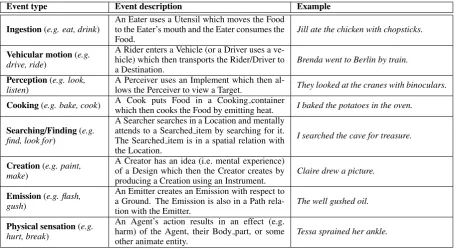
Table 1 contains a list of event types in the phys-ical and mental domains that require a more fine grained event structure representation. A short description of the event structure is provided for each event type to illustrate how the causal rela-tions between participants in these event types are too complex to be accurately represented by causal chains associated with the semantics of argument structure constructions.
Event type Event description Example
Ingestion(e.g. eat, drink)
An Eater uses a Utensil which moves the Food to the Eater’s mouth and the Eater consumes the Food.
Jill ate the chicken with chopsticks.
Vehicular motion(e.g. drive, ride)
A Rider enters a Vehicle (or a Driver uses a ve-hicle) which then transports the Rider/Driver to a Destination.
Brenda went to Berlin by train.
Perception(e.g. look, listen)
A Perceiver uses an Implement which then
al-lows the Perceiver to view a Target. They looked at the cranes with binoculars.
Cooking(e.g. bake, cook) A Cook puts Food in a Cooking container
which then cooks the Food by emitting heat. I baked the potatoes in the oven.
Searching/Finding(e.g. find, look for)
A Searcher searches in a Location and mentally attends to a Searched item by searching for it. The Searched item is in a spatial relation with the Location.
I searched the cave for treasure.
Creation(e.g. paint, make)
A Creator has an idea (i.e. mental experience) of a Design which then the Creator creates by producing a Creation using an Instrument.
Claire drew a picture.
Emission(e.g. flash, gush)
An Emitter creates an Emission with respect to a Ground. The Emission is also in a Path rela-tion with the Emitter.
The well gushed oil.
Physical sensation(e.g. hurt, break)
An Agent’s action results in an effect (e.g. harm) of the Agent, their Body part, or some other animate entity.
[image:3.595.72.528.61.312.2]Tessa sprained her ankle.
Table 1: Event types with complex event structures
structure.
3 Verbal meaning representation
Our representation of the verbal event structure uses a network model which consists of causal relations between participants and participants’ subevents, not unlike causal chains. However, ver-bal networks contain richer information about the participants’ causal relations that are not evoked by the argument structure construction and are therefore not represented in causal chains.
Each causal network is associated with an event type evoked by the verb meaning. For example, an Ingestion network represents the event struc-ture associated with verbs of eating. As shown in Figure2, the Ingestion network is cyclic and non-branching1: the Eater uses the Utensil (“Manipu-late” relation) to reach the Food (“Force” relation). The Food moves to the Eater’s mouth (“Path” re-lation) and is subsequently consumed by the Eater (“Force” relation)2.
Unlike the causal chain representation, the ver-bal network representation allows for a direct causal relation between the Eater and Food. This 1Although the Ingestion network is non-branching, we
have not ruled out the possibility of branching in other verbal networks. However, so far we have not come across a verbal network that requires a branching representation.
2FollowingCroft(1991,2012), causal relations are
repre-sented by an arrow and non-causal relations are reprerepre-sented by a straight line in the diagram.
[image:3.595.356.477.404.456.2]accommodates the semantics of ingestion events in which the Eater, rather than the Utensil, con-sumes the Food.
Figure 2: Ingestion network
Two participants in the network are involved in more than one causal relation. The Eater and Food have three distinct roles in the event structure. The Eater is the Agent who initiates the event; it is the ground that is in a Path relation with the Food, and it is also the consumer of the Food. The Food is an endpoint of the Force relation; it is a motion theme that is in a Path relation with the Eater, and it is also a Patient in a Change of State event as it gets consumed.
Figure 3: Unthreaded Ingestion network
Since the unthreaded version lays out the par-ticipants’ relations in a linear chain, this represen-tation also includes information about the change that each participant undergoes in its subevent(s). The network representation in Figure 2 does not include these labels due to a lack of space. We use the unthreaded version of verbal networks in the remainder of this paper to illustrate the mapping of the semantics of argument structure construc-tions onto the verbal event structure.
3.1 Mapping causal chains into verbal networks
Argument structure constructions may evoke only part of the verbal event structure. That is, causal chains may evoke a subset of participants and the relations between them in the verbal network. Mapping a causal chain into a network allows us to provide a comprehensive event structure represen-tation that accounts for the meaning of the argu-ment structure construction as well as the meaning evoked by the verb.
In many cases, there is a considerable overlap in the two types of representations, i.e. a one-to-one mapping exists between participants and their relations in the causal chain and in the verbal net-work. This is usually the case with simple event types, e.g. Motion or Force verbs (see Figure6in section3.2and Figure11in section4). However, the mapping becomes more complicated when a causal chain is mapped into a complex network that contains additional participant relations not present in the causal chain.
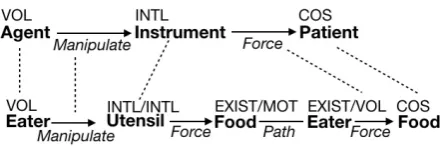
Figure 4 demonstrates the mapping between a causal chain associated with the example Jill ate the chicken with chopsticks and the Inges-tion network. The network representation con-tains additional participant relations that are not evoked by the causal chain. The correct mapping of participants from the causal chain to the net-work is achieved by linking participants by their subevents and relations. In addition, the sequence of subevents in the causal chain and in the network must follow the same order. As a result of this constraint, the dotted lines that link participants in causal chains and networks should not cross each
other.
Figure 4: Causal chain (upper part of the diagram) to network (lower part) mapping
The causal chain participants and their relations are mapped into the network as follows: Jill, the Agent in the causal chain, is linked to the Eater. Although there are two instances of Eater in the network event structure, the Agent is only linked to the Eater which is the initiator of the causal chain. This is because the Eater must be in a direct Manipulate relation with the Utensil. In addition, both the Agent and the Eater are labeled Volitional (VOL3).Chopsticks are labeled Internal (INTL4) in the causal chain and are therefore linked to the Internal participant in the causal network, which is the Utensil. The Patient, a change of state (COS5) theme, is linked to the Food participant at the end of the verbal network which is also labeled COS.
The Food and Eater participants that are in a Path relation with each other constitute a part of the verbal event structure and are therefore repre-sented in the causal network; however, they are not evoked by the argument structure construction. As a result, there is no direct linking of these partici-pants to the causal chain.
3.2 Structure of verbal causal networks
Examining the more complex verbal networks in Table1has led us to conclude that networks can be analyzed as a concatenation of less complex event types. Networks can be thought of as being made up of subchains. Each subchain denotes a force dynamic image schema that is used to describe the semantics of argument structure constructions. The internal structure of verbal networks is thus composed of subchains that can be used indepen-dently as simple networks or concatenated to each other to form complex networks.
3
Volitional describes an entity who exerts volitional force to bring about an event.
4Internal is used for participants that undergo internal
change.
5COS is used for participants that undergo some change
Subchains are not random subparts of a verbal causal network. A subchain is a subpart of a com-plex network that can be expressed by itself with a main verb. For example, the Motion subchain can be expressed by a motion verb such asmoveas in He moved the ball. The Manipulate network can be expressed by a manipulate verb such asuseas inHe used the shovel. The Force network can be expressed with a verb of force such ashitas inHe hit the ball, and the Change of State network can be expressed with a verb of change of state such asbreakas inThe vase broke.
[image:5.595.75.294.417.509.2]The concatenation analysis of causal networks can be illustrated on the unthreaded version of the Ingestion network as shown in the bottom part of Figure 5. The event structure for ingestion verbs can be analyzed as being composed of five subchains: (1) a Manipulate image schema be-tween the Eater and the Utensil, (2) a Force im-age schema between the Utensil and the Food, (3) a Motion image schema between the Food and the Eater, (4) a Force image schema between the Eater and the Food, and (5) a Change of State im-age schema that contains only one participant, the Food.
Figure 5: Concatenation of image schemas in the In-gestion network
The Manipulate image schema describes a causal chain in which an Agent uses an Instrument to interact with another physical entity. The phys-ical interaction between an Instrument and Food describes a Force image schema which, in more general terms, denotes an event in which a physi-cal entity interacts with another physiphysi-cal entity (a theme) by exerting physical force and thus caus-ing the theme to undergo some physical change, e.g. a translational motion or a change of state. Alternatively, the physical entity that initiates the Force relation comes into contact with the theme without any physical change taking place. The Motion image schema describes a causal chain in which a motion theme moves along a path with
re-spect to some ground. The Change of State image schema describes a single-participant causal chain in which a theme undergoes a change of state. The change of state event may be initiated by an exter-nal entity, such as an Agent in this ingestion ex-ample.
Subchains denoting image schemas may be concatenated in various ways to form complex net-works; however, they must be connected by one shared participant. Each participant that occurs in two subchains, i.e. as the endpoint of the first sub-chain and also the initiator of the next subsub-chain in the verbal causal network, has two separate labels that describe the participant’s subevent.
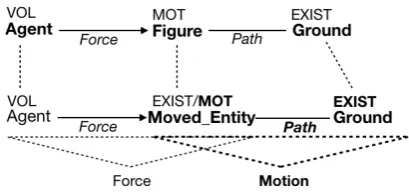
To illustrate this point further, let’s consider a Motion event. Motion may be concatenated with an external cause (e.g. Force), as in the exam-pleSteve tossed the ball to the garden(VerbNet). The AgentSteveexerts force on the Moved Entity ball, which consequently undergoes motion. The Moved Entity is in a path relation with the Ground garden. The Moved Entity is both an endpoint of the Force image schema (labeled EXIST6) and a motion theme in the Motion image schema (la-beled MOT7), as shown in Figure6.
Figure 6: Concatenation of Force and Motion
Each network consists of acore subchainwhich corresponds to a particular event type. For ex-ample, in networks with motion verbs, the core subchain consists of two participants: a motion theme or figure which is in a path relation with a ground(Talmy, 1974). To distinguish the core subchain from a concatenated subchain, partici-pants and their relations in the core subchain are highlighted in bold, as shown in Figure6.
6EXIST is used to signal the presence of a participant, i.e.
that it is part of the event but does not necessarily undergo a change of state or other changes on the qualitative dimension.
7MOT is used for themes that undergo motion in motion
[image:5.595.313.518.430.526.2]3.3 Network participants and overlap
Verbal event structure determines the participants and their roles in causal networks. In our net-work representation, we include all participants that are obligatorily evoked by the verb. To ensure that our networks for event types are comprehen-sive, we consult VerbNet and FrameNet databases for their semantic identification of event partici-pants (i.e. Roles in VerbNet and Core Frame Ele-ments in FrameNet). Our labels for network par-ticipants are chosen based on the participant’s role in a given verbal event structure (not unlike Frame Elements in FrameNet); the labels are not meant to be interpreted as semantic role labels.
[image:6.595.312.523.237.341.2]Including only the participants that are obliga-torily evoked by verbal semantics results in causal networks that are closely related but not identi-cal. Consequently, some event types have mul-tiple networks that partially overlap. For exam-ple, the event structure for vehicular motion (VM) verbs, such asdriveandride, overlaps since they share event participants, i.e. a Rider, Vehicle, and Destination (see Figure7). However, their event structure representations are not identical. Ride and drive evoke different initiators of the causal network, as shown in Figure 7 (cf. FrameNet’s Ride vehicle, Operate vehicle, and Cause motion frames).
Figure 7: Vehicular Motion network forride (a) and drive(b).
The core subchain in both VM networks is a Motion image schema which describes the rela-tion between a Rider and Destinarela-tion; however, unlike other Motion networks, the VM network is more complex since VM verbs obligatorily evoke a Vehicle as an additional participant in the event structure.
As depicted in Figure 7, the relation between the initiators (i.e. Rider and Driver) and the
[image:6.595.79.286.462.592.2]Ve-hicle in these two types of VM networks is dif-ferent. In the Drive network, a Driver drives a Vehicle (Manipulate image schema) to transport a Rider (Force image schema) to a Destination (Mo-tion image schema). Figure 8 shows a mapping of the causal chain associated with the exampleHe drove him to the hospitalto the Drive verbal causal network8. The Vehicle in the network is not linked to any participant in the causal chain since it is not expressed by the argument structure construction. However, it is represented in the causal network because it is evoked by the semantics ofdrive.
Figure 8: Causal chain to network mapping fordrive
Ride evokes a similar network representation that partially overlaps with the Drive network. However, in the Ride network, a Rider boards a Vehicle (Motion image schema) which transports the Rider (Force image schema) to a Destination (Motion image schema). Unlike the Drive net-work, the Ride network is cyclic, i.e. the Rider is involved in more than one relation. This is illus-trated on the mapping of the causal chain associ-ated with the example Brenda went to Berlin by trainto the Ride network in Figure9.
Figure 9: Causal chain to network mapping forride
The Path relation between the Rider and the Ve-8
[image:6.595.312.522.537.640.2]hicle is usually not syntactically expressed in ar-gument structure constructions with VM verbs in English; however, it is evoked by the verbal se-mantics of ride verbs. The Instrument is linked to the Vehicle and the Theme to the Rider in the network.
Overlapping of verbal causal networks is com-mon in our event structure representation. Another case of network overlapping can be found with the ingestion verbseat and feed, as shown in Figure
[image:7.595.89.274.231.363.2]10.
Figure 10: Ingestion network foreat(a) andfeed. (b)
Feed in (b) obligatorily evokes an external ini-tiator, i.e. a Feeder, which is different from an Eater. The Ingestion network for eat in (a) does not include a Feeder sinceeat does not obligato-rily evoke this participant. The two networks share most of the event participants; however, we pro-vide a separate representation for each event struc-ture since the networks do not overlap fully.
4 Representing construals with causal networks
Using the analysis of image schema concatenation to form complex networks allows us to provide a more comprehensive representation of event struc-ture for examples in which a verb meaning has different construals. As noted in the introductory section of this paper, a verb can have more than one construal depending on the argument struc-ture construction in which it occurs. To demon-strate how our network representation deals with this issue, we will return to the construals ofkick discussed in the Introduction.
Our causal chain analysis distinguishes the vari-ous meanings ofkickby having a causal chain rep-resentation for the constructional semantics. How-ever, an additional layer of information must be
included to indicate which part of the event struc-ture is evoked by the verb meaning and which part comes from the meaning of the argument struc-ture construction. In particular, a causal chain analysis of constructional meaning does not con-vey thatkickis a Force verb, rather than a Motion verb, when it occurs in a Motion construction or in other construals. Our model pairing constructional meaning (i.e. causal chains) with verb meaning (i.e. verbal networks) provides an event structure representation that accounts for verb construals in various constructions.
4.1 A Motion construal ofkick
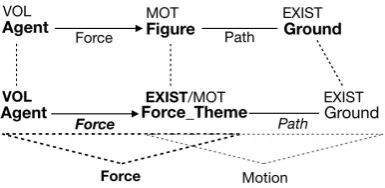
Kick can occur in a caused motion construction, as inPat kicked the football into the stadium. As shown in Figure 11, the core event type in the network representation for this example is iden-tified as Force. The Force image schema de-scribes a causal relation between an Agent and a Force Theme evoked by the verb kick. Since the argument structure construction describes a Motion event, a Motion schema is concatenated onto the Force image schema. That is, the argu-ment structure construction evokes a more com-plex event structure in which the Force Theme is also in a Path relation with a Ground. The Force Theme football is both an endpoint of the Force relation as well as a motion theme in the Motion image schema.
Figure 11: Concatenation of Motion and Force
The two representations for the motion argu-ment structure constructions with toss in Figure
[image:7.595.320.513.486.580.2]to the Motion subchain.
The network representation of the motion ex-ample withkickin Figure11is different. Force is identified as the core subchain sincekickis a Force verb. The motion theme is labeled Force Theme. The event structure evoked by the constructionPat kicked the football into the stadiumadds a Motion image schema to the Force subchain. The distinct labels for participants in each network are moti-vated by the core subchain which is evoked by the verb meaning.
4.2 COS and Transfer construals ofkick
Our representation also allows us to differentiate the event structure evoked by the COS argument structure construction Pat kicked Bob black and bluefrom the verbal semantics of kick. The core event type profiles a causal relation between an Agent and a Force Theme. As shown in Figure
[image:8.595.117.245.393.488.2]12, the Force Theme is identified as both the end-point of the Force image schema as well as a COS theme in the COS image schema evoked by the constructional semantics.
Figure 12: Concatenation of Change of State and Force
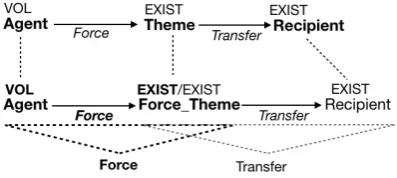
Figure13shows our event structure representa-tion for kick in a Transfer construction as inPat kicked Bob the football. Similarly to the network representation in Figure11and12, the core event type in the network is Force. The Transfer argu-ment structure construction adds a RecipientBob who is in a Control relation with the Force Theme football.
Figure 13: Concatenation of Transfer and Force
As these examples demonstrate, verbal causal networks provide more detailed information about the event structure than causal chains. Using the notion of image schema concatenation allows us to deal with various verb construals in different argu-ment structure constructions. Our event structure representation represents verb meaning and con-structional meaning, and distinguishes one from the other.
5 Conclusion
In this paper, we present a model of verb meaning representation that accounts for the semantics of argument structure constructions as well as verbal event structures associated with event types. Our proposed causal networks for verb meanings rep-resent richer event structures associated with com-plex event types. Our network representations can also deal with verb construals in various argument structure constructions.
The verbal causal networks are more general than VerbNet classes and subclasses which are based on Levin (1993) argument structure con-structions. As a result, they subsume more than one VerbNet class. The networks are also more general than frames in FrameNet. In some cases, our networks link to higher order non-lexical frames in FrameNet. However, this is not always the case. In many cases, our networks link to mul-tiple less schematic lexical frames.
Verbal networks will be stored with verbs in VerbNet in the relevant classes. For example, the Ingestion network will be linked to the follow-ing VerbNet classes: chew-39.2, dine-39.5, eat-39.1, gobble-39.3.-1, and gorge-39.6. Given the direct correspondence between verbal networks and VerbNet classes, our verbal analysis provides the same verb coverage of corpus data as Verb-Net (cf. Palmer et al.(2005) for VerbNet’s cover-age of the Penn Treebank II). An automated anal-ysis and linking of networks to verbal entries in corpora will use existing computational methods for verb sense disambiguation (Loper et al.,2007;
Chen and Palmer,2009;Brown et al.,2011; Peter-son et al.,2016) to accomplish a correct match of verb senses to verbal networks.
[image:8.595.82.281.654.743.2]the path through the network that describes an event. Developing such a computational model will be complicated by the multiple possible in-teractions of verb meaning and accompanying ar-gument structure construction, the many possible concatenations of image schemas, the need to re-spect the dimensionality of the links in the causal representations, as well as how to account for co-ercion and construal. A starting point is to recog-nize that argument structure constructions are de-fined by a small set of force dynamic relations, and these relations also define verbal networks. The next step toward a computational model will be to extract constructional meaning from raw text, to be reported on in future work.
Currently, our event structure representation covers physical and mental domains. However, there are many complex event types in the social domain that need to be analyzed. Among others, verbs of transfer of possession and communica-tion, which make up a large portion of the verbal lexicon in the social domain, all involve complex cyclic networks which will benefit from a seman-tic representation that is separate from the argu-ment structure construction meaning.
6 Acknowledgments
This research was partly funded by grant number HDTRA1-15-0063 from the Defense Threat Re-duction Agency to the last author.
References
Omri Abend and Ari Rappoport. 2013. Universal con-ceptual cognitive annotation (ucca). InProceedings of the 51st Annual Meeting of the Association for Computational Linguistics, volume 1, pages 228– 238.
Laura Banarescu, Claire Bonial, Shu Cau, Madalina Georgescu, Kira Griffitt, Ulf Hermjakob, Kevin Knight, Phillipp Koehn, Martha Palmer, and Nathan Schneider. 2013. Abstract meaning representation for sembanking. InProceedings of the 7th Linguis-tic Annotation Workshop.
Susan Windisch Brown, Dmitriy Dligach, and Martha Palmer. 2011. VerbNet class assignment as a WSD task. InProceedings of the Ninth International Con-ference on Computational Semantics. Association for Computational Linguistics.
Jinying Chen and Martha S. Palmer. 2009. Improv-ing English verb sense disambiguation performance with linguistically motivated features and clear sense distinction boundaries. Language Resources and Evaluation, 43(2):181–208.
William Croft. 1991. Syntactic categories and gram-matical relations: the cognitive organization of in-formation. Chicago: University of Chicago Press.
William Croft. 2012. Verbs: aspect and causal struc-ture. Oxford University Press.
William Croft, Pavl´ına Peˇskov´a, and Michael Regan. 2016. Annotation of causal and aspectual struc-ture of events in RED: a preliminary report. In4th Events Workshop, 15th Annual Conference of the North American Chapter of the Association of Com-putational Linguistics: Human Language Technolo-gies, NAAACL-HLT 2016, pages 8–17. Strouds-burg, Penn: Association for Computational Linguis-tics.
William Croft, Pavl´ına Peˇskov´a, and Michael Regan. 2017. Integrating decompositional event structure into storylines. InProceedings of the Workshop on Events and Stories in the News, pages 98–109.
William Croft, Pavl´ına Peˇskov´a, Michael Regan, and Sook-kyung Lee. 2018. A rich annotation scheme for mental events. InProceedings of the Workshop on Events and Stories in the News, pages 7–17.
David Dowty. 1991. Thematic proto-roles and argu-ment selection. Language, 67:547–619.
Charles J. Fillmore. 1968. Lexical entries for verb. Foundations of Language, 4(4):373–393.
Charles J. Fillmore. 1982. Frame semantics. In The Linguistic Society of Korea, editor, Linguistics in the morning calm, pages 111–137. Seoul: Hanshin.
Charles J. Fillmore. 1985. Frames and the semantics of understanding. Quaderni di semantica, 6:622–54.
Charles J. Fillmore, Christopher R. Johnson, and Miriam R. Petruck. 2003. Background to FrameNet. International Journal of Lexicography, 16:235–50.
Adele E. Goldberg. 1995. Constructions: A Con-struction Grammar Approach to Argument Struc-ture. Chicago: University of Chicago Pres.
Adele E. Goldberg. 2006. Constructions at work: the nature of generalization in language. Oxford: Ox-ford University Press.
Jan Hajiˇc, Eva Hajiˇcov´a, Jarmila Panevov´a, Petr Sgall, Ondˇrej Bojar, Silvie Cinkov´a, Eva Fuc´ıkov´a, Marie Mikulov´a, Petr Pajas, Jan Popelka, Jiˇr´ı Se-meck´y, Jana ˇSindlerov´a, Jan ˇStˇep´anek, Josef Toman, Zdeˇnka Ureˇsov´a, and Zdenˇek ˇZabokrtsk´y. 2012. Announcing prague czech-english dependency tree-bank 2.0. InLREC, pages 3153–3160.
Seizi Iwata. 2005. Locative alternation and two levels of verb meaning. Cognitive Linguistics, 16(2):355– 407.
Karin Kipper, Anna Korhonen, Neville Ryant, and Martha Palmer. 2007. A large-scale classification of English verbs. English Resources and Evaluations, 42:21–40.
Beth Levin. 1993. English verb classes and alterna-tions: a preliminary investigation. Chicago: Uni-versity of Chicago Press.
Edward Loper, Szu-Ting Yi, and Martha Palmer. 2007. Combining lexical resources: mapping between Propbank and VerbNet. In Proceedings of the 7th International Workshop on Computational Linguis-tics, Tilburg, the Netherlands.
Martha Palmer, Daniel Gildea, and Paul Kingsbury. 2005. The proposition bank: an annotated cor-pus of semantic roles. Computational linguistics, 31(1):71–106.
Daniel Peterson, Jordan Boyd-Graber, Martha Palmer, and Daisuke Kawahara. 2016. Leveraging verbnet to build corpus-specific verb clusters. In Proceed-ings of the Fifth Joint Conference on Lexical and Computational Semantics, pages 102–107.
Josef Ruppenhofer, Michael Ellsworth, Miria R. L. Petruck, Christopher R. Johnson, Collin F. Baker, and Jan Scheffczyk. 2016. FrameNet II: Extended Theory and Practice. http://framenet.icsi.berkeley.edu.
Leonard Talmy. 1974. Semantics and syntax in mo-tion. In John Kimball, editor,Syntax and Semantics 4, pages 181–238. New York: Academic Press.
Leonard Talmy. 1988. Force dynamics in language and cognition. Cognitive Science, 2:49–100.
Carol L. Tenny. 1994. Aspectual roles and the syntax-semantics interface. Dordrech: Kluwer.
Robert D. Van Valin and Randy J. LaPolla. 1997. Syn-tax: structure, meaning, and function. Cambridge University Press.