Proceedings of the 54th Annual Meeting of the Association for Computational Linguistics, pages 1330–1340,
The Creation and Analysis of a Website Privacy Policy Corpus
Shomir Wilson1, Florian Schaub1, Aswarth Abhilash Dara1, Frederick Liu1, Sushain Cherivirala1, Pedro Giovanni Leon2, Mads Schaarup Andersen1, Sebastian Zimmeck3, Kanthashree Mysore Sathyendra1, N. Cameron Russell4,
Thomas B. Norton4, Eduard Hovy1, Joel Reidenberg4and Norman Sadeh1
1Carnegie Mellon University, School of Computer Science, Pittsburgh, PA, USA 2Stanford University, Center for Internet and Society, Stanford, CA, USA 3Columbia University, Department of Computer Science, New York, NY, USA
4Fordham University, Law School, New York, NY, USA [email protected],[email protected]
Abstract
Website privacy policies are often ignored by Internet users, because these docu-ments tend to be long and difficult to un-derstand. However, the significance of pri-vacy policies greatly exceeds the attention paid to them: these documents are binding legal agreements between website opera-tors and their users, and their opaqueness is a challenge not only to Internet users but also to policy regulators. One proposed al-ternative to the status quo is to automate or semi-automate the extraction of salient de-tails from privacy policy text, using a com-bination of crowdsourcing, natural lan-guage processing, and machine learning. However, there has been a relative dearth of datasets appropriate for identifying data practices in privacy policies. To remedy this problem, we introduce a corpus of 115 privacy policies (267K words) with man-ual annotations for 23K fine-grained data practices. We describe the process of us-ing skilled annotators and a purpose-built annotation tool to produce the data. We provide findings based on a census of the annotations and show results toward au-tomating the annotation procedure. Fi-nally, we describe challenges and oppor-tunities for the research community to use this corpus to advance research in both pri-vacy and language technologies.
1 Introduction
Privacy policies written in natural language are a nearly pervasive feature of websites and mo-bile applications. The “notice and choice”
le-gal regimes of many countries require that web-site operators post a notice of how they gather and process users’ information. In theory, users then choose whether to accept those practices or to abstain from using the website or service. In practice, however, the average Internet user strug-gles to understand the contents of privacy poli-cies (McDonald and Cranor, 2008) and generally does not read them (Federal Trade Commission, 2012; President’s Concil of Advisors on Science and Technology, 2014). This disconnect between Internet users and the data practices that affect them has led to the assessment that the notice and choice model is ineffective in the status quo (Rei-denberg et al., 2015b; Cate, 2010).
Thus, an opening exists for language technolo-gies to help “bridge the gap” between privacy poli-cies in their current form and representations that serve the needs of Internet users. Such a bridge would also serve unmet needs of policy regula-tors, who do not have the means to assess privacy policies in large numbers. Legal text is a familiar domain for natural language processing, and the legal community has demonstrated some recipro-cal interest (Mahler, 2015). However, the srecipro-cale of the problem and its significance—i.e., to vir-tually any Internet user, as well as to website op-erators and policy regulators—distinguishes it and provides immense motivation (Sadeh et al., 2013). To this end, we introduce a corpus of 115 web-site privacy policies annotated with detailed in-formation about the data practices that they de-scribe.1 This information consists of 23K data practices, 128K practice attributes, and 103K an-notated text spans, all produced by skilled
tators. To the best of our knowledge, this is the first large-scale effort to annotate privacy policies at such a fine level of detail. It exceeds prior ef-forts to annotate sentence-level fragments of pol-icy text (Breaux and Schaub, 2014), answer simple overarching questions about privacy policy con-tents (Wilson et al., 2016; Zimmeck and Bellovin, 2014), or analyze the readability of privacy poli-cies (Massey et al., 2013). We further present anal-ysis that demonstrates the richness of the corpus and the feasibility of partly automating the anno-tation of privacy policies.
The remainder of this paper is structured as fol-lows. We discuss related work and contextualize the corpus we have created in Section 2. In Section 3 we describe the creation of the corpus, including the collection of a diverse set of policies and the creation of a privacy policy annotation tool. Sec-tion 4 presents analysis that illustrates the diver-sity and complexity of the corpus, and Section 5 shows results on the prediction of policy structure. Finally, in Section 6 we describe some promising avenues for future work.
2 Related Work
Prior attempts on analyzing privacy policies fo-cused largely on manually assessing their usabil-ity (Jensen and Potts, 2004) or compliance with self-regulatory requirements (Hoke et al., 2015). Breaux et al. proposed a description logic to ana-lyze and reason about data sharing properties in privacy policies (2013), but rely on a small set of manually annotated privacy policies to instan-tiate their language. Automated assessments have largely focused on readability scores (Massey et al., 2013; Meiselwitz, 2013; Ermakova et al., 2015). Cranor et al. leveraged the standardized format of privacy notices in the U.S. financial in-dustry to automatically analyze privacy polices of financial institutions (2013). However, in spite of notable efforts such as P3P (Wenning et al., 2006), the majority of privacy policies are unstructured and do not follow standardized formats.
Costante et al. (2012) proposed a supervised learning approach to determine which data prac-tice categories are covered in a privacy policy. Rule-based extraction techniques have been pro-posed to extract some of a website’s data collec-tion practices from its privacy policy (Costante et al., 2013) or to answer certain binary questions about a privacy policy (Zimmeck and Bellovin, 2014). Other approaches leverage topic
mod-eling (Chundi and Subramaniam, 2014; Stamey and Rossi, 2009) or sequence alignment tech-niques (Liu et al., 2014; Ramanath et al., 2014) to analyze privacy policies or identify similar pol-icy sections and paragraphs. However, the com-plexity and vagueness of privacy policies makes it difficult to automatically extract complex data practices from privacy policies without substantial gold standard data.
Crowdsourcing has been proposed as a potential approach to obtain annotations for privacy poli-cies (Sadeh et al., 2013; Breaux and Schaub, 2014; Wilson et al., 2016). However, crowdworkers are not trained in understanding and interpreting legal documents, which may result in interpretation dis-crepancies compared to experts (Reidenberg et al., 2015a). Our policy annotation tool shares some common features with GATE (Bontcheva et al., 2013), although the interface for our tool is sim-pler to fit the specific requirements of the task.
Few prior efforts, aside from those we cite above, have applied natural language processing to privacy policies or other legal documents pur-ported for the general public to regularly read. More generally, legal text has a history of atten-tion from natural language processing (Bach et al., 2013; Galgani et al., 2012; Francesconi et al., 2010) and from artificial intelligence (Sartor and Rotolo, 2013; Bench-Capon et al., 2012). Classi-fying legal text into categories has received some interest (ˇSavelka and Ashley, 2015; Mickevicius et al., 2015), as well as making the contents of legal texts more accessible (Boella et al., 2015; Curtotti and McCreath, 2013).
Compared to prior efforts, our data set is notable for its combination of size, input from experts (for the label scheme) and skilled annotators (for the annotation procedure), and fine-grained detail. 3 Corpus Creation and Structure
In this section we describe our procedure for se-lecting a diverse set of privacy policies, our anno-tation scheme, how we obtained annoanno-tations, and the structure of the corpus.
3.1 Privacy Policy Selection
poli-cies of smaller or less popular companies may have narrower focus or vary in employed lan-guage, and they may be updated less frequently.
To reflect this diversity, we used a two-step process for policy selection: (1) relevance-based website pre-selection and (2) sector-relevance-based
sub-sampling. First, we monitored Google
Trends (Google, 2015) for one month (May 2015) to collect the top five search queries for each trend. Then, for each query we retrieved the first five websites listed on each of the first 10 pages of re-sults. This process produced a diverse sample of 1,799 unique websites.
Second, we sub-sampled from this website dataset according to DMOZ.org’s top-level web-site sectors.2 More specifically, we organized the dataset into 15 sectors (e.g., Arts, Shopping, Busi-ness, News). We excluded the “World” sector and limited the “Regional” sector to the “U.S.” sub-sector in order to ensure that all privacy policies in our corpus are subject to the same legal and regula-tory requirements. We ranked the websites in each sector according to their frequency in the retrieved search results. Then we selected eight websites from each sector by randomly chosing two web-sites from each rank quartile.
For each selected website, we manually verified that it had an English-language privacy policy and that it pertained to a US company (based on con-tact information and WHOIS entry) before down-loading its privacy policy. Excluded websites were replaced with random re-draws from the same sec-tor rank quartile. Some privacy policies covered more than one of the selected websites (e.g., the Disney privacy policy covered disney.go.com and espn.go.com), resulting in a final dataset of 115 privacy policies across 15 sectors.
3.2 Annotation Scheme and Process
We developed a policy annotation scheme to cap-ture the data practices specified by privacy poli-cies. To ensure the scheme reflected actual policy contents, development occurred as an iterative re-finement process, in which a small group of do-main experts (privacy experts, public policy ex-perts, and legal scholars) identified different data practice categories and their descriptive attributes from multiple privacy policies. The annotation scheme was then applied to additional policies and refined over multiple iterations during discussions
2The DMOZ.org website sectors are notable for their use by Alexa.com.
among the experts.
The final annotation scheme consists of ten data practice categories:
1. First Party Collection/Use: how and why a service provider collects user information. 2. Third Party Sharing/Collection: how user
in-formation may be shared with or collected by third parties.
3. User Choice/Control: choices and control
options available to users.
4. User Access, Edit, & Deletion: if and how users may access, edit, or delete their infor-mation.
5. Data Retention: how long user information is stored.
6. Data Security: how user information is pro-tected.
7. Policy Change: if and how users will be in-formed about changes to the privacy policy. 8. Do Not Track: if and how Do Not Track
sig-nals3 for online tracking and advertising are honored.
9. International & Specific Audiences: practices that pertain only to a specific group of users (e.g., children, Europeans, or California resi-dents).
10. Other: additional sub-labels for introduc-tory or general text, contact information, and practices not covered by the other categories. An individual data practice belongs to one of the ten categories above, and it is articulated by a category-specific set of attributes. For exam-ple, a User Choice/Control data practice is associ-ated with four mandatory attributes (Choice Type,
Choice Scope, Personal Information Type, Pur-pose) and one optional attribute (User Type). The annotation scheme defines a set of potential values for each attribute. To ground the data practice in the policy text, each attribute also may be associ-ated with atext spanin the privacy policy.
The set of mandatory and optional attributes re-flects the potential level of specificity with which a data practice of a given category may be de-scribed. Optional attributes are less common, while mandatory attributes are necessary to rep-resent a data practice. However, privacy policies are often vague or ambiguous on many of these at-tributes. Therefore, a valid value for each attribute isUnspecified, allowing annotators to express an absence of information.
Documents 115
Words 266,713
Annotated Data Practices 23,194
Annotated Attributes 128,347
Annotated Text Spans 102,576
Annotators Per Document 3
[image:4.595.95.268.76.176.2]Annotators Total 10
Table 1: Totalized statistics on the corpus.
We developed a web-based annotation tool, shown in Figure 1, for skilled annotators to ap-ply our annotation scheme to the selected privacy policies.4 In preparation, privacy policies were di-vided into paragraph-lengthsegments for annota-tors to read in the tool, one at a time in sequence. For each segment, an annotator may label zero or more data practices from each category. To create a data practice, an annotator first selects a practice category and then specifies values and text spans for each of its attributes. Annotators can see a list of data practices they have created for a segment and selectively duplicate and edit them to annotate practices that differ only slightly, though we omit these features from the figure for brevity.
4 Composition of the OPP-115 Corpus The annotation process produced a nuanced and diverse dataset, which we describe in detail below. We name the dataset theOPP-115 Corpus(Online Privacy Policies, set of 115) for convenience.
4.1 Policy Contents
Table 1 shows some descriptive statistics for the corpus as a whole. Each privacy policy was read by three skilled annotators, who worked indepen-dently, and a total of ten annotators participated in the process. All annotators were law students and were compensated for their work at rates appropri-ate for student employees at their respective uni-versities. They required a mean of 72 minutes per policy, though this number is slightly inflated by outliers when they stepped away from in-progress sessions for extended periods of time. The anno-tators produced a total of 23K data practices, al-though this number contains some redundancies between annotators’ efforts.5 In aggregate, these
4Our experts for the annotation scheme development and our skilled annotators were mutually exclusive groups.
5We describe a method toconsolidateannotations (i.e., to eliminate redundancies between annotators’ data) in Section 4.2. Here, we analyze policy contents pre-consolidation to avoid propagating the effects of nontrivial assumptions
nec-data practices are associated with 128K values for attributes and 103K selected spans of policy text. Note that the annotation tool required the selec-tion of a text span for mandatory attributes, but did not require a text-based justification for optional attributes or attributes marked as “Unspecified”.
The corpus allows us to investigate the compo-sition of typical privacy policies in terms of data practices. Privacy policies are known for their length and complexity, but those notions do not necessarily entail a density of pertinent informa-tion. Table 2 shows the pre-consolidation quanti-ties of practices that we collected in each of the ten annotation categories, along with the mean and median counts of practices per privacy policy. Intuitively, First Party Collection/Use and Third Party Sharing/Collection dominated the rankings by frequency: the collection, usage, and sharing of user data are the primary concerns that compel the production of privacy policies. Data practices in the Other category, while frequent, were mostly statements that were ostensibly not about user data; 57% were introductory, contact, or generic information. Means were above medians for all categories, reflecting rightward skews for all the distributions.
Table 2 also contains statistics on segment-level category coverage and annotator agreement. Here,
coverageis meant in an ipso factosense: a prac-tice category covers a policy segment if two of three annotators each identified at least one prac-tice from that category in the segment text. Differ-ences in the category rankings by frequency and by coverage reveal that practices in some cate-gories are less tightly clustered than others. In par-ticular, Data Retention is the second rarest prac-tice category but ranks fourth by segment cov-erage. Since Kappa is applied here to an artifi-cial task (annotators were not asked to label en-tire segments) the common conventions for its in-terpretation (Carletta, 1996; Viera and Garrett, 2005) are not directly applicable. However, Do Not Track and International and Specific Audi-ences remain standout categories with the great-est segment-level agreement. We hypothesize that these two categories have the most easily recog-nizable cues for annotation. Do Not Track prac-tices, for example, are associated with the epony-mous phrase.
Finally, the pre-consolidation mean and median
Figure 1: Web-based tool for our skilled annotators of privacy policies.
Category Freq. Mean Median Coverage Fleiss’ Kappa
First Party Collection/Use 8,956 78 74 .27 .76
Third Party Sharing/Collection 5,230 45 39 .21 .76
Other 3,551 31 25 .24 .49
User Choice/Control 1,791 16 13 .08 .61
Data Security 1,009 9 7 .05 .67
International and Specific Audiences 941 8 6 .07 .87
User Access, Edit and Deletion 747 6 5 .03 .74
Policy Change 550 5 4 .03 .73
Data Retention 370 3 2 .20 .55
[image:5.595.90.506.132.470.2]Do Not Track 90 1 0 .01 .91
Table 2: By-category descriptive statistics for the data practices in the corpus. These statistics are cal-culated prior to consolidating multiple annotators’ work. Means and medians are calcal-culated across the population of policies in the corpus. Coverage and Kappa are calculated in terms of by-segment contents.
0 5 10 15 20 25
600 550 500 450 400 350 300 250 200 150 100 <50
Frequency
D
at
a P
ra
ct
ic
es
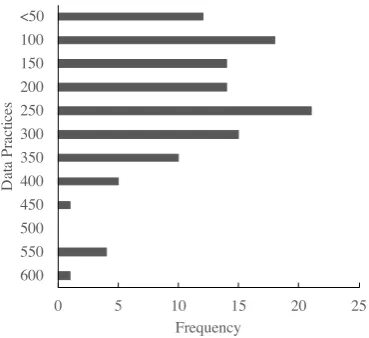
Figure 2: Distribution of data practices per policy.
[image:5.595.90.275.563.732.2]4.2 Consolidating Annotators’ Work
In this section we discuss the problem of consol-idation, or merging data practices from multiple annotators if those practices refer to the same un-derlying practice expressed by the text. The ambi-guity and vagueness of privacy policies (Reiden-berg et al., 2016) and the sophistication of the an-notation scheme are natural limitations on anno-tator agreement. With that in mind, we present a consolidation procedure to collapse redundant an-notations with the proviso that practices labeled by only one or two skilled annotators also have sub-stantial value and merit retention.
First, we institute some basic requirements about locality and topicality to determine which data practices are eligible for consolidation. Given a segment, if annotatorsA1, ..., An (forn = 2or
n = 3 in our dataset) respectively produce sets of data practices P1, ..., Pn, then a selection of
data practices p1∈P1, ..., pn∈Pn is eligible to
be consolidated into a single data practice only if all of them belong to the same category. Addition-ally, three implicit assumptions in this requirement are that (1) at least two annotators contribute prac-tices to a consolidation set, (2) all the pracprac-tices are located in the same policy segment, and (3) each practice must belong to a unique annotator.
For each segment we create an exhaustive list of eligible combinations of data practices to con-solidate, score and rank each combination using a method detailed below, prune the list with a score threshold, and finally perform consolidations in order of ranking until no further consolidations are possible. Consolidation sets containing three an-notators’ practices are considered prior to sets con-taining practices from only two annotators. The data practices in a chosen consolidation set are removed and replaced by a single “master” data practice. To do this, it is necessary to merge sets of values and sets of text spans respectively associ-ated with each attribute. Sets of values are merged using a majority vote if possible and set to Unspec-ified if otherwise; the latter case occurs in approxi-mately a third of all mergers. Sets of text spans are merged with a strong bias toward recall, by creat-ing a new text span that begins and ends with re-spectively the first and last indexes in the set.
Our scoring method is based on the summative overlap between the sets of text spans associated with attributes of data practices, with normaliza-tion to account for longer spans. Since the text
���� ���� ���� ���� �� ���� ���� ���� ���� ��
�� ���� ���� ���� ���� ��
����
�
������������
�
������
�
���
�
����
[image:6.595.310.516.80.207.2]�����������������������
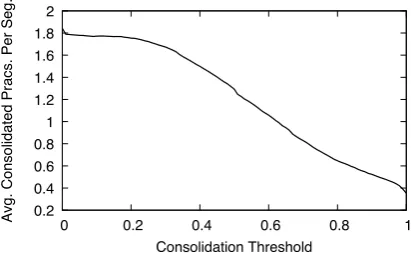
Figure 3: Consolidation threshold value versus the average number of data practices per segment pro-duced by consolidation.
spans connect data practices to the policy text, we use their overlaps as evidence that two annotators’ data practices refer to the same underlying practice in the text. Thus, a score for two data practices that are associated with roughly the same policy text is relatively high, and a score for two data practices that are associated with different text is low.
Figure 3 shows the effect of the consolidation threshold on the average number of practices pro-duced by consolidation per policy segment (i.e., excluding those original data practices that were retained because they were not subject to consoli-dation). Past a threshold value of approximately 0.2, the number of practices steadily decreases. Notably the average number of practices produced by consolidation is substantially less than the av-erage practices per annotator per segment (2.04) at any point on the curve, indicating a relative lack of agreement between annotators in terms of text span selections. As part of the corpus, we release consolidated datasets at threshold values of 0.5, 0.75, and 1.
4.3 Data Exploration Website
The data practice annotations are difficult for hu-man readers to interpret without visual connec-tions to the policy text. To help researchers, pol-icy regulators, and the general public understand the structure and utility of the data set, we cre-ated a data exploration website6that visually inte-grates the data practice annotations with the texts of privacy policies. Site interactivity allows users to search for websites in the dataset or browse by DMOZ sectors.
The website also allows users to compare pri-vacy policies by categorical structure, data
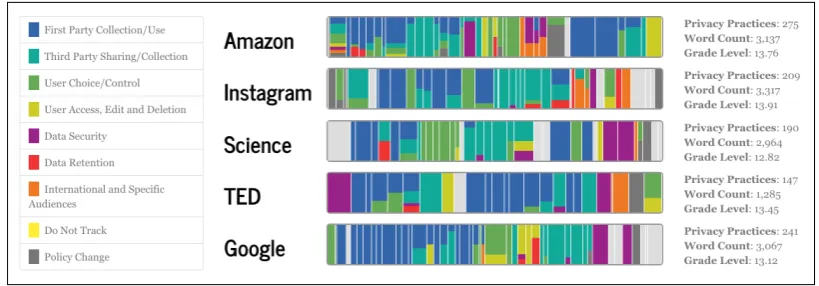
Figure 4: Comparing five policies on the data exploration website.
tice quantities, and reading level.7 Figure 4 shows a sample comparison between five websites. Each policy’s segments are depicted in order from left to right. Segments are colored according to the practice categories that annotators labeled within them. Qualitative patterns are discernible; for ex-ample, several of these policies have large blocks of First Party Collection/Use toward the beginning or large blocks of Third Party Sharing/Collection further inward. We discuss exploiting such recur-ring structures in the next section.
5 Prediction of Policy Structure
The current human annotation procedure is im-practical for covering the entire Internet or ac-counting for changes in privacy policies. This raises the question of whether the process can be partly automated. In this section we describe our experiments to automatically assign category la-bels to policy segments, which would enable the simplification of the annotation task.
5.1 Experiments
Our dataset consisted of 3,792 segments from 115 privacy policies. We represented the text of each segment as a dense vector using Paragraph2Vec (Le and Mikolov, 2014) and the GENSIM toolkit ( ˇReh˚uˇrek and Sojka, 2010). This approach ex-ploited semantic similarities between words in the vocabulary of privacy policies, acknowledg-ing that the vocabulary in this domain is special-ized but not completely standardspecial-ized. We assigned each policy segment a binary vector of category-specific labels, with each element in the vector corresponding to the presence or absence of a data practice category in the segment. We considered a vector with twelve elements, with nine of them
7explore.usableprivacy.org/compare
coming from existing practice categories (all ex-cept Other). The remaining three came from el-evating three attributes of Other to category sta-tus: Introductory/Generic,Practice Not Covered, andPrivacy Contact Information. We created gold standard data for this problem using a simplified consolidation approach: if two or more annotators agreed that a category is present in a segment, then we labeled that segment with the category.
that is represented as a cluster. These two distribu-tions are estimated empirically from the training data, and we used Viterbi decoding to obtain the best labeling sequence during the prediction.
5.2 Results
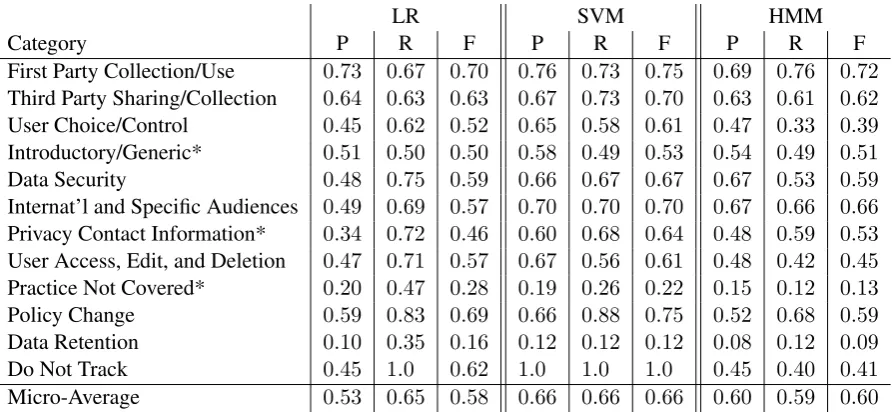
We split the set of 115 policies into subsets of 75 for training and 40 for testing. The number of clus-ters in the HMM approach8is set to 100 and the re-sults are shown in Table 3 as means across 10 runs. The standard deviations for these performance fig-ures are generally between0.01and0.05; the one exception is Do Not Track (the least frequent cat-egory) with a standard deviation of0.2. As the ta-ble shows, although the HMM does not reach the same performance as SVM, it performs similarly to logistic regression and meets or exceeds its F1-score for five categories.
We interpret the strength of the SVM as indi-cating the strong potential to partly automate the policy labeling procedure, especially for two cate-gories: First Party Collection/Use (a standout per-formance and the category for which the most la-beled data exists) and Do Not Track (a perfect performance, likely due to the limited vocabulary used to describe practices in this category). Addi-tionally, while the HMM did not perform as well overall, we note that its micro-average F1 was a slight improvement over logistic regression. With relatively little data to train this HMM, we expect that the accumulation of more labeled instances can improve its performance substantially. 6 Future Directions
The OPP-115 Corpus enables research in sev-eral directions of interest to natural language pro-cessing and usable privacy. We sketch some op-portunites for future work below.
A central challenge for this research is the scal-ability of policy annotation. Although it was nec-essary to annotate the first 115 policies manu-ally, to ensure the annotations were responsive to the annotation scheme, a less labor-intensive ap-proach will be required for large-scale Web cov-erage. The OPP-115 Corpus is a valuable dataset for this move toward automated methods. Addi-tionally, a strong potential exists for a combina-tion of automated annotacombina-tion of coarse informa-tion and human annotainforma-tion of finer details. For
8We tuned the parameters of the HMM approach and SVM after performing a five-fold cross validation on the training data.
example, automated category labeling of policy segments is feasible, as demonstrated in Section 5. Asking a human to label practices in a single category would be a reduction in effort, especially if they are shown text that is relevant to the cat-egory. Crowdsourcing also becomes a possibility when the complexity of the task is reduced.
An ambitious goal will be to eliminate human annotators altogether. Our preliminary analysis has shown that the policy vocabularies associated with certain annotations are very distinctive (e.g., the Do Not Track category or financial information as a data type, for example), lending themselves to automatic identification. By producing confidence ratings alongside data practice predictions, an au-tomated system could mitigate its shortcomings.
Separately, data practices must be presented to Internet users in a way that is responsive to their concerns. Text summarization is a possibility, us-ing the annotations as a guide for important details to retain. Internet users have already demonstrated limited patience with text-based privacy policies, which adds a nuance to this challenge and sug-gests the need for a combination of text and picto-rial representations (or chiefly pictopicto-rial represen-tations) to communicate data practices (Schaub et al., 2015).
Additional questions of interest include:
• How can the data practice annotations for
a policy be combined into a cohesive
inter-pretation? The relationships between data
practices are not straightforward. Vague-ness, contradictions, and unclear scope are all problems for constructing a knowledge base of them.
• How can the balance between human and
automated methods for annotation be
opti-mized? The model for the ideal
combina-tion is subject to parameters such as the avail-ability of resources and the necessary level of confidence for annotations.
• How can sectoral norms and outliers be
iden-tified automatically? A bank website that
LR SVM HMM
Category P R F P R F P R F
First Party Collection/Use 0.73 0.67 0.70 0.76 0.73 0.75 0.69 0.76 0.72 Third Party Sharing/Collection 0.64 0.63 0.63 0.67 0.73 0.70 0.63 0.61 0.62 User Choice/Control 0.45 0.62 0.52 0.65 0.58 0.61 0.47 0.33 0.39 Introductory/Generic* 0.51 0.50 0.50 0.58 0.49 0.53 0.54 0.49 0.51
Data Security 0.48 0.75 0.59 0.66 0.67 0.67 0.67 0.53 0.59
Internat’l and Specific Audiences 0.49 0.69 0.57 0.70 0.70 0.70 0.67 0.66 0.66 Privacy Contact Information* 0.34 0.72 0.46 0.60 0.68 0.64 0.48 0.59 0.53 User Access, Edit, and Deletion 0.47 0.71 0.57 0.67 0.56 0.61 0.48 0.42 0.45 Practice Not Covered* 0.20 0.47 0.28 0.19 0.26 0.22 0.15 0.12 0.13
Policy Change 0.59 0.83 0.69 0.66 0.88 0.75 0.52 0.68 0.59
Data Retention 0.10 0.35 0.16 0.12 0.12 0.12 0.08 0.12 0.09
Do Not Track 0.45 1.0 0.62 1.0 1.0 1.0 0.45 0.40 0.41
[image:9.595.77.524.75.281.2]Micro-Average 0.53 0.65 0.58 0.66 0.66 0.66 0.60 0.59 0.60
Table 3: Precision/Recall/F1 for the three models. The three starred categories resulted from the decom-position of the original Other category, which is excluded here. Categories are ordered in this table in descending order by frequency in the dataset.
7 Conclusion
We have described the motivation, creation, and analysis of a unique corpus of 115 privacy policies and 23K fine-grained data practice annotations, and we have demonstrated the feasibility of partly automating the annotation process. The annota-tions reveal the structure and complexity of these documents, which Internet users are expected to understand and accept. This corpus should serve as a resource for language technologies research to help Internet users understand the privacy prac-tices of businesses and other entities that they in-teract with online.
Acknowledgements
This work is funded by the National Sci-ence Foundation under grants CNS-1330596 and CNS-1330214. The authors would like to ac-knowledge the law students at Fordham Uni-versity and the UniUni-versity of Pittsburgh who worked as annotators to make this corpus possi-ble. The authors also wish to acknowledge all members of the Usable Privacy Policy Project (www.usableprivacy.org) for their contri-butions.
References
Ngo Xuan Bach, Nguyen Le Minh, Tran Thi Oanh, and Akira Shimazu. 2013. A two-phase framework for learning logical structures of paragraphs in legal ar-ticles. ACM Transactions on Asian Language
Infor-mation Processing (TALIP), 12(1):3:1–3:32, March.
Trevor Bench-Capon, Michał Araszkiewicz, Kevin Ashley, Katie Atkinson, Floris Bex, Filipe Borges, Daniele Bourcier, Paul Bourgine, Jack G Conrad, Enrico Francesconi, et al. 2012. A History of AI and Law in 50 Papers: 25 Years of the International Conference on AI and Law. Artificial Intelligence
and Law, 20(3):215–319.
Guido Boella, Luigi Di Caro, Michele Graziadei, Loredana Cupi, Carlo Emilio Salaroglio, Llio Humphreys, Hristo Konstantinov, Kornel Marko, Livio Robaldo, Claudio Ruffini, et al. 2015. Link-ing legal open data: BreakLink-ing the accessibility and language barrier in European legislation and case law. InProceedings of the 15th International
Con-ference on Artificial Intelligence and Law, ICAIL
’15, pages 171–175. ACM.
Kalina Bontcheva, Hamish Cunningham, Ian Roberts, Angus Roberts, Valentin Tablan, Niraj Aswani, and Genevieve Gorrell. 2013. GATE teamware: a web-based, collaborative text annotation framework.
Language Resources and Evaluation, 47(4):1007–
1029.
Travis D. Breaux and Florian Schaub. 2014. Scal-ing requirements extraction to the crowd. InRE’14: Proceedings of the 22nd IEEE International
Re-quirements Engineering Conference, RE’ 14, pages
163–172, Washington, DC, USA, August. IEEE So-ciety Press.
Jean Carletta. 1996. Assessing agreement on classi-fication tasks: The kappa statistic. Computational
Linguistics, 22(2):249–254, June.
F.H. Cate. 2010. The limits of notice and choice.IEEE
Security Privacy, 8(2):59–62, March.
Parvathi Chundi and Pranav M. Subramaniam. 2014. An approach to analyze web privacy policy docu-ments. InKDD Workshop on Data Mining for
So-cial Good.
Elisa Costante, Yuanhao Sun, Milan Petkovi´c, and Jerry den Hartog. 2012. A machine learning solu-tion to assess privacy policy completeness. In Pro-ceedings of the 2012 ACM Workshop on Privacy
in the Electronic Society, WPES ’12, pages 91–96.
ACM.
Elisa Costante, Jerry den Hartog, and Milan Petkovi´c. 2013. What websites know about you: Privacy policy analysis using information extraction. In Roberto Di Pietro, Javier Herranz, Ernesto Dami-ani, and Radu State, editors,Data Privacy
Manage-ment and Autonomous Spontaneous Security,
vol-ume 7731 of Lecture Notes in Computer Science, pages 146–159. Springer.
Lorrie Faith Cranor, Kelly Idouchi, Pedro Giovanni Leon, Manya Sleeper, and Blase Ur. 2013. Are they actually any different? Comparing thousands of fi-nancial institutions’ privacy practices. InWorkshop
on the Economics of Information Security, WEIS
’13, June.
Michael Curtotti and Eric McCreath. 2013. A right to access implies a right to know: An open online platform for research on the readability of law. J.
Open Access L., 1:1–56.
Tatiana Ermakova, Benjamin Fabian, and Eleonora Babina. 2015. Readability of privacy policies of healthcare websites. In 12. Internationale Tagung
Wirtschaftsinformatik (Wirtschaftsinformatik 2015).
Federal Trade Commission. 2012. Protecting con-sumer privacy in an era of rapid change: Rec-ommendations for businesses and policymakers.
http://www.ftc.gov/reports. Last
ac-cessed: June 22, 2016.
Enrico Francesconi, Simonetta Montemagni, Wim Pe-ters, and Daniela Tiscornia. 2010. Semantic pro-cessing of legal texts: Where the language of law
meets the law of language, volume 6036 ofLecture
Notes in Artificial Intelligence. Springer.
Filippo Galgani, Paul Compton, and Achim Hoffmann. 2012. Combining different summarization tech-niques for legal text. In Proceedings of the Work-shop on Innovative Hybrid Approaches to the
Pro-cessing of Textual Data, HYBRID ’12, pages 115–
123. ACL.
Google. 2015. Google Trends. https://www. google.com/trends/. Last accessed: June 22, 2016.
Candice Hoke, Lorrie Cranor, Pedro Leon, and Alyssa Au. 2015. Are they worth reading? An in-depth analysis of online tracker’s privacy policies. I/S: A Journal of Law and Policy for the Information Soci-ety, 11(2):325–404, April.
Carlos Jensen and Colin Potts. 2004. Privacy policies as decision-making tools: An evaluation of online privacy notices. InProceedings of the SIGCHI
Con-ference on Human Factors in Computing Systems,
CHI ’04, pages 471–478. ACM.
Quoc V Le and Tomas Mikolov. 2014. Distributed representations of sentences and documents. arXiv
preprint arXiv:1405.4053.
Fei Liu, Rohan Ramanath, Norman Sadeh, and Noah A. Smith. 2014. A step towards usable pri-vacy policy: Automatic alignment of pripri-vacy state-ments. In Proceedings of COLING 2014, the 25th International Conference on Computational
Lin-guistics: Technical Papers, COLING ’14, pages
884–894. ANLP, August.
Lars Mahler. 2015. What is NLP and why should lawyers care? http://www. lawpracticetoday.org/article/
nlp-lawyers/, February. Last accessed:
June 22, 2016.
Aaron K. Massey, Jacob Eisenstein, Annie I. Ant´on, and Peter P. Swire. 2013. Automated text mining for requirements analysis of policy documents. In 21st IEEE International Requirements Engineering
Conference, RE ’13, pages 4–13. IEEE.
Aleecia M. McDonald and Lorrie Faith Cranor. 2008. The cost of reading privacy policies. I/S: J Law &
Policy Info. Soc., 4(3):540–561.
Gabriele Meiselwitz. 2013. Readability assessment of policies and procedures of social networking sites. In A. Ant Ozok and Panayiotis Zaphiris, editors,5th International conference, OCSC 2013, Held as Part
of HCI International 2013, Lecture Notes in
Com-puter Science, pages 67–75. Springer, January. Vytautas Mickevicius, Tomas Krilavicius, and Vaidas
Morkevicius. 2015. Classification of short legal Lithuanian texts. In The 5th Workshop on
Balto-Slavic Natural Language Processing, BSNLP ’15,
pages 106–111. ACM.
F. Pedregosa, G. Varoquaux, A. Gramfort, V. Michel, B. Thirion, O. Grisel, M. Blondel, P. Pretten-hofer, R. Weiss, V. Dubourg, J. Vanderplas, A. Pas-sos, D. Cournapeau, M. Brucher, M. Perrot, and E. Duchesnay. 2011. Scikit-learn: Machine learn-ing in Python. Journal of Machine Learning
Re-search, 12:2825–2830.
Rohan Ramanath, Fei Liu, Norman Sadeh, and Noah A. Smith. 2014. Unsupervised alignment of privacy policies using hidden markov models. In Proceedings of the Annual Meeting of the
Associ-ation of ComputAssoci-ational Linguistics, ACL ’14, pages
605–610. ACL, June.
Radim ˇReh˚uˇrek and Petr Sojka. 2010. Software Framework for Topic Modelling with Large Cor-pora. InProceedings of the LREC 2010 Workshop
on New Challenges for NLP Frameworks, pages 45–
50. ELRA, May.
Joel R. Reidenberg, Travis Breaux, Lorrie Faith Cranor, Brian French, Amanda Grannis, James T. Graves, Fei Liu, Aleecia McDonald, Thomas B. Norton, Ro-han Ramanath, N. Cameron Russell, Norman Sadeh, and Florian Schaub. 2015a. Disagreeable privacy policies: Mismatches between meaning and users’ understanding. Berkeley Technology Law Journal, 30(1):39–88.
Joel R. Reidenberg, N. Cameron Russell, Alexan-der J. Callen, Sophia Qasir, and Thomas B. Norton. 2015b. Privacy harms and the effectiveness of the notice and choice framework. I/S: J Law & Policy
Info. Soc., 11(2).
Joel R. Reidenberg, Jaspreet Bhatia, Travis Breaux, and Thomas B. Norton. 2016. Automated comparisons of ambiguity in privacy policies and the impact of regulation. Social Science Research Network
Work-ing Paper Series, January.
Norman Sadeh, Alessandro Acquisti, Travis D. Breaux, Lorrie Faith Cranor, Aleecia M. Mcdonald, Joel R. Reidenberg, Noah A. Smith, Fei Liu, N. Cameron Russell, Florian Schaub, and Shomir Wilson. 2013. The usable privacy policy project: Combining crowdsourcing, machine learning and natural lan-guage processing to semi-automatically answer those privacy questions users care about. Technical Report CMU-ISR-13-119, Carnegie Mellon Univer-sity.
Giovanni Sartor and Antonino Rotolo. 2013. AI and law. In Agreement Technologies, pages 199–207. Springer.
Jarom´ır ˇSavelka and Kevin D Ashley. 2015. Transfer of predictive models for classification of statutory texts in multi-jurisdictional settings. InProceedings of the 15th International Conference on Artificial
Intelligence and Law, ICAIL ’15, pages 216–220.
ACM.
Florian Schaub, Rebecca Balebako, Adam L. Durity, and Lorrie Faith Cranor. 2015. A design space for effective privacy notices. In Eleventh Symposium
On Usable Privacy and Security, SOUPS ’15, pages
1–17. USENIX Association, July.
John W. Stamey and Ryan A. Rossi. 2009. Auto-matically identifying relations in privacy policies.
In 27th ACM International Conference on Design
of Communication, SIGDOC ’09, pages 233–238.
ACM.
Anthony J. Viera and Joanne M. Garrett. 2005. Under-standing interobserver agreement: the kappa
statis-tic.Family Medicine, 37(5):360–363, 5.
Rigo Wenning, Matthias Schunter, Lorrie Cranor, B. Dobbs, S. Egelman, G. Hogben, J. Humphrey, M. Langheinrich, M. Marchiori, M. Presler-Marshall, J. Reagle, and D. A. Stampley. 2006. The platform for privacy preferences 1.1 (P3P 1.1) spec-ification.
Shomir Wilson, Florian Schaub, Rohan Ramanath, Norman Sadeh, Fei Liu, Noah A. Smith, and Freder-ick Liu. 2016. Crowdsourcing annotations for web-sites’ privacy policies: Can it really work? In
Pro-ceedings of the 25th World Wide Web Conference,
WWW ’13, pages 133–143.
Sebastian Zimmeck and Steven M. Bellovin. 2014. Privee: An architecture for automatically analyz-ing web privacy policies. In 23rd USENIX
Secu-rity Symposium, USENIX Security ’14, pages 1–16.