A Neural Network based Approach to Automatic Post-Editing
Santanu Pal1, Sudip Kumar Naskar3, Mihaela Vela1, Josef van Genabith1,2
1Saarland University, Saarbr¨ucken, Germany
2German Research Center for Artificial Intelligence (DFKI), Germany 3Jadavpur University, Kolkata, India
{santanu.pal, josef.vangenabith}@uni-saarland.de [email protected],[email protected]
Abstract
We present a neural network based auto-matic post-editing (APE) system to im-prove raw machine translation (MT) out-put. Our neural model of APE (NNAPE) is based on a bidirectional recurrent neu-ral network (RNN) model and consists of an encoder that encodes an MT output into a fixed-length vector from which a de-coder provides a post-edited (PE) trans-lation. APE translations produced by NNAPE show statistically significant im-provements of 3.96, 2.68 and 1.35 BLEU points absolute over the original MT, phrase-based APE and hierarchical APE outputs, respectively. Furthermore, human evaluation shows that the NNAPE gener-ated PE translations are much better than the original MT output.
1 Introduction
For many applications the performance of state-of-the-art MT systems is useful but often far from perfect. MT technologies have gained wide ac-ceptance in the localization industry. Computer aided translation (CAT) has become the de-facto standard in large parts of the translation industry which has resulted in a surge of demand for pro-fessional post-editors. This, in turn, has resulted in substantial quantities of PE data which can be used to develop APE systems.
In the context of MT, “post-editing” (PE) is de-fined as the correction performed by humans over the translations produced by an MT system (Veale and Way, 1997), often with minimal amount of manual effort (TAUS Report, 2010) and as a pro-cess of modification rather than revision (Loffler-Laurian, 1985).
MT systems primarily make two types of errors – lexical and reordering errors. However, due to the statistical and probabilistic nature of modelling in statistical MT (SMT), the currently dominant MT technology, it is non-trivial to rectify these er-rors in the SMT models. Post-edited data are of-ten used in incremental MT frameworks as addi-tional training material. However, often this does not fully exploit the potential of these rich PE data: e.g., PE data may just be drowned out by a large SMT model. An APE system trained on human post-edited data can serve as a MT post-processing module which can improve overall performance. An APE system can be considered as an MT sys-tem, translating predictable error patterns in MT output into their corresponding corrections.
APE systems assume the availability of source language input text (SLIP), target language MT
output (T LMT) and target language PE data
(T LP E). An APE system can be modelled as
an MT system betweenSLIP T LMT andT LP E.
However, if we do not have access to SLIP, but
have sufficiently large amounts of parallelT LMT
-T LP E data, we can still build an APE model
be-tweenT LMT andT LP E.
Translations provided by state-of-the-art MT systems suffer from a number of errors including incorrect lexical choice, word ordering, word in-sertion, word deletion, etc. The APE work pre-sented in this paper is an effort to improve the MT output by rectifying some of these errors. For this purpose we use a deep neural network (DNN) based approach. Neural MT (NMT) (Kalchbren-ner and Blunsom, 2013; Cho et al., 2014a; Cho et al., 2014b) is a newly emerging approach to MT. On the one hand DNNs represent language in a continuous vector space which eases the mod-elling of semantic similarities (or distance) be-tween phrases or sentences, and on the other hand it can also consider contextual information, e.g.,
utilizing all available history information in decid-ing the next target word, which is not an easy task to model with standard APE systems.
Unlike phrase-based APE systems (Simard et al., 2007a; Simard et al., 2007b; Pal, 2015; Pal et al., 2015), our NNAPE system builds and trains a single, large neural network that accepts a ‘draft’ translation (T LMT) and outputs an
im-proved translation (T LP E).
The remainder of the paper is organized as fol-lows. Section 2 gives an overview of relevant re-lated work. The proposed NNAPE system is de-scribed in detail in Section 3. We present the ex-perimental setup in Section 4. Section 5 presents the results of automatic and human evaluation to-gether with some analysis. Section 6 concludes the paper and provides avenues for future work.
2 Related Work
APE has proved to be an effective remedy to some of the inaccuracies in raw MT output. APE approaches cover a wide methodological range. Simard et al. (2007a) and Simard et al. (2007b) applied SMT for post-editing, handling the repeti-tive nature of errors typically made by rule-based MT systems. Lagarda et al. (2009) used statis-tical information from the trained SMT models for post-editing of rule-based MT output. Rosa et al. (2012) and Mareˇcek et al. (2011) applied a rule-based approach to APE on the morphologi-cal level. Denkowski (2015) developed a method for real time integration of post-edited MT output into the translation model by extracting a gram-mar for each input sentence. Recent studies have even shown that the quality of MT plus PE can exceed the quality of human translation (Fiederer and OBrien, 2009; Koehn, 2009; DePalma and Kelly, 2009) as well as the productivity (Zampieri and Vela, 2014) in some cases.
Recently, a number of papers have presented the application of neural networks in MT (Kalchbren-ner and Blunsom, 2013;?; Cho et al., 2014b; Bah-danau et al., 2014). These approaches typically consist of two components: an encoder encodes a source sentence and a decoder decodes into a target sentence.
In this paper we present a neural network based approach to automatic PE (NNAPE). Our NNAPE model is inspired by the MT work of Bah-danau et al. (2014) which is based on bidirectional recurrent neural networks (RNN). Unlike
Bah-danau et al. (2014), we use LSTMs rather than GRUs as hidden units. RNNs allow process-ing of arbitrary length sequences, however, they are susceptible to the problem of vanishing and exploding gradients (Bengio et al., 1994). To tackle vanishing gradients in RNNs, two archi-tectures are generally used: gated recurrent units (GRU) (Cho et al., 2014b) and long-short term memory (LSTM) (Hochreiter and Schmidhuber, 1997). According to empirical studies (Chung et al., 2014; J´ozefowicz et al., 2015) both architec-tures yield comparable performance. GRUs tend to train faster than LSTMs. On the other hand, given sufficient amounts of training data, LSTMs may lead to better results. Since our task is mono-lingual and we have more than 200K sentence pairs for training, we use a full LSTM (as the hid-den units) to model our NNAPE system.
The model takesT LMT as input and provides
T LP Eas output. To the best of our knowledge the
work presented in this paper is the first approach to APE using neural networks.
3 Neural Network based APE
The NNAPE system is based on a bidirectional (forward-backward) RNN based encoder-decoder. 3.1 A Bidirectional RNN APE
Encoder-Decoder
Our NNAPE model encodes a variable-length se-quence ofT LMT (e.g. x = x1, x2, x3...xm) into
a fixed-length vector representation and then de-codes a given fixed-length vector representation back into a variable-length sequence of T LP E
(e.g. y = y1, y2, y3...yn). Input and output
se-quence lengths,mandn, may differ.
A Bidirectional RNN encoder consists of for-ward and backfor-ward RNNs. The forfor-ward RNN en-coder reads in eachxsequentially fromx1 toxm
and at each time stept, the hidden statehtof the
RNN is updated by using a non-linear activation functionf (Equation 1), an elementwise logistic sigmoid with an LSTM unit.
ht=f(ht−1, xt) (1)
Figure 1: Generating thetthT LP E wordytfor a
givenT LMT (x) by our NNAPE System.
The decoder is another RNN trained to generate the output sequence by predicting the next wordyt
given the hidden stateηtand the context vectorct
(c.f., Figure1). The hidden state of the decoder at timetis computed as given below.
P(yt|y1, ...yt−1,x) =f(ηt, yt−1, ct) (2)
ηt=f(ηt−1, yt−1, ct) (3)
The context vectorctcan be computed as
ct= m X
i=1
αtihi (4)
Here,αti, is the weight of eachhiand can be
com-puted as
αti = Pmexp(eti)
j=1exp(etj) (5)
where eti = a(ηt−1, hi) is an alignment model
which provides a matching score between the in-puts around position i and the output at position
t. The alignment score is based on theith
annota-tionhi of the input sentence and the RNN hidden
stateηt−1. The alignment model itself is a feed-forward neural network which directly computes a soft alignment that allows the gradient of the cost function to be backpropagated through. The gra-dient is used to train the alignment model as well as theT LMT–T LP E translation model jointly.
The alignment model is computedm×ntimes as follows:
a(ηt−1, hi) =vaTtanh(Waηt−1+Uahi) (6)
whereWa ∈ Rnh×nh,Ua ∈ Rnh×2nh andva ∈ Rnhare the weight matrices ofnhhidden units.
4 Experiments
We evaluate the model on an English–Italian APE task, which is detailed in the following subsec-tions.
4.1 Data
The training data used for the experiments was de-veloped in the MateCat1 project and consists of 312KT LMT–T LP E parallel sentences. The
par-allel sentences are (English to) Italian MT out-put and their corresponding (human) post-edited Italian translations. Google Translate (GT) is the MT engine which provided the original Italian
T LMT output. The data includes sentences from
the Europarl corpus as well as news commen-taries. Since the data contains some non-Italian sentences, we applied automatic language identifi-cation (Shuyo, 2010) in order to select only Italian sentences. Automatic cleaning and pre-processing of the data was carried out by sorting the entire parallel training corpus based on sentence length, filtering the parallel data on maximum allowable sentence length of 80 and sentence length ratio of 1:2 (either direction), removing duplicates and applying tokenization and punctuation normaliza-tion using Moses (Koehn et al., 2007) scripts. Af-ter cleaning the corpus we obtained a sentence-alignedT LMT–T LP E parallel corpus containing
213,795 sentence pairs. We randomly extracted 1000 sentence pairs each for the development set and test set from the pre-processed parallel cor-pus and used the remaining (211,795) as the train-ing corpus. The traintrain-ing data features 57,568 and 61,582 unique word types inT LMT and T LP E,
respectively. We chose the 40,000 most frequent words from both T LMT and T LP E to train our
NNAPE model. The remaining words which are not among the most frequent words are re-placed by a special token ([UNK]). The model was trained for approximately 35 days, which is equiv-alent to 2,000,000 updates with GPU settings.
4.2 Experimental Settings
Our bidirectional RNN Encoder-Decoder contains 1000 hidden units for the forward backward RNN encoder and 1000 hidden units for the decoder.
The network is basically a multilateral neural net-work with a single maxout unit as hidden layer (Goodfellow et al., 2013) to compute the condi-tional probability of each target word. The word embedding vector dimension is 620 and the size of the maxout hidden layer in the deep output is 500. The number of hidden units in the alignment model is 1000. The model has been trained on a mini-batched stochastic gradient descent (SGD) with ‘Adadelta’ (Zeiler, 2012). The main rea-son behind the use of ‘Adadelta’ is to automat-ically adapt the learning rate of each parameter ( = 10−6 andρ = 0.95). Each SGD update di-rection is computed using a mini-batch of 80 sen-tences.
We compare our NNAPE system with state-of-the-art phrase-based (Simard et al., 2007b) as well as hierarchical phrase-based APE (Pal, 2015) sys-tems. We also compare the output provided by our system against the original GT output. For building the based and hierarchical phrase-based APE systems, we set maximum phrase length to 7. A 5-gram language model built using KenLM (Heafield, 2011) was used for decoding. System tuning was carried out using both k-best MIRA (Cherry and Foster, 2012) and Minimum Error Rate Training (MERT) (Och, 2003) on the held-out development set (devset). After parame-ters were tuned, decoding was carried out on the held out test set.
5 Evaluation
The performance of the NNAPE system was eval-uated using both automatic and human evaluation methods, as described below.
5.1 Automatic Evaluation
The output of the NNAPE system on the 1000 sentences testset was evaluated using three MT evaluation metrics: BLEU (Papineni et al., 2002), TER (Snover et al., 2006) and Meteor (Denkowski and Lavie, 2011). Table 1 provides a comparison of our neural system performance against the base-line phrase-based APE (S1), baseline hierarchical phrase-based APE (S2) and the original GT output. We usea,b,c, anddto indicate statistical signif-icance over GT, S1, S2 and our NNAPE system (NN), respectively. For example, the S2 BLEU score 63.87a,bin Table 1 means that the
improve-ment provided by S2in BLEU is statistically sig-nificant over Google Translator and phrase-based
APE. Table 1 shows that S1 provides statistically significant (0.01< p < 0.04) improvements over GT across all metrics. Similarly S2 yields statis-tically significant (p < 0.01) improvements over both GT and S1 across all metrics. The NN sys-tem performs best and results in statistically sig-nificant (p < 0.01) improvements over all other systems across all metrics. A systematic trend (NN > S2 > S1 > GT) can be observed in Ta-ble 1 and the improvements are consistent across the different metrics. The relative performance gain achieved by NN over GT is highest in TER.
System BLEU TER METEOR
GT (a) 61.26 30.94 72.73
S1(b) 62.54a 29.49a 73.21a
S2(c) 63.87a,b 28.67a,b 73.63a,b
NN (d) 65.22a,b,c 27.56a,b,c 74.59a,b,c
Table 1: Automatic evaluation.
5.2 Human Evaluation
Human evaluation was carried out by four profes-sional translators, native speakers of Italian, with professional translation experience between one and two years. Since human evaluation is very costly and time consuming, it was carried out on a small portion of the test set consisting of 145 ran-domly sampled sentences and only compared NN with the original GT output. We used a polling scheme with three different options. Translators choose which of the two (GT or NN) outputs is the better translation or whether there is a tie (‘un-certain’). To avoid any bias towards any particular system, the order in which two system outputs are presented is randomized so that the translators do not know which system they are contributing their votes to.
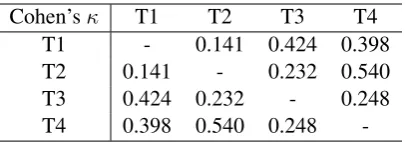
We analyzed the outcome of the voting pro-cess (4 translators each giving 145 votes) and found that the winning NN system received 285 (49.13%) votes compared to 99 (17.07%) votes received by the GT system, while the rest of the votes (196, 33.79%) go to the ‘uncertain’ option. We measured pairwise inter-annotator agreement between the translators by computing Cohen’s κ
Cohen’sκ T1 T2 T3 T4
T1 - 0.141 0.424 0.398
T2 0.141 - 0.232 0.540
T3 0.424 0.232 - 0.248
T4 0.398 0.540 0.248
-Table 2: Pairwise correlation between translators in the evaluation process.
5.3 Analysis
The results of the automatic evaluation show that NNAPE has advantages over the phrase-based and hierarchical APE approaches. On manual inspec-tion we found that the NNAPE system drastically reduced the preposition insertion and deletion er-ror in Italian GT output and was also able to han-dle the improper use of prepositions and determin-ers (e.g. “states” → “dei stati”, “the states” →
“gli stati”). The use of a bidirectional RNN neu-ral model makes the model sensitive towards con-texts. Moreover, NNAPE captures global reorder-ing by capturreorder-ing contextual features which helps to reduce word ordering errors to some extent.
6 Conclusion and Future Work
The NNAPE system provides statistically sig-nificant improvements over existing state-of-the-art APE models and produces significantly bet-ter translations than GT which is very difficult to beat. This enhancement in translation qual-ity through APE should reduce human PE effort. Human evaluation revealed that the NNAPE gen-erated PE translations contain less lexical errors, NNAPE rectifies erroneous word insertions and deletions, and improves word ordering.
In future, we would like to test our system in a real-life translation scenario to analyze productiv-ity gains in a commercial environment. We also want to extend the APE system by incorporating source language knowledge into the network and compare LSTM against GRU hidden units.
Acknowledgments
We would like to thank all the anonymous re-viewers for their feedback. We are also thank-ful to Translated SRL, Rome, Italy. They have shared their data for the experiments and enabled the manual evaluation of our system.
Santanu Pal is supported by the People Pro-gramme (Marie Curie Actions) of the European
Union’s Framework Programme (FP7/2007-2013) under REA grant agreement no 317471.
References
Dzmitry Bahdanau, Kyunghyun Cho, and Yoshua Ben-gio. 2014. Neural Machine Translation by Jointly
Learning to Align and Translate. arXiv preprint
arXiv:1409.0473.
Yoshua Bengio, Patrice Simard, and Paolo Frasconi. 1994. Learning Long-Term Dependencies with
Gra-dient Descent is Difficult. IEEE Transactions on
Neural Networks, 5(2):157–166.
Colin Cherry and George Foster. 2012. Batch Tun-ing Strategies for Statistical Machine Translation. In
Proceedings of the 2012 Conference of the North American Chapter of the Association for Computa-tional Linguistics: Human Language Technologies, pages 427–436.
KyungHyun Cho, Bart van Merrienboer, Dzmitry Bah-danau, and Yoshua Bengio. 2014a. On the Prop-erties of Neural Machine Translation:
Encoder-Decoder Approaches. CoRR, abs/1409.1259.
Kyunghyun Cho, Bart Van Merri¨enboer, C¸alar G¨ulc¸ehre, Dzmitry Bahdanau, Fethi Bougares, Hol-ger Schwenk, and Yoshua Bengio. 2014b. Learn-ing Phrase Representations usLearn-ing RNN Encoder– Decoder for Statistical Machine Translation. In Pro-ceedings of the 2014 Conference on Empirical Meth-ods in Natural Language Processing (EMNLP), pages 1724–1734.
Junyoung Chung, C¸alar G¨ulc¸ehre, Kyunghyun Cho, and Yoshua Bengio. 2014. Empirical Evalua-tion of Gated Recurrent Neural Networks on Se-quence Modeling. Technical Report Arxiv report 1412.3555, Universit´e de Montr´eal.
Jacob Cohen. 1960. A Coefficient of Agreement for
Nominal Scales. Educational and Psychological
Measurement, 20(1):37–46, April.
Michael Denkowski and Alon Lavie. 2011. Meteor 1.3: Automatic Metric for Reliable Optimization and Evaluation of Machine Translation Systems. In
Proceedings of the EMNLP 2011 Workshop on Sta-tistical Machine Translation, pages 85–91.
Michael Denkowski. 2015. Machine Translation for
Human Translators. Ph.D. thesis, Carnegie Mellon University.
Donald A. DePalma and Nataly Kelly. 2009. Project Management for Crowdsourced Translation: How User-Translated Content Projects Work in Real Life.
Translation and Localization Project Management: The Art of the Possible, pages 379–408.
Rebecca Fiederer and Sharon OBrien. 2009. Qual-ity and Machine Translation: a Realistic Objective.
[image:5.595.81.284.61.132.2]Ian J Goodfellow, David Warde-Farley, Mehdi Mirza, Aaron Courville, and Yoshua Bengio. 2013. Max-out networks. arXiv preprint arXiv:1302.4389.
Kenneth Heafield. 2011. KenLM: Faster and Smaller
Language Model Queries. In Proceedings of the
Sixth Workshop on Statistical Machine Translation, pages 187–197.
Sepp Hochreiter and J¨urgen Schmidhuber. 1997. Long
Short-Term Memory. Neural Comput., 9(8):1735–
1780, November.
Rafal J´ozefowicz, Wojciech Zaremba, and Ilya Sutskever. 2015. An Empirical Exploration of
Recurrent Network Architectures. In Proceedings
of the 32nd International Conference on Machine Learning, pages 2342–2350.
Nal Kalchbrenner and Phil Blunsom. 2013. Recurrent
Continuous Translation Models. InProceedings of
the 2013 Conference on Empirical Methods in Nat-ural Language Processing, pages 1700–1709.
Philipp Koehn, Hieu Hoang, Alexandra Birch, Chris Callison-Burch, Marcello Federico, Nicola Bertoldi, Brooke Cowan, Wade Shen, Christine Moran, Richard Zens, Chris Dyer, Ondˇrej Bojar, Alexandra Constantin, and Evan Herbst. 2007. Moses: Open Source Toolkit for Statistical Machine Translation. In Proceedings of the 45th Annual Meeting of the ACL on Interactive Poster and Demonstration Ses-sions, pages 177–180.
Philipp Koehn. 2009. A Process Study of Computer-aided Translation. Machine Translation, 23(4):241– 263.
Antonio Lagarda, Vicent Alabau, Francisco Casacu-berta, Roberto Silva, and Enrique D´ıaz-de Lia˜no. 2009. Statistical post-editing of a rule-based
ma-chine translation system. InProceedings of Human
Language Technologies: The 2009 Annual Confer-ence of the North American Chapter of the Associa-tion for ComputaAssocia-tional Linguistics, Companion Vol-ume: Short Papers, NAACL-Short ’09, pages 217– 220.
J. Richard Landis and Gary G. Koch. 1977. The Measurement of Observer Agreement for Categor-ical Data. Biometrics, 33(1):159–74.
Anne-Marie Loffler-Laurian. 1985. Traduction Au-tomatique et Style. Babel, 31(2):70–76.
David Mareˇcek, Rudolf Rosa, Petra Galuˇsˇc´akov´a, and Ondˇrej Bojar. 2011. Two-step Translation with
Grammatical Post-processing. InProceedings of the
Sixth Workshop on Statistical Machine Translation, pages 426–432.
Franz Josef Och. 2003. Minimum Error Rate Training
in Statistical Machine Translation. InProceedings
of the 41st Annual Meeting on Association for Com-putational Linguistics - Volume 1, pages 160–167.
Santanu Pal, Mihaela Vela, Sudip Kumar Naskar, and Josef van Genabith. 2015. USAAR-SAPE: An English–Spanish Statistical Automatic Post-Editing
System. InProceedings of the Tenth Workshop on
Statistical Machine Translation, pages 216–221. Santanu Pal. 2015. Statistical Automatic Post Editing.
In The Proceedings of the EXPERT Scientific and Technological workshop.
Kishore Papineni, Salim Roukos, Todd Ward, and Wei-Jing Zhu. 2002. BLEU: A Method for Automatic
Evaluation of Machine Translation. InProceedings
of the 40th Annual Meeting on Association for Com-putational Linguistics, ACL ’02, pages 311–318. Rudolf Rosa, David Mareˇcek, and Ondˇrej Duˇsek.
2012. DEPFIX: A System for Automatic
Correc-tion of Czech MT Outputs. In Proceedings of the
Seventh Workshop on Statistical Machine Transla-tion, pages 362–368.
Nakatani Shuyo. 2010. Language Detection Library for Java.
Michel Simard, Cyril Goutte, and Pierre Isabelle. 2007a. Statistical Phrase-Based Post-Editing. In
Human Language Technologies 2007: The Confer-ence of the North American Chapter of the Associa-tion for ComputaAssocia-tional Linguistics; Proceedings of the Main Conference, pages 508–515.
Michel Simard, Nicola Ueffing, Pierre Isabelle, and Roland Kuhn. 2007b. Rule-Based Translation with
Statistical Phrase-Based Post-Editing. In
Proceed-ings of the Second Workshop on Statistical Machine Translation, pages 203–206.
Matthew Snover, Bonnie Dorr, Richard Schwartz, Lin-nea Micciulla, and John Makhoul. 2006. A study of Translation Edit Rate with Targeted Human An-notation. InProceedings of association for machine translation in the Americas, pages 223–231. TAUS Report. 2010. Post editing in practice.
Techni-cal report, TAUS.
Tony Veale and Andy Way. 1997. Gaijin: A Bootstrap-ping, Template-driven Approach to Example-based
MT. InProceedings of the Recent Advances in
Nat-ural Language Processing.
Marcos Zampieri and Mihaela Vela. 2014. Quantify-ing the Influence of MT Output in the Translators Performance: A Case Study in Technical
Transla-tion. InProceedings of the EACL Workshop on
Hu-mans and Computer-assisted Translation (HaCat), pages 93–98.
Matthew D. Zeiler. 2012. ADADELTA: An Adaptive