J. Range Manage.
48:53-59 January 1995
Predicting buffelgrass survival across a geograph- ical and environmental gradient
FERNANDO A. IBARRA-F., JERRY R. COX, MARTHA H. MARTIN-R., TODD A. CROWL AND CHRISTOPHER A. CALL
Ibarra-F. and Martin-R. are graduate students, Range Science Departmenr, Utah Srate University and USDA- Agricul~urai Research Service, Forage and Range Research Laboratory, &ah Stare University, Logan S4322-6300. Both are permanenrly stationed at Cenrro de Investigaciones Pencaries de1 Esraro de Sonora, Apdo Postal 1754, Hennosillo, Sonora, Mesico.: Cox is resident director of research and range extension specialist, Tuas A&M University, Agricltltural Research and Extension Center, P.O. Box 16% Vernon 763S5. When this research was initiated, Cox was a range scientist with USDA-Agricultural Research Service in Tucson, Ark. and Logan, Ut.; Crow1 is assistant professor, Ecology Center, Department of Fisheries and Wildrife and Watershed Sciences Unit, Urah State University, Logan S4322-5210.; and Call is associarc professor, Range Science Department, Utah Slate Universiv, Logan S4322-5230.
Abstract
Thii research was designed to identify relationships between T- 4464 buffelgrass (Ce&zrus ciliaris L.) survival and climatic and soil characteristics. At 167 buffelgrass seeding sites in North America we collected climatic and soils data where the grass: 1) persisted over time and increased in area covered (spreads), 2) persisted over time but does not increase in area covered (per- sists), and 3) declined over time and all plants eventually died (dies). At 30 sites in Kenya we collected climatic and soils data in the area where T4464 seed was originally collected. Only total soil nitrogen and organic carbon differed among survival regimes. Total soil nitrogen and organic carbon concentrations were least where buffelgrass spreads, intermediate where the grass persists and greatest where the grass dies. To predict buf- felgrass survival among the 3 survival regimes, and between areas where the grass spreads or dies, we used discriminant func- tion analyses. A model including organic carbon, total soil nitro- gen, sand, clay, potassium and cation exchange capacity correctly classified 78% (13=0.8) of the seeding sites in the 3 survival regimes. A model including sand, total soil nitrogen, calcium, mean minimum temperature in the coldest month, annual pre-
The authors acknowledge the financial suppon provided by USDA-Agricultural Research Service (Drs. Plowman. Knipling and Child). We thank Dr. N.J.
Chatterton (USDA-ARS) for laboratory f&ilitk. Drs. Gary Richardson (USDA- ARS) and D.V. Sisson (Utah State University) for statistical advice. We also appreciate support and financial assistance provided by Consejo National de Ciencia y Tecnologia, the directors of Petronato de1 Centro de Investigaciones Pecuarias de1 Estado de Sonora, Institute National de Jnvestigaciones Forestales y Agropecuarias, the Cattlemen Union and the State of Sonora. Appreciation is estended to Jng. Victor Jaramillo V., Director de Comision Tecnico Consultiva pam la Determination de Coeticientes de Agobtadero. and Jng. Rogelio Alcaraz-E, Albert0 Nararro-C., Jarier Arellanes-A., Carmen R. Lopez-A., and Marco A.
Pew-L. for data collection. Drs. Roger E. Banner, Raymond IV. hliller. Brien E.
Norton, G. Allan Rasmussen and John C. hlalechek provided encouragement and manuscript review.
Part of dissertation submitted by the senior author in partial fulfillment of a Ph.D. degree. Reprint requests should be sent to J.R. Cox. Cooperative investiga- tions of the USDA-Agricultural Research Serwe and the Utah State Agricultural Esprriment Station. Journal paper 4560.
hfanuscript accepted 19 Apr. 1994.
cipitation and winter precpitation correctly classified 88%
(+0.8) of the seeding sites between spreads and dies. Survival regime selection prior to brush control, seedbed preparation and sowing will reduce planting failure probabilities, soil erosion and economic losses, and enhance long-term beef production.
Key Words: Cenchrus Cilitzris L., range seeding, climate, soil nutrients, Mesico, Tesas, Kenya
Buffelgrass (Cenchrus ciliaris L.), a perennial warm-season bunchgrass is native to Africa, Asia, and the Middle East (Bogdan 1961, Khan and Zarif 1982, Holt 1985, Mannetje and Jones 1990). The species predominates where surface soils are sandy and annual precipitation ranges from 200 to 1,200 mm (Cox et al. 1988).
Buffelgrass seed collected in the Turkana Desert, northcentral Kenya, was sown in Texas during the 1940’s and resulting stands were evaluated for seedling establishment, forage production and persistence (Holt 19%). Seedlings from seed sown in summer were easily established and mature plants survived winter in south Texas.
In 1949, the USDA-Soil Conservation Service informally released T-4464 buffelgrass (Holt 1985). T-4464 plants were established at most planting sites in south Texas, and between 1949 and 1985, the grass was established on over 4 million ha (Cox et al. 1988). Seed was transported to Mexico and success- fully established along the eastern and western coasts (Cota and Johnson 1975, Molina et al. 1976, Agostini et al. 1981, Hanselka 1985). Land managers assumed that plant populations would per- sist under a variety of climatic and soil conditions. However, spread of stands occurred only at a few locations. At other seeded sites, plant stands have persisted but have not spread or have dis- appeared. Similar observations have been reported in Africa (Brzostowski 1962, Bnostowski and Owen 1964, DuToit et al.
1976), Australia (Wilson 1964, Coaldrake and Russell 1969,
Ebersohn 1970, Anderson 1974, Hacker 1989, Silcock and Smith
1990, Walker and Weston 1990) and the United States (Ball
1964. Gonzales and Dodd 1979, Gonzales and Latigo 1981).
Because T-4464 was originally collected in northcentral Kenya, and spreads most frequently in south Texas and northwest Mexico, we hypothesized that climate and soils around the origi- nal collection site and where the plant spreads in North America were more similar than where the plant fails to spread or dies. If the hypothesis is true, then climatic and soil information from south Texas, northwestern Mexico and northcentral Kenya can be used worldwide to select seeding sites where buffelgrass has a high probability for establishment and persistence.
If range reseeding continues to be an economical alternative in reclamation of degraded rangeland, then information which increases success in species establishment and persistence is needed. The objectives of this study were i) to identify climatic and soil properties which determine where the species either 1) persists over time, and increases in area coverage (spreads), 2) persists over time but does not increase in area coverage (per- sists) or 3) declines over time and all plants eventually die (dies);
and ii) to develop predictive models that can be used by land managers and ranchers to select seeding sites where buffelgrass has a high probability for establishment and persistence.
Methods and Materials Study Site Selection
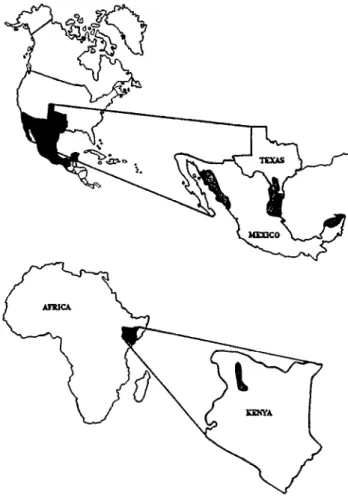
Historical records and journals were examined to determine where T-4&.! seed was collected in Africa and where the plant had been established in North America (Fig. 1). Rangeland con- servationists in Kenya, Texas and Mexico identified the original seed collection area or located and aged sites where the grass sur- vived for 10 or more years. Together we selected 167 buffelgrass seeding sites in North America, and 30 sites around the area where T-4464 seed was collected in northcentral Kenya. Seeding site sizes varied from 50 to 500 ha, and approximately 95% of the annual biomass production was harvested by domestic livestock and wildlife. Forty-seven stands were located in northwest Mexico, 59 in northeast Mexico, 27 in south Texas, and 34 in southeast Mexico. Northwest Mexico sites were between the set- tlements of Hermosillo and Mazatlan; southeast sites were within the Yucatan Peninsula; and northeast Mexico and south Texas sites were between Ciudad Victoria, Tamaulipas and Monterrey, Nuevo Leon, Mexico, and San Antonio and Laredo, Tex. (Fig. 1).
Planting sites in northwest Mexico were at low elevations between the Sierra Madre Occidental and the Gulf of California Plain (22’ 30’ and 31’ 00’ N lat.; and 105’ 30’ and 111” 20’ W long.). Climate varies from tropical dry, semitropical subdesertic, subtropical very dry, to semitropical desertic (FAO-UNESCO
1975a). Dominant soils are Yermosols and Regosols with lithic Yermosols, lithic Xerosols, lithic Kastanozems, Lithosols, lithic orthic Luvisols, Fluvisols and Gleysols.
Sites in northeast Mexico and south Texas were between the Gulf of Mexico Coastal Plain, the Rio Grande Plain, and the Sierra Oriental foothills (23 00’ and 28’ 30’ N lat.; and 97’ 50’ and 100” 00’ W long.). Climate within this area varies from humid to very dry subtropical, and rather humid to very dry warm temper- ate to semitropical subdesertic (FAO-UNESCO 1975a, 1975b).
Dominant soils are luvic and calcic Kastanozems, Rendzinas, luvic Phaeozems, pellic Vertisols, eutric Cambisols, eutric Fluvisols, eutric Gleysols and Regosols.
Sites in southeast Mexico were within the Yucatan Peninsula
(20” 21’ and 21” 25’ N lat.; and X8‘ 45’ and 90‘ 25’ W long.).
Climate within this area varies from dry tropical to very dry tropi- cal (FAO-UNESCO 1975a). Dominant soils are Rendzinas, pellic Vertisols, Lithosols, eutric Nitosols, lithic chromic Luvisols, lith- ic chromic Cambisols and shallow Miocene Histosols.
Sites in northcentral Kenya were west of Lake Turkana;
between the Ethiopian Highlands and the East African Plateaus (0’ 30’ and 4” 30’ N lat.; and 35’ 45’ and 36 20’ W long.). Climate in this area varies from semiarid tropical to hot tropical desert (FAO-UNESCO 1977). Dominant soils are eutric and calcaric Regosols, Xerisols, Fluvisols, Vertisols and Solonchaks.
Site elevations vary from 20 to 700 m in North America, and from 15 to 580 m in Kenya. Slopes range from 2 to 10%.
Precipitation ranges from 200 to 1,200 mm in North America, and is bimodally distributed in either spring and summer or win- ter and summer. In Kenya, precipitation ranges from 200 to 400 mm, and is bimodally distributed in early and late summer.
Study Site Classification
At North American seeding sites the plant stabilized at one of the following end points: 1) plants survived in the seeded area and new plants established naturally from seed outside the planti- ng area (spreads), 2) plants survived in the seeded area but did not spread outside the seeded area (persists), and 3) plants persist- ed in the seeded area for 10 or more years, and over time all plants eventually died (dies). Where T-4464 spreads, densities inside and outside the seeded area exceed 1 plant ms2. Where the
Fig. 1. Location of buffelgrass (Cenchrus ciliark) sampling sites.
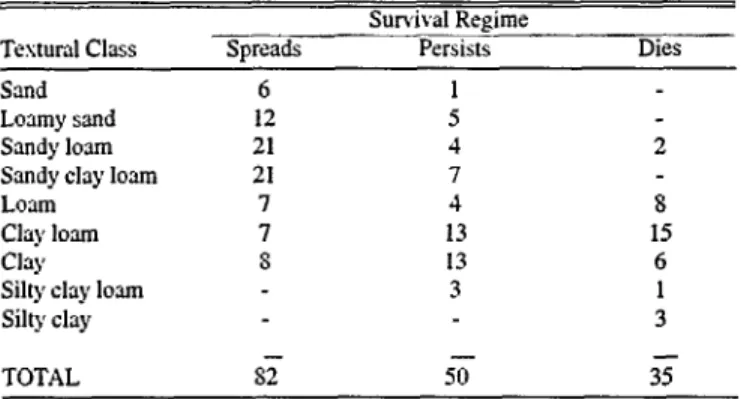
Table 1. Soil textural classes at buffelgrass seeding sties where the plant either spreads (82 sites), persists (50 sites), or dies (35 sites)
in Mexico and south Tesas.
Survival Regime
Textural Class Spreads Persists Dies
Sand 6 1
Loamy sand 12 5
Sandy loam 21 4 2
Sandy clay loam 21 7
Loam 7 4 8
Clay loam 7 13 15
Clay S 13 6
Silty clay loam 3 1
Silty clay 3
TOTAL ST 50 35
plant persists, densities inside the seeded area exceed 1 plant m*, and densities outside the seeded area were <l plant in 4 m”.
Where the plant dies no plants were observed inside or outside the seeded area. Based on these criteria, seeding sites in Mexico and Texas were divided among 3 survival regimes: 1) 82 sites were classified in survival regime 1 (spreads), 2) 50 sites were classified in survival regime 2 (persists) and 3) 35 sites were clas- sified in survival regime 3 (dies).
Soil Sampling
Soils were collected at O-10, 10-20, and 20-30 cm depths near the crown of 3 buffelgrass plants or in open areas where buffel- grass plants died. Three soils samples were collected at each soil depth. Cornposited samples were air dried, passed through a 2- mm sieve and thoroughly mixed. Duplicate subsamples from each composite were analyzed for particle-size distribution (Day
1950). pH (saturated paste), electrical conductivity of the saturat- ed extract and cation exchange capacity (U.S. Salinity Laboratory
Staff 1954), ammonium acetate soluble cations including calci- um, potassium, sodium and magnesium, total nitrogen, organic carbon, (Jackson 1958) and available phosphorus was extracted with NAHCO, (Olsen and Sommers 1982).
Climatic Parameters
Climatic data were collected at or from nearby areas where seed was orginially collected, and where plants either spread, per- sisted or died. Climatic reporting stations were selected based upon 1) topographic similarities between reporting stations and the 3 survival regimes plus areas where seed were collected, and 2) having 20 or more years of continuous records which corre- sponded with actual planting and subsequent growing years.
Climatic data are summarized in the following categories: 1) win- ter 2) summer and 3) total precipitation, and mean monthly 4) maximum and 5) minimum temperatures. We selected 17 stations in northwest Mexico, 25 stations in northeast Mexico and south Texas, 10 stations in southeast Mexico, and 7 stations in north- central Kenya (Agroclimatological Data for Africa 1984, Climatography of Mexico 1982, Climatography of the United States 1985).
Data Analysis
Because site selection was not random and site numbers within survival regimes were unequal, the treatment variances were compared. A Hartley test (Zar 1984) was used to determine dif- ferences (P I 0.05) among survival regimes for each weather parameter and soil component. When significant differences existed, a log (X+1) transformation was performed. All measured
parameters were compared across survival regimes using a multi- ple-analysis-variance (MANOVA) test. Univariate comparisons were adjusted according to the Bon Ferroni correction (Winer 1971).
A mean and coefficient of variation were generated for each soil component using data from the 3 depths at each sampling Table 2. Surface soil (O-10 cm) means and standard deviations for particle-size distribution and selected chemical properties at sites where buffelgrass either spreads, persists or dies at planting sites in south Tesas and hlesico, and where the seed was originally collected in northcentral Kenya. An asterisk (*) indicates a significant difference (P 5 0.05) among variances in the 3 survival regimes.
Soil
Properties Spreads
Survival Regime
Persists Dies
Hartley
test Kenya
Sand (%) 61.Ok20.2 44.9 + 24.6 35.3 f 15.4 NS 82.0 z!z 14.s
Silt (9,) 17.5 t 10.8 24.1 f 13.2 32.3 zt 7.2 NS 11.9 f 9.2
Clay (%i) 21.5* 11.6 31.0 f 15.3 32.4 zt 11.2 NS 6.126.1
Silt + clay (8) 39.0 f 18.7 55.1 + 24.3 64.7 + 16.2 NS lS.O + 14.8
PH 7.8 t 0.5 7.6 I 0.6 7.5 * 0.4 NS x.1 * 0.5
Electrical conductivity (ds m-‘) 0.3 f 0.2 0.3ztO.l 0.3ztO.l NS 0.2ztO.l
Total nitrogen (Q) 0.1 10.1 0.3 + 0.2 0.5 Et 0.3 * 0.1 zto.1
Organic carbon (8) 0.9 + 0.7 2.62 2.9 4.4 + 3.6 * 0.6 2 0.2
Phosphorus (mg kg’) 10.61 11.9 12.9 + 12.7 10.0 f 22.3 NS 17.2+ 9.2
Cation exchange capacity (cmol kg-‘) 22.5 + 13.4 38.1 zt 24.4 61.8 f 24.9 NS 15.6 t 13.7
Sodium (cmol kg-‘) 0.4 I 0.6 0.42 0.4 0.4 2 0.2 NS 0.2 I 0.2
Pot&urn (cm01 kg-‘) 1.1 i 0.7 I.92 1.3 1.8zt 0.9 NS 1.0* 0.9
Calcium (cm01 kg ‘) 35.9 2 26.5 42.0 + 23.0 47.8 iz 16.6 NS 12.4* 13.5
Magnesium (cm01 kg-‘) 1.92 1.5 3.2k 2.2 3.7* 2.5 NS 2.1 zt 1.6
Fig 2. The variation in mean monthly precipitation distribution at buffelgrass seeding sites in North America and where seed was originally collected in Africa. Lines represent sites where the plant
persists and spreads from a seeding (A), persists but does not spread from a seeding (.), dies (o), and where seed were originally collected in northcentral Kenya (A).
site. Individual depth means, an overall depth mean, and the coef- ficient of variation were included in the analyses to generate pre- dictive equations for the different buffelgrass survival regimes.
Because climatic and soil variables are correlated, discriminant function analyses was used to select the best predictors of buffel- grass survival. In initial discriminate function analyses runs we included the 3 survival regimes. Because variable values in regime 2 frequently overlapped those in regimes 1 and 3, we escluded regime 2 in the second model. Data from Kenya were not included in discriminate function analyses because different survival regimes were not assigned to sampling sites. Climatic and soil data from Kenya were included in order to compare con- ditions where the plant evolved with those of the 3 survival regimes in Mesico and Tesas. Analyses were performed using the SAS statistical package for personal computers (SAS 1988).
Results and Discussion Soil Physical and Chemical Properties
Where buffelgrass spreads in North America, soils are general- ly coarse-textured (Table 1). At 73% of the sampling sites where the species spreads, textural classes are predominantly sandy.
Where the species persists, 34% of the textural classes are sandy and 66% are silty or clayey. Where the species dies, 94% of the testural classes are either silty or clayey. On sandy and loamy soils in southeast Mesico, T-4464 dies because a shallow hardpan limits downward water movement and seasonal flooding saturates the soil profile. In Australia, poor soil aeration limits buffelgrass growth and survival (Humphreys 1967, Anderson 1972).
Of the measured soil chemical properties, only total nitrogen and organic carbon variances differed (PsO.05) among T-4464 survival regimes (Table 2). Total nitrogen and organic carbon quantities are least where the species spreads, intermediate where the species persists and greatest where the species dies. In north- central Kenya, soils are coarser and less fertile than where the species has been planted in North America. However, chemical
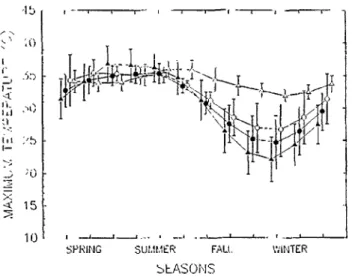
Fig. 3. The variation in mean monthly masimum temperatures at buffelgrass seeding sites in North American and where seed were originally collected in northcentral Kenya. Lines represent sites where the plant persists and spreads from a seeding (A), persists hut does not spread from a seeding @), dies (o), and where seed were originally collected in northcentral Kenya (A).
and physical soil properties where the species evolved in Africa are similar to where the species spreads in North America; with the exception of available phosphorus, which is consistently high- er in Kenya than North America. This verifies the hypothesis that soils in Kenya where T-4464 mother plants evolved are more similar to soils in North America where the plant spreads, than soils where plants either persist or die.
In Queensland, Australia the growth of buffelgrass plants on sandy red soils was delayed when available phosphorus (O.OlN H2S04 extractable) was less than 25 mg kg-‘, and when available phosphorus was limiting few plants survived drought (Christie 1975) Where buffelgrass spreads in North America and evolved in Kenya, available soil phosphorus varied from 0.1 to 26.4 mg kg’, averaged 13.1 mg kg*‘, and seldom exceeded 16.5 mg kg”.
Low available soil phosphorus in North American soils may limit buffelgrass productivity (Molina et al. 1976, Gonzales and Dodd 1979, Gonzales and Latigo 198 1) but concentrations below 0.1 mg kg-’ do not appear to impact the plant’s ability to either estab- lish from seed or survive.
Climatic Parameters
In North America, buffelgrass spreads where annual precipita- tion amounts range from 330 to 550 mm, and the species persists and dies when amounts range from 600 to 1,200 mm (Fig. 2).
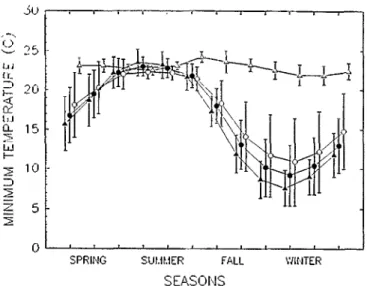
Buffelgrass seed from plants established on planted sites actively colonize adjacent nonplanted sites between Crystal City and Larado, Tex. and Carbo and Hermosillo, Mexico. At these loca- tions, summer rainfall varies from 170 to 400 mm and winter rainfall varies from 10 to 285 mm. Dry periods totaling 150 to 210 days occur in either winter or fall and spring, and mean max- imum and minimum temperatures in the coldest month range between 24 and 32. C (Fig. 3), and 5 and 15-C (Fig. 4), respec- tively.
Annual precipitation in northcentral Kenya varies from 200 to
400 mm, and is bimodally distributed in 2 summer growing sea-
sons (Fig. 2). Mean minimum and maximum temperatures annu-
Table 3. Disciminant function analyses statistics. hiodel I differentiates among sites where buffelgrass either spreads, persists or dies, and hlodel II differentiates between sites where the grass either spreads or dies.
Parameter F P Partial R2 Total R2
hlODEL I
Sand(B)atO-10cm 25.3 o.ooo1 0.6479 0.267
Total nitrogen (55,) at O-10 cm 13.9 O.oool 0.80 0.434 Clay (Q) at 20-30 cm x.2 0.0004 0.6146 0.539 Organic carbon (Q) at O-10 cm 6.3 0.0025 0.7934 0.622 Potassium (cm01 kg ‘) at O-30 cm 5.1 0.0072 0.4476 0.691 CEOCV (cm01 kg I) at O-30 cm’ 3.0 0.0222 0.0994 0.744
hlODEL II
Total nitrogen (%) at O-10 cm 30.7 OS@01 0.9488 0.242 hlran min. temperature (OC) 21.1 0.0601 0.734s 0.422
Sand(Q) at O-10 cm 18.9 0.0001 0.6517 0.5S6
Winter precipitation (mm) 15.5 0.0002 0.5144 0.725 Total precipitation (mm) 9.4 0.002s 0.8225 0.814
Sand (Q) at IO-20 cm s.0 0.0056 0.9447 0.x91
Calcium (cm01 kg ‘) at IO-20 cm 6.4 0.0129 0.4059 0.954
‘CEC = Cstion exchange capacity; CV = Coefticlent of wiation
ally vary from 21 to 24 C and 3 1 to 36 C (Figs. 3 and 4), respec- tively, and buffelgrass growth occurs whenever soil moisture is available (Cos et al. 198s). Temperature extremes in Texas and Mesico differ from those in northcentral Kenya but rainfall amount and distribution where the plant evolved in Africa are more similar to where the plant spreads, than where the plant per- sists or dies in North America.
Model Development
Comparisons of log-transformed means among soil depths within the 3 survival regimes indicate the importance of cation exchange capacity, organic carbon, total nitrogen, potassium, sand, silt, clay, silt plus clay, and magnesium when selecting buf- felgrass seeding sites. Climatic parameters influencing seedling persistence and spread were mean minimum temperature in the coldest month, summer precipitation, and total annual precipita- tion.
In Model I, plant survival among the 3 survival regimes was influenced by sand (%) at O-10 cm, total nitrogen (%) at O-10 cm, clay (%) at 20-30 cm, organic carbon (%) at O-10 cm, potassium (cmol kg-‘) at O-30 cm, and the cation exchange capacity (cmol kg-l) coefficient of variation at O-30 cm (Tables 3 and 4). The combined parameter group classified 78% of the seeding sites in the correct survival regime (overall Wilk’s lambda = 0.39, com- posite r’ = O.SO). Predictive equations for the 3 survival regimes were:
SPRING SUMiER FALL WINTER
SEASOI\IS
Fig. 4. The variation in mean monthly minimum temperatures at buffelgrass seeding sites in North America and where seed were originally collected in northcentral Africa. Lines represent sites where the plant persists and spreads from a seeding (A), persists but does not spread from a seeding (.), dies (o), and where seed were originally collected in northcentral Kenya (A).
spreads =- 3.01 + 1.61 (sand) + 1.0 (total nitrogen) + 0.84 (clay) - 1.0 (organic carbon) - 0.16 (potassium) - 0.05 (cation exchange capacity - coefficient of variation);
persists =+ 2.90 - 1.09 (sand) - 4.77 (total nitrogen) - 0.59 (clay) + 1.03 (organic carbon) + 0.82 (potassium) - 0.16 (cation exchange capacity - coefficient of variation);
dies = + 1.11 - 0.52 (sand) + 3.77 (total nitrogen) - 0.25 (clay) - 0.02 (organic carbon) - 0.66 (potassium) + 0.21 (cation exchange capacity - coefficient of variation).
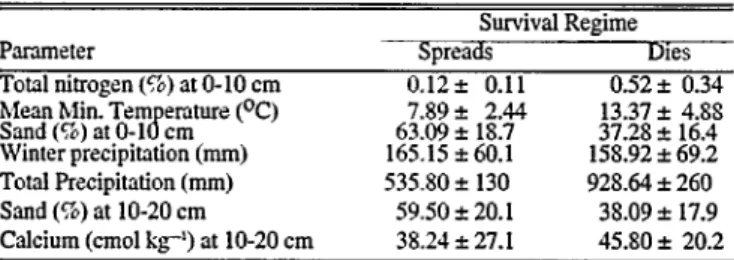
Due to data variability and overlapping values between survival regimes 1 and 2, and between survival regimes 2 and 3 we devel- oped Model II to differentiate between the spreads and dies regimes (Table 5). Plant survival between the 2 regimes was influenced by total nitrogen at O-10 cm, mean minimum tempera- ture in the coldest month (C), sand (%) at O-10 cm, winter pre- cipitation (mm), total annual precipitation (mm), sand (%) at lo- 20 cm, and calcium (cmol kg1 ) at lo-20 cm. The combined para- meter group classified SS% of the seeding sites in the correct sur- vival regime (overall Wilk’s lambda = 0.34, composite r’ = 0.82).
Predictive equations for the 2 survival regimes were:
spreads =- 0.82 - 3.22 (total nitrogen) + 1.37 (mean minimum temperature in the coldest month) + 2.41 (sand at O-10 Table 4. hleans and standard deviations for parameters in hlodel I that discriminate among seeding sites where buffelgrass either spreads, per&s or
dies.
Parameter Spreads
Sand (Q) at O-10 cm 63.092 IS.7
Total nitrogen (Q) at O-10 cm 0.122 0.11
Clay (Q) at 20-30 cm 26.90 + 12.8
Organic carbon (5%) at O-10 cm o.s4* 0.55 Potassium (cm01 kg-‘) at O-30 cm 0.76i 0.5 1 CEC-CV (cm01 kg I) at O-30 cm’ 14.54i14.5
‘CEC = Cation exchange capacity; CV = Coefficient of variation
Survival Regime Persists 41.61 k24.4
0.25i 0.23 35.78 A 17.6 2.19+ 2.32 1.39* 0.83 9.71 -c 7.45
Dies 37.28 f 16.4
0.52s~ 0.34
34.59 f 16.9
4.102 3.25
1.3s* 0.93
10.49 + 5.29
Table 5 Means and standard deviations for parameters in Model H that dIIrImInate between seeding sites where buffelgrass either spreads or dies.
Survival Regime
Parameter Spreads ies
Total nitrogen (8) at O-10 cm 0.;2* 0.11 0.52 f 0.34 M&anMrlltTl$nn~n,tue pc, 63.09 7.89 f * 18.7 2.44 37.28 13.37 f + 16.4 4.8s Winter precipitation (mm) 165.15 560.1 158.92 * 69.2 Total Precipitation (mm) 535.80 I 130 928.64 5 260
Sand (%) at lo-20 cm 59.50 + 20.1 38.09 + 17.9
Calcium (cm01 kg’) at lo-20 cm 3X.24 f 27.1 45.80 f 20.2
cm) + 0.88 (winter precipitation) - 1.21 (total precipita- tion) - 1.38 (sand at lo-20 cm) + 0.20 (calcium) dies =+ 1.82 + 3.22 (total nitrogen) - 1.37 (mean minimum tem-
perature in the coldest month) - 2.41 (sand at O-10 cm) - 0.80 (winter precipitation) + 1.21 (total precipitation) + 1.38 (sand at IO-20 cm) - 0.20 (calcium).
Our inability to measure freezing temperature impact on exposed T-4464 crowns may account for predictive differences (10%) between the 2 models. To illustrate freezing temperature importance, we will describe the fate of 4 T-4464 seeding sites in southern Arizona (unpublished data, USDA-Agricultural Research Service, Tucson, Ariz.). Soils at the 4 sites were similar in depth and classified as sandy loam, elevations varied from 1,100 to 1,125 m, and 3.0 kg ha-’ of T-4464 seed (PLS) was sown on disk plowed fields in July 1980. In summer 1981, plant densi- ties varied from 3 to 4 plants m-‘, and all sites were heavily grazed in summer-fall 1981 through 1985. Following a rapid drop in temperatures during mid-January 1986, plants at 2 sites died, and plants at 2 sites persisted. Where T-4464 died, temperatures at the crown base varied from 3 to 5 C for 4 hours. Where plants persisted, temperatures at the crown base varied form 3 to 5” C for 1.5 hours.
To generate predictions from discriminant function analyses models, all equations are solved using data from the potential seeding site. The prediction for a potential seeding site is from the equation where the solution is closest to 1.0. For example, if we solve for the 3 equations in Model I and generate values of 0.21, 0.817 and 0.01 for spreads, persists and dies, respectively, the model prediction is that T-4464 would persist.
Management Implications
Many range seeding failures occurred because land managers did not appreciate the importance of climate and soil to species adaptation. To emphasize this point, Cox et al. (1988) summa- rized rangeland revegetation techniques most frequently used in the past 100 years. The most widely used procedure has been to:
1) chemically or mechanically reduce competition, 2) prepare a seedbed, 3) plant seed of as many species, accessions or cultivars as possible, and 4) hope for rain. In about 1 of every 10 attempts, plants were successfully established but it was not possible to predict planting success at another site or estimate plant adapt- ability because climate and soils were not compared among sites.
To determine the importance of climate and soil on T-4464 buffelgrass survival, we classified 167 seeding sites into 3 sur- vival regimes. We conclude that planting success or failure can be predicted with selected climatic and soil parameters, and cli- matic and soil parameters where T-4464 seed was collected in
northcentral Kenya are more similar to where the species spreads than where it persists or dies in North America. Our results are practical and easily used by land managers who wish to masi- mize plant survival, and minimize soil erosion and economic loss.
Literature Cited
Agostini, JJ., J.A. Morales, and D. Enkerlin. 1981. Yield and quality of two hybrids of buffelgrass (Cenchrur ciliaris) damaged by different popu- lations of the spittlebug (Aneolumia albofascitu) and mites (Prosapia simu- luns). (In Spanish). Agronomia 200:42-47.
Agroclimatological Data for Africa. 1984. Rome, Italy. Food and Agriculture Organization of the United Nations.
Anderson, E.R. 1972. Emergence of buffelgrass (Cenchncr ciliuris) from seed after flooding. Queensland J. Agr. Anirn. Sci. 29:167-172.
Anderson, E.R 1974. The reaction of seven Cenchrus ciliuris L. cultivars to flooding. Trop. Grassl. 8:33-40.
Ball, D.E. 1964. Range seeding - Introduced grasses on rootplowed land in the northwest Rio Grande Plain. J. Range Manage. 17:217-220.
Bogdan, A.B 1961. Breeding behavior of Cetzchrus ciliuris in Kenya. East African Agr. and Forest. J. 26241.
Brzostowski, H.W. 1962. Influence of pH and superphosphate on establish- ment of Cenchncs ciliuris from seed. Trop. Agr. Trin. 39:259-296 Brzostowski, H.W., and MA. Owen. 1964. Botanical changes in a sown
pasture. Trop Agr. Trin. 41:231-242.
Christie, E.K. 1975. A study of phosphorus nutrition and water supply on the early growth and survival of buffelgrass grown on a sandy red earth from southwest Queensland. Australian J. Esp. Agr. and Anim. Husb. 15:239- 249.
Climatography of Mesico. 1982. Mexico City, Mexico. Nat. Meteorol. Serv.
(In Spanish).
Climatography of the United States. 1985. Ashville, N.C.: Nat. Oceanic and Atmospheric Admin.
Coaldrake, J.E., and MJ. Russell. 1969. Establishment and persistence of some legumes and grasses after ash seeding on newly burnt brigalow land.
Trop. Grassl. 3:49-55.
Cotn, A., and D. Johnson. 1975. Adaptation and production of ten perenni- al grass species in Sonora. (In Spanish). Pastizales-CI-MP-001. Chihuahua, Medco.
Cox, J.R, M.H. Martin-R, F.A. Ibarra-F, J.H. Fourie, N.F.G. Rethman, and D.G. Wilcos. 1988. The influence of climate and soils on the distribu- tion of four African grasses. J. Range Manage. 41:127-139.
Day, P.R 1950. Physical basis of particle size analysis by the hydrometer method. Soil Sci. 74:X l-86.
Du Toit, J., J.W. Rabie, and J.O. Gntnow. 1976. Nutrition and production studies on Cenchrus ciliuris L. cv. Molopo. Proc. Grass]. Sot. Sth. Afr.
8:107-115.
Ebersohn, J.P. 1970. Herbage production from native grasses and sown pas- tures in southwest Queensland. Trop. Grassl. 4~37-41.
FAO-UNESCO. 1975a. Food and Agricultural Organization of The United Nations. United Nations Educational, Scientific and Cultural Organization.
Soil map of the world Vol. III, Mesico and Central America.
FAO-UNESCO. 1975b. Food and Agricultural Organization of The United Nations. United Nations Educational, Scientific and Cultural Organization.
Soil map of the world Vol. II, North America.
FAO-UNESCO. 1977. Food and Agricultural Organization of The United Nations. United Nations Educational, Scientific and Cultural Organization.
Soil map of the world Vol. VI, Africa.
Gonzalez, C.L., and J.D. Dodd. 1979. Production response of native and introduced grasses to mechanical brush manipulation, seeding, and fertil- ization. J. Range Manage. 32~305-309.
Gonzalez, C.L., and G.V. Latigo. 1981. Rootplowing, front-end stacking, and seeding effects on herbaceous plant species composition. J. Range Manage. 34~460-465.
Hacker, J. B. 1989. The potential for buffelgrass renewal from seed in 16- year-old buffelgrass-siratro pastures in south-east Queensland. J. Appl.
Ecol. 26~213-222.
Hanselka, C. W. 1985. Grazing management strategies for buffelgrass, p. 53-
64. In: E.C.A. Runge, and J. L. Schuster (ed.). Buffelgrass: Adaptation, management and forage quality symposium: Texas Agr. Exp. Sta. MP-
1575. College Station, Tes.
Holt, E. C. 1985. Buffelgrass - A brief history, p. 1-5. In: E.C.A. Runge and J. L. Schuster (rd.), Buffelgrass: Adaptation, management and forage quah- ty symposium, Texas Agr. Exp. Sta. MP-1.575. College Station, Tex.
Humphreys, L. R 1967. Buffelgrass (Cenchrus ciliuris) in Australia. Trop.
Grassl. 1:123-134.
Jackson, hl. L. 1958. Soil chemical analysis. Prentice-Hill Inc., Englewood Cliffs. NJ.
Khan, S. M., and R hi. Zarif. 1982. Enhancing range productivity through grass seeding in subtropical semiarid shrublands near Pashawar. Pakistan J.
Forest. 32:S9-94.
hlannetje. L. t’., and R M. Jones. 1990. Pasture and animal productivity of buffelgmss with siratro, luceme or nitrogen fertilizer. Trop. Grassl. 24:269- 281.
Molina, S. I., T. R. Gana, and H. hf. Torres. 1976. Beef production on guinea and buffelgmss with two fertilizer rates, during one year in Tizimin, Yucatan. (In Spanish). Tecnica Pecuatia en Mexico. 31:17-21.
Olsen, S. R, and L. E. Sommers. 1982. Phosphorus. In: A. L. Page (rd.), Methods of Soil Analysis, Part II. American Society of Agronomy.
Madison, Wis.
SAS Institute Inc., 1988. SAS Procedures Guide, Release 6.03 Edition. SAS Institute Inc. Gary, N.C.
Silcock, R G., and F. T. Smith. 1990. Viable seed retention under field con- ditions by western Queensland pasture species. Trop. Grassl. 2465-74.
U. S. Salinity Laboratory Staff. 1954. Diagnosis and improvement of saline and alkaline soils. USDA, Agr. Handbook 60. Washington, D.C.
Walker, B., and E. J. Weston. 1990. Pasture development in Queensland - A success story. Trop. Grass]. 24257-268.
Wilson, R. G. 1964. Plowing buffel seedbeds on hard soils. Queensland Agr.
J. 90:256-288.
Winer, B.J. 1971. Statistical Concepts in Experimental Design. McGraw- Hill, N.Y.
Zar, J. H. 1984. Biostatistical analysis. Prentice Hall, N.J.
granite
@SFFr)
.I:
./’ l
Pasture & Range
l
Erosion Control
l
Alfalfa
l
Custom Seed Blends
l
Over 300 Species in Stock
l