Cross-Lingual Image Caption Generation
Takashi Miyazaki∗ Yahoo Japan Corporation
Tokyo, Japan
Nobuyuki Shimizu∗ Yahoo Japan Corporation
Tokyo, Japan
Abstract
Automatically generating a natural lan-guage description of an image is a fun-damental problem in artificial intelligence. This task involves both computer vision and natural language processing and is called “image caption generation.” Re-search on image caption generation has typically focused on taking in an image and generating a caption in English as ex-isting image caption corpora are mostly in English. The lack of corpora in languages other than English is an issue, especially for morphologically rich languages such as Japanese. There is thus a need for cor-pora sufficiently large for image caption-ing in other languages. We have developed a Japanese version of the MS COCO cap-tion dataset and a generative model based on a deep recurrent architecture that takes in an image and uses this Japanese ver-sion of the dataset to generate a caption in Japanese. As the Japanese portion of the corpus is small, our model was de-signed to transfer the knowledge represen-tation obtained from the English portion into the Japanese portion. Experiments showed that the resulting bilingual compa-rable corpus has better performance than a monolingual corpus, indicating that image understanding using a resource-rich lan-guage benefits a resource-poor lanlan-guage.
1 Introduction
Automatically generating image captions by de-scribing the content of an image using natural lan-guage sentences is a challenging task. It is es-pecially challenging for languages other than
En-∗∗Both authors contributed equally to this work.
glish due to the sparsity of annotated resources in the target language. A promising solution to this problem is to create a comparable corpus. To support the image caption generation task in Japanese, we have annotated images taken from the MS COCO caption dataset (Chen et al., 2015b) with Japanese captions. We call our corpus the “YJ Captions 26k Dataset.” While the size of our dataset is comparatively large with 131,740 captions, it greatly trails the 1,026,459 captions in the MS COCO dataset. We were thus moti-vated to transfer the resources in English (source language) to Japanese and thereby improve im-age caption generation in Japanese (target lan-guage). In natural language processing, a task in-volving transferring information across languages is known as a cross-lingual natural language task, and well known tasks include cross-lingual senti-ment analysis (Chen et al., 2015a), cross-lingual named entity recognition (Zirikly and Hagiwara, 2015), cross-lingual dependency parsing (Guo et al., 2015), and cross-lingual information retrieval (Funaki and Nakayama, 2015).
Existing work in the cross-lingual setting is usu-ally formulated as follows. First, to overcome the language barrier, create a connection between the source and target languages, generally by using a dictionary or parallel corpus. Second, develop an appropriate knowledge transfer approach to lever-age the annotated data from the source langulever-age for use in training a model in the target language, usually supervised or semi-supervised. These two steps typically amount to automatically generat-ing and expandgenerat-ing the pseudo-traingenerat-ing data for the target language by exploiting the knowledge ob-tained from the source language.
We propose a very simple approach to cross-lingual image caption generation: exploit the En-glish corpus to improve the performance of image caption generation in another language. In this
proach, no resources besides the images found in the corpus are used to connect the languages, and we consider our dataset to be a comparable cor-pus. Paired texts in a comparable corpus describe the same topic, in this case an image, but unlike a parallel corpus, the texts are not exact translations of each other. This unrestrictive setting enables the model to be used to create image caption re-sources in other languages. Moreover, this model scales better than creating a parallel corpus with exact translations of the descriptions.
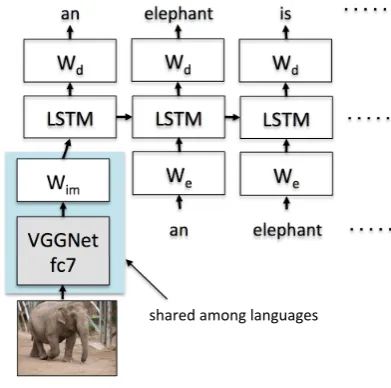
Our transfer model is very simple. We start with a neural image caption model (Vinyals et al., 2015) and pretrain it using the English portion of the corpus. We then remove all of the trained neu-ral network layers except for one crucial layer, the one closest to the vision system. Next we attach an untrained Japanese generation model and train it using the Japanese portion of the corpus. This results in improved generation in Japanese com-pared to using only the Japanese portion of the corpus. To the best of our knowledge, this is the first paper to address the problem of cross-lingual image caption generation.
Our contribution is twofold. First, we have cre-ated and plan to release the first ever significantly large corpus for image caption generation for the Japanese language, forming a comparable corpus with existing English datasets. Second, we have created a very simple model based on neural im-age caption generation for Japanese that can ex-ploit the English portion of the dataset. Again, we are the first to report results in cross-lingual im-age caption generation, and our surprisingly sim-ple method improves the evaluation metrics signif-icantly. This method is well suited as a baseline for future work on cross-lingual image caption gener-ation.
The paper is organized as follows. In the next section, we describe related work in image cap-tion generacap-tion and list the corpora currently avail-able for caption generation. Then in Section 3 we present the statistics for our corpus and explain how we obtained them. We then explain our model in Section 4 and present the results of our experi-mental evaluation in Section 5. We discuss the re-sults in Section 6, and conclude in Section 7 with a summary of the key points.
2 Related Work
Recent advances in computer vision research have led to halving the error rate between 2012 and 2014 at the Large Scale Visual Recognition Chal-lenge (Russakovsky et al., 2015), largely driven by the adoption of deep neural networks (Krizhevsky et al., 2012; Simonyan and Zisserman, 2014; Don-ahue et al., 2014; Sharif Razavian et al., 2014). Similarly, we have seen increased adaptation of deep neural networks for natural language pro-cessing. In particular, sequence-to-sequence train-ing ustrain-ing recurrent neural networks has been suc-cessfully applied to machine translation (Cho et al., 2014; Bahdanau et al., 2015; Sutskever et al., 2014; Kalchbrenner and Blunsom, 2013).
These developments over the past few years have led to renewed interest in connecting vision and language. The encoder-decoder framework (Cho et al., 2014) inspired the development of many methods for generating image captions since generating an image caption is analogous to trans-lating an image into a sentence.
Since 2014, many research groups have re-ported a significant improvement in image caption generation due to using a method that combines a convolutional neural network with a recurrent neural network. Vinyals et al. used a convolu-tional neural network (CNN) with inception mod-ules for visual recognition and long short-term memory (LSTM) for language modeling (Vinyals et al., 2015). Xu et al. introduced an attention mechanism that aligns visual information and sen-tence generation for improving captions and un-derstanding of model behavior (Xu et al., 2015). The interested reader can obtain further informa-tion elsewhere (Bernardi et al., 2016).
These developments were made possible due to a number of available corpora. The following is a list of available corpora that align images with crowd-sourced captions. A comprehensive list of other kinds of corpora connecting vision and lan-guage, e.g., visual question answering, is available elsewhere (Ferraro et al., 2015).
1. UIUC Pascal Dataset (Farhadi et al., 2010) includes 1,000 images with 5 sentences per image; probably one of the first datasets. 2. Abstract Scenes Dataset (Clipart) (Zitnick et
3. Flickr 30K Images (Young et al., 2014) ex-tends Flickr datasets (Rashtchian et al., 2010) and contains 31,783 images of people in-volved in everyday activities.
4. Microsoft COCO Dataset (MS COCO) (Lin et al., 2014; Chen et al., 2015b) includes about 328,000 images of complex everyday scenes with common objects in naturally oc-curring contexts. Each image is paired with five captions.
5. Japanese UIUC Pascal Dataset (Funaki and Nakayama, 2015) is a Japanese translation of the UIUC Pascal Dataset.
To the best of our knowledge, there are no large datasets for image caption generation except for English. With the release of the YJ Captions 26k dataset, we aim to remedy this situation and thereby expand the research horizon by exploiting the availability of bilingual image caption corpora.
3 Statistics for Data Set
In this section we describe the data statistics and how we gathered data for the YJ Captions 26k dataset. For images, we used the Microsoft COCO dataset (Chen et al., 2015b). The images in this dataset were gathered by searching for pairs of 80 object categories and various scene types on Flickr. They thus tended to contain multiple ob-jects in their natural context. Obob-jects in the scene were labeled using per-instance segmentations. This dataset contains pictures of 91 basic object types with 2.5 million labeled instances. To collect Japanese descriptions of the images, we used Ya-hoo! Crowdsourcing1, a microtask crowdsourcing
service operated by Yahoo Japan Corporation. Given 26,500 images taken from the train-ing part of the MS COCO dataset, we collected 131,740 captions in total. The images had on av-erage 4.97 captions; the maximum number was 5 and the minimum was 3. On average, each caption had 23.23 Japanese characters. We plan to release the YJ Captions 26k dataset2.
3.1 Crowdsourcing Procedure
Our captions were human generated using Yahoo! Crowdsourcing. As this crowdsourcing platform is operated in Japan, signing up for the service and participating require Japanese proficiency. Thus,
1http://crowdsourcing.yahoo.co.jp
[image:3.595.312.514.68.313.2]2http://research-lab.yahoo.co.jp/software/index.html
Figure 1: User Interface
we assumed that the participants were fluent in Japanese.
First, we posted a pilot task that asked the par-ticipants to describe an image. We then exam-ined the results and selected promising partici-pants (comprising a “white list”) for future task re-quests. That is, only the participants on the white list could see the next task. This selection pro-cess was repeated, and the final white list included about 600 participants. About 150 of them regu-larly participated in the actual image caption col-lection task. We modified the task request page and user interface on the basis of our experience with the pilot task. In order to prevent their fa-tigue, the tasks were given in small batches so that the participants were unable to work over long hours.
crowds are shown pictures with scenery in the US or Europe in MS-COCO dataset, the scenes them-selves appear exotic and words such as ‘foreign’ and ‘oversea’ would be everywhere in the descrip-tions. As such words are not common in the orig-inal dataset, and to make the corpus nicer comple-ment to the English dataset and to reduce the ef-fects of such cultural bias, we modified the instruc-tions: “2. Please give only factual statements”; “3. Please do not specify place names or nation-alities.” We also strengthened two sections in the task request page and added more examples.
The interface is shown in Figure 1. The instruc-tions in the user interface can be translated into English as “Please explain the image using 16 or more Japanese characters. Write a single sentence as if you were writing an example sentence to be included in a textbook for learning Japanese. De-scribe all the important parts of the scene; do not describe unimportant details. Use correct punctu-ation. Write a single sentence, not multiple sen-tences or a phrase.”
Potential participants are shown task request pages, and the participants select which crowd-sourcing task(s) to perform. The task request page for our task had the following instructions (En-glish translation):
1. Please explain an image using 16 or more Japanese characters. Please write a single sentence as if you were writing an example sentence to be included in a textbook for learning Japanese.
(a) Do not use incorrect Japanese.
(b) Use a polite style of speech (desu/masustyle) as well as correct punctuation.
(c) Write a single complete sentence that ends with a period. Do not write just a phrase or multiple sentences.
2. Please give only factual statements.
(a) Do not write about things that might have hap-pened or might happen in the future. Do not write about sounds.
(b) Do not speculate. Do not write about something about which you feel uncertain.
(c) Do not state your feelings about the scene in the picture. Do not use an overly poetic style. (d) Do not use a demonstrative pronoun such as
’this’ or ’here.’
3. Please do not specify place names or nationalities. (a) Please do not give proper names.
4. Please describe all the important parts of the scene; do not describe unimportant details.
Together with the instructions, we provided 15 examples (1 good example; 14 bad examples).
Upon examining the collected data, manual checks of first 100 images containing 500 captions revealed that 9 captions were clearly bad, and 12
captions had minor problems in descriptions. In order to further improve the quality of the corpus, we crowdsourced a new data-cleaning task. We showed each participant an image and five cap-tions that describe the image and asked to fix them. The following is the instructions (English trans-lation) for the task request page for our data-cleaning task.
1. There are five sentences about a hyper-linked image, and several sentences require fixes in order to satisfy the conditions below. Please fix the sentences, and while doing so, tick a checkbox of the item (condition) being fixed.
2. The conditions that require fixes are:
(a) Please fix typographical errors, omissions and input-method-editor conversion misses. (b) Please remove or rephrase expressions such as
‘oversea’, ‘foreign’ and ‘foreigner.’
(c) Please remove or rephrase expressions such as ‘image’, ‘picture’ and ‘photographed.’
(d) Please fix the description if it does not match the contents of the image.
(e) Please remove or rephrase subjective expressions and personal impressions.
(f) If the statement is divided into several sentences, please make it one sentence.
(g) If the sentence is in a question form, please make it a declarative sentence.
(h) Please rewrite the entire sentence if meeting all above conditions requires extensive modifica-tions.
(i) If there are less than 16 characters, please pro-vide additional descriptions so that the sentence will be longer than 16 characters.
For each condition, we provided a pair of exam-ples (1 bad example and 1 fixed example).
To gather participants for the data-cleaning task, we crowdsourced a preliminary user qualification task that explained each condition requiring fixes in the first half, then quizzed the participants in the second half. This time we obtained over 900 qualified participants. We posted the data-cleaning task to these qualified participants.
The interface is shown in Figure 2. The instruc-tions in the user interface are very similar to the task request page, except that we have an addi-tional checkbox:
(j) All conditions are satisfied and no fixes were necessary. We provided these checkboxes to be used as a checklist, so as to reduce failure by compensating for potential limits of participants’ memory and at-tention, and to ensure consistency and complete-ness in carrying out the data-cleaning task.
Figure 2: Data Cleaning Task User Interface
45,909. To our surprise, a relatively large por-tion of the cappor-tions were fixed by the participants. We suspect that in our data-cleaning task, the con-dition (e) was especially ambiguous for the par-ticipants, and they errored on the cautious side, fixing “a living room” to just “a room”, thinking that a room that looks like a living room may not be a living room for the family who occupies the house, for example. Another example includes fix-ing “beautiful flowers” to just “flowers” because beauty is in the eye of the beholder and thought to be subjective. The percentage of the ticked checkboxes is as follows: (a) 27.2%, (b) 5.0%, (c) 12.3%, (d) 34.1%, (e) 28.4%, (f) 3.9%, (g) 0.3%, (h) 11.6%, (i) 18.5%, and (j) 24.0%. Note that a checkbox is ticked if there is at least one sentence
out of five that meets the condition. In machine learning, this setting is called multiple-instance multiple-label problem (Zhou et al., 2012). We cannot directly infer how many captions corre-spond to a condition ticked by the participants.
After this data-cleaning task, we further re-moved a few more bad captions that came to our attention. The resulting corpus finally contains 131,740 captions as noted in the previous section.
4 Methodology
!"#$! !"#$!
%&'( %)(
%*(
+,,-*.( /01!
%)(
!"#$!
%*(
%)(
23! 23! *4*5623.!
*4*5623.! &7!
[image:5.595.317.513.226.420.2]7628*)(2'93:(423:;2:*7!
Figure 3: Model Overview
4.1 Model Overview
Figure 3 shows an overview of our model. Follow-ing the approach of Vinyals et al. (Vinyals et al., 2015), we used a discriminative model that max-imizes the probability of the correct description given the image. Our model is formulated as
θ∗ = arg max
θ
∑
(I,S)
N
∑
t=0
logp(St|I, S0, ..., St−1;θ), (1)
where the first summation is over pairs of an im-age I and its correct transcriptionS. For the sec-ond summation, the sum is over all wordsStinS,
andN is the length ofS. θrepresents the model parameters. Note that the second summation rep-resents the probability of the sentence with respect to the joint probability of its words.
We modeledp(St|I, S0, ..., St−1;θ)by using a recurrent neural network (RNN). To model the se-quences in the RNN, we let a fixed length hidden state or memory ht express the variable number
is updated after obtaining a new inputxtusing a
non-linear function f, so that ht+1 = f(ht, xt).
Since an LSTM network has state-of-the art per-formance in sequence modeling such as machine translation, we use one forf, which we explain in the next section.
A combination of LSTM and CNN are used to modelp(St|I, S0, ..., St−1;θ).
x−1 = WimCNN(I) (2)
xt = WeSt, t∈ {0...N−1} (3)
pt+1 = Softmax(WdLST M(xt)),
t∈ {0...N−1} (4)
whereWimis an image feature encoding matrix,
Weis a word embedding matrix, andWdis a word
decoding matrix.
4.2 LSTM-based Language Model
An LSTM is an RNN that addresses the vanish-ing and explodvanish-ing gradients problem and that han-dles longer dependencies well. An LSTM has a memory cell and various gates to control the in-put, the outin-put, and the memory behaviors. We use an LSTM with input gateit, input modulation
gategt, output gateot, and forgetting gateft. The
number of hidden units ht is 256. At each time
stept, the LSTM statect,htis as follows:
it = σ(Wixxt+Wihht−1+bi) (5)
ft = σ(Wfxxt+Wfhht−1+bf) (6)
ot = σ(Woxxt+Wohht−1+bo) (7)
gt = ϕ(Wcxxt+Wchht−1+bc) (8)
ct = ft⊙ct−1+it⊙gt (9)
ht = ot⊙ϕ(ct), (10)
whereσ(x) = (1 +e−x)−1is a sigmoid function, ϕ(x) = (ex−e−x)/(ex +e−x) is a hyperbolic
tangent function, and⊙denotes the element-wise product of two vectors.W andbare parameters to be learned. From the values of the hidden unitsht,
the probability distribution of words is calculated as
pt+1=Softmax(Wdht). (11)
We use a simple greedy search to generate cap-tions as a sequence of words, and, at each time stept, the predicted word is obtained usingSt =
arg maxSpt.
4.3 Image Feature Extraction with Deep Convolutional Neural Network
The image recognition performance of deep con-volutional neural network models has rapidly ad-vanced in recent years, and they are now widely used for various image recognition tasks. We used a 16-layer VGGNet (Simonyan and Zisser-man, 2014), which was a top performer at the Im-ageNet Large Scale Visual Recognition Challenge in 2014. A 16-layer VGGNet is composed of 13 convolutional layers having small 3x3 filter ker-nels and 3 fully connected layers. An image fea-ture is extracted as a 4096-dimensional vector of the VGGNet’s fc7 layer, which is the second fully connected layer from the output layer. VGGNet was pretrained using the ILSVRC2014 subset of the ImageNet dataset, and its weights were not up-dated through training.
4.4 Dataset Split
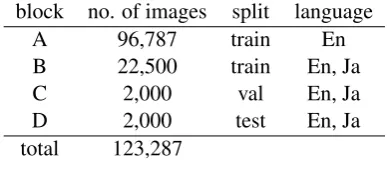
Because our caption dataset is annotated for only 26,500 images of the MS COCO training set, we reorganized the dataset split for our experi-ments. Training and validation set images of the MS COCO dataset were mixed and split into four blocks, and these blocks were assigned to training, validation, and testing as shown in Table 1. All blocks were used for the English caption dataset. Blocks B, C, and D were used for the Japanese caption dataset.
block no. of images split language
A 96,787 train En
B 22,500 train En, Ja
C 2,000 val En, Ja
D 2,000 test En, Ja
[image:6.595.319.513.487.573.2]total 123,287
Table 1: Dataset Split
4.5 Training
image caption generation, we used three learning schemes.
Monolingual learning This was the base-line method. The model had only one LSTM for Japanese caption generation, and only the Japanese caption corpus was used for training.
Alternate learningIn this scheme, a model had two LSTMs, one for English and one for Japanese. The training batches for captions contained either English or Japanese, and the batches were fed into the model alternating between English and Japanese.
Transfer learning A model with one LSTM was trained completely for the English dataset. The trained LSTM was then removed, and another LSTM was added for Japanese caption genera-tion. Wim was shared between the English and
Japanese training.
These models were implemented using the Chainer neural network framework (Tokui et al., 2015). We consulted NeuralTalk (Karpathy, 2014), an open source implemenation of neural network based image caption generation system, for training parameters and dataset preprocessing. Training took about one day using NVIDIA TI-TAN X/Tesla M40 GPUs.
5 Evaluation
0 10000 20000 30000 40000 50000
No. of iterations
0.1 0.2 0.3 0.4 0.5 0.6 0.7
CID
Er
[image:7.595.75.282.462.604.2]transfer
monolingual
alternate
Figure 4: Learning Curve Represented by CIDEr Score
5.1 Evaluation Metrics
We used six standard metrics for evaluating the quality of the generated Japanese sentences: BLEU-1, BLEU-2, BLEU-3, BLEU-4 (Papineni et al., 2002), ROUGE-L (Lin, 2004), and CIDEr-D (Vedantam et al., 2014). We used the COCO cap-tion evaluacap-tion tool (Chen et al., 2015b) to
com-pute the metrics. BLEU (Papineni et al., 2002) was originally designed for automatic machine translation. By counting n-gram co-occurrences, it rates the quality of a translated sentence given sev-eral reference sentences. To apply BLEU, we con-sidered that generating image captions is the same as translating images into sentences. ROUGE (Lin, 2004) is an evaluation metric designed by adapting BLEU to evaluate automatic text sum-marization algorithms. ROUGE is based on the longest common subsequences instead of n-grams. CIDEr (Vedantam et al., 2014) is a metric devel-oped specifically for evaluating image captions. It measures consensus in image captions by per-forming a term-frequency inverse document fre-quency (TF-IDF) weighting for each n-gram. We used a robust variant of CIDEr called CIDEr-D. For all evaluation metrics, higher scores are better. In addition to these metrics, MS COCO caption evaluation (Chen et al., 2015b) uses METEOR (Lavie, 2014), another metric for evaluating auto-matic machine translation. Although METEOR is a good metric, it uses an English thesaurus. It was not used in our study due to the lack of a thesaurus for the Japanese language.
The CIDEr and METEOR metrics perform well in terms of correlation with human judgment (Bernardi et al., 2016). Although BLEU is unable to sufficiently discriminate between judgments, we report the BLEU figures as well since their use in literature is widespread. In the next section, we focus our analysis on CIDEr.
0 5000 10000 15000 20000 25000
No. of images (Ja)
0.40 0.45 0.50 0.55 0.60 0.65
CIDE
r
transfer
monolingual
Figure 5: CIDEr Score vs. Japanese Data Set Size
5.2 Results
[image:7.595.309.515.520.655.2]gener-no. of images metrics
En Ja BLEU-1 BLEU-2 BLEU-3 BLEU-4 ROUGE-L CIDEr-D
monolingual 0 22,500 0.715 0.573 0.468 0.379 0.616 0.580
alternate 119,287 22,500 0.709 0.565 0.460 0.370 0.611 0.568
[image:8.595.77.540.63.132.2]transfer 119,287 22,500 0.717 0.574 0.469 0.380 0.619 0.625
Table 2: Evaluation Metrics
ated for test set images. Our proposed model is la-beled “transfer.” As you can see, it outperformed the other two models for every metric. In par-ticular, the CIDEr-D score was about 4% higher than that for the monolingual baseline. The per-formance of a model trained using the English and Japanese corpora alternately is shown on the line label “alternate.” Surprisingly, this model had lower performance than the baseline model.
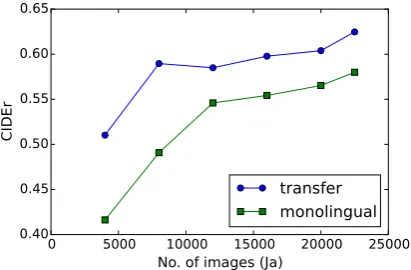
In Figure 4, we plot the learning curves rep-resented by the CIDEr score for the Japanese captions generated for the validation set images. Transfer learning from English to Japanese con-verged faster than learning from the Japanese dataset or learning by training from both lan-guages alternately. Figure 5 shows the relation-ship between the CIDEr score and the Japanese dataset size (number of images). The models pretrained using English captions (blue line) out-performed the ones trained using only Japanese captions for all training dataset sizes. As can be seen by comparing the case of 4,000 im-ages with that of 20,000 imim-ages, the improvement due to cross-lingual transfer was larger when the Japanese dataset was smaller. These results show that pretraining the model with all available En-glish captions is roughly equivalent to training the model with captions for 10,000 additional images in Japanese. This, in our case, nearly halves the cost of building the corpus.
Examples of machine-generated captions along with the crowd-written ground truth captions (En-glish translations) are shown in Figure 6.
6 Discussion
Despite our initial belief, training by alternating English and Japanese input batch data for learning both languages did not work well for either guage. As Japanese is a morphologically rich lan-guage and word ordering is subject-object-verb, it is one of most distant languages from English. We suspect that the alternating batch training inter-fered with learning the syntax of either language.
Moreover, when we tried character-based models for both languages, the performance was signif-icantly lower. This was not surprising because one word in English is roughly two characters in Japanese, and presumably differences in the lan-guage unit should affect performance. Perhaps not surprisingly, cross-lingual transfer was more ef-fective when the resources in the target language are poor. Convergence was faster with the same amount of data in the target language when pre-training in the source language was done ahead of time. These two findings ease the burden of devel-oping a large corpus in a resource poor language.
7 Conclusion
We have created an image caption dataset for the Japanese language by collecting 131,740 captions for 26,500 images using the Yahoo! Crowdsourc-ing service in Japan. We showed that pretrainCrowdsourc-ing a neural image caption model with the English por-tion of the corpus improves the performance of a Japanese caption generation model subsequently trained using Japanese data. Pretraining the model using the English captions of 119,287 images was roughly equivalent to training the model using the captions of 10,000 additional images in Japanese. This, in our case, nearly halves the cost of building a corpus. Since this performance gain is obtained without modifying the original monolingual image caption generator, the proposed model can serve as a strong baseline for future research in this area. We hope that our dataset and proposed method kick start studies on cross-lingual image caption generation and that many others follow our lead.
References
Dzmitry Bahdanau, Kyunghyun Cho, and Yoshua Ben-gio. 2015. Neural machine translation by jointly learning to align and translate. InInternational Con-ference on Learning Representation (ICLR). Raffaella Bernardi, Ruket Cakici, Desmond Elliott,
2016. Automatic description generation from im-ages: A survey of models, datasets, and evaluation measures. arXiv preprint arXiv:1601.03896. Qiang Chen, Wenjie Li, Yu Lei, Xule Liu, and
Yanxi-ang He. 2015a. Learning to adapt credible
knowl-edge in cross-lingual sentiment analysis. In
Pro-ceedings of the 53rd Annual Meeting of the Associ-ation for ComputAssoci-ational Linguistics and the 7th In-ternational Joint Conference on Natural Language Processing (Volume 1: Long Papers), pages 419– 429, Beijing, China, July. Association for Computa-tional Linguistics.
Xinlei Chen, Tsung-Yi Lin Hao Fang, Ramakr-ishna Vedantam, Saurabh Gupta, Piotr Dollr, and C. Lawrence Zitnick. 2015b. Microsoft coco cap-tions: Data collection and evaluation server. arXiv preprint arXiv:1504.00325.
Kyunghyun Cho, Bart van Merrienboer, Caglar Gul-cehre, Dzmitry Bahdanau, Fethi Bougares, Holger Schwenk, and Yoshua Bengio. 2014. Learning phrase representations using rnn encoder–decoder for statistical machine translation. InProceedings of the 2014 Conference on Empirical Methods in Nat-ural Language Processing (EMNLP), pages 1724– 1734, Doha, Qatar, October. Association for Com-putational Linguistics.
Jeff Donahue, Yangqing Jia, Oriol Vinyals, Judy Hoff-man, Ning Zhang, Eric Tzeng, and Trevor Darrell. 2014. Decaf: A deep convolutional activation fea-ture for generic visual recognition. InInternational Conference in Machine Learning (ICML).
Ali Farhadi, Mohsen Hejrati, Mohammad Amin Sadeghi, Peter Young, Cyrus Rashtchian, Julia Hockenmaier, and David Forsyth. 2010. Every pic-ture tells a story: Generating sentences from images. InProceedings of the 11th European Conference on Computer Vision: Part IV, ECCV’10, pages 15–29, Berlin, Heidelberg. Springer-Verlag.
Francis Ferraro, Nasrin Mostafazadeh, Ting-Hao Huang, Lucy Vanderwende, Jacob Devlin, Michel Galley, and Margaret Mitchell. 2015. A survey of current datasets for vision and language research. In Proceedings of the 2015 Conference on Empiri-cal Methods in Natural Language Processing, pages 207–213, Lisbon, Portugal, September. Association for Computational Linguistics.
Ruka Funaki and Hideki Nakayama. 2015. Image-mediated learning for zero-shot cross-lingual
doc-ument retrieval. In Proceedings of the 2015
Con-ference on Empirical Methods in Natural Lan-guage Processing, pages 585–590, Lisbon, Portugal, September. Association for Computational Linguis-tics.
Jiang Guo, Wanxiang Che, David Yarowsky, Haifeng Wang, and Ting Liu. 2015. Cross-lingual depen-dency parsing based on distributed representations. In Proceedings of the 53rd Annual Meeting of the
Association for Computational Linguistics and the 7th International Joint Conference on Natural Lan-guage Processing (Volume 1: Long Papers), pages 1234–1244, Beijing, China, July. Association for Computational Linguistics.
Nal Kalchbrenner and Phil Blunsom. 2013. Recurrent
continuous translation models. In Proceedings of
the 2013 Conference on Empirical Methods in Natu-ral Language Processing, pages 1700–1709, Seattle, Washington, USA, October. Association for Compu-tational Linguistics.
Andrej Karpathy. 2014. Neuraltalk. https://
github.com/karpathy/neuraltalk.
Alex Krizhevsky, Ilya Sutskever, and Geoffrey E. Hin-ton. 2012. Imagenet classification with deep con-volutional neural networks. In F. Pereira, C.J.C. Burges, L. Bottou, and K.Q. Weinberger, editors,
Advances in Neural Information Processing Systems 25, pages 1097–1105. Curran Associates, Inc. Michael Denkowski Alon Lavie. 2014. Meteor
univer-sal: Language specific translation evaluation for any target language. ACL 2014, page 376.
Tsung-Yi Lin, Michael Maire, Serge Belongie, James Hays, Pietro Perona, Deva Ramanan, Piotr Doll´ar,
and C. Lawrence Zitnick, 2014. Computer Vision
– ECCV 2014: 13th European Conference, Zurich, Switzerland, September 6-12, 2014, Proceedings, Part V, chapter Microsoft COCO: Common Objects in Context, pages 740–755. Springer International Publishing, Cham.
Chin-Yew Lin. 2004. Rouge: A package for
auto-matic evaluation of summaries. Text summarization
branches out: Proceedings of the ACL-04 workshop, 8.
Kishore Papineni, Salim Roukos, Todd Ward, and Wei-Jing Zhu. 2002. Bleu: A method for automatic
evaluation of machine translation. InProceedings
of the 40th Annual Meeting on Association for Com-putational Linguistics, ACL ’02, pages 311–318, Stroudsburg, PA, USA. Association for Computa-tional Linguistics.
Cyrus Rashtchian, Peter Young, Micah Hodosh, and Julia Hockenmaier. 2010. Collecting image
annota-tions using amazon’s mechanical turk. In
Proceed-ings of the NAACL HLT 2010 Workshop on Creating Speech and Language Data with Amazon’s Mechan-ical Turk, CSLDAMT ’10, pages 139–147, Strouds-burg, PA, USA. Association for Computational Lin-guistics.
Olga Russakovsky, Jia Deng, Hao Su, Jonathan Krause, Sanjeev Satheesh, Sean Ma, Zhiheng Huang, An-drej Karpathy, Aditya Khosla, Michael Bernstein, Alexander C. Berg, and Li Fei-Fei. 2015. Ima-geNet Large Scale Visual Recognition Challenge.
Ali Sharif Razavian, Hossein Azizpour, Josephine Sul-livan, and Stefan Carlsson. 2014. Cnn features off-the-shelf: An astounding baseline for recognition. In The IEEE Conference on Computer Vision and Pattern Recognition (CVPR) Workshops, June.
K. Simonyan and A. Zisserman. 2014. Very deep con-volutional networks for large-scale image recogni-tion. CoRR, abs/1409.1556.
Ilya Sutskever, Oriol Vinyals, and Quoc VV Le. 2014. Sequence to sequence learning with neural
net-works. InAdvances in neural information
process-ing systems, pages 3104–3112.
T. Tieleman and G. Hinton. 2012. Lecture 6.5— RmsProp: Divide the gradient by a running average of its recent magnitude. COURSERA: Neural Net-works for Machine Learning.
Seiya Tokui, Kenta Oono, Shohei Hido, and Justin Clayton. 2015. Chainer: a next-generation open
source framework for deep learning. InProceedings
of Workshop on Machine Learning Systems (Learn-ingSys) in The Twenty-ninth Annual Conference on Neural Information Processing Systems (NIPS).
Ramakrishna Vedantam, C Lawrence Zitnick, and
Devi Parikh. 2014. Cider: Consensus-based
image description evaluation. arXiv preprint
arXiv:1411.5726.
Oriol Vinyals, Alexander Toshev, Samy Bengio, and Dumitru Erhan. 2015. Show and tell: A neural
im-age caption generator. InThe IEEE Conference on
Computer Vision and Pattern Recognition (CVPR), June.
Kelvin Xu, Jimmy Ba, Ryan Kiros, Kyunghyun Cho, Aaron Courville, Ruslan Salakhutdinov, Richard Zemel, and Yoshua Bengio. 2015. Show, attend and tell: Neural image caption generation with visual at-tention. arXiv preprint arXiv:1502.03044.
Peter Young, Alice Lai, Micah Hodosh, and Julia Hockenmaier. 2014. From image descriptions to visual denotations: New similarity metrics for
se-mantic inference over event descriptions.
Transac-tions of the Association for Computational Linguis-tics, 2:67–78.
Zhi-Hua Zhou, Min-Ling Zhang, Sheng-Jun Huang, and Yu-Feng Li. 2012. Multi-instance multi-label learning.Artificial Intelligence, 176(1):2291–2320.
Ayah Zirikly and Masato Hagiwara. 2015. Cross-lingual transfer of named entity recognizers without parallel corpora. InProceedings of the 53rd Annual Meeting of the Association for Computational Lin-guistics and the 7th International Joint Conference on Natural Language Processing (Volume 2: Short Papers), pages 390–396, Beijing, China, July. Asso-ciation for Computational Linguistics.
C.L. Zitnick, D. Parikh, and L. Vanderwende. 2013. Learning the visual interpretation of sentences. In