Transition-based dependency parsing with topological fields
Dani¨el de Kok and Erhard Hinrichs Seminar f¨ur Sprachwissenschaft
Wilhemstraße 19 72072, T¨ubingen, Germany
{daniel.de-kok,erhard.hinrichs}@uni-tuebingen.de
Abstract
The topological field model is commonly used to describe the regularities in German word order. In this work, we show that topological fields can be predicted reliably using sequence labeling and that the pre-dicted field labels can inform a transition-based dependency parser.
1 Introduction
The topological field model (Herling, 1821; Erd-mann, 1886; Drach, 1937; H¨ohle, 1986) has tra-ditionally been used to account for regularities in word order across different clause types of Ger-man. This model assumes that each clause type contains a left bracket (LK) and a right bracket
(RK), which appear to the left and the right of the
middle field(MF). Additionally, in a verb-second declarative clause, the LK is preceded by the ini-tial field(VF) with the RK optionally followed by the final field (NF).1 Table 1 gives examples of topological fields in verb-second declarative (MC) and verb-final relative (RC) clauses.
Certain syntactic restrictions can be described in terms of topological fields. For instance, only a single constituent is typically allowed in the VF, while multiple constituents are allowed in the MF and the NF. Many ordering preferences can also be stated using the model. For example, in a main clause, placing the subject in the VF and the direct object in the MF is preferred over the opposite or-der.
In parsing, topological field analysis is often seen as a task that is embedded in parsing itself. For instance, K¨ubler (2005), Maier (2006), and Cheung and Penn (2009) train PCFG parsers on
1The abbreviations are derived from the German terms
linke Klammer, rechte Klammer, Mittelfeld, Vorfeld, and Nachfeld.
treebanks that annotate topological fields as inte-rior nodes. It is perhaps not surprising that this ap-proach works effectively for phrase structure pars-ing, because topological fields favor annotations that do not rely on crossing or discontinuous de-pendencies (Telljohann et al., 2006).
However, the possible role of topological fields in statistical dependency parsing (K¨ubler et al., 2009) has not been explored much. We will show that statistical dependency parsing of German can benefit from knowledge of clause structure as pro-vided by the topological field model.
2 Motivation and corpus analysis
Transition-based dependency parsers (Nivre, 2003; K¨ubler et al., 2009) typically use two tran-sitions (LEFT ARCand RIGHT ARC) to introduce
a dependency relation between the token that is on top of the processing stack and the next token on the buffer of unprocessed tokens. The decision to make an attachment, the direction of attachment, and the label of the attachment is made by a classifier. Consequently, a good classifier is tasked to learn syntactic constraints, ordering preferences, and selectional preferences.
Since transition-based dependency parsers pro-cess sentences in one deterministic linear-time left-to-right sweep, the classifier typically has lit-tle global information. One popular approach for reducing the effect of early attachment er-rors is to retain some competition between alter-native parses using a globally optimized model with beam search (Zhang and Clark, 2008). Beam search presents a trade-off between speed (smaller beam) and higher accuracy (larger beam). More recently, Dyer et al. (2015) have proposed to use Long short-term memory networks (LSTMs) to maintain (unbounded) representations of the buffer of unprocessed words, previous parsing
VF LK MF RK NF
MC: In Tansania ist das Rad mehr verbreitet als in Uganda In Tansania is the bike more common than in Uganda RC: der f¨unfmal mehr nach Bremerhaven liefert als Daewoo
[image:2.595.90.506.61.131.2]who five-times more to Bremerhaven delivers than Daewoo Table 1: Topological fields of a verb-second clause and a verb-final clause.
tions, and constructed tree fragments.
We believe that in the case of German, the topo-logical field model can provide a linguistically-motivated approach for providing the parser with more global knowledge of the sentence structure. More concretely, if we give the transition classi-fier access to topological field annotations, it can learn regularities with respect to the fields wherein the head and dependent of a particular dependency relations lie.
In the remainder of this section, we provide a short (data-driven) exploration of such regulari-ties. Since there is a myriad of possible triples2 consisting of relation, head field, and dependent field, we will focus on dependency relations that virtually never cross a field and relations that nearly always cross a field.
Table 2 lists the five dependency relation that cross fields the least often in the T¨uBa-D/Z tree-bank (Telljohann et al., 2006; Versley, 2005) of German newspaper text. Using these statistics, a classifier could learn hard constraints with regard to these dependency relations — they should never be used to attach heads and dependents that are in different fields.
Dependency label Cross-field (%)
Particles 0.00
Determiner 0.03
Adjective or attr. pronoun 0.04 Prepositional complement 0.04 Genetive attribute 0.07
Table 2: The five dependency relations that most rarely cross fields in the T¨uBa-D/Z.
Table 3 lists the five dependency relations that cross fields most frequently.3 These relations (vir-tually) always cross fields because they are verbal attachments and verbs typically form the LK and RK. This information is somewhat informative,
2335 in the T¨uBa-D/Z treebank.
3Dependency relations that connect two clauses are ex-cluded.
since a classifier should clearly avoid to attach to-kens within the same field using one of these re-lations. However, we can gain more interesting insights by looking at the dependents’ fields.
Dependency label Cross-field (%)
Expletivees 100.00 Separated verb prefix 100.00
Subject 100.00
[image:2.595.311.495.238.321.2]Prepositional object 99.80 Direct object 99.51
Table 3: The five dependency relations that most frequently cross fields in the T¨uBa-D/Z.
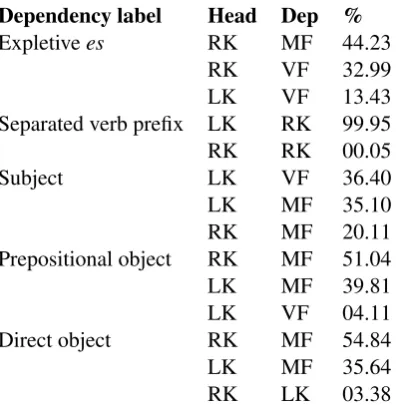
Table 4 enumerates the three (where applicable) most frequent head and dependent field combina-tions of the five relacombina-tions that always cross fields. As expected, the head is always in the LK or RK. Moreover, the dependents are in VF or MF in the far majority of cases. The actual distributions pro-vides some insights with respect to these depen-dency relations. We will discuss thedirect object,
prepositional object, andseparated verb prefix re-lations in some more detail.
Direct objects In German, direct objects can be put in the VF. However, we can see that di-rect object fronting only happens very rarely in the T¨uBa-D/Z. This is in line with earlier obser-vations in corpus-based studies (c.f. Weber and M¨uller (2004)). Since the probability of having a subject in the VF is much higher, the parser should attach the head of a noun phrase in the VF as a sub-ject, unless there is overwhelming evidence to the contrary, such as case markers, verb agreement, or other cues (Uszkoreit, 1984; M¨uller, 1999).
de-Dependency label Head Dep %
Expletivees RK MF 44.23
RK VF 32.99
LK VF 13.43
Separated verb prefix LK RK 99.95
RK RK 00.05
Subject LK VF 36.40
LK MF 35.10
RK MF 20.11
Prepositional object RK MF 51.04
LK MF 39.81
LK VF 04.11
Direct object RK MF 54.84
LK MF 35.64
[image:3.595.79.280.61.264.2]RK LK 03.38
Table 4: The three most frequent head-dependent field combinations of the five relations that always cross fields.
ciding whether a prepositional phrase is a preposi-tional object or not. Topological field information can complement verb-preposition co-occurrence statistics in deciding between these two different relations. The prepositional object mainly occurs in MF, while a prepositional phrase headed by the LK is almost as likely to be in the VF as in the MF (42.12% and 55.70% respectively).
Separated verb prefixes Some verbs in German have separable prefixes. A complicating factor in parsing is that such prefixes are often words that can also be used by themselves. For example, in (1-a) festis a separated prefix of bindet (present tense third person of festbinden), while in (1-b)
festis an optional adverbial modifier ofgebunden
(the past participle ofbinden).
(1) a. Sie
Shebindetties dasthePferdhorsefesttight..
b. Das
TheBuchbook istis festtightlygebundenbound ..
Similarly to prepositional objects, a statistical parser is handicapped by not having an extensive lexicon. Again, topological fields can complement co-occurence statistics. In (1-a),festis in the RK. As we can see in Table 4, the separated verb pre-fix is always in the RK. In contrast, an adverbial modifier as in (1-b) is rarely in the RK (0.35% of the adverbs cases in the T¨uBa-D/Z).
3 Predicting fields
As mentioned in Section 1, topological field an-notation has often been performed as a part of phrase structure parsing. In order to test our hy-pothesis that topological field annotation could in-form dependency parsing, it would be more ap-propriate to use a syntax-less approach. Several shallow approaches have been tried in the past. For instance, Veenstra et al., (2002) compare three different chunkers (finite state, PCFG, and clas-sification using memory-based learning). Becker and Frank (2002) predict topological fields using a PCFG specifically tailored towards topological fields. Finally, Liepert (2003) proposes a chunker that uses support vector machines.
In the present work, we will treat the topolog-ical field annotation as a sequence labeling task. This is more useful in the context of dependency parsing because it allows us to treat the topological field as any other property of a token.
Topological field projection In order to obtain data for training, validation, and evaluation, we use the T¨uBa-D/Z treebank. Topological fields are only annotated in the constituency version of the T¨uBa-D/Z, where the fields are represented as special constituent nodes. To obtain token-level field annotations for the dependency version of the treebank, we project the topological fields of the constituency trees on the tokens. The recursive projection function for projection is provided in Appendix B. The function is initially called with the root of the tree and a special unknown field marker, so that tokens that are not dominated by a topological field node (typically punctuation) also receive the topological field feature.
We should point out that our current projection method results in a loss of information when a sentence contains multiple clauses. For instance, an embedded clause is in a topological field of the main clause, but also has its own topological structure. In our projection method, the topologi-cal field features of tokens in the embedded clause reflect the topological structure of the embedded clause.
Schmidhu-ber, 1997), and finally an output layer with the softmax activation function. The use of a recur-rent model is motivated by the necessity to have long-distance memory. For example, (2-a) con-sists of a main clause with the LK wird and RK
begr¨untand an embedded clausewie geplantwith its own clausal structure. When the labeler en-counters jetzt, it needs to ‘remember’ that it was in the MF field of the main clause.
(2) a. Die
Theneuenew Streckestretch wirdis ,,wieas geplantplanned,, jetzt
nowbegr¨untbeing-greened..
Moreover, the use of a bidirectional LSTM is mo-tivated by the need for backwards-flowing infor-mation to make some labeling decisions. For in-stance,die Siegerinis in the VF of the verb-second clause (3-a), while it is in the MF of the verb-final clause (3-b). The labeller can only make such choices by knowing the position of the finite verb. (3) a. die
dieSiegerinwinner wurdewas disqualifiziertdisqualified
b. die
theSiegerinwinner zutodisqualifizierendisqualify
4 Parsing with topological fields
To evaluate the effectiveness of adding topo-logical fields to the input, we use the publicly available neural network parser described by De Kok (2015). This parser uses an architecture that is similar to that of Chen and Manning (2014). However, it learns morphological analysis as an embedded task of parsing. Since most inflectional information that can be relevant for parsing Ger-man is available in the prefix or suffix, this parser learns morphological representations over charac-ter embeddings of prefixes and suffixes.
We use the same parser configuration as that of De Kok (2015), with the addition of topological field annotations. We encode the topological fields as one-hot vectors in the input of the parser. This information is included for the four tokens on top of the stack and the next three tokens on the buffer.
5 Evaluation and results
To evaluate the proposed topological field model, we use the same partitioning of T¨uBa-D/Z and the word and tag embeddings as De Kok (2015). For training, validation, and evaluation of the parser, we use these splits as-is. Since we want to test the
parser with non-gold topological field annotations as well, we swapped the training and validation data for training our topological field predictor.
The parser was trained using the same hyper-parameters and embeddings as in De Kok (2015). Our topological field predictor is trained using Keras (Chollet, 2015).4 The hyperparameters that we use are summarized in Appendix A. The topo-logical field predictor uses the same word and tag embeddings as the parser.
In Table 5, we show the accuracy of the topo-logical field labeler. The use of a bi-directional LSTM is clearly justified, since it outperforms the stacked unidirectional LSTM by a wide margin.
Parser Accuracy (%)
LSTM + LSTM 93.33
Bidirectional LSTM + LSTM 97.24
Table 5: Topological field labeling accuracies. The addition of backward flowing information im-proves accuracy considerably.
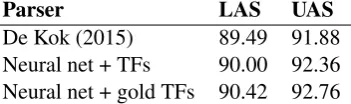
Table 6 shows the labeled attachment scores (LAS) for parsing with topological fields. As we can see, adding gold topological field annota-tions provides a marked improvement over pars-ing without topological fields. Although the parser does not achieve quite the same performance with the output of the LSTM-based sequence labeler, it is still a relatively large improvement over the parser of De Kok (2015). All differences are sig-nificant atp <0.0001.5
Parser LAS UAS
[image:4.595.312.488.525.577.2]De Kok (2015) 89.49 91.88 Neural net + TFs 90.00 92.36 Neural net + gold TFs 90.42 92.76
Table 6: Parse results with topological fields and gold topological fields. Parsers that use topolog-ical field information outperform parsers without access to such information.
6 Result analysis
Our motivation for introducing topological fields in dependency parsing is to provide the parser with
4The software is available from: https://github.
com/danieldk/toponn
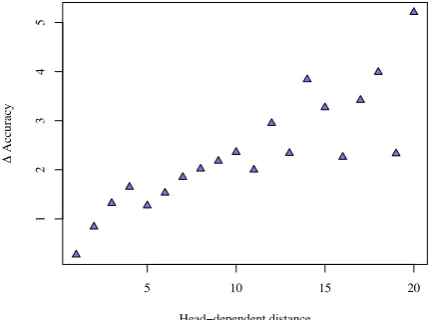
a more global view of sentence structure (Sec-tion 2). If this is indeed the case, we expect the parser to improve especially for longer-distance relations. Figure 1 shows the improvement in LAS as a result of adding gold-standard topolog-ical fields. We see a strong relation between the relation length and the improvement in accuracy. The introduction of topological fields clearly ben-efits the attachment of longer-distance dependents.
5 10 15 20
1
2
3
4
5
Head−dependent distance
∆
Accurac
y
Figure 1: The improvement in labeled attachment score as a result of adding gold topological fields to the parser by dependency length.
Since the introduction of topological fields has very little impact on short-distance relations, the differences in the attachment of relations that vir-tually never cross fields (Table 2) turn out to be negligable. However, for the relations that cross fields frequently, we see a marked improvements (Table 7) for every relation except the preposi-tional object. In hindsight, this difference should not be surprising — the relations that never cross fields are usually very local, while those that al-most always cross fields tend to have longer dis-tances and/or are subject to relatively free order-ing.
Dependency label LAS∆
Expletivees 2.71 Separated verb prefix 1.64
Subject 1.22
[image:5.595.315.520.61.212.2]Prepositional object -0.29 Direct object 1.59
Table 7: The LAS∆of the parser with access to gold standard topological fields compared to the De Kok (2015) parser for the relations of Table 4.
Dependency label LAS∆
Coordinating conjunction (clausal) 11.48
Parenthesis 8.31
Dependent clause 3.49
Conjunct 3.38
Sentence root7 2.92
Expletivees 2.71
Sentence 2.64
Comparative 1.87
Separated verb prefix 1.64
Direct object 1.59
Table 8: The ten dependency relations with the highest LAS∆of the parser with access to gold topological fields compared to the (de Kok, 2015) parser.
The ten dependency relations with the highest overall improvement in LAS are shown in Table 8. Many of these relations are special when it comes to topological field structure and were not dis-cussed in Section 2. The relationsparenthesis, de-pendent clause, andsentencelink two clauses; the
sentence root marks the root of the dependency tree; and the coordinating conjunction (clausal)
relation attaches a token that is always in its own field.6 This confirms that the addition of topologi-cal fields also improves the analysis of the overall clausal structure.
7 Conclusion and outlook
In this paper, we have argued and shown that access to topological field information can im-prove the accuracy of transition-based dependency parsers. In future, we plan to see how com-petitive the bidirectional LSTM-based sequence labeling approach is compared to existing ap-proaches. Moreover, we plan to evaluate the use of topological fields in the architecture proposed by Dyer et al., (2015) to see how many of these regularities that approach captures.
Acknowledgments
The authors gratefully acknowledge the financial support of their research by the German Ministry for Education and Research (BMBF) as part of the CLARIN-D research infrastructure grant given to the University of T¨ubingen. Furthermore, we would like to thank Jianqiang Ma for his extensive comments on an early draft of this paper.
[image:5.595.73.289.200.360.2] [image:5.595.109.255.633.715.2]References
Markus Becker and Anette Frank. 2002. A stochas-tic topological parser for German. InProceedings of the 19th international conference on Computa-tional linguistics-Volume 1, pages 1–7. Association for Computational Linguistics.
Danqi Chen and Christopher D Manning. 2014. A fast and accurate dependency parser using neural net-works. InProceedings of the 2014 Conference on Empirical Methods in Natural Language Processing (EMNLP), volume 1, pages 740–750.
Jackie Chi Kit Cheung and Gerald Penn. 2009. Topo-logical field parsing of German. InProceedings of the Joint Conference of the 47th Annual Meeting of the ACL and the 4th International Joint Conference on Natural Language Processing of the AFNLP: Vol-ume 1-VolVol-ume 1, pages 64–72. Association for Com-putational Linguistics.
Franc¸ois Chollet. 2015. Keras. https://github.
com/fchollet/keras.
Dani¨el de Kok. 2015. A poor man’s morphology for German transition-based dependency parsing. In In-ternational Workshop on Treebanks and Linguistic Theories (TLT14).
Erich Drach. 1937. Grundgedanken der Deutschen
Satzlehre. Frankfurt/Main.
Chris Dyer, Miguel Ballesteros, Wang Ling, Austin Matthews, and Noah A. Smith. 2015. Transition-based dependency parsing with stack long short-term memory. In Proceedings of the 53rd Annual Meeting of the Association for Computational Lin-guistics and the 7th International Joint Conference on Natural Language Processing (Volume 1: Long Papers), pages 334–343, Beijing, China, July. Asso-ciation for Computational Linguistics.
Oskar Erdmann. 1886. Grundz¨uge der deutschen
Syntax nach ihrer geschichtlichen Entwicklung dargestellt. Stuttgart: Cotta. Erste Abteilung. Alex Graves and J¨urgen Schmidhuber. 2005.
Frame-wise phoneme classification with bidirectional lstm and other neural network architectures. Neural Net-works, 18(5):602–610.
Simon Herling. 1821. ¨Uber die Topik der deutschen Sprache. In Abhandlungen des frankfurterischen Gelehrtenvereins f¨ur deutsche Sprache, pages 296– 362, 394. Frankfurt/Main. Drittes St¨uck.
Sepp Hochreiter and J¨urgen Schmidhuber. 1997.
Long short-term memory. Neural computation,
9(8):1735–1780.
Tilman H¨ohle. 1986. Der Begriff ‘Mittelfeld’.
Anmerkungen ¨uber die Theorie der topologischen Felder. In A. Sch¨one, editor, Kontroversen alte und neue. Akten des 7. Internationalen Germanis-tenkongresses G¨ottingen, pages 329–340. T¨ubingen: Niemeyer.
Sandra K¨ubler, Ryan McDonald, and Joakim Nivre. 2009. Dependency parsing. Synthesis Lectures on Human Language Technologies, 1(1):1–127.
Sandra K¨ubler. 2005. How do treebank annota-tion schemes influence parsing results? or how not
to compare apples and oranges. Proceedings of
RANLP 2005.
Martina Liepert. 2003. Topological fields chunking for German with SVM’s: Optimizing SVM-parameters with GA’s. InProceedings of the International Con-ference on Recent Advances in Natural Language Processing.
Wolfgang Maier. 2006. Annotation schemes and their influence on parsing results. In Proceedings of the 21st International Conference on computa-tional Linguistics and 44th Annual Meeting of the Association for Computational Linguistics: Student Research Workshop, pages 19–24. Association for Computational Linguistics.
Gereon M¨uller. 1999. Optimality, markedness, and word order in German.Linguistics, 37(5):777–818.
Joakim Nivre. 2003. An efficient algorithm for pro-jective dependency parsing. In Proceedings of the 8th International Workshop on Parsing Technologies (IWPT), pages 149–160.
Eric W Noreen. 1989. Computer intensive methods for hypothesis testing: An introduction.
Nitish Srivastava, Geoffrey Hinton, Alex Krizhevsky, Ilya Sutskever, and Ruslan Salakhutdinov. 2014. Dropout: A simple way to prevent neural networks from overfitting. The Journal of Machine Learning Research, 15(1):1929–1958.
Heike Telljohann, Erhard W Hinrichs, Sandra K¨ubler, Heike Zinsmeister, and Kathrin Beck. 2006. Style-book for the t¨ubingen treebank of written German (T¨uBa-D/Z). In Seminar fur Sprachwissenschaft, Universit¨at Tubingen, T¨ubingen, Germany.
Hans Uszkoreit. 1984. Word order and constituent
structure in German. CSLI Publications.
Jorn Veenstra, Frank Henrik M¨uller, and Tylman Ule. 2002. Topological field chunking for German. In Proceedings of the 6th Conference on Natural Lan-guage Learning - Volume 20, COLING-02, pages 1– 7, Stroudsburg, PA, USA. Association for Computa-tional Linguistics.
Yannick Versley. 2005. Parser evaluation across text types. In Proceedings of the Fourth Workshop on Treebanks and Linguistic Theories (TLT 2005).
Yue Zhang and Stephen Clark. 2008. A tale of two parsers: investigating and combining graph-based and transition-graph-based dependency parsing us-ing beam-search. InProceedings of the Conference on Empirical Methods in Natural Language Pro-cessing, pages 562–571. Association for Computa-tional Linguistics.
A Hyperparameters
The topological field labeler was trained using Keras (Chollet, 2015). Here, we provide a short overview the hyperparameters that we used:
• Solver:rmsprop, this solver is recommended by the Keras documentation for recurrent neural networks. The solver is used with its default parameters.
• Learning rate: the learning rate was deter-mined by the function 0.01(1 + 0.02i)−2,
where i is the epoch. The intuition was to start with some epochs with a high learning rate, dropping the learning rate quickly. The results were not drastically different when us-ing a constant learnus-ing rate of0.001.
• Epochs: The models was trained for 200
epochs, then we picked the model of the epoch with the highest performance on the validation data (27 epochs for the unidirec-tional LSTM, 124 epochs for the bidirec-tional LSTM).
• LSTM layers:all LSTM layers were trained with 50 output dimensions. Increasing the number of output dimensions did not provide an improvement.
• Regularization: 10% dropout (Srivastava et al., 2014) was used after each LSTM layer for regularization. A stronger dropout did not provide better performance.
B Topological field projection algorithm
Algorithm 1Topological field projection.
functionPROJECT(node,field)
ifIS TERMINAL NODE(node)then
node.field←field
else
ifIS TOPO NODE(node)then
field←node.field
end if
forchild∈nodedo PROJECT(child,field) end for