Cross-Lingual Lexico-Semantic Transfer in Language Learning
Ekaterina Kochmar
The ALTA Institute University of Cambridge
Ekaterina Shutova
Computer Laboratory University of Cambridge
Abstract
Lexico-semantic knowledge of our native language provides an initial foundation for second language learning. In this paper, we investigate whether and to what extent the lexico-semantic models of the native language (L1) are transferred to the sec-ond language (L2). Specifically, we focus on the problem of lexical choice and in-vestigate it in the context of three typolog-ically diverse languages: Russian, Span-ish and EnglSpan-ish. We show that a statistical semantic model learned from L1 data im-proves automatic error detection in L2 for the speakers of the respective L1. Finally, we investigate whether the semantic model learned from a particular L1 is portable to other, typologically related languages.
1 Introduction
Lexico-semantic knowledge of our native lan-guage is one of the factors that underlie our ability to communicate and reason about the world. It is also the knowledge that guides us in the process of second language learning. Lexico-semantic vari-ation across languages (Bach and Chao, 2008) makes lexical choice a challenging task for sec-ond language learners (Odlin, 1989). For instance,
the meaning of the English expression pull the
triggeris realised as*push the triggerin Russian and Spanish, possibly leading to errors of lexical choice by Russian and Spanish speakers learning English. Our native language (L1) plays an essen-tial role in the process of lexical choice. When choosing between several linguistic realisations in L2, non-native speakers may rely on the lexico-semantic information from L1 and select a trans-lational equivalent that they deem to match their communicative intent best. For example, Russian
speakers*do exceptionsandoffersinstead of
mak-ingthem, and*find decisionsinstead offinding
so-lutions, since in Russiando andmakehave a sin-gle translational equivalent (delat’), and so do de-cisionandsolution(resheniye). As a result, non-native speakers who tend to fall back to their L1 translate phrases word-for-word, violating English lexico-semantic conventions.
The effect of L1 interference on lexical choice in L2 has been pointed out in a number of stud-ies (Chang et al., 2008; Rozovskaya, 2010; Ro-zovskaya, 2011; Dahlmeier and Ng, 2011). Some of these studies also demonstrated that using L1-specific properties, such as the error patterns of speakers of a given L1 or L1-induced paraphrases, improves the performance of automatic error cor-rection in non-native writing. However, neither of the approaches has constructed a semantic model from L1 data and systematically studied the effects of its transfer onto L2. In addition, most previous work has focused on error correction, bypassing the task of error detection for lexical choice. Lex-ical choice is one of the most challenging tasks for both non-native speakers and automated error detection and correction (EDC) systems. The re-sults of the most recent shared task on EDC, which spanned all error types including lexical choice, show that most teams either did not propose any algorithms for this type of errors or did not per-form well on them (Ng, 2014).
In this paper, we experimentally investigate the influence of L1 on lexical choice in L2 and whether lexico-semantic models from L1 are transferred to L2 during language learning. For this purpose, we induce L1 and L2 semantic mod-els from corpus statistics in each language in-dependently, and then use the discrepancies be-tween the two models to identify errors of
lexi-cal choice. We focus on two types ofverb–noun
combinations,VERB–DIRECT OBJECT(dobj) and
SUBJECT–VERB (subj), and consider two widely spoken L1s from different language families – Russian and Spanish. We conduct our experiments using the Cambridge Learner Corpus (Nicholls, 2003), containing writing samples of non-native speakers of English. Spanish speakers account for
around 24.6% of the non-native speakers
repre-sented in this corpus and Russian speakers for4%.
Our experiments test two hypotheses: (1) that L1 effects in the lexical choice in L2 reveal them-selves in the difference of the word association strength in the L1 and L2; and (2) that L1 lexico-semantic models are portable to other, typologi-cally related languages. To the best of our knowl-edge, our paper is the first one to experimentally investigate these questions. Our results demon-strate that L1-induced information improves auto-matic error detection for lexical choice, confirm-ing the hypothesis that L1 speakers rely on se-mantic knowledge from their native language dur-ing L2 learndur-ing. We test the second hypothesis by verifying that Russian speakers exhibit similar trends in errors with the speakers of other Slavic languages, and Spanish speakers with the speakers of other Romance languages. We find that the L1-induced information from Russian and Spanish is effective in assessing lexical choice of the speak-ers of other languages for both language groups.
2 Related work
2.1 Error detection in content words
Early approaches to collocation error detection re-lied on manually created databases of correct and incorrect word combinations (Shei and Pain, 2000; Wible et al., 2003; Chang et al., 2008). Con-structing such databases is expensive and time-consuming, and therefore, more recent research turned to the use of machine learning techniques.
Leacock et al. (2014) note that most approaches to detection and correction of collocation errors compare the writer’s word choice to the set of al-ternatives using association strength measures and choose the combination with the highest score, re-porting an error if this combination does not coin-cide with the original choice (Futagi et al., 2008; ¨Ostling and Knutsson, 2009; Liu et al., 2009). This strategy is expensive as it relies on compar-ison with a set of alternatives, limited in capac-ity as it depends on the qualcapac-ity of the alternatives generated and circular as the detection cannot be performed independently of the correction. Our
approach alleviates these problems, since error de-tection depends on the original combination only.
Some previous approaches focused on correc-tion only (Dahlmeier and Ng, 2011; Kochmar and Briscoe, 2015), and although they show promising results, they have not attempted to per-form error detection in lexical choice. Kochmar and Briscoe (2014) focus on error detection, but their system addresses adjective–noun combina-tions and does not use L1-induced information.
2.2 L1 factors in L2 writing
The influence of an L1 on lexical choice in L2 and the resulting errors have been previously stud-ied (Chang et al., 2008; ¨Ostling and Knutsson, 2009; Dahlmeier and Ng, 2011). These works fo-cus on errors in particular L1s and use the trans-lational equivalents directly to improve candidate selection and quality of corrections. Dahlmeier and Ng (2011) show that L1-induced paraphrases outperform approaches based on edit distance, ho-mophones, and WordNet synonyms in selecting the appropriate corrections.
Rozovskaya and Roth (2010) show that an error correction system for prepositions benefits from restricting the set of possible corrections to those observed in the non-native data. Rozovskaya and Roth (2011) further demonstrate that the models perform better when they use knowledge about er-ror patterns of the non-native writers. According to their results, an error correction algorithm that relies on a set of priors dependent on the writer’s preposition and the writer’s L1 outperforms other methods. Madnani et al. (2008) show promising results in whole-sentence grammatical error cor-rection using round-trip translations from Google
Translate via8different pivot languages.
The results of these studies suggest that L1 is a valuable source of information in EDC. However, all these works use isolated translational equiva-lents and focus on error correction only. In con-trast, we construct holistic semantic models of L1 from L1 corpora and use these models to perform the more challenging task of error detection.
3 Data
3.1 L1 Data
Spanish data The Spanish data was extracted from the Spanish Gigaword corpus (Mendonca et al., 2011), a one billion-word collection of news articles in Spanish. The corpus was parsed using the Spanish Malt parser (Nivre et al., 2007;
Balles-teros et al., 2010). We extracted VERB–SUBJECT
and VERB–DIRECT OBJECT relations from the output of the parser, which we then used to build an L1 word association model for Spanish.
Russian data The Russian data was extracted from the RU-WaC corpus (Sharoff, 2006), a two billion-word representative collection of texts from the Russian Web. The corpus was parsed us-ing Malt dependency parser for Russian (Sharoff
and Nivre, 2011), and the VERB–SUBJECT and
VERB–DIRECT OBJECT relations were extracted from the parser output to create an L1 word as-sociation model for Russian.
Dictionaries and translation Once the L1 word associations have been computed for the verb– noun pairs, we identify possible translations for verbs and nouns (in each pair) in isolation, as a language learner might do. To create the trans-lation dictionaries, we extracted transtrans-lations from the English–Spanish and English–Russian edi-tions of Wiktionary, both from the translation sec-tions and the gloss secsec-tions if the latter contained single words as glosses. We focus on verb–noun pairs, therefore multi-word expressions were uni-versally removed. We added inverse translations for every original translation. We then created separate translation dictionaries for each language and part-of-speech tag combination from the re-sulting collection of translations.
3.2 L2 data
To build the English word association model, we have used a combination of the British National Corpus (Burnard, 2007) and the UKWaC (Baroni et al., 2009). The corpora were parsed by the
RASP parser (Briscoe et al., 2006) and VERB–
SUBJECT and VERB–DIRECT OBJECT relations were extracted from the parser output. Since the UKWaC is a Web corpus, we assume that the data contains a certain amount of noise, e.g. typograph-ical errors, slang and non-words. We filter these out by checking that the verbs and nouns in the ex-tracted relations are included in WordNet (Miller, 1995) with the appropriate part of speech.
3.3 Learner data
To extract the verb–noun combinations that have been used by non-native speakers in practice,
we use the Cambridge Learner Corpus (CLC),
which is a52.5million-word corpus of learner
En-glish collected by Cambridge University Press and Cambridge English Language Assessment since 1993 (Nicholls, 2003). It comprises English ex-amination scripts written by learners of English
with 148 different L1s, ranging across multiple
examinations and covering all levels of language
proficiency. A 25.5 million-word component of
the CLC has been manually error-annotated. We have preprocessed the CLC with the RASP parser (Briscoe et al., 2006), as it is robust when applied to ungrammatical sentences. We have then
extracted alldobjandsubjcombinations: in total,
we have extracted187,109dobjand225,716subj
combinations. We have used the CLC error anno-tation to split the data into correct combinations and errors. We note that some verb–noun com-binations are annotated both as being correct and as errors, depending on their wider context of use. To ensure that the annotation we use in our exper-iments is reliable and not context-dependent, we have empirically set a threshold to filter out am-biguously annotated instances. The set of correct word combinations includes only those word pairs
that are used correctly in at least70%of the cases
they occur in the CLC; the set of errors includes
only those that are used incorrectly at least70%of
the time.
3.4 Experimental datasets
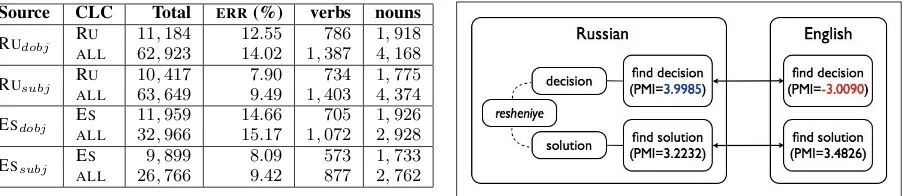
We split the annotated CLC data by language and relation type. Table 1 presents the statistics on
the datasets collected.1 We extract the verb–noun
combinations from the CLC texts written by native speakers of Russian (RU) and Spanish (ES) to test
our first hypothesis, as well as by speakers ofALL
L1s in the CLC to test our second hypothesis. We then filter the extracted relations using the trans-lated verb–noun pairs from Russian and Spanish corpora.
We note that Russian and Spanish have compa-rable number of word combinations in L1-specific
subsets – 10K-12K for dobj and subj
combina-tions – and comparable error rates (ERR). We
also note that the error rates in the dobj
Source CLC Total ERR(%) verbs nouns
RUdobj RALLU 11,62,184923 12.5514.02 1,387786 4,1,918168
RUsubj RALLU 10,63,417649 7.909.49 1,403734 4,1,775374
ESdobj EALLS 11,32,959966 14.6615.17 1,072705 2,1,926928
[image:4.595.79.530.62.160.2]ESsubj EALLS 26,9,899766 8.099.42 877573 2,1,733762
Table 1: Statistics on the datasets collected.
sets are higher than in subj subsets, presumably,
because VERB–SUBJECT combinations allow for
more flexibility in lexical choice. We find a large number of translated word combinations in other L1s, and it is interesting to note that the error rates are higher across multiple languages than in the same L1s, which corroborates our second hy-pothesis that the lexico-semantic models from L1s transfer to L2. The last two columns of Table 1 show how diverse our datasets are in terms of verbs and nouns used in the constructions: for
ex-ample, RUdobj subset contains combinations with
786different verbs and1,918different nouns.
4 Methods
Our approach to detecting lexico-semantic trans-fer errors relies on the intuition that a mismatch between the lexico-semantic models in two lan-guages reveals itself in the difference in word as-sociation scores. We argue that a high asas-sociation
score of a verb–noun combination in L1 shows
that it is a collocation in L1, but low association score of its translational equivalent in L2 signals an error in L2 stemming from the lexico-semantic transfer. Following previous research (Baldwin and Kim, 2010), we measure the strength of verb– noun association using pointwise mutual informa-tion (PMI). Figure 1 illustrates this intuiinforma-tion. In
Russian, both*find decisionvs.find solutionhave
a high PMI score. However, in English the latter has a high PMI while the former has a negative PMI. We expect such a discrepancy in word asso-ciation to be an indicator of error of lexical choice, driven by the L1 semantics.
We treat the task of lexico-semantic transfer er-ror detection as a binary classification problem and train a classifier for this task. The classifier uses a combination of L1 and L2 semantic features. If our hypothesis holds, we expect to see an improve-ment in the classifier’s performance when adding L1 semantic features.
Figure 1: Russian to English interface for *find
decision.
4.1 L2 lexico-semantic features
We experiment with two types of L2 features: lexico-semantic features and semantic vector space features.
Lexico-semantic features include:
• pmi in L2: we estimate the association
strength between the noun and verb using the combined BNC and UKWaC corpus;
• verbandnoun: the identity of the verb and
the noun in the pair, encoded in a numerical
form in the range of (0,1). The motivation
behind that step is that certain words are more error-prone than others and converting them into numerical features helps the classifier to use this information.
Semantic vector space features Kochmar and Briscoe (2014) obtained state-of-the-art results in error detection by using the semantic component of the content word combinations. We reimple-ment these features and test their impact on our task. We extracted the noun and verb vectors from
the publicly availableword2vecdataset of word
embeddings for3million words and phrases.2 The
300-dimensional vectors have been trained on a
part of Google News dataset (about 100 billion
words) usingword2vec(Mikolov et al., 2013).
The dobj and subj vectors are then built using
element-wise addition on the vectors (Mitchell and Lapata, 2008; Mikolov et al., 2013; Kochmar and Briscoe, 2014).
Once the compositional vectors are created, the method relies on the idea that correct combina-tions can be distinguished from the erroneous ones by certain vector properties (Vecchi et al., 2011; Kochmar and Briscoe, 2014). We implement a set of numerical features based on the following prop-erties of the vectors:
• lengthof the additive (vn) vector
• cosvn∧n– cosine between thevnvector and
the noun vector
• cosvn∧v– cosine between thevnvector and
the verb vector
• dist10 – distance to the 10 nearest
neigh-bours of thevnvector
• lex-overlap– proportion of the10
near-est neighbours of thevnvector containing the
verb/noun
• comp-overlap– overlap between the 10
neighbours of the vn vector and 10
neigh-bours of the verb/noun vector
• cosv∧n – cosine between the verb and the
noun vectors.
The 10 nearest neighbours are retrieved in the
combined semantic space containing word embed-dings and additive phrase vectors. All features, ex-cept for the last one, have been introduced in pre-vious work and showed promising results (Vecchi et al., 2011; Kochmar and Briscoe, 2014). For ex-ample, it has been shown that the distance from the constructed word combination vector to its nearest neighbours is one of the discriminative features of the error detection classifier. Manual inspection of the vectors and nearest neighbours shows that the
closest neighbour to*find decisionissee decision
with the similarity of0.8735while the closest one
tofind solutionisdiscover solutionwith the simi-larity of0.9048.
We implement an additional cosv∧n feature
based on the intuition that the distance between the verb and noun vectors themselves may indicate a semantic mismatch and thus help in detecting lex-ical choice errors.
4.2 L1 lexico-semantic features
We first quantified the strength of association be-tween the L1 verbs and nouns in the original L1 data, using PMI. We then generated a set of possi-ble translations for each verb–noun pair in L1 us-ing the translation dictionaries. Each verb–noun pair in the CLC was then mapped to one of the translated L1 pairs and its L1 features. We used the following L1 features in classification:
• pmiin L1: we estimate the strength of
asso-ciation on the original L1 corpora;
• differencebetween the PMI of the verb– noun pair in L1 and in L2.
4.3 Classification
Classifier settings We treat the task as a binary classification problem and apply a linear SVM
classifier using scikit-learn LinearSVC
implementation.3 The error rates in Table 1 show
that we are dealing with a two-class problem
where one class (correctword combinations)
sig-nificantly outnumbers the other class (errors) by
up to 11:1(on RUsubj). To address the problem
of class imbalance, we use subsampling: we ran-domly split the set of correct word combinations
inn samples keeping the majority class baseline
under0.60, and run nexperiments over the
sam-ples. We apply 10-fold cross-validation within
each sample. The results reported in the follow-ing sections are averaged across the samples for each dataset.
Evaluation The goal of the classifier is to detect errors, therefore we primarily focus on its
perfor-mance on the error class and, in addition to
ac-curacy, reportprecision (P),recall(R) and F1 on
this class. Previous studies (Nagata and Nakatani, 2010) suggest that systems with high precision in detecting errors are more helpful for L2 learning than systems with high recall as non-native speak-ers find misidentified errors very misleading. In line with this research, we focus on maximising
precision on theerrorclass.
Baseline We compare the performance of our different feature sets to the baseline classifier which uses L2 co-occurrence frequency of the verb and noun in the pair as a single feature. Fre-quency sets a competitive baseline as it is often judged to be the measure of acceptability of an ex-pression and many previous works relied on the frequency of occurrence as an evidence of accept-ability (Shei and Pain, 2000; Futagi et al., 2008).
5 Experimental Results
To test our hypothesis that lexico-semantic mod-els are transferred from L1 to L2, we first run the set of experiments on the L1 subsets of the CLC
data, that is RU → RUCLC and ES → ESCLC,
where the left-hand side of the notation denotes the lexico-semantic model and the right-hand side the L1 of the speakers that produced the word pairs extracted from the CLC. We incrementally add the features, starting with the set of lexico-semantic
L1 Features Acc Pe Re F1e
RUdobj
baseline 55.68 47.77 61.44 53.55 pmiEn 64.74 59.76 47.55 52.96
+verb 64.79 59.87 47.56 53.01 RUsubj
baseline 54.48 46.30 63.96 53.17 pmiEn 67.02 58.86 62.74 60.74
+verb 67.64 59.84 62.17 60.98 ESdobj
baseline 56.74 52.25 74.44 61.36 pmiEn 64.28 61.75 59.55 60.63
+verb 64.34 61.80 59.67 60.71 ESsubj
baseline 54.45 46.71 70.31 56.00 pmiEn 69.22 61.35 68.83 64.87
[image:6.595.307.527.62.155.2]+verb 69.51 61.79 68.58 65.00
Table 2: System performance (in %) using L2
lexico-semantic features, L1→L1CLC.
features in L2 that are readily available without reference to the L1, and later adding L1 semantic features, and measure their contribution.
5.1 L2 lexico-semantic features
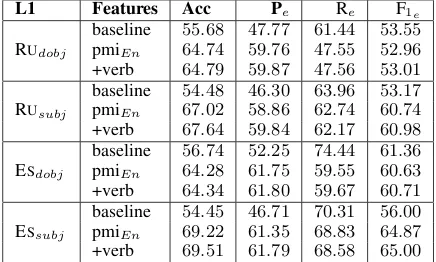
The first system configuration we experiment with uses the set of lexico-semantic features from L2. Table 2 reports the results. Our experiments show
that a classifier that uses L2 PMI (pmiEn) as a
single feature performs with relatively high accu-racy: on all four datasets it outperforms the
base-line classifier achieving an increase from 7.54%
(on ESdobj) up to14.77%(on ESsubj) in accuracy.
Adding thenounas a feature decreases
perfor-mance of the classifier and we do not further use
this feature. Theverbused as an additional
fea-ture consistently improves classifier performance.
5.2 L2 semantic vector space features
Next, we test the combination of the semantic
vec-tor space features (sem) and combine them with
two L2 lexico-semantic features includingpmiEn
andverb(denoted asftEnhereafter for brevity).
Table 3 reports the results.
We note that the semantic vector space features
on their own yield precision of50%−52%on the
error class in dobj combinations and lower than
50%onsubjcombinations. This suggests that the
classifier misidentifies correct combinations as rors more frequently than it correctly detects er-rors. Moreover, recall of this system configura-tion is also low on all datasets. Adding the seman-tic vector space features to the other L2 semanseman-tic features, however, improves the performance, as shown in Table 3. As both groups of features refer to the phenomena in L2, the results suggest that they complement each other.
L1 Features Acc Pe Re F1e
RUdobj sem+ft 58.36 50.72 6.98 12.22 En 65.90 58.64 62.18 60.35
RUsubj sem+ft 58.62 36.07 3.40 6.12 En 68.37 60.05 66.48 63.07
ESdobj sem+ft 54.51 52.01 20.78 29.48 En 66.87 63.36 67.08 65.16
[image:6.595.72.290.63.194.2]ESsubj sem+ft 58.63 49.37 9.27 15.47 En 70.75 62.21 74.31 67.72
Table 3: System performance (in%) using a
com-bination of L2 semantic features, L1→L1CLC.
L1 Features Acc Pe Re F1e
RUdobj ft+pmiEn 64.79 59.87 47.56 53.01 L1 66.05 58.74 62.72 60.67
RUsubj ft+pmiEn 67.64 59.88 62.17 60.98 L1 68.68 62.10 69.61 64.38
ESdobj ft+pmiEn 64.34 61.80 59.67 60.71 L1 66.89 63.01 68.61 65.68
ESsubj ft+pmiEn 69.51 61.79 68.58 65.00 L1 71.19 62.10 77.66 69.00
Table 4: System performance (in%) using L1 and
L2 lexico-semantic features, L1→L1CLC.
5.3 L1 lexico-semantic features
Finally, we add the L1 lexico-semantic features to
the well-performing L2 features (pmiandverb).
The combination of L1 lexico-semantic features with the L2 lexico-semantic and semantic vec-tor space features achieves lower results, there-fore we do not report them here. The use of L1
pmi improves both the accuracy and the F-score
of theerror class (see Table 4). For the ease of
comparison, we also include the results obtained using a combination of L1 lexico-semantic
fea-tures (denotedftEn). The addition of the explicit
differencefeature between the two PMIs has not yielded further improvement. This is likely to be due to the fact that the classifier already implic-itly captures the knowledge of this difference in the form of individual L1 and L2 PMIs.
We note that the system using a combination of L1 and L2 lexico-semantic features gains an
ab-solute improvement in accuracy from 1.04% for
RUsubj to2.55%on ESdobj. The performance on
the error class improves in all but one case (Pe
on RUdobj), with an absolute increase in F1 up to
7.66%. The system has both a higher coverage in
error detection (a rise in recall) and a higher pre-cision. The improvement in performance across all four datasets is statistically significant at0.05
6 Effect on different L1s
Next, we test our second hypothesis that a lexico-semantic model from one L1 is portable across several L1s, in particular, typologically related ones. We first experiment with the data repre-senting all L1s in the CLC and then with the data representing a specific language group. We com-pare the performance of the baseline system us-ing verb–noun co-occurrence frequency as a sus-ingle feature, the system that uses L2 semantic features only and the system that combines both L2 and L1 semantic features.
6.1 Experiments on all L1s
Table 1 shows that using the translated verb–noun
combinations from our L1s (RU and ES) we are
able to find a large amount of both correct and er-roneous combinations in different L1s in the CLC
including RU and ES (seeALL). This gives us an
initial confirmation that the lexico-semantic mod-els may be shared across multiple languages.
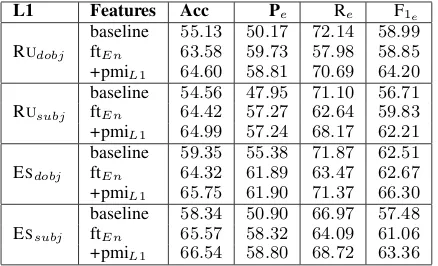
We then experiment with error detection across all L1s represented in the CLC. The results are shown in Table 5. The baseline system achieves
similar performance on RU → ALLCLC as on
RU→ RUCLC, and better performance on ES →
ALLCLC than on ES → ESCLC. The results
ob-tained with the L2 lexico-semantic features are also comparable: the system achieves an absolute
increase in accuracy of up to9.86%for the model
transferred from RUsubj, reaching an accuracy of
around 65 −66% with balanced performance in
terms of precision and recall onerrors.
When the L1 lexico-semantic features are added to the model, we observe an absolute increase in
the accuracy ranging from0.57%(for RUsubj) to
1.43%(for ESdobj). The Spanish lexico-semantic
model has a higher positive effect on all measures,
including precision on theerror class. Although
the addition of the L1 lexico-semantic features does not have a significant effect on the accuracy and precision, the system achieves an absolute
im-provement in recall of up to12.71%(on RUdobj).
That is, the system that uses L1 lexico-semantic features is able to find more errors in the data orig-inating with a set of different L1s. Generally, the results of the Spanish model are more stable and comparable to the results in the previous Section, which may be explained by the fact that Spanish is more well-represented in the CLC.
L1 Features Acc Pe Re F1e
RUdobj
baseline 55.13 50.17 72.14 58.99 ftEn 63.58 59.73 57.98 58.85
+pmiL1 64.60 58.81 70.69 64.20
RUsubj
baseline 54.56 47.95 71.10 56.71 ftEn 64.42 57.27 62.64 59.83
+pmiL1 64.99 57.24 68.17 62.21
ESdobj
baseline 59.35 55.38 71.87 62.51 ftEn 64.32 61.89 63.47 62.67
+pmiL1 65.75 61.90 71.37 66.30
ESsubj
baseline 58.34 50.90 66.97 57.48 ftEn 65.57 58.32 64.09 61.06
[image:7.595.308.527.62.195.2]+pmiL1 66.54 58.80 68.72 63.36
Table 5: System performance (in %) using L1 and
L2 lexico-semantic features, L1→all L1s.
6.2 Experiments on related L1s
The results onALLL1s confirm our expectations:
since we have extracted verb–noun combinations that originate with two particular L1s from the set of all different L1s in the CLC, and then used the L1 lexico-semantic features, the system is able to identify more errors thus we observe an improve-ment in recall. The precision, however, does not
improve, possibly because the set of errors inALL
L1s is different from that in the two L1s we rely on to build the lexico-semantic models. The final question that we investigate is whether the lexico-semantic models of our L1s are directly portable to typologically related languages. If this is the case, we expect to see an effect on the precision of the classifier as well as on the recall.
We experiment with the following groups of re-lated languages ordered by the number of verb– noun pairs we found in the CLC data:
• RU group: Russian, Polish, Czech, Slovak, Serbian, Croatian, Bulgarian, Slovene;
• ES group: Spanish, Italian, Portuguese, French, Catalan, Romanian, Romansch.
In addition to investigating the effect of the L1 lexico-semantic model on the whole language group, we also consider its effects on individual
languages. We chose Polish for the RUmodel, and
Italian for the ES model as these two languages
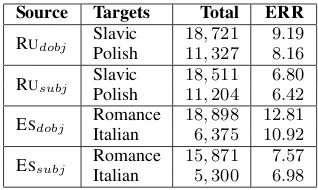
have the most data representing their native speak-ers in the CLC. Table 6 shows the number of verb– noun combinations and error rates for the language groups and these individual languages.
The results are presented in Tables 7 and 8. They exhibit similar trends in the change of the
Source Targets Total ERR RUdobj SlavicPolish 18,11,721327 9.198.16
RUsubj SlavicPolish 18,11,511204 6.806.42
ESdobj RomanceItalian 18,6,898375 12.8110.92
ESsubj RomanceItalian 15,5,871300 7.576.98
Table 6: Statistics on the L1 groups and related languages.
L1 Features Acc Pe Re F1e
RUdobj
baseline 57.08 51.80 71.58 59.78 ftEn 64.20 60.99 55.36 58.04
+pmiL1 65.77 61.06 64.78 62.86
RUsubj
baseline 56.43 49.52 62.04 54.24 ftEn 62.26 55.84 50.02 52.76
+pmiL1 62.78 56.02 54.48 55.21
ESdobj
baseline 59.18 51.44 72.31 59.97 ftEn 65.14 59.82 53.83 56.66
+pmiL1 66.24 58.92 67.00 62.70
ESsubj
baseline 58.10 52.95 77.43 62.45 ftEn 66.29 61.24 68.45 64.64
[image:8.595.101.260.61.156.2]+pmiL1 67.00 61.68 70.50 65.78
Table 7: System performance (in %) using L1 and
L2 lexico-semantic features, L1→L1 GROUP.
see for L1 → ALL L1s. Adding the L1
lexico-semantic features has only a minor effect on accu-racy and precision, and a more pronounced effect on recall. On the contrary, when we test the system on one particular related L1 (Table 8) we observe
the opposite effect: with the exception of ESsubj
data, precision and accuracy improve, suggesting that the error detection system using L1-induced information identifies errors more precisely.
Overall, the observed gains in performance in-dicate that L1 semantic models contribute infor-mation to lexical choice error detection in L2 for the speakers of typologically related languages. This in turn suggests that there may be less seman-tic variation within a language group than across different language groups.
7 Discussion and data analysis
The best accuracy achieved in our experiments
is 71.19% on ESsubj combinations. However,
previous research suggests that error detection in lexical choice is a difficult task. For instance, Kochmar and Briscoe (2014) report that the agree-ment between human annotators on error detection
in adjective–noun combinations is86.50%.
We then qualitatively assessed the performance of our systems by analysing what types of errors
L1 Features Acc Pe Re F1e
RUdobj
baseline 55.04 47.68 63.87 53.81 ftEn 64.73 59.76 46.05 52.01
+pmiL1 65.15 60.63 45.77 52.16
RUsubj
baseline 53.30 44.77 61.09 51.29 ftEn 61.84 54.63 35.81 43.22
+pmiL1 62.53 57.24 35.11 43.18
ESdobj
baseline 55.25 51.67 76.79 61.21 ftEn 64.06 62.30 56.01 58.98
+pmiL1 65.21 63.44 58.13 60.66
ESsubj
baseline 54.34 47.76 68.73 56.23 ftEn 62.71 58.80 43.09 49.69
[image:8.595.307.527.62.195.2]+pmiL1 62.44 58.46 41.71 48.60
Table 8: System performance (in %) using L1 and
L2 lexico-semantic features, L1→REL L1.
the classifiers reliably detect and what types of er-rors the classifiers miss across all runs over the samples. Some of the most reliably identified
er-rors in both RUand ESdatasets include:
• verbs offer, propose and suggest which are
often confused with each other. Correctly
identified errors include*offer planvs.
sug-gest plan,*propose workvs. offer workand
*suggest costvs.offer cost;
• verbs demonstrate and show where
demon-strate is often used instead of show as in
*chart demonstrates;
• verbssayandtellparticularly well identified
with the ES model. Examples include*say
ideainstead oftell ideaand*tell goodbye
in-stead ofsay goodbye.
These examples represent lexical choice errors when selecting among near-synonyms, and viola-tions of verb subcategorization frames. The error in*find solutiondiscussed throughout the paper is also reliably identified by the classifier across all runs. It is interesting to note that in the pair of
verbsdoandmake, which are often confused with
each other by both Russian and Spanish L1
speak-ers, errors involvingmakeare identified more
reli-ably than errors involvingdo: for example,*make
business is correctly identified as an error, while
*do jokeis missed by the classifier.
8 Conclusion
We have investigated whether lexico-semantic models from the native language are transferred to the second language, and what effect this trans-fer has on lexical choice in L2. We focused on two typologically different L1s – Russian and Spanish, and experimentally confirmed the hypothesis that statistical semantic models learned from these L1s significantly improve automatic error detection in L2 data produced by the speakers of the respec-tive L1s. We also investigated whether the seman-tic models learned from parseman-ticular L1s are portable to other languages, and in particular to languages that are typologically close to the investigated L1s. Our results demonstrate that L1 models improve the coverage of the error detection system on a range of other L1s.
Acknowledgments
We are grateful to the ACL reviewers for their helpful feedback. Ekaterina Kochmar’s research is supported by Cambridge English Language Assessment via the ALTA Institute. Ekaterina Shutova’s research is supported by the Leverhulme Trust Early Career Fellowship.
References
Bach E. and Chao W. 2008. Semantic universals and
typology. In Chris Collins, Morten Christiansen and Shimon Edelman, eds., Language Universals (Ox-ford: Oxford University Press).
Baldwin T. and Kim S. N. 2010. Multiword
Expres-sions. In Handbook of Natural Language Process-ing, Second Edition, N. Indurkhya and F. J. Damerau (eds.), pp. 267–292.
Ballesteros M., Herrera J., Francisco V., and Gerv´as P.
2010. A Feasibility Study on Low Level Techniques
for Improving Parsing Accuracy for Spanish Using Maltparser. In Proceedings of the 6th Hellenic Con-ference on Artificial Intelligence: Theories, Models and Applications, pp. 39–48.
Baroni M., Bernardini S., Ferraresi A., and
Zanchetta E. 2009. The WaCky Wide Web: A
Collection of Very Large Linguistically Processed Web-Crawled Corpora. Language Resources and Evaluation, 43(3): 209–226.
Briscoe E., Carroll J., and Watson R. 2006. The
Sec-ond Release of the RASP System. In Proceedings of the COLING/ACL-2006 Interactive Presentation Sessions, pp. 59–68.
Burnard L. 2007. The British National Corpus,
ver-sion 3 (BNC XML Edition). Distributed by Ox-ford University Computing Services on behalf of the
BNC Consortium.http://www.natcorp.ox.
ac.uk/.
Chang Y.C., Chang J.S., Chen H.J., and Liou H.C.
2012. An automatic collocation writing assistant
for Taiwanese EFL learners: A case of corpus-based NLP technology. Computer Assisted Lan-guage Learning, 21(3), pp. 283–299.
Dahlmeier D. and Ng H.T. 2011. Correcting
Se-mantic Collocation Errors with L1-induced Para-phrases. In Proceedings of the EMNLP-2011, pp. 107–117.
Futagi Y., Deane P., Chodorow M., and Tetreault J.
2009. A computational approach to detecting
col-location errors in the writing of non-native speakers of English. Computer Assisted Language Learning, 21(4), pp. 353–367.
Joachims T. 1999. Making Large-Scale SVM
Learn-ing Practical. Advances in Kernel Methods – Sup-port Vector Learning. B. Sch¨olkopf and C. Burges and A. Smola (ed.), MIT-Press.
Kochmar E. and Briscoe T. 2014. Detecting Learner
Errors in the Choice of Content Words Using Com-positional Distributional Semantics. In Proceedings of the 25th International Conference on Computa-tional Linguistics: Technical Papers, pp. 1740–1751
Kochmar E. and Briscoe T. 2015.Using Learner Data
to Improve Error Correction in AdjectiveNoun Com-binations. In Proceedings of the Tenth Workshop on Innovative Use of NLP for Building Educational Applications, pp. 233-242.
Leacock C., Chodorow M., Gamon M. and Tetreault J.
2014. Automated Grammatical Error Detection for
Language Learners. Morgan and Claypool Publish-ers.
Liu A. L.-E., Wible D., and Tsao N.-L. 2009.
Auto-mated suggestions for miscollocations. In Proceed-ings of the 4th Workshop on Innovative Use of NLP for Building Educational Applications, pp. 47–50.
Madnani N., Tetreault J., and Chodorow M. 2012.
Ex-ploring Grammatical Error Correction with Not-So-Crummy Machine Translation. In Proceedings of the 7th Workshop on the Innovative Use of NLP for Building Educational Applications, pp. 44-53.
Mendonca A., Jaquette D., Graff D., and DiPersio D.
2011. Spanish Gigaword Third Edition. Linguistic
Data Consortium, Philadelphia.
Mikolov T., Sutskever I., Chen K., Corrado G., and
Dean J. 2013. Distributed Representations of Words
Mikolov T., Yih W.-T., and Zweig G. 2013. Linguistic Regularities in Continuous Space Word Representa-tions. In Proceedings of NAACL HLT.
Miller G. A. 1995. WordNet: A Lexical Database for
English. Communications of the ACM, 38(11): 39– 41.
Mitchell J. and Lapata M. 2008. Vector-based models
of semantic composition. In Proceedings of ACL, pp. 236–244.
Mitchell J. and Lapata M. 2010. Composition in
dis-tributional models of semantics. Cognitive Science, 34, pp. 1388–1429.
Nagata, R. and Nakatani, K. 2010. Evaluating
Per-formance of Grammatical Error Detection to Max-imize Learning Effect. In Proceedings of COLING (Posters), pp. 894-900.
Ng, H.T., Wu, S. M., Briscoe, T., Hadiwinoto, C.,
Su-santo, R. H., Bryant, C. 2014. The CoNLL-2014
Shared Task on Grammatical Error Correction. In Proceedings of the Eighteenth Conference on Com-putational Natural Language Learning: Shared Task, pp. 1–14.
Nicholls D. 2003. The Cambridge Learner
Cor-pus: Error coding and analysis for lexicography and ELT. In Proceedings of the Corpus Linguistics con-ference, pp. 572–581.
Nivre J., Hall J., Nilsson J., Chanev A., Eryigit G.,
K¨ubler S., Marinov S., and Marsi E. 2007.
Malt-Parser: A language-independent system for data-driven dependency parsing. Natural Language En-gineering, 2(13):95–135.
Odlin T. 1989. Language transfer: Cross-linguistic in-fluence in language learning. Cambridge University Press.
¨Ostling R. and Knutsson O. 2009. A corpus-based
tool for helping writers with Swedish collocations. In Proceedings of the Workshop on Extracting and Using Constructions in NLP, NODALIDA, pp. 28– 33.
Park T., Lank E., Poupart P., and Terry M. 2008. Is
the sky pure today? AwkChecker: an assistive tool for detecting and correcting collocation errors. In Proceedings of the 21st annual ACM symposium on User interface software and technology, pp. 121– 130.
Rozovskaya A. and Roth D. 2010. Generating
Confu-sion Sets for Context-Sensitive Error Correction. In Proceedings of the 2010 Conference on Empirical Methods in Natural Language Processing, pp. 961-970.
Rozovskaya A. and Roth D. 2011.Algorithm Selection
and Model Adaptation for ESL Correction Tasks. In Proceedings of the 49th Annual Meeting of the Association for Computational Linguistics: Human Language Technologies – Volume 1, pp. 924–933.
Sharoff S. 2006. Creating General-Purpose Corpora
Using Automated Search Engine Queries. WaCky! Working papers on the Web as Corpus, Marco Ba-roni and Silvia Bernardini (ed.).
Sharoff S. and Nivre J. 2011. The proper place of
men and machines in language technology Process-ing Russian without any lProcess-inguistic knowledge. Dia-logue 2011, Russian Conference on Computational Linguistics.
Shei C.C. and Pain H. 2000. An ESL Writer’s
Collo-cation Aid. Computer Assisted Language Learning, 13(2), pp. 167–182.
Vecchi E., Baroni M. and Zamparelli R. 2011.
(Lin-ear) maps of the impossible: Capturing semantic anomalies in distributional space. In Proceedings of the DISCO Workshop at ACL-2011, pp. 1–9. Wible H., Kwo C.-H., Tsao N.-L., Liu A., and Lin
H.-L. 2003. Bootstrapping in a language-learning