273
Graph-to-Sequence Learning using Gated Graph Neural Networks
Daniel Beck† Gholamreza Haffari‡ Trevor Cohn† †School of Computing and Information Systems
University of Melbourne, Australia {d.beck,t.cohn}@unimelb.edu.au
‡Faculty of Information Technology
Monash University, Australia
Abstract
Many NLP applications can be framed as a graph-to-sequence learning problem. Previous work proposing neural architec-tures on this setting obtained promising results compared to grammar-based ap-proaches but still rely on linearisation heuristics and/or standard recurrent net-works to achieve the best performance. In this work, we propose a new model that encodes the full structural informa-tion contained in the graph. Our ar-chitecture couples the recently proposed Gated Graph Neural Networks with an in-put transformation that allows nodes and edges to have their own hidden represen-tations, while tackling the parameter ex-plosion problem present in previous work. Experimental results show that our model outperforms strong baselines in generation from AMR graphs and syntax-based neu-ral machine translation.
1 Introduction
Graph structures are ubiquitous in representations of natural language. In particular, many whole-sentence semantic frameworks employ directed acyclic graphs as the underlying formalism, while most tree-based syntactic representations can also be seen as graphs. A range of NLP applications can be framed as the process of transducing a graph structure into a sequence. For instance, lan-guage generation may involve realising a semantic graph into a surface form and syntactic machine translation involves transforming a tree-annotated source sentence to its translation.
Previous work in this setting rely on grammar-based approaches such as tree transducers (Flani-gan et al., 2016) and hyperedge replacement
gram-mars (Jones et al., 2012). A key limitation of these approaches is that alignments between graph nodes and surface tokens are required. These alignments are usually automatically generated so they can propagate errors when building the grammar. More recent approaches transform the graph into a linearised form and use off-the-shelf methods such as phrase-based machine translation (Pourdamghani et al., 2016) or neural sequence-to-sequence (henceforth, s2s) models (Konstas et al., 2017). Such approaches ignore the full graph structure, discarding key information.
In this work we propose a model for graph-to-sequence (henceforth, g2s) learning that lever-ages recent advances in neural encoder-decoder architectures. Specifically, we employ an encoder based on Gated Graph Neural Networks (Li et al., 2016, GGNNs), which can incorporate the full graph structure without loss of information. Such networks represent edge information as label-wise parameters, which can be problematic even for small sized label vocabularies (in the order of hun-dreds). To address this limitation, we also intro-duce a graph transformation that changes edges to additional nodes, solving the parameter explosion problem. This also ensures that edges have graph-specific hidden vectors, which gives more infor-mation to the attention and decoding modules in the network.
want-01
believe-01
boy girl
ARG0
ARG1
ARG0
[image:2.595.87.522.62.263.2]ARG1
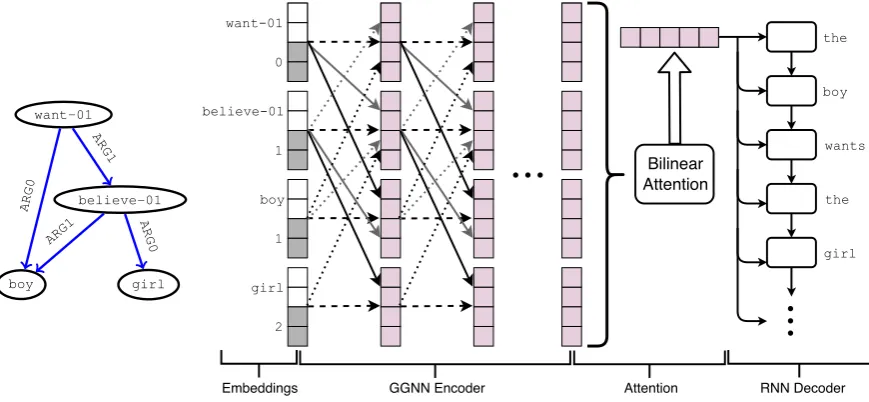
Figure 1: Left: the AMR graph representing the sentence “The boy wants the girl to believe him.”. Right: Our proposed architecture using the same AMR graph as input and the surface form as output. The first layer is a concatenation of node and positional embeddings, using distance from the root node as the position. The GGNN encoder updates the embeddings using edge-wise parameters, represented by different colors (in this example,ARG0andARG1). The encoder also add corresponding reverse edges (dotted arrows) and self edges for each node (dashed arrows). All parameters are shared between layers. Attention and decoder components are similar to standards2smodels. This is a pictorial representation: in our experiments the graphs are transformed before being used as inputs (see§3).
approach: linguistic biases can be added to the in-puts by simple graph transformations, without the need for changes to the model architecture.
2 Neural Graph-to-Sequence Model
Our proposed architecture is shown in Figure 1, with an example AMR graph and its transforma-tion into its surface form. Compared to standard
s2smodels, the main difference is in the encoder, where we employ a GGNN to build a graph repre-sentation. In the following we explain the compo-nents of this architecture in detail.1
2.1 Gated Graph Neural Networks
Early approaches for recurrent networks on graphs (Gori et al., 2005; Scarselli et al., 2009) assume a fixed point representation of the parameters and learn using contraction maps. Li et al. (2016) ar-gues that this restricts the capacity of the model and makes it harder to learn long distance rela-tions between nodes. To tackle these issues, they propose Gated Graph Neural Networks, which ex-tend these architectures with gating mechanisms
1Our implementation uses MXNet (Chen et al., 2015) and
is based on the Sockeye toolkit (Hieber et al., 2017). Code is available at github.com/beckdaniel/acl2018_ graph2seq.
in a similar fashion to Gated Recurrent Units (Cho et al., 2014). This allows the network to be learnt via modern backpropagation procedures.
In following, we formally define the version of GGNNs we employ in this study. Assume a di-rected graph G = {V,E, LV, LE}, where V is a set of nodes(v, `v),Eis a set of edges(vi, vj, `e) andLV andLE are respectively vocabularies for nodes and edges, from which node and edge la-bels (`v and`e) are defined. Given an input graph with nodes mapped to embeddingsX, a GGNN is defined as
h0v =xv
rtv =σ crv X u∈Nv
W`erh(ut−1)+br`e
!
ztv =σ czv X u∈Nv
W`ezh(ut−1)+bz`e
!
e
htv =ρ cv X u∈Nv
W`e
rtuh(ut−1)
+b`e !
hvt = (1−ztv)hv(i−1)+ztvehtv
wheree= (u, v, `e)is the edge between nodesu
andv,N(v)is the set of neighbour nodes forv,ρ
and cv = czv = crv = |Nv|−1 are normalisation
constants.
Our formulation differs from the original GGNNs from Li et al. (2016) in some aspects: 1) we add bias vectors for the hidden state, re-set gate and update gate computations; 2) label-specific matrices do not share any components; 3) reset gates are applied to all hidden states before any computation and 4) we add normalisation con-stants. These modifications were applied based on preliminary experiments and ease of implementa-tion.
An alternative to GGNNs is the model from Marcheggiani and Titov (2017), which add edge label information to Graph Convolutional Net-works (GCNs). According to Li et al. (2016), the main difference between GCNs and GGNNs is analogous to the difference between convolu-tional and recurrent networks. More specifically, GGNNs can be seen as multi-layered GCNs where layer-wise parameters are tied and gating mecha-nisms are added. A large number of layers can propagate node information between longer dis-tances in the graph and, unlike GCNs, GGNNs can have an arbitrary number of layers without in-creasing the number of parameters. Nevertheless, our architecture borrows ideas from GCNs as well, such as normalising factors.
2.2 Using GGNNs in attentional encoder-decoder models
In s2s models, inputs are sequences of tokens where each token is represented by an embedding vector. The encoder then transforms these vec-tors into hidden states by incorporating context, usually through a recurrent or a convolutional net-work. These are fed into an attention mechanism, generating a single context vector that informs de-cisions in the decoder.
Our model follows a similar structure, where the encoder is a GGNN that receivesnodeembeddings as inputs and generatesnodehidden states as out-puts, using the graph structure as context. This is shown in the example of Figure 1, where we have 4 hidden vectors, one per node in the AMR graph. The attention and decoder components fol-low similar standards2smodels, where we use a bilinear attention mechanism (Luong et al., 2015) and a 2-layered LSTM (Hochreiter and Schmid-huber, 1997) as the decoder. Note, however, that other decoders and attention mechanisms can be
easily employed instead. Bastings et al. (2017) employs a similar idea for syntax-based NMT, but using GCNs instead.
2.3 Bidirectionality and positional embeddings
While our architecture can in theory be used with general graphs, rooted directed acyclic graphs (DAGs) are arguably the most common kind in the problems we are addressing. This means that node embedding information is propagated in a top down manner. However, it is desirable to have information flow from the reverse direction as well, in the same way RNN-based encoders benefit from right-to-left propagation (as in bidi-rectional RNNs). Marcheggiani and Titov (2017) and Bastings et al. (2017) achieve this by adding reverse edges to the graph, as well as self-loops edges for each node. These extra edges have spe-cific labels, hence their own parameters in the net-work.
In this work, we also follow this procedure to ensure information is evenly propagated in the graph. However, this raises another limitation: be-cause the graph becomes essentially undirected, the encoder is now unaware of any intrinsic hier-archy present in the input. Inspired by Gehring et al. (2017) and Vaswani et al. (2017), we tackle this problem by adding positional embeddings to every node. These embeddings are indexed by in-teger values representing the minimum distance from the root node and are learned as model pa-rameters.2 This kind of positional embedding is restricted to rooted DAGs: for general graphs, dif-ferent notions of distance could be employed.
3 Levi Graph Transformation
Theg2s model proposed in§2 has two key defi-ciencies. First, GGNNs have three linear transfor-mationsper edge type. This means that the num-ber of parameters can explode: AMR, for instance, has around 100 different predicates, which corre-spond to edge labels. Previous work deal with this problem by explicitly grouping edge labels into a single one (Marcheggiani and Titov, 2017; Bast-ings et al., 2017) but this is not an ideal solution since it incurs in loss of information.
2
want-01
believe-01
boy
girl
ARG1
ARG0
ARG1
ARG0
want-01
believe-01
boy
girl
ARG1
ARG0
ARG1
[image:4.595.74.291.58.365.2]ARG0
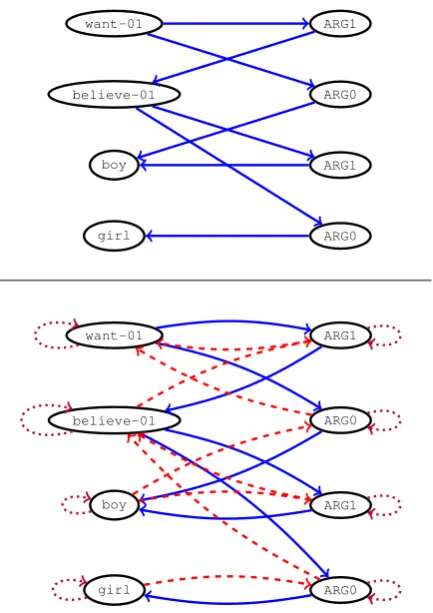
Figure 2: Top: the AMR graph from Figure 1 transformed into its corresponding Levi graph. Bottom: Levi graph with added reverse and self edges (colors represent different edge labels).
The second deficiency is that edge label in-formation is encoded in the form of GGNN pa-rameters in the network. This means that each label will have the same “representation” across all graphs. However, the latent information in edges can depend on the content in which they appear in a graph. Ideally, edges should have instance-specific hidden states, in the same way as nodes, and these should also inform decisions made in the decoder through the attention mod-ule. For instance, in the AMR graph shown in Fig-ure 1, theARG1predicate betweenwant-01and
believe-01 can be interpreted as the prepo-sition “to” in the surface form, while the ARG1
predicate connecting believe-01 and boy is realised as a pronoun. Notice that edge hidden vectors are already present in s2s networks that use linearised graphs: we would like our architec-ture to also have this benefit.
Instead of modifying the architecture, we pro-pose to transform the input graph into its equiv-alent Levi graph (Levi, 1942; Gross and Yellen, 2004, p. 765). Given a graphG={V,E, LV, LE},
a Levi graph3is defined asG ={V0,E0, L
V0, LE0}, whereV0 =V ∪ E,LV0 =LV∪LEandLE0 =∅. The new edge set E0 contains a edge for every (node, edge) pair that is present in the original graph. By definition, the Levi graph is bipartite.
Intuitively, transforming a graph into its Levi graph equivalent turns edges into additional nodes. While simple in theory, this transformation ad-dresses both modelling deficiencies mentioned above in an elegant way. Since the Levi graph has no labelled edges there is no risk of parame-ter explosion: original edge labels are represented as embeddings, in the same way as nodes. Further-more, the encoder now naturally generates hidden states for original edges as well.
In practice, we follow the procedure in §2.3 and add reverse and self-loop edges to the Levi graph, so the practical edge label vocabulary is
LE0 = {default,reverse,self}. This still keeps the parameter space modest since we have only three labels. Figure 2 shows the transformation steps in detail, applied to the AMR graph shown in Figure 1. Notice that the transformed graphs are the ones fed into our architecture: we show the original graph in Figure 1 for simplicity.
It is important to note that this transformation can be applied to any graph and therefore is inde-pendent of the model architecture. We speculate this can be beneficial in other kinds of graph-based encoder such as GCNs and leave further investiga-tion to future work.
4 Generation from AMR Graphs
Our first g2s benchmark is language genera-tion from AMR, a semantic formalism that repre-sents sentences as rooted DAGs (Banarescu et al., 2013). Because AMR abstracts away from syntax, graphs do not have gold-standard alignment infor-mation, so generation is not a trivial task. There-fore, we hypothesize that our proposed model is ideal for this problem.
4.1 Experimental setup
Data and preprocessing We use the latest AMR corpus release (LDC2017T10) with the default split of 36521/1368/1371 instances for training,
3
development and test sets. Each graph is prepro-cessed using a procedure similar to what is per-formed by Konstas et al. (2017), which includes entity simplification and anonymisation. This pre-processing is done before transforming the graph into its Levi graph equivalent. For thes2s base-lines, we also add scope markers as in Konstas et al. (2017). We detail these procedures in the Supplementary Material.
Models Our baselines are attentionals2s mod-els which take linearised graphs as inputs. The architecture is similar to the one used in Konstas et al. (2017) for AMR generation, where the en-coder is a BiLSTM followed by a unidirectional LSTM. All dimensionalities are fixed to 512.
For theg2smodels, we fix the number of layers in the GGNN encoder to 8, as this gave the best results on the development set. Dimensionalities are also fixed at 512 except for the GGNN encoder which uses 576. This is to ensure all models have a comparable number of parameters and therefore similar capacity.
Training for all models uses Adam (Kingma and Ba, 2015) with 0.0003 initial learning rate and 16 as the batch size.4 To regularise our models we perform early stopping on the dev set based on perplexity and apply 0.5 dropout (Srivastava et al., 2014) on the source embeddings. We detail addi-tional model and training hyperparameters in the Supplementary Material.
Evaluation Following previous work, we eval-uate our models using BLEU (Papineni et al., 2001) and perform bootstrap resampling to check statistical significance. However, since re-cent work has questioned the effectiveness of BLEU with bootstrap resampling (Graham et al., 2014), we also report results using sentence-level CHRF++ (Popovi´c, 2017), using the Wilcoxon signed-rank test to check significance. Evaluation is case-insensitive for both metrics.
Recent work has shown that evaluation in neu-ral models can lead to wrong conclusions by just changing the random seed (Reimers and Gurevych, 2017). In an effort to make our con-clusions more robust, we run each model 5 times using different seeds. From each pool, we report
4
Larger batch sizes hurt dev performance in our prelim-inary experiments. There is evidence that small batches can lead to better generalisation performance (Keskar et al., 2017). While this can make training time slower, it was doable in our case since the dataset is small.
BLEU CHRF++ #params
Single models
s2s 21.7 49.1 28.4M
s2s(-s) 18.4 46.3 28.4M
g2s 23.3 50.4 28.3M
Ensembles
s2s 26.6 52.5 142M
s2s(-s) 22.0 48.9 142M
g2s 27.5 53.5 141M
Previous work (early AMR treebank versions)
KIYCZ17 22.0 – –
Previous work (as above + unlabelled data)
KIYCZ17 33.8 – –
PKH16 26.9 – –
SPZWG17 25.6 – –
[image:5.595.308.524.61.303.2]FDSC16 22.0 – –
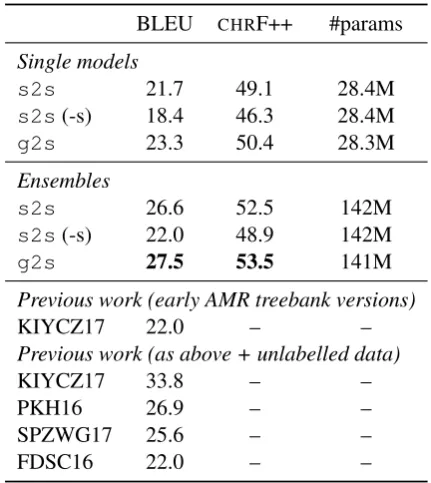
Table 1: Results for AMR generation on the test set. All score differences between our models and the corresponding baselines are significantly dif-ferent (p<0.05). “(-s)” means input without scope marking. KIYCZ17, PKH16, SPZWG17 and FDSC16 are respectively the results reported in Konstas et al. (2017), Pourdamghani et al. (2016), Song et al. (2017) and Flanigan et al. (2016).
results using the median model according to per-formance on the dev set (simulating what is ex-pected from a single run) and using an ensemble of the 5 models.
Finally, we also report the number of parame-ters used in each model. Since our encoder archi-tectures are quite different, we try to match the number of parameters between them by chang-ing the dimensionality of the hidden layers (as ex-plained above). We do this to minimise the effects of model capacity as a confounder.
4.2 Results and analysis
Table 1 shows the results on the test set. For the s2s models, we also report results without the scope marking procedure of Konstas et al. (2017). Our approach significantly outperforms thes2sbaselines both with individual models and ensembles, while using a comparable number of parameters. In particular, we obtain these results without relying on scoping heuristics.
refer-Original AMR graph
(p / propose-01 :ARG0 (c / country
:wiki "Russia" :name (n / name
:op1 "Russia"))
:ARG1 (c5 / cooperate-01 :ARG0 c
:ARG1 (a / and
:op1 (c2 / country
:wiki "India" :name (n2 / name
:op1 "India"))
:op2 (c3 / country
:wiki "China" :name (n3 / name
:op1 "China")))) :purpose (i / increase-01
:ARG0 c5
:ARG1 (s / security) :location (a2 / around
:op1 (c4 / country :wiki "Afghanistan" :name (n4 / name
:op1 "Afghanistan"))) :purpose (b / block-01
:ARG0 (a3 / and
:op1 c :op2 c2 :op3 c3
:ARG1 (s2 / supply-01 :ARG1 (d / drug)))))
Reference surface form
Russia proposes cooperation withIndia and Chinato in-crease security around Afghanistan to block drug supplies.
s2soutput (CHRF++ 61.8)
Russia proposed cooperation withIndia and Chinato in-crease security around the Afghanistan to block security around the Afghanistan ,India and China.
g2soutput (CHRF++ 78.2)
Russia proposed cooperation withIndia and Chinato in-crease security around Afghanistan to block drug supplies.
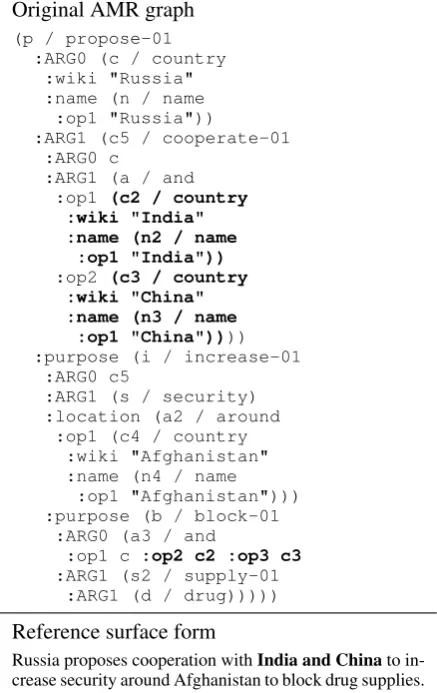
Figure 3: Example showing overgeneration due to reentrancies. Top: original AMR graph with key reentrancies highlighted. Bottom: reference and outputs generated by the s2s and g2s models, highlighting the overgeneration phenomena.
[image:6.595.72.291.68.415.2]ence previously defined concepts in the graph. In the s2s models including Konstas et al. (2017), reentrant nodes are copied in the linearised form, while this is not necessary for our g2s models. We can see that thes2sprediction overgenerates the “India and China” phrase. The g2s predic-tion avoids overgenerapredic-tion, and almost perfectly matches the reference. While this is only a sin-gle example, it provides evidence that retaining the full graphical structure is beneficial for this task, which is corroborated by our quantitative results.
Table 1 also show BLEU scores reported in pre-vious work. These results are not strictly com-parable because they used different training set versions and/or employ additional unlabelled cor-pora; nonetheless some insights can be made. In particular, ourg2sensemble performs better than many previous models that combine a smaller training set with a large unlabelled corpus. It is also most informative to compare ours2smodel with Konstas et al. (2017), since this baseline is very similar to theirs. We expected our single model baseline to outperform theirs since we use a larger training set but we obtained similar per-formance. We speculate that better results could be obtained by more careful tuning, but neverthe-less we believe such tuning would also benefit our proposedg2sarchitecture.
The best results with unlabelled data are ob-tained by Konstas et al. (2017) using Gigaword sentences as additional data and a paired trained procedure with an AMR parser. It is important to note that this procedure is orthogonal to the in-dividual models used for generation and parsing. Therefore, we hypothesise that our model can also benefit from such techniques, an avenue that we leave for future work.
5 Syntax-based Neural Machine Translation
Our second evaluation is NMT, using as graphs source language dependency syntax trees. We fo-cus on a medium resource scenario where addi-tional linguistic information tends to be more ben-eficial. Our experiments comprise two language pairs: English-German and English-Czech.
5.1 Experimental setup
Data and preprocessing We employ the same data and settings from Bastings et al. (2017),5 which use the News Commentary V11 corpora from the WMT16 translation task.6 English text is tokenised and parsed using SyntaxNet7 while German and Czech texts are tokenised and split into subwords using byte-pair encodings (Sen-nrich et al., 2016, BPE) (8000 merge operations).
5
We obtained the data from the original authors to ensure results are comparable without any influence from prepro-cessing steps.
6http://www.statmt.org/wmt16/
translation-task.html
7https://github.com/tensorflow/models/
We refer to Bastings et al. (2017) for further infor-mation on the preprocessing steps.
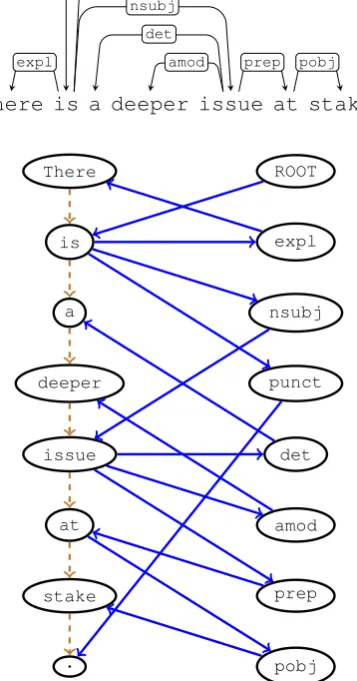
Labelled dependency trees in the source side are transformed into Levi graphs as a preprocessing step. However, unlike AMR generation, in NMT the inputs are originally surface forms that contain important sequential information. This informa-tion is lost when treating the input as dependency trees, which might explain why Bastings et al. (2017) obtain the best performance when using an initial RNN layer in their encoder. To investigate this phenomenon, we also perform experiments adding sequential connections to each word in the dependency tree, corresponding to their order in the original surface form (henceforth, g2s+). These connections are represented as edges with specificleftandrightlabels, which are added af-ter the Levi graph transformation. Figure 4 shows an example of an input graph forg2s+, with the additional sequential edges connecting the words (reverse and self edges are omitted for simplicity).
Models Our s2s and g2s models are almost the same as in the AMR generation experiments (§4.1). The only exception is the GGNN encoder dimensionality, where we use 512 for the experi-ments with dependency trees only and 448 when the inputs have additional sequential connections. As in the AMR generation setting, we do this to ensure model capacity are comparable in the num-ber of parameters. Another key difference is that the s2s baselines do not use dependency trees: they are trained on the sentences only.
In addition to neural models, we also report re-sults for Phrase-Based Statistical MT (PB-SMT), using Moses (Koehn et al., 2007). The PB-SMT models are trained using the same data conditions ass2s(no dependency trees) and use the standard setup in Moses, except for the language model, where we use a 5-gram LM trained on the target side of the respective parallel corpus.8
Evaluation We report results in terms of BLEU andCHRF++, using case-sensitive versions of both metrics. Other settings are kept the same as in the AMR generation experiments (§4.1). For PB-SMT, we also report the median result of 5 runs, obtained by tuning the model using MERT (Och and Ney, 2002) 5 times.
8Note that target data is segmented using BPE, which is
not the usual setting for PB-SMT. We decided to keep the segmentation to ensure data conditions are the same.
There is a deeper issue at stake .
ROOT
expl
nsubj
punct
det
amod prep pobj
There
is
a
deeper
issue
at
stake
.
ROOT
expl
nsubj
punct
det
amod
prep
[image:7.595.324.503.90.431.2]pobj
Figure 4: Top: a sentence with its corresponding dependency tree. Bottom: the transformed tree into a Levi graph with additional sequential con-nections between words (dashed lines). The full graph also contains reverse and self edges, which are omitted in the figure.
5.2 Results and analysis
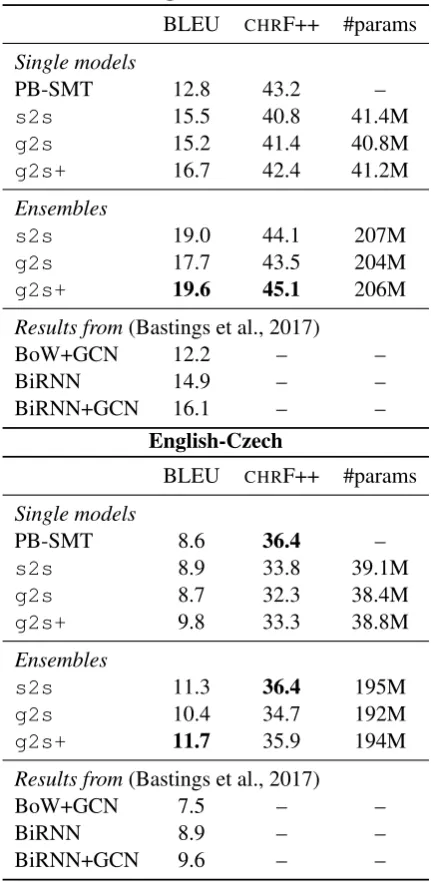
English-German
BLEU CHRF++ #params
Single models
PB-SMT 12.8 43.2 –
s2s 15.5 40.8 41.4M
g2s 15.2 41.4 40.8M
g2s+ 16.7 42.4 41.2M
Ensembles
s2s 19.0 44.1 207M
g2s 17.7 43.5 204M
g2s+ 19.6 45.1 206M
Results from(Bastings et al., 2017)
BoW+GCN 12.2 – –
BiRNN 14.9 – –
BiRNN+GCN 16.1 – –
English-Czech
BLEU CHRF++ #params
Single models
PB-SMT 8.6 36.4 –
s2s 8.9 33.8 39.1M
g2s 8.7 32.3 38.4M
g2s+ 9.8 33.3 38.8M
Ensembles
s2s 11.3 36.4 195M
g2s 10.4 34.7 192M
g2s+ 11.7 35.9 194M
Results from(Bastings et al., 2017)
BoW+GCN 7.5 – –
BiRNN 8.9 – –
[image:8.595.73.289.77.519.2]BiRNN+GCN 9.6 – –
Table 2: Results for syntax-based NMT on the test sets. All score differences between our models and the corresponding baselines are significantly dif-ferent (p<0.05), including the negative CHRF++ result for En-Cs.
Interestingly, we found different trends when analysing theCHRF++ numbers. In particular, this metric favours the PB-SMT models for both lan-guage pairs, while also showing improved perfor-mance fors2sin En-Cs.CHRF++ has been shown to better correlate with human judgments com-pared to BLEU, both at system and sentence level for both language pairs (Bojar et al., 2017), which motivated our choice as an additional metric. We leave further investigation of this phenomena for future work.
We also show some of the results reported by Bastings et al. (2017) in Table 2. Note that their results were based on a different implementation, which may explain some variation in performance. Their BoW+GCN model is the most similar to ours, as it uses only an embedding layer and a GCN encoder. We can see that even our sim-pler g2smodel outperforms their results. A key difference between their approach and ours is the Levi graph transformation and the resulting hidden vectors for edges. We believe their architecture would also benefit from our proposed transforma-tion. In terms of baselines, s2s performs better than their BiRNN model for En-De and compara-bly for En-Cs, which corroborates that our base-lines are strong ones. Finally, our g2s+ single models outperform their BiRNN+GCN results, in particular for En-De, which is further evidence that RNNs are not necessary for obtaining the best performance in this setting.
An important point about these experiments is that we did not tune the architecture: we simply employed the same model we used in the AMR generation experiments, only adjusting the dimen-sionality of the encoder to match the capacity of the baselines. We speculate that even better re-sults would be obtained by tuning the architecture to this task. Nevertheless, we still obtained im-proved performance over our baselines and previ-ous work, underlining the generality of our archi-tecture.
6 Related work
Graph-to-sequence modelling Early NLP ap-proaches for this problem were based on Hy-peredge Replacement Grammars (Drewes et al., 1997, HRGs). These grammars assume the trans-duction problem can be split into rules that map portions of a graph to a set of tokens in the out-put sequence. In particular, Chiang et al. (2013) defines a parsing algorithm, followed by a com-plexity analysis, while Jones et al. (2012) report experiments on semantic-based machine transla-tion using HRGs. HRGs were also used in pre-vious work on AMR parsing (Peng et al., 2015). The main drawback of these grammar-based ap-proaches though is the need for alignments be-tween graph nodes and surface tokens, which are usually not available in gold-standard form.
un-der the name Graph Neural Networks (Gori et al., 2005; Scarselli et al., 2009). Our work is based on the architecture proposed by Li et al. (2016), which add gating mechanisms. The main differ-ence between their work and ours is that they fo-cus on problems that concern the input graph it-self such as node classification or path finding while we focus on generating strings. The main alternative for neural-based graph representations is Graph Convolutional Networks (Bruna et al., 2014; Duvenaud et al., 2015; Kipf and Welling, 2017), which have been applied in a range of prob-lems. In NLP, Marcheggiani and Titov (2017) use a similar architecture for Semantic Role Labelling. They use heuristics to mitigate the parameter ex-plosion by grouping edge labels, while we keep the original labels through our Levi graph trans-formation. An interesting alternative is proposed by Schlichtkrull et al. (2017), which uses tensor factorisation to reduce the number of parameters.
Applications Early work on AMR generation employs grammars and transducers (Flanigan et al., 2016; Song et al., 2017). Linearisation ap-proaches include (Pourdamghani et al., 2016) and (Konstas et al., 2017), which showed that graph simplification and anonymisation are key to good performance, a procedure we also employ in our work. However, compared to our approach, lin-earisation incurs in loss of information. MT has a long history of previous work that aims at incor-porating syntax (Wu, 1997; Yamada and Knight, 2001; Galley et al., 2004; Liu et al., 2006, inter alia). This idea has also been investigated in the context of NMT. Bastings et al. (2017) is the most similar work to ours, and we benchmark against their approach in our NMT experiments. Eriguchi et al. (2016) also employs source syntax, but us-ing constituency trees instead. Other approaches have investigated the use of syntax in the target language (Aharoni and Goldberg, 2017; Eriguchi et al., 2017). Finally, Hashimoto and Tsuruoka (2017) treats source syntax as a latent variable, which can be pretrained using annotated data.
7 Discussion and Conclusion
We proposed a novel encoder-decoder architec-ture for graph-to-sequence learning, outperform-ing baselines in two NLP tasks: generation from AMR graphs and syntax-based NMT. Our approach addresses shortcomings from previous work, including loss of information from
lineari-sation and parameter explosion. In particular, we showed how graph transformations can solve is-sues with graph-based networks without chang-ing the underlychang-ing architecture. This is the case of the proposed Levi graph transformation, which ensures the decoder can attend to edges as well as nodes, but also to the sequential connections added to the dependency trees in the case of NMT. Overall, because our architecture can work with general graphs, it is straightforward to add linguis-tic biases in the form of extra node and/or edge information. We believe this is an interesting re-search direction in terms of applications.
Our architecture nevertheless has two major limitations. The first one is that GGNNs have a fixed number of layers, even though graphs can vary in size in terms of number of nodes and edges. A better approach would be to allow the encoder to have a dynamic number of layers, pos-sibly based on the diameter (longest path) in the input graph. The second limitation comes from the Levi graph transformation: because edge la-bels are represented as nodes they end up shar-ing the vocabulary and therefore, the same seman-tic space. This is not ideal, as nodes and edges are different entities. An interesting alternative is Weave Module Networks (Kearnes et al., 2016), which explicitly decouples node and edge repre-sentations without incurring in parameter explo-sion. Incorporating both ideas to our architecture is an research direction we plan for future work.
Acknowledgements
This work was supported by the Australian Re-search Council (DP160102686). The research reported in this paper was partly conducted at the 2017 Frederick Jelinek Memorial Summer Workshop on Speech and Language Technolo-gies, hosted at Carnegie Mellon University and sponsored by Johns Hopkins University with un-restricted gifts from Amazon, Apple, Facebook, Google, and Microsoft. The authors would also like to thank Joost Bastings for sharing the data from his paper’s experiments.
References
Roee Aharoni and Yoav Goldberg. 2017. Towards String-to-Tree Neural Machine Translation. In Pro-ceedings of ACL. pages 132–140.
Knight, Philipp Koehn, Martha Palmer, and Nathan Schneider. 2013. Abstract Meaning Representation for Sembanking. InProceedings of the 7th Linguis-tic Annotation Workshop and Interoperability with Discourse. pages 178–186.
Joost Bastings, Ivan Titov, Wilker Aziz, Diego Marcheggiani, and Khalil Sima’an. 2017. Graph Convolutional Encoders for Syntax-aware Neural Machine Translation. In Proceedings of EMNLP. pages 1947–1957.
Ondej Bojar, Yvette Graham, and Amir Kamran. 2017. Results of the WMT17 Metrics Shared Task. In Pro-ceedings of WMT. volume 2, pages 293–301.
Joan Bruna, Wojciech Zaremba, Arthur Szlam, and Yann LeCun. 2014. Spectral Networks and Locally Connected Networks on Graphs. InProceedings of ICLR. page 14.
Tianqi Chen, Mu Li, Yutian Li, Min Lin, Naiyan Wang, Minjie Wang, Tianjun Xiao, Bing Xu, Chiyuan Zhang, and Zheng Zhang. 2015. MXNet: A Flexible and Efficient Machine Learning Library for Hetero-geneous Distributed Systems. InProceedings of the Workshop on Machine Learning Systems. pages 1–6.
David Chiang, Jacob Andreas, Daniel Bauer, Karl Moritz Hermann, Bevan Jones, and Kevin Knight. 2013. Parsing Graphs with Hyperedge Replacement Grammars. In Proceedings of ACL. pages 924–932.
Kyunghyun Cho, Bart van Merrienboer, Caglar Gul-cehre, Dzmitry Bahdanau, Fethi Bougares, Hol-ger Schwenk, and Yoshua Bengio. 2014. Learn-ing Phrase Representations usLearn-ing RNN Encoder-Decoder for Statistical Machine Translation. In Pro-ceedings of EMNLP. pages 1724–1734.
Frank Drewes, Hans J¨org Kreowski, and Annegret Ha-bel. 1997. Hyperedge Replacement Graph Gram-mars. Handbook of Graph Grammars and Comput-ing by Graph Transformation.
David Duvenaud, Dougal Maclaurin, Jorge Aguilera-Iparraguirre, Rafael G´omez-Bombarelli, Timothy Hirzel, Al´an Aspuru-Guzik, and Ryan P Adams. 2015. Convolutional Networks on Graphs for Learning Molecular Fingerprints. InProceedings of NIPS. pages 2215–2223.
Akiko Eriguchi, Kazuma Hashimoto, and Yoshimasa Tsuruoka. 2016. Tree-to-Sequence Attentional Neu-ral Machine Translation. InProceedings of ACL.
Akiko Eriguchi, Yoshimasa Tsuruoka, and Kyunghyun Cho. 2017. Learning to Parse and Translate Im-proves Neural Machine Translation. InProceedings of ACL.
Jeffrey Flanigan, Chris Dyer, Noah A. Smith, and Jaime Carbonell. 2016. Generation from Abstract Meaning Representation using Tree Transducers. In
Proceedings of NAACL. pages 731–739.
Michel Galley, Mark Hopkins, Kevin Knight, and Daniel Marcu. 2004. What’s in a translation rule? InProceedings of NAACL. pages 273–280.
Jonas Gehring, Michael Auli, David Grangier, Denis Yarats, and Yann N. Dauphin. 2017. Convolutional Sequence to Sequence Learning. arXiv preprint.
Marco Gori, Gabriele Monfardini, and Franco Scarselli. 2005. A New Model for Learning in Graph Domains. In Proceedings of IJCNN. vol-ume 2, pages 729–734.
Yvette Graham, Nitika Mathur, and Timothy Baldwin. 2014. Randomized Significance Tests in Machine Translation. In Proceedings of WMT. pages 266– 274.
Jonathan Gross and Jay Yellen, editors. 2004. Hand-book of Graph Theory. CRC Press.
Kazuma Hashimoto and Yoshimasa Tsuruoka. 2017. Neural Machine Translation with Source-Side La-tent Graph Parsing. In Proceedings of EMNLP. pages 125–135.
Felix Hieber, Tobias Domhan, Michael Denkowski, David Vilar, Artem Sokolov, Ann Clifton, and Matt Post. 2017. Sockeye: A Toolkit for Neural Machine Translation. arXiv preprintpages 1–18.
Sepp Hochreiter and J¨urgen Schmidhuber. 1997. Long Short-Term Memory. Neural Computation
9(8):1735–1780.
Bevan Jones, Jacob Andreas, Daniel Bauer, Karl Moritz Hermann, and Kevin Knight. 2012. Semantics-Based Machine Translation with Hyper-edge Replacement Grammars. In Proceedings of COLING. pages 1359–1376.
Steven Kearnes, Kevin McCloskey, Marc Berndl, Vi-jay Pande, and Patrick Riley. 2016. Molecu-lar Graph Convolutions: Moving Beyond Finger-prints. Journal of Computer-Aided Molecular De-sign30(8):595–608.
Nitish Shirish Keskar, Dheevatsa Mudigere, Jorge No-cedal, Mikhail Smelyanskiy, and Ping Tak Peter Tang. 2017. On Large-Batch Training for Deep Learning: Generalization Gap and Sharp Minima. InProceedings of ICLR. pages 1–16.
Diederik P. Kingma and Jimmy Ba. 2015. Adam: A Method for Stochastic Optimization. In Proceed-ings of ICLR. pages 1–15.
Thomas N. Kipf and Max Welling. 2017. Semi-Supervised Classification with Graph Convolutional Networks. InProceedings of ICLR.
Philipp Koehn, Hieu Hoang, Alexandra Birch, Chris Callison-Burch, Marcello Federico, Nicola Bertoldi, Brooke Cowan, Wade Shen, Christine Moran, Richard Zens, Chris Dyer, Ondrej Bojar, Alexandra Constantin, and Evan Herbst. 2007. Moses: Open source toolkit for statistical machine translation. In
Ioannis Konstas, Srinivasan Iyer, Mark Yatskar, Yejin Choi, and Luke Zettlemoyer. 2017. Neural AMR: Sequence-to-Sequence Models for Parsing and Gen-eration. InProceedings of ACL. pages 146–157.
Friedrich Wilhelm Levi. 1942. Finite Geometrical Sys-tems.
Yujia Li, Daniel Tarlow, Marc Brockschmidt, and Richard Zemel. 2016. Gated Graph Sequence Neu-ral Networks. InProceedings of ICLR. 1, pages 1– 20.
Yang Liu, Qun Liu, and Shouxun Lin. 2006. Tree-to-string alignment template for statistical machine translation. InProceedings of the 21st International Conference on Computational Linguistics and the 44th annual meeting of the ACL - ACL ’06. pages 609–616.
Minh-Thang Luong, Hieu Pham, and Christopher D. Manning. 2015. Effective Approaches to Attention-based Neural Machine Translation. InProceedings of EMNLP. pages 1412–1421.
Diego Marcheggiani and Ivan Titov. 2017. Encod-ing Sentences with Graph Convolutional Networks for Semantic Role Labeling. In Proceedings of EMNLP.
Franz Josef Och and Hermann Ney. 2002. Dis-criminative training and maximum entropy mod-els for statistical machine translation. In Proceed-ings of the 40th Annual Meeting on Association for Computational Linguistics - ACL ’02. page 295. https://doi.org/10.3115/1073083.1073133.
Kishore Papineni, Salim Roukos, Todd Ward, and Wei-Jing Zhu. 2001. Bleu: a method for automatic eval-uation of machine translation. In Proceedings of ACL. pages 311–318.
Xiaochang Peng, Linfeng Song, and Daniel Gildea. 2015. A Synchronous Hyperedge Replacement Grammar based approach for AMR parsing. In Pro-ceedings of CoNLL. pages 32–41.
Maja Popovi´c. 2017. chrF ++: words helping character n-grams. InProceedings of WMT. pages 612–618.
Nima Pourdamghani, Kevin Knight, and Ulf Herm-jakob. 2016. Generating English from Abstract Meaning Representations. InProceedings of INLG. volume 0, pages 21–25.
Nils Reimers and Iryna Gurevych. 2017. Reporting Score Distributions Makes a Difference: Perfor-mance Study of LSTM-networks for Sequence Tag-ging. InProceedings of EMNLP. pages 338–348.
Franco Scarselli, Marco Gori, Ah Ching Tsoi, and Gabriele Monfardini. 2009. The Graph Neural Net-work Model. IEEE Transactions on Neural Net-works20(1):61–80.
Michael Schlichtkrull, Thomas N. Kipf, Peter Bloem, Rianne van den Berg, Ivan Titov, and Max Welling. 2017. Modeling Relational Data with Graph Convo-lutional Networks pages 1–12.
Rico Sennrich, Barry Haddow, and Alexandra Birch. 2016. Neural Machine Translation of Rare Words with Subword Units. InProceedings of ACL. pages 1715–1725.
Linfeng Song, Xiaochang Peng, Yue Zhang, Zhiguo Wang, and Daniel Gildea. 2017. AMR-to-text Gen-eration with Synchronous Node Replacement Gram-mar. InProceedings of ACL. pages 7–13.
Nitish Srivastava, Geoffrey Hinton, Alex Krizhevsky, Ilya Sutskever, and Ruslan Salakhutdinov. 2014. Dropout: A Simple Way to Prevent Neural Networks from Overfitting. Journal of Machine Learning Re-search15:1929–1958.
Ashish Vaswani, Noam Shazeer, Niki Parmar, Jakob Uszkoreit, Llion Jones, Aidan N. Gomez, Lukasz Kaiser, and Illia Polosukhin. 2017. Attention Is All You Need. InProceedings of NIPS.
Dekai Wu. 1997. Stochastic inversion transduction grammars and bilingual parsing of parallel corpora.
Computational Linguistics23(3):377–403.