191
Extraction of Lactation Frames from Drug Labels and LactMed
Heath Goodrum, Meghana Gudala, Ankita Misra, Kirk Roberts
School of Biomedical Informatics
University of Texas Health Science Center at Houston
{heath.goodrum,kirk.roberts}@uth.tmc.edu
Abstract
This paper describes a natural language processing (NLP) approach to extracting lactation-specific drug information from two sources: FDA-mandated drug labels and the NLM Drugs and Lactation Database (LactMed). A frame semantic approach is utilized, and the paper describes the selected frames, their annotation on a set of 900 sec-tions from drug labels and LactMed articles, and the NLP system to extract such frame in-stances automatically. The ultimate goal of the project is to use such a system to identify dis-crepancies in lactation-related drug informa-tion between these resources.
1 Introduction
Medical information about prescription drugs is publicly available in a variety of sources, includ-ing the biomedical literature, consumer-focused websites, and the drug labels mandated by the U.S. Food & Drug Administration (FDA). But the rapid advances in biomedicine—especially recently-approved drugs—threatens to make these sources discordant. Synchronizing such sources is difficult due to their unstructured nature and the wide variety of ways in which they are organized. This paper presents initial work in an effort to align two such sources—drug labels and a single consumer health website—for information partic-ular to a single sub-population—nursing mothers. This is a critical sub-population for providing validated health information to, especially for pre-scription drugs. Notably, randomized trials, the gold standard in drug evaluation, contain few if any nursing mothers in their trial populations. Thus, the information that a pharmaceutical sub-stance has on such mothers and their children is scarce and of poor evidence quality, which only serves to promote misinformation and discourage
mothers from taking needed medications. Author-itative guidance is critical in regards to what is supported or contradicted by the limited evidence, as well as what is simply unknown. Several pub-lic sources attempt to provide such authoritative information. Here, two such sources are studied: a section of drug labels specific to nursing moth-ers and a government website specific to drugs and lactation, LactMed. By identifying discrepancies in the free text narratives of these sources, further review can pinpoint information gaps, conflicting opinions, and out-of-date guidance.
The general strategy proposed in this paper in-volves (a) identifying seven key information types of drug information specific to nursing mothers, (b) utilizing linguistically-motivated frame seman-tic representations for these information types, (c) annotating instances of these frames on both lacta-tion informalacta-tion sources, and (d) developing natu-ral language processing (NLP) methods to extract this information automatically from these sources.
Our specific contributions include:
1. The first NLP method to focus specifically on drug information for nursing mothers.
2. Development of frame representations for lactation-specific drug information.
3. Application of a deep learning-based sys-tem on two separate lactation information sources, drug labels and LactMed.
4. Evaluation of cross-corpus similarity in terms of important lactation information.
2 Related Work
The existing work related to that proposed here is broken down into information extraction efforts on drug labels (§2.1), maternal health in particular (§2.2), and frame semantics in biomedicine (§2.3).
2.1 Drug Label Information Extraction
Drug labels contain a wealth of unstructured in-formation relating to FDA-approved pharmaceuti-cals, and thus have proven to be a consistent target of NLP-based systems interested in automatically creating knowledge bases (KBs) (Harpaz et al.,
2014). For instance, SIDER (Kuhn et al., 2010,
2016) is a well-used KB, constructed from drug labels, for adverse drug reaction (ADR) informa-tion (i.e., side effects). The 2017 TAC ADR task (Roberts et al.,2017) utilized a corpus of 200 drug labels with sections specific to ADR information (Demner-Fushman et al., 2018b). On the other hand,Duke et al.(2013) demonstrated the dangers of using drug labels as an ADR KB by identifying numerous inconsistencies between the labels for bioequivalent drugs. Meanwhile, drug indications (i.e., the medical condition the drug is intended to treat) have also been well-studied (N´ev´eol and Lu,2010;Fung et al.,2013;Li et al.,2013;Khare et al., 2014), as have drug interactions ( Demner-Fushman et al.,2018a). All of these focus on gen-eral aspects of a drug, while hardly any work has focused on the information in drug labels related to specific populations, though both the TAC task as well asCulbertson et al.(2014) identified ADR-population relations.
2.2 Maternal Health Information Extraction
A few NLP methods have been applied to support maternal health. This includes processing biomed-ical literature to support evidence-based review of maternal mortality (de Groot et al., 2015) and identifying genes associated with placenta-mediated maternal diseases (Rodriguez et al.,
2017). Electronic health record (EHR) data has been used to identify important maternal health information (Borra et al., 2013; Abhyankar and Demner-Fushman, 2013) and screen for suicide (Zhong et al.,2018,2019). Social media has been used to identify pregnant women (Chandrashekar et al., 2017; Sarker et al., 2017). Finally, only one known work focuses drug labels for maternal health, focusing on the identification of pregnancy risk categories (Rodriguez and Fushman,2015).
2.3 Frame Semantics in Biomedicine
Frame semantics (Fillmore, 1976,1982) is a lin-guistic theory that postulates the meaning of most words is understood in relation to a conceptual frame in which entities take part. E.g., the mean-ing of sell in the “Jerry sold a car to Chuck” evokes a frame related to COMMERCE, which
in-cludes four elements: BUYER, SELLER, MONEY, and GOODS, though not all elements are required (as with MONEYhere). Frames also include a
lexi-cal unit that triggers the frame (“sold” in the exam-ple). Frames provide a good connection between an abstract information representation and the ac-tual text that specifies that information, and is thus a natural choice for a task such as identifying de-tailed lactation information in drug labels. Most notably, frame semantics have been operational-ized in the large-scale resource FrameNet (Baker et al.,1998,2003), though this resource is not spe-cific to biomedicine.
Several works have explicitly extended FrameNet for biomedical tasks. This includes frame for molecular biology information (Dolbey et al., 2006; Dolbey, 2009; Tan, 2014), cancer information from EHRs (Roberts et al., 2018;
Si and Roberts, 2018; Datta et al., 2017), and general medical information for Swedish ( Kokki-nakis, 2013). Many other works have implicitly used representations that are similar to frames, including the TAC ADR task data on drug labels (Roberts et al., 2017; Demner-Fushman et al.,
2018b).
3 Data
Two different datasets were used to create the text corpus for frame annotation. Section3.1describes the drug labels dataset and Section3.2 describes the LactMed dataset.
3.1 Lactation Information in Drug Labels
Drug labels were downloaded in August 2018 from the full release collection made available by DailyMed1. DailyMed is a public website oper-ated by the National Library of Medicine (NLM) and is the official provider of FDA label informa-tion. These labels are maintained in a document markup standard approved by Health Level Seven (HL7) referred to as Structured Product Labeling (SPL), which specifies various drug label sections.
Figure 1: Example “Lactation” section of a drug label
For this work, only the lactation section was ex-tracted. An example of this section is shown in Figure1.
3.2 LactMed
LactMed2 is a database created by the National Library of Medicine under the collection of TOXNET databases. LactMed provides informa-tion about various drugs and chemicals that nurs-ing mothers may be exposed to that may then be passed to their infant through breast feed-ing. Information provided in LactMed includes the amount of a substance that may be excreted into breast milk, the absorption rate of an infant, and any potential adverse effects to a nursing in-fant. Data in LactMed is derived from reviews of the scientific literature, with each entry includ-ing references. Additionally, all records are peer-reviewed by a panel of experts. For this work, only the “Summary of Use During Lactation” section was extracted for each LactMed article. An exam-ple of this section is shown in Figure2.
3.3 Preprocessing
Each individual drug label is stored in the Daily-Med collection as a zip compressed folder that in-cludes the drug label as an XML file and scanned images of the label. We extracted the folders and parsed each XML document to identify the rele-vant lactation information. While the drug labels provide additional information regarding the use of the drug, only section 8.2, “Lactation”, was extracted into individual documents for each la-bel. Prior to a specification change in June 2015,
2https://toxnet.nlm.nih.gov/newtoxnet/lactmed.htm
Figure 2: Example “Use During Lactation” section from LactMed
this section was labeled as section 8.3, “Nursing Mothers”. There were 37,005 separate drug labels parsed. Of those, lactation information was iden-tified in 31,309 drug labels. Additionally, since many drug labels exist for the same drug, due to multiple manufactures and dosage amounts, only the lactation information from the most recent la-bel for a drug was extracted. After this process of selecting only unique drug labels based on name, a dataset of 4,486 documents was created.
The entirety of LactMed is made available as a single XML document. This file was parsed to identify the drug name and the Summary of Use During Lactation section. Each LactMed article was already unique, therefore no de-duplication process is required. In total, 1,151 documents were created from LactMed.
4 Lactation Frames
Section 4.1 describes the frames annotated for both the drug labels and LactMed. Section4.2 de-scribes the annotation process.
4.1 Frame Descriptions
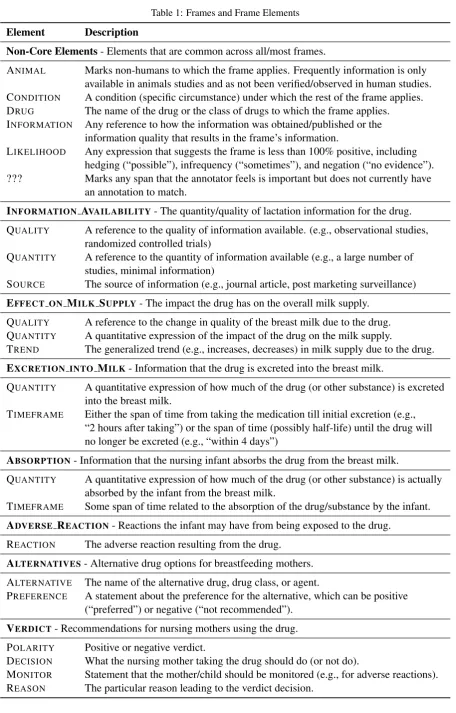
Since one of the primary purposes of annotating these two datasets is to compare information between them, a standard set of frames was chosen that would be applicable to both datasets. Seven lactation-related frames were chosen based on an initial review of sample drug labels and LactMed entries. These frames, detailed in Table 1, are: INFORMATION AVAILABILITY, EFFECT ON MILK SUPPLY,
Table 1: Frames and Frame Elements
Element Description
Non-Core Elements- Elements that are common across all/most frames.
ANIMAL Marks non-humans to which the frame applies. Frequently information is only available in animals studies and as not been verified/observed in human studies. CONDITION A condition (specific circumstance) under which the rest of the frame applies. DRUG The name of the drug or the class of drugs to which the frame applies. INFORMATION Any reference to how the information was obtained/published or the
information quality that results in the frame’s information.
LIKELIHOOD Any expression that suggests the frame is less than 100% positive, including hedging (“possible”), infrequency (“sometimes”), and negation (“no evidence”). ??? Marks any span that the annotator feels is important but does not currently have
an annotation to match.
INFORMATION AVAILABILITY- The quantity/quality of lactation information for the drug.
QUALITY A reference to the quality of information available. (e.g., observational studies, randomized controlled trials)
QUANTITY A reference to the quantity of information available (e.g., a large number of studies, minimal information)
SOURCE The source of information (e.g., journal article, post marketing surveillance)
EFFECT ON MILK SUPPLY- The impact the drug has on the overall milk supply.
QUALITY A reference to the change in quality of the breast milk due to the drug.
QUANTITY A quantitative expression of the impact of the drug on the milk supply.
TREND The generalized trend (e.g., increases, decreases) in milk supply due to the drug.
EXCRETION INTO MILK- Information that the drug is excreted into the breast milk.
QUANTITY A quantitative expression of how much of the drug (or other substance) is excreted into the breast milk.
TIMEFRAME Either the span of time from taking the medication till initial excretion (e.g., “2 hours after taking”) or the span of time (possibly half-life) until the drug will no longer be excreted (e.g., “within 4 days”)
ABSORPTION- Information that the nursing infant absorbs the drug from the breast milk.
QUANTITY A quantitative expression of how much of the drug (or other substance) is actually
absorbed by the infant from the breast milk.
TIMEFRAME Some span of time related to the absorption of the drug/substance by the infant.
ADVERSE REACTION- Reactions the infant may have from being exposed to the drug.
REACTION The adverse reaction resulting from the drug.
ALTERNATIVES- Alternative drug options for breastfeeding mothers.
ALTERNATIVE The name of the alternative drug, drug class, or agent.
PREFERENCE A statement about the preference for the alternative, which can be positive (“preferred”) or negative (“not recommended”).
VERDICT- Recommendations for nursing mothers using the drug.
POLARITY Positive or negative verdict.
DECISION What the nursing mother taking the drug should do (or not do).
DL LM Total Length FRAMES
EXCRETION INTO 631 222 853 1.24
MILK
VERDICT 492 360 852 1.10
ADVERSE 376 351 727 1.84
REACTION
EFFECT ONMILK 132 52 184 1.70
SUPPLY
INFORMATION 15 113 128 1.09
AVAILABILITY
ABSORPTION 30 96 126 1.09
ALTERNATIVES 3 111 114 1.33
ELEMENTS
DRUG 1452 901 2353 1.31
CONDITION 603 639 1242 4.66
REACTION 606 554 1160 1.92
DECISION 669 357 1026 2.84
INFORMATION 563 341 904 2.53
REASON 310 283 593 5.57
QUANTITY 202 315 517 2.15
MONITOR 37 118 155 1.97
ANIMAL 128 3 131 1.09
PREFERENCE 2 101 103 1.62
TREND 45 42 87 1.31
TIMEFRAME 21 12 33 4.79
POLARITY 3 26 29 1.41
QUALITY 16 1 17 1.08
SOURCE 3 14 17 1.50
[image:5.595.78.287.60.369.2]ALTERNATIVE 0 17 17 2.67
Table 2: Frame and Element Frequency and average number of tokens. DL: drug labels, LM: LactMed, Length: Average length of each lexical unit or frame element (in tokens)
were selected that describe the individual at-tributes and relations for the frame. These elements are where the detailed semantic infor-mation is located. Certain elements were selected that exist across all frames, these are referred to as Non-Core Elements.
4.2 Annotation
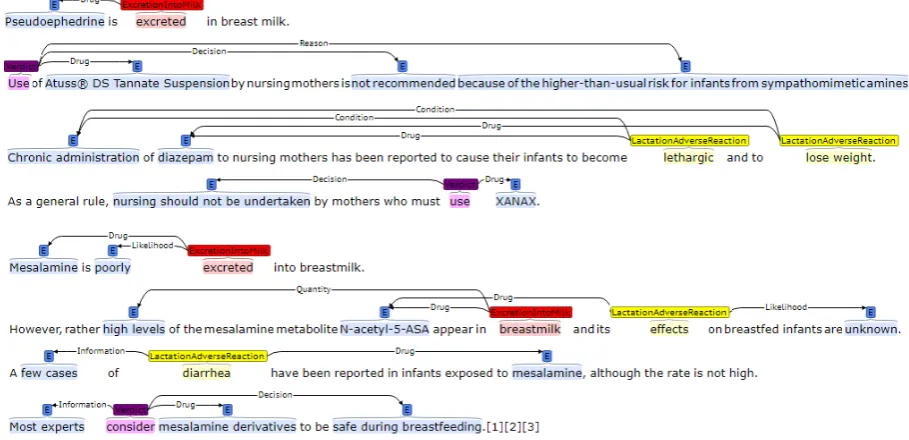
A random subset of equal amounts of documents from the drug labels dataset and LactMed dataset were selected for manual annotation. Example an-notations from LactMed articles and the drug la-bels are shown in Figure3.
The annotation process was completed by three individuals using BRAT (Stenetorp et al., 2013). Documents were double-annotated with a pair of individuals first annotating a collection of docu-ments independently and then meeting to recon-cile any differences. In cases where annotations could not be easily reconciled, the case was pre-sented to two other individuals to help establish rules which could be used in similar situations moving forward. Annotation guidelines, which included frequently occurring lexical units for a given frame and example annotations, were
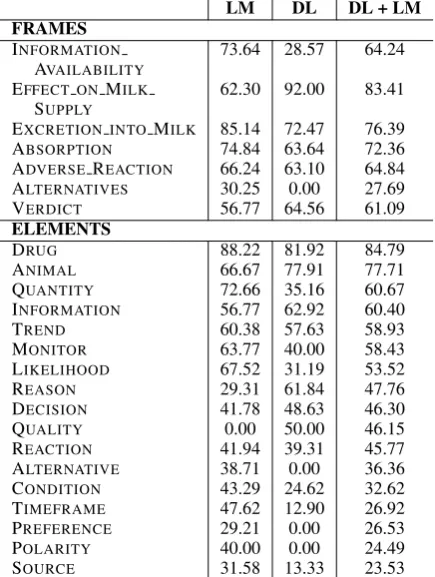
devel-LM DL DL + LM
FRAMES
INFORMATION 73.64 28.57 64.24
AVAILABILITY
EFFECT ONMILK 62.30 92.00 83.41
SUPPLY
EXCRETION INTOMILK 85.14 72.47 76.39
ABSORPTION 74.84 63.64 72.36
ADVERSE REACTION 66.24 63.10 64.84
ALTERNATIVES 30.25 0.00 27.69
VERDICT 56.77 64.56 61.09
ELEMENTS
DRUG 88.22 81.92 84.79
ANIMAL 66.67 77.91 77.71
QUANTITY 72.66 35.16 60.67
INFORMATION 56.77 62.92 60.40
TREND 60.38 57.63 58.93
MONITOR 63.77 40.00 58.43
LIKELIHOOD 67.52 31.19 53.52
REASON 29.31 61.84 47.76
DECISION 41.78 48.63 46.30
QUALITY 0.00 50.00 46.15
REACTION 41.94 39.31 45.77
ALTERNATIVE 38.71 0.00 36.36
CONDITION 43.29 24.62 32.62
TIMEFRAME 47.62 12.90 26.92
PREFERENCE 29.21 0.00 26.53
POLARITY 40.00 0.00 24.49
[image:5.595.308.526.63.352.2]SOURCE 31.58 13.33 23.53
Table 3: Inter-Annotator Agreement, measured by F1.
oped in order to identify and ensure consistency.
After annotation of each subset of documents was completed and reconciled, a final review was performed by one of the annotators to ensure that any newly-established guidelines were consistent throughout all documents.
In total, 900 documents were double-annotated, 450 drug labels and 450 LactMed entries. Within these 900 documents a total of 2,984 frames and 8,384 frame elements were annotated. The frequency breakdown for each frame and frame element type is shown in Table 2. The most frequently identified frames were EXCRE
-TION INTO MILK with 853 frames, VERDICT
with 852 frames, and ADVERSE REACTIONwith 727 frames.
[image:5.595.308.527.67.355.2]Figure 3: Annotation Examples
5 Extraction
A standard bi-directional Long Short-Term Mem-ory (Bi-LSTM) Conditional Random Field (CRF) was utilized to extract lactation frames. The Bi-LSTM utilizes both character embeddings (dy-namic) and word embeddings (static, described below). Specifically, a pipeline approach was used that extracts frames and frame elements are identi-fied in two separate steps. The first step identifies lexical units in a sentence for all potential frames, essentially equivalent to a named entity recogni-tion approach. The second step performs relarecogni-tion extraction for each identified lexical unit, identify-ing frame elements associated for the frames iden-tified in the first step.
We experimented with four different embed-ding corpora: (i) pre-built 300-dimension GloVe (Pennington et al., 2014) embeddings built from Wikipedia; (ii) pre-built 100-dimension word2vec (Mikolov et al., 2013) embeddings built from MIMIC-III (Johnson et al., 2016); (iii) pre-built 200-dimension word2vec embeddings built from PubMed, PMC, and Wikipedia (Pyysalo et al.,
2013); and (iv) specially-built 300-dimension GloVe embeddings on the lactation data (all drug labels and LactMed articles combined). Section7
describes experiments with how these embedding combinations perform.
6 Evaluation
For our evaluation we created three separate col-lections of training, test, and validation sets by
Embeddings Frame FE
MIMIC + GloVe (Wikipedia) 84.53 71.33 MIMIC + GloVe (DL + LM) 83.89 70.93 W2V (PubMed + PMC + Wikipeida) 82.57 73.31 GloVe (DL + LM) 80.78 68.67
Table 4: Experiment with different word embeddings, measured by F1. DL: drug labels; LM: LactMed; FE: frame elements.
splitting the documents of the drug labels (DL), LactMed (LM), and LactMed and drug label com-bined (DL+LM). 80 percent of each dataset was used for training, 10 percent for testing, and 10 percent for validation. We trained and tested on various combinations of datasets.
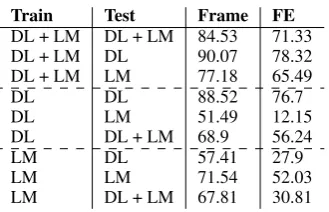
We also experimented with training and test-ing on the different combinations of datasets, for example training on drug labels and LactMed (DL+LM) and testing on LactMed (LM), or train-ing on LactMed (LM) and testtrain-ing on the drug la-bels (DL).
[image:6.595.310.522.335.387.2]Train Test Frame FE
[image:7.595.99.264.52.158.2]DL + LM DL + LM 84.53 71.33 DL + LM DL 90.07 78.32 DL + LM LM 77.18 65.49 DL DL 88.52 76.7 DL LM 51.49 12.15 DL DL + LM 68.9 56.24 LM DL 57.41 27.9 LM LM 71.54 52.03 LM DL + LM 67.81 30.81
Table 5: Experiment with different train/test combina-tions, measured by F1, using best system from Table4. DL: drug label; LM: LactMed; FE: frame elements
7 Results
Table4shows the results of our different embed-ding experiments. The GloVe embedembed-dings gen-erated from the drug labels and LactMed articles combined with the MIMIC embeddings, which had an F1 measure for the frames of 83.89 and the elements of 70.93, performed slightly worse than the top performing embeddings. The GloVe (Wikipedia) embeddings combined with MIMIC embeddings had an F1 of 84.53 for frames and 71.33 for frame elements. The W2V (PubMed + PMC + Wikipeida) embeddings performed best on frame element extraction with an F1 of 73.31.
Table 5 shows the different combinations of training and testing on various datasets. This data shows that training on the drug labels and LactMed together does improve the prediction performance on a single dataset opposed to just training on one dataset alone. For example, the model that was trained on drug labels and LactMed performed better on the LactMed test set (frame F1 of 77.18) than the model that was trained only on the LactMed dataset (frame F1 of 71.54). This effect is likely caused by an in-crease in training data overcoming the differences between the datasets.
Table 6 shows the breakdown of the results by each frame and frame element for the model that was created using the embeddings that per-formed best on frame identification (MIMIC + GloVe (Wikipedia)) and the combined drug labels and LactMed dataset for training and testing.
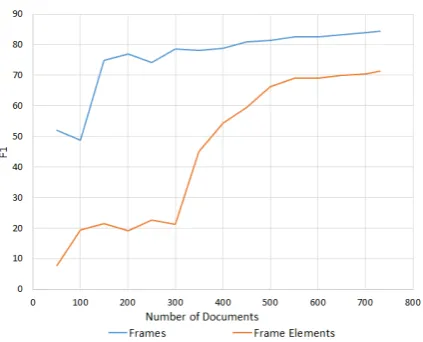
Figure4shows the learning curve as additional documents were added to the training set and the effect it has on the overall F1-measure. For both the frame and frame element the curve is begin-ning to level off, however it does seem to show that additional training data may continue to have a positive effect on the overall F1 for both cases.
P R F1
FRAME
OVERALL 85.52 83.55 84.53
ABSORPTION 71.43 35.71 47.62
ALTERNATIVES 86.67 86.67 86.67
EFFECT ON MILK 100.0 85.71 92.31
SUPPLY
EXCRETION INTO MILK 86.21 83.33 84.75
INFORMATION 100.0 91.67 95.65
AVAILABILITY
ADVERSEREACTION 89.71 85.92 87.77
VERDICT 78.02 87.65 82.56
ELEMENT
OVERALL 69.74 72.99 71.33
ALTERNATIVE 100.0 50.00 66.67
ANIMAL 76.47 92.86 83.87
CONDITION 54.19 67.20 60.00
DECISION 76.84 71.57 74.11
DRUG 74.52 83.55 78.78
INFORMATION 92.59 82.42 87.21
LIKELIHOOD 68.12 74.60 71.21
MONITOR 44.19 76.00 55.88
POLARITY 100.0 75.00 85.71
PREFERENCE 81.25 100.0 89.66
QUALITY 100.0 100.0 100.0
QUANTITY 62.75 55.17 58.72
REACTION 92.86 50.00 65.00
REASON 54.39 58.49 56.36
SOURCE 100.0 100.0 100.0
TIMEFRAME 33.33 16.67 22.22
[image:7.595.314.516.59.375.2]TREND 66.67 76.92 71.43 Table 6: Frame and Element Breakdown
8 Discussion
[image:7.595.313.516.67.375.2]Figure 4: Learning curve of test performance with in-creasing amounts of training data.
whether sufficient annotated data exists to maxi-mize frame extraction performance. These exper-iments yield several observations that have impli-cations on further development of such a frame ex-traction system.
First, the fact that open-domain embeddings outperformed embeddings trained on the drug la-bels and LactMed (see Table 4) can be consid-ered a negative, but not entirely conclusive, result. In our initial error analysis it was clear that the lack of embedding information for common terms in the dataset (such as particular drug names) re-sulted in numerous errors. We did not experiment with additional embedding combinations, such as concatenating separate embeddings for Wikipedia, MIMIC, and drug label/LactMed, though this con-catenation strategy has shown promise in other biomedical tasks (Roberts,2016).
Second, the experiments demonstrated that training on both drug labels and LactMed im-proves performance over training on each individ-ually (Table5). This improvement is despite the fact that the drug labels and LactMed data appears to be quite different, as can be seen by compar-ing the result of traincompar-ing on one and testcompar-ing on the other. For instance, LactMed results are quite poor when only training on drug labels (51.49 F1) and improve significantly when training on LactMed (71.54), but improve further still when training on both drug labels and LactMed (77.18). This would suggest that there is sufficient similarity to train on both, but perhaps domain adaptation methods could be employed to gain the benefits of larger training datasets while still identifying source-specific differences in the data.
Third, the amount of data available for
train-ing (Figure4) suggest small gains are still likely to be expected given more data. Our error analy-sis, however, suggested that many of the “errors” could in fact be considered legitimate frame in-stances. This is typically a result of inconsistent frame annotation, which is of course quite com-mon in complex semantic annotation tasks. How-ever, it is clear that further quality control on the existing annotations will likely be a more promis-ing effort prior to addpromis-ing further annotations.
Beyond the work described in this paper, there is still a good distance to go before an auto-matic method exists for detecting inconsistencies in lactation information sources. Notably, this work only extracts the basic frame instances from each of these sources, but does nothing to com-pare frames. Future work will thus be neces-sary to compare frame instances from a drug la-bel and its corresponding LactMed article (not to mention that there are often multiple labels per drug). Comparing frames is certainly much easier than comparing full documents, but not without its challenges. Comparing individual frames requires both frame element-specific comparisons (e.g., is “safe during breastfeeding” equivalent to “no ma-jor concerns”) as well as comparing to null frame elements (e.g., if one frame has a QUANTITY of “high levels” but the other frame has no QUAN -TITY at all). It is unlikely simple rule-based pro-cedures can be used to identify equivalent or con-tradictory frames with high accuracy. However, this need not be the goal. Instead of providing a complete list of all inconsistent labels/articles, a likely application for the use of such a system is to provide a ranked list of labels/articles that are most likely to be incongruous. This approach may have greater robustness to errors in frame match-ing, and is a likely direction of future work.
9 Conclusion
This paper described a frame-based approach for lactation information extraction from drug labels and LactMed. Seven lactation-related frames were identified, manually annotated, and automatically extracted using a standard NLP approach. Future work will involve utilizing this system in order to identify discordant information present in drug in-formation sources for nursing mothers.
References
Swapna Abhyankar and Dina Demner-Fushman. 2013. A simple method to extract key maternal data from neonatal clinical notes. InProceedings of the AMIA Annual Symposium, pages 2–9.
Collin F Baker, Charles J Fillmore, and Beau Cronin. 2003. The Structure of the Framenet Database.
International Journal of Lexicography, 16(3):281– 296.
Collin F. Baker, Charles J. Fillmore, and John B. Lowe. 1998. The Berkeley FrameNet project.
Allan Borra, Karla Delos Santos, Daniel Gonzales, and Alden Reyes. 2013. Maternal Medication Informa-tion ExtracInforma-tion (MaMIE) System. InProceedings of the 9th National Natural Language Processing Re-search Symposium, pages 25–29.
Pramod Bharadwaj Chandrashekar, Arjun Magge, Abeed Sarker, and Graciela Gonzalez. 2017. So-cial media mining for identification and exploration of health-related information from pregnant women.
CoRR, abs/1702.02261.
Adam Culbertson, Marcelo Fiszman, Dongwook Shin, and Thomas C. Rindflesch. 2014. Semantic Pro-cessing to Identify Adverse Drug Event Information from Black Box Warnings. In Proceedings of the AMIA Annual Symposium, pages 442–448.
Surabhi Datta, Elmer V Bernstam, and Kirk Roberts. 2017.A frame semantic overview of NLP-based in-formation extraction for cancer-related EHR notes.
CoRR, abs/1904.01655.
Christianne J. M. de Groot, Thed van Leeuwen, Ben Willem J. Mol, and Ludo Waltman. 2015. A Longitudinal Analysis of Publications on Maternal Mortality. Paediatric and Perinatal Epidemiology, 29(6):481–489.
Dina Demner-Fushman, Kin Wah Fung, Phong Do, Richard D. Boyce, and Travis R. Goodwin. 2018a. Overview of the TAC 2018 Drug-Drug Interaction Extraction from Drug Labels Track. InProceedings of the Text Analysis Conference.
Dina Demner-Fushman, Sonya E. Shooshan, Laritza Rodriguez, Alan R. Aronson, Francois Lang, Willie Rogers, Kirk Roberts, and Joseph Tonning. 2018b. A dataset of 200 structured product labels anno-tated for adverse drug reactions. Scientific Data, 5:180001.
A. Dolbey. 2009. BioFrameNet: A FrameNet Exten-sion to the Domain of Molecular Biology. Ph.D. thesis, UC Berkeley.
A. Dolbey, M. Ellsworth, and J. Scheffzyk. 2006. BioFrameNet: A Domain-specific FrameNet Ex-tension with Links to Biomedical Ontologies. In
Proceedings of the Biomedical Ontology in Action Workshop at KR-MED, pages 86–94.
Jon Duke, Jeff Friedlin, and Xiaochun Li. 2013. Con-sistency in the safety labeling of bioequivalent med-ications. Pharmacoepidemiology Drug Safety, 22(3):294–301.
Charles J Fillmore. 1976. Frame Semantics and the Nature of Language. Annals of the New York Academy of Sciences, 280(1):20–32.
Charles J Fillmore. 1982. Frame semantics. Linguis-tics in the Morning Calm, pages 111–137.
Kin Wah Fung, Chiang S Jao, and Dina Demner-Fushman. 2013. Extracting drug indication infor-mation from structured product labels using natural language processing.Journal of the American Med-ical Informatics Association, 20(3):482–488.
Rave Harpaz, Alison Callahan, Suzanne Tamang, Yen Low, David Odgers, Sam Finlayson, Kenneth Jung, Paea LePendu, and Nigam H. Shah. 2014. Text Mining for Adverse Drug Events: the Promise, Challenges, and State of the Art. Drug Safety, 37(10):777–790.
Alistair E.W. Johnson, Tom J. Pollard, Lu Shen, Li wei H. Lehman, Mengling Feng, Mohammad Ghassemi, Benjamin Moody, Peter Szolovits, Leo Anthony Celi, , and Roger G. Mark. 2016. MIMIC-III, a freely accessible critical care database. Scientific Data, 3:160035.
Ritu Khare, Jiao Li, and Zhiyong Lu. 2014. LabeledIn: Cataloging Labeled Indications for Human Drugs.
Journal of Biomedical Informatics, 52:448–456.
Dimitrios Kokkinakis. 2013. Medical Event Extraction using Frame Semantics – Challenges and Opportu-nities. International Journal of Computational Lin-guistics and Applications, 4(2):121–133.
Michael Kuhn, Monica Campillos, Ivica Letunic, Lars Juhl Jensen, and Peer Bork. 2010. A side ef-fect resource to capture phenotypic efef-fects of drugs.
Molecular Systems Biology, 6:343.
Michael Kuhn, Ivica Letunic, Lars Juhl Jensen, and Peer Bork. 2016. The SIDER database of drugs and side effects. Nucleic Acids Research, 44(D1):D1075–D1079.
Qi Li, Louise Deleger, Todd Lingren, Haijun Zhai, Megan Kaiser, Laura Stoutenborough, Anil G Jegga, Kevin Bretonnel Cohen, and Imre Solti. 2013. Min-ing FDA drug labels for medical conditions. BMC Medical Informatics and Decision Making, 13(53).
Aur´elie N´ev´eol and Zhiyong Lu. 2010. Automatic In-tegration of Drug Indications from Multiple Health Resources. In Proceedings of the 1st ACM Inter-national Health Informatics Symposium, pages 666– 673.
Jeffrey Pennington, Richard Socher, and Christopher D Manning. 2014. GloVe: Global Vectors for Word Representation. In Proceedings of the 2014 Con-ference on Empirical Methods in Natural Language Processing, pages 1532–1543.
Sampo Pyysalo, Filip Ginter, Hans Moen, Tapio Salakoski, and Sophia Ananiadou. 2013. Distri-butional Semantics Resources for Biomedical Text Processing. InProceedings of Languages in Biol-ogy and Medicine.
Kirk Roberts. 2016. Assessing the Corpus Size vs Sim-ilarity Trade-off for Word Embeddings in Clinical NLP. InProceedings of the COLING Workshop on Clinical Natural Language Processing.
Kirk Roberts, Dina Demner-Fushman, and Joseph Ton-ning. 2017. Overview of the TAC 2017 Adverse Re-action ExtrRe-action from Drug Labels Track. In Pro-ceedings of the Text Analysis Conference (TAC).
Kirk Roberts, Yuqi Si, Anshul Gandhi, and Elmer Bernstam. 2018. A FrameNet for Cancer Informa-tion in Clinical Narratives: Schema and Annota-tion. InProceedings of the Language Resources and Evaluation Conference, pages 272–279.
Laritza M. Rodriguez and Dina Demner Fushman. 2015. Automatic Classification of Structured Prod-uct Labels for Pregnancy Risk Drug Categories, a Machine Learning Approach. InProceedings of the AMIA Annual Symposium, pages 1093–1102.
Laritza M. Rodriguez, Stephanie M. Morrison, Kath-leen Greenberg, and Dina Demner Fushman. 2017. Mining the literature for genes associated with placenta-mediated maternal diseases. In Proceed-ings of the AMIA Annual Symposium, pages 1498– 1506.
Abeed Sarker, Pramod Chandrashekar, Arjun Magge, Haitao Cai, Ari Klein, and Graciela Gonzalez. 2017. Discovering Cohorts of Pregnant Women From So-cial Media for Safety Surveillance and Analysis.
Journal of Medical Internet Research, 19(10):e361.
Yuqi Si and Kirk Roberts. 2018. A Frame-Based NLP System for Cancer-Related Information Extraction. InProceedings of the AMIA Annual Symposium.
Pontus Stenetorp, Sampo Pyysalo, Goran Topic, Tomoko Ohta, Sophia Ananiadou, and Junichi Tsu-jii. 2013. BRAT: a Web-based Tool for NLP-Assisted Text Annotation. In Proceedings of the 13th Conference of the European Chapter of the As-sociation for Computational Linguistics, pages 102– 107.
He Tan. 2014. A System for Building FrameNet-like Corpus for the Biomedical Domain. InProceedings of the 5th International Workshop on Health Text Mining and Information Analysis (Louhi), pages 46– 53.
Qiu-Yue Zhong, Elizabeth W. Karlson, Bizu Gelaye, Sean Finan, Paul Avillach, Jordan W. Smoller, Tianxi Cai, and Michelle A. Williams. 2018. Screening pregnant women for suicidal behavior in electronic medical records: diagnostic codes vs. clinical notes processed by natural language pro-cessing. BMC Medical Informatics and Decision Making, 18:30.