24
Second-order Co-occurrence Sensitivity of
Skip-Gram with Negative Sampling
Dominik Schlechtweg, Cennet Oguz, Sabine Schulte im Walde Institute for Natural Language Processing, University of Stuttgart {schlecdk,oguzct,schulte}@ims.uni-stuttgart.de
Abstract
We simulate first- and second-order context overlap and show that Skip-Gram with Neg-ative Sampling is similar to Singular Value Decomposition in capturing second-order co-occurrence information, while Pointwise Mu-tual Information is agnostic to it. We sup-port the results with an empirical study find-ing that the models react differently when pro-vided with additional second-order informa-tion. Our findings reveal a basic property of Skip-Gram with Negative Sampling and point towards an explanation of its success on a va-riety of tasks.
1 Introduction
The idea of second-order co-occurrence vectors was introduced bySch¨utze(1998) for word sense discrimination and has since then been extended and applied to a variety of tasks (Lemaire and Denhiere,2006;Islam and Inkpen,2006;Schulte im Walde,2010;Zhuang et al., 2018). The basic idea is to represent a wordwnot by a vector of the counts of context words it directly co-occurs with, but instead by a count vector of the context words of the context words, i.e., the second-order context words of w. These second-order vectors are sup-posed to be less sparse and more robust than first-order vectors (Sch¨utze,1998). Moreover, captur-ing second-order co-occurrence information can be seen as a way of generalization. To see this, cf. examples (1) and (2) inspired bySch¨utze and Pedersen(1993).
(1) As far as the Soviet CommunistPartyand the Comintern were concerned . . .
(2) . . . this is precisely the approach taken by the BritishGovernment.
The nouns Party and Government have similar meanings in these contexts, although they have little contextual overlap: A frequent topic in the
British corpus used bySch¨utze and Pedersenis the Communist Party of the Soviet Union, but gov-ernments are rarely qualified as communist in the corpus. Hence, there is little overlap in first-order context words of Party and Government. How-ever, their context words Communistand British
in turn have a greater overlap, because they are frequently used to qualify the same nouns from the political domain, as inCommunist authorities
andBritish authorities. Hence, althoughPartyand
Governmentmay have no first-order context over-lap, they do have second-order context overlap. According toSch¨utze and Pedersen, capturing this information corresponds to the generalization “oc-curring with a political adjective.”
While most traditional count-based vector learning techniques such as raw count vectors or Point-wise Mutual Information (PPMI) do not capture second-order co-occurrence information, truncated Singular Value Decomposition (SVD) has been shown to do so. Regarding the more recently developed embeddings based on shallow neural networks, such as Skip-Gram with Nega-tive Sampling (SGNS), it is presently unknown whether they capture higher-order co-occurrence information. So far, this question has been ne-glected as a research topic, although the answer is crucial to explain performance differences: Levy et al. (2015) show that SGNS performs similarly to SVD and differently from PPMI across seman-tic similarity data sets. If SGNS captures second-order co-occurrence information, this provides a possible explanation for the observed performance differences.
work on SVD and introduces a method to further investigate questions more precisely than done be-fore. (ii) We transfer second-order context infor-mation to the first-order level in a small corpus and test the models’ reaction on a standard eval-uation data set when provided with the additional information. We find that SGNS and SVD, already capturing second-order information, do not bene-fit, whereas PPMI benefits.
2 Related Work
An early connection between second-order con-text information and generalization can be found in Sch¨utze and Pedersen (1993). The authors claim that SVD is able to generalize by us-ing second-order context information as described above. Later work supports this claim and indicates that SVD even captures information from higher orders of co-occurrence (Landauer et al., 1998; Kontostathis and Pottenger, 2002; Newo Kenmogne, 2005; Kontostathis and Pot-tenger,2006).
Since then, second-order co-occurrence infor-mation has mainly been exploited for traditional count-based vector learning techniques with dif-ferent aims. Sch¨utze (1998) had used second-order vectors for word sense clustering. Vari-ous studies model synonymy or semantic simi-larity (Edmonds, 1997; Islam and Inkpen, 2006; Lemaire and Denhiere, 2006) indicating that second-order co-occurrence plays an important role for these tasks.
The only works we are aware of exploring second-order information for word embeddings are Newman-Griffis and Fosler-Lussier (2017) learning embeddings from nearest-neighbor graphs and Zhuang et al. (2018) indicating that a specific type of word embeddings may benefit from second-order information. However, no study investigated the question whether SGNS or other word embeddings already capture higher-order co-occurrence information, which may make the integration of second-order information superfluous.
3 Semantic Vector Spaces
We compare SGNS to two traditional count-based vector space learning techniques: PPMI and SVD, where the former does not capture second-order information while the latter does. All methods are based on the concept of semantic vector spaces:
A semantic vector space constructed from a cor-pus C with vocabulary V is a matrix M, where each row vector represents a word w in the vo-cabulary V reflecting its co-occurrence statistics (Turney and Pantel,2010).
Positive Pointwise Mutual Information (PPMI).
For PPMI representations, we first construct a high-dimensional and sparse co-occurrence matrix M. The value of each matrix cellMi,j represents the number of co-occurrences of the wordwi and the contextcj,#(wi, cj). Then, the co-occurrence counts in each matrix cellMi,jare weighted by the smoothed and shifted positive mutual information of targetwi and contextcj reflecting their degree of association. The values of the transformed ma-trix are
Mi,jPPMI= max
log #(w
i, cj)Pc#(c)α #(wi)#(cj)α
−log(k),0
,
where k > 1 is a prior on the probability of observing an actual occurrence of (wi, cj) and 0 < α < 1 is a smoothing parameter reducing PPMI’s bias towards rare words (Levy and Gold-berg,2014;Levy et al.,2015). To our knowledge PPMI representations have never been claimed to capture higher-order co-occurrence information.
Singular Value Decomposition (SVD). Trun-cated Singular Value Decomposition is an alge-braic algorithm finding the optimal rank d fac-torization of matrix M with respect to L2 loss (Eckart and Young, 1936).1 It is used to obtain low-dimensional approximations of the PPMI rep-resentations by factorizingMPPMIinto the product
of the three matricesUΣV>. We keep only the top delements ofΣand obtain
MSVD=UdΣpd,
where p is an eigenvalue weighting parameter (Levy et al., 2015). Ignoring V for MSVD re-duces dimensionality while preserving the dot-products between rows. While it is not clear whether SVD generalizes better than other mod-els in general (Gamallo and Bordag, 2011), its sensitivity to higher orders of co-occurrence has been shown empirically and mathematically (Kon-tostathis and Pottenger, 2002; Newo Kenmogne, 2005; Kontostathis and Pottenger, 2006). Kon-tostathis and Pottenger(2006) prove that the
ex-1
istence of a non-zero value in a truncated term-to-term co-occurrence matrix follows directly from the existence of a higher-order co-occurrence in the full matrix. They also show that there is an empirical correlation between the magnitude of the value and the number of higher-order co-occurrences found for the particular term pair.
Skip-Gram with Negative Sampling (SGNS).
SGNS differs from the above techniques in that it directly represents each wordw ∈ V and each context c ∈ V as a d-dimensional vector by im-plicitly factorizingM =W C>when solving
arg max θ
X
(w,c)∈D
logσ(vc·vw) + X
(w,c)∈D0
logσ(−vc·vw),
where σ(x) = 1+1e−x, D is the set of all ob-served word-context pairs andD0 is the set of ran-domly generated negative samples (Mikolov et al., 2013a,b; Goldberg and Levy, 2014). The opti-mized parametersθarevci =Ci∗ andvwi =Wi∗ forw, c∈V,i∈1, ..., d.D0is obtained by draw-ingkcontexts from the empirical unigram distri-butionP(c) = #(|Dc|)for each observation of(w, c), cf. Levy et al.(2015). The final SGNS matrix is given by
MSGNS=W.
Levy and Goldberg (2014) relate SGNS to SVD by showing that under specific assumptions their learning objectives have the same global opti-mum. However, it is unknown whether SGNS is also similar to SVD in capturing higher-order co-occurrence information. The model architecture suggests that this is possible: consider the two context vectors c~1, ~c2 in C of two words having
large context overlap (e.g. the vectors for Commu-nistandBritish).c~1, ~c2will be similar, because the
dot product with the same target vectors inW will be maximized (as c~1, ~c2 frequently occur as
con-texts of the same target words). Ifc~1, ~c2 are then
in turn each used to maximize the dot product with two different new target vectors (e.g. the vectors forParty andGovernment), these also tend to be similar.
Model Training. For both experiments we use the implementation ofLevy et al.(2015), allowing us to train all models on extracted word-context pairs instead of the corpus directly. We follow pre-vious work in setting the hyper-parameters (Levy et al.,2015). For PPMI we setα=.75andk= 5.
We set the number of dimensionsdfor SVD and SGNS to 300. SGNS is trained with 5 negative samples, 5 epochs and without subsampling. For SVD we setp= 0.
Similarity Measure. For all methods we mea-sure similarity between word vectors with Cosine Distance (CD), where low CD means high simi-larity. CD is based on cosine similarity,cos(~x, ~y), which measures the cosine of the angle between two non-zero vectors ~x, ~y with equal magnitudes (Salton and McGill,1983). CD is then defined as
CD(~x, ~y) = 1−cos(~x, ~y).
4 Experiment 1: Simulating second-order context overlap
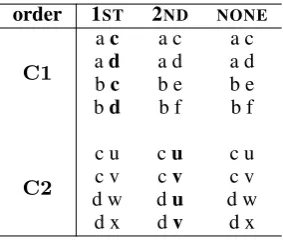
In order to see whether SGNS captures second-order co-occurrence information, we artificially simulate context overlap for first- and second-order co-occurrence separately. This allows us to simulate clear cases of overlap controlling for confounding factors which are present in empiri-cal data. We generate target-context pairs in such a way that specific target words have either con-text word overlap in first-order co-occurrence, or by contrast in second order. We compare the be-havior of PPMI, SVD and SGNS on three groups of such target words (see Table1):
first-order overlap (1ST): Target wordsT occur-ring with the samecontext words C1 in the first order, while in the second order all con-text words from C1 have distinct context wordsC2.
2nd-order overlap (2ND): Target words T oc-curring withdistinctcontext wordsC1in the first order, while all context words fromC1 have the same context wordsC2.
no overlap (NONE): Target words T occurring with distinct context wordsC1in the first or-der and also all context words inC1have dis-tinct context wordsC2.
As an example, consider the column 2NDin Ta-ble1. The target wordsT are aandb. Each has distinct context words: aoccurs only withc, d ∈
For each group we generate 10 target words (T). Per target word, each ofC1,C2is constructed by first generating 1000 context words C, assigning a sampling probability from a lognormal distri-bution to each context word inC and then sam-pling 1000 times fromC.2 For the 1ST-group, the set of context wordsC will be shared across tar-get words, meaning that they have a context word overlap. For the target words in the 2ND-group this will not be the case, but instead their first-order context words (C1) will have context over-lap (see Table 1). In this way, we simulate con-text overlap in first vs. second order. For the tar-get words in the NONE-group, C will instead be completely disjunct in both orders. Because co-occurrence is symmetric (ifaoccurs withc,calso occurs with a), for each pair (a,c) generated by the above-described process, we also add the re-verse pair (c,a). To make sure that the pairs from the different groups (1ST, 2ND,NONE) do not in-terfere with each other, each string generated for a group is unique to the group. Finally, we mix and randomly shuffle the pairs from all groups. In this way, we generate 10 x 1000 x 1000 x 2 target-context pairs for each group: 10 target words oc-curring with 1000 context words inC1where each in turn occurs with 1000 context words inC2, plus each of these pairs reversed.3
Our main hypothesis is that SGNS and SVD will predict target words from the 2ND-group to be more similar on average than target words from the NONE-group (although both groups have no first-order context overlap), while PPMI will pre-dict similar averages for both groups.
Results. Figure1shows the average cosine dis-tance between the target words in each of the three target word groups with context overlap in differ-ent orders (1ST, 2ND and NONE). As expected, PPMI predicts the target words without contex-tual overlap in any order (NONE) to be orthogonal to each other (1.0). Further, PPMI is sensitive to first-order overlap, but not at all to second-order overlap (0.51vs. 1.0). SVD also predicts orthog-onality for theNONE-group (1.0) and shows sensi-tivity to first-order overlap (0.34), but is extremely
2
By sampling from a lognormal distribution we aim to approximate the empirical frequency distribution of context words. Context words receive probabilities by randomly sam-pling 1000 values fromf(x) = 1
x√2πexp
−log(2x)2and normalizing them to a probability distribution.
3Find the code generating the artificial pairs under:
https://github.com/Garrafao/SecondOrder.
order 1ST 2ND NONE
C1
ac
ad
bc
bd
a c a d b e b f
a c a d b e b f
C2
c u c v d w d x
cu
cv
du
dv
[image:4.595.346.488.61.181.2]c u c v d w d x
Table 1: Artificial co-occurrence pairs with context overlap in different orders of co-occurrence (1ST, 2ND andNONE).C1andC2give co-occurrence in first and second order respectively. For each pair (a,c) shown above we also add the reverse pair (c,a).
sensitive to second-order overlap: it predicts the target words in 2NDto be perfectly similar to each other (0.0), notwithstanding the fact that they have no first-order context word overlap. SGNS shows a similar behavior, although its vectors are dis-tributed more densely: target words in NONEare predicted to be least similar (0.79), while target words in 1STare more similar (0.11) and in 2ND they are predicted to be completely similar (0.0).
We further hypothesize that the fact that for SGNS and SVD the average cosine distance in 1ST is higher than in 2ND is related to our choice to make the context words C1 of the target words in 1STdissimilar to each other by assigning com-pletely distinct context words C2 (see Table 1). We test this hypothesis by creating a second artifi-cial set of target-context pairs completely parallel to the above-described set with the only difference that 1SThas additional context overlap inC2. On these targets words with overlap in both orders we find that PPMI makes similar predictions (0.56) as before, while for SVD and SGNS predictions drop to0.0, confirming our hypothesis.
Figure 1: Results of simulation experiment. Values give average cosine distances across target words with different levels of context overlap. Pair-wise differ-ences between group means (except PPMI 2ND vs. NONE) are statistically significant according to a two-sample bootstrap test (p < 0.001, adjusted through Bonferroni correction for 9 tests, two-tailed).
5 Experiment 2: Propagating second-order co-occurrence information
We now propagate second-order information to the first-order level by extracting second-order word-context pairs and adding them to the first-order pairs. We hypothesize that the additional second-order information will impact PPMI rep-resentations positively and stronger than SVD and SGNS, because we saw that the latter already cap-ture second-order information. We reckon that the additional information is beneficial for PPMI in two ways: (i) it helps to generalize as described in (1) and (2), and (ii) it overcomes data sparsity for low-frequency words. Note that these two as-pects are often highly related: with only a limited amount of data available it is more likely that sim-ilar words do not have exactly the same, but still similar context words. Generalization then helps to overcome sparsity.
Corpus. We use ukWaC (Baroni et al., 2009), a >1B token web-crawled corpus of English. The corpus provides part-of-speech tagging and lemmatization. We keep only the lemmas which are tagged as nouns, adjectives or verbs. In or-der to assure we have low-frequency words in the test data, we create a small corpus by randomly choosing 1M sentences and shuffling them. The final corpus contains roughly 10M tokens. Un-der these sparse conditions we expect to observe
strong effects on model performance highlighting the differences between the models.
5.1 Pair Extraction
We first extract first-order word-context pairs by iterating over all sentences and extracting one word context pair (w,c) for each tokenwand each context wordcsurroundingwin a symmetric win-dow of size 5 (BASEpairs). Then, we extract ad-ditional second-order pairs in the following way: For each word type t in the corpus, we build a second-order vector~v by summing over all oft’s first-order context token count vectors (Sch¨utze, 1998). Then we randomly samplensecond-order context tokens from~v (with replacement) where each context typecihas a sampling probability of
~vi P
j=1~vj and~viis~v’sith entry. We then exclude all sampled context tokensc=t.4
We extract second-order pairs only for words below a specific co-occurrence frequency thresh-oldfto test the impact on sparse words separately. We experiment withf ∈ {2k,20k,200k}. We set nglobally to200%oft’s co-occurrence frequency to add a substantial amount of information. For each of the second-order pairs we add the reverse pair (c,w). Finally, the respective second-order pairs are combined with the base pairs and ran-domly shuffled. In this way, we generate roughly 22/99/218M (2/20/200k) second-order pairs from 57M base pairs. Then we train each model on each of the combined pair files separately.
5.2 Results
We evaluate the obtained vector spaces on Word-Sim353 (Finkelstein et al., 2002), a standard hu-man similarity judgment data set, by measuring the Spearman correlation of the cosine similarity for target word pairs with human judgments. The results are shown in Figure2. As we can see, the models show different reactions to the additional second-order information: PPMI is the only model benefiting (in one case), while SVD and SGNS never benefit from the additional information and are always impacted negatively. The strongest negative impact can be observed for SVD (-0.17). PPMI shows a clear improvement with rather low-frequency words (20k). Adding second-order in-formation for high-frequency words (200k) has a strong negative impact for PPMI and SVD.
4
Figure 2: Results of experiment 2. Values give correla-tion (Spearman’sρ) of model predictions with human similarity judgments.
Discussion. The different reactions of PPMI vs. SVD and SGNS partly confirm our hypothesis which was based on the findings in experiment 1: only PPMI benefits from additional second-order information. However, we did not expect the ob-served negative impacts, especially the strong per-formance drop for SVD. Moreover, it is notable that SVD on the base pairs shows a much higher performance (0.51) than SGNS and PPMI (0.43, 0.41), which is not the case in less sparse condi-tions (Levy et al.,2015). This indicates that SVD makes much better use of the available informa-tion and overcomes data sparsity in this way. It re-mains for future research to determine how much the exploitation of higher-order co-occurrence in-formation contributes to this clear performance ad-vantage.
6 Conclusion
We showed that SGNS captures second-order co-occurrence information, a property it shares with SVD and distinguishes it from PPMI. We further tested the reaction of the models when provided with additional second-order information, expect-ing that only PPMI would benefit. We find this confirmed, but also observe unexpectedly strong negative impacts on SVD by the supposedly re-dundant information. In general, SVD turns out to have strong performance advantages over PPMI and SGNS in the sparse experimental conditions we created.
Our findings are relevant for a variety of al-gorithms relying on the SGNS architecture (i.a. Grover and Leskovec, 2016; Bamler and Mandt,
2017). Future work will look into the relation-ship between the second-order sensitivity of SVD and SGNS and their high performances across tasks. In addition, we aim to use the introduced method of generating artificial context overlap to see which higher orders of co-occurrence SVD, SGNS and other embedding types (Pennington et al., 2014; Peters et al., 2018; Athiwaratkun et al.,2018) capture. Because the aim of the study was only to test the second-order sensitivity of dif-ferent models, we did not focus on finding the best way to provide this information. Given the re-sults for PPMI, however, developing a smoother way to provide second-order information to mod-els seems to be a promising starting point for fur-ther research.
Acknowledgments
The first author was supported by the Kon-rad Adenauer Foundation and the CRETA cen-ter funded by the German Ministry for Educa-tion and Research (BMBF) during the conduct of this study. We thank Agnieszka Falenska, Sascha Schlechtweg and the anonymous reviewers for their valuable comments.
References
Ben Athiwaratkun, Andrew Gordon Wilson, and An-ima Anandkumar. 2018. Probabilistic fasttext for multi-sense word embeddings. In Proceedings of the 56th Annual Meeting of the Association for Computational Linguistics, pages 1–11, Melbourne, Australia.
Robert Bamler and Stephan Mandt. 2017. Dynamic word embeddings. InProceedings of the 34th In-ternational Conference on Machine Learning, vol-ume 70, pages 380–389, Sydney, Australia.
Marco Baroni, Silvia Bernardini, Adriano Ferraresi, and Eros Zanchetta. 2009. The wacky wide web: A collection of very large linguistically processed web-crawled corpora. Language Resources and Evaluation, 43(3):209–226.
Carl Eckart and Gale Young. 1936. The approximation of one matrix by another of lower rank. Psychome-trika, 1:211–218.
Lev Finkelstein, Evgeniy Gabrilovich, Yossi Matias, Ehud Rivlin, Zach Solan, Gadi Wolfman, and Ey-tan Ruppin. 2002. Placing search in context: The concept revisited. ACM Transactions on Informa-tion Systems, 20(1):116–131.
Pablo Gamallo and Stefan Bordag. 2011. Is singu-lar value decomposition useful for word simisingu-larity extraction? Language Resources and Evaluation, 45(2):95–119.
Yoav Goldberg and Omer Levy. 2014. Word2vec Explained: Deriving Mikolov et al.’s negative-sampling word-embedding method. CoRR, abs/1402.3722.
Aditya Grover and Jure Leskovec. 2016. Node2vec: Scalable feature learning for networks. In Proceed-ings of the 22nd ACM SIGKDD International Con-ference on Knowledge Discovery and Data Mining, pages 855–864, San Francisco, California, USA.
Aminul Islam and Diana Inkpen. 2006. Second or-der co-occurrence pmi for determining the semantic similarity of words. InProceedings of the 5th In-ternational Conference on Language Resources and Evaluation, pages 1033–1038, Genoa, Italy.
April Kontostathis and William M. Pottenger. 2002. Detecting patterns in the LSI term-term matrix. In
Proceedings of the Workshop on Foundations of Data Mining and Discovery.
April Kontostathis and William M. Pottenger. 2006. A framework for understanding latent semantic in-dexing LSI performance. Information Processing & Management, 42(1):56–73.
Thomas K Landauer, Peter W Foltz, and Darrell La-ham. 1998. An introduction to latent semantic anal-ysis. Discourse Processes, 25(2-3):259–284.
Benoit Lemaire and Guy Denhiere. 2006. Effects of high-order co-occurrences on word semantic sim-ilarity. Current Psychology Letters – Behaviour, Brain and Cognition, 18(1).
Omer Levy and Yoav Goldberg. 2014. Neural word embedding as implicit matrix factorization. In
Proceedings of the 27th International Conference on Neural Information Processing Systems, pages 2177–2185, Montreal, Canada.
Omer Levy, Yoav Goldberg, and Ido Dagan. 2015. Im-proving distributional similarity with lessons learned from word embeddings. Transactions of the Associ-ation for ComputAssoci-ational Linguistics, 3:211–225.
Tomas Mikolov, Kai Chen, Greg Corrado, and Jeffrey Dean. 2013a. Efficient estimation of word represen-tations in vector space. InProceedings of the Inter-national Conference on Learning Representations.
Tomas Mikolov, Ilya Sutskever, Kai Chen, Greg Cor-rado, and Jeffrey Dean. 2013b. Distributed repre-sentations of words and phrases and their composi-tionality. InProceedings of the Neural Information Processing Systems Conference.
Denis Newman-Griffis and Eric Fosler-Lussier. 2017. Second-order word embeddings from nearest neighbor topological features. arXiv preprint arXiv:1705.08488.
Regis Newo Kenmogne. 2005. Understanding LSI via the truncated term-term matrix. Master’s thesis, Universit¨at des Saarlandes, Saarbr¨ucken.
Jeffrey Pennington, Richard Socher, and Christopher Manning. 2014. Glove: Global vectors for word representation. In Proceedings of the 2014 Con-ference on Empirical Methods in Natural Language Processing, pages 1532–1543, Doha, Qatar.
Matthew Peters, Mark Neumann, Mohit Iyyer, Matt Gardner, Christopher Clark, Kenton Lee, and Luke Zettlemoyer. 2018. Deep contextualized word repre-sentations. InProceedings of the 2018 Conference of the North American Chapter of the Association for Computational Linguistics: Human Language Technologies, pages 2227–2237, New Orleans, LA, USA.
Gerard Salton and Michael J McGill. 1983. Introduc-tion to Modern InformaIntroduc-tion Retrieval. McGraw -Hill Book Company, New York.
Sabine Schulte im Walde. 2010. Comparing com-putational approaches to selectional preferences: Second-order co-occurrence vs. latent semantic clusters. In Proceedings of the 7th International Conference on Language Resources and Evaluation, pages 1381–1388, Valletta, Malta.
Hinrich Sch¨utze. 1998. Automatic word sense discrim-ination. Computational Linguistics, 24(1):97–123.
Hinrich Sch¨utze and Jan Pedersen. 1993. A vector model for syntagmatic and paradigmatic relatedness. InProceedings of the 9th Annual Conference of the UW Centre for the New OED and Text Research, pages 104–113, Oxford, UK.
Peter D Turney and Patrick Pantel. 2010. From fre-quency to meaning: Vector space models of se-mantics. Journal of Artificial Intelligence Research, 37:141–188.