Munich Personal RePEc Archive
Economic Operation of Unit
Commitment Using Multiverse
Optimization Algorithm
Mirzaei, Farzad and Mahdavi, Sadegh and Bayat, Alireza
Electrical and Computer Engineering Department, Azad University
of Shiraz, Shiraz, Iran, Electrical and Computer Engineering
Department, Azad University of Shiraz, Shiraz, Iran, Electrical and
Computer Engineering Department, Azad University of Shiraz,
Shiraz, Iran
2019
Online at
https://mpra.ub.uni-muenchen.de/95894/
Economic Operation of Unit Commitment
Using Multiverse Optimization Algorithm
Farzad Mirzaei, Sadegh Mahdavi, Alireza Bayat
Electrical and Computer Engineering Department, Azad University of Shiraz, Shiraz, Iran
Abstract: Security Constraint Unit commitment (SCUC) is one of the challenging
economic problem of the power utilities due to the ON and OFF status of the units. Indeed,
in SCUC we should determine the status of the units for the day-ahead horizon. SCUC is
a mixed integer linear problem (MILP), which is hard to solve. Hence, in this paper, a new
evolutionary algorithm, known as the multiverse optimization algorithm is developed to
solve the problem.
Keywords—Security constrained unit commitment, evolutionary algorithm,
optimization
I. INTRODUCTION
During the past decades, unit commitment has been attracted lots of attentions due to
significant progress in tools and methods. Indeed, these methods can overcome the
complexity of the power grids problems. Unit commitment (UC) is one of the challenging
problems due to integer variables within the problem. In fact, these variables are utilized
to show the status of the units: 1 when unit is ON, and 0 when unit is OFF. This paper
developed a new population based evolutionary algorithm to overcome the complexity of
the unit commitment problem [1-8]. This method is known as the multiverse optimization
lower operational costs, compared to the well-known techniques such as particle swarm
optimization (PSO) and genetic algorithm (GA) [9-14].
II. UNIT COMMITMENT FORMULATIONS
In the UC problem, the main goal is to determine the status of the generation units sothat
the total operation cost is minimized, as
𝑚𝑖𝑛 ∑ [𝐶∀𝑖 𝑖𝑃𝑖𝑡𝐼𝑖𝑡+ 𝑆𝑈𝑖𝑡 + 𝑆𝐷𝑖𝑡] (1)
Here, I is a binary variable that can be zero or one and determine the status of unit i at
time t. SU and SD are the startup and shutdown costs of the ith unit at time t.
Also, there exist some constraints associated with the problem. For instance, the capacity
of the DGs should be within limits as
𝑃𝑖𝑡,𝑚𝑖𝑛 ≤ 𝑃𝑖𝑡 ≤ 𝑃𝑖𝑡,𝑚𝑎𝑥 (2)
Here, P is the output power of DGs.
In addition, the limitation on the ramp up and down of generators are as:
𝑃𝑖𝑡 − 𝑃𝑖(𝑡−1) ≤ 𝑅𝑈𝑖 (3)
𝑃𝑖(𝑡−1)− 𝑃𝑖𝑡 ≤ 𝑅𝐷𝑖 (4)
Where:
𝑅𝑈𝑖 and 𝑅𝑈𝑖 are the ramp up and ramp down rates of the ith generation units, respectively.
Finally, the minimum up and down time limits are considered as:
𝑇(𝑜𝑛)𝑖𝑡 ≥ 𝑈𝑇𝑖(𝐼𝑖𝑡− 𝐼𝑖(𝑡−1) (5)
𝑇(𝑜𝑓𝑓)𝑖𝑡 ≥ 𝐷𝑇𝑖(𝐼𝑖(𝑡−1)− 𝐼𝑖𝑡 (6)
Where:
𝑇(𝑜𝑛) and 𝑇(𝑜𝑓𝑓) represents the number of successive on and off hours.
This paper utilized a new evolutionary algorithm known as the multiverse evolutionary
algorithm. This method is taken form [15]. Compared to the well-known methods such as
particle swarm optimization (PSO) and genetic algorithm (GA), the proposed technique
has higher accuracy and speed [16].
III. RESULTS
In this section, the proposed technique is tested on the UC problem. The problem has
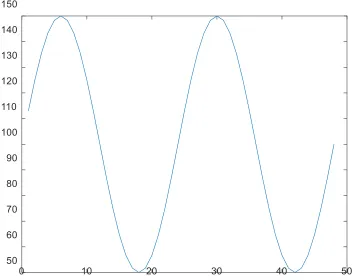
[image:4.612.119.472.343.623.2]3 units. Also the load demand is shown in Fig 1.
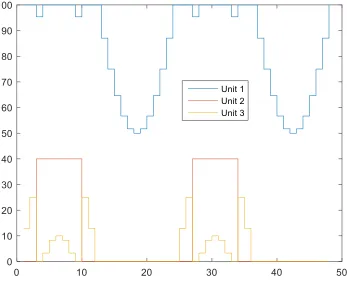
The optimal output power of generation units is shown in Fig. 2. The results show that
[image:5.612.124.471.146.434.2]the cheapest unit are committed than others, means economic consideration.
Fig. 2. Output power of the generation units
Table I compares the optimal operation cost and speed of the several methods. Based
on this table, the proposed method has less cost, as well as higher speed.
Table I
Cost of operation for several methods
cost ($) Convergence (s)
PSO 4534.2 14.3
GA 4843.4 10.9
IV. CONCLUSION
In this paper, one of the most challenging problems of the power system, known as the
unit commitment is solve by the new evolutionary algorithm. This algorithm known as the
multiverse optimization algorithm and it has some significant merit from both economic
and speed perspectives, compared to the PSO and GA algorithms.
Reference
[1] Padhy, Narayana Prasad. "Unit commitment-a bibliographical survey." IEEE Transactions on power systems 19, no. 2 (2004): 1196-1205.
[2] Pandžić, Hrvoje, Yury Dvorkin, Ting Qiu, Yishen Wang, and Daniel S. Kirschen. "Toward cost-efficient and reliable unit commitment under uncertainty." IEEE Transactions on Power Systems 31, no. 2 (2015): 970-982.
[3] Kavousi-Fard, Abdollah, Morteza Dabbaghjamanesh, Jie Zhang, and Omid Avatefipour. "Superconducting Fault Current Limiter Allocation in Reconfigurable Smart Grids." arXiv preprint arXiv:1905.02324 (2019).
[4] TTahanan, Milad, Wim Van Ackooij, Antonio Frangioni, and Fabrizio Lacalandra. "Large-scale unit commitment under uncertainty." 4OR 13, no. 2 (2015): 115-171.
[5] Dimeas, Aris L., and Nikos D. Hatziargyriou. "Operation of a multiagent system for microgrid control." IEEE Transactions on Power systems 20, no. 3 (2005): 1447-1455.
[6] Dabbaghjamanesh, Morteza, Boyu Wang, Shahab Mehraeen, Jie Zhang, and Abdollah Kavousi-Fard. "Networked Microgrid Security and Privacy Enhancement By the Blockchain-enabled Internet of Things Approach." In 2019 IEEE Green Technologies Conference (GreenTech), pp. 1-5. IEEE, 2019.
[7] Wen, Yunfeng, Wenyuan Li, Gang Huang, and Xuan Liu. "Frequency dynamics constrained unit commitment with battery energy storage." IEEE Transactions on Power Systems 31, no. 6 (2016): 5115-5125.
[8] Ghaffari, Saeed, and Maryam Ashkaboosi. "Applying Hidden Markov Model Baby Cry Signal Recognition Based on Cybernetic Theory." IJEIR 5: 243-247.
[10] Ghaffari, Saeed, and M. Ashkaboosi. "Applying Hidden Markov M Recognition Based on C." (2016).
[11] Cheung, Kwok, Dinakar Gade, César Silva-Monroy, Sarah M. Ryan, Jean-Paul Watson, Roger J-B. Wets, and David L. Woodruff. "Toward scalable stochastic unit commitment." Energy Systems 6, no. 3 (2015): 417-438.
[12] Dabbaghjamanesh, Morteza, Boyu Wang, Abdollah Kavousi-Fard, Shahab Mehraeen, Nikos D. Hatziargyriou, Dimitris Trakas, and Farzad Ferdowsi. "A Novel Two-Stage Multi-Layer Constrained Spectral Clustering Strategy for Intentional Islanding of Power Grids." IEEE Transactions on Power Delivery (2019).
[13] Wang, Boyu, Morteza Dabbaghjamanesh, Abdollah Kavousi Fard, and Shahab Mehraeen. "Cybersecurity Enhancement of Power Trading Within the Networked Microgrids Based on Blockchain and Directed Acylic Graph Approach." IEEE Transactions on Industry Applications (2019).
[14] Saberi, Hossein, Shahab Mehraeen, and Boyu Wang. "Stability improvement of microgrids using a novel reduced UPFC structure via nonlinear optimal control." In 2018 IEEE Applied Power Electronics Conference and Exposition (APEC), pp. 3294-3300. IEEE, 2018.
[15] Benmessahel, Ilyas, Kun Xie, and Mouna Chellal. "A new evolutionary neural networks based on intrusion detection systems using multiverse optimization." Applied Intelligence48, no. 8 (2018): 2315-2327.