Using Sentence-Level LSTM Language Models for Script Inference
Karl Pichotta
Department of Computer Science The University of Texas at Austin
Raymond J. Mooney Department of Computer Science The University of Texas at Austin
Abstract
There is a small but growing body of research on statistical scripts, models of event sequences that allow probabilistic inference of implicit events from docu-ments. These systems operate on struc-tured verb-argument events produced by an NLP pipeline. We compare these sys-tems with recent Recurrent Neural Net models that directly operate on raw tokens to predict sentences, finding the latter to be roughly comparable to the former in terms of predicting missing events in documents.
1 Introduction
Statistical scripts are probabilistic models of event sequences (Chambers and Jurafsky, 2008). A learned script model is capable of processing a document and inferring events that are probable but not explicitly stated. These models operate on automatically extracted structured events (for ex-ample, verbs with entity arguments), which are de-rived from standard NLP tools such as dependency parsers and coreference resolution engines.
Recent work has demonstrated that standard se-quence models applied to such extracted event sequences, e.g. discriminative language models (Rudinger et al., 2015) and Long Short Term Memory (LSTM) recurrent neural nets (Pichotta and Mooney, 2016), are able to infer held-out events more accurately than previous approaches. These results call into question the extent to which statistical event inference systems require linguis-tic preprocessing and syntaclinguis-tic structure. In an at-tempt to shed light on this issue, we compare ex-isting script models to LSTMs trained as sentence-level language models which try to predict the sequence of words in the next sentence from a
learned representation of the previous sentences using no linguistic preprocessing.
Some prior statistical script learning systems are focused on knowledge induction. These sys-tems are primarily designed to induce collections of co-occurring event types involving the same en-tities, and their ability to infer held-out events is not their primary intended purpose (Chambers and Jurafsky, 2008; Ferraro and Van Durme, 2016, in-ter alia). In the present work, we instead investi-gate the behavior of systems trained to directly op-timize performance on the task of predicting sub-sequent events; in other words, we are investigat-ing statistical models of events in discourse.
Much prior research on statistical script learn-ing has also evaluated on inferrlearn-ing misslearn-ing events from documents. However, the exact form that this task takes depends on the adopted definition of what constitutes an event: in previous work, events are defined in different ways, with differ-ing degrees of structure. We consider simply us-ing raw text, which requires no explicit syntactic annotation, as our mediating representation, and evaluate how raw text models compare to models of more structured events.
Kiros et al. (2015) introducedskip-thought vec-tor models, in which an RNN is trained to en-code a sentence within a document into a low-dimensional vector that supports predicting the neighboring sentences in the document. Though the objective function used to train networks max-imizes performance on the task of predicting sen-tences from their neighbors, Kiros et al. (2015) do not evaluate directly on the ability of networks to predict text; they instead demonstrate that the intermediate low-dimensional vector embeddings are useful for other tasks. We directly evaluate the text predictions produced by such sentence-level RNN encoder-decoder models, and measure their utility for the task of predicting subsequent events.
We find that, on the task of predicting the text of held-out sentences, the systems we train to operate on the level of raw text generally outperform the systems we train to predict text mediated by auto-matically extracted event structures. On the other hand, if we run an NLP pipeline on the automat-ically generated text and extract structured events from these predictions, we achieve prediction per-formance roughly comparable to that of systems trained to predict events directly. The difference between word-level and event-level models on the task of event prediction is marginal, indicating that the task of predicting the next event, particularly in an encoder-decoder setup, may not necessarily need to be mediated by explicit event structures. To our knowledge, this is the first effort to evalu-ate sentence-level RNN language models directly on the task of predicting document text. Our re-sults show that such models are useful for pre-dicting missing information in text; and the fact that they require no linguistic preprocessing makes them more applicable to languages where quality parsing and co-reference tools are not available. 2 Background
2.1 Statistical Script Learning
Scripts, structured models of stereotypical se-quences of events, date back to AI research from the 1970s, in particular the seminal work of Schank and Abelson (1977). In this concep-tion, scripts are modeled as temporally ordered sequences of symbolic structured events. These models are nonprobabilistic and brittle, and pose serious problems for automated learning.
In recent years, there has been a growing body of research into statistical script learning sys-tems, which enable statistical inference of im-plicit events from text. Chambers and Jurafsky (2008; 2009) describe a number of simple event co-occurrence based systems which infer (verb, dependency) pairs related to a particular discourse entity. For example, given the text:
Andrew Wiles won the 2016 Abel prize for proving Fermat’s last theorem,
such a system will ideally be able to infer novel facts like (accept, subject) or (publish, subject) for the entityAndrew Wiles, and facts like (accept, ob-ject) for the entityAbel prize. A number of other systems inferring the same types of pair events have been shown to provide superior performance
in modeling events in documents (Jans et al., 2012; Rudinger et al., 2015).
Pichotta and Mooney (2014) give a co-occurrence based script system that models and infers more complex multi-argument events from text. For example, in the above example, their model would ideally be able to infer a single event like accept(Wiles, prize), as opposed to the two simpler pairs from which it is composed. They provide evidence that modeling and inferring more complex multi-argument events also yields supe-rior performance on the task of inferring simpler (verb, dependency) pair events. These events are constructed using only coreference information; that is, the learned event co-occurrence models do not directly incorporate noun information.
More recently, Pichotta and Mooney (2016) presented an LSTM-based script inference model which models and infers multi-argument events, improving on previous systems on the task of ferring verbs with arguments. This system can in-corporate both noun and coreference information about event arguments. We will use this multi-argument event formulation (formalized below) and compare LSTM models using this event for-mulation to LSTM models using raw text.
2.2 Recurrent Neural Networks
Recurrent Neural Networks (RNNs) are neu-ral nets whose computation graphs have cycles. In particular, RNN sequence models are RNNs which map a sequence of inputs x1, . . . , xT to a
sequence of outputs y1, . . . , yT via a learned
la-tent vector whose value at timesteptis a function of its value at the previous timestept−1.
The most basic RNN sequence models, so-called “vanilla RNNs” (Elman, 1990), are de-scribed by the following equations:
zt=f(Wi,zxt+Wz,zzt−1) ot=g(Wz,ozt)
wherextis the vector describing the input at time
t; zt is the vector giving the hidden state at time t; ot is the vector giving the predicted output at
timet; f andg are element-wise nonlinear func-tions (typically sigmoids, hyperbolic tangent, or rectified linear units); and Wi,z, Wz,z, and Wz,o
are learned matrices describing linear transforma-tions. The recurrency in the computation graph arises from the fact thatztis a function ofzt−1.
zt
ot
ft
it gt
zt-1 xt
mt
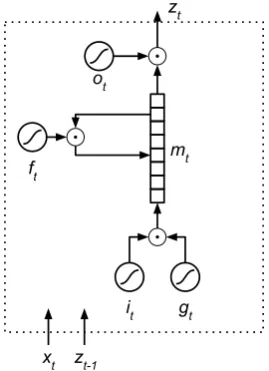
Figure 1: Long Short-Term Memory unit at timestept. The four nonlinearity nodes (it,gt,ft,
andot) all have, as inputs,xtandzt−1. Small
cir-cles with dots are elementwise vector multiplica-tions.
1997) have been shown to perform well on a wide variety of NLP tasks (Sutskever et al., 2014; Her-mann et al., 2015; Vinyals et al., 2015,inter alia). The LSTM we use is described by:
it=σ(Wx,ixt+Wz,izt−1+bi) ft=σ(Wx,fxt+Wz,fzt−1+bf) ot=σ(Wx,oxt+Wh,izt−1+bo) gt= tanh (Wx,mxt+Wz,mzt−1+bg) mt=ft◦mt−1+it◦gt
zt=ot◦tanhmt.
The model is depicted graphically in Figure 1. The memory vectormtis a function of both its
previ-ous valuemt−1 and the inputxt; the vectorztis
output both to any layers above the unit (which are trained to predict the output valuesyt), and is
addi-tionally given as input to the LSTM unit at the next timestept+ 1. TheW∗,∗ matrices andb∗vectors
are learned model parameters, andu◦v signifies element-wise multiplication.
2.3 Sentence-Level RNN Language Models RNN sequence models have recently been shown to be extremely effective for word-level and character-level language models (Mikolov et al., 2011; Jozefowicz et al., 2016). At each timestep, these models take a word or character as input, update a hidden state vector, and predict the next
timestep’s word or character. There is also a growing body of work on training RNN encoder-decoder models for NLP problems. These systems first encode the entire input into the network’s hid-den state vector and then, in a second step, decode the entire output from this vector (Sutskever et al., 2014; Vinyals et al., 2015; Serban et al., 2016).
Sentence-level RNN language models, for ex-ample the skip-thought vector system of Kiros et al. (2015), conceptually bridge these two ap-proaches. Whereas standard language models are trained to predict the next token in the sequence of tokens, these systems are explicitly trained to pre-dict the nextsentencein the sequence of sentences. Kiros et al. (2015) train an encoder-decoder model to encode a sentence into a fixed-length vector and subsequently decode both the following and preceding sentence, using Gated Recurrent Units (Chung et al., 2014). In the present work, we train an LSTM model to predict a sentence’s succes-sor, which is essentially the forward component of the skip-thought system. Kiros et al. (2015) use the skip-thought system as a means of project-ing sentences into low-dimensional vector dings, demonstrating the utility of these embed-dings on a number of other tasks; in contrast, we will use our trained sentence-level RNN language model directly on the task its objective function optimizes: predicting a sentence’s successor.
3 Methodology
3.1 Narrative Cloze Evaluation
The evaluation of inference-focused statistical script systems is not straightforward. Cham-bers and Jurafsky (2008) introduced theNarrative Cloze evaluation, in which a single event is held out from a document and systems are judged by the ability to infer this held-out event given the remaining events. This evaluation has been used by a number of published script systems (Cham-bers and Jurafsky, 2009; Jans et al., 2012; Pichotta and Mooney, 2014; Rudinger et al., 2015). This automated evaluation measures systems’ ability to model and predict events as they co-occur in text.
[image:3.595.126.261.76.262.2]verbs with coreference information about multi-ple arguments; and Pichotta and Mooney (2016) evaluate inference of verbs with noun informa-tion about multiple arguments. In order to gather human judgments of inference quality, the latter also learn an encoder-decoder LSTM network for transforming verbs and noun arguments into En-glish text to present to annotators for evaluation.
We evaluate instead on the task of directly in-ferring sequences of words. That is, instead of defining the Narrative Cloze to be the evaluation of predictions of held-out events, we define the task to be the evaluation of predictions of held-out text; in this setup, predictions need not be medi-ated by noisy, automatically-extracted events. To evaluate inferred text against gold standard text, we argue that the BLEU metric (Papineni et al., 2002), commonly used to evaluate Statistical Ma-chine Translation systems, is a natural evaluation metric. It is an n-gram-level analog to the event-level Narrative Cloze evaluation: whereas the Nar-rative Cloze evaluates a system on its ability to re-construct events as they occur in documents,BLEU evaluates a system on how well it reconstructs the n-grams.
This evaluation takes some inspiration from the evaluation of neural encoder-decoder translation models (Sutskever et al., 2014; Bahdanau et al., 2015), which use similar architectures for the task of Machine Translation. That is, the task we present can be thought of as “translating” a sen-tence into its successor. While we do not claim thatBLEUis necessarily the optimal way of eval-uating text-level inferences, but we do claim that it is a natural ngram-level analog to the Narrative Cloze task on events.
If a model infers text, we may also evaluate it on the task of inferring events by automatically ex-tracting structured events from its output text (in the same way as events are extracted from natural text). This allows us to compare directly to previ-ous event-based models on the task they are opti-mized for, namely, predicting structured events.
3.2 Models
Statistical script systems take a sequence of events from a document and infer additional events that are statistically probable. Exactly what constitutes an event varies: it may be a (verb, dependency) pair inferred as relating to a particular discourse entity (Chambers and Jurafsky, 2008; Rudinger et
al., 2015), a simplex verb (Chambers and Juraf-sky, 2009; Orr et al., 2014), or a verb with multi-ple arguments (Pichotta and Mooney, 2014). In the present work, we adopt a representation of events as verbs with multiple arguments (Balasub-ramanian et al., 2013; Pichotta and Mooney, 2014; Modi and Titov, 2014). Formally, we define an event to be a variadic tuple (v, s, o, p∗), where v
is a verb,sis a noun standing in subject relation tov, ois a noun standing as a direct object to v, andp∗denotes an arbitrary number of (pobj,prep)
pairs, withprepa preposition andpobja noun re-lated to the verbvvia the prepositionprep.1 Any argument exceptvmay benull, indicating no noun fills that slot. For example, the text
Napoleon sent the letter to Josephine
would be represented by the event (sent, Napoleon, letter, (Josephine, to)). We rep-resent arguments by their grammatical head words.
We evaluate on a number of different neural models which differ in their input and output. All models are LSTM-based encoder-decoder models. These models encode a sentence (either its events or text) into a learned hidden vector state and then, subsequently, decode that vector into its successor sentence (either its events or its text).
Our general system architecture is as follows. At each timestep t, the input token is repre-sented as a learned 100-dimensional embedding vector (learned jointly with the other parameters of the model), such that predictively similar words should get similar embeddings. This embedding is fed as input to the LSTM unit (that is, it will be the vectorxtin Section 2.2, the input to the LSTM). The output of the LSTM unit (calledztin Section
2.2) is then fed to a softmax layer via a learned linear transformation.
During the encoding phase the network is not trained to produce any output. During the decod-ing phase the output is a one-hot representation of the subsequent timestep’s input token (that is, with a V-word vocabulary, the output will be a
V-dimensional vector with one 1 andV −1 ze-ros). In this way, the network is trained to con-sume an entire input sequence and, as a second step, iteratively output the subsequent timestep’s
1This is essentially the event representation of Pichotta
Hello ∅
</S> ∅
<S> ∅
LSTM
<GEN> <S>
<S> Goodbye
Goodbye </S>
</S> ∅
Input Hidden (zt) Output (yt)
Encoding Decoding
LSTM LSTM LSTM LSTM LSTM LSTM
[image:5.595.122.473.64.186.2]Embedding (xt)
Figure 2: Encoder-Decoder setup predicting the text “Goodbye” from “Hello”
input, which allows the prediction of full output sequences. This setup is pictured diagrammati-cally in Figure 2, which gives an example of in-put and outin-put sequence for a token-level encoder-decoder model, encoding the sentence “Hello .” and decoding the successor sentence “Goodbye .” Note that we add beginning-of-sequence and end-of-sequence pseudo-tokens to sentences. This formulation allows a system to be trained which can encode a sentence and then infer a successor sentence by iteratively outputting next-input pre-dictions until the </S> end-of-sentence pseudo-token is predicted. We use different LSTMs for encoding and decoding, as the dynamics of the two stages need not be identical.
We notate the different systems as follows. Let
s1 be the input sentence ands2 its successor
sen-tence. Lett1 denote the sequence of raw tokens in s1, andt2 the tokens ofs2. Further, lete1 ande2
be the sequence of structured events occurring in
s1ands2, respectively (described in more detail in
Section 4.1), and lete2[0]denote the first event of e2. The different systems we compare are named
systematically as follows:
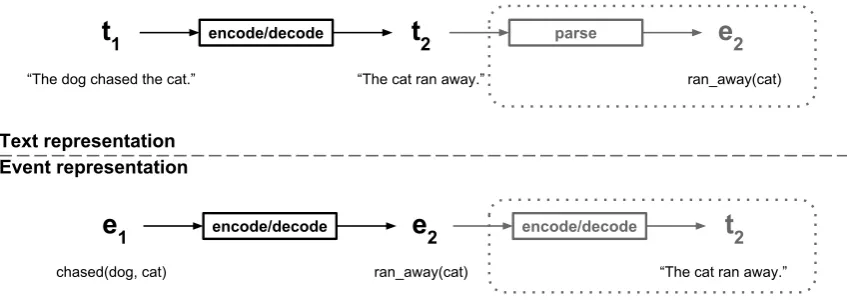
• The system t1 t2 is trained to encode a
sentence’s tokens and decode its successor’s tokens.
• The system e1 e2 is trained to encode a
sentence’s events and decode its successor’s events.
• The systeme1 e2 t2 is trained to
en-code a sentence’s events, deen-code its succes-sor’s events, and then encode the latter and subsequently decode the successor’s text.
We will not explicitly enumerate all systems, but other systems are defined analogously, with the
schema X Y describing a system which is trained to encodeXand subsequently decodeY, and X Y Z indicating a system which is trained to encodeX, decodeY, and subsequently encode Y and decode Z. Note that in a system
XY Z, onlyXis provided as input.
We also present results for systems of the form
X a Y, which signifies that the system is trained to decodeY fromXwith the addition of an atten-tion mechanism. We use the attenatten-tion mechanism of Vinyals et al. (2015). In short, these models have additional parameters which can learn soft alignments between positions of encoded inputs and positions in decoded outputs. Attention mech-anisms have recently been shown to be quite em-pirically valuable in many complex sequence pre-diction tasks. For more details on the model, see Vinyals et al. (2015).
Figure 3 gives a diagrammatic representation of the different system setups. Text systems in-fer successor text and, optionally, parse that text and extract events from it; event sequences infer successor events and, optionally, expand inferred events into text.
Note that the system t1 t2, in which both
the encoding and decoding steps operate on raw text, is essentially a one-directional version of the skip-thought system of Kiros et al. (2015).2 Fur-ther, the systeme1 e2 t2, which is trained to
take a sentence’s event sequence as input, predict its successor’s events, and then predict its succes-sor’s words, is comparable to the event inference system of Pichotta and Mooney (2016). They use an LSTM sequence model of events in sequence
2The system of Kiros et al. (2015), in addition to being
t
1 encode/decode“The dog chased the cat.” “The cat ran away.” ran_away(cat)
t
2 parsee
2e
1 encode/decodee
2 encode/decode
t
2chased(dog, cat) ran_away(cat) “The cat ran away.”
[image:6.595.86.510.63.216.2]Text representation Event representation
Figure 3: Different system setups for modeling the two-sentence sequence “The dog chased the cat.” followed by “The cat ran away.” The gray components inside dotted boxes are only present in some systems.
for event inference, and optionally transform in-ferred events to text using another LSTM; we, on the other hand, use an encoder/decoder setup to infer text directly.
4 Evaluation
4.1 Experimental Details
We train a number of LSTM encoder-decoder net-works which vary in their input and output. Mod-els are trained on English Language Wikipedia, with 1% of the documents held out as a validation set. Our test set consists of 10,000 unseen sen-tences (from articles in neither the training nor val-idation set). We train models with batch stochas-tic gradient descent with momentum, minimizing the cross-entropy error of output predictions. All models are implemented in TensorFlow (Abadi et al., 2015). We use a vocabulary of the 50,000 most frequent tokens, replacing all other tokens with an out-of-vocabulary pseudo-token. Learned word embeddings are 100-dimensional, and the la-tent LSTM vector is 500-dimensional. To extract events from text, we use the Stanford Dependency Parser (De Marneffe et al., 2006; Socher et al., 2013). We use the Moses toolkit (Koehn et al., 2007) to calculateBLEU.3
We evaluate the task of predicting held-out text with three metrics. The first metric isBLEU, which
is standardBLEU(the geometric mean of modified 1-, 2-, 3-, and 4-gram precision against a gold stan-dard, multiplied by a brevity penalty which pe-nalizes short candidates). The second metric we present, BLEU-BP, is BLEU without the brevity
3Via the scriptmulti-bleu.pl.
penalty: in the task of predicting successor sen-tences, depending on predictions’ end use, on-topic brevity is not necessarily undesirable. Eval-uations are over top system inferences (that is, de-coding is done by taking the argmax). Finally, we also present values for unigram precision (1G P), one of the components ofBLEU.
We also evaluate on the task of predicting held-out verb-argument events, either directly or via in-ferred text. We use two evaluation metrics for this task. First, theAccuracymetric measures the per-centage of a system’s most confident guesses that are totally correct. That is, for each held-out event, a system makes its single most confident guess for that event, and we calculate the total percentage of such guesses which are totally correct. Some au-thors (e.g. Jans et al. (2012), Pichotta and Mooney (2016)) present results on the “Recall atk” met-ric, judging gold-standard recall against a list of topkevent inferences; this metric is equivalent to “Recall at 1.” This is quite a stringent metric, as an inference is only counted correct if the verb and all arguments are correct. To relax this requirement, we also present results on what we call thePartial Creditmetric, which is the percentage of held-out event components identical to the respective com-ponents in a system’s top inference.4
4.2 Experimental Evaluation
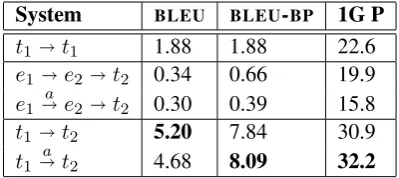
Table 1 gives the results of evaluating predicted successor sentence text against the gold standard using BLEU. The baseline system t1 t1
sim-4This metric was used in Pichotta and Mooney (2014),
System BLEU BLEU-BP 1G P
t1 t1 1.88 1.88 22.6
e1e2 t2 0.34 0.66 19.9 e1a e2 t2 0.30 0.39 15.8
t1 t2 5.20 7.84 30.9
t1 a t2 4.68 8.09 32.2
Table 1: Successor text predictions evaluated with BLEU.
ply reproduces the input sentence as its own suc-cessor.5 Below this are systems which make predictions from event information, with systems which make predictions from raw text under-neath. Transformations writtenXa Y are, recall, encoder-decoder LSTMs with attention.
Note, first, that the text-level models outperform other models onBLEU. In particular, the two-step modele1 e2 t2 (and comparable model with
attention) which first predicts successor events and then, as a separate step, expands these events into text, performs quite poorly. This is perhaps due to the fact that the translation from text to events is lossy, so reconstructing raw sentence tokens is not straightforward.
The BLEU-BP scores, which areBLEUwithout the brevity penalty, are noticeably higher in the text-level models than the rawBLEUscores. This is in part because these models seem to produce shorter sentences, as illustrated below in section 4.4.
The attention mechanism does not obviously benefit either text or event level prediction encoder-decoder models. This could be because there is not an obvious alignment structure be-tween contiguous spans of raw text (or events) in natural documents.
[image:7.595.81.281.62.151.2]These results provide evidence that, if the Nar-rative Cloze task is defined to evaluate prediction of held-out text from a document, then sentence-level RNN language models provide superior per-formance to RNN models operating at the event level. In other words, linguistic pre-processing does not obviously benefit encoder-decoder mod-els trained to predict succeeding text.
Table 2 gives results on the task of predicting the next verb with its nominal arguments; that is, whereas Table 1 gave results on a text analog to the Narrative Cloze evaluation (BLEU), Table 2 gives
5“t
1t1” is minor abuse of notation, as the system is not
an encoder/decoder but a simple identity function.
System Accuracy Partial Credit Most common 0.2 26.5
e1e2[0] 2.3 26.7 e1a e2[0] 2.2 25.6 t1 t2e2[0] 2.0 30.3 t1 a t2e2[0] 2.0 27.7
Table 2: Next event prediction accuracy (numbers are percentages: maximum value is 100).
results on the verb-with-arguments prediction ver-sion. In the t1 t2 e2[0] system (and the
comparable system with attention), events are ex-tracted from automatically generated text by pars-ing output text and applypars-ing the same event ex-tractor to this parse used to extract events from raw text.6 The row labeledMost commonin Ta-ble 2 gives performance for the baseline system which always guesses the most common event in the training set.
The LSTM models trained to directly predict events are roughly comparable to systems which operate on raw text, performing slightly worse on accuracy and slightly better when taking partial credit into account. As with the previous com-parisons withBLEU, the attention mechanism does not provide an obvious improvement when decod-ing inferences, perhaps, again, because the event inference problem lacks a clear alignment struc-ture.
These systems infer their most probable guesses ofe2[0], the first event in the succeeding sentence.
In order for a system prediction to be counted as correct, it must have the correct strings for gram-matical head words of all components of the cor-rect event. Note also that we judge only against a system’s single most confident prediction (as op-posed to some prior work (Jans et al., 2012; Pi-chotta and Mooney, 2014) which takes the top
k predictions—the numbers presented here are therefore noticeably lower). We do this mainly for computational reasons: namely, a beam search over a full sentence’s text would be quite compu-tationally expensive.
4.3 Adding Additional Context
The results given above are for systems which en-code information about one sentence and deen-code
6This is also a minor abuse of notation, as the second
information about its successor. This is within the spirit of the skip-gram system of Kiros et al. (2015), but we may wish to condition on more of the document. To investigate this, we per-form an experiment varying the number of previ-ous sentences input during the encoding step of
t1 t2 text-level models without attention. We
train three different models, which take either one, three, or five sentences as input, respectively, and are trained to output the successor sentence.
Num Prev Sents BLEU BLEU-BP 1G P
1 5.80 8.59 29.4
3 5.82 9.35 31.2
5 6.83 6.83 21.4
Table 3: Varying the amount of context in text-level models. “Num Prev Sents” is the number of previous sentences supplied during encoding.
Table 3 gives the results of running these mod-els on 10,000 sentences from the validation set. As can be seen, in the training setup we investigate, more additional context sentences have a mixed effect, depending on the metric. This is perhaps due in part to the fact that we kept hyperparam-eters fixed between experiments, and a different hyperparameter regime would benefit predictions from longer input sequences. More investigation could prove fruitful.
4.4 Qualitative Analysis
Figure 4 gives some example automatic next-sentence text predictions, along with the input sen-tence and the gold-standard next sensen-tence. Note that gold-standard successor sentences frequently introduce new details not obviously inferrable from previous text. Top system predictions, on the other hand, are frequently fairly short. This is likely due part to the fact that the cross-entropy loss does not directly penalize short sentences and part to the fact that many details in gold-standard successor text are inherently difficult to predict. 4.5 Discussion
The general low magnitude of the BLEU scores presented in Table 1, especially in comparison to the scores typically reported in Machine Trans-lation results, indicates the difficulty of the task. In open-domain text, a sentence is typically not straightforwardly predictable from preceding text; if it were, it would likely not be stated.
On the task of verb-argument prediction in Ta-ble 2, the difference betweent1 t2 ande1 e2[0] is fairly marginal. This raises the general
question of how much explicit syntactic analysis is required for the task of event inference, partic-ularly in the encoder/decoder setup. These results provide evidence that a sentence-level RNN lan-guage model which operates on raw tokens can predict what comes next in a document as well or nearly as well as an event-mediated script model.
5 Future Work
There are a number of further extensions to this work. First, in this work (and, more generally, Neural Machine Translation research), though generated text is evaluated using BLEU, systems are optimized for per-token cross-entropy error, which is a different objective (Luong et al. (2016) give an example of a system which improves cross-entropy error but reducesBLEUscore in the Neural Machine Translation context). Finding dif-ferentiable objective functions that more directly target more complex evaluation metrics likeBLEU is an interesting future research direction.
Relatedly, though we argue that BLEU is a natural token-sequence-level analog to the verb-argument formulation of the Narrative Cloze task, it is not obviously the best metric for evaluat-ing inferences of text, and comparevaluat-ing these auto-mated metrics with human judgments is an im-portant direction of future work. Pichotta and Mooney (2016) present results on crowdsourced human evaluation of script inferences that could be repeated for our RNN models.
Though we focus here on forward-direction models predicting successor sentences, bidirec-tional encoder-decoder models, which predict sen-tences from both previous and subsequent text, are another interesting future research direction.
6 Related Work
Input: As of October 1 , 2008 ,hOOVichanged its company name to Panasonic Corporation. Gold: hOOViproducts that were branded “National” in Japan are currently marketed under the
“Pana-sonic” brand.
Predicted: The company’s name is nowhOOVi.
Input: White died two days after Curly Bill shot him.
Gold: Before dying, White testified that he thought the pistol had accidentally discharged and that he did not believe that Curly Bill shot him on purpose.
Predicted: He was buried athOOViCemetery. Input: The foundation stone was laid in 1867.
Gold: The members of the predominantly Irish working class parish managed to save£700 towards construction, a large sum at the time.
Predicted: ThehOOViwas founded in the early 20th century.
Input: Soldiers arrive to tell him thathOOVihas been seen in camp and they call for his capture and death.
Gold: hOOViagrees .
[image:9.595.95.498.60.226.2]Predicted: hOOViis killed by thehOOVi.
Figure 4: Sample next-sentence text predictions. hOOViis the out-of-vocabulary pseudo-token, which frequently replaces proper names.
pairs from documents; Jans et al. (2012) give a superior model in the same general framework. Chambers and Jurafsky (2009) give a method of generalizing from single sequences of pair events to collections of such sequences. Rudinger et al. (2015) apply a discriminative language model to the (verb, dependency) sequence modeling task, raising the question of to what extent event in-ference can be performed with standard language models applied to event sequences. Pichotta and Mooney (2014) describe a method of learning a co-occurrence based model of verbs with multiple coreference-based entity arguments.
There is a body of related work focused on learning models of co-occurring events to au-tomatically induce templates of complex events comprising multiple verbs and arguments, aimed ultimately at maximizing coherency of templates (Chambers, 2013; Cheung et al., 2013; Balasub-ramanian et al., 2013). Ferraro and Van Durme (2016) give a model integrating various levels of event information of increasing abstraction, evalu-ating both on coherence of induced templates and log-likelihood of predictions of held-out events. McIntyre and Lapata (2010) describe a system that learns a model of co-occurring events and uses this model to automatically generate stories via a Ge-netic Algorithm.
There have been a number of recent published neural models for various event- and discourse-related tasks. Pichotta and Mooney (2016) show that an LSTM event sequence model outper-forms previous co-occurrence methods for pre-dicting verbs with arguments. Granroth-Wilding and Clark (2016) describe a feedforward
neu-ral network which composes verbs and argu-ments into low-dimensional vectors, evaluating on a multiple-choice version of the Narrative Cloze task. Modi and Titov (2014) describe a feedfward network which is trained to predict event or-derings. Kiros et al. (2015) give a method of em-bedding sentences in low-dimensional space such that embeddings are predictive of neighboring sen-tences. Li et al. (2014) and Ji and Eisenstein (2015), use RNNs for discourse parsing; Liu et al. (2016) use a Convolutional Neural Network for implicit discourse relation classification.
7 Conclusion
We have given what we believe to be the first systematic evaluation of sentence-level RNN lan-guage models on the task of predicting held-out document text. We have found that models oper-ating on raw text perform roughly comparably to identical models operating on predicate-argument event structures when predicting the latter, and that text models provide superior predictions of raw text. This provides evidence that, for the task of held-out event prediction, encoder/decoder mod-els mediated by automatically extracted events may not be learning appreciably more structure than systems trained on raw tokens alone.
Acknowledgments
References
Mart´ın Abadi, Ashish Agarwal, Paul Barham, Eugene Brevdo, Zhifeng Chen, Craig Citro, Greg S. Cor-rado, Andy Davis, Jeffrey Dean, Matthieu Devin, Sanjay Ghemawat, Ian Goodfellow, Andrew Harp, Geoffrey Irving, Michael Isard, Yangqing Jia, Rafal Jozefowicz, Lukasz Kaiser, Manjunath Kudlur, Josh Levenberg, Dan Man´e, Rajat Monga, Sherry Moore, Derek Murray, Chris Olah, Mike Schuster, Jonathon Shlens, Benoit Steiner, Ilya Sutskever, Kunal Tal-war, Paul Tucker, Vincent Vanhoucke, Vijay Vasude-van, Fernanda Vi´egas, Oriol Vinyals, Pete Warden, Martin Wattenberg, Martin Wicke, Yuan Yu, and Xi-aoqiang Zheng. 2015. TensorFlow: Large-scale machine learning on heterogeneous systems. Soft-ware available from tensorflow.org.
Dzmitry Bahdanau, KyungHyun Cho, and Yoshua Bengio. 2015. Neural machine translation by jointly learning to align and translate. In Proceed-ings of the 2015 International Conference on Learn-ing Representations (ICLR 2015).
Niranjan Balasubramanian, Stephen Soderland, Mausam, and Oren Etzioni. 2013. Generating coherent event schemas at scale. In Proceedings of the 2013 Conference on Empirical Methods in Natural Language Processing (EMNLP-2013). Nathanael Chambers and Daniel Jurafsky. 2008.
Un-supervised learning of narrative event chains. In
Proceedings of the 46th Annual Meeting of the As-sociation for Computational Linguistics (ACL-08), pages 789–797.
Nathanael Chambers and Dan Jurafsky. 2009. Unsu-pervised learning of narrative schemas and their par-ticipants. InProceedings of the 47th Annual Meet-ing of the Association for Computational LMeet-inguistics (ACL-09), pages 602–610.
Nathanael Chambers. 2013. Event schema induc-tion with a probabilistic entity-driven model. In
Proceedings of the 2013 Conference on Empirical Methods in Natural Language Processing (EMNLP-2013).
Jackie Chi Kit Cheung, Hoifung Poon, and Lucy Van-derwende. 2013. Probabilistic frame induction. In
Proceedings of the 2013 Conference of the North American Chapter of the Association for Computa-tional Linguistics: Human Language Technologies (NAACL-13).
Junyoung Chung, Caglar Gulcehre, KyungHyun Cho, and Yoshua Bengio. 2014. Empirical evaluation of gated recurrent neural networks on sequence model-ing. InNIPS Deep Learning Workshop.
Marie-Catherine De Marneffe, Bill MacCartney, and Christopher D. Manning. 2006. Generating typed dependency parses from phrase structure parses. In
Proceedings of the 5th International Conference on Language Resources & Evaluation (LREC-2006), volume 6, pages 449–454.
Jeffrey L. Elman. 1990. Finding structure in time.
Cognitive Science, 14:179–211.
Francis Ferraro and Benjamin Van Durme. 2016. A unified Bayesian model of scripts, frames and lan-guage. InProceedings of the 30th AAAI Conference on Artificial Intelligence (AAAI-16).
Mark Granroth-Wilding and Stephen Clark. 2016. What happens next? Event prediction using a com-positional neural network model. InProceedings of the 30th AAAI Conference on Artificial Intelligence (AAAI-16).
Karl Moritz Hermann, Tom´aˇs Koˇcisk`y, Edward Grefenstette, Lasse Espeholt, Will Kay, Mustafa Su-leyman, and Phil Blunsom. 2015. Teaching ma-chines to read and comprehend. InProceedings of the 29th Annual Conference on Neural Information Processing Systems (NIPS-15).
Sepp Hochreiter and J¨urgen Schmidhuber. 1997. Long short-term memory. Neural Computation, 9(8):1735–1780.
Bram Jans, Steven Bethard, Ivan Vuli´c, and
Marie Francine Moens. 2012. Skip n-grams
and ranking functions for predicting script events. InProceedings of the 13th Conference of the Euro-pean Chapter of the Association for Computational Linguistics (EACL-12), pages 336–344.
Yangfeng Ji and Jacob Eisenstein. 2015. One vector is not enough: Entity-augmented distributional se-mantics for discourse relations. Transactions of the Association for Computational Linguistics (TACL). Rafal Jozefowicz, Oriol Vinyals, Mike Schuster, Noam
Shazeer, and Yonghui Wu. 2016. Exploring
the limits of language modeling. arXiv preprint arXiv:1602.02410.
Ryan Kiros, Yukun Zhu, Ruslan Salakhutdinov, Richard S. Zemel, Antonio Torralba, Raquel Urta-sun, and Sanja Fidler. 2015. Skip-thought vectors. In Proceedings of the 29th Annual Conference on Neural Information Processing Systems (NIPS-15). Philipp Koehn, Hieu Hoang, Alexandra Birch, Chris
Callison-Burch, Marcello Federico, Nicola Bertoldi, Brooke Cowan, Wade Shen, Christine Moran, Richard Zens, Chris Dyer, Ondrej Bojar, Alexandra Constantin, and Evan Herbst. 2007. Moses: Open source toolkit for statistical machine translation. In
Proceedings of the 45th Annual Meeting of the As-sociation for Computational Linguistics (ACL-07) Companion Volume: Proceedings of the Demo and Poster Sessions, pages 177–180, Prague, Czech Re-public.
Yang Liu, Sujian Li, Xiaodong Zhang, and Zhifang Sui. 2016. Implicit discourse relation classification via multi-task neural networks. In Proceedings of the 30th AAAI Conference on Artificial Intelligence (AAAI-16).
Minh-Thang Luong, Quoc V. Le, Ilya Sutskever, Oriol Vinyals, and Lukasz Kaiser. 2016. Multi-task se-quence to sese-quence learning. InProceedings of the 4th International Conference on Learning Represen-tations (ICLR-16).
Neil McIntyre and Mirella Lapata. 2010. Plot induc-tion and evoluinduc-tionary search for story generainduc-tion. In
Proceedings of the 48th Annual Meeting of the As-sociation for Computational Linguistics (ACL-10), pages 1562–1572.
Tomas Mikolov, Anoop Deoras, Stefan Kombrink, Lukas Burget, and Jan Cernock`y. 2011. Empir-ical evaluation and combination of advanced lan-guage modeling techniques. InProceedings of the 12th Annual Conference of the International Speech Communication Association 2011 (INTERSPEECH 2011), pages 605–608.
Marvin Minsky. 1974. A framework for representing knowledge. Technical report, MIT-AI Laboratory.
Ashutosh Modi and Ivan Titov. 2014. Inducing neu-ral models of script knowledge. In Proceedings of the Eighteenth Conference on Computational Nat-ural Language Learning (CoNLL-2014), Baltimore, MD, USA.
J Walker Orr, Prasad Tadepalli, Janardhan Rao Doppa, Xiaoli Fern, and Thomas G Dietterich. 2014. Learning scripts as Hidden Markov Models. In Pro-ceedings of the 28th AAAI Conference on Artificial Intelligence (AAAI-14).
Kishore Papineni, Salim Roukos, Todd Ward, and Wei-Jing Zhu. 2002. BLEU: a method for automatic evaluation of machine translation. InProceedings of the 40th Annual Meeting of the Association for Com-putational Linguistics (ACL-02), pages 311–318.
Karl Pichotta and Raymond J. Mooney. 2014. Statis-tical script learning with multi-argument events. In
Proceedings of the 14th Conference of the European Chapter of the Association for Computational Lin-guistics (EACL 2014), pages 220–229.
Karl Pichotta and Raymond J. Mooney. 2016. Learn-ing statistical scripts with LSTM recurrent neural networks. In Proceedings of the 30th AAAI Con-ference on Artificial Intelligence (AAAI-16).
Rachel Rudinger, Pushpendre Rastogi, Francis Ferraro, and Benjamin Van Durme. 2015. Script induction as language modeling. InProceedings of the 2015 Conference on Empirical Methods in Natural Lan-guage Processing (EMNLP-15).
Roger C. Schank and Robert P. Abelson. 1977.Scripts, Plans, Goals and Understanding: An Inquiry into Human Knowledge Structures. Lawrence Erlbaum and Associates.
Iulian V. Serban, Alessandro Sordoni, Yoshua Bengio, Aaron Courville, and Joelle Pineau. 2016. Building end-to-end dialogue systems using generative hier-archical neural network models. InProceedings of the 30th AAAI Conference on Artificial Intelligence (AAAI-16).
Richard Socher, John Bauer, Christopher D. Manning, and Andrew Y. Ng. 2013. Parsing with compo-sitional vector grammars. In Proceedings of the 51st Annual Meeting of the Association for Compu-tational Linguistics (ACL-13).
Ilya Sutskever, Oriol Vinyals, and Quoc V. Le. 2014. Sequence to sequence learning with neural net-works. In Proceedings of the 28th Annual Con-ference on Neural Information Processing Systems (NIPS-14), pages 3104–3112.
Oriol Vinyals, Łukasz Kaiser, Terry Koo, Slav Petrov, Ilya Sutskever, and Geoffrey Hinton. 2015. Gram-mar as a foreign language. In Proceedings of the 29th Annual Conference on Neural Information Pro-cessing Systems (NIPS-15), pages 2755–2763.
A Supplemental Material