3944
Attention-based Conditioning Methods
for External Knowledge Integration
Katerina Margatina1, Christos Baziotis2∗, Alexandros Potamianos1,3,4
1School of ECE, National Technical University of Athens, Athens, Greece 2School of Informatics, University of Edinburgh, UK
3Signal Analysis and Interpretation Laboratory (SAIL), USC, Los Angeles, USA 4 Behavioral Signal Technologies, Los Angeles, USA
[email protected], [email protected], [email protected]
Abstract
In this paper, we present a novel approach for incorporating external knowledge in
Re-current Neural Networks (RNNs). We
pro-pose the integration of lexicon features into the self-attention mechanism of RNN-based architectures. This form of conditioning on the attention distribution, enforces the contri-bution of the most salient words for the task at hand. We introduce three methods, namely attentional concatenation, feature-based gating and affine transformation. Experiments on six benchmark datasets show the effectiveness of our methods. Attentional feature-based gating yields consistent performance improvement across tasks. Our approach is implemented as a simple add-on module for RNN-based mod-els with minimal computational overhead and can be adapted to any deep neural architecture.
1 Introduction
Modern deep learning algorithms often do away with feature engineering and learn latent represen-tations directly from raw data that are given as in-put to Deep Neural Networks (DNNs) (Mikolov et al., 2013; McCann et al., 2017; Peters et al., 2018). However, it has been shown that linguistic knowledge (manually or semi-automatically en-coded into lexicons and knowledge bases) can sig-nificantly improve DNN performance for Natural Language Processing (NLP) tasks, such as natural language inference (Mrkši´c et al.,2017), language modelling (Ahn et al.,2016), named entity recog-nition (Ghaddar and Langlais,2018) and relation extraction (Vashishth et al.,2018).
For NLP tasks, external sources of information are typically incorporated into deep neural archi-tectures by processing the raw inputin the context of such external linguistic knowledge. In machine
∗
The research was conducted when the author was a re-searcher at School of ECE, NTUA in Athens, Greece.
learning, this contextual processing is known as conditioning; the computation carried out by a model is conditioned or modulated by informa-tion extracted from an auxiliary input. The most commonly-used method of conditioning is con-catenating a representation of the external infor-mation to the input or hidden network layers.
Attention mechanisms (Bahdanau et al., 2015; Vaswani et al., 2017;Lin et al., 2017) are a key ingredient for achieving state-of-the-art perfor-mance in tasks such as textual entailment ( Rock-täschel et al., 2016), question answering (Xiong et al.,2017), and neural machine translation (Wu et al.,2016). Often task-specific attentional archi-tectures are proposed in the literature to further improve DNN performance (Dhingra et al.,2017; Xu et al.,2015;Barrett et al.,2018).
In this work, we propose a novel way of utiliz-ing word-level prior information encoded in lin-guistic, sentiment, and emotion lexicons, to im-prove classification performance. Usually, lexi-con features are lexi-concatenated to word-level rep-resentations (Wang et al.,2016;Yang et al.,2017; Trotzek et al.,2018), as additional features to the embedding of each word or the hidden states of the model. By contrast, we propose to incorporate them into the self-attention mechanism of RNNs. Our goal is to enable the self-attention mechanism to identify the most informative words, by directly conditioning on their additional lexicon features.
Our contributions are the following: (1) we pro-pose an alternative way for incorporating exter-nal knowledge to RNN-based architectures, (2) we present empirical results that our proposed ap-proach consistently outperforms strong baselines, and (3) we report state-of-the-art performance in two datasets. We make our source code publicly available1.
1https://github.com/mourga/
2 Related Work
In the traditional machine learning literature where statistical models are based on sparse fea-tures, affective lexicons have been shown to be highly effective for tasks such as sentiment anal-ysis, as they provide additional information not captured in the raw training data (Hu and Liu, 2004; Kim and Hovy, 2004; Ding et al., 2008; Yu and Dredze,2014;Taboada et al.,2011). Af-ter the emergence of pretrained word represen-tations (Mikolov et al., 2013; Pennington et al., 2014), the use of lexicons is no longer common practice, since word embeddings can also capture some of the affective meaning of these words.
Recently, there have been notable contribu-tions towards integrating linguistic knowledge into DNNs for various NLP tasks. For sentiment anal-ysis,Teng et al.(2016) integrate lexicon features to an RNN-based model with a custom weighted-sum calculation of word features. Shin et al. (2017) propose three convolutional neural network specific methods of lexicon integration achiev-ing state-of-the-art performance on two datasets. Kumar et al. (2018) concatenate features from a knowledge base to word representations in an at-tentive bidirectional LSTM architecture, also re-porting state-of-the-art results. For sarcasm detec-tion,Yang et al.(2017) incorporate psycholinguis-tic, stylispsycholinguis-tic, structural, and readability features by concatenating them to paragraph and document-level representations.
Furthermore, there is limited literature regard-ing the development and evaluation of methods for combining representations in deep neural net-works. Peters et al. (2017) claim that con-catenation, non-linear mapping and attention-like mechanisms are unexplored methods for includ-ing language model representations in their se-quence model. They employ simple concatena-tion, leaving the exploration of other methods to future work. Dumoulin et al. (2018) provide an overview of feature-wise transformations such as concatenation-based conditioning, conditional bi-asing and gating mechanisms. They review the ef-fectiveness of conditioning methods in tasks such as visual question answering (Strub et al.,2018), style transfer (Dumoulin et al.,2017) and language modeling (Dauphin et al., 2017). They also ex-tend the work byPerez et al. (2017), which pro-poses the Feature-wise Linear Modulation (FiLM) framework, and investigate its applications in
vi-sual reasoning tasks. Balazs and Matsuo (2019) provide an empirical study showing the effects of different ways of combining character and word representations in word-level and sentence-level evaluation tasks. Some of the reported findings are that gating conditioning performs consistently better across a variety of word similarity and relat-edness tasks.
3 Proposed Model
3.1 Network Architecture
Word Embedding Layer. The input sequence of words w1, w2, ..., wT is projected to a
low-dimensional vector spaceRW, whereW is the size of the embedding layer andTthe number of words in a sentence. We initialize the weights of the em-bedding layer with pretrained word emem-beddings.
LSTM Layer. A Long Short-Term Memory
unit (LSTM) (Hochreiter and Schmidhuber,1997) takes as input the words of a sentence and pro-duces the word annotationsh1, h2, ..., hT, where
hi is the hidden state of the LSTM at time-stepi,
summarizing all sentence information up towi.
Self-Attention Layer. We use a self-attention mechanism (Cheng et al.,2016) to find the relative importance of each word for the task at hand. The attention mechanism assigns a score ai to each
word annotationhi. We compute the fixed
repre-sentationr of the input sequence, as the weighted sum of all the word annotations. Formally:
ai=sof tmax(v|af(hi)) (1)
r=
T
X
i=1
aihi (2)
where f(.) corresponds to a non-linear transfor-mation tanh(Wahi +ba) and Wa, ba, va are the
parameters of the attention layer.
Lexicons Annotations # dim. # words
LIWC psycho-linguistic 73 18,504
Bing Liu valence 1 2,477
AFINN sentiment 1 6,786
MPQA sentiment 4 6,886
SemEval15 sentiment 1 1,515
[image:2.595.308.528.634.728.2]Emolex emotion 19 14,182
3.2 External Knowledge
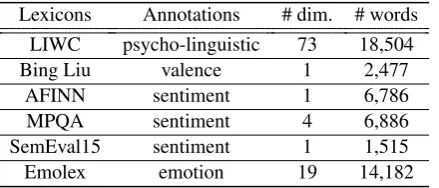
In this work, we augment our models with exist-ing lexist-inguistic and affective knowledge from hu-man experts. Specifically, we leverage lexica con-taining psycho-linguistic, sentiment and emotion annotations. We construct a feature vector c(wi)
for every word in the vocabulary by concatenating the word’s annotations from the lexicons shown in Table1. For missing words we append zero in the corresponding dimension(s) ofc(wi).
3.3 Conditional Attention Mechanism
We extend the standard self-attention mechanism (Eq.1,2), in order to condition the attention dis-tribution of a given sentence, on each word’s prior lexical information. To this end, we use as input to the self-attention layer both the word annota-tionhi, as well as the lexicon featurec(wi)of each
word. Therefore, we replacef(hi)in Eq. 1with
f(hi, c(wi)). Specifically, we explore three
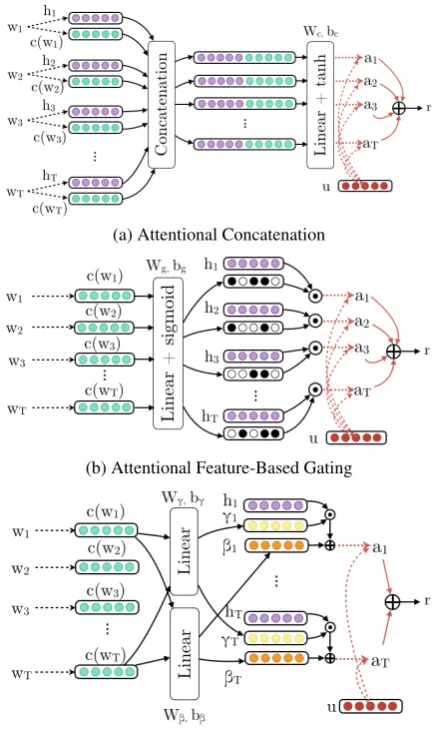
condi-tioning methods, which are illustrated in Figure1. We refer to the conditioning function asfi(.), the
weight matrix asWi and the biases asbi, wherei
is an indicative letter for each method. We present our results in Section5 (Table 3) and we denote the three conditioning methods as“conc.”,“gate” and“affine”respectively.
Attentional Concatenation. In this approach, as illustrated in Fig.1(a), we learn a function of the concatenation of each word annotationhiwith its
lexicon features c(wi). The intuition is that by
adding extra dimensions to hi, learned
represen-tations are more discriminative. Concretely:
fc(hi, c(wi)) =tanh(Wc[hi kc(wi)] +bc) (3)
wherek denotes the concatenation operation and Wc, bcare learnable parameters.
Attentional Feature-based Gating. The second approach, illustrated in Fig.1(b), learns a feature mask, which is applied on each word annotation hi. Specifically, a gate mechanism with a sigmoid
activation function, generates a mask-vector from eachc(wi)with values between 0 and 1 (black and
white dots in Fig. 1(b)). Intuitively, this gating mechanism selects salient dimensions (i.e. fea-tures) of hi, conditioned on the lexical
informa-tion. Formally:
fg(hi, c(wi)) =σ(Wgc(wi) +bg)hi (4)
wheredenotes element-wise multiplication and Wg, bgare learnable parameters.
(a) Attentional Concatenation
(b) Attentional Feature-Based Gating
[image:3.595.308.526.65.430.2](c) Attentional Affine Transformation
Figure 1: The proposed conditioning methods of the self-attention mechanism.
Attentional Affine Transformation. The third approach, shown in Fig.1(c), is adopted from the work ofPerez et al.(2017) and applies a feature-wise affine transformation to the latent space of the hidden states. Specifically, we use the lexicon fea-turesc(wi), in order to conditionally generate the
corresponding scalingγ(·)and shifting β(·) vec-tors. Concretely:
fa(hi, c(wi)) =γ(c(wi))hi+β(c(wi)) (5)
γ(x) =Wγx+bγ, β(x) =Wβx+bβ (6)
whereWγ, Wβ, bγ, bβ are learnable parameters.
3.4 Baselines
vec-Dataset Study Task Domain Classes Ntrain Ntest
SST-5 Socher et al.(2013) Sentiment Movie Reviews 5 9,645 2,210
Sent17 Rosenthal et al.(2017) Sentiment Twitter 3 49,570 12,284
PhychExp Wallbott and Scherer(1986) Emotion Experiences 7 1000 6480
Irony18 Van Hee et al.(2018) Irony Twitter 4 3,834 784
SCv1 Lukin and Walker(2013) Sarcasm Debate Forums 2 1000 995
[image:4.595.75.525.201.323.2]SCv2 Oraby et al.(2016) Sarcasm Debate Forums 2 1000 2260
Table 2: Description of benchmark datasets. We split 10% of the train set to serve as the validation set.
Model SST-5 Sent17 PhychExp Irony18 SCv1 SCv2
baseline 43.5±0.5 68.3±0.2 53.2±0.8 46.3±1.4 64.1±0.5 74.0±0.7
emb. conc. 43.3±0.6 68.4±0.2 57.1±1.2 48.1±1.2 64.2±0.7 74.2±0.7
conc. 44.0±0.7 68.6±0.3 54.3±0.6 47.4±0.9 65.1±0.6 74.3±1.2
gate 44.2±0.4 68.7±0.3 53.4±1.0 48.5±0.7 64.7±0.7 74.3±1.2
affine 43.2±0.7 68.5±0.3 53.1±0.9 45.3±1.5 60.3±0.8 74.0±1.0
gate+emb.conc. 46.2±0.5 68.9±0.3 57.2±1.1 48.4±1.0 64.9±0.6 74.4±0.9
state-of-the-art 51.7 68.5 57.0 53.6 69.0 76.0
Shen et al.(2018) Cliche(2017) Felbo et al.(2017) Baziotis et al.(2018) Felbo et al.(2017) Ili´c et al.(2018)
Table 3: Comparison across benchmark datasets. Reported values are averaged across ten runs. All reported
measures areF1scores, apart fromSST−5which is evaluated withAccuracy.
tors to the word representations in the embedding layer. In Table3we use the abbreviations “base-line”and“emb. conc.” for the two baseline mod-els respectively.
4 Experiments
Lexicon Features. As prior knowledge, we lever-age the lexicons presented in Table 1. We se-lected widely-used lexicons that represent differ-ent facets of affective and psycho-linguistic fea-tures, namely; LIWC (Tausczik and Pennebaker, 2010), Bing Liu Opinion Lexicon (Hu and Liu, 2004), AFINN (Nielsen,2011), Subjectivity Lex-icon (Wilson et al., 2005), SemEval 2015 En-glish Twitter Lexicon (Svetlana Kiritchenko and
Mohammad, 2014), and NRC Emotion Lexicon
(EmoLex) (Mohammad and Turney,2013).
Datasets. The proposed framework can be ap-plied to different domains and tasks. In this paper, we experiment with sentiment analysis, emotion recognition, irony, and sarcasm detection. Details of the benchmark datasets are shown in Table2. Preprocessing. To preprocess the words, we use the tool Ekphrasis (Baziotis et al., 2017). Af-ter tokenization, we map each word to the corre-sponding pretrained word representation: Twitter-specific word2vec embeddings (Chronopoulou
et al., 2018) for the Twitter datasets, and fast-text (Bojanowski et al.,2017) for the rest.
Experimental Setup. For all methods, we em-ploy a single-layer LSTM model with 300 neurons augmented with a self-attention mechanism, as de-scribed in Section3. As regularization techniques, we apply early stopping, Gaussian noiseN(0,0.1) to the word embedding layer, and dropout to the LSTM layer withp = 0.2. We use Adam to op-timize our networks (Kingma and Ba,2014) with mini-batches of size 64 and clip the norm of the gradients (Pascanu et al.,2013) at 0.5, as an extra safety measure against exploding gradients. We also use PyTorch (Paszke et al.,2017) and scikit-learn (Pedregosa et al.,2011).
5 Results & Analysis
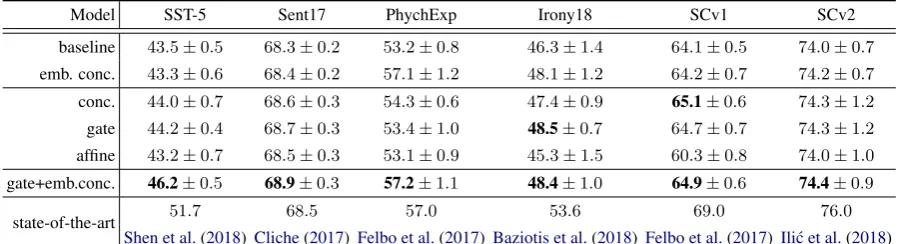
We compare the performance of the three pro-posed conditioning methods with the two base-lines and the state-of-the-art in Table3. We also provide results for the combination of our best method, attentional feature-based gating, and the second baseline model (emb. conc.).
im-when when 0.055 0.055 aa 0.048 0.048 mistake mistake 0.053 0.053 occurred occurred 0.058 0.058 at at 0.049 0.049 work work 0.048 0.048 which which 0.046 0.046 ii 0.043 0.043 was was 0.044 0.044 not not 0.048 0.048 responsible responsible 0.106 0.106 for for 0.071 0.071 .. 0.065 0.065 this this 0.059 0.059 was was 0.052 0.052 disclosed disclosed 0.054 0.054 later later 0.050 0.050 .. 0.052 0.052 when when 0.022 0.022 aa 0.023 0.023 mistake mistake 0.153 0.153 occurred occurred 0.150 0.150 at at 0.138 0.138 work work 0.133 0.133 which which 0.068 0.068 ii 0.025 0.025 was was 0.022 0.022 not not 0.033 0.033 responsible responsible 0.038 0.038 for for 0.029 0.029 .. 0.035 0.035 this this 0.027 0.027 was was 0.023 0.023 disclosed disclosed 0.026 0.026 later later 0.024 0.024 .. 0.029 0.029 anger guilt
Figure 2: Attention heatmap of aPsychExprandom test sample. The first attention distribution is created with
thebaselinemodel without lexicon feature integration, while the second with the combination of our attentional
feature-based gating method and the concatenation to word embeddings baseline (gate+emb.conc.).
proves upon baseline concatenation in the embed-ding layer across benchmarks, with the exception ofPsychExpdataset.
For the Sent17 dataset we achieve state-of-the-art F1 score using the feature-based gating
method; we further improve performance when combining gating with the emb. conc. method. For SST-5, we observe a significant performance boost with combined attentional gating and em-bedding conditioning (gate + emb. conc.). For PsychExp, we marginally outperform the state-of-the-art also with the combined method, while for Irony18, featubased gating yields the best re-sults. Finally, concatenation based conditioning is the top method forSCv1, and the combination method forSCv2.
Overall, attentional feature-based gating is the best performing conditioning method followed by concatenation. Attentional affine transformation underperforms, especially, for smaller datasets; this is probably due to the higher capacity of this model. This is particularly interesting since gat-ing (Eq.4) is a special case of the affine transfor-mation method (Eq.5), where the shifting vector β is zero and the scaling vector γ is bounded to the range[0,1](Eq.6). Interestingly, the combi-nation of gating with traditional embedding-layer concatenation gives additional performance gains for most tasks, indicating that there are synergies to exploit in various conditioning methods.
In addition to the performance improvements, we can visually evaluate the effect of condition-ing the attention distribution on prior knowledge and improve the interpretability of our approach. As we can see in Figure2, lexicon features guide the model to attend to more salient words and thus predict the correct class.
6 Conclusions & Future work
We introduce three novel attention-based condi-tioning methods and compare their effectiveness
with traditional concatenation-based conditioning. Our methods are simple, yet effective, achiev-ing consistent performance improvement for all datasets. Our approach can be applied to any RNN-based architecture as a extra module to fur-ther improve performance with minimal computa-tional overhead.
In the future, we aim to incorporate more elab-orate linguistic resources (e.g. knowledge bases) and to investigate the performance of our meth-ods on more complex NLP tasks, such as named entity recognition and sequence labelling, where prior knowledge integration is an active area of re-search.
Acknowledgements
We would like to thank our colleagues Alexan-dra Chronopoulou and Georgios Paraskevopoulos for their helpful suggestions and comments. This work has been partially supported by computa-tional timegranted from the Greek Research & Technology Network (GR-NET) in the National HPC facility - ARIS. We thank NVIDIA for sup-porting this work by donating a TitanX GPU.
This work was conducted within the scope of the Research and Innovation Ac-tion Gourmet, which has received funding from the European Union’s Horizon 2020 research and innovation programme under grant agreement No 825299.
References
Sungjin Ahn, Heeyoul Choi, Tanel Pärnamaa, and
Yoshua Bengio. 2016. A neural knowledge
lan-guage model.arXiv preprint arXiv:1608.00318.
Dzmitry Bahdanau, Kyunghyun Cho, and Yoshua
Ben-gio. 2015. Neural machine translation by jointly
Jorge Balazs and Yutaka Matsuo. 2019.Gating mecha-nisms for combining character and word-level word representations: an empirical study. In Proceed-ings of the 2019 Conference of the North American Chapter of the Association for Computational Lin-guistics: Student Research Workshop, pages 110– 124, Minneapolis, Minnesota. Association for Com-putational Linguistics.
Maria Barrett, Joachim Bingel, Nora Hollenstein,
Marek Rei, and Anders Søgaard. 2018. Sequence
classification with human attention. InProceedings of the Conference on Computational Natural Lan-guage Learning, pages 302–312.
Christos Baziotis, Athanasiou Nikolaos, Pinelopi
Papalampidi, Athanasia Kolovou, Georgios
Paraskevopoulos, Nikolaos Ellinas, and Alexandros
Potamianos. 2018.Ntua-slp at semeval-2018 task 3:
Tracking ironic tweets using ensembles of word and character level attentive rnns. InProceedings of the International Workshop on Semantic Evaluation, pages 613–621.
Christos Baziotis, Nikos Pelekis, and Christos
Doulk-eridis. 2017. Datastories at semeval-2017 task
4: Deep lstm with attention for message-level and topic-based sentiment analysis. InProceedings of the International Workshop on Semantic Evaluation, pages 747–754.
Piotr Bojanowski, Edouard Grave, Armand Joulin, and
Tomas Mikolov. 2017. Enriching word vectors with
subword information. Transactions of the Associa-tion for ComputaAssocia-tional Linguistics, 5:135–146.
Jianpeng Cheng, Li Dong, and Mirella Lapata. 2016.
Long short-term memory-networks for machine reading. InProceedings of the Conference on Em-pirical Methods in Natural Language Processing, pages 551–561.
Alexandra Chronopoulou, Aikaterini Margatina, Chris-tos Baziotis, and Alexandros Potamianos. 2018.
Ntua-slp at iest 2018: Ensemble of neural trans-fer methods for implicit emotion classification. In
Proceedings of the Workshop on Computational Ap-proaches to Subjectivity, Sentiment and Social Me-dia Analysis, pages 57–64.
Mathieu Cliche. 2017. Bb_twtr at semeval-2017 task
4: Twitter sentiment analysis with cnns and lstms. InProceedings of the International Workshop on Se-mantic Evaluation, pages 573–580.
Yann N. Dauphin, Angela Fan, Michael Auli, and
David Grangier. 2017. Language modeling with
gated convolutional networks. InProceedings of the 34th International Conference on Machine Learning - Volume 70, ICML’17, pages 933–941. JMLR.org.
Bhuwan Dhingra, Hanxiao Liu, Zhilin Yang, William
Cohen, and Ruslan Salakhutdinov. 2017.
Gated-attention readers for text comprehension. In Pro-ceedings of the Annual Meeting of the Association for Computational Linguistics, pages 1832–1846.
Xiaowen Ding, Bing Liu, and Philip S. Yu. 2008. A
holistic lexicon-based approach to opinion mining. In Proceedings of the International Conference on Web Search and Data Mining, pages 231–240.
Vincent Dumoulin, Ethan Perez, Nathan Schucher, Flo-rian Strub, Harm de Vries, Aaron Courville, and
Yoshua Bengio. 2018. Feature-wise
transforma-tions.Distill.
Vincent Dumoulin, Jonathon Shlens, and Manjunath
Kudlur. 2017. A learned representation for artistic
style.International Conference on Learning Repre-sentations.
Bjarke Felbo, Alan Mislove, Anders Søgaard, Iyad
Rahwan, and Sune Lehmann. 2017. Using millions
of emoji occurrences to learn any-domain represen-tations for detecting sentiment, emotion and sar-casm. InProceedings of the Conference on Empiri-cal Methods in Natural Language Processing, pages 1615–1625.
Abbas Ghaddar and Phillippe Langlais. 2018.
Ro-bust lexical features for improved neural network named-entity recognition. InProceedings of the In-ternational Conference on Computational
Linguis-tics, pages 1896–1907.
Sepp Hochreiter and JÃijrgen Schmidhuber. 1997.
Long short-term memory. Neural Computation, 9:1735–1780.
Minqing Hu and Bing Liu. 2004. Mining and
sum-marizing customer reviews. InProceedings of the International Conference on Knowledge Discovery and Data Mining, pages 168–177.
Suzana Ili´c, Edison Marrese-Taylor, Jorge Balazs, and
Yutaka Matsuo. 2018. Deep contextualized word
representations for detecting sarcasm and irony. In
Proceedings of the Workshop on Computational Ap-proaches to Subjectivity, Sentiment and Social Me-dia Analysis, pages 2–7.
Soo-Min Kim and Eduard H. Hovy. 2004. Determining
the sentiment of opinions. InProceedings of the In-ternational Conference on Computational Linguis-tics.
Diederik Kingma and Jimmy Ba. 2014. Adam: A
method for stochastic optimization. arXiv preprint arXiv:1412.6980.
Abhishek Kumar, Daisuke Kawahara, and Sadao
Kuro-hashi. 2018. Knowledge-enriched two-layered
at-tention network for sentiment analysis. In Proceed-ings of the Conference of the North American Chap-ter of the Association for Computational Linguistics, pages 253–258.
Zhouhan Lin, Minwei Feng, Cicero Nogueira dos San-tos, Mo Yu, Bing Xiang, Bowen Zhou, and Yoshua
Bengio. 2017. A structured self-attentive sentence
Stephanie Lukin and Marilyn Walker. 2013. Really? well. apparently bootstrapping improves the perfor-mance of sarcasm and nastiness classifiers for online dialogue. InProceedings of the Workshop on Lan-guage Analysis in Social Media, pages 30–40.
Bryan McCann, James Bradbury, Caiming Xiong, and
Richard Socher. 2017. Learned in translation:
Con-textualized word vectors. InAdvances in Neural In-formation Processing Systems, pages 6294–6305.
Tomas Mikolov, Ilya Sutskever, Kai Chen, Greg
Cor-rado, and Jeffrey Dean. 2013. Distributed
repre-sentations of words and phrases and their composi-tionality. InProceedings of the International Con-ference on Neural Information Processing Systems, pages 3111–3119.
Saif M. Mohammad and Peter D. Turney. 2013.
Crowdsourcing a word-emotion association lexicon. 29(3):436–465.
Nikola Mrkši´c, Ivan Vuli´c, Diarmuid Ó Séaghdha, Ira Leviant, Roi Reichart, Milica Gaši´c, Anna
Korho-nen, and Steve Young. 2017. Semantic
special-ization of distributional word vector spaces using monolingual and cross-lingual constraints. 5:309– 324.
F. Å. Nielsen. 2011.Afinn.
Shereen Oraby, Vrindavan Harrison, Lena Reed, Ernesto Hernandez, Ellen Riloff, and Marilyn
Walker. 2016. Creating and characterizing a diverse
corpus of sarcasm in dialogue. InProceedings of the Annual Meeting of the Special Interest Group on Discourse and Dialogue, pages 31–41.
Razvan Pascanu, Tomas Mikolov, and Yoshua Bengio.
2013. On the difficulty of training recurrent
neu-ral networks. International Conference on Machine Learning, 28:1310–1318.
Adam Paszke, Sam Gross, Soumith Chintala, Gre-gory Chanan, Edward Yang, Zachary DeVito, Zem-ing Lin, Alban Desmaison, Luca Antiga, and Adam Lerer. 2017.Automatic differentiation in pytorch.
Fabian Pedregosa, Gaël Varoquaux, Alexandre Gram-fort, Vincent Michel, Bertrand Thirion, Olivier Grisel, Mathieu Blondel, Peter Prettenhofer, Ron
Weiss, Vincent Dubourg, and others. 2011.
Scikit-learn: Machine learning in Python. Journal of Ma-chine Learning Research, 12:2825–2830.
Jeffrey Pennington, Richard Socher, and Christopher D
Manning. 2014. Glove: Global vectors for word
representation. InProceedings of the Conference on Empirical Methods in Natural Language
Process-ing, pages 1532–1543.
Ethan Perez, Florian Strub, Harm de Vries, Vincent
Dumoulin, and Aaron C. Courville. 2017. Film:
Visual reasoning with a general conditioning layer.
CoRR, abs/1709.07871.
Matthew Peters, Mark Neumann, Mohit Iyyer, Matt Gardner, Christopher Clark, Kenton Lee, and Luke
Zettlemoyer. 2018. Deep contextualized word
rep-resentations. InProceedings of the Conference of the North American Chapter of the Association for Computational Linguistics, pages 2227–2237.
Matthew E. Peters, Waleed Ammar, Chandra
Bhaga-vatula, and Russell Power. 2017. Semi-supervised
sequence tagging with bidirectional language
mod-els.CoRR, abs/1705.00108.
Tim Rocktäschel, Edward Grefenstette, Karl Moritz Hermann, Tomás Kociský, and Phil Blunsom. 2016.
Reasoning about entailment with neural attention. In Proceedings of the International Conference on Learning Representations.
Sara Rosenthal, Noura Farra, and Preslav Nakov. 2017.
Semeval-2017 task 4: Sentiment analysis in twitter. InProceedings of the International Workshop on Se-mantic Evaluation, pages 502–518.
Tao Shen, Tianyi Zhou, Guodong Long, Jing Jiang,
Shirui Pan, and Chengqi Zhang. 2018. Disan:
Di-rectional self-attention network for rnn/cnn-free lan-guage understanding. In Association for the Ad-vancement of Artificial Intelligence.
Bonggun Shin, Timothy Lee, and Jinho D. Choi. 2017.
Lexicon integrated cnn models with attention for sentiment analysis. InProceedings of the Workshop on Computational Approaches to Subjectivity, Senti-ment and Social Media Analysis, pages 149–158.
Richard Socher, Alex Perelygin, Jean Wu, Jason Chuang, Christopher D. Manning, Andrew Ng, and
Christopher Potts. 2013. Recursive deep models
for semantic compositionality over a sentiment tree-bank. InProceedings of the Conference on Empiri-cal Methods in Natural Language Processing, pages 1631–1642.
Florian Strub, Mathieu Seurin, Ethan Perez, Harm de Vries, Jeremie Mary, Philippe Preux, and Aaron
CourvilleOlivier Pietquin. 2018. Visual reasoning
with multi-hop feature modulation. In The Euro-pean Conference on Computer Vision (ECCV).
Xiaodan Zhu Svetlana Kiritchenko and Saif M.
Mo-hammad. 2014. Sentiment analysis of short
infor-mal texts. 50:723–762.
Maite Taboada, Julian Brooke, Milan Tofiloski,
Kim-berly Voll, and Manfred Stede. 2011. Lexicon-based
methods for sentiment analysis. Comput. Linguist., 37(2):267–307.
Yla R. Tausczik and James W. Pennebaker. 2010. The
psychological meaning of words: Liwc and comput-erized text analysis methods. Journal of Language and Social Psychology, 29(1):24–54.
Zhiyang Teng, Duy-Tin Vo, and Yue Zhang. 2016.
Processing, pages 1629–1638, Austin, Texas. Asso-ciation for Computational Linguistics.
Marcel Trotzek, Sven Koitka, and Christoph M.
Friedrich. 2018. Utilizing neural networks and
lguistic metadata for early detection of depression in-dications in text sequences.CoRR, abs/1804.07000.
Cynthia Van Hee, Els Lefever, and Veronique Hoste.
2018. Semeval-2018 task 3: Irony detection in
en-glish tweets. In Proceedings of The International Workshop on Semantic Evaluation, pages 39–50.
Shikhar Vashishth, Rishabh Joshi, Sai Suman Prayaga, Chiranjib Bhattacharyya, and Partha Talukdar. 2018.
Reside: Improving distantly-supervised neural rela-tion extracrela-tion using side informarela-tion. In Proceed-ings of the Conference on Empirical Methods in Nat-ural Language Processing, pages 1257–1266.
Ashish Vaswani, Noam Shazeer, Niki Parmar, Jakob Uszkoreit, Llion Jones, Aidan N Gomez, Ł ukasz
Kaiser, and Illia Polosukhin. 2017. Attention is all
you need. InAdvances in Neural Information Pro-cessing Systems, pages 5998–6008.
Harald G. Wallbott and Klaus R. Scherer. 1986. How
universal and specific is emotional experience? ev-idence from 27 countries on five continents. In-formation (International Social Science Council), 25:763–795.
Bingning Wang, Shangmin Guo, Kang Liu, Shizhu
He, and Jun Zhao. 2016. Employing external
rich knowledge for machine comprehension. In
Proceedings of the Twenty-Fifth International Joint Conference on Artificial Intelligence, IJCAI’16, pages 2929–2935. AAAI Press.
Theresa Wilson, Paul Hoffmann, Swapna Somasun-daran, Jason Kessler, Janyce Wiebe, Yejin Choi, Claire Cardie, Ellen Riloff, and Siddharth
Patward-han. 2005. Opinionfinder: A system for
subjectiv-ity analysis. InProceedings of HLT/EMNLP on In-teractive Demonstrations. Association for Computa-tional Linguistics.
Yonghui Wu, Mike Schuster, Zhifeng Chen, Quoc V. Le, Mohammad Norouzi, Wolfgang Macherey,
Maxim Krikun, Yuan Cao, Qin Gao, Klaus
Macherey, Jeff Klingner, Apurva Shah, Melvin Johnson, Xiaobing Liu, Lukasz Kaiser, Stephan
Gouws, Yoshikiyo Kato, Taku Kudo, Hideto
Kazawa, Keith Stevens, George Kurian, Nishant Patil, Wei Wang, Cliff Young, Jason Smith, Jason Riesa, Alex Rudnick, Oriol Vinyals, Greg Corrado,
Macduff Hughes, and Jeffrey Dean. 2016. Google’s
neural machine translation system: Bridging the gap between human and machine translation. CoRR, abs/1609.08144.
Caiming Xiong, Victor Zhong, and Richard Socher.
2017. Dynamic coattention networks for question
answering. InInternational Conference on Learn-ing Representations.
Kelvin Xu, Jimmy Ba, Ryan Kiros, Kyunghyun Cho, Aaron Courville, Ruslan Salakhudinov, Rich Zemel,
and Yoshua Bengio. 2015. Show, attend and tell:
Neural image caption generation with visual atten-tion. InProceedings of the International Conference on Machine Learning, pages 2048–2057.
Fan Yang, Arjun Mukherjee, and Eduard Dragut. 2017.
Satirical news detection and analysis using attention mechanism and linguistic features. InProceedings of the Conference on Empirical Methods in Natural Language Processing, pages 1979–1989.
Mo Yu and Mark Dredze. 2014. Improving lexical