5155
Modeling affirmative and negated action processing in the brain with
lexical and compositional semantic models
Vesna G. Djokic♠ Jean Maillard♣ Luana Bulat♣ Ekaterina Shutova♦
♠Department of Neuroscience, University of Southern California, USA
♣Dept. of Computer Science & Technology, University of Cambridge, United Kingdom ♦ILLC, University of Amsterdam, The Netherlands
[email protected],[email protected],
[email protected],[email protected]
Abstract
Recent work shows that distributional seman-tic models can be used to decode patterns of brain activity associated with individual words and sentence meanings. However, it is yet un-clear to what extent such models can be used to study and decode fMRI patterns associated with specific aspects of semantic composition such as the negation function. In this paper, we apply lexical and compositional seman-tic models to decode fMRI patterns associated with negated and affirmative sentences con-taining hand-action verbs. Our results show reduced decoding (correlation) of sentences where the verb is in the negated context, as compared to the affirmative one, within brain regions implicated in action-semantic process-ing. This supports behavioral and brain imag-ing studies, suggestimag-ing that negation involves reduced access to aspects of the affirmative mental representation. The results pave the way for testing alternate semantic models of negation against human semantic processing in the brain.
1 Introduction
Computational semantic models are increasingly being evaluated in their ability to capture aspects of human semantic processing, including similar-ity and association judgments (De Deyne et al., 2016) and semantic representation in the brain (Bulat et al., 2017). Prior work shows that dis-tributional semantic models (DSMs) are able to decode functional magnetic resonance imaging (fMRI) patterns associated with the meaning of concrete words (Anderson et al.,2013). Relevant to our work, Carota et al.(2017) showed that the similarity structure of DSMs for action words cor-relates with that of fMRI patterns in brain regions implicated in action-semantic processing.
More recent studies have also investigated the
ability of DSMs to predict fMRI patterns of sen-tential meanings (Pereira et al., 2018) and larger narrative text passages (Wehbe et al.,2014;Huth et al.,2016). They have shown that encoding mod-els based on word embeddings are able to capture subtle aspects of sentence meaning in the brain, even when these models are oblivious of word or-der and syntactic structure. While promising, none of this research has so far systematically investi-gated specific semantic composition phenomena and processing at the syntax-semantic interface, such as that of the negation function.
Negation is a fundamental abstraction necessary for efficient reasoning and communication (Horn, 1989). Although it is typically marked syntac-tically, the semantics of negation in natural lan-guage usage has proven to be rather challenging to pinpoint (Speranza and Horn, 2010). In logi-cal negation, the negation operator has been suc-cinctly described as a truth-functional operation, reversing the truth value of a sentence. On the other hand, from a pragmatic point of view, the primary function of negation is to direct attention to an alternative meaning and can thus be, more generally, compared to our ability for counterfac-tual thinking (Hasson and Glucksberg,2006). It is also often assumed that negation entails affirma-tion (as it is always positive by default), yet the extent to which the the affirmative situation need be processes is debated (Orenes et al.,2014). De-spite the intuition that negated meanings are in-deed quite distinct from their affirmative counter-parts, there is still no comprehensive account of how the brain represents negated entities.
exam-ple, negation of action-related sentences or im-peratives involves decreased activity in motor sys-tems of the brain implicated in action semantics when compared to the affirmative context ( Tetta-manti et al.,2008;Tomasino et al., 2010). How-ever, overall reduced activation does not necessar-ily equate to a lack of information across patterns of activated or deactivated voxels in a brain region (Kriegeskorte et al.,2008). More importantly, the degree to which negation of action-related sen-tences impacts access to lexico-semantic repre-sentations and semantic similarity in the brain is not yet well understood. To contribute to our un-derstanding of negation and its modeling, we in-vestigate the extent to which lexical and compo-sitional semantic models can decode fMRI pat-terns of negated and affirmative action sentences in the brain using similarity-based decoding ( An-derson et al., 2016). We also test the extent to which the representational similarity structure (Kriegeskorte et al., 2008) of DSMs of action-verbs correlates with that of fMRI patterns asso-ciated with negated versus affirmative sentences containing hand-action verbs. We focus on motor areas and classical language-related brain regions implicated in action-semantic processing (e.g., un-derstanding action words and sentences) ( Pulver-muller,2005;Kemmerer,2015).
DSMs have proven successful in modeling as-pects of semantic composition in the context of the natural language inference task (Bowman et al., 2015b). Although the modeling of logical negation using DSMs is wrought with challenges (Kruszewski et al.,2017), current state-of-the-art neural network based models appear to capture el-ements of markedness asymmetry in negation (Li et al., 2016) and, presumably, implicitly model negation at some level. In our experiments, we investigate the extent to which DSMs are able to decode (correlate with) fMRI patterns asso-ciated with the reading of sentences containing negated and affirmative action verbs. We exper-iment with (1) word-level representations of ac-tion verbs; and (2) composiac-tional semantic models (based on addition of word-level representations and long short-term memory (LSTM) networks).
In agreement with previous work, our results show that distributional representations of action verbs (and to some extent verb-object phrases) show reduced decoding for negated versus affir-mative action sentences. This is also reflected as
a reduced correlation between the similarity struc-ture of DSMs of action verbs and fMRI patterns of negated as compared to affirmative action sen-tences. Importantly, we show for the first time that negation impacts semantic similarity in motor ar-eas, but also to some extent language-related brain regions. These findings lend further support to the hypothesis that negation may involve reduced ac-cess to aspects of the affirmative mental represen-tation.
2 Related Work
Decoding brain activity Mitchell et al. (2008) were the first to show that DSMs based on co-occurrence counts with 25 sensorimotor verbs (e.g. see, hear, taste) can predict fMRI pat-terns associated with the meaning of concrete nouns. Later research has demonstrated that a range of DSMs can decode fMRI patterns of con-crete nouns (Murphy et al.,2012;Anderson et al., 2013;Bulat et al.,2017) and, more recently, ab-stract nouns (Anderson et al., 2017). Most rel-evant to our study, Carota et al. (2017) showed that the similarity structure of a Latent Seman-tic Analysis (LSA) model for action words (nouns and verbs) correlates with that of fMRI patterns in motor areas (left precentral gyrus (LPG)) and clas-sical language-related brain regions (left inferior frontal gyrus (LIFG), left posterior middle tempo-ral gyurs (LMTP)) implicated in lexico-semantic processing (Binder et al.,2009).
of linguistic context on semantic representation in the brain. Our work extends this line of research to study individual aspects of semantic composition, focusing on the negation function.
Modeling negation in NLP Kruszewski et al. (2017) contrast logical negation, which captures the idea of the complement of a set, with con-versational negation, the phenomenon by which negation identifies a set of alternative plausible utterances: i.e., the assertion “this is not a dog” suggests that the speaker may have been talking about other mammals, but is unlikely to have been talking about a skyscraper. They argue that dis-tributional semantics is a good fit to model con-versational negation. Their focus is on compo-sitional distributional methods, which model the negation of nouns via linear transformations. This approach, unlike those used in the present work, relies on the availability of parsed training data.
The effect of negation has also been studied in recurrent neural network models for sentiment classification: Li et al. (2016) observe that their LSTM model does not simply learn a fixed trans-formation for “not”, but rather manages to capture differences in the composition of different words; while Wang et al. (2015) study the behaviour of the LSTM gates in response to negation, showing the network’s ability to simulate complex linguis-tic phenomena. Both groups of authors, like us, focus on LSTM networks, but their models were trained on a sentiment analysis task. We chose a natural language inference task, as it has over an order of magnitude more training data, and re-quires models to learn a full range of logical and commonsense inferences (Bowman et al.,2015a).
Neurocognitive processing of negation Neu-roimaging studies show that negated hand action sentences (e.g.,Now I don’t push the button) and negative imperatives (e.g., Don’t write) involve decreased activity in motor systems of the brain compared to the same sentences in the affirmative context (Tettamanti et al.,2008;Tomasino et al., 2010). Importantly, Papeo et al. (2016) using Transcranial Magnetic Stimulation (TMS) provide evidence that negation of action-related impera-tives involves an immediate reduction of motor (cortical-spinal) excitability for negated compared to affirmative sentences as early as at the initial semantic access stage. Interestingly, the authors show that this suppression does not necessarily re-flect neural inhibition in motor areas in contrast
to prior studies suggesting a link between action negation and the inhibition of actions (de Vega et al.,2016).
These findings seem in some regards contrary to the predictions of linguistic theories of negation. For example, it has been suggested that, at some level, negation must involve processing of the af-firmative situation followed by either its modifi-cation or rejection (Russell, 1948). Specifically, Kaup et al. (2007) suggest that the abstract syn-tactic negation marker may act to reverse the truth value of a sentence through a two-step simulation process involving first, a simulation of the affir-mative situation, and, subsequently, a simulation of the actual state of affairs, leading eventually to the suppression of the affirmative situation. While a few behavioral studies have found evidence in favor of the idea that negation involves a simula-tion of the affirmative situasimula-tion (Kaup et al.,2007), it has been argued that these effects may be the result of task-induced cognitive strategies (Papeo et al., 2016). On the whole, behavioral and neu-roscientific findings do not paint a complete pic-ture of negation, but they suggest that access to some aspects of the affirmative semantic represen-tation in the brain are being immediately reduced (or blocked). Given the above, we might expect to see significant differences in the way in which the semantic similarity of DSM models for action-words and sentences is reflected across the brain areas implicated in action-semantics when com-paring affirmative and negated actions.
3 Brain Imaging Data
We use the fMRI data by Djokic et al. ( forth-coming), who investigated negation of literal and metaphoric actions in the brain.
Participants Fifteen healthy adults (8 female, ages 18 to 35) took part in the study. All subjects were right-handed, native English speakers.
Condition Sentence
Affirm. Literal She’spushingthe wheelbarrow Negated Literal He’s notpushingthe carriage Affirm. Metaphor She’spushingthe agenda Negated Metaphor He’s notpushingthe idea
Figure 1: Sample stimuli for the verbpush
the authors of the study and normed for psycholin-guistic variables in a separate experiment.
Experimental Paradigm Subjects were in-structed to passively read the object of the sen-tence (e.g. ‘the yellow lemon’), briefly shown on screen first, followed by the sentence (e.g. ‘She’s squeezing the lemon’). Catch trials were included that contained a semantically incongruent object (e.g., ‘the wooden table’, ‘She’s eating the table’). Participant’s recall of catch trials (and non-catch) trials was tested to ensure participants were paying attention. The object was shown on screen for 2 s, followed by a 0.5 s interval, then the sentence was presented for 4 s followed by a rest of 8 s. A total of 5 runs were completed, each lasting 10.15 min-utes (3 subjects only completed 4 runs). Stimulus presentation was pseudo-randomized (i.e., such that sentences with the same verb were not shown in succession).
fMRI Data Acquisition fMRI images were ac-quired with a Siemens MAGNETOM Trio 3T Sys-tem with a 32-channel head matrix coil. High-resolution anatomical scans were acquired with a structural T1-weighted magnetization prepared rapid gradient echo (MPRAGE) with TR=1950 ms, TE=2.26 ms, flip angle 10◦, 256 × 256
mm matrix, 1 mm resolution, and 208 coro-nal slices. Whole brain functional images were obtained with a T2* weighted single-shot gradient-recalled echo-planar sequence (EPI) us-ing blood oxygenation-level-dependent contrast with TR=2000 ms, TE=30 ms, flip angle 90◦,
64 × 64 mm matrix, 3.5 mm resolution. Each functional image consisted of 37 contiguous axial slices, acquired in interleaved mode.
4 Semantic models
All our semantic models are based on GloVe ( Pen-nington et al., 2014) word embeddings. We use the 100-dimensional word vectors provided by the authors, trained on Wikipedia and Gigaword cor-pora.1 We investigate the following models:
1https://nlp.stanford.edu/projects/glove/
Verb In this model, stimulus phrases are repre-sented as the individualD-dimensional word em-beddings of their verb.
Addition This model takes the embeddings of the verb and object of the phrase, and computes the phrase representation as their average.
LSTM As a more sophisticated compositional model, we take the long short-term memory (LSTM) recurrent neural network architecture (Hochreiter and Schmidhuber,1997). Due to the lack of a large training set, directly training the LSTM model for our specific task (i.e. brain de-coding) was not possible. Instead, we trained the LSTM on a natural language inference task ( Bow-man et al., 2015a), as it is a complex semantic task where we expect rich meaning representa-tions to play an important role. Given two sen-tences, the goal of natural language inference is to decide whether the firstentailsorcontradictsthe second, or whether they areunrelated. We used the LSTM to compute hidden representations for each sentence, and then used a single-layer per-ceptron classifier as in Bowman (2016) to predict the correct relationship. The inputs were the same 100-dimensional word embeddings used for the other models, and were updated during training. The model was optimised using Adam (Kingma and Ba,2014). We extracted the 100-dimensional hidden representations learnt by the LSTM for the verb-object phrases in our stimulus set.
5 Brain activity decoding
5.1 fMRI data preprocessing
We restricted analysis to the 12 subjects that com-pleted all runs (3 out of 15 subjects scanned only completed 4 out of 5 runs). The runs were com-bined across time to form each subject’s dataset. The functional data was co-registered with the MPRAGE structural image, high-pass filtered (90 secs) and motion corrected to the middle slice us-ing the fMRI software FSL2. Lastly each dataset was linearly detrended and (baseline) normalized per run using PyMVPA3.
5.2 Estimation of fMRI Patterns
GLM Modeling The Blood oxygenation level dependent (BOLD) signal response was estimated
2
Oxford Centre for Functional Magnetic Resonance Imaging of the Brain (FMRIB’s) Software Library, https://fsl.fmrib.ox.ac.uk/fsl
using the general linear model (GLM) with the hemodynamic response function (HRF) regressor with PyMVPA. The entire stimulus duration for each object and action-related sentence was mod-eled as an event lasting six seconds (3 TRs) after taking into account the hemodynamic lag. This gave a response amplitude (Beta) estimate for each sentence resulting in voxel-wise Beta maps that were normalized to Z-scores.
Verbs Estimated fMRI patterns were calcu-lated for each of the thirty-one action-verbs by combining action-related sentences with the same action-verb across all stimuli, irrespective of sen-tence context (All Verbs). Estimated fMRI pat-terns for action-verbs presented in an affirma-tive context (Aff Verbs) were obtained by com-bining only affirmative sentences containing the same action-verbs. Similarly, fMRI estimates for action-verbs in a negative context (Neg Verbs) were obtained by combining negative sentences containing the same action-verbs. In all three cases, estimated brain responses for sentences containing the same action-verbs were averaged together across runs to yield voxel-wise Z-score maps for each of the thirty-one verb presenta-tions and used to perform similarity-based anal-ysis within each subject’s native functional space. We performed voxel selection by selecting the top fifteen percent of voxels that had the highest cor-relation stability across runs usingAll Verbs.
Stimulus Phrases Estimated fMRI patterns for individual action sentences in each condi-tion (affirmative literal (AL), affirmative metaphor (AM), negated literal (NL), and negated metaphor (NM)), were calculated, separately, by modeling unique action sentences within a condition as sep-arate events. Analysis was restricted to only sen-tences within each condition representative of the 31 unique verbs. We performed voxel selection by selecting the top fifteen percent of voxels with the greatest correlation stability across runs between sentences in the specific condition being modeled.
5.3 Definition of Regions of Interest
[image:5.595.312.518.65.175.2]We selected a priori regions of interest (ROIs) implicated in action semantics to perform our analysis. This includes 1) left precentral gyrus (LPG), implicated in sensorimotor processing (i.e., motoric features) (Pulvermuller, 2005); 2) left middle temporal gyrus, posterior (LMTP); 3) left inferior frontal gyrus (LIFG), the latter two
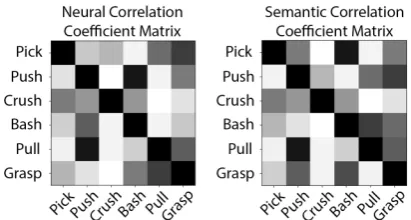
Figure 2: Neural and semantic correlation coefficient matrices. In the study the number of verbs is 31.
implicated in language processing (i.e., lexical-semantics/syntax) (Fedorenko et al.,2011). ROIs were created using the Harvard-Oxford Corti-cal Structural Probabilistic Atlases thresholded at 25% in FSL. Masks were transformed from the Montreal Neurological Institute (MNI) standard space into the subject’s native functional space.
5.4 Representational Similarity Analysis
Representational similarity analysis (RSA) is a multivariate approach to fMRI data analysis and avoids model over-fitting and dependence on learning parameters when dealing with high-dimensional data (Kriegeskorte et al., 2008). It calculates a global measure comparing the simi-larity structures of neural and model-based stimuli representations. The neural and semantic model vectors are first transformed into an abstracted similarity space by computing a similarity matrix from the brain activity vectors (N stimuli × N
signed-rank test to test whether correlations across sub-jects were significantly greater than zero. False-Discovery-Rate (FDR) (Benjamini and Hochberg, 1995) was used to correct for multiple testing.
5.5 Group-level Similarity-based Decoding
We used similarity-based decoding (Anderson et al., 2016), based on RSA, to investigate if our semantic models can decode fMRI patterns of action-related sentences. In similarity-based de-coding, neural and semantic models are first each projected to a similarity space, in the same man-ner as in RSA, allowing decoding to be performed in a common unit space. Following Anderson et al.(2016), we perform leave-two-out decoding (for n = 31, possible pairs = 465). Given a pair of stimuli, the neural and semantic similar-ity codes for each stimulus are obtained by ex-tracting the relevant labeled column vector from the neural similarity matrix and the semantic sim-ilarity matrix, respectively. These simsim-ilarity codes are further reduced by removing the entries refer-ring to that pair, to avoid auto-correlations. These reduced neural and semantic similarity codes are then correlated with each other. If the sum of the correlation coefficients of the correct labeling scheme (i.e. when the neural and semantic codes have the same label) has a higher sum of corre-lation coefficients than the incorrect labeling (i.e., when they don’t match) this is counted as a correct classification, otherwise as incorrect. The decod-ing accuracy is calculated as the number of correct classifications over the number of possible pairs.
We performed group-level similarity-based de-coding in which prior to the dede-coding step the neural similarity codes of each subject are aver-aged together to yield one single group-level neu-ral similarity code, as in Anderson et al. (2016). Leave-two-out decoding was then performed us-ing group-level neural similarity and model-based similarity codes as described above.
Statistical significance of group-level decoding accuracies was assessed using permutation test-ing as in Anderson et al. (2016). The rows and columns of the model-based correlation matrix were shuffled to remove relationships between the stimulus label and its model-based similarity code, while the neural correlation matrix was held fixed. Classification accuracies were obtained using the randomly shuffled data. This procedure was re-peated 10,000 times to obtain a null distribution of
decoding accuracies, reflecting expected chance-level accuracies with random labeling. The null hypothesis is that there is no relationship between the model-based and the group-level neural sim-ilarity codes of our stimuli. The p-value for each accuracy was calculated as the proportion of scores equal to or larger than that accuracy score.
6 Experiments and Results
6.1 Verb Model
Representational Similarity Analysis We used RSA to obtain a measure of relatedness between our fMRI patterns for 31 verbs and the semantic similarity of the VERB model. We performed a condition-based analysis, comparing three types of neural estimates of the verbs: 1) All Verbs, 2)Aff Verbs, and 3) Neg Verbs. We correlated the RDMs for each condition of the neural esti-mates of the verbs (All Verbs, Aff Verbs, and
Neg Verbs) separately with the RDM of the VERB
model. Each analysis was performed within the a priori-defined ROIs (LPG, LIFG, and LMTP).
Significant correlations (greater than zero) across subjects were found between the dissimilar-ity structures of the neural estimates forAll Verbs
and the VERBmodel in the LPG (r = 0.04, p < 0.01), LIFG (r = 0.04, p < 0.01), but not the LMTP (Table1). Similarly, theAff Verbsneural estimates showed significant correlations with the VERB model in the LPG (r = 0.04, p < 0.01), LIFG (r = 0.05, p < 0.01) and not the LMTP. In contrast, we did not find thatNeg Verbs trig-gered any significant correlations with the VERB
model in the ROIs tested. Moreover, Aff Verbs
showed greater overall correlations with the VERB
model when compared toNeg Verbs(as assessed by two-tailed paired Wilcoxon Sign Rank test) within the LPG and the LIFG (p < 0.05), but not the LMTP. These results suggest that (1) the semantic similarity of the VERB model corre-lates with fMRI patterns of sentences containing the same action verb (irrespective of polarity) in motor (LPG) and the language-related brain re-gion (LIFG) (2) neural estimates for Neg Verbs
show a reduced sensitivity to the similarity struc-ture of the VERB model compared to Aff Verbs
Region All Aff Neg
[image:7.595.330.500.63.113.2]LPG 0.04(0.00) 0.04(0.00) -0.01(0.83) LIFG 0.04(0.00) 0.05(0.00) 0.00(0.21) LMTP 0.01(0.24) 0.01(0.18) 0.01(0.07)
Table 1: RSA with VERBModel: Significant Spear-man’s rank correlation coefficients and p-value in bold.
Region All Aff Neg
[image:7.595.85.279.64.113.2]LPG 0.09(0.02) 0.09(0.00) -0.03(0.77) LIFG 0.05(0.00) 0.08(0.00) 0.04(0.11) LMTP 0.07(0.02) 0.10(0.00) 0.01(0.21)
Table 2: RSA with VERBmodel for restricted set of verbs: Significant Spearman’s rank correlation coeffi-cients and p-value in bold.
We performed an additional analysis restricted to nine verbs, for which we had maximal num-ber of sentences with these same verbs (giving improved signal to noise ratio). We observed a stronger but similar pattern with significant corre-lations forAll Verbs in the LPG (r = 0.09, p < 0.05), LIFG (r= 0.05, p <0.01), and also within the LMTP (r = 0.07, p < 0.05) (Table 2). Sim-ilarly, forAff Verbswe found significant correla-tions across the LPG (r = 0.09, p < 0.01), LIFG (r = 0.08, p < 0.01), and also within the LMTP (r = 0.10, p < 0.01). These results are in line with work showing semantic category effects for words in brain regions implicated in action-semantics (Carota et al., 2017), extending this to action sentences. Similar to the previous analysis, we did not find any significant correlations with theNeg Verbsin any of the ROIs tested (Table2). In the restricted analysis only the LPG (p <0.05) (as opposed to both the LPG and LIFG) showed greater correlations forAff VerbsthanNeg Verbs
in line with work showing that action negation im-pacts modal (e.g., motor) areas (Ghio et al.,2018).
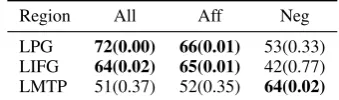
Group-level Similarity-based Decoding We also performed the same condition-based analysis with group-level similarity-based decoding allow-ing us to observe systematic patterns across sub-jects, more generally. Table 3 shows the decod-ing accuracy obtained for each ROI at the group-level in the condition-based analysis. Overall, findings are in line with the RSA results with sig-nificant decoding accuracies found forAll Verbs
in the LPG (Acc = 0.72, p < 0.01) and LIFG (Acc = 0.64, p < 0.05), as well as, similar significant decoding accuracies for Aff Verbs in the LPG (Acc = 0.66, p < 0.05) and LIFG (Acc = 0.65, p <0.05). Although theNeg Verbs
Region All Aff Neg
[image:7.595.83.281.149.198.2]LPG 72(0.00) 66(0.01) 53(0.33) LIFG 64(0.02) 65(0.01) 42(0.77) LMTP 51(0.37) 52(0.35) 64(0.02)
Table 3: Group-Level Similarity-based decoding with VERB. Significant accuracies (%) and p-value in bold.
did not show significant decoding in the LPG and LIFG, we observed significant decoding within the LMTP for Neg Verbs (Acc = 0.64, p < 0.05). The above finding coupled with the fact that in the RSA analysis we never observed significant cor-relation differences between Neg Verbs and Aff Verbsin the LMTP, may suggest that this area is less impacted by polarity.
6.2 Addition and LSTM Models
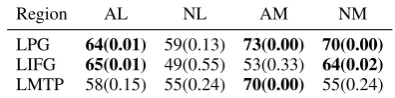
Group-level Similarity-Based Decoding As an exploratory component to our study we also per-formed group-level similarity-based decoding for the 31 sentences that each contained a unique verb for each condition type (i.e., AL, NL, AM, NM), separately, allowing us to assess the abil-ity of compositional semantic models (ADDITION
Region AL NL AM NM
LPG 64(0.01) 59(0.13) 73(0.00) 70(0.00)
LIFG 65(0.01) 49(0.55) 53(0.33) 64(0.02)
[image:8.595.81.279.64.113.2]LMTP 58(0.15) 55(0.24) 70(0.00) 55(0.24)
Table 4: Group-Level Similarity-based decoding with ADDITION. Significant accuracies and p-value in bold.
Region AL NL AM NM
LPG 67(0.01) 60(0.10) 71(0.00) 56(0.20) LIFG 50(0.48) 51(0.41) 61(0.08) 62(0.06) LMTP 56(0.22) 48(0.58) 75(0.00) 54(0.34)
Table 5: Group-Level Similarity-based decoding with LSTM. Significant accuracies (%) and p-value in bold.
case for the negated metaphoric condition.
7 Discussion
Representational similarity analysis showed that the semantic similarity structure provided by the VERB model corresponded well with neu-ral similarity of sentences containing the same action-verbs (All Verbs) within motor (LPG) and language-related brain regions (LIFG, LMTP), both implicated in action-semantic processing (Pulvermuller, 2005). Crucially, when looking at the specific impact of sentential context we found that the fMRI response patterns for negated action-verbs (Neg Verbs) showed significantly re-duced correlations with the VERB model than the affirmative action-verbs (Aff Verbs) mainly in the LPG and LIFG. Similarly, when performing a group-level similarity-based decoding analysis, we also found evidence suggesting reduced de-coding accuracies forNeg Verbscompared toAff Verbswithin the LPG and LIFG. Taken together, these findings provide support to previous neuro-scientific studies that suggest that negation man-ifests foremost as reduced access to motor areas implicated in coding sensorimotor features of ac-tion verbs (Tettamanti et al.,2008;Tomasino et al., 2010;Papeo et al.,2016). However, they also pro-vide compelling epro-vidence in support of the idea that the modulatory impact of negation may ex-tend to areas of the language-network. Lastly, our experiments with compositional models show that some of these effects may carry over to more com-plex models.
Our RSA findings for All Verbs (and alsoAff Verbs) are consistent with the work ofCarota et al. (2017) who showed that an LSA model reflecting semantic category information about both verbs
and objects associated with actions (e.g., tools and foods) significantly correlated with the similarity of fMRI patterns for verbs and objects in the LPG and LIFG (and to a lesser extent the LMTP). When this analysis was restricted to only action verbs, the LIFG was predominantly sensitive to the se-mantic similarity of action verbs. It is likely that our results for All Verbs (irrespective of polar-ity) are more closely aligned with their results for verbs and objects associated with actions, given that our action verbs were presented in a sentence context that included information about the object.
Notably, we found a modulatory impact of negation in both sensorimotor (LPG) and to some extent the language-related brain region (LIFG). The LIFG has been implicated in lexical-semantic similarity in the brain but also in the selection of competing semantic alternatives ( Thompson-Schill et al., 1997;Carota et al., 2017). For ex-ample, the LIFG may be important for event pre-diction, such as knowing which words (objects or tools) are implied by a given action verb (Carota et al.,2017). This provides further support to the hypothesis that negation involves reduced access to the affirmative mental representation. Impor-tantly, this involves not only reduced access to mo-toric features, but also access to lexico-semantic relations in language-related brain regions.
The LMTP may have been less impacted by ac-tion negaac-tion as it is more closely associated with higher-level object processing (Devereux et al., 2013) and, therefore, possibly captures less of the overall semantic variance associated with any given action verb. Moreover, in our study we fo-cused on neural estimates of action verbs irrespec-tive of their specific objects. Thus, the LPG and LIFG may more closely reflect action-semantic variance and show a greater modulatory effect of negation. However, given that similarity-based analysis is sensitive to the semantic distance of the stimuli in question, future work should investigate polarity decoding with verb-object phrases with maximal semantic-variance (e.g., action verbs as-sociated with distinct effectors and object-directed goals).
con-text, possibly suggesting that compositional mod-els are better able to capture motor features asso-ciated with metaphorical meanings on the whole, but this would need further investigation.
Our main finding of a modulatory impact of negation on motor but also to some extent language-related brain regions is in line with the earlier work ofTettamanti et al.(2008) who found a reduction in activations within left-hemispheric frontal-temporal-parietal areas implicated in the representation of actions for negative compared to positive action sentences, but see (Ghio et al., 2018). Importantly, however, our results do not rule out the possibility that other brain regions may correlate with the VERBmodel. Recent neurosci-entific work suggests that negation not only modu-lates modality-specific brain regions but also brain areas implicated in syntactic processing and cog-nitive control (Ghio et al.,2018). It is possible that prefrontal areas implicated in control and work-ing memory may act as an intermediate stage in charge of assigning polarity and temporarily hold a representation of the affirmative situation. We are currently investigating this possibility through a whole-brain searchlight analysis, but note that the temporal resolution of fMRI may possibly hin-der detection of any intermediate processing steps.
In this study we provide support for the idea that negation may be mediated in part by reduc-ing (or blockreduc-ing) access to aspects of the affir-mative representation. This may provide a ‘de-fault’ negation meaning (Papeo et al., 2016), as well as allow competing or cooperating semantic alternatives to emerge. On the other hand, it is also possible that the results reflect a more ‘cat-egorical’ representation of negation and that the current semantic models are merely not a suit-able represenation for the negated meaning. Fu-ture work will need to understand the mechanisms by which negation modulates semantic similarity and lexico-semantic relations in brain regions im-plicated in action-semantics and how this gives rise to a negated meaning. It would be interesting to test alternate models for negation that can si-multaneously explain, for example, why the verb ‘grasping’ has a more crystallized meaning than its negation ‘not grasping’, whose meaning may also depend to a greater extent on the specific linguistic (or extralinguistic) context.
A fruitful avenue of research may be to inves-tigate the extent to which contextual
representa-tions of LSTM models in the context of a sen-timent classification task can be used to predict fMRI activations for positive versus negative af-fective phrases. Predicting sentiment is intimately tied to polarity (e.g., ‘good’ versus ‘not good’) and the relationship between affective words and their negated counterparts near orthogonal. Prior work shows the role of LSTM gates in modeling negation in sentiment prediction in part by locally minimizing the input of the negated affective word (Wang et al.,2015), providing insight into the role of learned contextual information in building the negated meaning. The sentiment test case may of-fer a means to measure how changes in contextual representations relevant to the semantic modeling of negation can contribute directly to predicting brain activity associated with negation processing. Alternatively, Kruszewski et al. (2017) show that conversational negation can be modeled with a distributional approach, acting like a ‘graded similarity function’ that prompts a search for ‘similar’ alternative meanings. Although prior psycholinguistics work on negation consistently shows evidence to suggest that negation reduces access to the affirmative representation, at least one study showed that this is not the case for enti-ties semantically related to the negated represen-tation (MacDonald and Just, 1989). This more closely aligns with the idea that some dimensions of the affirmative representation are being pro-cessed while others reduced, possibly due to com-peting semantic alternatives. Thus, future work should also investigate whether modeling negation as a set of alternative meanings can further show the impact of negation on semantic representation in the brain.
8 Conclusion
References
Andrew J Anderson, Elia Bruni, Ulisse Bordignon, Massimo Poesio, and Marco Baroni. 2013. Of words, eyes and brains: Correlating image-based distributional semantic models with neural represen-tations of concepts. InEMNLP, pages 1960–1970.
Andrew J Anderson, Douwe Kiela, Stephen Clark, and Massimo Poesio. 2017. Visually grounded and tex-tual semantic models differentially decode brain ac-tivity associated with concrete and abstract nouns. Transactions of the Association for Computational Linguistics, 5:17–30.
Andrew J Anderson, Benjamin D Zinszer, and Ra-jeev DS Raizada. 2016. Representational similarity encoding for fMRI: Pattern-based synthesis to pre-dict brain activity using stimulus-model-similarities. NeuroImage, 128:44–53.
Yoav Benjamini and Yosef Hochberg. 1995. Control-ling the false discovery rate: a practical and pow-erful approach to multiple testing. J R Stat Soc B., pages 289–300.
Jeffrey R Binder, Rutvik H Desai, William W Graves, and Lisa L Conant. 2009. Where is the seman-tic system? A criseman-tical review and meta-analysis of 120 functional neuroimaging studies. Cereb. Cor-tex, 19(12):2767–96.
Samuel R Bowman, Gabor Angeli, Christopher Potts, and Christopher D Manning. 2015a. A large anno-tated corpus for learning natural language inference. CoRR, abs/1508.05326.
Samuel R Bowman, Jon Gauthier, Abhinav Ras-togi, Raghav Gupta, Christopher D Manning, and Christopher Potts. 2016. A fast unified model for parsing and sentence understanding. In Proceed-ings of the 54th Annual Meeting of the Association for Computational Linguistics (Volume 1: Long Pa-pers), pages 1466–1477, Berlin, Germany. Associa-tion for ComputaAssocia-tional Linguistics.
Samuel R Bowman, Christopher Potts, and Christo-pher D Manning. 2015b. Learning distributed word representations for natural logic reasoning. Knowl-edge representation and reasoning: Integrating sym-bolic and neural approaches: Papers from the 2015 AAAI Spring Symposium., pages 289–300.
Luana Bulat, Stephen Clark, and Ekaterina Shutova. 2017. Speaking, seeing, understanding: Correlating semantic models with conceptual representation in the brain. InProceedings of the 2017 Conference on Empirical Methods in Natural Language Process-ing, pages 1092–1102, Copenhagen, Denmark. As-sociation for Computational Linguistics.
Francesa Carota, Nikolaus Kriegeskorte, Hamed Nili, and Friedemann Pulvermuller. 2017. Representa-tional similarity mapping of distribuRepresenta-tional semantics in left inferior frontal, middle temporal, and motor cortex. Cerebral Cortex, 27(1):294–309.
Simon De Deyne, Amy Perfors, and Daniel J Navarro. 2016. Predicting human similarity judgments with distributional models: The value of word associa-tions. InProceedings of COLING 2016, the 26th In-ternational Conference on Computational Linguis-tics: Technical Papers, pages 1861–1870.
Barry Devereux, Lorraine Tyler, Jeroen Geertzen, and Billi Randall. 2013. The centre for speech, language and the brain (cslb) concept property norms. Behav-ior research methods, pages 1–9.
Vesna G Djokic, Ekaterina Shutova, Elisabeth Wehling, Benjamin Bergen, and Lisa Aziz-Zadeh. forthcom-ing. Affirmation and negation of metaphorical ac-tions in the brain.
Evelina Fedorenko, Michael K Behra, and Nancy Kan-wisher. 2011. Functional specificity for high-level linguistic processing in the human brain. Proceed-ings of the National Academy of Sciences of the United States of America, 108(39):16428–33.
Marta Ghio, Karolin Haegert, Matilde M Vaghi, and Marco Tettamanti. 2018. Sentential negation of ab-stract and concrete conceptual categories: a brain decoding multivariate pattern analysis study. Philo-sophical Transactions B, (373).
Uri Hasson and Sam Glucksberg. 2006. Does under-standing negation entail affirmation? an examina-tion of negated metaphors. Journal of Pragmatics, 38:1015–1032.
Sepp Hochreiter and J¨urgen Schmidhuber. 1997. Long short-term memory. Neural Comput., 9(8):1735– 1780.
Laurence R Horn. 1989. A Natural History of Nega-tion. University of Chicago Press, Chicago.
Alexander G Huth, Wendy A de Heer, Thomas L Grif-fiths, Frederic E Theunissen, and Jack L Gallant. 2016. Natural speech reveals the semantic maps that tile human cerebral cortex. Nature, 532:453.
Barbara Kaup, Richard H Yaxley, Carol J Madden, Rolf A Zwaan, and Jana L¨udtke. 2007. Experiential simulations of negated text information. Quarterly Journal of Experimental Psychology, 60(7):976– 990.
David Kemmerer. 2015. Are the motor features of verb meanings represented in the precentral motor cor-tices? yes, but within the context of a flexible, mul-tilevel architecture for conceptual knowledge. Psy-chonomic Bulletin Review, 22:1068–1075.
Diederik P Kingma and Jimmy Ba. 2014. Adam: A method for stochastic optimization. CoRR, abs/1412.6980.
Nikolaus Kriegeskorte, Mur Marieke, and Peter Ban-dettini. 2008. Representational similarity analysis - connecting the branches of systems neuroscience.
German Kruszewski, Denis Paperno, Raffaella Bernardi, and Marco Baroni. 2017. There is no logical negation here, but there are alternatives: Modeling conversational negation with distribu-tional semantics. Association for Computational Linguistics, 42(4):637–660.
Jiwei Li, Xinlei Chen, Eduard Hovy, and Dan Jurafsky. 2016. Visualizing and understanding neural models in nlp. InHLT-NAACL, pages 681–691.
Maryellen C MacDonald and Marcel A Just. 1989.
Changes in activation levels with negation. Jour-nal of Experimental Psychology. Learning, Memory, and Cognition, 15(4):633–642.
Tom M Mitchell, Svetlana V Shinkareva, Andrew Carl-son, Kai-Min Chang, Vicente L Malave, Robert A Mason, and Marcel A Just. 2008. Predicting human brain activity associated with the meanings of nouns. Science, 320(5880):1191–1195.
Brian Murphy, Partha Talukdar, and Tom Mitchell. 2012. Selecting corpus-semantic models for neu-rolinguistic decoding. In Proceedings of the First Joint Conference on Lexical and Computational Se-mantics, pages 114–123. Association for Computa-tional Linguistics.
Isabel Orenes, David Beltran, and Carlos Santamaria. 2014. How negation is understood: Evidence from the visual world paradigm. Journal of Memory and Language, 74:36–45.
Liuba Papeo, Jean-Remy Hochmann, and Lorella Bat-telli. 2016. The default computation of negated meanings. Journal of Cognitive Neuroscience, 28(12):1980–1986.
Jeffrey Pennington, Richard Socher, and Christopher D Manning. 2014. Glove: Global vectors for word representation. In Empirical Methods in Natural Language Processing (EMNLP), pages 1532–1543.
Francisco Pereira, Bin Lou, Brianna Pritchett, Samuel Ritter, Samuel J Gershman, Nancy Kanwisher, Matthew Botvinick, and Evelina Fedorenko. 2018. Toward a universal decoder of linguistic meaning from brain activation. Nature Communications, 9:963.
Friedemann Pulvermuller. 2005. Brain mechanisms linking language and action. Nature Reviews Neu-roscience, 6:576–582.
Bertrand Russell. 1948. Human knowledge: Its scope and limits. Simon & Schuster, New York.
John L Speranza and Laurence R Horn. 2010. A brief history of negation. Journal of Applied Logic, 8(3):277–301.
Marco Tettamanti, Rosa Manenti, Pasquale A Della Rosa, Andrea Falini, Daniela Perani, Ste-fano F Cappa, and Andrea Moro. 2008. Negation in the brain: Modulating action representations.
NeuroImage, 43(2):358–367.
Sharon L Thompson-Schill, Mark D’Esposito, Geof-frey K Aguirre, and Martha J Farah. 1997. Role of left prefrontal cortex in retrieval of semantic knowledge: a re-evaluation. Proc Natl Acad Sci., 94:14792–14797.
Barbara Tomasino, Peter H Weiss, and Gereon R Fink. 2010. To move or not to move: Imperatives modu-late action-remodu-lated verb processing in the motor sys-tem. Neuroscience, 169(1):246–258.
Manuel de Vega, Yvrena Morera, Immaculada Le´on, David Beltr´an, Pialr Casado, and Manuel Mart´ın-Loeches. 2016. Sentential negation might share neu-rophysiological mechanisms with action inhibition. Evidence from frontal theta rhythm. The Journal of Neuroscience : The Official Journal of the Society for Neuroscience, 36(22):6002–6010.
Xin Wang, Yuanchao Liu, Chengjie SUN, Baoxun Wang, and Xiaolong Wang. 2015. Predicting po-larities of tweets by composing word embeddings with long short-term memory. InProceedings of the 53rd Annual Meeting of the Association for Compu-tational Linguistics and the 7th International Joint Conference on Natural Language Processing (Vol-ume 1: Long Papers), pages 1343–1353, Beijing, China.