3742
Budgeted Policy Learning for Task-Oriented Dialogue Systems
Zhirui Zhang† Xiujun Li‡§ Jianfeng Gao‡ Enhong Chen†
†University of Science and Technology of China
‡Microsoft Research AI §University of Washington
†[email protected] †[email protected]
‡{xiul,jfgao}@microsoft.com
Abstract
This paper presents a new approach that ex-tends Deep Dyna-Q (DDQ) by incorporating a Budget-Conscious Scheduling (BCS) to best utilize a fixed, small amount of user interac-tions (budget) for learning task-oriented dia-logue agents. BCS consists of (1) a Poisson-based global scheduler to allocate budget over different stages of training; (2) a controller to decide at each training step whether the agent is trained using real or simulated experiences; (3) a user goal sampling module to generate the experiences that are most effective for pol-icy learning. Experiments on a movie-ticket booking task with simulated and real users show that our approach leads to significant im-provements in success rate over the state-of-the-art baselines given the fixed budget.
1 Introduction
There has been a growing interest in exploiting reinforcement learning (RL) for dialogue policy learning in task-oriented dialogue systems (Levin et al., 1997;Williams,2008;Young et al., 2013;
Fatemi et al.,2016;Zhao and Esk´enazi,2016;Su et al.,2016;Li et al.,2017;Williams et al.,2017;
Dhingra et al., 2017; Budzianowski et al., 2017;
Chang et al.,2017;Liu and Lane,2017;Liu et al.,
2018; Gao et al., 2019). This is a challenging machine learning task because an RL learner re-quires real users to interact with a dialogue agent constantly to provide feedback. The process in-curs significant real-world cost for complex tasks, such as movie-ticket booking and travel planning, which require exploration in a large state-action space.
In reality, we often need to develop a dialogue agent with some fixed, limited budget due to lim-ited project funding, conversational data, and de-velopment time. Specifically, in this study we measurebudgetin terms of the number of real user
interactions. That is, we strive to optimize a dia-logue agent via a fixed, small number of interac-tions with real users.
One common strategy is to leverage a user sim-ulator built on human conversational data ( Schatz-mann et al.,2007;Li et al.,2016). However, due to design bias and the limited amounts of pub-licly available human conversational data for train-ing the simulator, there always exists discrepan-cies between the behaviors of real and simulated users, which inevitably leads to a sub-optimal dia-logue policy. Another strategy is to integrate plan-ning into dialogue policy learplan-ning, as the Deep Dyna-Q (DDQ) framework (Peng et al., 2018), which effectively leverages a small number of real experiences to learn a dialogue policy efficiently. In DDQ, the limited amounts of real user experi-ences are utilized for: (1) training aworld modelto mimic real user behaviors and generate simulated experiences; and (2) improving the dialogue pol-icy using both real experiences via direct RL and simulated experiences via indirect RL (planning). Recently, some DDQ variants further incorporate discriminators (Su et al.,2018) and active learn-ing (Wu et al.,2019) into planning to obtain high-quality simulated experiences.
Dialogue
Agent User
World Model Controller
Human Conversational Data Scheduler
Budget
Real Experience
Simulated Experience User Goal
Sampling Module
Planning
Direct Reinforcement Learning
Acting
[image:2.595.79.522.67.232.2]BCS
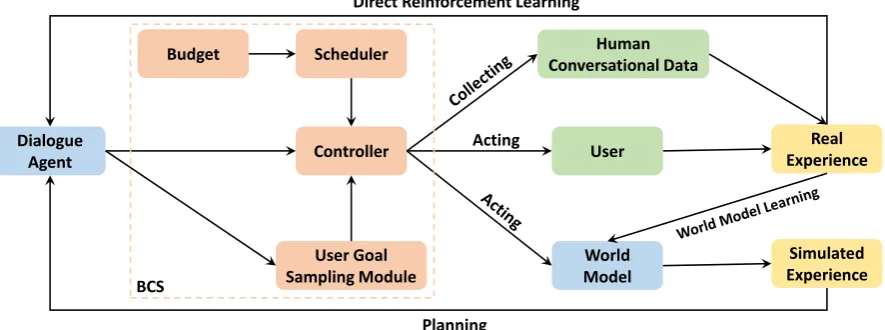
Figure 1: Proposed BCS-DDQ framework for dialogue policy learning. BCS represents the Budget-Conscious Scheduling module, which consists of a scheduler, a controller and a user goal sampling module.
with the ability to decide whether to learn from human demonstrations or from agent-user interac-tions where the user can be a real user or simulated by the world model.
In this paper, we propose a new framework, called Budget-Conscious Scheduling-based Deep Dyna-Q (BCS-DDQ), to best utilize a fixed, small number of human interactions (budget) for task-oriented dialogue policy learning. Our new frame-work extends DDQ by incorporating Budget-Conscious Scheduling (BCS), which aims to con-trol the budget and improve DDQ’s sample effi-ciency by leveraging active learning and human teaching to handle the aforementioned issues. As shown in Figure 1, the BCS module consists of (1) a Poisson-based global scheduler to allocate budget over the different stages of training; (2) auser goal sampling moduleto select previously failed or unexplored user goals to generate experi-ences that are effective for dialogue policy learn-ing; (3) acontrollerwhich decides (based on the pre-allocated budget and the agent’s performance on the sampled user goals) whether to collect human conversation, or to conduct human-agent interactions to obtain high-quality real ex-periences, or to generate simulated experiences through interaction with the world model. During dialogue policy learning, real experiences are used to train the world model via supervised learning (world model learning) and directly improve the dialogue policy via direct RL, while simulated ex-periences are used to enhance the dialogue policy via indirect RL (planning).
Experiments on the movie-ticket booking task with simulated and real users show that our
ap-proach leads to significant improvements in suc-cess rate over the state-of-the-art baselines given a fixed budget. Our main contributions are two-fold:
• We propose a BCS-DDQ framework, to best uti-lize a fixed, small amount of user interactions (budget) for task-oriented dialogue policy learn-ing.
• We empirically validate the effectiveness of BCS-DDQ on a movie-ticket booking domain with simulated and real users.
2 Budget-Conscious Scheduling-based Deep Dyna-Q (BCS-DDQ)
As illustrated in Figure 2, the BCS-DDQ di-alogue system consists of six modules: (1) an LSTM-based natural language understanding (NLU) module (Hakkani-T¨ur et al., 2016) for identifying user intents and extracting associated slots; (2) a state tracker (Mrksic et al., 2017) for tracking dialogue state; (3) a dialogue policy that chooses the next action based on the current state and database results; (4) a model-based natural language generation (NLG) module for producing a natural language response (Wen et al., 2015); (5) a world model for generating simulated user actions and simulated rewards; and (6) the BCS module incorporating a global scheduler, a user goal sampling module and a controller, to man-age the budget and select the most effective way to generate real or simulated experiences for learning a dialogue policy.
ini-Natural Language Generation (NLG) Natural Language
Understanding (NLU) 𝑜1 𝑜2 Dialogue State Tracker
𝑜𝑡
Dialogue Policy Learning Dialogue Manager
System Action (Policy)
𝑠𝑡
𝑠1 𝑠2 𝑠𝑛
𝑎1 𝑎2 𝑎𝑘 ……
…
Semantic Frame
State Representation
𝑎∗= max 𝑎 𝜋 𝑎|𝑠
Backend Database Controller
Scheduler
Budget User Goal
Sampling Module Budget-Conscious Scheduling (BCS)
User World Model Human-Human
1 2
3
4 5
[image:3.595.74.289.63.263.2]6
Figure 2: Illustration of the proposed BCS-DDQ dia-logue system.
tial world model, both trained with pre-collected human conversational data. Given the total bud-get b and maximum number of training epochs
m, the scheduler allocates the available budgetbk
at each training step. Then, the user goal sam-pling module actively selects a previously failed or unexplored user goalgu. Based on the agent’s
performance and the current pre-allocated bud-get, the controller chooses the most effective way, with costcu = {0,1,2}, to generate real or sim-ulated experiences Br/Bs for this sampled user
goal. For convenience, the cost of different dia-logue generation methods is defined as the number of people involved:
• costcu= 2 for collecting human-human demon-strated conversational data.
• costcu = 1 for conducting the interactions be-tween human and agent.
• costcu = 0 for performing the interactions be-tween world model and agent.
The generated experiences are used to update the dialogue policy and the world model. This pro-cess continues until all pre-allocated budget is ex-hausted. In the rest of this section, we detail the components of BCS, and describe the learn-ing methods of the dialogue agent and the world model.
2.1 Budget-Conscious Scheduling (BCS)
As illustrated in Figure2 and Algorithm 1, BSC consists of a budget allocation algorithm for the scheduler, an active sampling strategy for the user
Algorithm 1 BCS-DDQ for Dialogue Policy Learning
Input: The total budgetb, the maximum number of training epochs m, the dialogue agent A and the world model W (both trained with pre-collected human conversational data);
1: procedureTRAINING PROCESS 2: whilek < mdo
3: bk←Scheduler(b,m,k);
4: repeat
5: gu←UserGoalSampler(A); 6: Br, Bs, cu ← Controller(gu, bk,
A,W);
7: bk ←bk−cu;
8: untilbk≤0
9: Train the dialogue agentAonBr∪Bs
10: Train world modelW onBr
11: end while
12: end procedure
goal sampling module, and a selection policy for the controller.
2.1.1 Poisson-based Budget Allocation The global scheduler is designed to allocate bud-get {b1, . . . , bm} (where m is the final training
epoch) during training. The budget allocation pro-cess can be viewed as a series of random events, where the allocated budget is a random variable. In this manner, the whole allocation process es-sentially is a discrete stochastic process, which can be modeled as a Poisson process. Specifically, at each training stepk, the probability distribution of a random variablebkequalingnis given by:
P{bk=n}= λnk
n!e −λk, λ
k=
m+ 1−k
m λ (1)
In addition, to ensure that the sum of the allo-cated budget does not exceed the total budget b, we impose the following constraint:
m X
k=1
E[bk] = m X
k=1
m+ 1−k
m λ≤b (2)
Using this formula, we can calculate the range of the parameter value: λ ≤ 2b
m+1. In our experi-ments, we setλ = m2+1b and sample bk from the
probability distribution defined in Equation1.
2.1.2 Active Sampling Strategy
The active sampling strategy involves the defini-tion of a user goal space and sampling algorithm.
In a typical task-oriented dialogue (Schatzmann et al., 2007), the user begins a conversation with a user goal gu which consists of multiple con-straints. In fact, these constraints correspond to attributes in the knowledge base. For example, in the movie-ticket-booking scenario, the constraints may be the name of the theater (theater), the number of tickets to buy (numberofpeople) or the name of the movie (moviename), and so on. Given the knowledge base, we can generate large amounts of user goals by traversing the combina-tion of all the attributes, and then filtering unrea-sonable user goals which are not similar to real user goals collected from human-human conver-sational data. We then group the user goals with the same inform and request slots into a category. Suppose there are altogetherldifferent categories of user goals. We design a Thompson-Sampling-like algorithm (Chapelle and Li,2011;Eckles and Kaptein,2014;Russo et al.,2018) to actively se-lect a previously failed or unexplored user goal in two steps.
• Draw a numberpi for each category
follow-ingpi ∼ N(fi, q
llnN
ni ), whereN represents
the Gaussian distribution,fidenotes the
fail-ure rate of each category estimated on the val-idation set, ni is the number of samples for each category andN =P
ini.
• Select the category with maximum pi, then randomly sample a user goalgu in the cate-gory.
Using this method, user goals in the categories with higher failure rates or less exploration are more likely to be selected during training, which encourages the real or simulated user to generate dialogue experiences in the state-action space that the agent has not fully explored.
2.1.3 Controller
Given a sampled user goalgu, based on the agent’s performance on gu and pre-allocated budget bk, the controller decides whether to collect human-human dialogues, human-human-agent dialogues, or sim-ulated dialogues between the agent and the world model. We design a heuristic selection policy of Equation3where dialogue experiencesBare col-lected as follow: we first generate a set of simu-lated dialoguesBs givengu, and record the suc-cess rateSgu. IfSgu is higher than a thresholdλ1
(i.e. λ1 = 2/3) or there is no budget left, we use
Bs for training. If Sgu is lower than a threshold λ2 (i.e. λ2 = 1/3) and there is still budget, we resort to human agents and real users to generate real experiencesBhhr . Otherwise, we collect real experiences generated by human users and the di-alogue agentBr
ha.
(B, cu) =
(Bs , 0) ifSgu ≥λ1orbk= 0
(Br
hh, 2) ifSgu ≤λ2andbk≥2
(Bhar , 1) otherwise
(3)
Combined with the active sampling strategy, this selection policy makes fuller use of the bud-get to generate experiences that are most effective for dialogue policy learning.
2.2 Direct Reinforcement Learning and Planning
Policy learning in task-oriented dialogue using RL can be cast as a Markov Decision Process which consists of a sequence of<state, action, reward>
tuples. We can use the same Q-learning algorithm to train the dialogue agent using either real or sim-ulated experiences. Here we employ the Deep Q-network (DQN) (Mnih et al.,2015).
Specifically, at each step, the agent observes the dialogue states, then chooses an actionausing an
-greedy policy that selects a random action with probability , and otherwise follows the greedy policy a = arg maxa0Q(s, a0;θQ). Q(s, a;θQ)
approximates the state-action value function with a Multi-Layer Perceptron (MLP) parameterized by
θQ. Afterwards, the agent receives rewardr,
ob-serves the next user or simulator response, and up-dates the state tos0. The experience(s, a, r, au, s0) is then stored in a real experience buffer Br1 or
simulated experience bufferBs depending on the source. Given these experiences, we optimize the
value functionQ(s, a;θQ) through mean-squared
loss:
L(θQ) =E(s,a,r,s0)∼Br∪Bs[(y−Q(s, a;θQ))2]
y=r+γmax
a0 Q
0
(s0, a0;θQ0)
(4) whereγ ∈ [0,1]is a discount factor, andQ0(·)is the target value function that is updated only peri-odically (i.e., fixed-target). The updating ofQ(·) thus is conducted through differentiating this ob-jective function via mini-batch gradient descent.
2.3 World Model Learning
We utilize the same design of the world model inPeng et al. (2018), which is implemented as a multi-task deep neural network. At each turn of a dialogue, the world model takes the current di-alogue state sand the last system action a from the agent as input, and generates the correspond-ing user response au, rewardr, and a binary
ter-mination signalt. The computation for each term can be shown as below:
h = tanh(Wh[s, a] +bh)
r = Wrh+br
au = softmax(Wah+ba)
t = sigmoid(Wth+bt)
(5)
where all W andb are weight matrices and bias vectors respectively.
3 Experiments
We evaluate BCS-DDQ on a movie-ticket booking task in three settings: simulation, human evalua-tion and human-in-the-loop training. All the ex-periments are conducted on the text level.
3.1 Setup
Dataset. The dialogue dataset used in this study is a subset of the movie-ticket booking dialogue dataset released in Microsoft Dialogue Chal-lenge (Li et al., 2018). Our dataset consists of 280 dialogues, which have been manually labeled based on the schema defined by domain experts, as in Table1. The average length of these dialogues is 11 turns.
Dialogue Agents. We benchmark the BCS-DDQ agent with several baseline agents:
• The SLagent is learned by a variant of imita-tion learning (Lipton et al.,2018). At the begin-ning of traibegin-ning, the entire budget is used to
col-Intent
request, inform, deny, confirm question, confirm answer, greeting, closing, not sure, multiple choice, thanks, welcome
Slot
city, closing, date, distanceconstraints, greeting, moviename, numberofpeople, price, starttime, state, taskcomplete, theater, theater chain, ticket, video format, zip
Table 1: The dialogue annotation schema
lect human-human dialogues, based on which the dialogue agent is trained.
• The DQN agent is learned by standard DQN At each epoch of training, the budget is spent on human-agent interactions, and the agent is trained by direct RL.
• TheDDQagent is learned by the DDQ method (Peng et al.,2018). The training process is sim-ilar to that of the DQN agent, differing in that DDQ integrates a jointly-trained world model to generate simulated experience which can fur-ther improve the dialogue policy. At each epoch of training, the budget is spent on human-agent interactions.
• TheBCS-DDQagent is learned by the proposed BCS-DDQ approach. For a fair comparison, we use the same number of training epochsmused for the DQN and DDQ agents.
Hyper-parameter Settings. We use an MLP to parameterize function Q(·) in all the dialogue agents (SL, DQN, DDQ and BCS-DDQ), with hidden layer size set to 80. The -greedy pol-icy is adopted for exploration. We set discount factor γ = 0.9. The target value function Q0(·) is updated at the end of each epoch. The world model contains one shared hidden layer and three task-specific hidden layers, all of size 80. The number of planning steps is set to 5 for using the world model to improve the agent’s policy in DDQ and BCS-DDQ frameworks. Each dialogue is allowed a maximum of 40 turns, and dialogues exceeding this maximum are considered failures. Other parameters used in BCS-DDQ are set as
l= 128, d= 10.
Training Details. The parameters of all neu-ral networks are initialized using a normal dis-tribution with a mean of 0 and a variance of
p
6/(drow+dcol), where drow and dcol are the
learn-90
SL DQN DDQ(5) Our method 0
10 20 30 40 50 60 70 80 90
0 50 100
Suc
ces
s
R
at
e(%
)
10 20 30 40 50 60 70 80 90
50 100 150 200 250 300
Su
cc
ess
Ra
te(
%)
Budget
[image:6.595.73.291.61.244.2]SL DQN DDQ BCS-DDQ
Figure 3: The success rates of different agents (SL, DQN, DDQ, BCS-DDQ) given a fixed budget (b =
{50,100,150,200,250,300}). Each number is aver-aged over 5 runs, each run tested on 50 dialogues.
ing rate is 5e-4. The buffer sizes of Br and Bs
are set to 3000. In order to train the agents more efficiently, we utilized a variant of imitation learn-ing, Reply Buffer Spiking (Lipton et al.,2018), to pre-train all agent variants at the starting stage.
3.2 Simulation Evaluation
In this setting, the dialogue agents are trained and evaluated by interacting with the user simulators (Li et al., 2016) instead of real users. In spite of the discrepancy between simulated and real users, this setting enables us to perform a detailed analy-sis of all agents without any real-world cost. Dur-ing trainDur-ing, the simulator provides a simulated user response on each turn and a reward signal at the end of the dialogue. The dialogue is con-sidered successful if and only if a movie ticket is booked successfully and the information provided by the agent satisfies all the user’s constraints (user goal). When the dialogue is completed, the agent receives a positive reward of2∗Lfor success, or a negative reward of −L for failure, where L is the maximum number of turns allowed (40). To encourage shorter dialogues, the agent receives a reward of−1on each turn.
In addition to the user simulator, the train-ing of SL and BCS-DDQ agents requires a high-performance dialogue agent to play the role of the human agent in collecting human-human conver-sational data. In the simulation setting, we lever-age a well-trained DQN lever-agent as the human lever-agent.
6LPXODWLRQ(SRFK
6XFFHVV5DWH
[image:6.595.310.526.66.223.2]6/ '41 ''4 %&6''4
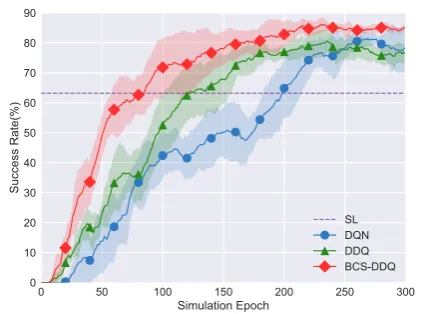
Figure 4: The learning curves of different agents (DQN, DDQ and BCS-DDQ) with budgetb= 300.
Main Results. We evaluate the performance of all agents (SL, DQN, DDQ, BCS-DDQ) given a fixed budget (b = {50,100,150,200,250,300}). As shown in Figure3, the BCS-DDQ agent con-sistently outperforms other baseline agents by a statistically significant margin. Specifically, when the budget is small (b = 50), SL does better than DQN and DDQ that haven’t been trained long enough to obtain significant positive reward. BCS-DDQ leverages human demonstrations to explic-itly guide the agent’s learning when the agent’s performance is very bad. In this way, BCS-DDQ not only takes advantage of imitation learning, but also further improves the performance via ex-ploration and RL. As the budget increases, DDQ can leverage real experiences to learn a good pol-icy. Our method achieves better performance than DDQ, demonstrating that the BCS module can better utilize the budget by directing exploration to parts of the state-action space that have been less explored.
Agent Epoch=100 Epoch=150 Epoch=200 Success Reward Turns Success Reward Turns Success Reward Turns DQN 0.3032 -18.77 32.31 0.4675 2.07 30.07 0.5401 18.94 26.59 DDQ 0.4204 -2.24 27.34 0.5467 15.46 22.26 0.6694 32.00 18.66 BCS-DDQ 0.7542 43.80 15.42 0.7870 47.38 16.13 0.7629 44.45 16.20
Table 2: The performance of different agents at training epoch ={100, 150, 200}in the human-in-the-loop experi-ments. The differences between the results of all agent pairs evaluated at the same epoch are statistically significant (p <0.05). (Success: success rate)
0 0.1 0.2 0.3 0.4 0.5
SL
Suc
cess
Ra
te
0.6 0.7 0.8 0.9
Succ
ess
Ra
te
34.39
54.05
64.12
81.94
0 10 20 30 40 50 60 70 80 90
SL DQN DDQ BCS-DDQ
Succ
ess
Ra
te(
%)
70
74
78
[image:7.595.74.292.185.347.2]72 p=0.013
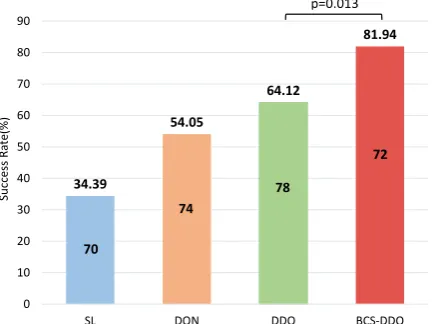
Figure 5: The human evaluation results for SL, DQN, DDQ and BCS-DDQ agents, the number of test dia-logues indicated on each bar, and the p-values from a two-sided permutation test. The differences between the results of all agent pairs are statistically significant (p <0.05).
3.3 Human Evaluation
For human evaluation, real users interact with dif-ferent agents without knowing which agent is be-hind the system. At the beginning of each dia-logue session, we randomly pick one agent to con-verse with the user. The user is provided with a randomly-sampled user goal, and the dialogue ses-sion can be terminated at any time, if the user be-lieves that the dialogue is unlikely to succeed, or if it lasts too long. In either case, the dialogue is considered as failure. At the end of each dialogue, the user is asked to give explicit feedback about whether the conversation is successful.
Four agents (SL, DQN, DDQ and BCS-DDQ) trained in simulation (withb = 300) are selected for human evaluation. As illustrated in Figure5, the results are consistent with those in the simu-lation evaluation (the rightmost group with bud-get=300 in Figure3). In addition, due to the dis-crepancy between simulated users and real users, the success rates of all agents drop compared to the simulation evaluation, but the performance
(SRFK
6XFFHVV5DWH
'41 ''4 %&6''4
Figure 6: Human-in-the-Loop learning curves of dif-ferent agents with budgetb= 200.
dation of BCS-DDQ is minimal. This indicates that our approach is more robust and effective than the others.
3.4 Human-in-the-Loop Training
We further verify the effectiveness of our method in human-in-the-loop training experiments. In this experiment, we replace the user simulator with real users during training. Similar to the human evaluation, based on a randomly-sampled user goal, the user converses with a randomly-selected agent and gives feedback as to whether the con-versation is successful. In order to collect human-human conversations during the training of the BCS-DDQ agent, human agents are interacting di-rectly with real users through the dialogue system. In a dialogue session, the human agent has access to the conversation history, as well as the current search results from the knowledge base, before se-lecting each dialogue action in response to the real user. Each learning curve is trained with two runs, with each run assigning a budget of 200 human interactions.
[image:7.595.308.526.188.334.2]Real User Dialogue Sample
movie-ticketbooking user goal:
{
“constraint slots”:{ “request slots”:{
“numberofpeople”: “four” “ticket”:“?” “moviename”: “creed” “theater”: “?” “city”: “regency” }
“date”: “tomorrow” “starttime”: “around noon”
} }
DDQ agent
1 usr: I want to watch creed at around noon. 2 agt: around noon is available.
3 usr: I want four tickets please! 4 agt: Which city would you like? 5 usr: I want to watch at regency. 6 agt:Which theater would you like?
7 usr: Which theater is available?
8 agt: What date would you like to watch it? 9 usr: I want to set it up tomorrow.
10 agt:Which theater would you like?
11 usr: Which theater is available? 12 agt: Which city would you like? 13 usr: I want to watch at regency. 14 agt:Which theater would you like?
15 usr: Which theater is available?
16 agt: What date would you like to watch it? ..
.
Failure:Agent does not book the right ticket within the max turns.
BCS-DDQ agent
1 usr: I want to watch creed at around noon. 2 agt: Which city would you like?
3 usr: I want to watch at regency.
4 agt: What date would you like to watch it? 5 usr: I want to set it up tomorrow.
6 agt:Which theater would you like?
7 usr: Which theater is available? 8 agt:century eastport 16 is available. 9 usr: Could you help me to book the tickets? 8 agt: How many tickets do you need? 9 usr: I want four tickets please!
10 agt:
Great - I was able to purchase 4 tickets for you to see creed tomorrow at century eastport 16 theater in regency at around noon.
11 usr: Thank you. 12 agt: Thank you.
[image:8.595.74.291.56.585.2]Success
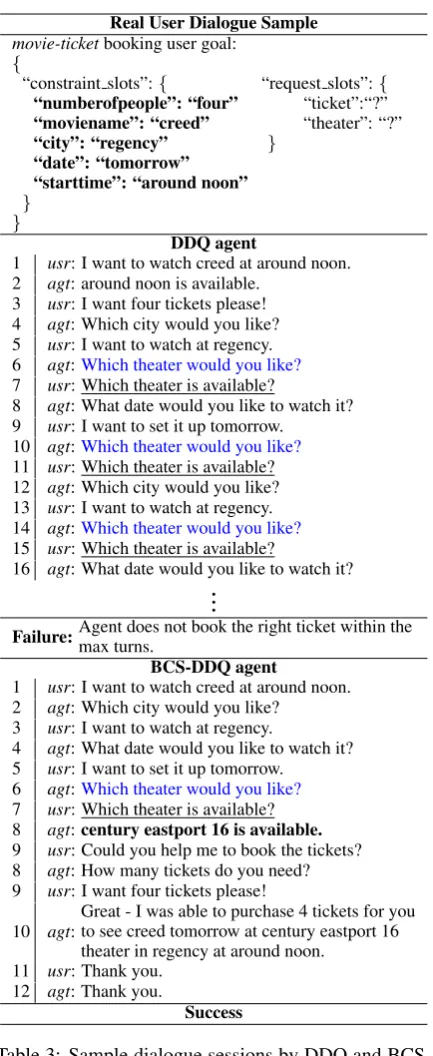
Table 3: Sample dialogue sessions by DDQ and BCS-DDQ agents trained at epoch 200 (with total budget
b = 200) in the human-in-the-loop experiments: (agt: agent,usr: user)
drawn from the simulation evaluation. Besides, Table3shows example dialogues produced by two dialogue agents (DDQ and BCS-DDQ) interacting with human users respectively. We can see that DDQ agent fails to respond to the user question “which theater is available?”, which lead to the re-peated inquiry of theater information. By intro-ducing human demonstrations for agent training,
6LPXODWLRQ(SRFK
6XFFHVV5DWH
[image:8.595.308.525.64.221.2]%&6''4 %&6''4YDU %&6''4YDU
Figure 7: The learning curves of BCS-DDQ and its variants agents with budgetb= 300.
BCS-DDQ agent can successfully respond to the available theater information.
3.5 Ablation Study
We investigate the relative contribution of the bud-get allocation algorithm and the active sampling strategy in BCS-DDQ by implementing two vari-ant BCS-DDQ agents:
• TheBCS-DDQ-var1agent: Replacing the de-cayed Poisson process with a regular Pois-son process in the budget allocation algorithm, which means that the parameterλ is set to mb during training.
• The BCS-DDQ-var2 agent: Further replacing the active sampling strategy with random sam-pling, based on the BCS-DDQ-var1 agent. The results in Figure7shows that the budget allo-cation algorithm and active sampling strategy are helpful for improving a dialogue policy in the lim-ited budget setting. The active sampling strategy is more important, without which the performance drops significantly.
4 Conclusion
We presented a new framework BCS-DDQ for task-oriented dialogue policy learning. Compared to previous work, our approach can better utilize the limited real user interactions in a more efficient way in the fixed budget setting, and its effective-ness was demonstrated in the simulation evalua-tion, human evaluaevalua-tion, including human-in-the-loop experiments.
is to design a trainable budget scheduler. In this paper, the budget scheduler was created indepen-dently of the dialogue policy training algorithm, so a trainable budget scheduler may incur additional cost. One possible solution is transfer learning, in which we train the budget scheduler on some well-defined dialogue tasks, then leverage this sched-uler to guide the policy learning on other complex dialogue tasks.
5 Acknowledgments
We appreciate Sungjin Lee, Jinchao Li, Jingjing Liu, Xiaodong Liu, and Ricky Loynd for the fruit-ful discussions. We would like to thank the volun-teers from Microsoft Research for helping us with the human evaluation and the human-in-the-loop experiments. We also thank the anonymous re-viewers for their careful reading of our paper and insightful comments. This work was done when Zhirui Zhang was an intern at Microsoft Research.
References
Merwan Barlier, Romain Laroche, and Olivier Pietquin. 2018. Training dialogue systems with hu-man advice. InAAMAS.
Pawel Budzianowski, Stefan Ultes, Pei hao Su, Nikola Mrksic, Tsung-Hsien Wen, I˜nigo Casanueva, Lina Maria Rojas-Barahona, and Milica Gasic. 2017. Sub-domain modelling for dialogue manage-ment with hierarchical reinforcemanage-ment learning. In
SIGDIAL.
Cheng Chang, Runzhe Yang, Lu Chen, Xiang Zhou, and Kai Yu. 2017. Affordable on-line dialogue pol-icy learning. InEMNLP.
Olivier Chapelle and Lihong Li. 2011. An empirical evaluation of thompson sampling. InNIPS.
Bhuwan Dhingra, Lihong Li, Xiujun Li, Jianfeng Gao, Yun-Nung Chen, Faisal Ahmed, and Li Deng. 2017. End-to-end reinforcement learning of dia-logue agents for information access. InACL.
Dean Eckles and Maurits Kaptein. 2014. Thomp-son sampling with the online bootstrap. CoRR, abs/1410.4009.
Mehdi Fatemi, Layla El Asri, Hannes Schulz, Jing He, and Kaheer Suleman. 2016. Policy networks with two-stage training for dialogue systems. In SIG-DIAL Conference.
Jianfeng Gao, Michel Galley, and Lihong Li. 2019. Neural approaches to conversational ai. Founda-tions and TrendsR in Information Retrieval, 13(2-3):127–298.
Xavier Glorot and Yoshua Bengio. 2010. Understand-ing the difficulty of trainUnderstand-ing deep feedforward neural networks. InAISTATS.
Dilek Z. Hakkani-T¨ur, G¨okhan T¨ur, Asli elikyilmaz, Yun-Nung Chen, Jianfeng Gao, Li Deng, and Ye-Yi Wang. 2016. Multi-domain joint semantic frame parsing using bi-directional rnn-lstm. In INTER-SPEECH.
Esther Levin, Roberto Pieraccini, and Wieland Eck-ert. 1997. Learning dialogue strategies within the markov decision process framework. InASRU 1997, pages 72–79.
Xiujun Li, Yun-Nung Chen, Lihong Li, and Jianfeng Gao. 2017. End-to-end task-completion neural dia-logue systems. InIJCNLP.
Xiujun Li, Zachary C Lipton, Bhuwan Dhingra, Lihong Li, Jianfeng Gao, and Yun-Nung Chen. 2016. A user simulator for task-completion dialogues. arXiv preprint arXiv:1612.05688.
Xiujun Li, Sarah Panda, Jingjing Liu, and Jianfeng Gao. 2018. Microsoft dialogue challenge: Building end-to-end task-completion dialogue systems. arXiv preprint arXiv:1807.11125.
Zachary C Lipton, Jianfeng Gao, Lihong Li, Xiujun Li, Faisal Ahmed, and Li Deng. 2018. Efficient ex-ploration for dialogue policy learning with bbq net-works & replay buffer spiking. AAAI.
Bing Liu and Ian Lane. 2017. Iterative policy learning in end-to-end trainable task-oriented neural dialog models. ASRU, pages 482–489.
Bing Liu, G¨okhan T¨ur, Dilek Z. Hakkani-T¨ur, Pararth Shah, and Larry P. Heck. 2018. Dialogue learn-ing with human teachlearn-ing and feedback in end-to-end trainable task-oriented dialogue systems. In
NAACL-HLT.
Volodymyr Mnih, Koray Kavukcuoglu, David Silver, Andrei A. Rusu, Joel Veness, Marc G. Bellemare, Alex Graves, Martin A. Riedmiller, Andreas Fidje-land, Georg Ostrovski, Stig Petersen, Charles Beat-tie, Amir Sadik, Ioannis Antonoglou, Helen King, Dharshan Kumaran, Daan Wierstra, Shane Legg, and Demis Hassabis. 2015. Human-level con-trol through deep reinforcement learning. Nature, 518:529–533.
Nikola Mrksic, Diarmuid ´O S´eaghdha, Tsung-Hsien Wen, Blaise Thomson, and Steve J. Young. 2017. Neural belief tracker: Data-driven dialogue state tracking. InACL.
Baolin Peng, Xiujun Li, Jianfeng Gao, Jingjing Liu, and Kam-Fai Wong. 2018. Integrating planning for task-completion dialogue policy learning. InACL.
Jost Schatzmann, Blaise Thomson, Karl Weilhammer, Hui Ye, and Steve J. Young. 2007. Agenda-based user simulation for bootstrapping a pomdp dialogue system. InHLT-NAACL.
Peihao Su, Milica Gasic, Nikola Mrksic, Lina Maria Rojas-Barahona, Stefan Ultes, David Vandyke, Tsung-Hsien Wen, and Steve J. Young. 2016. Con-tinuously learning neural dialogue management.
CoRR, abs/1606.02689.
Shang-Yu Su, Xiujun Li, Jianfeng Gao, Jingjing Liu, and Yun-Nung Chen. 2018. Discriminative deep dyna-q: Robust planning for dialogue policy learn-ing. InEMNLP.
Tijmen Tieleman and Geoffrey Hinton. 2012. Lecture 6.5-rmsprop: Divide the gradient by a running av-erage of its recent magnitude. COURSERA: Neural networks for machine learning, 4(2):26–31.
Tsung-Hsien Wen, Milica Gasic, Nikola Mrksic, Pei hao Su, David Vandyke, and Steve J. Young. 2015. Semantically conditioned lstm-based natural lan-guage generation for spoken dialogue systems. In
EMNLP.
Jason D Williams. 2008. The best of both worlds: Unifying conventional dialog systems and pomdps. In Ninth Annual Conference of the International Speech Communication Association.
Jason D. Williams, Kavosh Asadi, and Geoffrey Zweig. 2017. Hybrid code networks: practical and efficient end-to-end dialog control with supervised and rein-forcement learning. InACL.
Yuexin Wu, Xiujun Li, Jianfeng Gao, Jingjing Liu, and Yiming Yang. 2019. Switch-based active deep dyna-q: Efficient adaptive planning for task-completion dialogue policy learning. InAAAI.
Steve J. Young, Milica Gasic, Blaise Thomson, and Ja-son D. Williams. 2013. Pomdp-based statistical spo-ken dialog systems: A review. Proceedings of the IEEE, 101:1160–1179.
Tiancheng Zhao and Maxine Esk´enazi. 2016. Towards end-to-end learning for dialog state tracking and management using deep reinforcement learning. In