Proceedings of the 55th Annual Meeting of the Association for Computational Linguistics, pages 1160–1170 Vancouver, Canada, July 30 - August 4, 2017. c2017 Association for Computational Linguistics Proceedings of the 55th Annual Meeting of the Association for Computational Linguistics, pages 1160–1170
Vancouver, Canada, July 30 - August 4, 2017. c2017 Association for Computational Linguistics
Detecting annotation noise in automatically labelled data
Ines Rehbein Josef Ruppenhofer
IDS Mannheim/University of Heidelberg, Germany
Leibniz Science Campus “Empirical Linguistics and Computational Language Modeling”
[email protected], [email protected]
Abstract
We introduce a method for error detec-tion in automatically annotated text, aimed at supporting the creation of high-quality language resources at affordable cost. Our method combines an unsupervised gener-ative model with human supervision from active learning. We test our approach on in-domain and out-of-domain data in two languages, in AL simulations and in a real world setting. For all settings, the results show that our method is able to detect annotation errors with high precision and high recall.
1 Introduction
Until recently, most of the work in Computational Linguistics has been focussed on standard written text, often from newswire. The emergence of two new research areas, Digital Humanities and Com-putational Sociolinguistics, have however shifted the interest towards large, noisy text collections from various sources. More and more researchers are working with social media text, historical data, or spoken language transcripts, to name but a few. Thus the need for NLP tools that are able to pro-cess this data has become more and more appar-ent, and has triggered a lot of work on domain adaptation and on developing more robust prepro-cessing tools. Studies are usually carried out on large amounts of data, and thus fully manual an-notation or even error correction of automatically prelabelled text is not feasible. Given the impor-tance of identifying noisy annotations in automat-ically annotated data, it is all the more surpris-ing that up to now this area of research has been severely understudied.
This paper addresses this gap and presents a
method for error detection in automatically
la-belled text. As test cases, we use POS tagging and Named Entity Recognition, both standard prepro-cessing steps for many NLP applications. How-ever, our approach is general and can also be ap-plied to other classification tasks.
Our approach is based on the work of Hovy et
al. (2013) who develop a generative model for
es-timating the reliability of multiple annotators in a crowdsourcing setting. We adapt the generative
model to the task of finding errors inautomatically
labelled data by integrating it in an active learning (AL) framework. We first show that the approach of Hovy et al. (2013) on its own is not able to beat a strong baseline. We then present our integrated model, in which we impose human supervision on the generative model through AL, and show that we are able to achieve substantial improvements in two different tasks and for two languages.
Our contributions are the following. We provide a novel approach to error detection that is able to
identify errors inautomaticallylabelled text with
high precisionandhigh recall. To the best of our
knowledge, our method is the first that addresses this task in an AL framework. We show how AL can be used to guide an unsupervised generative model, and we will make our code available to the
research community.1 Our approach works
par-ticularly well in out-of-domain settings where no annotated training data is yet available.
2 Related work
Quite a bit of work has been devoted to the
iden-tifcation of errors in manuallyannotated corpora
(Eskin, 2000; van Halteren, 2000; Kveton and Oliva,2002;Dickinson and Meurers,2003; Lofts-son,2009;Ambati et al.,2011).
1Our code is available at http://www.cl. uni-heidelberg.de/˜rehbein/resources.
Several studies have tried to identify
trustwor-thy annotators in crowdsourcing settings (Snow
et al., 2008; Bian et al., 2009), amongst them
the work of Hovy et al. (2013) described in
Sec-tion3. Others have proposed selective relabelling
strategies when working with non-expert annota-tors (Sheng et al.,2008;Zhao et al.,2011).
Manual annotations are often inconsistent and annotation errors can thus be identified by looking at the variance in the data. In contrast to this, we
focus on detecting errors inautomaticallylabelled
data. This is a much harder problem as the an-notation errors are systematic and consistent and therefore hard to detect. Only a few studies have addressed this problem. One of them is Rocio
et al. (2007) who adapt a multiword unit
extrac-tion algorithm to detect automatic annotaextrac-tion er-rors in POS tagged corpora. Their semi-automatic method is geared towards finding (a small number of) high frequency errors in large datasets, often caused by tokenisation errors. Their algorithm ex-tracts sequences that have to be manually sorted into linguistically sound patterns and erroneous patterns.
Loftsson (2009) tests several methods for error
detection in POS tagged data, one of them based on the predictions of an ensemble of 5 POS tag-gers. Error candidates are those tokens for which the predictions of all ensemble taggers agree but that diverge from the manual annotation. This simple method yields a precision of around 16% (no. of true positives amongst the error candi-dates), but no information is given about the re-call of the method, i.e. how many of the errors in
the corpus have been identified. Rehbein (2014)
extends the work of Loftsson (2009) by training
a CRF classifier on the output of ensemble POS taggers. This results in a much higher precision, but with low recall (for a precision in the range of 50-60% they report a recall between 10-20%).
Also related is work that addresses the issue of
learning in the presence of annotation noise (
Rei-dsma and Carletta,2008;Beigman and Klebanov,
2009;Bekker and Goldberger, 2016). The main difference to our work lies in its different focus. While our focus is on identifying errors with the
goal of improving the quality of an existing
lan-guage resource, their main objective is to improve
the accuracy of amachine learning system.
In the next section we describe the approach
of Hovy et al. (2013) and present our adaptation
Algorithm 1AL with variational inference
Input: classifier predictionsA 1: for1 ... n iterationsdo 2: procedureGENERATE(A) 3: fori = 1 ... n classifiersdo 4: Ti∼U nif orm
5: forj = 1 ... n instancesdo 6: Sij∼Bernoulli(1−θj)
7: ifSij= 0then
8: Aij=Ti
9: else
10: Aij∼M ultinomial(ξj)
11: end if
12: end for
13: end for
14: returnposterior entropiesE 15: end procedure
16: procedureACTIVELEARNING(A)
17: rankJ→max(E)
18: forj= 1... n instancesdo
19: Oracle→label(j); 20: select random classifieri; 21: update model prediction fori(j);
22: end for
23: end procedure 24: end for
for semi-supervised error detection that combines Bayesian inference with active learning.
3 Method
3.1 Modelling human annotators
Hovy et al. (2013) develop a generative model
for Multi-Annotator Competence Estimation (MACE) to determine which annotators to trust
in a crowdsourcing setting (Algorithm 1, lines
2-15). MACE implements a simple graphical model where the input consists of all annotated
instancesI by a set ofJ annotators. The model
generates the observed annotations Aas follows.
The (unobserved) “true” labelTi is sampled from
a uniform prior, based on the assumption that the annotators always try to predict the correct label and thus the majority of the annotations should, more often than not, be correct. The model is unsupervised, meaning that no information on the real gold labels is available.
To model each annotator’s behaviour, a binary
variable Sij (also unobserved) is drawn from a
Bernoulli distribution that describes whether
an-notator j is trying to predict the correct label for
instanceior whether s/he is just spamming (a
be-haviour not uncommon in a crowdsourcing set-ting). IfSij is 0, the “true” labelTiis used to gen-erate the annotationAij. IfSij is 1, the predicted
labelAij for instanceicomes from a multinomial
The model parameter θj can be interpreted as a “trustworthiness” parameter that describes the
probability that annotatorjpredicts the correct
la-bel. ξj, on the other hand, contains information
about the actual behaviour of annotator j in the
case that the annotator is not trying to predict the correct label.
The model parameters are learned by maximiz-ing the marginal likelihood of the observed data,
using Expectation Maximization (EM) (Dempster
et al., 1977) and Bayesian variational inference. Bayesian inference is used to provide the model with priors on the annotators’ behaviour and yields improved correlations over EM between the model estimates and the annotators’ proficiency while keeping accuracy high. For details on the imple-mentation and parameter settings refer to Hovy et al. (2013) and Johnson (2007).
We adapt the model of Hovy et al. (2013) and
apply it to the task of error detection in
automat-ically labelled text. To that end, we integrate the variational model in an active learning (AL) set-ting, with the goal of identifying as many errors as possible while keeping the number of instances to be checked as small as possible. The tasks we chose in our experiments are POS tagging and NER, but our approach is general and can easily be applied to other classification tasks.
3.2 Active learning
Active learning (Cohn et al., 1996) is a semi-supervised framework where a machine learner is trained on a small set of carefully selected in-stances that are informative for the learning pro-cess, and thus yield the same accuracy as when training the learner on a larger set of randomly chosen examples. The main objective is to save time and money by minimising the need for man-ual annotation. Many different measures of infor-mativeness as well as selection strategies for AL have been proposed in the literature, amongst them
query-by-committeelearning (Seung et al.,1992). The query-by-committee (QBC) approach uses
a classifier ensemble (or committee) and selects the instances that show maximal disagreement be-tween the predictions of the committee members. These instances are assumed to provide new infor-mation for the learning process, as the classifiers are most unsure about how to label them. The
selected instances are then presented to the
ora-cle(the human annotator), to be manually
disam-biguated and added to the training data. Then the
classifier committee is retrained on the extended training set and the next AL iteration starts.
The query-by-committee strategy calls to mind
previous work on error detection in manually
la-belled text that made use of disagreements be-tween the predictions of a classifier ensemble and the manually assigned tag, to identify potential
an-notation errors in the data (Loftsson,2009). This
approach works surprisingly well, and the trade-off between precision and recall can be balanced by adding a threshold (i.e. by considering all
in-stances where at least N of the ensemble
classi-fiers disagree with the manually assigned label).
Loftsson (2009) reports a precision of around 16%
for using a committee of five POS taggers to iden-tify annotation errors (see section2).
Let us assume we follow this approach and ap-ply a tagger with an average accuracy of 97% to a corpus with 100,000 tokens. We can then ex-pect around 3,000 incorrectly tagged instances in the data. Trying to identify these with a preci-sion of 16% means that when looking at 1,000 in-stances of potential errors, we can only expect to see around 160 true positive cases, and we would have to check a large amount of data in order to correct a substantial part of the annotation noise. This means that this approach is not feasible for correcting large automatically annotated data.
It is thus essential to improve precisionand
re-call for error detection, and our goal is to minimise the number of instances that have to be manually checked while maximizing the number of true er-rors in the candidate set. In what follows we show how we can achieve this by using active learning to guide variational inference for error detection.
3.3 Guiding variational inference with AL Variational inference is a method from calculus where the posterior distribution over a set of
un-observed random variablesY is approximated by a
variational distributionQ(Y). We start with some
observed dataX(a set of predictions made by our
committee of classifiers) The distribution of the true labelsY ={y1, y2, ..., yn}is unknown.
As it is too difficult to work with the posterior
p(y|x), we try to approximate it with a much
sim-pler distributionq(y)which modelsyfor each
ob-servedx. To that end, we define a familyQof
dis-tributions that are computationally easy to work
with, and pick theq inQthat best approximates
For computing variational inference, we use the
implementation of Hovy et al. (2013)2who jointly
optimisepandqusing variational EM. They
alter-nate between adjusting q given the currentp
(E-step) and adjustingpgiven the currentq(M-step).
In the E-step, the objective is to find the q that
minimises the divergence between the two
distri-butions,D(q||p). In the M-step, we keep q fixed
and try to adjustp. The two steps are repeated until
convergence.
We extend the model for use in AL as follows
(Algorithm1). We start with the predictions from
a classifier ensemble and learn a variational in-ference model on the data (lines 2-15). We then use the posterior entropies according to the current
model, and select thecinstances with the highest
entropies for manual validation. These instances are presented to the oracle who assigns the true la-bel. We save the predictions made by the human annotator and, in the next iteration, use them in the variational E-step as a prior to guide the learn-ing process. In addition, we randomly pick one of the classifiers and update its prediction by replac-ing the classifier’s prediction with the label we
ob-tained from the oracle.3 In the next iteration, we
train the variational model on the updated predic-tions. By doing this, we also gradually improve the quality of the input to the variational model.
In a typical AL approach, the main goal is to
improve theclassifiers’ accuracyon new data. In
contrast to that, our approach aims at increasing
precision and recall for error detection in auto-maticallylabelled data, and thus at minimising the time needed for manual correction. Please note
that in our model we do not need to retrain the
classifiers used for predicting the labels but only retrain the model that determines which of the classifiers’ predictions we can trust. This is cru-cial as it saves time and makes it easy to integrate the approach in a realistic scenario with a real hu-man annotator in the loop.
4 Data and setup
In our first experiment (§5.1) we want to assess the benefits of our approach for finding POS errors in standard newspaper text (in-domain setting) where
2MACE is available for download from
http://www.isi.edu/publications/licensed-sw/mace
3We also experimented with updating more than one
clas-sifier, which resulted in lower precision and recall. We take this as evidence for the importance of keeping the variance in the predictions high.
we have plenty of training data. For this setting, we use the English Penn Treebank, annotated with parts-of-speech, for training and testing.
In the second experiment (§5.2) we apply our
method in an out-of-domain setting where we want to detect POS errors in text from new do-mains where no training data is yet available (out-of-domain setting). For this we use the Penn Tree-bank as training data, and test our models on data
from the English Web treebank (Bies et al.,2012).
To test our method on a different task and a new language, we apply it to Named Entity
Recog-nition (NER) (experiment 3, §5.3), using
out-of-domain data from the Europarl corpus.4 The data
was created by Faruqui and Pado (2010) and
in-cludes the first two German Europarl session tran-scripts, manually annotated with NER labels ac-cording to the CoNLL 2003 annotation guidelines (Tjong Kim Sang and De Meulder,2003).
The first three experiments are simulation stud-ies. In our last experiment (§5.4), we show that our method also works well in a real AL scenario with a human annotator in the loop. For this we use the out-of-domain setting from the second experiment and let the annotators correct POS errors in two
web genres (answers, weblogs) from the English
Web treebank.
4.1 Tools for preprocessing
For the POS tagging experiments, we use the fol-lowing taggers to predict the labels:
• bi-LSTM-aux (Plank et al.,2016)
• HunPos (Hal´acsy et al.,2007)
• Stanford postagger (Toutanova et al.,2003)
• SVMTool (Gim´enez and M`arquez,2004)
• TreeTagger (Schmid,1999)
• TWeb (Ma et al.,2014)
• Wapiti (Lavergne et al.,2010)
The taggers implement a range of different al-gorithms, including HMMs, decision trees, SVMs, maximum entropy and neural networks. We train the taggers on subsets of 20,000 sentences ex-tracted from the standard training set of the PTB
(sections 00-18)5and use the development and test
set (sections 19-21 and 22-24) for testing. The training times of the taggers vary considerably, ranging from a few seconds (HunPos) to several
4The NER taggers have been trained on written German
data from the HGC and DeWaC corpora (see§4.1).
5For taggers that use a development set during training,
hours. This is a problem for the typical AL setting where it is crucial not to keep the human annota-tors waiting for the next instance while the system retrains. A major advantage of our setup is that we do not need to retrain the baseline classifiers as we only use them once, for preprocessing, before the actual error detection starts.
For the NER experiment, we use tools for which pretrained models for German are available,
namely GermaNER (Benikova et al., 2015), and
the StanfordNER system (Finkel and Manning,
2009) with models trained on the HGC and the
DeWaC corpus (Baroni et al., 2009; Faruqui and
Pad´o,2010).6
4.2 Evaluation measures
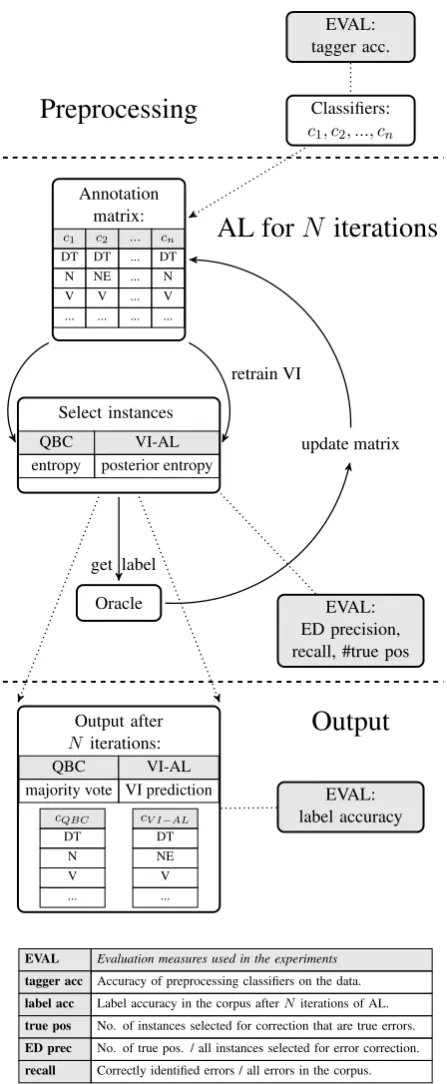
We report results for different evaluation measures to asses the usefulness of our method. First, we re-porttagger accuracyon the data, obtained during
preprocessing (figure1). This corresponds to the
accuracy of the labels in the corpus before error
correction (baseline accuracy). Label accuracy
measures the accuracy of the labels in the corpus
afterN iterations of error correction. Please note that we do not retrain the tools used for
prepro-cessing, but assess the quality of the data afterN
iterations of manual inspection and correction. We also report precision and recall for the error
detection itself. True positives (tp)refers to the
number of instances selected for correction during AL that were actual annotation errors. We com-puteError detection (ED) precisionas the num-ber of true positives divided by the numnum-ber of all
instances selected for error correction duringN
it-erations of AL, andrecallas the ratio of correctly
identified errors to all errors in the data.
4.3 Baseline accuracies
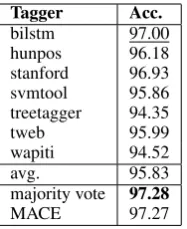
Table 1 shows the accuracies for the individual
POS taggers used in experiments 1, 2 and 4. Please note that this is not a fair comparison as
each tagger was trained on a different randomly
sampled subset of the data and, crucially, we did not optimise any of the taggers but used default
settings in all experiments.7 The accuracies of the
6To increase the number of annotators we use an older
version of the StanfordNER (2009-01-16) and a newer ver-sion (2015-12-09), with both the DeWaC and HGC models, resulting in a total of 5 annotators for the NER task.
7Please note that the success of our method relies on the
variation in the ensemble predictions, and thus improving the accuracies for preprocessing is not guaranteed to improve precision for the error detection task.
Annotation matrix:
c1 c2 ... cn
DT DT ... DT
N NE ... N
V V ... V
... ... ... ...
EVAL: tagger acc.
Classifiers:
c1, c2, ..., cn
EVAL: ED precision, recall, #true pos
EVAL: label accuracy
QBC VI-AL
entropy posterior entropy
Oracle Select instances
get label
Output after
N iterations:
update matrix retrain VI
QBC VI-AL
majority vote VI prediction
cQBC
DT N V ...
cV I−AL
DT NE V ...
EVAL Evaluation measures used in the experiments
tagger acc Accuracy of preprocessing classifiers on the data.
label acc Label accuracy in the corpus afterNiterations of AL.
true pos No. of instances selected for correction that are true errors.
ED prec No. of true pos. / all instances selected for error correction.
recall Correctly identified errors / all errors in the corpus.
Preprocessing
AL for
N
iterations
[image:5.595.306.530.58.601.2]Output
Figure 1: Error detection procedure and overview over different evaluation measures for assessing the quality of error identification.
baseline taggers vary between 94-97%, with an average accuracy of 95.8%. The majority base-line yields better results than the best individual tagger, with an accuracy of 97.3%. Importantly, the predictions made by the variational inference model (MACE) are in the same range as the
Tagger Acc. bilstm 97.00 hunpos 96.18 stanford 96.93 svmtool 95.86 treetagger 94.35
tweb 95.99
wapiti 94.52
avg. 95.83
majority vote 97.28
[image:6.595.314.519.60.143.2]MACE 97.27
Table 1: Tagger accuracies for POS taggers
trained on subsamples of the WSJ with 20,000 to-kens (for the majority vote, ties were broken ran-domly).
majority voteon theautomaticallylabelled data. To be able to run the variational inference model in an AL setting, we limit the size of the test data (the size of the pre-annotated data to be corrected) to batches of 5,000 tokens. This allows us to re-duce the training time of the variational model and avoid unnecessary waiting times for the oracle.
For NER (experiment 3), in contrast to POS tag-ging, we have a much smaller label set with only 5 labels (PER, ORG, LOC, MISC, O), and a highly skewed distribution where most of the in-stances belong to the negative class (O). To ensure a sufficient number of NEs in the data, we increase the batch size and use the whole out-of-domain
testset with 4,395 sentences in the experiment.8
The overall accuracies of the different NER mod-els are all in the range of 97.7-98.6%. Results for individual classes, however, vary considerably be-tween the different models.
5 Results
5.1 Experiment 1: In-domain setting
In our first experiment, we explore the benefits of our AL approach to error detection in a setting where we have a reasonably large amount of train-ing data, and where traintrain-ing and test data come from the same domain (in-domain setting).
We implement two selection strategies. The
first one is aQuery-by-Committeeapproach (QBC)
where we use the disagreements in the predictions of our tagger ensemble to identify potential errors.
For each instancei, we compute the entropy over
the predicted labelsM by the 7 taggers and select
8This is possible because, given the lower number of class
labels, the training time for theVI-ALmodel for NER is much
shorter than for the POS data.
QBC VI-AL
N label acc ED prec label acc ED prec
0 97.58 - 97.56
-100 97.84 13.0 98.42 41.0
200 97.86 7.0 98.90 33.0
300 97.90 5.3 99.16 26.3
400 97.82 3.0 99.26 21.0
500 97.92 3.4 99.34 17.6
Table 2: Label accuracies on 5,000 tokens of
WSJ text afterN iterations, and precision for error
detection (ED prec).
the N instances with the highest entropy
(Equa-tion1).
H=−
M
X
m=1
P(yi=m) logP(yi=m) (1)
For each selected instance, we then replace the label predicted by majority vote with the gold la-bel. Please note that the selected instances might already have the correct label, and thus the re-placement does not necessarily increase accuracy but only does so when the algorithm selects a true error. We then evaluate the accuracy of the
ma-jority predictions after updating the N instances
ranked highest for entropy9(figure1).
We compare the QBC setting to our integrated
approach where we guide the generative model with human supervision. Here the instances are selected according to their posterior entropy as as-signed by the variational model, and after being disambiguated by the oracle, the predictions of a randomly selected classifier are updated with the oracle tags. We run the AL simulation for 500
iterations10 and select one new instance in each
iteration. After replacing the predicted label for this instance by the gold label, we retrain the vari-ational model and select the next instance, based on the new posterior probabilities learned on the
modified dataset. We refer to this setting as VI
-AL.
Table2shows POS tag accuracies (lab-acc)
af-ter N iterations of active learning. For the QBC
setting, we see a slight increase in label accuracy of 0.3% (from 97.6 to 97.9) after manually validat-ing 10% of the instances in the data. For the first 100 instances, we see a precision of 13% for error
9Please recall that, in contrast to a traditionalQBCactive
learning approach, we do not retrain the classifiers but only update the labels predicted by the classifiers.
10We stopped after 500 iterations as this was enough to
[image:6.595.136.230.61.176.2]answer email newsg. review weblog bilstm 85.5 84.2 86.5 86.9 89.6
hun 88.5 87.4 89.2 89.7 92.2
stan 89.0 88.1 89.9 90.7 93.0
svm 87.4 86.1 88.2 88.8 91.3
tree 86.8 85.6 87.1 88.7 87.4
tweb 88.2 87.1 88.5 89.3 92.0
wapiti 85.2 82.4 84.6 86.5 87.3
avg. 87.2 85.8 87.7 88.7 90.4
major. 87.4 88.8 89.1 90.9 93.8
[image:7.595.307.525.62.184.2]MACE 87.4 88.6 89.1 91.0 93.9
Table 3:Tagger accuracieson different web
gen-res (trained on the WSJ); avg. accuracy, accu-racy for majority vote (major.), and accuaccu-racy for MACE.
detection. In the succeeding iterations, the preci-sion slowly decreases as it gets harder to identify new errors. We even observe a slight decrease in label accuracy after 400 iterations that is due to the fact that ties are broken randomly and thus the vote for the same instance can vary between iterations. Looking at the AL setting with variational infer-ence, we also see the highest precision for identi-fying errors during the first 100 iterations. How-ever, the precision for error dection is more than
3 times as high as for QBC(41% vs. 13%), and
we are still able to detect new errors during the last 100 iterations. This results in an increase in POS label accuracy in the corpus from 97.56% to 99.34%, a near perfect result.
To find out what error types we were not able to identify, we manually checked the remaining 33 errors that we failed to detect in the first 500 iter-ations. Most of those are cases where an adjective (JJ) was mistaken for a past participle (VBN).
(2) Companies wereclosedJJ/V BN yesterday
Manning (2011), who presents a categorization
of the type of errors made by a state-of-the-art POS tagger on the PTB, refers to the error type
in example (2) asunderspecified/unclear, a
cate-gory that he applies to instances where “the tag is underspecified, ambiguous, or unclear in the con-text”. These cases are also hard to disambiguate for human annotators, so it is not surprising that our system failed to detect them.
5.2 Experiment 2: Out-of-domain setting
In the second experiment, we test how our ap-proach performs in an out-of-domain setting. For
this, we use the English Web treebank (Bies et al.,
N answer email newsg review weblog
0 87.4 88.6 89.1 91.0 93.9
[image:7.595.72.291.63.176.2]100 88.9 90.0 90.4 92.2 95.2 200 90.3 91.1 91.3 93.4 96.2 300 91.6 92.2 92.0 94.4 97.2 400 92.9 93.3 92.8 95.4 97.5 500 93.9 94.0 93.5 96.0 97.8 600 94.8 94.9 93.9 96.5 97.9 700 95.6 95.6 94.1 96.9 98.0 800 96.2 95.9 94.7 97.3 98.4 900 96.7 96.2 94.9 97.7 98.6 1000 97.0 96.8 95.1 97.9 98.6
Table 4: Increase in POSlabel accuracy on the
web genres (5,000 tokens) afterNiterations of
er-ror correction withVI-AL.
2012), a corpus of over 250,000 words of
Eng-lish weblogs, newsgroups, email, reviews and question-answers manually annotated for parts-of-speech and syntax. Our objective is to develop and test a method for error detection that can also be applied to out-of-domain scenarios for
creat-ing and improvcreat-ing language resources whenno
in-domain training data is available. We thus abstain from retraining the taggers on the web data and use
the tools and models from experiment 1 (§5.1) as
is, trained on the WSJ. As the English Web tree-bank uses an extended tagset with additional tags for URLs and email addresses etc., we allow the oracle to assign new tags unknown to the prepro-cessing classifiers. In a traditional AL setting, this would not be possible, as all class labels have to be known from the start. In our setting, however, this can be easily implemented.
For each web genre, we extract samples of 5,000 tokens and run an active learning simulation with 500 iterations, where in each iteration one new instance is selected and disambiguated. Af-ter each iAf-teration, we update the variational model and the predictions of a randomly selected classi-fier, as described in Section5.1.
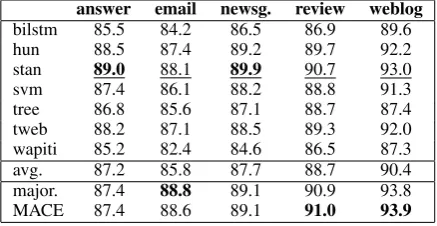
Table 3 shows the performance of the
WSJ-trained taggers on the web data. As expected, the results are much lower than the ones from the in-domain setting. This allows us to explore the be-haviour of our error detection approach under dif-ferent conditions, in particular to test our approach on tag predictions of a lower quality. The last three
rows in Table3give the average tagger accuracy,
the accuracy for the majority vote for the
ensem-ble (not to be confused withQBC), and the
accu-racy we get when using the predictions from the
QBC VI-AL
N # tp ED prec rec # tp ED prec rec
100 85 85.0 13.5 75 75.0 11.9
200 148 74.0 23.5 146 73.0 23.2 300 198 66.0 31.4 212 70.7 33.6 400 239 59.7 37.9 278 69.5 44.1 500 282 56.4 44.8 323 64.6 51.3 600 313 52.2 49.7 374 62.3 59.4 700 331 47.3 52.5 412 58.9 65.4 800 355 44.4 56.3 441 55.1 70.0 900 365 40.6 57.9 465 51.7 73.8 1000 371 37.1 58.9 484 48.4 76.8
Table 5: No. of true positives (# tp), precision (ED prec) and recall for error detection on 5,000 tokens
from theanswersset afterN iterations.
We can see that the majority baseline often, but not always succeeds in beating the best individual tagger. Results for MACE are more or less in the same range as the majority vote, same as in
exper-iment 1, butdo not improve over the baseline.
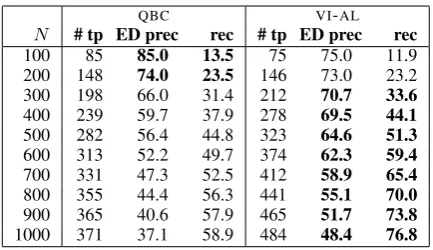
Next, we employ AL in the out-of-domain set-ting (Tables4,5and6). Table4shows the increase in POS label accuracy for the five web genres
af-ter runningN iterations of AL with variational
in-ference (VI-AL). Table5 compares the results of
the two selection strategies, QBC and VI-AL, on
theanswerssubcorpus after an increasing number
of AL iterations.11 Table6completes the picture
by showing results for error detection for all web
genres, for QBCandVI-AL, after inspecting 10%
of the data (500 iterations).
Table4shows that usingVI-ALfor error
detec-tion results in a substantial increase in POS label
accuracy for all genres. VI-AL still detects new
errors after a high number of iterations, without retraining the ensemble taggers. This is especially useful in a setting where no labelled target domain data is yet available.
Table 5 shows the number of true positives
amongst the selected error candidates as well as precision and recall for error detection for
differ-ent stages of AL on the answers genre. We can
see that during the early learning stages, both
se-lection strategies have a high precision and QBC
beatsVI-AL. After 200 iterations it becomes more
difficult to detect new errors, and the precision for both methods decreases. The decrease, however,
is much slower forVI-AL, leading to higher
preci-sion after the initial rounds of training, and the gap in results becomes more and more pronounced.
11Due to space restrictions, we can only report detailed
re-sults for one web genre. Rere-sults for the other web genres follow the same trend (see Tables4and6).
QBC VI-AL
[image:8.595.73.290.60.185.2]# tp ED prec rec # tp ED prec rec answer 282 56.4 44.8 323 64.6 51.3 email 264 52.8 47.1 261 52.2 46.6 newsg. 195 39.0 36.0 214 42.8 39.6 review 227 45.4 49.7 255 51.0 55.8 weblog 166 33.2 54.6 196 39.2 64.5
Table 6: No. of true positives (# tp), precision (ED prec) and recall for error detection on 5,000 tokens after 500 iterations on all web genres.
After 600 iterations,VI-ALbeatsQBCby more
than 10%, thus resulting in a lower number of in-stances that have to be checked to obtain the same POS accuracy in the final dataset. Looking at re-call, we see that by manually inspecting 10% of
the dataVI-ALmanages to detect more than 50%
of all errors, and after validating 20% of the data, we are able to eliminate 75% of all errors in the
corpus. In contrast, QBCdetects less than 60% of
the annotation errors in the dataset.
In the out-of-domain setting where we start with low-quality POS predictions, we are able to detect errors in the data with a much higher precision than in the in-domain setting, where the number of errors in the dataset is much lower. Even after 1,000 iterations, the precision for error detection is close to 50% in the answers data.
Table 6 shows that the same trend appears for
the other web genres, where we observe a substan-tially higher precision and recall when guiding AL
with variational inference (VI-AL). Only on the
email data are the results below the ones forQBC,
but the gap is small.
5.3 Experiment 3: A new task (and language)
We now want to test if the approach generalises well to other classification tasks, and also to new languages. To that end, we apply our approach to the task of Named Entity Recognition (NER) on German data (§4).
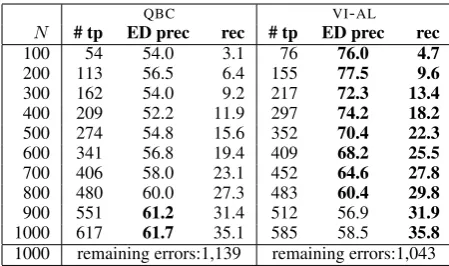
Table 7 shows results for error detection for
NER. In comparison to the POS experiments, we
observe a much lower recall, for bothQBCandVI
-AL. This is due to the larger size of the NER testset
which results in a higher absolute number of er-rors in the data. Please bear in mind that recall is computed as the ratio of correctly identified errors to all errors in the testset (here we have a total of 110,405 tokens in the test set which means that we identified>35% of all errors by queryingless than 1% of the data). Also note that the overall
[image:8.595.308.532.62.136.2]QBC VI-AL
N # tp ED prec rec # tp ED prec rec
100 54 54.0 3.1 76 76.0 4.7
200 113 56.5 6.4 155 77.5 9.6
300 162 54.0 9.2 217 72.3 13.4
[image:9.595.71.296.62.195.2]400 209 52.2 11.9 297 74.2 18.2 500 274 54.8 15.6 352 70.4 22.3 600 341 56.8 19.4 409 68.2 25.5 700 406 58.0 23.1 452 64.6 27.8 800 480 60.0 27.3 483 60.4 29.8 900 551 61.2 31.4 512 56.9 31.9 1000 617 61.7 35.1 585 58.5 35.8 1000 remaining errors:1,139 remaining errors:1,043
Table 7: Error detection results on the GermEval
2014 NER testset afterNiterations (true positives,
ED precision and recall).
errors) than in theVI-ALsetting (1,628 errors), as
in the first setting we used a majority vote for gen-erating the data pool while in the second setting we relied on the predictions of MACE. For POS tagging, we did not observe a difference between
the initial data pools (Table3). For NER, however,
the initial predictions of MACE are better than the majority vote.
During the first 800 iterations, precision forVI
-AL is much higher than for QBC, but then slowly
decreases. ForQBC, however, we see the opposite
trend. Here precision stays in the range of 52-56% for the first 600 iterations. After that, it slowly
increases, and during the last iterationsQBC
preci-sion outperformsVI-AL.
Recall, however, is higher for theVI-ALmodel,
for all iterations. This means that even if
preci-sion is slightly lower than in the QBC setting
af-ter 800 iaf-terations, it is still betaf-ter to use theVI-AL
model. For comparison, in theQBCsetting we still
have 1,139 errors left in the corpus after 1,000
it-erations, while forVI-ALthe number of errors
re-maining in the data is much lower (1,043).
5.4 Experiment 4: A real-world scenario
In our final experiment, we test our approach in a real-world scenario with a human annotator in the loop. To that end, we let two linguistically trained human annotators correct POS errors identified by AL. We use the out-of-domain data from
experi-ment 2 (§5.2), specifically theanswersandweblog
subcorpora.
We run twoVI-ALexperiments where the oracle
is presented with new error candidates for 500 it-erations. The time needed for correction was 135 minutes (annotator 1, answers) and 157 minutes (annotator 2, weblog) for correcting 500 instances
VI-ALwith human annotator
answers weblog
N # tp ED prec rec # tp ED prec rec
100 71 68.0 10.8 62 62.0 20.3
200 103 63.5 20.2 112 56.0 36.7 300 177 58.0 27.6 156 52.0 51.1 400 224 55.3 35.1 170 42.5 55.7 500 259 51.2 40.6 180 36.0 59.0
Table 8: POS results forVI-ALwith ahuman
an-notatoron 2 web genres (true positives, precision and recall for error detection on 5,000 tokens) each. This includes the time needed to consult the annotation guidelines, as both annotators had no prior experience with the extended English Web treebank guidelines. We expect that the amount of time needed for correction will decrease when the annotators become more familiar with the
annota-tion scheme. Results are shown in Table8.
As expected, precision as well as recall are lower for the human annotators as compared to
the simulation study (Table 6). However, even
with some annotation noise we were able to detect
more than 40% of all errors in the answers data
and close to 60% of all errors in theweblog
cor-pus, by manually inspecting only 10% of the data. This results in an increase in POS label accuracy
from 88.8 to 92.5% for the answers corpus and
from 93.9 to 97.5% for theweblogs, which is very
close to the 97.8% we obtained in the simulation study (Table4).
6 Conclusions
In the paper, we addressed a severely understud-ied problem, namely the detection of errors in
automatically annotated language resources. We present an approach that combines an unsuper-vised generative model with human supervision in an AL framework. Using POS tagging and NER as test cases, we showed that our model can detect
er-rors with high precisionandrecall, and works
es-pecially well in an out-of-domain setting. Our ap-proach is language-agnostic and can be used with-out retraining the classifiers, which saves time and is of great practical use in an AL setting. We also showed that combining an unsupervised genera-tive model with human supervision is superior to using a query-by-committee strategy for AL.
[image:9.595.299.529.63.146.2]Acknowledgments
This research has been conducted within the Leib-niz Science Campus “Empirical Linguistics and Computational Modeling”, funded by the Leibniz Association under grant no. SAS-2015-IDS-LWC and by the Ministry of Science, Research, and Art (MWK) of the state of Baden-W¨urttemberg.
References
Bharat Ram Ambati, Mridul Gupta, Rahul Agarwal, Samar Husain, and Dipti Misra Sharma. 2011. Er-ror detection for treebank validation. InProceedings of the 9th Workshop on Asian Language Resources. Chiang Mai, Thailand, ALR9, pages 23–30. Marco Baroni, Silvia Bernardini, Adriano Ferraresi,
and Eros Zanchetta. 2009. The WaCky wide web: a collection of very large linguistically processed web-crawled corpora. Language Resources and Evaluation43(3):209–226.
Eyal Beigman and Beata Beigman Klebanov. 2009. Learning with annotation noise. In Proceedings of the Joint Conference of the 47th Annual Meeting of the ACL and the 4th International Joint Conference on Natural Language Processing of the AFNLP. Suntec, Singapore, ACL’09, pages 280–287. Alan Joseph Bekker and Jacob Goldberger. 2016.
Training deep neural-networks based on unreliable labels. InProceedings of IEEE International Con-ference on Acoustic, Speech and Signal Processing. ICASSP.
Darina Benikova, Seid Muhie Yimam, Prabhakaran Santhanam, and Chris Biemann. 2015. GermaNER: Free open German Named Entity Recognition tool. In Proceedings of the International Conference of the German Society for Computational Linguistics and Language Technology (GSCL’15). Essen, Ger-many, pages 31–38.
Jiang Bian, Yandong Liu, Ding Zhou, Eugene Agichtein, and Hongyuan Zha. 2009. Learning to recognize reliable users and content in social media with coupled mutual reinforcement. InProceedings of the 18th International Conference on World Wide Web. Madrid, Spain, WWW’09, pages 51–60. Ann Bies, Justin Mott, Colin Warner, and Seth Kulick.
2012. English Web Treebank. Technical Report LDC2012T13, Philadelphia: Linguistic Data Con-sortium.
David Cohn, Zoubin Ghahramani, and Michael Jordan. 1996. Active learning with statistical models. Jour-nal of Artificial Intelligence Research4:129–145. A. P. Dempster, N. M. Laird, and D. B. Rubin. 1977.
Maximum likelihood from incomplete data via the EM algorithm. Journal of the Royal Statistical So-ciety, Series B39(1):1–38.
Marcus Dickinson and Detmar W. Meurers. 2003. De-tecting errors in part-of-speech annotation. In Pro-ceedings of the 10th Conference of the European Chapter of the Association for Computational Lin-guistics. Budapest, Hungary, EACL’03, pages 107– 114.
Eleazar Eskin. 2000. Automatic corpus correction with anomaly detection. InProceedings of the 1st Con-ference of the North American Chapter of the Asso-ciation for Computational Linguistics. NAACL’00, pages 148–153.
Manaal Faruqui and Sebastian Pad´o. 2010. Training and evaluating a German Named Entity Recognizer with semantic generalization. InProceedings of the Conference on Natural Language Processing. KON-VENS’10, pages 129–133.
Jenny Rose Finkel and Christopher D. Manning. 2009. Nested Named Entity Recognition. InProceedings of the Conference on Empirical Methods in Natural Language Processing. EMNLP’09, pages 141–150. Jes´us Gim´enez and Llu´ıs M`arquez. 2004. SVMTool: A
general POS tagger generator based on Support Vec-tor Machines. InProceedings of the Fourth Interna-tional Conference on Language Resources and Eval-uation (LREC’04). Lisbon, Portugal, LREC, pages 43–46.
P´eter Hal´acsy, Andr´as Kornai, and Csaba Oravecz. 2007. HunPos: An open source trigram tagger. In
Proceedings of the 45th Annual Meeting of the ACL on Interactive Poster and Demonstration Sessions. Prague, Czech Republic, ACL’07, pages 209–212. Dirk Hovy, Taylor Berg-Kirkpatrick, Ashish Vaswani,
and Eduard Hovy. 2013. Learning whom to trust with MACE. In Proceedings of the 2013 Con-ference of the North American Chapter of the As-sociation for Computational Linguistics: Human Language Technologies. Atlanta, Georgia, USA, NAACL-HLT’13, pages 1120–1130.
Mark Johnson. 2007. Why doesn’t EM find good HMM pos-taggers? In Proceedings of the Con-ference on Empirical Methods in Natural Language Processing. Prague, Czech Republic, EMNLP’07, pages 296–305.
Pavel Kveton and Karel Oliva. 2002. (Semi-)automatic detection of errors in pos-tagged corpora. In Pro-ceedings of the 19th International Conference on Computational Linguistics. Taipei, Taiwan, COL-ING’02, pages 1–7.
Thomas Lavergne, Olivier Capp´e, and Franc¸ois Yvon. 2010. Practical very large scale CRFs. In Pro-ceedings the 48th Annual Meeting of the Associa-tion for ComputaAssocia-tional Linguistics. Uppsala, Swe-den, ACL’10, pages 504–513.
of the ACL. Athens, Greece, EACL’09, pages 523– 531.
Ji Ma, Yue Zhang, and Jingbo Zhu. 2014. Tagging the web: Building a robust web tagger with neural net-work. InProceedings of the 52nd Annual Meeting of the Association for Computational Linguistics. Bal-timore, Maryland, ACL’14, pages 144–154.
Christopher D. Manning. 2011. Part-of-speech tagging from 97linguistics? InProceedings of the 12th In-ternational Conference on Computational Linguis-tics and Intelligent Text Processing. Tokyo, Japan, CICLing’11, pages 171–189.
Barbara Plank, Anders Søgaard, and Yoav Goldberg. 2016. Multilingual part-of-speech tagging with bidirectional long short-term memory models and auxiliary loss. In Proceedings of the 54th Annual Meeting of the Association for Computational Lin-guistics. Berlin, Germany, ACL’16, pages 412–418. Ines Rehbein. 2014. POS error detection in automati-cally annotated corpora. In Proceedings of the 8th Linguistic Annotation Workshop. LAW VIII, pages 20–28.
Dennis Reidsma and Jean Carletta. 2008. Reliability measurement without limits. Computational Lin-guistics34(3):319–326.
Vitor Rocio, Joaquim Silva, and Gabriel Lopes. 2007. Detection of strange and wrong automatic part-of-speech tagging. In Proceedings of the Arit-ficial Intelligence 13th Portuguese Conference on Progress in Artificial Intelligence. Guimar˜aes, Por-tugal, EPIA07, pages 683–690.
Helmut Schmid. 1999. Improvements in part-of-speech tagging with an application to German. In Susan Armstrong, Kenneth Church, Pierre Isabelle, Sandra Manzi, Evelyne Tzoukermann, and David Yarowsky, editors, Natural Language Processing Using Very Large Corpora, Kluwer Academic Pub-lishers, Dordrecht, volume 11 of Text, Speech and Language Processing, pages 13–26.
H. Sebastian Seung, Manfred Opper, and Haim Som-polinsky. 1992. Query by committee. In Proceed-ings of the Fifth Annual Workshop on Computational Learning Theory. Pittsburgh, Pennsylvania, USA, COLT’92, pages 287–294.
Victor Sheng, Foster Provost, and Panagiotis G. Ipeiro-tis. 2008. Get another label? Improving data qual-ity and data mining using multiple, noisy labelers. In Proceedings of the 14th ACM SIGKDD interna-tional conference on Knowledge discovery and data mining. KDD’08, pages 614–622.
Rion Snow, Brendan O’Connor, Daniel Jurafsky, and Andrew Y. Ng. 2008. Cheap and fast—but is it good?: Evaluating non-expert annotations for natu-ral language tasks. In Proceedings of the Confer-ence on Empirical Methods in Natural Language Processing. Honolulu, Hawaii, EMNLP’08, pages 254–263.
Erik F. Tjong Kim Sang and Fien De Meulder. 2003. Introduction to the CoNLL-2003 shared task: Language-independent named entity recognition. In Walter Daelemans and Miles Osborne, editors, Pro-ceedings of the SIGNLL Conference on Compu-tational Natural Language Learning. Edmonton, Canada, CoNLL’03, pages 142–147.
Kristina Toutanova, Dan Klein, Christopher D. Man-ning, and Yoram Singer. 2003. Feature-rich part-of-speech tagging with a cyclic dependency network. InProceedings of the 2003 Conference of the North American Chapter of the Association for Computa-tional Linguistics on Human Language Technology - Volume 1. Edmonton, Canada, NAACL’03, pages 173–180.
Hans van Halteren. 2000. The detection of incon-sistency in manually tagged text. In Proceedings of the COLING-2000 Workshop on Linguistically Interpreted Corpora. Centre Universitaire, Luxem-bourg, pages 48–55.