Proceedings of the 55th Annual Meeting of the Association for Computational Linguistics, pages 232–242 Vancouver, Canada, July 30 - August 4, 2017. c2017 Association for Computational Linguistics Proceedings of the 55th Annual Meeting of the Association for Computational Linguistics, pages 232–242
Vancouver, Canada, July 30 - August 4, 2017. c2017 Association for Computational Linguistics
Translating Neuralese
Jacob Andreas Anca Dragan Dan Klein Computer Science Division
University of California, Berkeley {jda,anca,klein}@cs.berkeley.edu
Abstract
Several approaches have recently been pro-posed for learning decentralized deep mul-tiagent policies that coordinate via a dif-ferentiable communication channel. While these policies are effective for many tasks, interpretation of their induced communi-cation strategies has remained a challenge. Here we propose to interpret agents’ mes-sages by translating them. Unlike in typi-cal machine translation problems, we have no parallel data to learn from. Instead we develop a translation model based on the insight that agent messages and natural lan-guage strings mean the same thingif they induce the same belief about the world in a listener. We present theoretical guarantees and empirical evidence that our approach preserves both the semantics and pragmat-ics of messages by ensuring that players communicating through a translation layer do not suffer a substantial loss in reward rel-ative to players with a common language.1
1 Introduction
Several recent papers have described approaches for learningdeep communicating policies(DCPs): decentralized representations of behavior that en-able multiple agents to communicate via a differ-entiable channel that can be formulated as a recur-rent neural network. DCPs have been shown to solve a variety of coordination problems, including reference games (Lazaridou et al., 2016b), logic puzzles (Foerster et al.,2016), and simple control (Sukhbaatar et al.,2016). Appealingly, the agents’ communication protocol can be learned via direct
1We have released code and data athttp://github.
com/jacobandreas/neuralese.
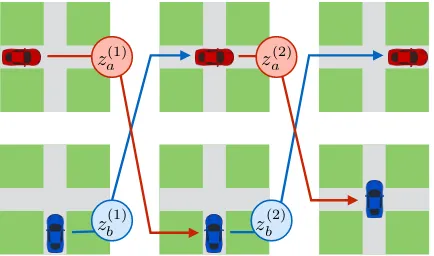
za(1) za(2)
[image:1.595.309.526.217.345.2]zb(1) zb(2)
Figure 1: Example interaction between a pair of agents in a deep communicating policy. Both cars are attempting to cross the intersection, but cannot see each other. By exchanging message vectorsz(t), the agents are able to coordinate and
avoid a collision. This paper presents an approach for under-standingthe contents of these message vectors by translating them into natural language.
backpropagation through the communication chan-nel, avoiding many of the challenging inference problems associated with learning in classical de-centralized decision processes (Roth et al.,2005).
But analysis of the strategies induced by DCPs has remained a challenge. As an example,Figure 1 depicts a driving game in which two cars, which are unable to see each other, must both cross an intersection without colliding. In order to ensure success, it is clear that the cars must communi-cate with each other. But a number of successful communication strategies are possible—for exam-ple, they might report their exact(x, y)coordinates at every timestep, or they might simply announce whenever they are entering and leaving the inter-section. If these messages were communicated in natural language, it would be straightforward to determine which strategy was being employed. However, DCP agents instead communicate with an automatically induced protocol of unstructured, real-valued recurrent state vectors—an artificial language we might call “neuralese,” which superfi-cially bears little resemblance to natural language, and thus frustrates attempts at direct interpretation.
We propose to understand neuralese messages bytranslatingthem. In this work, we present a sim-ple technique for inducing a dictionary that maps between neuralese message vectors and short natu-ral language strings, given only examples of DCP agents interacting with other agents, and humans interacting with other humans. Natural language already provides a rich set of tools for describing beliefs, observations, and plans—our thesis is that these tools provide a useful complement to the visu-alization and ablation techniques used in previous work on understanding complex models (Strobelt et al.,2016;Ribeiro et al.,2016).
While structurally quite similar to the task of machine translation between pairs of human lan-guages, interpretation of neuralese poses a number of novel challenges. First, there is no natural source of parallel data: there are no bilingual “speakers” of both neuralese and natural language. Second, there may not be a direct correspondence between the strategy employed by humans and DCP agents: even if it were constrained to communicate using natural language, an automated agent might choose to produce a different message from humans in a given state. We tackle both of these challenges by appealing to the grounding of messages in game-play. Our approach is based on one of the core insights in natural language semantics: messages (whether in neuralese or natural language) have similar meaningswhen they induce similar beliefs about the state of the world.
Based on this intuition, we introduce a transla-tion criterion that matches neuralese messages with natural language strings by minimizing statistical distance in a common representation space of dis-tributions over speaker states. We explore several related questions:
• What makes a good translation, and under what conditions is translation possible at all? (Section 4)
• How can we build a model to translate between neuralese and natural language? (Section 5)
• What kinds of theoretical guarantees can we provide about the behavior of agents communicating via this translation model? (Section 6)
Our translation model and analysis are general, and in fact apply equally to human–computer and
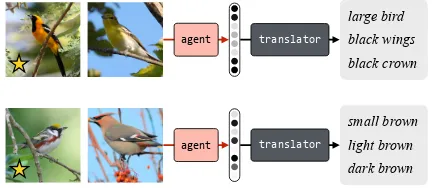
large bird black wings black crown agent translator
agent translator
[image:2.595.308.524.67.161.2]small brown light brown dark brown
Figure 2: Overview of our approach—best-scoring transla-tions generated for a reference game involving images of birds. The speaking agent’s goal is to send a message that uniquely identifies the bird on the left. From these translations it can be seen that the learned model appears to discriminate based on coarse attributes like size and color.
human–human translation problems grounded in gameplay. In this paper, we focus our experiments specifically on the problem of interpreting commu-nication in deep policies, and apply our approach to the driving game inFigure 1and two reference games of the kind shown inFigure 2. We find that this approach outperforms a more conventional ma-chine translation criterion both when attempting to interoperate with neuralese speakers and when predicting their state.
2 Related work
A variety of approaches for learning deep policies with communication were proposed essentially si-multaneously in the past year. We have broadly labeled these as “deep communicating policies”; concrete examples includeLazaridou et al.(2016b), Foerster et al.(2016), andSukhbaatar et al.(2016). The policy representation we employ in this paper is similar to the latter two of these, although the general framework is agnostic to low-level model-ing details and could be straightforwardly applied to other architectures. Analysis of communication strategies in all these papers has been largely ad-hoc, obtained by clustering states from which simi-lar messages are emitted and attempting to manu-ally assign semantics to these clusters. The present work aims at developing tools for performing this analysis automatically.
The literature on learning decentralized multi-agent policies in general is considerably larger (Bernstein et al., 2002; Dibangoye et al., 2016). This includes work focused on communication in multiagent settings (Roth et al., 2005) and even communication using natural language messages (Vogel et al.,2013b). All of these approaches em-ploy structured communication schemes with man-ually engineered messaging protocols; these are, in some sense, automatically interpretable, but at the cost of introducing considerable complexity into both training and inference.
Our evaluation in this paper investigates com-munication strategies that arise in a number of dif-ferent games, including reference games and an extended-horizon driving game. Communication strategies for reference games were previously ex-plored byVogel et al.(2013a),Andreas and Klein (2016) and Kazemzadeh et al. (2014), and refer-ence games specifically featuring end-to-end com-munication protocols byYu et al.(2016). On the control side, a long line of work considers nonver-bal communication strategies in multiagent policies (Dragan and Srinivasa,2013).
Another group of related approaches focuses on the development of more general machinery for interpreting deep models in which messages have no explicit semantics. This includes both visualiza-tion techniques (Zeiler and Fergus,2014;Strobelt et al.,2016), and approaches focused on generat-ing explanations in the form of natural language (Hendricks et al.,2016;Vedantam et al.,2017).
3 Problem formulation
Games Consider a cooperative game with two playersaandbof the form given inFigure 3. At every step tof this game, playeramakes an ob-servationx(at)and receives a messagezb(t−1)from
b. It then takes an actionu(at)and sends a message
z(at) tob. (The process is symmetric forb.) The
distributions p(ua|xa, zb) and p(za|xa) together
define a policy π which we assume is shared by both players, i.e.p(ua|xa, zb) = p(ub|xb, za)and
p(za|xa) = p(zb|xb). As in a standard Markov
decision process, the actions(u(at), u(bt))alter the
world state, generating new observations for both players and a reward shared by both.
The distributionsp(z|x)andp(u|x, z)may also be viewed as defining alanguage: they specify how a speaker will generate messages based on world states, and how a listener will respond to these
mes-a
b x(1)a
x(1)b x(2)b
u(1)a u(2)a
u(2)b u(1)b
za(1) za(2)
zb(1) zb(2)
a
b x(2)a
0.3: stop 0.5: forward 0.1: left 0.1: right
[image:3.595.333.496.64.245.2]observations actions messages
Figure 3: Schematic representation of communication games. At every timestept, playersaandbmake an observationx(t)
and receive a messagez(t−1), then produce an actionu(t)and
a new messagez(t).
sages. Our goal in this work is to learn to translate between pairs of languages generated by different policies. Specifically, we assume that we have ac-cess to two policies for the same game: a “robot policy”πr and a “human policy”πh. We would
like to use the representation ofπh, the behavior of
which is transparent to human users, in order to un-derstandthe behavior ofπr(which is in general an
uninterpretable learned model); we will do this by inducing bilingual dictionaries that map message vectorszrofπrto natural language stringszhof
πhand vice-versa.
Learned agentsπr Our goal is to present tools
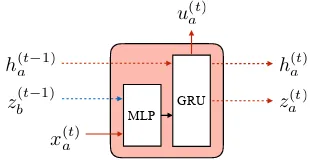
for interpretation of learned messages that are ag-nostic to the details of the underlying algorithm for acquiring them. We use a generic DCP model as a basis for the techniques developed in this paper. Here each agent policy is represented as a deep recurrent Q network (Hausknecht and Stone,2015). This network is built from communicating cells of the kind depicted inFigure 4. At every timestep, this agent receives three pieces of information: an
x(at) z(bt 1)
h(at 1) h(at)
u(at)
z(t)
a
MLP GRU
[image:3.595.337.492.621.701.2]observation of the current state of the world, the agent’s memory vector from the previous timestep, and a message from the other player. It then pro-duces three outputs: a predicted Q value for every possible action, a new memory vector for the next timestep, and a message to send to the other agent.
Sukhbaatar et al.(2016) observe that models of this form may be viewed as specifying a single RNN in which weight matrices have a particular block structure. Such models may thus be trained using the standard recurrent Q-learning objective, with communication protocol learned end-to-end.
Human agentsπh The translation model we
de-velop requires a representation of the distribution over messagesp(za|xa)employed by human
speak-ers (without assuming that humans and agents pro-duce equivalent messages in equivalent contexts). We model the human message generation process as categorical, and fit a simple multilayer percep-tron model to map from observations to words and phrases used during human gameplay.
4 What’s in a translation?
What does it mean for a messagezhto be a
“trans-lation” of a messagezr? In standard machine
trans-lation problems, the answer is thatzhis likely to
co-occur in parallel data withzr; that is,p(zh|zr)
is large. Here we have no parallel data: even if we could observe natural language and neuralese messages produced by agents in the same state, we would have no guarantee that these messages ac-tually served the same function. Our answer must instead appeal to the fact that both natural language and neuralese messages are grounded in a common environment. For a given neuralese message zr,
we will first compute a grounded representation of that message’s meaning; to translate, we find a natural-language message whose meaning is most similar. The key question is then what form this grounded meaning representation should take. The existing literature suggests two broad approaches:
Semantic representation The meaning of a mes-sagezais given by its denotations: that is, by the
set of world states of whichzamay be felicitously
predicated, given the existing context available to a listener. In probabilistic terms, this says that the meaning of a messagezais represented by the
dis-tributionp(xa|za, xb)it induces over speaker states.
Examples of this approach includeGuerin and Pitt (2001) andPasupat and Liang(2016).
Pragmatic representation The meaning of a messagezais given by the behavior it induces in
a listener. In probabilistic terms, this says that the meaning of a messagezais represented by the
dis-tributionp(ub|za, xb)it induces over actions given
the listener’s observationxb. Examples of this
ap-proach includeVogel et al.(2013a) andGauthier and Mordatch(2016).
These two approaches can give rise to rather dif-ferent behaviors. Consider the following example:
square hexagon circle
few many many
The top language (in blue) has a unique name for every kind of shape, while the bottom language (in red) only distinguishes between shapes with few sides and shapes with many sides. Now imagine a simple reference game with the following form: player ais covertly assigned one of these three shapes as a reference target, and communicates that reference tob;bmust then pull a lever labeled large or small depending on the size of the target shape. Blue language speakers can achieve perfect success at this game, while red language speakers can succeed at best two out of three times.
How should we translate the blue wordhexagon
into the red language? The semantic approach sug-gests that we should translatehexagon as many: whilemanydoes not uniquely identify the hexagon, it produces a distribution over shapes that is clos-est to the truth. The pragmatic approach instead suggests that we should translatehexagonasfew, as this is the only message that guarantees that the listener will pull the correct leverlarge. So in order to produce a correct listener action, the trans-lator might have to “lie” and produce a maximally inaccurate listener belief.
We instead build our approach around seman-tic representations of meaning. By preserving se-mantics, we allow listeners to reason accurately about the content and interpretation of messages. We might worry that by adopting a semantics-first view, we have given up all guarantees of effective interoperation between humans and agents using a translation layer. Fortunately, this is not so: as we will see inSection 6, it is possible to show that players communicating via a semantic translator perform only boundedly worse (and sometimes bet-ter!) than pairs of players with a common language.
5 Translation models
In this section, we build on the intuition that mes-sages should be translated via their semantics to define a concrete translation model—a procedure for constructing a natural language ↔neuralese dictionary given agent and human interactions.
We understand the meaning of a messagezato
be represented by the distribution p(xa|za, xb)it
induces over speaker states given listener context. We can formalize this by defining the belief distributionβfor a messagezand contextxbas:
β(za, xb) =p(xa|za, xb) = Pp(za|xa)p(xb|xa) x0ap(za|xa0)p(xb|x0a)
Here we have modeled the listener as performing a single step of Bayesian inference, using the lis-tener state and the message generation model (by assumption shared between players) to compute the posterior over speaker states. While in gen-eral neither humans nor DCP agents compute ex-plicit representations of this posterior, past work has found that both humans and suitably-trained neural networks can be modeled as Bayesian rea-soners (Frank et al.,2009;Paige and Wood,2016). This provides a context-specific representation of belief, but for messageszandz0to have the same semantics, they must induce the same belief over
allcontexts in which they occur. In our probabilis-tic formulation, this introduces an outer expectation over contexts, providing a final measureq of the quality of a translation fromztoz0:
q(z, z0) =EDKL(β(z, Xb)||β(z0, Xb))|z, z0
= X
xa,xb
p(xa, xb|z, z0)DKL(β(z, xb)||β(z0, xb))
∝ X
xa,xb
p(xa, xb)·p(z|xa)·p(z0|xa)
· DKL(β(z, xb)||β(z0, xb)); (1)
Algorithm 1Translating messages given: a phrase inventoryL functionTRANSLATE(z)
returnarg minz0∈Lqˆ(z, z0)
functionqˆ(z, z0)
// sample contexts and distractors
xai, xbi∼p(Xa, Xb)fori= 1..n
x0ai ∼p(Xa|xbi)
// compute context weights
˜
wi←p(z|xai)·p(z0|xai)
wi←w˜i/Pjw˜j
// compute divergences
ki ←Px∈{xa,x0a}p(z|x) logpp((zz0||xx))
returnPiwiki
recalling that in this setting
DKL(β||β0) =X
xa
p(xa|z, xb) log
p(xa|z, xb)
p(xa|z0, xb)
∝X
xa
p(xa|xb)p(z|xa) log
p(z|xa)
p(z0|xa) (2)
which is zero when the messageszandz0give rise to identical belief distributions and increases as they grow more dissimilar. To translate, we would like to computetr(zr) = arg minzhq(zr, zh)and
tr(zh) = arg minzrq(zh, zr). Intuitively, Equa-tion 1says that we will measure the quality of a proposed translationz7→z0by asking the follow-ing question: in contexts wherez is likely to be used, how frequently doesz0induce the same belief about speaker states asz?
While this translation criterion directly encodes the semantic notion of meaning described in Sec-tion 4, it is doubly intractable: the KL divergence and outer expectation involve a sum over all obser-vationsxaandxbrespectively; these sums are not
in general possible to compute efficiently. To avoid this, we approximateEquation 1by sampling. We draw a collection of samples(xa, xb)from the prior
over world states, and then generate for each sam-ple a sequence of distractors(x0a, xb)fromp(x0a|xb)
(we assume access to both of these distributions from the problem representation). The KL term inEquation 1is computed over each true sample and its distractors, which are then normalized and averaged to compute the final score.
Sampling accounts for the outer p(xa, xb) in
a
b
xa z
xb
[image:6.595.100.260.65.147.2]u
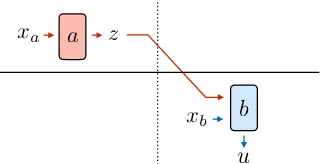
Figure 5: Simplified game representation used for analysis in Section 6. A speaker agent sends a message to a listener agent, which takes a single action and receives a reward.
The only quantities remaining are of the form p(z|xa). In the case of neuralese, this
distribu-tion already is part of the definidistribu-tion of the agent policyπrand can be reused directly. For natural
language, we use transcripts of human interactions to fit a model that maps from world states to a dis-tribution over frequent utterances as discussed in Section 3. Details of these model implementations are provided inAppendix B, and the full translation procedure is given inAlgorithm 1.
6 Belief and behavior
The translation criterion in the previous section makes no reference to listener actions at all. The shapes example in Section 4 shows that some model performance might be lost under translation. It is thus reasonable to ask whether this transla-tion model ofSection 5can make any guarantees about the effect of translation on behavior. In this section we explore the relationship between belief-preserving translations and the behaviors they pro-duce, by examining the effect of belief accuracy and strategy mismatch on the reward obtained by cooperating agents.
To facilitate this analysis, we consider a sim-plified family of communication games with the structure depicted inFigure 5. These games can be viewed as a subset of the family depicted in Fig-ure 3; and consist of two steps: a listener makes an observationxa and sends a single messagez
to a speaker, which makes its own observationxb,
takes a single actionu, and receives a reward. We emphasize that the results in this section concern the theoretical properties of idealized games, and are presented to provide intuition about high-level properties of our approach.Section 8investigates empirical behavior of this approach on real-world tasks where these ideal conditions do not hold.
Our first result is that translations that minimize semantic dissimilarityqcause the listener to take near-optimal actions:2
2Proof is provided inAppendix A.
Proposition 1.
Semantic translations reward rational listeners. Define arational listeneras one that chooses the best action in expectation over the speaker’s state:
U(z, xb) = arg max u
X
xa
p(xa|xb, z)r(xa, xb, u)
for a reward functionr ∈[0,1]that depends only on the two observations and the action.3Now leta be a speaker of a languager,bbe a listener of the same languager, andb0 be a listener of a different languageh. Suppose that we wish foraandb0to interact via the translator tr : zr 7→ zh (so that
aproduces a message zr, and b0 takes an action
U(zh =tr(zr), xb0)). Iftrrespects the semantics
ofzr, then the bilingual pairaandb0 achieves only
boundedly worse reward than the monolingual pair aandb. Specifically, ifq(zr, zh)≤D, then
Er(Xa, Xb, U(tr(Z))
≥Er(Xa, Xb, U(Z))−
√
2D (3)
So as discussed inSection 4, even by committing to a semantic approach to meaning representation, we have still succeeded in (approximately) captur-ing the nice properties of the pragmatic approach.
Section 4examined the consequences of a mis-match between the set of primitives available in two languages. In general we would like some measure of our approach’s robustness to the lack of an exact correspondence between two languages. In the case of humans in particular we expect that a variety of different strategies will be employed, many of which will not correspond to the behavior of the learned agent. It is natural to want some as-surance that we can identify the DCP’s strategy as long assomehuman strategy mirrors it. Our second observation is that it is possible to exactly recover a translation of a DCP strategy from a mixture of humans playing different strategies:
Proposition 2.
Semantic translations find hidden correspondences. Consider a fixed robot policy πr and a set of
p(z|xa) and p(u|z , xb)). Suppose further that
the messages employed by these human strate-gies aredisjoint; that is, if ph i(z|xa) > 0, then
ph j(z|xa) = 0for allj 6= i. Now suppose that
allq(zr, zh) = 0for all messages in the support
of someph i(z|xa)and> 0for allj 6=i. Then
every messagezris translated into a message
pro-duced byπh i, and messages from other strategies
are ignored.
This observation follows immediately from the definition of q(zr, zh), but demonstrates one of
the key distinctions between our approach and a conventional machine translation criterion. Maxi-mizingp(zh|zr)will produce the natural language
message most often produced in contexts where zris observed, regardless of whether that message
is useful or informative. By contrast, minimizing q(zh, zr) will find the zh that corresponds most
closely tozreven whenzhis rarely used.
The disjointness condition, while seemingly quite strong, in fact arises naturally in many circumstances—for example, players in the driving game reporting their spatial locations in absolute vs. relative coordinates, or speakers in a color refer-ence game (Figure 6) discriminating based on light-ness vs. hue. It is also possible to relax the above condition to require that strategies be onlylocally
disjoint (i.e. with the disjointness condition holding for each fixedxa), in which case overlapping
hu-man strategies are allowed, and the recovered robot strategy is a context-weighted mixture of these.
7 Evaluation
7.1 Tasks
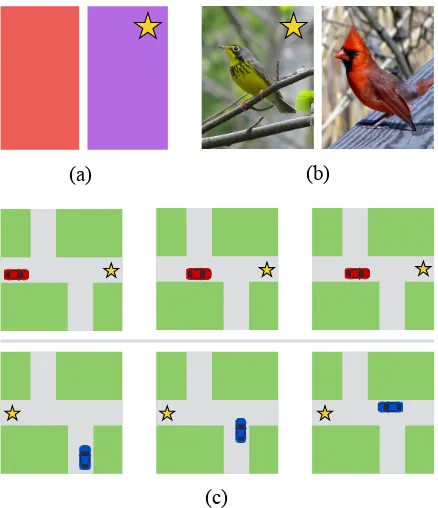
In the remainder of the paper, we evaluate the em-pirical behavior of our approach to translation. Our evaluation considers two kinds of tasks: reference games and navigation games. In a reference game (e.g.Figure 6a), both players observe a pair of can-didate referents. A speaker is assigned a target ref-erent; it must communicate this target to a listener, who then performs a choice action corresponding to its belief about the true target. In this paper we consider two variants on the reference game: a sim-ple color-naming task, and a more comsim-plex task involving natural images of birds. For examples of human communication strategies for these tasks, we obtain the XKCD color dataset (McMahan and Stone,2015;Monroe et al.,2016) and the Caltech Birds dataset (Welinder et al.,2010) with
accom-(a) (b)
[image:7.595.307.526.65.319.2](c)
Figure 6: Tasks used to evaluate the translation model. (a–b) Reference games: both players observe a pair of reference candidates (colors or images); Playerais assigned a target (marked with a star), which playerbmust guess based on a message froma. (c) Driving game: each car attempts to
navigate to its goal (marked with a star). The cars cannot see each other, and must communicate to avoid a collision.
panying natural language descriptions (Reed et al., 2016). We use standard train / validation / test splits for both of these datasets.
The final task we consider is the driving task (Figure 6c) first discussed in the introduction. In this task, two cars, invisible to each other, must each navigate between randomly assigned start and goal positions without colliding. This task takes a number of steps to complete, and potentially in-volves a much broader range of communication strategies. To obtain human annotations for this task, we recorded both actions and messages gener-ated by pairs of human Amazon Mechanical Turk workers playing the driving game with each other. We collected close to 400 games, with a total of more than 2000 messages exchanged, from which we held out 100 game traces as a test set.
7.2 Metrics
A mechanism for understanding the behavior of a learned model should allow a human user both to correctly infer its beliefs and to successfully interoperate with it; we accordingly report results of both “belief” and “behavior” evaluations.
translation), we focus on developing automatic measures of system performance. We use the avail-able training data to develop simulated models of human decisions; by first showing that these mod-els track well with human judgments, we can be confident that their use in evaluations will corre-late with human understanding. We employ the following two metrics:
Belief evaluation This evaluation focuses on the denotational perspective in semantics that moti-vated the initial development of our model. We have successfully understood the semantics of a messagezrif, after translatingzr 7→zh, a human
listener can form a correct belief about the state in whichzrwas produced. We construct a simple
state-guessing game where the listener is presented with a translated message and two state observa-tions, and must guess which state the speaker was in when the message was emitted.
When translating from natural language to neu-ralese, we use the learned agent model to directly guess the hidden state. For neuralese to natural language we must first construct a “model human listener” to map from strings back to state repre-sentations; we do this by using the training data to fit a simple regression model that scores (state, sen-tence) pairs using a bag-of-words sentence repre-sentation. We find that our “model human” matches the judgments of real humans 83% of the time on the colors task, 77% of the time on the birds task, and 77% of the time on the driving task. This gives us confidence that the model human gives a reason-ably accurate proxy for human interpretation.
Behavior evaluation This evaluation focuses on the cooperative aspects of interpretability: we mea-sure the extent to which learned models are able to interoperate with each other by way of a transla-tion layer. In the case of reference games, the goal of this semantic evaluation is identical to the goal of the game itself (to identify the hidden state of the speaker), so we perform this additional prag-matic evaluation only for the driving game. We found that the most data-efficient and reliable way to make use of human game traces was to construct a “deaf” model human. The evaluation selects a full game trace from a human player, and replays both the human’s actions and messages exactly (dis-regarding any incoming messages); the evaluation measures the quality of the natural-language-to-neuralese translator, and the extent to which the
(a)
as speaker
R H
as
listener
R 1.00
0.50 random 0.70 direct
0.73 belief (ours)
H* 0.50
0.83 0.72
0.86
(b)
as speaker
R H
as
listener
R 0.95
0.50 random 0.55 direct
0.60 belief (ours)
H* 0.50
0.77 0.57
[image:8.595.319.502.59.260.2]0.75
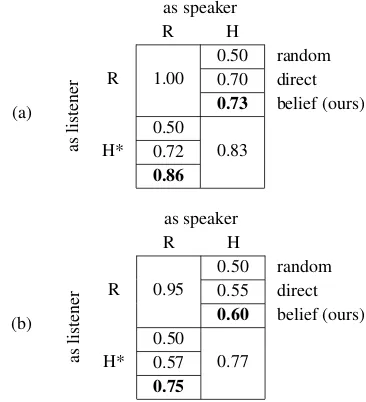
Table 1: Evaluation results for reference games. (a) The colors task. (b) The birds task. Whether the model human is in a listener or speaker role, translation based on belief matching outperforms both random and machine translation baselines.
learned agent model can accommodate a (real) hu-man given translations of the huhu-man’s messages. Baselines We compare our approach to two base-lines: arandombaseline that chooses a translation of each input uniformly from messages observed during training, and adirectbaseline that directly maximizesp(z0|z)(by analogy to a conventional machine translation system). This is accomplished by sampling from a DCP speaker in training states labeled with natural language strings.
8 Results
In all below, “R” indicates a DCP agent, “H” in-dicates a real human, and “H*” inin-dicates a model human player.
Reference games Results for the two reference games are shown inTable 1. The end-to-end trained model achieves nearly perfect accuracy in both
magenta, hot, rose, violet, purple
magenta, hot, violet, rose, purple
olive, puke, pea, grey, brown
pinkish, grey, dull, pale, light
[image:8.595.309.523.613.740.2]as speaker
R H
as
listener
R 0.85
0.50 random 0.45 direct
0.61 belief (ours)
H* 0.5
0.77 0.45
[image:9.595.325.499.62.253.2]0.57
Table 2: Belief evaluation results for the driving game. Driving states are challenging to identify based on messages alone (as evidenced by the comparatively low scores obtained by single-language pairs) . Translation based on belief achieves the best overall performance in both directions.
R / R H / H R / H
1.93 / 0.71 — / 0.77
1.35 / 0.64 random 1.49 /0.67 direct
[image:9.595.106.256.64.160.2]1.54 / 0.67 belief (ours) Table 3: Behavior evaluation results for the driving game. Scores are presented in the form “reward / completion rate”. While less accurate than either humans or DCPs with a shared language, the models that employ a translation layer obtain higher reward and a greater overall success rate than baselines.
cases, while a model trained to communicate in natural language achieves somewhat lower perfor-mance. Regardless of whether the speaker is a DCP and the listener a model human or vice-versa, translation based on the belief-matching criterion inSection 5achieves the best performance; indeed, when translating neuralese color names to natural language, the listener is able to achieve a slightly higher score than it is natively. This suggests that the automated agent has discovered a more effec-tive strategy than the one demonstrated by humans in the dataset, and that the effectiveness of this strategy is preserved by translation. Example trans-lations from the reference games are depicted in Figure 2andFigure 7.
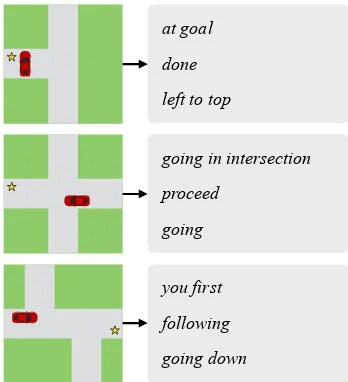
Driving game Behavior evaluation of the driving game is shown inTable 3, and belief evaluation is shown inTable 2. Translation of messages in the driving game is considerably more challenging than in the reference games, and scores are uniformly lower; however, a clear benefit from the belief-matching model is still visible. Belief belief-matching leads to higher scores on the belief evaluation in both directions, and allows agents to obtain a higher reward on average (though task completion rates remain roughly the same across all agents). Some example translations of driving game messages are shown inFigure 8.
at goal
done
left to top
going in intersection
proceed
going
you first
following
going down
Figure 8: Best-scoring translations generated for driving task generated from the given speaker state.
9 Conclusion
We have investigated the problem of interpreting message vectors from deep networks by translat-ing them. After introductranslat-ing a translation criterion based on matching listener beliefs about speaker states, we presented both theoretical and empirical evidence that this criterion outperforms a conven-tional machine translation approach at recovering the content of message vectors and facilitating col-laboration between humans and learned agents.
While our evaluation has focused on under-standing the behavior of deep communicating poli-cies, the framework proposed in this paper could be much more generally applied. Any encoder– decoder model (Sutskever et al., 2014) can be thought of as a kind of communication game played between the encoder and the decoder, so we can analogously imagine computing and translating “beliefs” induced by the encoding to explain what features of the input are being transmitted. The cur-rent work has focused on learning a purely categor-ical model of the translation process, supported by an unstructured inventory of translation candidates, and future work could explore thecompositional
[image:9.595.77.279.238.287.2]Acknowledgments
JA is supported by a Facebook Graduate Fellowship and a Berkeley AI / Huawei Fellowship. We are grateful to Lisa Anne Hendricks for assistance with the Caltech Birds dataset.
References
Jacob Andreas and Dan Klein. 2016. Reasoning about pragmatics with neural listeners and speakers. In
Proceedings of the Conference on Empirical Meth-ods in Natural Language Processing.
Daniel S Bernstein, Robert Givan, Neil Immerman, and Shlomo Zilberstein. 2002. The complexity of decentralized control of Markov decision processes.
Mathematics of operations research27(4):819–840.
Kyunghyun Cho, Bart van Merri¨enboer, Dzmitry Bah-danau, and Yoshua Bengio. 2014. On the properties of neural machine translation: Encoder-decoder ap-proaches. arXiv preprint arXiv:1409.1259.
Jilles Steeve Dibangoye, Christopher Amato, Olivier Buffet, and Franc¸ois Charpillet. 2016. Optimally solving Dec-POMDPs as continuous-state MDPs.
Journal of Artificial Intelligence Research 55:443– 497.
Anca Dragan and Siddhartha Srinivasa. 2013. Gener-ating legible motion. InRobotics: Science and Sys-tems.
Jakob Foerster, Yannis M Assael, Nando de Freitas, and Shimon Whiteson. 2016. Learning to commu-nicate with deep multi-agent reinforcement learning. In Advances in Neural Information Processing Sys-tems. pages 2137–2145.
Michael C Frank, Noah D Goodman, Peter Lai, and Joshua B Tenenbaum. 2009. Informative communi-cation in word production and word learning. In Pro-ceedings of the 31st annual conference of the cogni-tive science society. pages 1228–1233.
Yang Gao, Oscar Beijbom, Ning Zhang, and Trevor Darrell. 2016. Compact bilinear pooling. In Pro-ceedings of the IEEE Conference on Computer Vi-sion and Pattern Recognition. pages 317–326.
Jon Gauthier and Igor Mordatch. 2016. A paradigm for situated and goal-driven language learning. arXiv preprint arXiv:1610.03585.
Frank Guerin and Jeremy Pitt. 2001. Denotational se-mantics for agent communication language. In Pro-ceedings of the fifth international conference on Au-tonomous agents. ACM, pages 497–504.
Matthew Hausknecht and Peter Stone. 2015. Deep recurrent q-learning for partially observable mdps.
arXiv preprint arXiv:1507.06527.
Lisa Anne Hendricks, Zeynep Akata, Marcus Rohrbach, Jeff Donahue, Bernt Schiele, and Trevor Darrell. 2016. Generating visual explanations. In
European Conference on Computer Vision. Springer, pages 3–19.
Sahar Kazemzadeh, Vicente Ordonez, Mark Matten, and Tamara L Berg. 2014. ReferItGame: Referring to objects in photographs of natural scenes. In Pro-ceedings of the Conference on Empirical Methods in Natural Language Processing. pages 787–798. Diederik Kingma and Jimmy Ba. 2014. Adam: A
method for stochastic optimization. arXiv preprint arXiv:1412.6980.
Angeliki Lazaridou, Alexander Peysakhovich, and Marco Baroni. 2016a. Multi-agent cooperation and the emergence of (natural) language. arXiv preprint arXiv:1612.07182.
Angeliki Lazaridou, Nghia The Pham, and
Marco Baroni. 2016b. Towards multi-agent
communication-based language learning. arXiv preprint arXiv:1605.07133.
Brian McMahan and Matthew Stone. 2015. A
Bayesian model of grounded color semantics. Trans-actions of the Association for Computational Lin-guistics3:103–115.
Will Monroe, Noah D Goodman, and Christopher Potts. 2016. Learning to generate compositional color de-scriptions. arXiv preprint arXiv:1606.03821. Brooks Paige and Frank Wood. 2016. Inference
net-works for sequential monte carlo in graphical mod-els. volume 48.
Panupong Pasupat and Percy Liang. 2016. Inferring logical forms from denotations. arXiv preprint arXiv:1606.06900.
Scott Reed, Zeynep Akata, Honglak Lee, and Bernt Schiele. 2016. Learning deep representations of fine-grained visual descriptions. In Proceedings of the IEEE Conference on Computer Vision and Pat-tern Recognition. pages 49–58.
Marco Tulio Ribeiro, Sameer Singh, and Carlos Guestrin. 2016. Why should I trust you?: Explain-ing the predictions of any classifier. InProceedings of the 22nd ACM SIGKDD International Conference on Knowledge Discovery and Data Mining. ACM, pages 1135–1144.
Maayan Roth, Reid Simmons, and Manuela Veloso. 2005. Reasoning about joint beliefs for execution-time communication decisions. In Proceedings of the fourth international joint conference on Au-tonomous agents and multiagent systems. ACM, pages 786–793.
Sainbayar Sukhbaatar, Rob Fergus, et al. 2016. Learn-ing multiagent communication with backpropaga-tion. InAdvances in Neural Information Processing Systems. pages 2244–2252.
Ilya Sutskever, Oriol Vinyals, and Quoc VV Le. 2014. Sequence to sequence learning with neural networks. In Advances in Neural Information Processing Sys-tems. pages 3104–3112.
Ramakrishna Vedantam, Samy Bengio, Kevin Murphy, Devi Parikh, and Gal Chechik. 2017. Context-aware captions from context-agnostic supervision. arXiv preprint arXiv:1701.02870.
Adam Vogel, Max Bodoia, Christopher Potts, and Daniel Jurafsky. 2013a. Emergence of Gricean max-ims from multi-agent decision theory. In Proceed-ings of the Human Language Technology Confer-ence of the North American Chapter of the Asso-ciation for Computational Linguistics. pages 1072– 1081.
Adam Vogel, Christopher Potts, and Dan Jurafsky. 2013b. Implicatures and nested beliefs in approx-imate Decentralized-POMDPs. In ACL (2). pages 74–80.
P. Welinder, S. Branson, T. Mita, C. Wah, F. Schroff, S. Belongie, and P. Perona. 2010. Caltech-UCSD Birds 200. Technical Report CNS-TR-2010-001, California Institute of Technology.
Andrew Gordon Wilson, Been Kim, and William Her-lands. 2016. Proceedings of nips 2016 workshop on interpretable machine learning for complex systems.
arXiv preprint arXiv:1611.09139.
Licheng Yu, Hao Tan, Mohit Bansal, and Tamara L Berg. 2016. A joint speaker-listener-reinforcer model for referring expressions. arXiv preprint arXiv:1612.09542.