Proceedings of the 56th Annual Meeting of the Association for Computational Linguistics (Long Papers), pages 1403–1414 1403
Stack-Pointer Networks for Dependency Parsing
Xuezhe Ma
Carnegie Mellon University
Zecong Hu∗
Tsinghua University
Jingzhou Liu
Carnegie Mellon University
Nanyun Peng
University of Southern California
Graham Neubig and Eduard Hovy
Carnegie Mellon University
{gneubig, ehovy}@cs.cmu.edu
Abstract
We introduce a novel architecture for de-pendency parsing: stack-pointer networks (STACKPTR). Combining pointer net-works (Vinyals et al., 2015) with an in-ternal stack, the proposed model first reads and encodes the whole sentence, then builds the dependency tree top-down (from root-to-leaf) in a depth-first fashion. The stack tracks the status of the depth-first search and the pointer networks se-lect one child for the word at the top of the stack at each step. The STACKPTR
parser benefits from the information of the whole sentence and all previously derived subtree structures, and removes the left-to-right restriction in classical transition-based parsers. Yet, the number of steps for building any (including non-projective) parse tree is linear in the length of the sen-tence just as other transition-based parsers, yielding an efficient decoding algorithm with O(n2) time complexity. We evalu-ate our model on 29 treebanks spanning 20 languages and different dependency anno-tation schemas, and achieve state-of-the-art performance on 21 of them.
1 Introduction
Dependency parsing, which predicts the existence and type of linguistic dependency relations be-tween words, is a first step towards deep language understanding. Its importance is widely recog-nized in the natural language processing (NLP) community, with it benefiting a wide range of NLP applications, such as coreference resolu-tion (Ng,2010;Durrett and Klein,2013;Ma et al.,
∗
Work done while at Carnegie Mellon University.
2016), sentiment analysis (Tai et al., 2015), ma-chine translation (Bastings et al.,2017), informa-tion extracinforma-tion (Nguyen et al.,2009;Angeli et al.,
2015;Peng et al.,2017), word sense disambigua-tion (Fauceglia et al.,2015), and low-resource lan-guages processing (McDonald et al.,2013;Ma and Xia,2014). There are two dominant approaches to dependency parsing (Buchholz and Marsi, 2006;
Nivre et al., 2007): local and greedy transition-basedalgorithms (Yamada and Matsumoto,2003;
Nivre and Scholz,2004;Zhang and Nivre,2011;
Chen and Manning,2014), and the globally opti-mizedgraph-basedalgorithms (Eisner,1996; Mc-Donald et al.,2005a,b;Koo and Collins,2010).
Transition-based dependency parsers read words sequentially (commonly from left-to-right) and build dependency trees incrementally by making series of multiple choice decisions. The advantage of this formalism is that the number of operations required to build any projective parse tree is linear with respect to the length of the sen-tence. The challenge, however, is that the decision made at each step is based on local information, leading to error propagation and worse perfor-mance compared to graph-based parsers on root and long dependencies (McDonald and Nivre,
2011). Previous studies have explored solutions to address this challenge. Stack LSTMs (Dyer et al., 2015; Ballesteros et al., 2015, 2016) are capable of learning representations of the parser state that are sensitive to the complete contents of the parser’s state. Andor et al. (2016) proposed a globally normalized transition model to replace the locally normalized classifier. However, the parsing accuracy is still behind state-of-the-art graph-based parsers (Dozat and Manning,2017).
tree. Incorporating this global search algorithm with distributed representations learned from neu-ral networks, neuneu-ral graph-based parsers (
Kiper-wasser and Goldberg, 2016; Wang and Chang,
2016;Kuncoro et al., 2016;Dozat and Manning,
2017) have achieved the state-of-the-art accura-cies on a number of treebanks in different lan-guages. Nevertheless, these models, while accu-rate, are usually slow (e.g. decoding is O(n3) time complexity for first-order models (McDonald et al.,2005a,b) and higher polynomials for higher-order models (McDonald and Pereira,2006;Koo and Collins,2010;Ma and Zhao,2012b,a)).
In this paper, we propose a novel neural net-work architecture for dependency parsing, stack-pointer networks (STACKPTR). STACKPTR is
a transition-based architecture, with the corre-sponding asymptotic efficiency, but still main-tains a global view of the sentence that proves es-sential for achieving competitive accuracy. Our STACKPTRparser has a pointer network (Vinyals
et al., 2015) as its backbone, and is equipped
with an internal stack to maintain the order of head words in tree structures. The STACKPTR
parser performs parsing in an incremental, top-down, depth-first fashion; at each step, it gener-ates an arc by assigning a child for the head word at the top of the internal stack. This architecture makes it possible to capture information from the whole sentence and all the previously derived sub-trees, while maintaining a number of parsing steps linear in the sentence length.
We evaluate our parser on 29 treebanks across 20 languages and different dependency annotation schemas, and achieve state-of-the-art performance on 21 of them. The contributions of this work are summarized as follows:
(i) We propose a neural network architecture for dependency parsing that is simple, effective, and efficient.
(ii) Empirical evaluations on benchmark datasets over 20 languages show that our method achieves state-of-the-art performance on 21 different treebanks1.
(iii) Comprehensive error analysis is conducted to compare the proposed method to a strong graph-based baseline using biaffine atten-tion (Dozat and Manning,2017).
1Source code is publicly available at https://
github.com/XuezheMax/NeuroNLP2
2 Background
We first briefly describe the task of dependency parsing, setup the notation, and review Pointer Networks (Vinyals et al.,2015).
2.1 Dependency Parsing and Notations
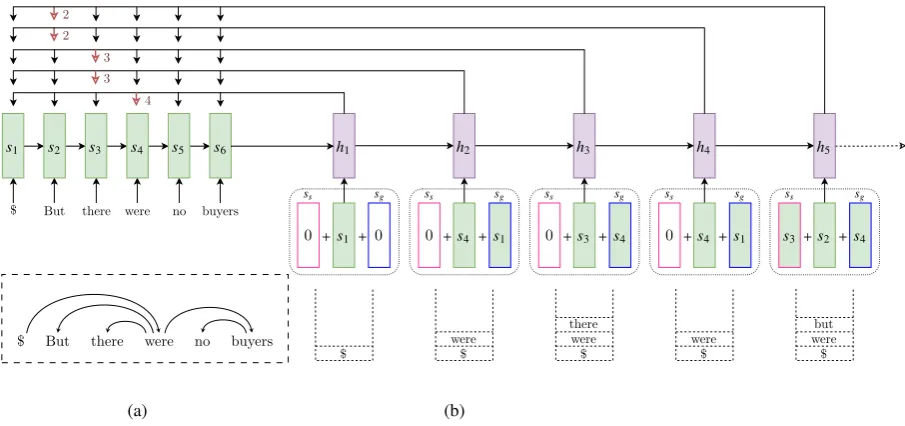
Dependency trees represent syntactic relationships between words in the sentences through labeled directed edges between head words and their de-pendents. Figure 1 (a) shows a dependency tree for the sentence, “But there were no buyers”.
In this paper, we will use the following notation:
Input: x ={w1, . . . , wn}represents a generic
sentence, wherewiis theith word.
Output: y = {p1, p2,· · ·, pk} represents a
generic (possibly non-projective) dependency tree, where each pathpi = $, wi,1, wi,2,· · ·, wi,li is a
sequence of words from the root to a leaf. “$” is an universal virtual root that is added to each tree.
Stack: σ denotes a stack configuration, which is a sequence of words. We useσ|wto represent a stack configuration that pushes wordwinto the stackσ.
Children:ch(wi)denotes the list of all the
chil-dren (modifiers) of wordwi.
2.2 Pointer Networks
Pointer Networks (PTR-NET) (Vinyals et al.,
2015) are a variety of neural network capable of learning the conditional probability of an output sequence with elements that are discrete tokens corresponding to positions in an input sequence. This model cannot be trivially expressed by stan-dard sequence-to-sequence networks (Sutskever et al., 2014) due to the variable number of input positions in each sentence. PTR-NET solves the
problem by using attention (Bahdanau et al.,2015;
Luong et al.,2015) as a pointer to select a member of the input sequence as the output.
Formally, the words of the sentence x are fed one-by-one into the encoder (a multiple-layer bi-directional RNN), producing a sequence of en-coder hidden states si. At each time step t, the
decoder (a uni-directional RNN) receives the input from last step and outputsdecoder hidden stateht.
Theattention vectoratis calculated as follows:
eti = score(ht, si)
at = softmax(et) (1)
s1
$
s2
But
s3
there
s4
were
s5
no
s6
buyers
h1
s1
h2
s4
h3
s3
h4
s4
h5
s2
$
were $
there were $
were $
but were
$
0 + +0 2
3
sg ss
0 + +s1 0 + +s4 0 + +s1 s3 + +s4
sg
ss ss sg ss sg ss sg
4 3 2
(b) $ But there were no buyers
[image:3.595.74.527.60.273.2](a)
Figure 1: Neural architecture for the STACKPTRnetwork, together with the decoding procedure of an example sentence. The BiRNN of the encoder is elided for brevity. For the inputs of decoder at each time step, vectors in red and blue boxes indicate the sibling and grandparent.
concatenation, and biaffine (Luong et al., 2015). PTR-NETregards the attention vectoratas a prob-ability distribution over the source words, i.e. it usesat
ias pointers to select the input elements.
3 Stack-Pointer Networks
3.1 Overview
Similarly to PTR-NET, STACKPTRfirst reads the whole sentence and encodes each word into the encoder hidden state si. The internal stackσ is
always initialized with the root symbol $. At each time stept, the decoder receives the input vector corresponding to the top element of the stack σ
(the head wordwpwherepis the word index),
gen-erates the hidden stateht, and computes the
atten-tion vectoratusing Eq. (1). The parser chooses a specific positioncaccording to the attention scores inatto generate a new dependency arc (wh, wc)
by selectingwcas a child ofwh. Then the parser
pusheswconto the stack, i.e.σ→σ|wc, and goes
to the next step. At one step if the parser pointswh
to itself, i.e. c = h, it indicates that all children of the head word wh have already been selected.
Then the parser goes to the next step by popping
whout ofσ.
At test time, in order to guarantee a valid de-pendency tree containing all the words in the in-put sentences exactly once, the decoder maintains a list of “available” words. At each decoding step, the parser selects a child for the current head word,
and removes the child from the list of available words to make sure that it cannot be selected as a child of other head words.
For head words with multiple children, it is pos-sible that there is more than one valid selection for each time step. In order to define a determin-istic decoding process to make sure that there is only one ground-truth choice at each step (which is necessary for simple maximum likelihood esti-mation), a predefined order for eachch(wi)needs
to be introduced. The predefined order of chil-dren can have different alternatives, such as left-to-right or inside-out2. In this paper, we adopt the inside-out order3 since it enables us to utilize second-ordersiblinginformation, which has been proven beneficial for parsing performance ( Mc-Donald and Pereira,2006;Koo and Collins,2010) (see§3.4for details). Figure1(b) depicts the ar-chitecture of STACKPTRand the decoding proce-dure for the example sentence in Figure1(a).
3.2 Encoder
The encoder of our parsing model is based on the bi-directional LSTM-CNN architecture (BLSTM-CNNs) (Chiu and Nichols, 2016; Ma and Hovy,
2016) where CNNs encode character-level infor-mation of a word into its character-level
repre-2
Order the children by the distances to the head word on the left side, then the right side.
sentation and BLSTM models context informa-tion of each word. Formally, for each word, the CNN, with character embeddings as inputs, en-codes the character-level representation. Then the character-level representation vector is concate-nated with the word embedding vector to feed into the BLSTM network. To enrich word-level infor-mation, we also use POS embeddings. Finally, the encoder outputs a sequence of hidden statessi.
3.3 Decoder
The decoder for our parser is a uni-directional LSTM. Different from previous work (Bahdanau et al.,2015;Vinyals et al.,2015) which uses word embeddings of the previous word as the input to the decoder, our decoder receives the encoder hid-den state vector (si) of the top element in the stack
σ (see Figure 1(b)). Compared to word embed-dings, the encoder hidden states contain more con-textual information, benefiting both the training and decoding procedures. The decoder produces a sequence of decoder hidden stateshi, one for each
decoding step.
3.4 Higher-order Information
As mentioned before, our parser is capable of uti-lizing higher-order information. In this paper, we incorporate two kinds of higher-order structures — grandparent and sibling. A sibling structure is a head word with two successive modifiers, and a grandparent structure is a pair of dependencies connected head-to-tail:
0123456278296569862521425237754395
ÿ
ÿ
!" "#$%&#&'
%!#&(()&*%&&!*"&(+("!"%)
&," "#$'
(%&#-.,"/" "#$ %
%%#*)(&***%&0%#(!$%
%()-123-4 5 67896:
;<=>?@ ABCDE3-F14 GH
I.J3-4%&*%&()!!&%#( &+!,&*
-"ABCDE3-F14K!&%&*K&&*&&1
%&*!$%%()%&#-'A#&*#"!0
&$()J3-4(,% (&!!$,&*&*!&*()
&*%&#."#&!$%(!KEL'% #&#!'
#((%&&$."(,*#*)(%&*)(0
#%()&*% .%&(MNOPQR#*" "#$&
&(%!!SNRPT.,*#*#+%#("%(!&('
#&(" %#+)(!U"%)(!!(,%
ABCDE3-F14 5 V
W<;A
BCDEXDY3-FZ4
Y*&%.,&&&*" "#$&1%%&
() &%Z.#*(),*#*[%% &#(&0
+&(&(&*%#(()1'(#&)#&(U&(%.
)/#& %!(&*%%&)(%(!KEL''
\"/&*QR]^R() &##("&(&*
+()" "#%&#(&%.,&*!(0
(%&(!($)()#&(U&(%" %!0
(&*%'_&*"()&*% .,)(#%
()#&(U&(%&!U&*)(!!(, &%
`
`
a a
a a a
b b b b b c c c d
efgfhefhij klmnlho opqheirlne
spltklmnlho opqhetklmnlho
A #/#!!$.A#&(%u'.u'v."u'w"%#+
%%&*&.% #&K!$.)#&(&%&("0
#*!" &%."0%+! &%."&()
"0%+!"&0%+! &%'
x yz{|}{~|{~{} |
C,&*"0("" "#$ %%+!"(
"%)( %& %!(&*%' _&*%
%#&(., (K"+#[("(&,(!K&
%%)( K(%,(['
GH
G+H
vY*"$#0(%&#&%
""K&(%()&*E%GvH!(&*'
B( !&% %" #&"%&!%"0
#( !&% %%& U("%'(+K&$.,!"
&*%$&#*&0*""K%(%'
x {|}}{}{~
Y*/%&&$ () %,"%#+%%/%&0
(")#&(U&(.,*#*"#( (%%" 0
"#$&&(&%"K"!" "#%'E%0
GvH&("#","!$0%""$#0
(!(&*)(/%&0(" %%
&%&*+%%)($ %%.#!"(,
!(&*%.,%U&%"%*'
Y*E%GvH!(&* %+%"(&,(
&!&"&$ %()"$#0(%�
&%OQ S¡^P^% %.,*#*#(%%&()*"0
,(""&%"%#"&%((%"."¢£OQ ¤
S¡^P^% %.,*#*#(%%&()" "#$"&*
(+&,&**""("/'
(!!$.,"(&#( !&% %¥¦§¨
,*©"ª&*"#%()&*% «%*"0
,(""" (&' #( !&% %"0
(&"%¬¦§,*©"® &*"()&*
*""("/()" "#$' _&&K!$.
#( !&% %&%*!)0#(%&&&
*""+$©.,*%#( !&% %(!$
&!*!)0#(%&&&.%#&*#(%&&&#
+&""+$""(("/%&(®'
E#*&$ ()% %#&"+$#%K!$
#(+&,(%!!."¯#&% %&*#(0
%&#&(%% #/" *#!!$v'
#( !&% %#(%&#&")(
()#( !&% %."#&&*"K%(()&*
°©F®±&(#(%&&&%*""+$©"
®' #( !&% %#&"+$#( !&0
#( !&% ,&*&*(&**!)()
®«%#(%&&&'Y* (&()#(#&&(
#*#(%&#&(²® vGH(³0
vG+H²%&*TS¡¢PSQ¢£P.)"&*&%&
+&"&(/"&*( &!#(%&#&('
_("&( %%&#-.&%)/#%&(
/"( &!#(%&#&(%)(!!#( !&"
#( !&% %"/"(-' Y*%#+
´
To utilize higher-order information, the de-coder’s input at each step is the sum of the encoder hidden states of three words:
βt=sh+sg+ss
where βt is the input vector of decoder at time
t and h, g, s are the indices of the head word and its grandparent and sibling, respectively. Fig-ure 1 (b) illustrates the details. Here we use the element-wise sum operation instead of concatena-tion because it does not increase the dimension of the input vectorβt, thus introducing no additional
model parameters.
3.5 Biaffine Attention Mechanism
For attention score function (Eq. (1)), we adopt the biaffine attention mechanism (Luong et al.,2015;
Dozat and Manning,2017):
eti=hTtWsi+UTht+VTsi+b
where W,U,V, b are parameters, denoting the weight matrix of the bi-linear term, the two weight vectors of the linear terms, and the bias vector.
As discussed inDozat and Manning(2017), ap-plying a multilayer perceptron (MLP) to the out-put vectors of the BLSTM before the score func-tion can both reduce the dimensionality and over-fitting of the model. We follow this work by using a one-layer perceptron tosiandhiwith elu ( Clev-ert et al.,2015) as its activation function.
Similarly, the dependency label classifier also uses a biaffine function to score each label, given the head word vectorhtand child vectorsi as
in-puts. Again, we use MLPs to transformhtandsi
before feeding them into the classifier.
3.6 Training Objectives
The STACKPTR parser is trained to optimize the probability of the dependency trees given sen-tences:Pθ(y|x), which can be factorized as:
Pθ(y|x) = k Q
i=1
Pθ(pi|p<i,x)
= k Q i=1 li Q j=1
Pθ(ci,j|ci,<j, p<i,x),
(2)
whereθrepresents model parameters. p<idenotes
the preceding paths that have already been gener-ated. ci,j represents thejth word inpi andci,<j
denotes all the proceeding words on the path pi.
Thus, the STACKPTR parser is an autoregressive
model, like sequence-to-sequence models, but it factors the distribution according to a top-down tree structure as opposed to a left-to-right chain. We definePθ(ci,j|ci,<j, p<i,x) =at, where
atten-tion vectorat(of dimensionn) is used as the dis-tribution over the indices of words in a sentence.
Arc Prediction Our parser is trained by optimiz-ing the conditional likelihood in Eq (2), which is implemented as the cross-entropy loss.
Label Prediction We train a separated multi-class multi-classifier in parallel to predict the depen-dency labels. Following Dozat and Manning
head word and its child as features. The label clas-sifier is trained simultaneously with the parser by optimizing the sum of their objectives.
3.7 Discussion
Time Complexity. The number of decoding steps to build a parse tree for a sentence of length
nis2n−1, linear inn. Together with the attention mechanism (at each step, we need to compute the attention vector at, whose runtime is O(n)), the time complexity of decoding algorithm isO(n2), which is more efficient than graph-based parsers that haveO(n3)or worse complexity when using dynamic programming or maximum spanning tree (MST) decoding algorithms.
Top-down Parsing. When humans comprehend a natural language sentence, they arguably do it in an incremental, left-to-right manner. How-ever, when humans consciously annotate a sen-tence with syntactic structure, they rarely ever pro-cess in fixed left-to-right order. Rather, they start by reading the whole sentence, then seeking the main predicates, jumping back-and-forth over the sentence and recursively proceeding to the sub-tree structures governed by certain head words. Our parser follows a similar kind of annotation process: starting from reading the whole sentence, and processing in a top-down manner by finding the main predicates first and only then search for sub-trees governed by them. When making latter decisions, the parser has access to the entire struc-ture built in earlier steps.
3.8 Implementation Details
Pre-trained Word Embeddings. For all the parsing models in different languages, we initial-ize word vectors with pretrained word embed-dings. For Chinese, Dutch, English, German and Spanish, we use the structured-skipgram (Ling et al.,2015) embeddings. For other languages we use Polyglot embeddings (Al-Rfou et al.,2013).
Optimization. Parameter optimization is per-formed with the Adam optimizer (Kingma and Ba,
2014) with β1 = β2 = 0.9. We choose an ini-tial learning rate of η0 = 0.001. The learning rate η is annealed by multiplying a fixed decay rateρ= 0.75when parsing performance stops in-creasing on validation sets. To reduce the effects of “gradient exploding”, we use gradient clipping of5.0(Pascanu et al.,2013).
Dropout Training. To mitigate overfitting, we apply dropout (Srivastava et al.,2014;Ma et al.,
2017). For BLSTM, we use recurrent dropout (Gal
and Ghahramani, 2016) with a drop rate of 0.33
between hidden states and 0.33 between layers. FollowingDozat and Manning(2017), we also use embedding dropout with a rate of 0.33 on all word, character, and POS embeddings.
Hyper-Parameters. Some parameters are cho-sen from those reported in Dozat and Manning
(2017). We use the same hyper-parameters across the models on different treebanks and languages, due to time constraints. The details of the chosen hyper-parameters for all experiments are summa-rized in Appendix A.
4 Experiments
4.1 Setup
We evaluate our STACKPTR parser mainly on three treebanks: the English Penn Treebank (PTB version 3.0) (Marcus et al., 1993), the Penn Chinese Treebank (CTB version 5.1) (Xue
et al., 2002), and the German CoNLL 2009
cor-pus (Hajiˇc et al.,2009). We use the same experi-mental settings asKuncoro et al.(2016).
To make a thorough empirical comparison with previous studies, we also evaluate our system on treebanks from CoNLL shared task and the Uni-versal Dependency (UD) Treebanks4. For the CoNLL Treebanks, we use the English treebank from CoNLL-2008 shared task (Surdeanu et al.,
2008) and all 13 treebanks from CoNLL-2006 shared task (Buchholz and Marsi,2006). The ex-perimental settings are the same asMa and Hovy
(2015). For UD Treebanks, we select 12 lan-guages. The details of the treebanks and experi-mental settings are in§4.5and Appendix B.
Evaluation Metrics Parsing performance is measured with five metrics: unlabeled attachment score (UAS), labeled attachment score (LAS), un-labeled complete match (UCM), un-labeled complete match (LCM), and root accuracy (RA). Following previous work (Kuncoro et al., 2016;Dozat and Manning,2017), we report results excluding punc-tuations for Chinese and English. For each experi-ment, we report the mean values with correspond-ing standard deviations over 5 repetitions.
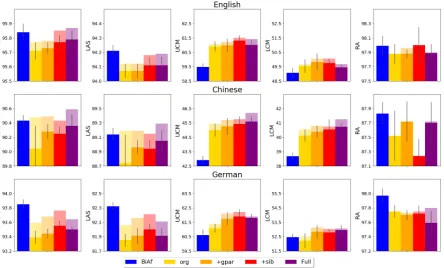
Figure 2: Parsing performance of different variations of our model on the test sets for three languages, together with baseline BIAF. For each of our STACKPTRmodels, we perform decoding with beam size equal to 1and10. The improvements of decoding with beam size10 over1 are presented by stacked bars with light colors.
Baseline For fair comparison of the parsing per-formance, we re-implemented the graph-based Deep Biaffine (BIAF) parser (Dozat and Manning,
2017), which achieved state-of-the-art results on a wide range of languages. Our re-implementation adds character-level information using the same LSTM-CNN encoder as our model (§ 3.2) to the original BIAF model, which boosts its perfor-mance on all languages.
4.2 Main Results
We first conduct experiments to demonstrate the effectiveness of our neural architecture by compar-ing with the strong baseline BIAF. We compare
the performance of four variations of our model with different decoder inputs —Org,+gpar,+sib andFull— where theOrgmodel utilizes only the encoder hidden states of head words, while the +gparand+sibmodels augments the original one with grandparent and sibling information, respec-tively. TheFullmodel includes all the three infor-mation as inputs.
Figure 2 illustrates the performance (five met-rics) of different variations of our STACKPTR
parser together with the results of baseline BIAF re-implemented by us, on the test sets of the three
languages. On UAS and LAS, the Full variation of STACKPTRwith decoding beam size 10 outper-forms BIAF on Chinese, and obtains competitive performance on English and German. An interest-ing observation is that theFullmodel achieves the best accuracy on English and Chinese, while per-forms slightly worse than+sib on German. This shows that the importance of higher-order infor-mation varies in languages. On LCM and UCM, STACKPTRsignificantly outperforms BIAF on all languages, showing the superiority of our parser on complete sentence parsing. The results of our parser on RA are slightly worse than BIAF. More
details of results are provided in Appendix C.
4.3 Comparison with Previous Work
English Chinese German
System UAS LAS UAS LAS UAS LAS
Chen and Manning(2014) T 91.8 89.6 83.9 82.4 – –
Ballesteros et al.(2015) T 91.63 89.44 85.30 83.72 88.83 86.10
Dyer et al.(2015) T 93.1 90.9 87.2 85.7 – –
Bohnet and Nivre(2012) T 93.33 91.22 87.3 85.9 91.4 89.4
Ballesteros et al.(2016) T 93.56 91.42 87.65 86.21 – –
Kiperwasser and Goldberg(2016) T 93.9 91.9 87.6 86.1 – –
Weiss et al.(2015) T 94.26 92.41 – – – –
Andor et al.(2016) T 94.61 92.79 – – 90.91 89.15
Kiperwasser and Goldberg(2016) G 93.1 91.0 86.6 85.1 – –
Wang and Chang(2016) G 94.08 91.82 87.55 86.23 – –
Cheng et al.(2016) G 94.10 91.49 88.1 85.7 – –
Kuncoro et al.(2016) G 94.26 92.06 88.87 87.30 91.60 89.24
Ma and Hovy(2017) G 94.88 92.98 89.05 87.74 92.58 90.54 BIAF:Dozat and Manning(2017) G 95.74 94.08 89.30 88.23 93.46 91.44
BIAF: re-impl G 95.84 94.21 90.43 89.14 93.85 92.32
STACKPTR:Org T 95.77 94.12 90.48 89.19 93.59 92.06
STACKPTR:+gpar T 95.78 94.12 90.49 89.19 93.65 92.12
STACKPTR:+sib T 95.85 94.18 90.43 89.15 93.76 92.21
[image:7.595.125.473.61.274.2]STACKPTR:Full T 95.87 94.19 90.59 89.29 93.65 92.11
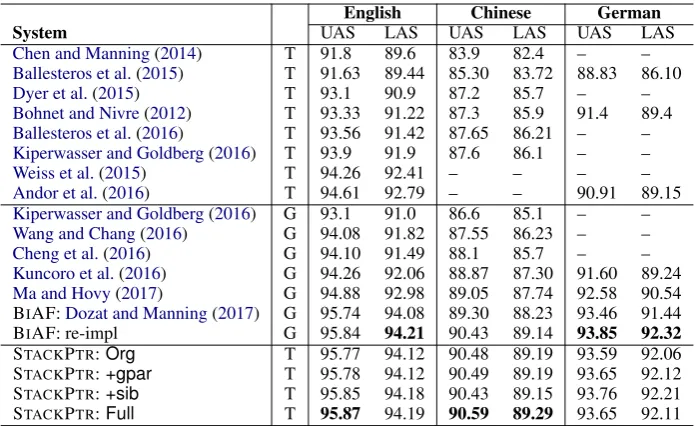
Table 1: UAS and LAS of four versions of our model on test sets for three languages, together with top-performing parsing systems. “T” and “G” indicate transition- and graph-based models, respectively. For BIAF, we provide the original results reported inDozat and Manning(2017) and our re-implementation. For STACKPTRand our re-implementation of BiAF, we report the average over 5 runs.
(a) (b) (c)
Figure 3: Parsing performance of BIAF and STACKPTRparsers relative to length and graph factors.
POS UAS LAS UCM LCM
Gold 96.12±0.03 95.06±0.05 62.22±0.33 55.74±0.44
Pred 95.87±0.04 94.19±0.04 61.43±0.49 49.68±0.47
None 95.90±0.05 94.21±0.04 61.58±0.39 49.87±0.46
Table 2: Parsing performance on the test data of PTB with different versions of POS tags.
re-implementation of BIAF obtains better perfor-mance than the original one in Dozat and Man-ning(2017), demonstrating the effectiveness of the character-level information. Our model achieves state-of-the-art performance on both UAS and LAS on Chinese, and best UAS on English. On German, the performance is competitive with BIAF, and significantly better than other models.
4.4 Error Analysis
In this section, we characterize the errors made by BIAF and STACKPTRby presenting a number of experiments that relate parsing errors to a set of linguistic and structural properties. For simplicity,
we followMcDonald and Nivre(2011) and report labeled parsing metrics (either accuracy, precision, or recall) for all experiments.
4.4.1 Length and Graph Factors
FollowingMcDonald and Nivre (2011), we ana-lyze parsing errors related to structural factors.
Sentence Length. Figure 3 (a) shows the ac-curacy of both parsing models relative to sen-tence lengths. Consistent with the analysis in
Mc-Donald and Nivre (2011), STACKPTR tends to
perform better on shorter sentences, which make fewer parsing decisions, significantly reducing the chance of error propagation.
[image:7.595.74.525.351.429.2]Bi-Att NeuroMST BIAF STACKPTR Best Published
UAS [LAS] UAS [LAS] UAS [LAS] UAS [LAS] UAS LAS
[image:8.595.85.510.60.225.2]ar 80.34 [68.58] 80.80 [69.40] 82.15±0.34 [71.32±0.36] 83.04±0.29 [72.94±0.31] 81.12 – bg 93.96 [89.55] 94.28 [90.60] 94.62±0.14 [91.56±0.24] 94.66±0.10[91.40±0.08] 94.02 – zh – 93.40 [90.10] 94.05±0.27 [90.89±0.22] 93.88±0.24 [90.81±0.55] 93.04 – cs 91.16 [85.14] 91.18 [85.92] 92.24±0.22 [87.85±0.21] 92.83±0.13 [88.75±0.16] 91.16 85.14 da 91.56 [85.53] 91.86 [87.07] 92.80±0.26 [88.36±0.18] 92.08±0.15 [87.29±0.21] 92.00 – nl 87.15 [82.41] 87.85 [84.82] 90.07±0.18 [87.24±0.17] 90.10±0.27[87.05±0.26] 87.39 – en – 94.66 [92.52] 95.19±0.05 [93.14±0.05] 93.25±0.05 [93.17±0.05] 93.25 – de 92.71 [89.80] 93.62 [91.90] 94.52±0.11 [93.06±0.11] 94.77±0.05 [93.21±0.10] 92.71 89.80 ja 93.44 [90.67] 94.02 [92.60] 93.95±0.06 [92.46±0.07] 93.38±0.08 [91.92±0.16] 93.80 – pt 92.77 [88.44] 92.71 [88.92] 93.41±0.08 [89.96±0.24] 93.57±0.12 [90.07±0.20] 93.03 – sl 86.01 [75.90] 86.73 [77.56] 87.55±0.17 [78.52±0.35] 87.59±0.36 [78.85±0.53] 87.06 – es 88.74 [84.03] 89.20 [85.77] 90.43±0.13 [87.08±0.14] 90.87±0.26 [87.80±0.31] 88.75 84.03 sv 90.50 [84.05] 91.22 [86.92] 92.22±0.15 [88.44±0.17] 92.49±0.21 [89.01±0.22] 91.85 85.26 tr 78.43 [66.16] 77.71 [65.81] 79.84±0.23 [68.63±0.29] 79.56±0.22 [68.03±0.15] 78.43 66.16
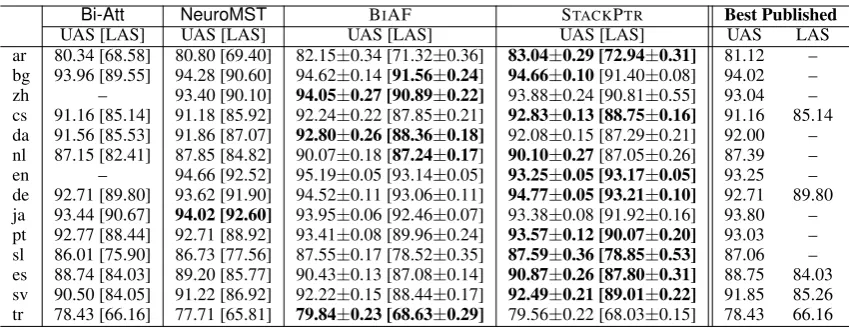
Table 3: UAS and LAS on 14 treebanks from CoNLL shared tasks, together with several state-of-the-art parsers. Bi-Attis the bi-directional attention based parser (Cheng et al., 2016), andNeuroMSTis the neural MST parser (Ma and Hovy,2017). “Best Published” includes the most accurate parsers in term of UAS amongKoo et al.(2010),Martins et al.(2011),Martins et al.(2013),Lei et al.(2014),Zhang et al.
(2014),Zhang and McDonald(2014),Pitler and McDonald(2015), andCheng et al.(2016).
in McDonald and Nivre (2011). One possible
reason is that, unlike traditional transition-based parsers that scan the sentence from left to right, STACKPTRprocesses in a top-down manner, thus sometimes unnecessarily creating shorter depen-dency arcs first.
Root Distance. Figure 3(c) plots the precision and recall of each system for arcs of varying dis-tance to the root. Different from the observation
inMcDonald and Nivre(2011), STACKPTRdoes
not show an obvious advantage on the precision for arcs further away from the root. Furthermore, the STACKPTRparser does not have the tendency to over-predict root modifiers reported in
McDon-ald and Nivre (2011). This behavior can be
ex-plained using the same reasoning as above: the fact that arcs further away from the root are usu-ally constructed early in the parsing algorithm of traditional transition-based parsers is not true for the STACKPTRparser.
4.4.2 Effect of POS Embedding
The only prerequisite information that our pars-ing model relies on is POS tags. With the goal of achieving an end-to-end parser, we explore the ef-fect of POS tags on parsing performance. We run experiments on PTB using our STACKPTRparser with gold-standard and predicted POS tags, and without tags, respectively. STACKPTRin these ex-periments is theFullmodel with beam=10.
Table2 gives results of the parsers with differ-ent versions of POS tags on the test data of PTB.
The parser with gold-standard POS tags signifi-cantly outperforms the other two parsers, show-ing that dependency parsers can still benefit from accurate POS information. The parser with pre-dicted (imperfect) POS tags, however, performs even slightly worse than the parser without us-ing POS tags. It illustrates that an end-to-end parser that doesn’t rely on POS information can obtain competitive (or even better) performance than parsers using imperfect predicted POS tags, even if the POS tagger is relative high accuracy (accuracy>97%in this experiment on PTB).
4.5 Experiments on Other Treebanks
4.5.1 CoNLL Treebanks
Table 3 summarizes the parsing results of our model on the test sets of 14 treebanks from the CoNLL shared task, along with the state-of-the-art baselines. Along with BIAF, we also list the
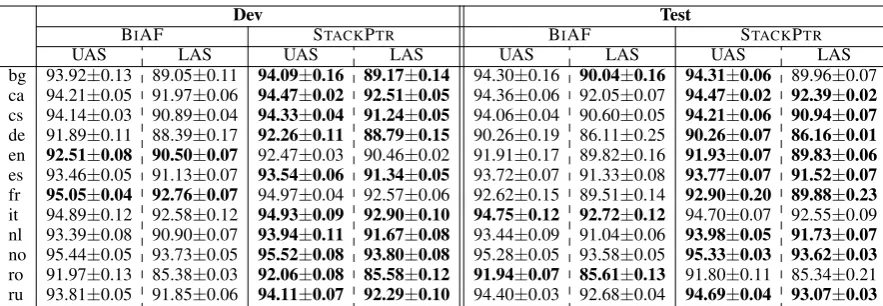
Dev Test
BIAF STACKPTR BIAF STACKPTR
UAS LAS UAS LAS UAS LAS UAS LAS
bg 93.92±0.13 89.05±0.11 94.09±0.16 89.17±0.14 94.30±0.16 90.04±0.16 94.31±0.06 89.96±0.07 ca 94.21±0.05 91.97±0.06 94.47±0.02 92.51±0.05 94.36±0.06 92.05±0.07 94.47±0.02 92.39±0.02
cs 94.14±0.03 90.89±0.04 94.33±0.04 91.24±0.05 94.06±0.04 90.60±0.05 94.21±0.06 90.94±0.07
de 91.89±0.11 88.39±0.17 92.26±0.11 88.79±0.15 90.26±0.19 86.11±0.25 90.26±0.07 86.16±0.01
en 92.51±0.08 90.50±0.07 92.47±0.03 90.46±0.02 91.91±0.17 89.82±0.16 91.93±0.07 89.83±0.06
es 93.46±0.05 91.13±0.07 93.54±0.06 91.34±0.05 93.72±0.07 91.33±0.08 93.77±0.07 91.52±0.07
fr 95.05±0.04 92.76±0.07 94.97±0.04 92.57±0.06 92.62±0.15 89.51±0.14 92.90±0.20 89.88±0.23
it 94.89±0.12 92.58±0.12 94.93±0.09 92.90±0.10 94.75±0.12 92.72±0.12 94.70±0.07 92.55±0.09 nl 93.39±0.08 90.90±0.07 93.94±0.11 91.67±0.08 93.44±0.09 91.04±0.06 93.98±0.05 91.73±0.07
no 95.44±0.05 93.73±0.05 95.52±0.08 93.80±0.08 95.28±0.05 93.58±0.05 95.33±0.03 93.62±0.03
[image:9.595.76.518.60.213.2]ro 91.97±0.13 85.38±0.03 92.06±0.08 85.58±0.12 91.94±0.07 85.61±0.13 91.80±0.11 85.34±0.21 ru 93.81±0.05 91.85±0.06 94.11±0.07 92.29±0.10 94.40±0.03 92.68±0.04 94.69±0.04 93.07±0.03
Table 4: UAS and LAS on both the development and test datasets of 12 treebanks from UD Treebanks, together with BIAF for comparison.
4.5.2 UD Treebanks
For UD Treebanks, we select 12 languages — Bul-garian, Catalan, Czech, Dutch, English, French, German, Italian, Norwegian, Romanian, Russian and Spanish. For all the languages, we adopt the standard training/dev/test splits, and use the uni-versal POS tags (Petrov et al., 2012) provided in each treebank. The statistics of these corpora are provided in Appendix B.
Table 4 summarizes the results of the STACKPTRparser, along with BIAF for
compari-son, on both the development and test datasets for each language. First, both BIAF and STACKPTR
parsers achieve relatively high parsing accuracies on all the 12 languages — all with UAS are higher than 90%. On nine languages — Catalan, Czech, Dutch, English, French, German, Norwegian, Russian and Spanish — STACKPTRoutperforms BIAF for both UAS and LAS. On Bulgarian, STACKPTR achieves slightly better UAS while LAS is slightly worse than BIAF. On Italian and Romanian, BIAF obtains marginally better parsing performance than STACKPTR.
5 Conclusion
In this paper, we proposed STACKPTR, a transition-based neural network architecture, for dependency parsing. Combining pointer networks with an internal stack to track the status of the top-down, depth-first search in the decoding pro-cedure, the STACKPTR parser is able to capture information from the whole sentence and all the previously derived subtrees, removing the left-to-right restriction in classical transition-based parsers, while maintaining linear parsing steps, w.r.t the length of the sentences. Experimental
re-sults on 29 treebanks show the effectiveness of our parser across 20 languages, by achieving state-of-the-art performance on 21 corpora.
There are several potential directions for future work. First, we intend to consider how to conduct experiments to improve the analysis of parsing er-rors qualitatively and quantitatively. Another in-teresting direction is to further improve our model by exploring reinforcement learning approaches to learn an optimal order for the children of head words, instead of using a predefined fixed order.
Acknowledgements
The authors thank Chunting Zhou, Di Wang and Zhengzhong Liu for their helpful discussions. This research was supported in part by DARPA grant FA8750-18-2-0018 funded under the AIDA program. Any opinions, findings, and conclusions or recommendations expressed in this material are those of the authors and do not necessarily reflect the views of DARPA.
References
Rami Al-Rfou, Bryan Perozzi, and Steven Skiena. 2013. Polyglot: Distributed word representations for multilingual nlp. In Proceedings of CoNLL-2013. Sofia, Bulgaria, pages 183–192.
Daniel Andor, Chris Alberti, David Weiss, Aliaksei Severyn, Alessandro Presta, Kuzman Ganchev, Slav Petrov, and Michael Collins. 2016. Globally nor-malized transition-based neural networks. In Pro-ceedings of ACL-2016 (Volume 1: Long Papers). Berlin, Germany, pages 2442–2452.
In Proceedings of ACL-2015 (Volume 1: Long Pa-pers). Beijing, China, pages 344–354.
Dzmitry Bahdanau, Kyunghyun Cho, and Yoshua Ben-gio. 2015. Neural machine translation by jointly learning to align and translate. In Proceedings of ICLR-2015.
Miguel Ballesteros, Chris Dyer, and Noah A. Smith. 2015. Improved transition-based parsing by model-ing characters instead of words with lstms. In Pro-ceedings of EMNLP-2015. Lisbon, Portugal, pages 349–359.
Miguel Ballesteros, Yoav Goldberg, Chris Dyer, and Noah A. Smith. 2016. Training with exploration im-proves a greedy stack lstm parser. InProceedings of EMNLP-2016. Austin, Texas, pages 2005–2010.
Joost Bastings, Ivan Titov, Wilker Aziz, Diego Marcheggiani, and Khalil Simaan. 2017. Graph convolutional encoders for syntax-aware neural ma-chine translation. InProceedings of EMNLP-2017. Copenhagen, Denmark, pages 1957–1967.
Bernd Bohnet and Joakim Nivre. 2012. A transition-based system for joint part-of-speech tagging and labeled non-projective dependency parsing. In Pro-ceedings of EMNLP-2012. Jeju Island, Korea, pages 1455–1465.
Sabine Buchholz and Erwin Marsi. 2006. CoNLL-X shared task on multilingual dependency parsing. In
Proceeding of CoNLL-2006. New York, NY, pages 149–164.
Danqi Chen and Christopher Manning. 2014. A fast and accurate dependency parser using neural net-works. In Proceedings of EMNLP-2014. Doha, Qatar, pages 740–750.
Hao Cheng, Hao Fang, Xiaodong He, Jianfeng Gao, and Li Deng. 2016. Bi-directional attention with agreement for dependency parsing. InProceedings of EMNLP-2016. Austin, Texas, pages 2204–2214.
Jason Chiu and Eric Nichols. 2016. Named entity recognition with bidirectional lstm-cnns. Transac-tions of the Association for Computational Linguis-tics4:357–370.
Djork-Arn´e Clevert, Thomas Unterthiner, and Sepp Hochreiter. 2015. Fast and accurate deep network learning by exponential linear units (elus). arXiv preprint arXiv:1511.07289.
Timothy Dozat and Christopher D. Manning. 2017. Deep biaffine attention for neural dependency pars-ing. InProceedings of ICLR-2017 (Volume 1: Long Papers). Toulon, France.
Greg Durrett and Dan Klein. 2013. Easy victories and uphill battles in coreference resolution. In Proceed-ings of EMNLP-2013. Seattle, Washington, USA, pages 1971–1982.
Chris Dyer, Miguel Ballesteros, Wang Ling, Austin Matthews, and Noah A. Smith. 2015. Transition-based dependency parsing with stack long short-term memory. InProceedings of ACL-2015 (Volume 1: Long Papers). Beijing, China, pages 334–343.
Jason M Eisner. 1996. Three new probabilistic models for dependency parsing: An exploration. In Pro-ceedings of COLING-1996 (Volume 1). Association for Computational Linguistics, pages 340–345.
Nicolas R Fauceglia, Yiu-Chang Lin, Xuezhe Ma, and Eduard Hovy. 2015. Word sense disambiguation via propstore and ontonotes for event mention detec-tion. In Proceedings of the The 3rd Workshop on EVENTS: Definition, Detection, Coreference, and Representation. Denver, Colorado, pages 11–15.
Yarin Gal and Zoubin Ghahramani. 2016. A theoret-ically grounded application of dropout in recurrent neural networks. InAdvances in Neural Information Processing Systems.
Jan Hajiˇc, Massimiliano Ciaramita, Richard Johans-son, Daisuke Kawahara, Maria Ant`onia Mart´ı, Llu´ıs M`arquez, Adam Meyers, Joakim Nivre, Sebastian Pad´o, Jan ˇStˇep´anek, et al. 2009. The conll-2009 shared task: Syntactic and semantic dependencies in multiple languages. In Proceedings of CoNLL-2009: Shared Task. pages 1–18.
Diederik Kingma and Jimmy Ba. 2014. Adam: A method for stochastic optimization. arXiv preprint arXiv:1412.6980.
Eliyahu Kiperwasser and Yoav Goldberg. 2016. Sim-ple and accurate dependency parsing using bidirec-tional lstm feature representations. Transactions of the Association for Computational Linguistics
4:313–327.
Terry Koo and Michael Collins. 2010. Efficient third-order dependency parsers. InProceedings of ACL-2010. Uppsala, Sweden, pages 1–11.
Terry Koo, Alexander M. Rush, Michael Collins, Tommi Jaakkola, and David Sontag. 2010. Dual decomposition for parsing with non-projective head automata. In Proceedings of EMNLP-2010. Cam-bridge, MA, pages 1288–1298.
Adhiguna Kuncoro, Miguel Ballesteros, Lingpeng Kong, Chris Dyer, and Noah A. Smith. 2016. Dis-tilling an ensemble of greedy dependency parsers into one mst parser. In Proceedings of EMNLP-2016. Austin, Texas, pages 1744–1753.
Tao Lei, Yu Xin, Yuan Zhang, Regina Barzilay, and Tommi Jaakkola. 2014. Low-rank tensors for scor-ing dependency structures. InProceedings of ACL-2014 (Volume 1: Long Papers). Baltimore, Mary-land, pages 1381–1391.
Thang Luong, Hieu Pham, and Christopher D. Man-ning. 2015. Effective approaches to attention-based neural machine translation. InProceedings of EMNLP-2015. Lisbon, Portugal, pages 1412–1421.
Xuezhe Ma, Yingkai Gao, Zhiting Hu, Yaoliang Yu, Yuntian Deng, and Eduard Hovy. 2017. Dropout with expectation-linear regularization. In Proceed-ings of the 5th International Conference on Learn-ing Representations (ICLR-2017). Toulon, France.
Xuezhe Ma and Eduard Hovy. 2015. Efficient inner-to-outer greedy algorithm for higher-order labeled de-pendency parsing. InProceedings of EMNLP-2015. Lisbon, Portugal, pages 1322–1328.
Xuezhe Ma and Eduard Hovy. 2016. End-to-end se-quence labeling via bi-directional lstm-cnns-crf. In
Proceedings of ACL-2016 (Volume 1: Long Papers). Berlin, Germany, pages 1064–1074.
Xuezhe Ma and Eduard Hovy. 2017. Neural proba-bilistic model for non-projective mst parsing. In
Proceedings of IJCNLP-2017 (Volume 1: Long Pa-pers). Taipei, Taiwan, pages 59–69.
Xuezhe Ma, Zhengzhong Liu, and Eduard Hovy. 2016. Unsupervised ranking model for entity coreference resolution. In Proceedings of NAACL-2016. San Diego, California, USA.
Xuezhe Ma and Fei Xia. 2014. Unsupervised depen-dency parsing with transferring distribution via par-allel guidance and entropy regularization. In Pro-ceedings of ACL-2014. Baltimore, Maryland, pages 1337–1348.
Xuezhe Ma and Hai Zhao. 2012a. Fourth-order depen-dency parsing. In Proceedings of COLING 2012: Posters. Mumbai, India, pages 785–796.
Xuezhe Ma and Hai Zhao. 2012b. Probabilistic models for high-order projective dependency parsing. Tech-nical Report, arXiv:1502.04174.
Mitchell Marcus, Beatrice Santorini, and Mary Ann Marcinkiewicz. 1993. Building a large annotated corpus of English: the Penn Treebank. Computa-tional Linguistics19(2):313–330.
Andre Martins, Miguel Almeida, and Noah A. Smith. 2013. Turning on the turbo: Fast third-order non-projective turbo parsers. In Proceedings of ACL-2013 (Volume 2: Short Papers). Sofia, Bulgaria, pages 617–622.
Andre Martins, Noah Smith, Mario Figueiredo, and Pedro Aguiar. 2011. Dual decomposition with many overlapping components. In Proceedings of EMNLP-2011. Edinburgh, Scotland, UK., pages 238–249.
Ryan McDonald, Koby Crammer, and Fernando Pereira. 2005a. Online large-margin training of de-pendency parsers. In Proceedings of ACL-2005. Ann Arbor, Michigan, USA, pages 91–98.
Ryan McDonald and Joakim Nivre. 2011. Analyzing and integrating dependency parsers. Computational Linguistics37(1):197–230.
Ryan McDonald, Joakim Nivre, Yvonne Quirmbach-Brundage, Yoav Goldberg, Dipanjan Das, Kuz-man Ganchev, Keith Hall, Slav Petrov, Hao Zhang, Oscar T¨ackstr¨om, Claudia Bedini, N´uria Bertomeu Castell´o, and Jungmee Lee. 2013. Uni-versal dependency annotation for multilingual pars-ing. InProceedings of ACL-2013. Sofia, Bulgaria, pages 92–97.
Ryan McDonald and Fernando Pereira. 2006. Online learning of approximate dependency parsing algo-rithms. InProceeding of EACL-2006.
Ryan McDonald, Fernando Pereira, Kiril Ribarov, and Jan Hajic. 2005b. Non-projective dependency pars-ing uspars-ing spannpars-ing tree algorithms. InProceedings of HLT/EMNLP-2005. Vancouver, Canada, pages 523–530.
Vincent Ng. 2010. Supervised noun phrase coreference research: The first fifteen years. InProceedings of ACL-2010. Association for Computational Linguis-tics, Uppsala, Sweden, pages 1396–1411.
Truc-Vien T. Nguyen, Alessandro Moschitti, and Giuseppe Riccardi. 2009. Convolution kernels on constituent, dependency and sequential structures for relation extraction. InProceedings of EMNLP-2009. Singapore, pages 1378–1387.
Joakim Nivre, Johan Hall, Sandra K¨ubler, Ryan McDonald, Jens Nilsson, Sebastian Riedel, and Deniz Yuret. 2007. The CoNLL 2007 shared task on dependency parsing. In Proceedings of the CoNLL Shared Task Session of EMNLP-CoNLL 2007. Prague, Czech Republic, pages 915–932.
Joakim Nivre and Mario Scholz. 2004. Deterministic dependency parsing of English text. InProceedings of COLING-2004. Geneva, Switzerland, pages 64– 70.
Razvan Pascanu, Tomas Mikolov, and Yoshua Bengio. 2013. On the difficulty of training recurrent neu-ral networks. InProceedings of ICML-2013. pages 1310–1318.
Nanyun Peng, Hoifung Poon, Chris Quirk, Kristina Toutanova, and Wen-tau Yih. 2017. Cross-sentence n-ary relation extraction with graph lstms. Transac-tions of the Association for Computational Linguis-tics5:101–115.
Slav Petrov, Dipanjan Das, and Ryan McDonald. 2012. A universal part-of-speech tagset. InProceedings of LREC-2012. Istanbul, Turkey, pages 2089–2096.
Nitish Srivastava, Geoffrey Hinton, Alex Krizhevsky, Ilya Sutskever, and Ruslan Salakhutdinov. 2014. Dropout: A simple way to prevent neural networks from overfitting. The Journal of Machine Learning Research15(1):1929–1958.
Mihai Surdeanu, Richard Johansson, Adam Meyers, Llu´ıs M`arquez, and Joakim Nivre. 2008. The conll-2008 shared task on joint parsing of syntactic and semantic dependencies. InProceedings of CoNLL-2008. pages 159–177.
Ilya Sutskever, Oriol Vinyals, and Quoc V Le. 2014. Sequence to sequence learning with neural net-works. InAdvances in neural information process-ing systems. pages 3104–3112.
Kai Sheng Tai, Richard Socher, and Christopher D. Manning. 2015. Improved semantic representations from tree-structured long short-term memory net-works. InProceedings ACL-2015 (Volume 1: Long Papers). Beijing, China, pages 1556–1566.
Oriol Vinyals, Meire Fortunato, and Navdeep Jaitly. 2015. Pointer networks. InAdvances in Neural In-formation Processing Systems. pages 2692–2700.
Wenhui Wang and Baobao Chang. 2016. Graph-based dependency parsing with bidirectional lstm. In Pro-ceedings of ACL-2016 (Volume 1: Long Papers). Berlin, Germany, pages 2306–2315.
David Weiss, Chris Alberti, Michael Collins, and Slav Petrov. 2015. Structured training for neural net-work transition-based parsing. In Proceedings of ACL-2015 (Volume 1: Long Papers). Beijing, China, pages 323–333.
Nianwen Xue, Fu-Dong Chiou, and Martha Palmer. 2002. Building a large-scale annotated chinese cor-pus. InProceedings of COLING-2002. pages 1–8.
Hiroyasu Yamada and Yuji Matsumoto. 2003. Statis-tical dependency analysis with support vector ma-chines. In Proceedings of IWPT. Nancy, France, volume 3, pages 195–206.
Hao Zhang and Ryan McDonald. 2014. Enforcing structural diversity in cube-pruned dependency pars-ing. InProceedings of ACL-2014 (Volume 2: Short Papers). Baltimore, Maryland, pages 656–661.
Yuan Zhang, Tao Lei, Regina Barzilay, and Tommi Jaakkola. 2014. Greed is good if randomized: New inference for dependency parsing. InProceedings of EMNLP-2014. Doha, Qatar, pages 1013–1024.
Yue Zhang and Joakim Nivre. 2011. Transition-based dependency parsing with rich non-local features. In