214
A Multi-task Approach to Learning Multilingual Representations
Karan Singla1, Dogan Can1, Shrikanth Narayanan1,2
1Department of Computer Science 2Department of Electrical Engineering
University of Southern California, Los Angeles, USA
{singlak, dogancan}@usc.edu, [email protected]
Abstract
We present a novel multi-task model-ing approach to learnmodel-ing multilmodel-ingual dis-tributed representations of text. Our sys-tem learns word and sentence embeddings jointly by training a multilingual skip-gram model together with a cross-lingual sentence similarity model. Our architec-ture can transparently use both monolin-gual and sentence aligned bilinmonolin-gual cor-pora to learn multilingual embeddings, thus covering a vocabulary significantly larger than the vocabulary of the bilingual corpora alone. Our model shows com-petitive performance in a standard cross-lingual document classification task. We also show the effectiveness of our method in a limited resource scenario.
1 Introduction
Learning distributed representations of text, whether it be at the level of words, phrases, sentences or documents has been one of the most widely researched subjects in natural lan-guage processing in recent years (Mikolov et al.,
2013; Pennington et al., 2014; Gouws et al.,
2015; Socher et al., 2010; Pham et al., 2015b;
Kiros et al., 2015;Conneau et al., 2017; Le and Mikolov, 2014; Chen, 2017; Wu et al., 2017). Word/sentence/document embeddings, as they are now commonly referred to, have quickly become essential ingredients of larger and more complex NLP systems looking to leverage the rich seman-tic and linguisseman-tic information present in distributed representations (Bengio et al., 2003;Maas et al.,
2011; Collobert et al., 2011; Bahdanau et al.,
2014;Chen and Manning,2014).
Research that has been taking place in the con-text of distributed con-text representations is
learn-ing multillearn-ingual text representations shared across languages (Faruqui and Dyer, 2014; Bengio and Corrado,2015;Luong et al.,2015). Multilingual embeddings open up the possibility of transferring knowledge across languages and building complex systems even for languages with limited amount of supervised resources (Ammar et al., 2016; John-son et al.,2016). By far the most popular approach to learning multilingual embeddings is to train a multilingual word embedding model that is then used to derive representations for sentences and documents by composition (Hermann and Blun-som, 2014). These models are typically trained solely on word or sentence aligned corpora and the composition models are usually simple pre-defined functions like averages over word embed-dings (Lauly et al.,2014;Hermann and Blunsom,
2014;Mogadala and Rettinger,2016) or paramet-ric composition models learned along with the word embeddings (Schwenk et al., 2017). For a thorough survey of cross-lingual text embedding models, please refer to (Ruder,2017).
affect the embeddings learned for words outside the vocabulary of the parallel corpora. We hypoth-esize these two aspects of approach lead to more robust sentence embeddings.
The main motivation behind our approach is to learn high quality multilingual sentence and doc-ument embeddings in the low resource scenario where parallel corpus sizes are limited. The main novelty of our approach is the joint training of multilingual skip-gram and cross-lingual sentence similarity objectives with a shared word embed-ding layer which allows the gradients from the sentence similarity task to affect the embeddings learned for words outside the vocabulary of the parallel corpora. By jointly training these two objectives, we can transparently use monolingual and parallel data for learning multilingual sen-tence embeddings. Using a BiLSTM layer to con-textualize word embeddings prior to averaging is orthogonal to the joint multi-task learning idea. We observed that this additional layer is benefi-cial in most settings and this is consistent with the observations of recent works on learning sen-tence and document embeddings such as ( Con-neau et al.,2017;Yang et al.,2016)
2 Model
Our model jointly optimizes multilingual skip-gram (Luong et al., 2015) and cross-lingual sen-tence similarity objectives using a shared word embedding layer in an end-to-end fashion.
Multilingual Skip-gram: Multilingual skip-gram model (Luong et al.,2015) extends the tradi-tional skip-gram model by predicting words from both the monolingual and the cross-lingual con-text. The monolingual context consists of words neighboring a given word as in the case of the tra-ditional skip-gram model. The cross-lingual con-text, on the other hand, consists of words neigh-boring the target word aligned with a given source word in a parallel sentence pair. Figure1 shows an example alignment, where an aligned pair of words are attached to both their monolingual and bilingual contexts. For a pair of languages L1
andL2, the word embeddings are learned by op-timizing the traditional skip-gram objective with
(word, context word) pairs sampled from mono-lingual neighbors in L1 → L1 and L2 → L2
directions as well as cross-lingual neighbors in
L1 → L2andL2→ L1directions. In our setup, cross-lingual pairs are sampled from parallel
[image:2.595.309.517.61.153.2]cor-Figure 1: Example context attachments for a bilin-gual (en-de) skip-gram model.
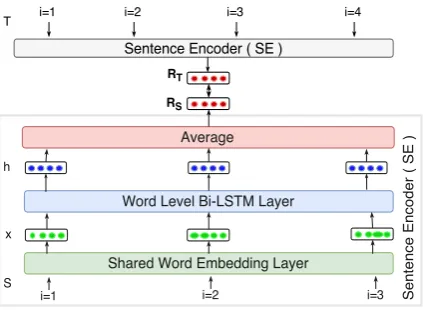
Figure 2: Overview of the architecture that we use for computing sentence representations RS and RT for input word sequencesSandT.
pora while monolingual pairs are sampled from both parallel and monolingual corpora.
Cross-lingual Sentence Similarity: We pro-cess word embeddings with a bi-directional LSTM (Hochreiter et al., 2001; Hochreiter and Schmidhuber, 1997) and then take an average of the LSTM outputs (Figure 2). There are various implementations of LSTMs available; in this work we use an implementation based on (Zaremba et al., 2014). The LSTM outputs (hidden states) contextualize input word embeddings by encod-ing the history of each word into its represen-tation. We hypothesize that this is better than averaging word embeddings as sentences gener-ally have complex semantic structure and two sen-tences with different meanings can have exactly the same words. Let R : S → Rd denote our sentence encoder mapping a given sequence of words S to a continuous vector in Rd. Given a
pair of parallel sentences (S, T), we define their distance as d(S, T) = kRS−RTk2. For every
[image:2.595.311.523.214.369.2]cross-lingual sentence similarity loss as follows:
l(S, T) =
k X
i=1
max(0, m+d(S, T)−d(S, Ni))
Without the LSTM layer, this loss is similar to the BiCVM loss (Hermann and Blunsom,2014) ex-cept that we use also the reversed sample(T, S)
to train the model, therefore showing each pair of sentences to the model two times per epoch.
3 Experiments
3.1 Corpora
We learn the distributed representations on the Eu-roparl corpus v71 (Koehn,2005). For a fair com-parison with literature, we use the first 500K paral-lel sentences for each of the English-German (en-de), English-Spanish (en-es) and English-French (en-fr) language pairs. We keep the first 90% for training and the remaining 10% for development purposes. We also use additional 500K monolin-gual sentences from the Europarl corpus for each language. These sentences do not overlap with the sentences in parallel data.
Words that occur less than 5 times are replaced with the <unk> symbol. In the joint multi-task setting, the words are counted in the combined monolingual and parallel corpora. The vocabulary sizes for German (de) and English (en) are respec-tively 39K and 21K in the parallel corpus, 120K and 68K in the combined corpus.
We evaluate our models on the RCV1/RCV2 cross-lingual document classification task ( Kle-mentiev et al.,2012), where for each language we use 1K documents for training and 5K documents for testing.
3.2 Models
In addition to the proposed joint multi-task (JMT) model, JMT-Sent-LSTM, we also present ab-lation experiments where we omit the LSTM layer, the multilingual skip-gram objective or both. JMT-Sent-Avg is like the proposed model but does not include an LSTM layer. Sent-LSTM
andSent-Avgare the single-task variants of these models.
We construct document embeddings by averag-ing sentence representations produced by a trained sentence encoder. For a language pair L1-L2, a document classifier (single layer average percep-tron) is trained on documents fromL1, and tested
on documents fromL2. Due to lack of supervision on theL2side, this setup relies on documents from different languages with similar meaning having similar representations.
3.3 Training
The single-task models are trained with the cross-lingual sentence similarity objective end-to-end using parallel data only. We also tried train-ing word embeddtrain-ings beforehand on parallel and mono data and tuning them on the cross-lingual sentence similarity task but that did not improve the results. Those results are omitted for brevity. The multi-task models are trained by alternating between the two tasks.
Multilingual Skip-gram: We use stochastic gradient descent with a learning rate of 0.01 and exponential decay of 0.98 after 10K steps (1 step is 256 word pairs), negative sampling with 512 samples, skip-gram context window of size 5. Re-ducing the learning rate of the skip-gram model helps in the multi-task scenario by allowing skip-gram objective to converge in parallel with the sentence similarity objective. At every step, we sample equal number of monolingual and cross-lingual word pairs to make a mini-batch.
Cross-lingual Sentence Similarity: The batch size is 50 sentence pairs. LSTM hidden state di-mension is 128 or 512. We use dropout at the em-bedding layer with drop probability 0.3. Hinge-loss margin m is equal to sentence embedding size. We sample 10 negative samples for the noise-contrastive loss. The model is trained using the Adam optimizer (Kingma and Ba, 2014) with a learning rate of 0.001 and an exponential decay of 0.98 after 10K steps (1 step is 50 sentence pairs).
3.4 Results
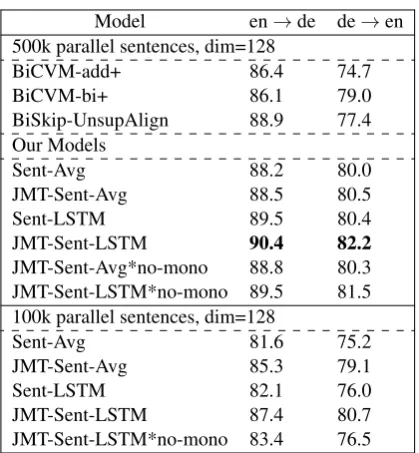
monolin-Model en→de de→en 500k parallel sentences, dim=128
BiCVM-add+ 86.4 74.7
BiCVM-bi+ 86.1 79.0
BiSkip-UnsupAlign 88.9 77.4
Our Models
Sent-Avg 88.2 80.0
JMT-Sent-Avg 88.5 80.5
Sent-LSTM 89.5 80.4
JMT-Sent-LSTM 90.4 82.2
JMT-Sent-Avg*no-mono 88.8 80.3 JMT-Sent-LSTM*no-mono 89.5 81.5 100k parallel sentences, dim=128
Sent-Avg 81.6 75.2
JMT-Sent-Avg 85.3 79.1
Sent-LSTM 82.1 76.0
JMT-Sent-LSTM 87.4 80.7
JMT-Sent-LSTM*no-mono 83.4 76.5
Table 1: Results for models trained on en-de language pair. *no-mono means no monolin-gual data was used in training. We compare our models to: BiCVM-add+ (Hermann and Blun-som,2014), BiCVM-bi+ (Hermann and Blunsom,
2014), BiSkip-UnsupAlign (Luong et al., 2015) and para doc (Pham et al.,2015a).
gual data and partly due to the multi-task objec-tive.
Varying monolingual vs parallel data: The main motivation behind the multi-task architecture is to create high quality embeddings in the limited resource scenario. The bottom section of Table1
shows the results for 128 dimensional embeddings when parallel data is limited to 100K sentences. JMT-Sent-LSTM results in this scenario are com-parable to the results from the middle section of Table1which use 500K parallel sentences. These findings suggest that JMT-Sent-LSTM model can produce high quality embeddings even with a lim-ited amount of parallel data by exploting addi-tional monolingual data. Table 2compares Sent-LSTM vs. JMT-Sent-Sent-LSTM at different data con-ditions. JMT-Sent-LSTM produces consistently better embeddings as long as the amount of ad-ditional monolingual data is neither too large nor too small compared to the amount of parallel data – 3-4 times parallel data size seems to be a good heuristic for choosing monolingual data size.
Multilingual vs Bilingual models: Table 3
compares multilingual models (en, es, de) to bilin-gual models. First four rows of Table 3 show re-sults for multilingual systems where sentence
en-Mono
Parallel
20K 50K 100K 500K
no-mono 60.3 68.3 82.1 89.5
20K 57.4 68.7 80.2 89.5
50K 62.7 69.0 83.5 89.5
100K 61.5 71.9 85.1 89.6
200K 58.1 72.1 85.5 90.0
[image:4.595.77.287.58.285.2]500K 52.6 64.8 87.4 90.4
Table 2: Sent-LSTM vs. JMT-Sent-LSTM at dif-ferent data conditions (en-de, dim=128).
Model en-es en-de de-en es-en es-de Sent-Avg 49.8 86.8 78.4 63.5 69.4 Sent-LSTM 53.1 89.9 77.0 67.8 65.3 JMT-Sent-Avg 51.5 87.2 75.7 60.3 72.6 JMT-Sent-LSTM 57.4 91.0 75.1 63.3 68.1 JMT-Sent-LSTM* 54.1 90.4 82.2 68.4
-Table 3: Multilingual vs. bilingual* models (dim=128).
coder is trained for three languages (en,es,de) us-ing en-es and en-de parallel data and additional monolingual data for each language. Document representations obtained from this sentence en-coder are then used to train a classifier for a language pair like en-de, where the classifier is trained on en documents and then tested on de doc-uments. In this scenario, we can build classifiers for language pairs like es-de even though we do not have access to es-de parallel data since embed-dings we learn are shared between the three lan-guages. Bottom row in Table 3 shows results for bilingual systems where we train the sentence en-coder for two languages, and then use that enen-coder to train a document classifier for one language and test on the other. In this scenario, we cannot build classifiers for language pairs like es-de for which we do not have access to parallel data.
Multilingual models perform better than bilin-gual ones when English is the source language but they perform worse in the other direction. We be-lieve this discrepancy is because Europarl docu-ments were originally in English and later trans-lated to other languages. The multilingual mod-els also show promising results for es-de pair, for which there was no parallel data.
4 Linguistic analysis
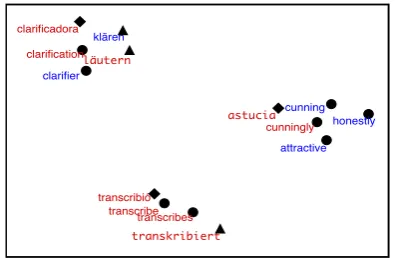
[image:4.595.314.520.61.161.2]Figure 3: t-SNE projections for 3 English words (clarification, transcribe, cunningly) which are not in the parallel corpus and their four nearest neigh-bors. Red words are only in the monolingual cor-pus. Blue words exist in parallel corpus too.
model for this purpose. Figure 3 shows t-SNE projections for some sample words. Even though the model didn’t use any German-Spanish parallel data it managed to map words which have sim-ilar meaning (transkribiert and transcribi) closer. Words that are antonyms but still have a similar meaning are close to each other (cunnigly (en), honestly (en) and astucia (es)). Nearest neighbors in the multilingual representation space are gener-ally of same form across languages. It can also be observed that English words lie towards the mid-dle of Spanish and German words which we be-lieve is due to English being the pivot for the other two languages.
5 Conclusion
Our results suggest that joint multi-task learning of multilingual word and sentence embeddings is a promising direction. We believe that our sen-tence embedding model can be improved further with straightforward modifications to the sentence encoder architecture, for instance using stacked LSTMs or batch/layer normalization, and addition of sentence level auxiliary tasks such as sentiment classification or natural language inference. We plan to explore these directions and evaluate our approach on additional tasks in the future.
6 Discussion and Future Work
In our exploration of architectures for the sen-tence encoding model, we also tried using a self-attention layer following the intuition that not all words are equally important for the meaning of a sentence. However, we later realized that the cross
lingual sentence similarity objective is at odds with what we want the attention layer to learn. When we used self attention instead of simple av-eraging of word embeddings, the attention layer learns to give the entire weight to a single word in both the source and the target language since that makes optimizing cross lingual sentence similarity objective easier. Another approach could be to de-rive high dimensional embeddings in a way similar to (Conneau et al., 2017) and using max-pooling which can allow efficient selection for each dimen-sion to represent meaning.
Even though they are related tasks, multilin-gual skip-gram and cross-linmultilin-gual sentence similar-ity models are always in a conflict to modify the shared word embeddings according to their objec-tives. This conflict, to some extent, can be eased by careful choice of hyper-parameters. This de-pendency on hyper-parameters suggests that better hyper-parameters can lead to better results in the multi-task learning scenario. We have not yet tried a full sweep of the hyper-parameters of our current models but we believe there may be easy gains to be had from such a sweep especially in the multi-task learning scenario. Other thing that remains rather unexplored is to do other levels of multi-tasking, like learning character representations or multitasking at sentence level.
References
Waleed Ammar, George Mulcaire, Miguel Balles-teros, Chris Dyer, and Noah A Smith. 2016. Many languages, one parser. arXiv preprint arXiv:1602.01595.
Dzmitry Bahdanau, Kyunghyun Cho, and Yoshua Ben-gio. 2014. Neural machine translation by jointly learning to align and translate. arXiv preprint arXiv:1409.0473.
Yoshua Bengio and Greg Corrado. 2015. Bilbowa: Fast bilingual distributed representations without word alignments.
Yoshua Bengio, R´ejean Ducharme, Pascal Vincent, and Christian Jauvin. 2003. A neural probabilistic lan-guage model. Journal of machine learning research, 3(Feb):1137–1155.
Danqi Chen and Christopher D Manning. 2014. A fast and accurate dependency parser using neural net-works. InEMNLP, pages 740–750.
Ronan Collobert, Jason Weston, L´eon Bottou, Michael Karlen, Koray Kavukcuoglu, and Pavel Kuksa. 2011. Natural language processing (almost) from scratch. Journal of Machine Learning Research, 12(Aug):2493–2537.
Alexis Conneau, Douwe Kiela, Holger Schwenk, Loic Barrault, and Antoine Bordes. 2017. Supervised learning of universal sentence representations from natural language inference data. arXiv preprint arXiv:1705.02364.
Manaal Faruqui and Chris Dyer. 2014. Improving vec-tor space word representations using multilingual correlation. Association for Computational Linguis-tics.
Stephan Gouws, Yoshua Bengio, and Greg Corrado. 2015. Bilbowa: Fast bilingual distributed represen-tations without word alignments. In International Conference on Machine Learning, pages 748–756.
Karl Moritz Hermann and Phil Blunsom. 2014. Multi-lingual models for compositional distributed seman-tics. arXiv preprint arXiv:1404.4641.
Sepp Hochreiter, Yoshua Bengio, Paolo Frasconi, and J¨urgen Schmidhuber. 2001. Gradient flow in recur-rent nets: the difficulty of learning long-term depen-dencies.
Sepp Hochreiter and J¨urgen Schmidhuber. 1997. Long short-term memory. Neural computation, 9(8):1735–1780.
Melvin Johnson, Mike Schuster, Quoc V Le, Maxim Krikun, Yonghui Wu, Zhifeng Chen, Nikhil Thorat, Fernanda Vi´egas, Martin Wattenberg, Greg Corrado, et al. 2016. Google’s multilingual neural machine translation system: Enabling zero-shot translation.
arXiv preprint arXiv:1611.04558.
Diederik P Kingma and Jimmy Ba. 2014. Adam: A method for stochastic optimization. arXiv preprint arXiv:1412.6980.
Ryan Kiros, Yukun Zhu, Ruslan R Salakhutdinov, Richard Zemel, Raquel Urtasun, Antonio Torralba, and Sanja Fidler. 2015. Skip-thought vectors. In
Advances in neural information processing systems, pages 3294–3302.
Alexandre Klementiev, Ivan Titov, and Binod Bhat-tarai. 2012. Inducing crosslingual distributed rep-resentations of words.
Philipp Koehn. 2005. Europarl: A parallel corpus for statistical machine translation. InMT summit, vol-ume 5, pages 79–86.
Stanislas Lauly, Alex Boulanger, and Hugo Larochelle. 2014. Learning multilingual word representations using a bag-of-words autoencoder. arXiv preprint arXiv:1401.1803.
Quoc V Le and Tomas Mikolov. 2014. Distributed rep-resentations of sentences and documents. InICML, volume 14, pages 1188–1196.
Thang Luong, Hieu Pham, and Christopher D Man-ning. 2015. Bilingual word representations with monolingual quality in mind. InProceedings of the 1st Workshop on Vector Space Modeling for Natural Language Processing, pages 151–159.
Andrew L Maas, Raymond E Daly, Peter T Pham, Dan Huang, Andrew Y Ng, and Christopher Potts. 2011. Learning word vectors for sentiment analysis. In
Proceedings of the 49th Annual Meeting of the Asso-ciation for Computational Linguistics: Human Lan-guage Technologies-Volume 1, pages 142–150. As-sociation for Computational Linguistics.
Tomas Mikolov, Ilya Sutskever, Kai Chen, Greg S Cor-rado, and Jeff Dean. 2013. Distributed representa-tions of words and phrases and their compositional-ity. InAdvances in neural information processing systems, pages 3111–3119.
Aditya Mogadala and Achim Rettinger. 2016. Bilin-gual word embeddings from parallel and non-parallel corpora for cross-language text classifica-tion. In Proceedings of NAACL-HLT, pages 692– 702.
Jeffrey Pennington, Richard Socher, and Christopher D Manning. 2014. Glove: Global vectors for word representation. InEMNLP, volume 14, pages 1532– 1543.
Hieu Pham, Minh-Thang Luong, and Christopher D Manning. 2015a. Learning distributed representa-tions for multilingual text sequences. In Proceed-ings of NAACL-HLT, pages 88–94.
Nghia The Pham, Germ´an Kruszewski, Angeliki Lazaridou, and Marco Baroni. 2015b. Jointly opti-mizing word representations for lexical and senten-tial tasks with the c-phrase model. InACL (1), pages 971–981.
Sebastian Ruder. 2017. A survey of cross-lingual em-bedding models.CoRR, abs/1706.04902.
Holger Schwenk, Ke Tran, Orhan Firat, and Matthijs Douze. 2017. Learning joint multilingual sen-tence representations with neural machine transla-tion. arXiv preprint arXiv:1704.04154.
Richard Socher, Christopher D Manning, and An-drew Y Ng. 2010. Learning continuous phrase representations and syntactic parsing with recursive neural networks. InProceedings of the NIPS-2010 Deep Learning and Unsupervised Feature Learning Workshop, pages 1–9.
Zichao Yang, Diyi Yang, Chris Dyer, Xiaodong He, Alex Smola, and Eduard Hovy. 2016. Hierarchical attention networks for document classification. In
Proceedings of NAACL-HLT, pages 1480–1489.
Wojciech Zaremba, Ilya Sutskever, and Oriol Vinyals. 2014. Recurrent neural network regularization.