2031
Neural Models for Documents with Metadata
Dallas Card1 Chenhao Tan2 Noah A. Smith3
1Machine Learning Department, Carnegie Mellon University, Pittsburgh, PA, 15213, USA 2Department of Computer Science, University of Colorado, Boulder, CO, 80309, USA
3Paul G. Allen School of CSE, University of Washington, Seattle, WA, 98195, USA
[email protected] [email protected] [email protected]
Abstract
Most real-world document collections in-volve various types of metadata, such as author, source, and date, and yet the most commonly-used approaches to modeling text corpora ignore this information. While specialized models have been developed for particular applications, few are widely used in practice, as customization typically requires derivation of a custom inference algorithm. In this paper, we build on recent advances in variational inference methods and propose a general neural framework, based on topic models, to enable flexible in-corporation of metadata and allow for rapid exploration of alternative models. Our ap-proach achieves strong performance, with a manageable tradeoff between perplex-ity, coherence, and sparsity. Finally, we demonstrate the potential of our framework through an exploration of a corpus of arti-cles about US immigration.
1 Introduction
Topic models comprise a family of methods for uncovering latent structure in text corpora, and are widely used tools in the digital humanities, political science, and other related fields (Boyd-Graber et al.,
2017). Latent Dirichlet allocation (LDA;Blei et al.,
2003) is often used when there is no prior knowl-edge about a corpus. In the real world, however, most documents have non-textual attributes such as author (Rosen-Zvi et al.,2004), timestamp (Blei and Lafferty,2006), rating (McAuliffe and Blei,
2008), or ideology (Eisenstein et al.,2011;Nguyen et al.,2015b), which we refer to asmetadata.
Many customizations of LDA have been devel-oped to incorporate document metadata. Two mod-els of note aresupervised LDA(SLDA;McAuliffe
and Blei,2008), which jointly models words and labels (e.g., ratings) as being generated from a la-tent representation, andsparse additive genera-tivemodels (SAGE;Eisenstein et al.,2011), which assumes that observed covariates (e.g., author ide-ology) have a sparse effect on the relative proba-bilities of words given topics. The structural topic model (STM;Roberts et al.,2014), which adds cor-relations between topics to SAGE, is also widely used, but like SAGE it is limited in the types of metadata it can efficiently make use of, and how that metadata is used. Note that in this work we will distinguish labels (metadata that are gener-ated jointly with words from latent topic represen-tations) fromcovariates(observed metadata that influence the distribution of labels and words).
The ability to create variations of LDA such as those listed above has been limited by the expertise needed to develop custom inference algorithms for each model. As a result, it is rare to see such varia-tions being widely used in practice. In this work, we take advantage of recent advances in variational methods (Kingma and Welling, 2014; Rezende et al.,2014;Miao et al.,2016;Srivastava and Sut-ton,2017) to facilitate approximate Bayesian infer-encewithout requiring model-specific derivations, and propose a general neural framework for topic models with metadata,SCHOLAR.1
SCHOLARcombines the abilities of SAGE and SLDA, and allows for easy exploration of the fol-lowing options for customization:
1. Covariates: as in SAGE and STM, we incorpo-rate explicit deviations for observed covariates, as well as effects forinteractionswith topics. 2. Supervision: as in SLDA, we can use metadata
as labels to help infer topics that are relevant in predicting those labels.
1Sparse Contextual Hidden and Observed Language
3. Rich encoder network: we use the encoding network of a variational autoencoder (VAE) to incorporate additional prior knowledge in the form of word embeddings, and/or to provide interpretable embeddings of covariates.
4. Sparsity: as in SAGE, a sparsity-inducing prior can be used to encourage more interpretable topics, represented as sparse deviations from a background log-frequency.
We begin with the necessary background and motivation (§2), and then describe our basic frame-work and its extensions (§3), followed by a series of experiments (§4). In an unsupervised setting, we can customize the model to trade off between perplexity, coherence, and sparsity, with improved coherence through the introduction of word vec-tors. Alternatively, by incorporating metadata we can either learn topics that are more predictive of labels than SLDA, or learn explicit deviations for particular parts of the metadata. Finally, by com-bining all parts of our model we can meaningfully incorporate metadata in multiple ways, which we demonstrate through an exploration of a corpus of news articles about US immigration.
In presenting this particular model, we empha-size not only its ability to adapt to the characteris-tics of the data, but the extent to which the VAE approach to inference provides a powerful frame-work for latent variable modeling that suggests the possibility of many further extensions. Our im-plementation is available athttps://github.
com/dallascard/scholar.
2 Background and Motivation
LDA can be understood as a non-negative Bayesian matrix factorization model: the observed document-word frequency matrix, X ∈ ZD×V
(Dis the number of documents, V is the vocab-ulary size) is factored into two low-rank matri-ces, ΘD×K and BK×V, where each row of Θ,
θi ∈∆Kis a latent variable representing a distri-bution over topics in documenti, and each row of
B,βk∈∆V, represents a single topic, i.e., a dis-tribution over words in the vocabulary.2 While it is possible to factor the count data into unconstrained
2
Zdenotes nonnegative integers, and∆K
denotes the set ofK-length nonnegative vectors that sum to one. For a proper probabilistic interpretation, the matrix to be factored is actually the matrix of latent mean parameters of the assumed data generating process,Xij∼Poisson(Λij). SeeCemgil(2009) orPaisley et al.(2014) for details.
matrices, the particular priors assumed by LDA are important for interpretability (Wallach et al.,
2009). For example, the neural variational docu-ment model (NVDM; Miao et al., 2016) allows
θi ∈ RK and achieves normalization by taking
the softmax ofθi>B. However, the experiments inSrivastava and Sutton(2017) found the perfor-mance of the NVDM to be slightly worse than LDA in terms of perplexity, and dramatically worse in terms of topic coherence.
The topics discovered by LDA tend to be parsi-monious and coherent groupings of words which are readily identifiable to humans as being related to each other (Chang et al.,2009), and the resulting mode of the matrixΘprovides a representation of each document which can be treated as a measure-ment for downstream tasks, such as classification or answering social scientific questions (Wallach,
2016). LDA does not require — and cannot make use of — additional prior knowledge. As such, the topics that are discovered may bear little connec-tion to metadata of a corpus that is of interest to a researcher, such as sentiment, ideology, or time.
In this paper, we take inspiration from two mod-els which have sought to alleviate this problem. The first, supervised LDA (SLDA;McAuliffe and Blei,2008), assumes that documents have labelsy
which are generated conditional on the correspond-ing latent representation, i.e.,yi ∼p(y|θi).3 By incorporating labels into the model, it is forced to learn topics which allow documents to be repre-sented in a way that is useful for the classification task. Such models can be used inductively as text classifiers (Balasubramanyan et al.,2012).
SAGE (Eisenstein et al.,2011), by contrast, is an exponential-family model, where the key inno-vation was to replace topics with sparse deviations from the background log-frequency of words (d), i.e.,p(word|softmax(d+θi>B)). SAGE can also incorporate deviations for observed covariates, as well as interactions between topics and covariates, by including additional terms inside the softmax. In principle, this allows for inferring, for example, the effect on an author’s ideology on their choice of words, as well as ideological variations on each underlying topic. Unlike the NVDM, SAGE still constrainsθito lie on the simplex, as in LDA.
SLDA and SAGE provide two different ways that users might wish to incorporate prior
edge as a way of guiding the discovery of topics in a corpus: SLDA incorporates labels through a distribution conditional on topics; SAGE includes explicit sparse deviations for each unique value of a covariate, in addition to topics.4
Because of the Dirichlet-multinomial conjugacy in the original model, efficient inference algorithms exist for LDA. Each variation of LDA, however, has required the derivation of a custom inference algorithm, which is a time-consuming and error-prone process. In SLDA, for example, each type of distribution we might assume forp(y |θ)would require a modification of the inference algorithm. SAGE breaks conjugacy, and as such, the authors adopted L-BFGS for optimizing the variational bound. Moreover, in order to maintain compu-tational efficiency, it assumed that covariates were limited to a single categorical label.
More recently, the variational autoencoder (VAE) was introduced as a way to perform approxi-mate posterior inference on models with otherwise intractable posteriors (Kingma and Welling,2014;
Rezende et al.,2014). This approach has previously been applied to models of text byMiao et al.(2016) andSrivastava and Sutton(2017). We build on their work and show how this framework can be adapted to seamlessly incorporate the ideas of both SAGE and SLDA, while allowing for greater flexibility in the use of metadata. Moreover, by exploiting au-tomatic differentiation, we allow for modification of the model without requiring any change to the inference procedure. The result is not only a highly adaptable family of models with scalable inference and efficient prediction; it also points the way to incorporation of many ideas found in the literature, such as a gradual evolution of topics (Blei and Laf-ferty,2006), and hierarchical models (Blei et al.,
2010;Nguyen et al.,2013,2015b).
3 SCHOLAR: A Neural Topic Model with
Covariates, Supervision, and Sparsity
We begin by presenting the generative story for our model, and explain how it generalizes both SLDA and SAGE (§3.1). We then provide a general expla-nation of inference using VAEs and how it applies to our model (§3.2), as well as how to infer
docu-4
A third way of incorporating metadata is the approach used by various “upstream” models, such as Dirichlet-multinomial regression (Mimno and McCallum,2008), which uses observed metadata to inform the document prior. We hy-pothesize that this approach could be productively combined with our framework, but we leave this as future work.
ment representations and predict labels at test time (§3.3). Finally, we discuss how we can incorporate additional prior knowledge (§3.4).
3.1 Generative Story
Consider a corpus ofDdocuments, where docu-mentiis a list ofNi words,wi, withV words in the vocabulary. For each document, we may have observed covariatesci(e.g., year of publication), and/or one or more labels,yi(e.g., sentiment).
Our model builds on the generative story of LDA, but optionally incorporates labels and covariates, and replaces the matrix product ofΘandBwith a more flexible generative network,fg, followed by a softmax transform. Instead of using a Dirichlet prior as in LDA, we employ a logistic normal prior onθas inSrivastava and Sutton(2017) to facilitate inference (§3.2): we draw a latent variable, r,5 from a multivariate normal, and transform it to lie on the simplex using a softmax transform.6
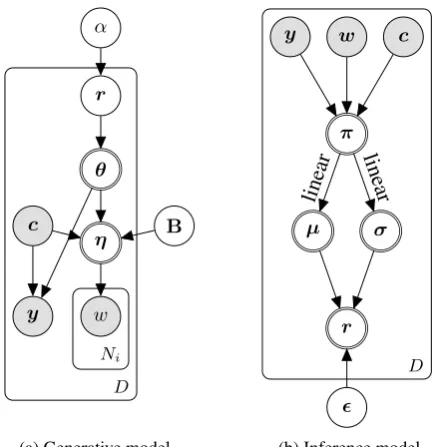
The generative story is shown in Figure1aand described in equations below:
For each documentiof lengthNi:
# Draw a latent representation on the sim-plex from a logistic normal prior:
ri ∼ N(r|µ0(α),diag(σ20(α)))
θi =softmax(ri)
# Generate words, incorporating covariates:
ηi =fg(θi,ci)
For each wordjin documenti:
wij ∼p(w|softmax(ηi))
# Similarly generate labels:
yi ∼p(y|fy(θi,ci)),
wherep(w|softmax(ηi))is a multinomial distri-bution andp(y|fy(θi,ci))is a distribution appro-priate to the data (e.g., multinomial for categorical labels).fgis a model-specific combination of latent variables and covariates,fyis a multi-layer neural network, andµ0(α)andσ20(α)are the mean and diagonal covariance terms of a multivariate nor-mal prior. To approximate a symmetric Dirichlet
5r
is equivalent tozin the original VAE. To avoid con-fusion with topic assignment of words in the topic modeling literature, we userinstead ofz.
6
prior with hyperparameterα, these are given by the Laplace approximation (Hennig et al.,2012) to be
µ0,k(α) = 0andσ20,k = (K−1)/(αK).
If we were to ignore covariates, place a Dirichlet prior onB, and letη=θ>i B, this model is equiv-alent to SLDA with a logistic normal prior. Sim-ilarly, we can recover a model that is like SAGE, but lacks sparsity, if we ignore labels, and let
ηi =d+θ>i B+c > i B
cov+ (θ
i⊗ci)>Bint, (1) where d is the V-dimensional background term (representing the log of the overall word frequency),
θi⊗ci is a vector of interactions between topics and covariates, andBcov andBint are additional
weight (deviation) matrices. The background is included to account for common words with ap-proximately the same frequency across documents, meaning that theB∗ weights now represent both positive and negative deviations from this back-ground. This is the form offg which we will use in our experiments.
To recover the full SAGE model, we can place a sparsity-inducing prior on eachB∗. As in Eisen-stein et al.(2011), we make use of the compound normal-exponential prior for each element of the weight matrices,B∗m,n, with hyperparameterγ,7
τm,n ∼Exponential(γ), (2)
B∗m,n ∼ N(0, τm,n). (3) We can choose to ignore various parts of this model, if, for example, we don’t have any labels or observed covariates, or we don’t wish to use interactions or sparsity.8 Other generator networks could also be considered, with additional layers to represent more complex interactions, although this might involve some loss of interpretability.
In the absence of metadata, and without sparsity, our model is equivalent to the ProdLDA model ofSrivastava and Sutton(2017) with an explicit background term, and ProdLDA is, in turn, a
7
To avoid having to tuneγ, we employ an improper Jef-fery’s prior,p(τm,n)∝1/τm,n, as in SAGE. Although this causes difficulties in posterior inference for the variance terms, τ, in practice, we resort to a variational EM approach, with MAP-estimation for the weights,B, and thus alternate be-tween computing expectations of theτ parameters, and up-dating all other parameters using some variant of stochastic gradient descent. For this, we only require the expectation of eachτmnfor each E-step, which is given by1/B2m,n. We re-fer the reader toEisenstein et al.(2011) for additional details. 8We could also ignore latent topics, in which case we would get a naïve Bayes-like model of text with deviations for each covariatep(wij|ci)∝exp(d+c>iBcov).
w
y η θ r
α
c B
Ni
D
(a) Generative model
r µ σ
π c y w
linear
linear
D
[image:4.595.305.524.59.283.2](b) Inference model
Figure 1: Figure1apresents the generative story of our model. Figure1billustrates the inference net-work using the reparametrization trick to perform variational inference on our model. Shaded nodes are observed; double circles indicate deterministic transformations of parent nodes.
special case of SAGE, without background log-frequencies, sparsity, covariates, or labels. In the next section we generalize the inference method used for ProdLDA; in our experiments we validate its performance and explore the effects of regular-ization and word-vector initialregular-ization (§3.4). The NVDM (Miao et al.,2016) uses the same approach to inference, but does not not restrict document representations to the simplex.
3.2 Learning and Inference
As in past work, each documentiis assumed to have a latent representation ri, which can be in-terpreted as its relative membership in each topic (after exponentiating and normalizing). In order to infer an approximate posterior distribution over
ri, we adopt the sampling-based VAE framework developed in previous work (Kingma and Welling,
2014;Rezende et al.,2014).
As in conventional variational inference, we assume a variational approximation to the poste-rior,qΦ(ri |wi,ci,yi), and seek to minimize the KL divergence between it and the true posterior,
sin-gle document,
L(wi) =EqΦ(ri|wi,ci,yi)
Ni
X
j=1
logp(wij |ri,ci)
+EqΦ(ri|wi,ci,yi)[logp(yi |ri,ci)]
−DKL[qΦ(ri |wi,ci,yi)||p(ri |α)]. (4) As in the original VAE, we will encode the pa-rameters of our variational distributions using a shared multi-layer neural network. Because we have assumed a diagonal normal prior onr, this will take the form of a network which outputs a mean vector,µi =fµ(wi,ci,yi)and diagonal of a covariance matrix,σi2=fσ(wi,ci,yi), such that
qΦ(ri | wi,ci,yi) = N(µi,σi2). Incorporating labels and covariates to the inference network used byMiao et al. (2016) andSrivastava and Sutton
(2017), we use:
πi =fe([Wxxi;Wcci;Wyyi]), (5)
µi =Wµπi+bµ, (6)
logσ2i =Wσπi+bσ, (7)
wherexi is aV-dimensional vector representing the counts of words inwi, andfeis a multilayer perceptron. The full set of encoder parameters,Φ, thus includes the parameters offeand all weight matrices and bias vectors in Equations 5–7 (see Figure1b).
This approach means that the expectations in Equation4are intractable, but we can approximate them using sampling. In order to maintain differen-tiability with respect toΦ, even after sampling, we make use of the reparameterization trick (Kingma and Welling,2014),9which allows us to reparame-terize samples fromqΦ(r|wi,ci,yi)in terms of samples from an independent source of noise, i.e.,
(s) ∼ N(0,I),
ri(s)=gΦ(wi,ci,yi,(s)) =µi+σi·(s).
We thus replace the bound in Equation4 with a Monte Carlo approximation using a single sam-9The Dirichlet distribution cannot be directly reparame-terized in this way, which is why we use the logistic normal prior onθto approximate the Dirichlet prior used in LDA.
ple10of(and thereby ofr):
L(wi)
≈
Ni
X
j=1
logp(wij |ri(s),ci) + logp(yi |r(is),ci)
−DKL[qΦ(ri |wi,ci,yi)||p(ri |α)]. (8) We can now optimize this sampling-based approxi-mation of the variational bound with respect toΦ,
B∗, and all parameters offg andfy using stochas-tic gradient descent. Moreover, because of this stochastic approach to inference, we are not re-stricted to covariates with a small number of unique values, which was a limitation of SAGE. Finally, the KL divergence term in Equation8can be com-puted in closed form (see supplementary materials). 3.3 Prediction on Held-out Data
In addition to inferring latent topics, our model can both infer latent representations for new docu-ments and predict their labels, the latter of which was the motivation for SLDA. In traditional vari-ational inference, inference at test time requires fixing global parameters (topics), and optimizing the per-document variational parameters for the test set. With the VAE framework, by contrast, the encoder network (Equations5–7) can be used to directly estimate the posterior distribution for each test document, using only a forward pass (no iterative optimization or sampling).
If not using labels, we can use this approach di-rectly, passing the word counts of new documents through the encoder to get a posterior qΦ(ri |
wi,ci). When we also include labels to be pre-dicted, we can first train a fully-observed model, as above, then fix the decoder, and retrain the encoder without labels. In practice, however, if we train the encoder network using one-hot encodings of document labels, it is sufficient to provide a vector of all zeros for the labels of test documents; this is what we adopt for our experiments (§4.2), and we still obtain good predictive performance.
The label network,fy, is a flexible component which can be used to predict a wide range of out-comes, from categorical labels (such as star ratings;
McAuliffe and Blei,2008) to real-valued outputs (such as number of citations or box-office returns;
Yogatama et al.,2011). For categorical labels, pre-dictions are given by
ˆ
yi=argmax y∈ Y
p(y|ri,ci). (9) Alternatively, when dealing with a small set of categorical labels, it is also possible to treat them as observed categorical covariates during training. At test time, we can then consider all possible one-hot vectors,e, in place ofci, and predict the label that maximizes the probability of the words, i.e.,
ˆ
yi =argmax y∈ Y
Ni
X
j=1
logp(wij |ri,ey). (10)
This approach works well in practice (as we show in §4.2), but does not scale to large numbers of labels, or other types of prediction problems, such as multi-class classification or regression.
The choice to include metadata as covariates, la-bels, or both, depends on the data. The key point is that we can incorporate metadata in two very different ways, depending on what we want from the model. Labels guide the model to infer topics that are relevant to those labels, whereas covari-ates induce explicit deviations, leaving the latent variables to account for the rest of the content. 3.4 Additional Prior Information
A final advantage of the VAE framework is that the encoder network provides a way to incorporate additional prior information in the form of word vectors. Although we can learn all parameters start-ing from a random initialization, it is also possible to initialize and fix the initial embeddings of words in the model,Wx, in Equation5. This leverages word similarities derived from large amounts of un-labeled data, and may promote greater coherence in inferred topics. The same could also be done for some covariates; for example, we could embed the source of a news article based on its place on the ideological spectrum. Conversely, if we choose to learn these parameters, the learned values (Wy andWc) may provide meaningful embeddings of these metadata (see section §4.3).
Other variants on topic models have also pro-posed incorporating word vectors, both as a par-allel part of the generative process (Nguyen et al.,
2015a), and as an alternative parameterization of topic distributions (Das et al.,2015), but inference is not scalable in either of these models. Because of the generality of the VAE framework, we could
also modify the generative story so that word em-beddings are emitted (rather than tokens); we leave this for future work.
4 Experiments and Results
To evaluate and demonstrate the potential of this model, we present a series of experiments below. We first test SCHOLAR without observed meta-data, and explore the effects of using regulariza-tion and/or word vector initializaregulariza-tion, compared to LDA, SAGE, and NVDM (§4.1). We then evaluate our model in terms of predictive performance, in comparison to SLDA and anl2-regularized logistic regression baseline (§4.2). Finally, we demonstrate the ability to incorporate covariates and/or labels in an exploratory data analysis (§4.3).
The scores we report are generalization to held-out data, measured in terms of perplexity; coher-ence, measured in terms of non-negative point-wise mutual information (NPMI; Chang et al., 2009;
Newman et al.,2010), and classification accuracy on test data. For coherence we evaluate NPMI us-ing the top10words of each topic, both internally (using test data), and externally, using a decade of articles from the English Gigaword dataset (Graff and Cieri,2003). Since our model employs varia-tional methods, the reported perplexity is an upper bound based on the ELBO.
As datasets we use the familiar 20 newsgroups, the IMDB corpus of 50,000 movie reviews (Maas et al.,2011), and the UIUC Yahoo answers dataset with 150,000 documents in 15 categories (Chang et al., 2008). For further exploration, we also make use of a corpus of approximately 4,000 time-stamped news articles about US immigration, each annotated with pro- or anti-immigration tone (Card et al.,2015). We use the original author-provided implementations of SAGE11 and SLDA,12 while for LDA we use Mallet.13. Our implementation ofSCHOLAR is in TensorFlow, but we have also provided a preliminary PyTorch implementation of the core of our model.14 For additional details about datasets and implementation, please refer to the supplementary material.
It is challenging to fairly evaluate the relative computational efficiency of our approach compared to past work (due to the stochastic nature of our
ap-11github.com/jacobeisenstein/SAGE 12github.com/blei-lab/class-slda 13
mallet.cs.umass.edu
proach to inference, choices about hyperparameters such as tolerance, and because of differences in im-plementation). Nevertheless, in practice, the perfor-mance of our approach is highly appealing. For all experiments in this paper, our implementation was much faster than SLDA or SAGE (implemented in C and Matlab, respectively), and competitive with Mallet.
4.1 Unsupervised Evaluation
Although the emphasis of this work is on incorpo-rating observed labels and/or covariates, we briefly report on experiments in the unsupervised setting. Recall that, without metadata,SCHOLARequates to ProdLDA, but with an explicit background term.15 We therefore use the same experimental setup as
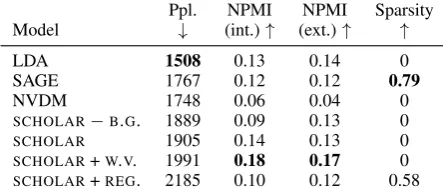
Srivastava and Sutton(2017) (learning rate, mo-mentum, batch size, and number of epochs) and find the same general patterns as they reported (see Table1and supplementary material): our model returns more coherent topics than LDA, but at the cost of worse perplexity. SAGE, by contrast, attains very high levels of sparsity, but at the cost of worse perplexity and coherence than LDA. As expected, the NVDM produces relatively low perplexity, but very poor coherence, due to its lack of constraints onθ.
Further experimentation revealed that the VAE framework involves a tradeoff among the scores; running for more epochs tends to result in bet-ter perplexity on held-out data, but at the cost of worse coherence. Adding regularization to encour-age sparse topics has a similar effect as in SAGE, leading to worse perplexity and coherence, but it does create sparse topics. Interestingly, initializing the encoder with pretrained word2vec embeddings, andnotupdating them returned a model with the best internal coherence of any model we considered for IMDB and Yahoo answers, and the second-best for 20 newsgroups.
The background term in our model does not have much effect on perplexity, but plays an important role in producing coherent topics; as in SAGE, the background can account for common words, so they are mostly absent among the most heavily weighted words in the topics. For instance, words like filmand movie in the IMDB corpus are rel-atively unimportant in the topics learned by our
15Note, however, that a batchnorm layer in ProdLDA may play a similar role to a background term, and there are small differences in implementation; please see supplementary ma-terial for more discussion of this.
Ppl. NPMI NPMI Sparsity
Model ↓ (int.)↑ (ext.)↑ ↑
LDA 1508 0.13 0.14 0
SAGE 1767 0.12 0.12 0.79
NVDM 1748 0.06 0.04 0
[image:7.595.307.529.62.158.2]SCHOLAR−B.G. 1889 0.09 0.13 0 SCHOLAR 1905 0.14 0.13 0 SCHOLAR+W.V. 1991 0.18 0.17 0 SCHOLAR+REG. 2185 0.10 0.12 0.58
Table 1: Performance of our various models in an unsupervised setting (i.e., without labels or co-variates) on the IMDB dataset using a 5,000-word vocabulary and 50 topics. The supplementary ma-terials contain additional results for 20 newsgroups and Yahoo answers.
model, but would be much more heavily weighted without the background term, as they are in topics learned by LDA.
4.2 Text Classification
We next consider the utility of our model in the context of categorical labels, and consider them alternately as observed covariates and as labels generated conditional on the latent representation. We use the same setup as above, but tune number of training epochs for our model using a random 20% of training data as a development set, and similarly tune regularization for logistic regression.
Table2summarizes the accuracy of various mod-els on three datasets, revealing that our model offers competitive performance, both as a joint model of words and labels (Eq.9), and a model which condi-tions on covariates (Eq.10). AlthoughSCHOLAR is comparable to the logistic regression baseline, our purpose here is not to attain state-of-the-art per-formance on text classification. Rather, the high accuracies we obtain demonstrate that we are learn-ing low-dimensional representations of documents that are relevant to the label of interest, outperform-ing SLDA, and have the same attractive properties as topic models. Further, any neural network that is successful for text classification could be incor-porated intofyand trained end-to-end along with topic discovery.
4.3 Exploratory Study
20news IMDB Yahoo Vocabulary size 2000 5000 5000
Number of topics 50 50 250
SLDA 0.60 0.64 0.65
[image:8.595.80.282.63.138.2]SCHOLAR(labels) 0.67 0.86 0.73 SCHOLAR(covariates) 0.71 0.87 0.72 Logistic regression 0.70 0.87 0.76
Table 2: Accuracy of various models on three datasets with categorical labels.
Tone as a label. We first consider using the an-notations as alabel, and train a joint model to infer topics relevant to the tone of the article (pro- or anti-immigration). Figure 2 shows a set of top-ics learned in this way, along with the predicted probability of an article being pro-immigration con-ditioned on the given topic. All topics are coherent, and the predicted probabilities have strong face validity, e.g., “arrested charged charges agents op-eration” is least associated with pro-immigration. Tone as a covariate. Next we consider using tone as acovariate, and build a model using both tone and tone-topic interactions. Table 3 shows a set of topics learned from the immigration data, along with the most highly-weighted words in the corresponding tone-topic interaction terms. As can be seen, these interaction terms tend to capture dif-ferent frames (e.g., “criminal” vs. “detainees”, and “illegals” vs. “newcomers”, etc).
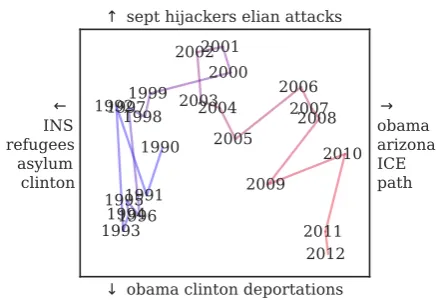
Combined model with temporal metadata. Fi-nally, we incorporate both the tone annotations and the year of publication of each article, treating the former as a label and the latter as a covariate. In this model, we also include an embedding matrix,
Wc, to project the one-hotyearvectors down to a two-dimensional continuous space, with a learned deviation for each dimension. We omit the topics in the interest of space, but Figure 3 shows the learned embedding for each year, along with the top terms of the corresponding deviations. As can be seen, the model learns that adjacent years tend to produce similar deviations,even though we have not explicitly encoded this information. The left-right dimension roughly tracks a temporal trend with positive deviations shifting from the years of ClintonandINSon the left, toObamaandICEon the right.16 Meanwhile, the events of 9/11 dom-inate the vertical direction, with the wordssept, 16The Immigration and Naturalization Service (INS) was transformed into Immigration and Customs Enforcement (ICE) and other agencies in 2003.
0 1
p
(pro-immigration | topic)
[image:8.595.312.529.64.169.2]arrested charged charges agents operation
state gov benefits arizona law bill bills
bush border president bill republicans
labor jobs workers percent study wages
asylum judge appeals deportation court
visas visa applications students citizenship
boat desert died men miles coast haitian
english language city spanish community
Figure 2: Topics inferred by a joint model of words and tone, and the corresponding probability of pro-immigration tone for each topic. A topic is repre-sented by the top words sorted by word probability throughout the paper.
1990
1991
1992
1993
1994
1995
1996
1997
1998
1999
2000
2001
2002
2003
2004
2005
2006
2007
2008
2009
2010
2011
2012
obama clinton deportations
sept hijackers elian attacks
INS
refugees
asylum
clinton
obama
arizona
ICE
path
Figure 3: Learned embeddings of year-of-publication (treated as a covariate) from combined model of news articles about immigration.
hijackers, andattacksincreasing in probability as we move up in the space. If we wanted to look at each year individually, we could drop the embed-ding of years, and learn a sparse set of topic-year interactions, similar to tone in Table3.
5 Additional Related Work
The literature on topic models is vast; in addition to papers cited throughout, other efforts to incorpo-rate metadata into topic models include Dirichlet-multinomial regression (DMR;Mimno and McCal-lum,2008), Labeled LDA (Ramage et al.,2009), and MedLDA (Zhu et al.,2009). A recent paper also extended DMR by using deep neural networks to embed metadata into a richer document prior (Benton and Dredze,2018).
[image:8.595.309.530.271.421.2]Base topics (each row is a topic) Anti-immigration interactions Pro-immigration interactions ice customs agency enforcement homeland criminalcustoms arrested detaineesdetention center agency population born percent americans english jobs millionillegalstaxpayers englishnewcomershispanic city judge case court guilty appeals attorney guilty charges man charged asylum court judge case appeals patrol border miles coast desert boat guard patrol border agents boat died authorities desert border bodies licenses drivers card visa cards applicants foreign sept visas system green citizenship card citizen apply island story chinese ellis international smuggling federal charges island school ellis english story guest worker workers bush labor bill bill border house senate workers tech skilled farm labor benefits bill welfare republican state senate republican california gov state law welfare students tuition
Table 3: Top words for topics (left) and the corresponding anti-immigration (middle) and pro-immigration (right) variations when treating tone as a covariate, with interactions.
2009;Larochelle and Lauly,2012), including non-Bayesian approaches (Cao et al.,2015). More re-cently,Lau et al.(2017) proposed a neural language model that incorporated topics, andHe et al.(2017) developed a scalable alternative to the correlated topic model by simultaneously learning topic em-beddings.
Others have attempted to extend the reparameter-ization trick to the Dirichlet and Gamma distribu-tions, either through transformations (Kucukelbir et al.,2016) or a generalization of reparameteriza-tion (Ruiz et al.,2016). Black-box and VAE-style inference have been implemented in at least two general purpose tools designed to allow rapid explo-ration and evaluation of models (Kucukelbir et al.,
2015;Tran et al.,2016). 6 Conclusion
We have presented a neural framework for general-ized topic models to enable flexible incorporation of metadata with a variety of options. We take advantage of stochastic variational inference to de-velop a general algorithm for our framework such that variations do not require any model-specific algorithm derivations. Our model demonstrates the tradeoff between perplexity, coherence, and sparsity, and outperforms SLDA in predicting doc-ument labels. Furthermore, the flexibility of our model enables intriguing exploration of a text cor-pus on US immigration. We believe that our model and code will facilitate rapid exploration of docu-ment collections with metadata.
Acknowledgments
We would like to thank Charles Sutton, anonymous reviewers, and all members of Noah’s ARK for helpful discussions and feedback. This work was made possible by a University of Washington Inno-vation award and computing resources provided by XSEDE.
References
Ramnath Balasubramanyan, William W. Cohen, Doug Pierce, and David P. Redlawsk. 2012. Modeling po-larizing topics: When do different political commu-nities respond differently to the same news? In Pro-ceedings of ICWSM.
Adrian Benton and Mark Dredze. 2018. Deep Dirichlet multinomial regression. InProceedings of NAACL.
David M. Blei, Thomas L. Griffiths, and Michael I. Jor-dan. 2010. The nested Chinese restaurant process and Bayesian nonparametric inference of topic hier-archies. JACM, 57(2).
David M. Blei and John D. Lafferty. 2006. Dynamic topic models. InProceedings of ICML.
David M. Blei, Andrew Y. Ng, and Michael I. Jordan. 2003. Latent Dirichlet allocation. JMLR, 3:993– 1022.
Jordan Boyd-Graber, Yuening Hu, and David Mimno. 2017. Applications of topic models. Foundations and Trends in Information Retrieval, 11(2-3):143– 296.
Ziqiang Cao, Sujian Li, Yang Liu, Wenjie Li, and Heng Ji. 2015. A novel neural topic model and its super-vised extension. InProceedings of AAAI.
Dallas Card, Amber E. Boydstun, Justin H. Gross, Philip Resnik, and Noah A. Smith. 2015. The media frames corpus: Annotations of frames across issues. InProceedings of ACL.
Ali Taylan Cemgil. 2009. Bayesian inference for nonnegative matrix factorisation models. Compu-tational Intelligence and Neuroscience, pages 4:1– 4:17.
Jonathan Chang, Sean Gerrish, Chong Wang, Jordan L Boyd-graber, and David M Blei. 2009. Reading tea leaves: How humans interpret topic models. In Pro-ceedings of NIPS.
Ming-Wei Chang, Lev-Arie Ratinov, Dan Roth, and Vivek Srikumar. 2008. Importance of semantic rep-resentation: Dataless classification. InProceedings of AAAI.
Jacob Eisenstein, Amr Ahmed, and Eric P. Xing. 2011. Sparse additive generative models of text. In Pro-ceedings of ICML.
David Graff and C Cieri. 2003. English gigaword cor-pus. Linguistic Data Consortium.
Junxian He, Zhiting Hu, Taylor Berg-Kirkpatrick, Ying Huang, and Eric P. Xing. 2017. Efficient correlated topic modeling with topic embedding. In Proceed-ings of KDD.
Philipp Hennig, David Stern, Ralf Herbrich, and Thore Graepel. 2012. Kernel topic models. InProceedings of AISTATS.
Geoffrey E Hinton and Ruslan R Salakhutdinov. 2009. Replicated softmax: An undirected topic model. In Proceedings of NIPS.
Diederik P Kingma and Max Welling. 2014. Auto-encoding variational bayes. InProceedings of ICLR.
Alp Kucukelbir, Rajesh Ranganath, Andrew Gelman, and David Blei. 2015. Automatic variational infer-ence in stan. InProceedings of NIPS.
Alp Kucukelbir, Dustin Tran, Rajesh Ranganath, Andrew Gelman, and David M. Blei. 2016. Automatic differentiation variational inference. ArXiv:1603.00788.
John D. Lafferty and David M. Blei. 2006. Correlated topic models. InProceedings of NIPS.
Hugo Larochelle and Stanislas Lauly. 2012. A neural autoregressive topic model. InProceedings of NIPS.
Jey Han Lau, Timothy Baldwin, and Trevor Cohn. 2017. Topically driven neural language model. In Proceedings of ACL.
Andrew L. Maas, Raymond E. Daly, Peter T. Pham, Dan Huang, Andrew Y. Ng, and Christopher Potts. 2011. Learning word vectors for sentiment analysis. InProceedings of ACL.
Jon D. McAuliffe and David M. Blei. 2008. Supervised topic models. InProceedings of NIPS.
Yishu Miao, Lei Yu, and Phil Blunsom. 2016. Neural variational inference for text processing. In Proceed-ings of ICML.
David Mimno and Andrew McCallum. 2008. Topic models conditioned on arbitrary features with Dirichlet-multinomial regression. InProceedings of UAI.
David Newman, Jey Han Lau, Karl Grieser, and Tim-othy Baldwin. 2010. Automatic evaluation of topic coherence. InProceedings of ACL.
Dat Quoc Nguyen, Richard Billingsley, Lan Du, and Mark Johnson. 2015a. Improving topic models with latent feature word representations. InProceedings of ACL.
Viet-An Nguyen, Jordan Boyd-Graber, Philip Resnik, and Kristina Miler. 2015b. Tea party in the house: A hierarchical ideal point topic model and its applica-tion to Republican legislators in the 112th congress. InProceedings of ACL.
Viet-An Nguyen, Jordan L. Boyd-Graber, and Philip Resnik. 2013. Lexical and hierarchical topic regres-sion. InProceedings of NIPS.
John William Paisley, David M. Blei, and Michael I. Jordan. 2014. Bayesian nonnegative matrix fac-torization with stochastic variational inference. In Handbook of Mixed Membership Models and Their Applications, pages 205–224.
Daniel Ramage, David Hall, Ramesh Nallapati, and Christopher D. Manning. 2009. Labeled LDA: A su-pervised topic model for credit attribution in multi-labeled corpora. InProceedings of EMNLP.
Danilo J. Rezende, Shakir Mohamed, and Daan Wier-stra. 2014. Stochastic backpropagation and approx-imate inference in deep generative models. In Pro-ceedings of ICML.
Molly Roberts, Brandon Stewart, Dustin Tingley, Christopher Lucas, Jetson Leder-Luis, Shana Gadar-ian, Bethany Albertson, and David Rand. 2014. Structural topic models for open ended survey re-sponses. American Journal of Political Science, 58:1064–1082.
Michal Rosen-Zvi, Thomas Griffiths, Mark Steyvers, and Padhraic Smyth. 2004. The author-topic model for authors and documents. InProceedings of UAI.
Francisco J R Ruiz, Michalis K Titsias, and David M Blei. 2016. The generalized reparameterization gra-dient. InProceedings of NIPS.
Akash Srivastava and Charles Sutton. 2017. Autoen-coding variational inference for topic models. In Proceedings of ICLR.
Dustin Tran, Alp Kucukelbir, Adji B. Dieng, Maja Rudolph, Dawen Liang, and David M. Blei. 2016. Edward: A library for probabilistic modeling, infer-ence, and criticism. ArXiv:1610.09787.
Hanna Wallach. 2016. Interpretability and measure-ment. EMNLP Workshop on Natural Language Pro-cessing and Computational Social Science.
Hanna Wallach, David M. Mimno, and Andrew McCal-lum. 2009. Rethinking LDA: Why priors matter. In Proceedings of NIPS.
Dani Yogatama, Michael Heilman, Brendan O’Connor, Chris Dyer, Bryan R Routledge, and Noah A Smith. 2011. Predicting a scientific community’s response to an article. InProceedings of EMNLP.