2268
A Spatial Model for Extracting and Visualizing Latent Discourse
Structure in Text
Shashank Srivastava∗ Carnegie Mellon University Pittsburgh, PA 15213, USA [email protected]
Nebojsa Jojic Microsoft Research Redmond, WA 98052, USA [email protected]
Abstract
We present a generative probabilistic model of documents as sequences of sentences, and show that inference in it can lead to extraction of long-range latent discourse structure from a collection of documents. The approach is based on embedding se-quences of sentences from longer texts into a 2- or 3-D spatial grids, in which one or two coordinates model smooth topic transi-tions, while the third captures the sequen-tial nature of the modeled text. A signif-icant advantage of our approach is that the learned models are naturally visualiz-able and interpretvisualiz-able, as semantic simi-larity and sequential structure are modeled along orthogonal directions in the grid. We show that the method can capture discourse structures in narrative text across multiple genres, including biographies, stories, and newswire reports. In particular, our method can capture biographical templates from Wikipedia, and is competitive with state-of-the-art generative approaches on tasks such as predicting the outcome of a story, and sentence ordering.
1 Introduction
The ability to identify discourse patterns and nar-rative themes from language is useful in a wide range of applications and data analysis. From a perspective of language understanding, learning such latent structure from large corpora can pro-vide background information that can aid machine reading. For example, computers can use such knowledge to predict what is likely to happen next
∗
*Work done while first author was an intern at Microsoft Research
in a narrative (Mostafazadeh et al.,2016), or rea-son about which narratives are coherent and which do not make sense (Barzilay and Lapata, 2008). Similarly, knowledge of discourse is increasingly important for language generation models. Modern neural generation models, while good at capturing surface properties of text – by fusing elements of syntax and style – are still poor at modeling long range dependencies that go across sentences (Li and Jurafsky,2017;Wang et al.,2017). Models of long range flow in the text can thus be useful as additional input to such methods.
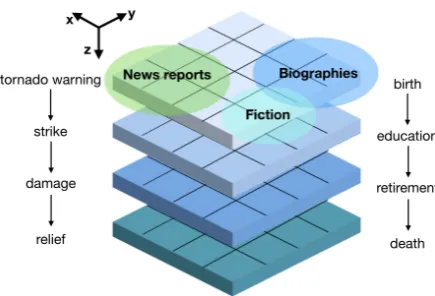
extract-Figure 1: Modeling principle for Sequential Count-ing Grids. We design the method to capture se-mantic similarities between documents along XY planes (e.g., biographies might be more similar to literary fiction than news reports), as well extract sequential trajectories along the Z axes similar to those shown. The sequence of sentences in a doc-ument is latently aligned to positions in the grid, such that the model prefers alignments of contigu-ous sentences to grid cells that are spatially close.
ing and visualizing sequential structure from a col-lection of text documents. Our method is based on embedding sentences in a document in a 3-dimensional grid, such that contiguous sentences in the document are likely to be embedded in the same order in the grid. Further, sentences across docu-ments that are semantically similar are also likely to be embedded in the same neighborhood in the grid. By leveraging the sequential order of sentences in a large document collection, the method can induce lexical semantics, as well as extract latent discourse trajectories in the documents. Figure1shows a con-ceptual schematic of our approach. The method can learn semantic similarity (across XY planes), as well as sequential discourse chains (along the Z-axis). The parameters and latent structure of the grid are learned by optimizing the likelihood of a collection of documents under a generative model. Our method outperforms state-of-the-art generative methods on two tasks: predicting the outcome of a story and coherence prediction; and is seen to yield a flexible range of interpretable visualizations in different domains of text. Our method is scalable, and can incorporate a broad range of features. In particular, the approach can work on simple tok-enized text.
The remainder of this paper is organized as fol-lows. In Section 2, we briefly summarize other related work. In Section3, we describe our method
in detail. We present experimental results in Sec-tion4, and conclude with a brief discussion.
2 Related work
Building on linguistic theories of discourse and text coherence, several computational approaches have attempted to model discourse structure from multiple perspectives. Prominent among these are Narrative Event Chains (Chambers and Jurafsky, 2008) which learn chains of events that follow a pattern in a unsupervised framework, and the Entity grid model (Barzilay and Lapata,2008), which rep-resents sentences in a context in terms of discourse entities occurring in them and trains coherence clas-sifiers over this representation. Other work extends these using better models of events and discourse entities (Lin et al., 2011; Pichotta and Mooney, 2015). Louis and Nenkova (2012) use manually provided syntactic patterns for sentence representa-tion, and model transitions in text as Markov prob-abilities, which is related to our work. However, while they use simple HMMs over discrete topics, our method allows for a richer model that also cap-tures smooth transition across them. Approaches such asKalchbrenner and Blunsom(2013);Li et al. (2014);Li and Jurafsky(2017) model text through recurrent neural architectures, but are hard to in-terpret and visualize. Other approaches have ex-plored applications related to modeling narrative discourse in context of limited tasks such as story cloze (Mostafazadeh et al.,2016) and identifying similar narratives (Chaturvedi et al.,2018).
[image:2.595.76.294.58.206.2]3 Sequential CG model
In this section, we present our method, which we call Sequential Counting Grids, or Sequential CG. We first present our notation, model formu-lation and training approach. We discuss how the method is designed to incorporate smoothness and sequential structure, and how the method can be efficiently scaled to train on large document collec-tions. In Section3.2, we present a mixture model variant that combines Sequential CG with a uni-gram language model.
3.1 Model description
We represent a document as a sequences of sen-tences, s = {s1, s2. . . sD}, whereD represents
the number of sentences in the document. In gen-eral, we assume each sentence is represented as a multiset of featuressi ={cz}i, whereciz
repre-sents the count of the feature indexed byzin the ith sentence in the sequence.1
The Sequential CG consists of a 3-D gridGof sizeEx×Ey×Ez, whereEx,Ey andEz denote
the extent of the grid along the X, Y and Z-axes (see Figure1). Let us denote an index of a position in the grid by an integer-valued vectori= (ixiyiz).
The three components of the index together spec-ify a XY location as well as a depth in the grid. The Sequential CG model is parametrized by two sets of parameters,πi,z andPij. Here,πi,z
repre-sents a multinomial distribution over the vocabu-lary of featuresz for each cell in the gridG, i.e.
P
zπi,z = 1 ∀ i ∈ G. To induce smoothness
across XY planes, we further define histogram dis-tributionshi,z, which average theπ distributions
in a 2-D neighborhood Wi (of size specified by W = [Wx, Wy]) around the grid positioni. This
notation followsJojic and Perina(2011).
hi,z =
1 WxWy
X
i0∈W i
πi0,z (1)
The generative model assumes that individual sen-tences in a document are generated byh distribu-tions in the grid. Movements from one positioni
to anotherjin the grid are modeled as transition probabilitiesPij. The generative process consists of the following. We uniformly sample a starting locationi1in the grid. We sample words in the first
1These may simply consist of tokens (words, entities and MWEs) in the sentence, but can include additional informa-tion, such as sentiment or event annotations, or other discrete sentence-level representations
sentence s1 from πi1, and sample the next posi-tioni2 from the distributionPi1,:, and so on till we generatesD. The alignmentsI = [i1,i2. . .iD]of
individual sentences in a document with positions in the grid are latent variables in our model.
Given the sequence of alignmentsI for a doc-ument, the conditional likelihood of generatings is given as a product of generating individual sen-tences:
p(s| I) =
D Y
d
p({cdz}|id) = D Y
d=1
Y
z
(hid,z)c
d z
(2)
Since the alignments of sequences to their posi-tions in the gridsIare latent, we marginalize over these to maximize the likelihood of an observed col-lection of documentsS :={st}T
t=1. Here,T is the total number of documents, andtis an index over individual documents. Using Jensen’s inequality,
anydistributionsqtIover the hidden alignmentsIt
provide lower-bounds on the data log-likelihood.
X
t
logp(st|π) = X
t
log X I
p(st,I|π)
=X
t
log X I
qtI
p(st|I)p(I))
qtI
≥ −X
t X
I
qItlogqIt
+X
t X
I
qItlog p(s|I, π)p(I))
(3)
Here,qtIdenotes a variational distribution for each of the data sequencesst. The learning algorithm
consists of an iterative generalized EM procedure (which can be interpreted as a block-coordinate ascent in the latent variablesqt
I and the model pa-rametersπandP). We maximize the lower bound in Eqn3exactly by settingqIt to the posterior dis-tribution of the data for the current values of the parametersπ(standard E step). Thus, we have
qtI ∝p(s|I)p(I)
=h
D Y
d=1
Y
z
(hid,z)
cd z(t)
ihYD
d=2
Pid−1,idi (4)
We do not need to explicitly compute the poste-rior distributionqt
see next. In the M-step, we considerqIt as fixed, and maximize the objective in terms of the model parametersπ. Substituting this in Eqn3, and focus-ing on terms that depend on the model parameters (πandP), we get
L(π,P)≥X
t X
I
qItlog p(s|I, π)p(I)) +Hq
=X
t X
I qIt
X
d X
z
cdz(t) loghid,z
+X
d
logPid−1,id
=X
t X
I
EqtI
h X
d X
z
Iit d=ic
d
z(t) loghid,z
i
+X
t X
I
EqtI
h X
d
Iit
d−1=i,itd=jlogPij
i
(5)
Maximizing the likelihood w.r.t.P leads to the following updates for the transition probabilities:2
Pij=
P t
P
dP(itd−1=i,itd=j) P
t P
dP(itd−1 =i)
(6)
Here, the pairwise state-probabilitiesP(it d−1 =
i,itd = j) for adjacent sentences in a sequence can be efficiently calculated using the Forward-Backward algorithm. In Equation5, rewriting the term containinghin terms ofπusing Eqn1(and ignoring constant termsWxWy), we get:
X
t X
I
EqtI
h X
d X
z
Iit d=ic
d z(t) log
X
i0∈W i
πi0,z
i =X t X I X d
P(itd=i)X
z
cdz(t) log X i0∈W i
πi0,z
(7)
The presence of a summation inside of a loga-rithm makes maximizing this objective forπharder. For this, we simply use Jensen’s inequality intro-ducing an additional variational distribution (for the latent grid positions within windowWi), and maximize the lower bound. The final M-step up-date forπbecomes:
πi,z ∝
X
t X
d
cdz(t) X k|i∈Wk
P(itd=k) hk,z
πi,z
(8)
2Since the optimal value for the concave problem P
jyjlogxjs.t.Pjxj= 1occurs whenx∗j∝yj
As before, the state-probabilitiesP(itd=i)can be computed using the Forward Backward algorithm. Intuitively, the expected alignments in the E-step are distributions over sequences of positions in the grid that best explain the structure of documents for the current value of Sequential CG parameters. In the M-step, we assume these distributions embedding documents into various parts of the grid as given, and update the multi-nomial parameters and transition probabilities. Modeling the transitions as having a Markov property allows us to use a dynamic programming approach (Forward Backward algorithm) to exactly compute the posterior probabilities required for parameter updates. We note that at the onset of the procedure, we need to initializeπrandomly to break symmetries. Unless otherwise stated, in all experiments, we run EM to 200 iterations.
Correlating space with sequential structure:
The use of histogram distributions h to generate data forces smoothness in the model along XY planes due to adjacent cells in the grid sharing a large number of parameters that contribute to their histograms (due to overlapping windows). On the other hand, in order to induce spatial proximity in the grid to mimic the sequential flow of discourse in documents, we constrain the transition matrix
P (which specifies transition preferences from one position in the grid to another) to a sparse banded matrix. In particular, a positioni= (ix, iy, iz)in
the grid can only transition to itself, its 4 neighbors in the same XY plane, and two cells in the suc-ceeding two layers along the Z-axis ((ix, iy, iz+1) and(ix, iy, iz+2)). This is enforced by fixing other elements in the transition matrix to 0, and only updating allowable transitions.
As an important note about implementation de-tails, we observe here that the Forward-Backward procedure (which is repeatedly invoked during model training) can be naturally formulated in terms of matrix operations.3 This allows training for the Sequential CG approach to be scalable for large document collections.
In our formulation, we have presented a Sequen-tial CG model for a 3-D grid. This can be adapted to learn 2-D grids (trellis) by settingEy = 1. In
our experiments, we found 3-D grids to be better
3To explain, iffd
in terms of task performance and visualization (for a comparable number of parameters).
3.2 Mixture model
The Sequential CG model described above can be combined with other generative models (e.g., lan-guage models) to get a mixture model. Here, we show how a unigram language model can be com-bined with Sequential CG. The rationale behind this is that since the Sequential CG is primarily designed to explain elements of documents that re-flect sequential discourse structures, mixing with a context-agnostic distribution can allow it to fo-cus specifically on elements that reflect sequential regularities. In experimental evaluation, we find that such a mixture model shows distinctly differ-ent behavior (see Section4.1.1). Next, we briefly describe updates for this approach.
Letµzdenote the multinomial distribution over
features for the unigram model to be mixed with the CG. Let βz be the mixing proportion for the
featurez, i.e. an occurrence ofzis presumed to come from the Sequential CG with probabilityβz,
and from the unigram distribution with probability 1 −βz. Further, let αtz be binary variable that
denotes whether a particular instance ofzcomes from the Sequential CG, or the unigram model. Then, Equation2changes to:
p(s| I, α) =Y
z,d
(hid,z)
cd zβ
z αt
z µcdz
z (1−βz) 1−αtz
Since we do not observeαtz (i.e., which distribu-tion generated a particular feature in a particular document), they are additional latent variables in the model. Thus, we need to introduce a Bernoulli variational distributionqαzt. Doing this modifies relevant parts (containingqαzt) of Equation5to:
X
t X
I qtI
X
z
qαztlog βz
Y
d
hcdz(t) id,z
+ (1−qαzt) log
1−βz)µ P
dcdz
z
+X
d
logPid−1,id
+Hqαzt
(9)
This leads to the following additional updates for estimatingqαzt (in the E-step)4 andβz (in the M-step).
4Since the optimal value for the concave problem P
jxjlog yj xj s.t.
P
jxj= 1occurs whenx∗j ∝yj
qαzt =
exp
PI
i P(itd=i)cdz(t) loghid,z
βz
exp
PI
iP(itd=i)cdz(t) loghid,z
βz+µ
P
d cdz z (1−βz)
In the M-step,βz can be estimated simply as the
fraction of timeszis generated from the Sequential CG component.
βz= P
tqαzt P
tIz
4 Evaluation
In this section, we analyze the performance of our approach on text collections from several do-mains (including short stories, newswire text and biographies). We first qualitatively evaluate our generative method on a dataset of biographical ex-tracts from Wikipedia, which visually illustrates biographical trajectories learned by the model, op-erationalizing our model concept from Figure1in real data (see Figure 2). Next, we evaluate our method on two standard tasks requiring document understanding: story cloze evaluation and sentence ordering. Since our method is completely unsu-pervised and is not tailored to specific tasks, com-petitive performance on these tasks would indicate that the method learns helpful regularities in text structure, useful for general-purpose language un-derstanding.
4.1 Visualizing Wikipedia biographies
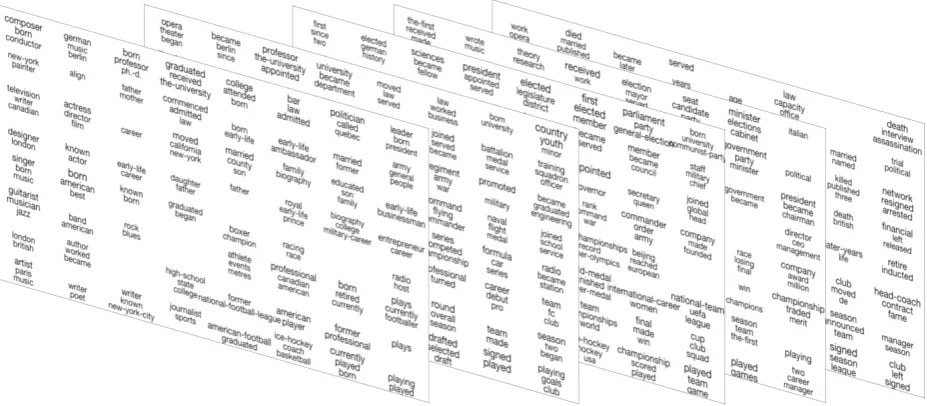
We now qualitatively explore models learned by our method on a dataset of biographies from Wikipedia.5 For this, we use the data previously collected and processed by Bamman and Smith (2014). In all, the original dataset consists of ex-tracts from biographies of about 240,000 individu-als. For ease of training, we trained our method on a subset of the 50,0000 shortest documents from this set. The original paper uses the numerical or-der of dates mentioned in the biographies to extract biographical templates, but we do not use this infor-mation. Figure2visualizes a Sequential CG model learned on this dataset for on a grid of dimensions E = 8×8×5, and a histogram windowW of dimensions3×3. In general, we found that using larger grids leads to smoother transitions and learn-ing more intricate patterns includlearn-ing hierarchies of trajectories, but here we show a model with a
Figure 2: Visualization of a Sequential-CG model with grid size of8×8×5, trained on 50,000 documents from the Wikipedia biographies dataset. Cells in the grid show words with highest probabilities (empty cells may indicate that no word has a substantially higher probability than others).
smaller grid for ease of visualization. Here, the words in each cell in the grid denote the highest probability assignments in that cell. Larger fonts within a cell indicate higher probabilities.
We observe that the method successfully extracts various biographical trajectories, as well as capture a notion of similarity between them. To explain, we observe that the lower-right part of the learned grid largely models documents about sportpersons (with discernable regions focusing on sports like soccer, American football and ice-hockey). On the other hand, the left-half of the grid is domi-nated by biographies of people from the arts and humanities (inlcuding artists, writers, musicians, etc.). The top-center of the grid focuses on aca-demicians and scientists, while the top-right repre-sents biographies of political and military leaders. We note smooth transitions between different re-gions, which is precisely what we would expect from the use of the smoothing filter that incorpo-rates parameter sharing across cells in the method. Further, as we go across the layers in the figure, we note the biographical trajectories learned by the model across the entire grid. For example, from the grid, the life trajectory of a football player can be visualized as being drafted, signing and playing for a team, and eventually becoming a head-coach or a hall-of-fame inductee.
4.1.1 Effects of mixing
The Sequential-CG method can be combined with other generative models in a mixture model,
fol-lowing the approach previously described in Sec-tion 3.2. A major reason to do this might be to allow the base model to handle general content, while allowing the Sequential-CG method to focus on modeling context-sensitive words only. Here, we empirically characterize the mixing behavior for different categories of words.
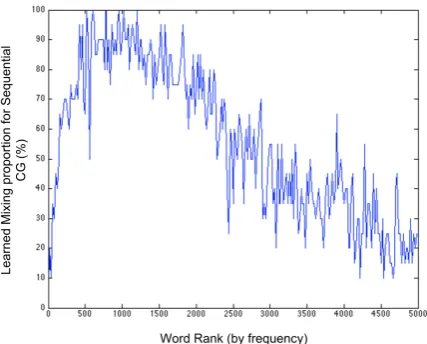
Figure3shows the mixing proportion of differ-ent words when the Sequdiffer-ential-CG model is com-bined with a unigram model. In the figure, the X-axis corresponds to words in the dataset with decreasing frequency of occurrence, whereas the Y-axis denotes the mixing proportionsβzlearned by
Figure 3: Learned mixing proportion (βz) in the
mixture model of Section3.2for words of different frequencies.βz denotes the probability of a word
being generated from the Sequential CG model (rather than from the Unigram model). The Se-quential CG learns to model content words (with intermediate ranks), and conserves modeling effort by avoiding modeling both very common words (that occur across contexts), as well as rare words.
be important elements in discourse trajectories.
4.2 Story-cloze
We next evaluate our method on the story-cloze task presented byMostafazadeh et al. (2016), which tests common-sense understanding in context of children stories. The task consists of identifying the correct ending to a four-sentence long story (calledcontextin the original paper) and two possi-ble ending options. The dataset for the task consists of a collection of around 45K unlabeled 5-sentence long stories as well as 3742 5-sentence stories with two provided endings, with one labeled as the cor-rect ending. For this task, we train our method on grids of dimension15×15×6(E), and histogram windowsW of size5×5on the unlabeled collec-tion of stories. At test time, for each story, we are provided two versions (a story-versionvconsists of the provided contextc, followed by a possible endinge1, i.e.v= [c, e]). For prediction, we need to define a goodness scoreSvfor a story-version.
In the simplest case, this score can simply be the log-likelihoodlogpSCG(v)of the story-version,
ac-cording to the Sequential-CG model. However, this is problematic since this is biased towards choos-ing shorter endchoos-ings. To alleviate this, we define the goodness score by discounting the log-likelihood by the probability of the endingeitself, under a
Accuracy
Our Method variants
Sequential CG + Unigram Mixture 0.602 Sequential CG + Brown clustering 0.593 Sequential CG + Sentiment 0.581
Sequential CG 0.589
Sequential CG (unnormalized) 0.531
DSSM 0.585
GenSim 0.539
Skip-thoughts 0.552
Narrative-Chain(Stories) 0.494
N-grams 0.494
Table 1: Performance of our approach on story-cloze task fromMostafazadeh et al.(2016) com-pared with other unsupervised approaches (accu-racy numbers as reported in Mostafazadeh et al. (2016)).
simple unigram model.
Sv = logpSCG(c, e)−logpuni(e)
The predicted ending is the story-version with a higher score. Table 1 shows the performance of variants of our approach for the task. Our base-lines include previous approaches for the same task:
DSSM is a deep-learning based approach, which maps the context and ending to the same space, and is the best-performing method inMostafazadeh et al.(2016). GenSimandN-gramreturn the end-ing that is more similar to the context based on
word2vecembeddings (Mikolov et al.,2013) and n-grams, respectively.Narrative-Chainscomputes the probability of each alternative based on event-chains, following the approach ofChambers and Jurafsky(2008).
[image:7.595.74.288.62.234.2]Figure 4: Illustrative story-cloze examples where the model correctly identifies the appropriate end-ing (model score in parentheses).
variant of Sequential-CG with the sentence-level sentiment annotation (from Stanford CoreNLP) also added as a feature. This does not improve per-formance, consistent with findings inMostafazadeh et al.(2016). We also experiment with a variant where we perform Brown clustering (Brown et al., 1992) of words in the unlabeled stories (K = 500 clusters), and include cluster-annotations as fea-tures for training the method. Doing this explicitly incorporates lexical similarity into the model, lead-ing to a small improvement in performance. Finally, a mixture model consisting of the Sequential-CG and a unigram language model leads to a further improvement in performance. The performance of our unsupervised approach on this task indicates that it can learn discourse structures that are helpful for general language understanding.
The story-cloze task has recently also been ad-dressed as a shared task at EACL (Mostafazadeh et al.,2017) with a significantly expanded dataset, and achieving much higher performance. How-ever, we note that the proposed best-performing ap-proaches (Chaturvedi et al.,2017;Schwartz et al., 2017) for this task are all supervised, and hence not included here for comparison.
Figure4shows examples where the model cor-rectly identifies the ending. These show a mix of behavior such as sentiment coherence (iden-tifying dissonance between ‘wonderful surprise’ and ‘stolen’) and modeling causation (police being called after being suspected).
4.3 Sentence Ordering
We next evaluate our method on the sentence order-ing task, which requires distorder-inguishorder-ing an original
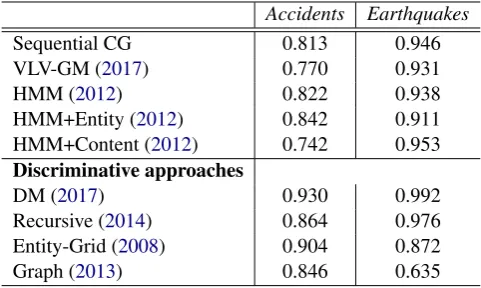
Accidents Earthquakes
Sequential CG 0.813 0.946 VLV-GM (2017) 0.770 0.931 HMM (2012) 0.822 0.938 HMM+Entity (2012) 0.842 0.911 HMM+Content (2012) 0.742 0.953 Discriminative approaches
[image:8.595.309.550.62.206.2]DM (2017) 0.930 0.992 Recursive (2014) 0.864 0.976 Entity-Grid (2008) 0.904 0.872 Graph (2013) 0.846 0.635
Table 2: Performance of our approach on sentence ordering dataset fromBarzilay and Lapata(2008).
document from a version consisting of permuta-tions of sentences of the original (Barzilay and Lapata,2008;Louis and Nenkova,2012). For this, we use two datasets of documents and their per-mutations fromBarzilay and Lapata(2008), which are used as standard evaluation for coherence pre-diction tasks. These consist of (i) reports of ac-cidents from the National Transportation Safety Bureau (we refer to this data asaccidents), and (ii) newswire reports about earthquake events from the Associated press (we refer to this asearthquakes). Each dataset consists of 100 training documents, and about 100 documents for testing. Also pro-vided are about 20 generated permutations for each document (resulting in 1986 test pairs foraccidents, and 1955 test pairs for earthquakes). Documents inaccidentsconsist of between 6 and 19 sentences each, with a median of 11 sentences. Documents in
earthquakesconsist of between 4 and 30 sentences each, with a median of 10 sentences.
Since the datasets for these tasks only have a relatively small number of training documents (100 each), we use Sequential-CG with smaller grids (3×3×15), and don’t train a mixture model (which needs to learn a parameterβzfor each word in the
vocabulary). Further, we train for a much smaller number of iterations to prevent overfitting (K = 3, chosen through cross-validation on the training set). During testing, since provided article pairs are sim-ply permutations of each other and identical in content, we do not need to normalize as needed in Section4.2. The score of a provided article is sim-ply calculated as its log-likelihood. The article with higher likelihood is predicted to be the original.
com-Figure 5: Example of newswire report about an earthquake event. Bold fonts represent words that align particularly well with the learned model at corresponding points in the narrative.
petitively with the state-of-the-art for generative approaches for the task, while needing no other annotation. In comparison, the HMM based ap-proaches use significant annotation and syntactic features. Sequential-CG also outperforms several discriminative approaches for the task. In Figure5 we illustrate the learned discourse trajectories in terms of the most salient features in each sentence. Words in bold are those identified by the model to be most context-appropriate at the correspond-ing point in the narrative. This is done by rankcorrespond-ing words by the ratio between their probabilities (π:,z)
in the grid weighted by alignment locations of the document (qIt), and unigram probabilities.
5 Conclusion
We have presented a simple model for extracting and visualizing latent discourse structure from un-labeled documents. The approach is coarse, and does not have explicit models for important ele-ments such as entities and events in a discourse. However, the method outperforms some previous approaches on document understanding tasks, even while ignoring syntactic structure within sentences. The ability to visualize learning is a key component of our method, which can find significant applica-tions in data mining and data-discovery in large text collections. More generally, similar approaches can explore a wider range of scenarios involving sequences of text. While here our focus was on learning discourse structures at the document level, similar methods can also be used at other scales, such as for syntactic or morphological analysis.
References
Nicholas Asher. 1986. Belief in discourse repre-sentation theory. Journal of Philosophical Logic, 15(2):127–189.
David Bamman and Noah Smith. 2014. Unsupervised discovery of biographical structure from text. Trans-actions of the Association for Computational Lin-guistics, 2:363–376.
Regina Barzilay and Mirella Lapata. 2008. Modeling local coherence: An entity-based approach. Compu-tational Linguistics, 34(1):1–34.
Peter F Brown, Peter V Desouza, Robert L Mercer, Vin-cent J Della Pietra, and Jenifer C Lai. 1992. Class-based n-gram models of natural language. Compu-tational linguistics, 18(4):467–479.
Nathanael Chambers and Daniel Jurafsky. 2008. Unsu-pervised learning of narrative event chains. InACL, pages 789–797. The Association for Computer Lin-guistics.
Snigdha Chaturvedi, Haoruo Peng, and Dan Roth. 2017. Story comprehension for predicting what hap-pens next. InProceedings of the 2017 Conference on Empirical Methods in Natural Language Process-ing, pages 1603–1614.
Snigdha Chaturvedi, Shashank Srivastava, and Dan Roth. 2018. ‘Where have I heard this story before?’ : Identifying narrative similarity in movie remakes. InProceedings of the 2018 Conference of the North American Chapter of the Association for Computa-tional Linguistics: Human Language Technologies.
Thomas L Griffiths, Mark Steyvers, David M Blei, and Joshua B Tenenbaum. 2005. Integrating topics and syntax. InAdvances in neural information process-ing systems, pages 537–544.
Camille Guinaudeau and Michael Strube. 2013. Graph-based local coherence modeling. InProceedings of the 51st Annual Meeting of the Association for Com-putational Linguistics (Volume 1: Long Papers), vol-ume 1, pages 93–103.
Nebojsa Jojic and Alessandro Perina. 2011. Multidi-mensional counting grids: Inferring word order from disordered bags of words. In Proceedings of the Twenty-Seventh Conference on Uncertainty in Arti-ficial Intelligence, pages 547–556. AUAI Press.
Nal Kalchbrenner and Phil Blunsom. 2013. Recurrent convolutional neural networks for discourse compo-sitionality.ACL 2013, page 119.
[image:9.595.80.278.66.188.2]Jiwei Li and Eduard Hovy. 2014. A model of coher-ence based on distributed sentcoher-ence representation. InProceedings of the 2014 Conference on Empirical Methods in Natural Language Processing (EMNLP), pages 2039–2048.
Jiwei Li and Dan Jurafsky. 2017. Neural net models of open-domain discourse coherence. In Proceed-ings of the 2017 Conference on Empirical Methods in Natural Language Processing, pages 198–209.
Jiwei Li, Rumeng Li, and Eduard H Hovy. 2014. Recursive deep models for discourse parsing. In
EMNLP, pages 2061–2069.
Ziheng Lin, Hwee Tou Ng, and Min-Yen Kan. 2011. Automatically evaluating text coherence using dis-course relations. In Proceedings of the 49th An-nual Meeting of the Association for Computational Linguistics: Human Language Technologies-Volume 1, pages 997–1006. Association for Computational Linguistics.
Annie Louis and Ani Nenkova. 2012. A coherence model based on syntactic patterns. InProceedings of the 2012 Joint Conference on Empirical Methods in Natural Language Processing and Computational Natural Language Learning, pages 1157–1168. As-sociation for Computational Linguistics.
William C Mann and Sandra A Thompson. 1988. Rhetorical structure theory: Toward a functional the-ory of text organization. Text-Interdisciplinary Jour-nal for the Study of Discourse, 8(3):243–281.
Tomas Mikolov, Ilya Sutskever, Kai Chen, Greg S Cor-rado, and Jeff Dean. 2013. Distributed representa-tions of words and phrases and their compositional-ity. InAdvances in neural information processing systems, pages 3111–3119.
Nasrin Mostafazadeh, Nathanael Chambers, Xiaodong He, Devi Parikh, Dhruv Batra, Lucy Vanderwende, Pushmeet Kohli, and James Allen. 2016. A cor-pus and cloze evaluation for deeper understanding of commonsense stories. InProceedings of NAACL-HLT, pages 839–849.
Nasrin Mostafazadeh, Michael Roth, Annie Louis, Nathanael Chambers, and James Allen. 2017. LS-DSem 2017 shared task: The story cloze test. In
Proceedings of the 2nd Workshop on Linking Mod-els of Lexical, Sentential and Discourse-level Seman-tics, pages 46–51, Valencia, Spain.
Karl Pichotta and Raymond J Mooney. 2015. Learning statistical scripts with LSTM recurrent neural net-works. InAAAI.
Roger C Schank and Robert P Abelson. 1977. Scripts, plans, goals and understanding: an inquiry into hu-man knowledge structures. Erlbaum.
Roy Schwartz, Maarten Sap, Ioannis Konstas, Leila Zilles, Yejin Choi, and Noah A Smith. 2017. The effect of different writing tasks on linguistic style: A
case study of the roc story cloze task.arXiv preprint arXiv:1702.01841.
Di Wang, Nebojsa Jojic, Chris Brockett, and Eric Ny-berg. 2017. Steering output style and topic in neu-ral response generation. InProceedings of the 2017 Conference on Empirical Methods in Natural Lan-guage Processing, pages 2140–2150, Copenhagen, Denmark. Association for Computational Linguis-tics.