2418
A
dv
E
ntu
R
e
: Adversarial Training for Textual Entailment
with Knowledge-Guided Examples
Dongyeop Kang1 Tushar Khot2 Ashish Sabharwal2 Eduard Hovy1 1School of Computer Science, Carnegie Mellon University, Pittsburgh, PA, USA
2Allen Institute for Artificial Intelligence, Seattle, WA, USA
fdongyeok,hovyg@cs.cmu.edu ftushark,ashishsg@allenai.org
Abstract
We consider the problem of learning tex-tual entailment models with limited super-vision (5K-10K training examples), and present two complementary approaches for it. First, we propose knowledge-guided adversarial example generators for incor-porating large lexical resources in entail-ment models via only a handful of rule templates. Second, to make the entailment model—a discriminator—more robust, we propose the first GAN-style approach for training it using a natural language ex-ample generator that iteratively adjusts based on the discriminator’s performance. We demonstrate effectiveness using two entailment datasets, where the proposed methods increase accuracy by 4.7% on SciTail and by 2.8% on a 1% training sub-sample of SNLI. Notably, even a sin-gle hand-written rule, negate, improves
the accuracy on the negation examples in SNLI by 6.1%.
1 Introduction
The impressive success of machine learning mod-els on large natural language datasets often does not carry over to moderate training data regimes, where models often struggle with infrequently ob-served patterns and simple adversarial variations. A prominent example of this phenomenon is tex-tual entailment, the fundamental task of decid-ing whether a premise text entails () a hypoth-esistext. On certain datasets, recent deep learn-ing entailment systems (Parikh et al.,2016;Wang et al., 2017; Gong et al., 2018) have achieved close to human level performance. Nevertheless, the problem is far from solved, as evidenced by how easy it is to generate minor adversarial
ex-Table 1:Failure examples from the SNLI dataset: negation (Top) and re-ordering (Bottom). P is premise,His hypothesis, andSis prediction made by an entailment system (Parikh et al.,2016).
P: The dog didnoteat all of the chickens.
H: The dog ate all of the chickens.
S: entails (score 56:5%)
P:The red boxis in the blue box.
H: The blue box is inthe red box.
S: entails (score 92:1%)
amples that break even the best systems. As Ta-ble 1 illustrates, a state-of-the-art neural system for this task, namely the Decomposable Attention Model (Parikh et al.,2016), fails when faced with simple linguistic phenomena such as negation, or a re-ordering of words. This is not unique to a particular model or task. Minor adversarial exam-ples have also been found to easily break neural systems on other linguistic tasks such as reading comprehension (Jia and Liang,2017).
A key contributor to this brittleness is the use of specific datasets such as SNLI (Bowman et al., 2015) and SQuAD (Rajpurkar et al.,2016) to drive model development. While large and challenging, these datasets also tend to be homogeneous. E.g., SNLI was created by asking crowd-source work-ers to generate entailing sentences, which then tend to have limited linguistic variations and an-notation artifacts (Gururangan et al.,2018). Con-sequently, models overfit to sufficiently repetitive patterns—and sometimes idiosyncrasies—in the datasets they are trained on. They fail to cover long-tail and rare patterns in the training distribu-tion, or linguistic phenomena such as negation that would be obvious to a layperson.
ad-versarial examples generated in two ways: (a) by incorporating knowledge from large linguistic resources, and (b) using a sequence-to-sequence neural model in a GAN-style framework.
The motivation stems from the following ob-servation. While deep-learning based textual en-tailment models lead the pack, they generally do not incorporate intuitive rules such as negation, and ignore large-scale linguistic resources such as PPDB (Ganitkevitch et al., 2013) and Word-Net (Miller, 1995). These resources could help them generalize beyond specific words observed during training. For instance, while the SNLI dataset contains the patterntwo men people, it does not contain the analogous patterntwo dogs
animalsfound easily in WordNet.
Effectively integrating simple rules or linguis-tic resources in a deep learning model, however, is challenging. Doing so directly by substantially adapting the model architecture (Sha et al.,2016; Chen et al.,2018) can be cumbersome and limit-ing. Incorporating such knowledge indirectly via modified word embeddings (Faruqui et al.,2015; Mrkˇsi´c et al., 2016), as we show, can have little positive impact and can even be detrimental.
Our proposed method, which is task-specific but model-independent, is inspired by data-augmentation techniques. We generate new training examples by applying knowledge-guided rules, via only a handful of rule templates, to the original training examples. Simultaneously, we also use a sequence-to-sequence or seq2seq model for each entailment class to generate new hypothe-ses from a given premise, adaptively creating new adversarial examples. These can be used with any entailment model without constraining model ar-chitecture.
We also introduce the first approach to train a robust entailment model using a Generative Ad-versarial Network or GAN (Goodfellow et al., 2014) style framework. We iteratively improve both the entailment system (the discriminator) and the differentiable part of the data-augmenter (specifically the neural generator), by training the generator based on the discriminator’s perfor-mance on the generated examples. Importantly, unlike the typical use of GANs to create a strong generator, we use it as a mechanism to create a strong and robust discriminator.
Our new entailment system, called AdvEntuRe,
demonstrates that in the moderate data regime,
adversarial iterative data-augmentation via only a handful of linguistic rule templates can be sur-prisingly powerful. Specifically, we observe 4.7% accuracy improvement on the challenging SciTail dataset (Khot et al., 2018) and a 2.8% improve-ment on 10K-50K training subsets of SNLI. An evaluation of our algorithm on the negation ex-amples in the test set of SNLI reveals a 6.1% im-provement from just a single rule.
2 Related Work
Adversarial example generation has recently re-ceived much attention in NLP. For example, Jia and Liang (2017) generate adversarial examples using manually defined templates for the SQuAD reading comprehension task. Glockner et al. (2018) create an adversarial dataset from SNLI by using WordNet knowledge. Automatic meth-ods (Iyyer et al.,2018) have also been proposed to generate adversarial examples through paraphras-ing. These works reveal how neural network sys-tems trained on a large corpus can easily break when faced with carefully designed unseen ad-versarial patterns at test time. Our motivation is different. We use adversarial examples at train-ing time, in a data augmentation setttrain-ing, to train a more robust entailment discriminator. The gener-ator uses explicit knowledge or hand written rules, and is trained in a end-to-end fashion along with the discriminator.
Incorporating external rules or linguistic sources in a deep learning model generally re-quires substantially adapting the model architec-ture (Sha et al., 2016; Liang et al., 2017; Kang et al.,2017). This is a model-dependent approach, which can be cumbersome and constraining. Sim-ilarly non-neural textual entailment models have been developed that incorporate knowledge bases. However, these also require model-specific engi-neering (Raina et al.,2005;Haghighi et al.,2005; Silva et al.,2018).
2017; Peters et al., 2018). We thus focus on a task-specific but model-independent approach.
Logical rules have also been defined to label ex-isting examples based on external resources (Hu et al.,2016). Our focus here is on generatingnew training examples.
Our use of the GAN framework to create a bet-ter discriminator is related to CatGANs (Wang and Zhang,2017) and TripleGANs (Chongxuan et al., 2017) where the discriminator is trained to classify the original training image classes as well as a new ‘fake’ image class. We, on the other hand, gener-ate examples belonging to the same classes as the training examples. Further, unlike the earlier fo-cus on the vision domain, this is the first approach to train a discriminator using GANs for a natural language task with discrete outputs.
3 Adversarial Example Generation
We present three different techniques to create ad-versarial examples for textual entailment. Specifi-cally, we show how external knowledge resources, hand-authored rules, and neural language genera-tion models can be used to generate such exam-ples. Before describing these generators in detail, we introduce the notation used henceforth.
We use lower-case letters for single instances (e.g., x; p; h), upper-case letters for sets of in-stances (e.g.,X; P; H), blackboard bold for mod-els (e.g.,D), and calligraphic symbols for discrete
spaces of possible values (e.g., class labelsC). For the textual entailment task, we assume each exam-ple is represented as a triexam-ple (p,h,c), wherepis a premise (a natural language sentence),his a hy-pothesis, andc is an entailment label: (a)entails (v) ifhis true wheneverpis true; (b)contradicts (f) ifh is false wheneverp is true; or (c) neu-tral(#) if the truth value ofhcannot be concluded frompbeing true.1
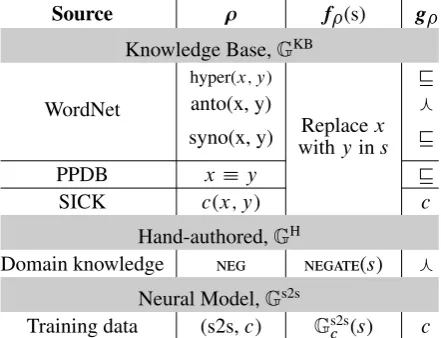
We will introduce various example generators in the rest of this section. Each such generator,G, is defined by a partial functionfand a labelg. If a sentenceshas a certain property required byf (e.g., contains a particular string), f transforms it into another sentences0andgprovides an en-tailment label fromstos0. Applied to a sentence s, G thus either “fails” (if the pre-requisite isn’t met) or generates a new entailment example triple, s; f(s); g. For instance, consider the generator
1The symbols are based on Natural Logic (Lakoff,1970)
and use the notation ofMacCartney and Manning(2012).
Source ρ f(s) g
Knowledge Base,GKB
WordNet
hyper(x; y) v
anto(x, y) f
syno(x, y) withReplaceyinxs v
PPDB xy v
SICK c(x; y) c
Hand-authored,GH
Domain knowledge neg negate(s) f
Neural Model,Gs2s Training data (s2s,c) Gs2s
[image:3.595.307.528.63.232.2]c (s) c
Table 2: Various generatorsGcharacterized by their source, (partial) transformation function f as applied to a sentences, and entailment labelg
for :=hypernym(car, vehicle) with the (partial) transformation function f:=“Replace car with vehicle” and the label g:=entails. f would fail when applied to a sentence not containing the word “car”. Applying f to the sentence s=“A man is driving the car” would generate s’=“A man is driving the vehicle”, creating the example (s; s0;entails).
The seven generators we use for experimenta-tion are summarized in Table 2 and discussed in more detail subsequently. While these particu-lar generators are simplistic and one can easily imagine more advanced ones, we show that train-ing ustrain-ing adversarial examples created ustrain-ing even these simple generators leads to substantial accu-racy improvement on two datasets.
3.1 Knowledge-Guided Generators
Large knowledge-bases such as WordNet and PPDB contain lexical equivalences and other re-lationships highly relevant for entailment models. However, even large datasets such as SNLI gen-erally do not contain most of these relationships in the training data. E.g., that two dogs entails animalsisn’t captured in the SNLI data. We de-fine simple generators based on lexical resources to create adversarial examples that capture the un-derlying knowledge. This allows models trained on these examples to learn these relationships.
or the model-specific approach (Sha et al.,2016; Chen et al.,2018), we use this knowledge to gener-ate task-specific examples. This allows any entail-ment model to learn how to use these relationships in the context of the entailment task, helping them outperform the above task-agnostic alternative.
Our knowledge-guided example
genera-tors, GKB , use lexical relations available in a knowledge-base: := r(x; y) where the relation r (such as synonym, hypernym, etc.) may differ across knowledge bases. We use a simple (partial) transformation function, f(s):=“Replace x in s with y”, as described in an earlier example. In some cases, when part-of-speech (POS) tags are available, the partial function requires the tags for x in s and in r(x; y) to match. The entailment labelg for the resulting examples is also defined based on the relationr, as summarized in Table2. This idea is similar to Natural Logic Inference or NLI (Lakoff, 1970; Sommers, 1982; Angeli and Manning, 2014) where words in a sentence can be replaced by their hypernym/hyponym to produce entailing/neutral sentences, depending on their context. We propose a context-agnostic use of lexical resources that, despite its simplicity, al-ready results in significant gains. We use three sources for generators:
WordNet (Miller, 1995) is a large, hand-curated, semantic lexicon with synonymous words grouped into synsets. Synsets are connected by many semantic relations, from which we use hy-ponymandsynonymrelations to generate entailing sentences, andantonymrelations to generate con-tradicting sentences2. Given a relationr(x; y), the (partial) transformation functionfis the POS-tag matched replacement ofxinswithy, and requires the POS tag to be noun or verb. NLI provides a more robust way of using these relations based on context, which we leave for future work.
PPDB (Ganitkevitch et al., 2013) is a large resource of lexical, phrasal, and syntactic para-phrases. We use 24,273 lexical paraphrases in their smallest set, PPDB-S (Pavlick et al.,2015), as equivalence relations, x y. The (partial) transformation function f for this generator is POS-tagged matched replacement of x ins with y, and the labelgisentails.
2A similar approach was used in a parallel work to
gener-ate an adversarial dataset from SNLI (Glockner et al.,2018).
SICK (Marelli et al.,2014) is dataset with en-tailment examples of the form (p; h; c), created to evaluate an entailment model’s ability to capture compositional knowledge via hand-authored rules. We use the 12,508 patterns of the formc(x; y) ex-tracted byBeltagy et al.(2016) by comparing sen-tences in this dataset, with the property that for each SICK example (p; h; c), replacing (when ap-plicable)x withy inp producesh. For simplic-ity, we ignore positional information in these pat-terns. The (partial) transformation functionf is replacement ofxinswithy, and the labelgisc.
3.2 Hand-Defined Generators
Even very large entailment datasets have no or very few examples of certain otherwise common linguistic constructs such as negation,3 causing models trained on them to struggle with these con-structs. A simple model-agnostic way to allevi-ate this issue is via a negation example generator whose transformation functionf(s) isnegate(s),
described below, and the labelgiscontradicts.
negate(s): If s contains a ‘be’ verb (e.g., is,
was), add a “not” after the verb. If not, also add a “did” or “do” in front based on its tense. E.g., change “A person is crossing” to “A person is not crossing” and “A person crossed” to “A person did not cross.” While many other rules could be added, we found that this single rule covered a majority of the cases. Verb tenses are also consid-ered4 and changed accordingly. Other functions such as dropping adverbial clauses or changing tenses could be defined in a similar manner.
Both the knowledge-guided and hand-defined generators make local changes to the sentences based on simple rules. It should be possible to ex-tend the hand-defined rules to cover the long tail (as long as they are procedurally definable). How-ever, a more scalable approach would be to extend our generators to trainable models that can cover a wider range of phenomena than hand-defined rules. Moreover, the applicability of these rules generally depends on the context which can also be incorporated in such trainable generators.
3.3 Neural Generators
For each entailment class c, we use a trainable sequence-to-sequence neural model (Sutskever
3Only 211 examples (2.11%) in the SNLI training set
con-tain negation triggers such as not, ’nt, etc.
et al.,2014;Luong et al.,2015) to generate an en-tailment example (s; s0; c) from an input sentence s. The seq2seq model, trained on examples la-beled c, itself acts as the transformation function f of the corresponding generatorGs2sc . The la-belg is set toc. The joint probability of seq2seq model is:
Gs2sc (Xc;c)=Gs2sc (Hc; Pc;c) (1)
= ΠiP(hi;cjpi;c;c)P(hi) (2)
The loss function for training the seq2seq is:
O
c =argmin c
L(Hc;Gs2sc (Xc;c)) (3)
where L is the cross-entropy loss between the original hypothesisHcand the predicted hypothe-sis. Cross-entropy is computed for each predicted word wi against the same in Hc given the se-quence of previous words inHc . Oc are the op-timal parameters in Gs2sc that minimize the loss for class c. We use the single most likely output to generate sentences in order to reduce decoding time.
3.4 Example Generation
The generators described above are used to cre-ate new entailment examples from the training data. For each example (p; h; c) in the data, we can create two new examples: p; f(p); g
and h; f(h); g.
The examples generated this way using GKB
and GH can, however, be relatively easy, as the
premise and hypothesis would differ by only a word or so. We therefore compose such simple (“first-order”) generated examples with the orig-inal input example to create more challenging “order” examples. We can create second-order examples by composing the original exam-ple (p; h; c) with a generated sentence from hy-pothesis,f(h) and premise,f(p). Figure1 de-picts how these two kinds of examples are gener-ated from an input example (p; h; c).
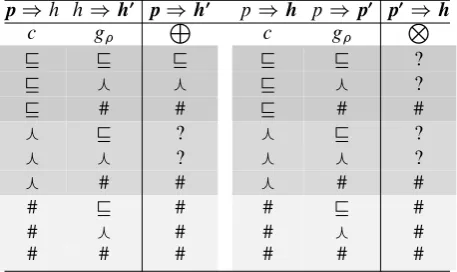
First, we consider the second-order example be-tween the original premise and the transformed hypothesis: (p; f(h);L(c; g)), where L, de-fined in the left half of Table3, composes the input example labelc(connectingpandh) and the gen-erated example label g to produce a new label. For instance, if p entails h and h entails f(h),
p would entail f. In other words, L(v;v) is v. For example, composing (“A man is playing
P
H
P'
H'
Entailment in data (x)
Generation (z)
[image:5.595.305.534.216.352.2]First/Second-order entailment between z & x
Figure 1: Generating first-order (blue) and second-order (red) examples.
p)h h)h0 p)h0 p)h p)p0 p0)h
c g L c g N
v v v v v ?
v f f v f ?
v # # v # #
f v ? f v ?
f f ? f f ?
f # # f # #
# v # # v #
# f # # f #
# # # # # #
Table 3: Entailment label composition functions
L
(left) and N
(right) for creating second-order examples.candgare the original and generated labels, resp.v:entails,f:contradicts, #:neutral, ?: undefined
soccer”, “A man is playing a game”, v) with a generated hypothesisf(h): “A person is playing a game.” will give a new second-order entailment example: (“A man is playing soccer”, “A person is playing a game”,v).
Second, we create an example from the generated premise to the original hypothesis: (f(p); h;N(g; c)). The composition function here, denoted N
and defined in the right half of Table 3, is often undetermined. For example, if p entailsf(p) and p entails h, the relation be-tweenf(p) andhis undetermined i.e. N(v;v ) =?. While this particular compositionN
often leads to undetermined or neutral relations, we use it here for completeness. For example, compos-ing the previous example with a generated neu-tralpremise, f(p): “A person is wearing a cap” would generate an example (“A person is wearing a cap”, “A man is playing a game”, #)
The composition function L
three entailment classes are mapped to ‘?’, and (b) the exclusivity/alternation relation is mapped tocontradicts. The composition functionN
, on the other hand, does not map to the join operation.
3.5 Implementation Details
Given the original training examples X, we gener-ate the examples from each premise and hypothe-sis in a batch usingGKBandGH. We also generate
new hypothesis per class for each premise using
Gs2sc . Using all the generated examples to train the model would, however, overwhelm the original training set. For examples, our knowledge-guided generatorsGKBcan be applied in 17,258,314
dif-ferent ways.
To avoid this, we sub-sample our synthetic ex-amples to ensure that they are proportional to the input examplesX, specifically they are bounded to ˛jXjwhere ˛ is tuned for each dataset. Also, as seen in Table3, our knowledge-guided generators are more likely to generateneutralexamples than any other class. To make sure that the labels are not skewed, we also sub-sample the examples to ensure that our generated examples have the same class distribution as the input batch. The SciTail dataset only contains two classes:entailsmapped tovandneutralmapped tof. As a result, gen-erated examples that do not belong to these two classes are ignored.
The sub-sampling, however, has a negative side-effect where our generated examples end up us-ing a small number of lexical relations from the large knowledge bases. On moderate datasets, this would cause the entailment model to potentially just memorize these few lexical relations. Hence, we generate new entailment examples for each mini-batch and update the model parameters based on the training+generated examples in this batch.
The overall example generation procedure goes as follows: For each mini-batchX (1) randomly choose 3 applicable rules per source and sentence (e.g., replacing men with people based on PPDB in premise is one rule), (2) produce examplesZal l usingGKB,GHandGs2s, (3) randomly sub-select
examplesZ fromZal l to ensure the balance be-tween classes andjZj=˛jXj.
4 AdvEntuRe
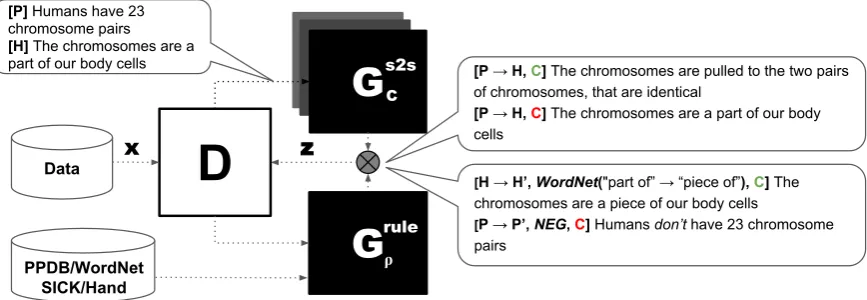
Figure 2 shows the complete architecture of our model, AdvEntuRe(ADVersarial training for
tex-tual ENTailment Using Rule-based Examples.).
The entailment modelDis shown with the white
box and two proposed generators are shown using black boxes. We combine the two symbolic un-trained generators,GKBandGHinto a singleGrule
model. We combine the generated adversarial ex-amples Z with the original training exex-amples X to train the discriminator. Next, we describe how the individual models are trained and finally present our new approach to train the generator based on the discriminator’s performance.
4.1 Discriminator Training
We use one of the state-of-the-art entailment mod-els (at the time of its publication) on SNLI, de-composable attention model (Parikh et al.,2016) with intra-sentence attention as our discriminator
D. The model attends each word in hypothesis
with each word in the premise, compares each pair of the attentions, and then aggregates them as a fi-nal representation. This discriminator model can be easily replaced with any other entailment model without any other change to the AdvEntuRe
archi-tecture. We pre-train our discriminator Don the
original dataset, X=(P, H, C) using:
D(X;)=argmax O
C
D(COjP; H;) (4)
O
=argmin
L(C;D(X;)) (5)
where L is cross-entropy loss function between the true labels, Y and the predicted classes, and
O
are the learned parameters.
4.2 Generator Training
Our knowledge-guided and hand-defined genera-tors are symbolic parameter-less methods which are not currently trained. For simplicity, we will refer to the set of symbolic rule-based generators asGrule:=GKB[GH. The neural generatorGs2s,
on the other hand, can be trained as described ear-lier. We leave the training of the symbolic models for future work.
4.3 Adversarial Training
We now present our approach to iteratively train the discriminator and generator in a GAN-style framework. Unlike traditional GAN (Goodfellow et al., 2014) on image/text generation that aims to obtain better generators, our goal is to build a robust discriminator regularized by the genera-tors (Gs2s andGrule). The discriminator and
[H → H’, WordNet("part of” → “piece of”), C] The chromosomes are a piece of our body cells
[P → P’, NEG, C] Humans don’t have 23 chromosome pairs
[image:7.595.89.523.64.214.2]Data
[P → H, C] The chromosomes are pulled to the two pairs of chromosomes, that are identical
[P → H, C] The chromosomes are a part of our body cells
x z
G
ruleG
s2sD
[P] Humans have 23chromosome pairs [H] The chromosomes are a part of our body cells
C
ρ
PPDB/WordNet SICK/Hand
Figure 2: Overview of AdvEntuRe, our model for knowledge-guided textual entailment.
Algorithm 1 Training procedure for AdvEntuRe.
1: pretraindiscriminatorD(O) onX; 2: pretraingeneratorsGs2sc (O) onX;
3: for number of training iterations do
4: formini-batch B X do
5: generateexamples fromG
6: ZG(G(B;),
7: balanceX andZG s.t.jZGj ˛jXj
8: optimizediscriminator:
9: O =argminLD(X+ZG;)
10: optimizegenerator:
11: O =argminLGs2s(ZG;LD;)
12: Update O; O
achieve better discrimination on the augmented data from the generator and better example gen-eration against the learned discriminator. Algo-rithm1shows our training procedure.
First, we pre-train the discriminator Dand the
seq2seq generators Gs2s on the original data X.
We alternate the training of the discriminator and generators over K iterations (set to 30 in our ex-periments).
For each iteration, we take a mini-batchBfrom our original data X. For each mini-batch, we generate new entailment examples,ZG using our adversarial examples generator. Once we collect all the generated examples, we balance the ex-amples based on their source and label (as de-scribed in Section 3.5). In each training itera-tion, we optimize the discriminator against the augmented training data, X + ZG and use the discriminator loss to guide the generator to pick challenging examples. For every mini-batch of examples X + ZG, we compute the
discrimina-tor loss L(C;D(X +ZG;)) and apply the neg-ative of this loss to each word of the generated sentence inGs2s. In other words, the
discrimina-tor loss value replaces the cross-entropy loss used to train the seq2seq model (similar to a REIN-FORCE (Williams,1992) reward). This basic ap-proach uses the loss over the entire batch to update the generator, ignoring whether specific examples were hard or easy for the discriminator. Instead, one could update the generator per example based on the discriminator’s loss on that example. We leave this for future work.
5 Experiments
Our empirical assessment focuses on two key questions: (a) Can a handful of rule templates im-prove a state-of-the-art entailment system, espe-cially with moderate amounts of training data? (b) Can iterative GAN-style training lead to an im-proved discriminator?
To this end, we assess various models on the two entailmentdatasetsmentioned earlier: SNLI (570K examples) and SciTail (27K examples).5To test our hypothesis that adversarial example based training prevents overfitting in small to moderate training data regimes, we compare model accura-cies on the test sets when using 1%, 10%, 50%, and 100% subsamples of the train and dev sets.
We consider two baseline models: D, the
De-composable Attention model (Parikh et al.,2016) with intra-sentence attention using pre-trained word embeddings (Pennington et al., 2014); and
Dretro which extends D with word embeddings
initialized by retrofitted vectors (Faruqui et al., 2015). The vectors are retrofitted on PPDB,
Word-5SNLI has a 96.4%/1.7%/1.7% split and SciTail has a
Table 4: Test accuracies with different subsam-pling ratios on SNLI (top) and SciTail (bottom).
SNLI 1% 10% 50% 100%
D 57.68 75.03 82.77 84.52
Dretro 57.04 73.45 81.18 84.14 AdvEntuRe
xD+Gs2s 58.35 75.66 82.91 84.68
xD+Grule 60.45 77.11 83.51 84.40
xD+Grule+Gs2s 59.33 76.03 83.02 83.25
SciTail 1% 10% 50% 100%
D 56.60 60.84 73.24 74.29
Dretro 59.75 67.99 69.05 72.63 AdvEntuRe
xD+Gs2s 65.78 70.77 74.68 76.92
xD+Grule 61.74 66.53 73.99 79.03
xD+Grule+Gs2s 63.28 66.78 74.77 78.60
Net, FrameNet, and all of these, with the best re-sults for each dataset reported here.
Our proposed model, AdvEntuRe, is evaluated
in three flavors:Daugmented with examples
gen-erated by Grule, Gs2s, or both, where Grule = GKB[GH. In the first two cases, we create new
ex-amples for each batch in every epoch using a fixed generator (cf. Section3.5). In the third case (D+ Grule+Gs2s), we use the GAN-style training.
We uses grid search to find the best hyper-parameters forDbased on the validation set:
hid-den size 200 for LSTM layer, embedding size 300, dropout ratio 0.2, and fine-tuned embeddings.
The ratio between the number of generated vs. original examples, ˛ is empirically chosen to be 1.0 for SNLI and 0.5 for SciTail, based on vali-dation set performance. Generally, very few gen-erated examples (small˛) has little impact, while too many of them overwhelm the original dataset resulting in worse scores (cf. Appendix for more details).
5.1 Main Results
Table4 summarizes the test set accuracies of the different models using various subsampling ratios for SNLI and SciTail training data.
We make a few observations. First,Dretrois
in-effective or even detrimental in most cases, except on SciTail when 1% (235 examples) or 10% (2.3K examples) of the training data is used. The gain in these two cases is likely because retrofitted lexical rules are helpful with extremely less data training while not as data size increases.
[image:8.595.307.526.111.253.2]On the other hand, our method always achieves
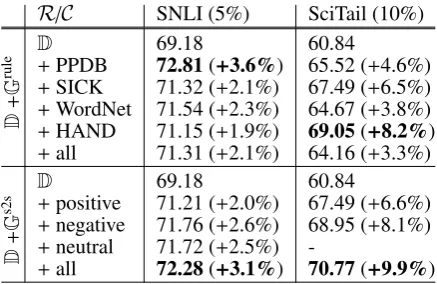
Table 5: Test accuracies across various rulesR
and classesC. Since SciTail has two classes, we only report results on two classes ofGs2s
R/C SNLI (5%) SciTail (10%)
D
+
G
rule
D 69.18 60.84
+PPDB 72.81(+3.6%) 65.52 (+4.6%)
+SICK 71.32 (+2.1%) 67.49 (+6.5%)
+WordNet 71.54 (+2.3%) 64.67 (+3.8%)
+HAND 71.15 (+1.9%) 69.05(+8.2%)
+all 71.31 (+2.1%) 64.16 (+3.3%)
D
+
G
s2s
D 69.18 60.84
+positive 71.21 (+2.0%) 67.49 (+6.6%)
+negative 71.76 (+2.6%) 68.95 (+8.1%)
+neutral 71.72 (+2.5%)
-+all 72.28(+3.1%) 70.77(+9.9%)
the best result compared to the baselines (D and Dretro). Especially, significant improvements are
made in less data setting: +2.77% in SNLI (1%) and 9.18% in SciTail (1%). Moreover,D+Grule’s
accuracy on SciTail (100%) also outperforms the previous state-of-the-art model (DGEM (Khot et al., 2018), which achieves 77.3%) for that dataset by 1.7%.
Among the three different generators combined with D, both Grule and Gs2s are useful in
Sci-Tail, whileGruleis much more useful thanGs2son
SNLI. We hypothesize that seq2seq model trained on large training sets such as SNLI will be able to reproduce the input sentences. Adversarial ex-amples from such a model are not useful since the entailment model uses the same training exam-ples. However, on smaller sets, the seq2seq model would introduce noise that can improve the robust-ness of the model.
5.2 Ablation Study
To evaluate the impact of each generator, we per-form ablation tests against each symbolic genera-tor in D+ Grule and the generator Gs2sc for each entailment classc. We use a 5% sample of SNLI and a 10% sample of SciTail. The results are sum-marized in Table5.
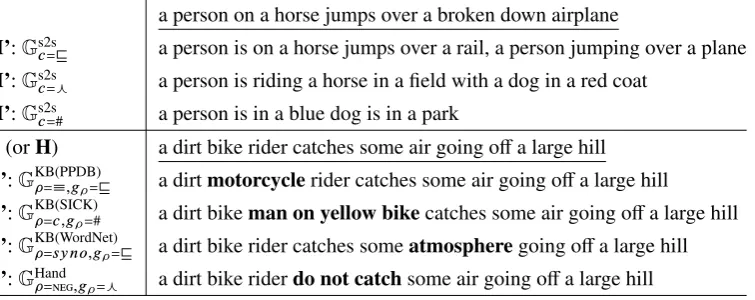
Table 6: Given a premiseP(underlined), examples of hypothesis sentencesH’ generated by seq2seq generators Gs2s, and premise sentences P’ generated by rule based generatorsGrule, on the full SNLI
data. Replaced words or phrases are shown in bold. This illustrates that even simple, easy-to-define rules can generate useful adversarial examples.
P a person on a horse jumps over a broken down airplane
H’:Gs2sc=v a person is on a horse jumps over a rail, a person jumping over a plane
H’:Gs2s
c=f a person is riding a horse in a field with a dog in a red coat
H’:Gs2sc=# a person is in a blue dog is in a park
P(orH) a dirt bike rider catches some air going offa large hill
P’:GKB(PPDB)=;g=v a dirtmotorcyclerider catches some air going offa large hill
P’:GKB(SICK)=c;g
=# a dirt bikeman on yellow bikecatches some air going offa large hill
P’:GKB(WordNet)=sy no;g=v a dirt bike rider catches someatmospheregoing offa large hill
P’:GHand=neg;g=f a dirt bike riderdo not catchsome air going offa large hill
examples) would end up learning a model relying on purely word overlap. We believe that the sim-ple negation examsim-ples introduceneutralexamples with high lexical overlap, forcing the model to find a more informative signal.
On the other hand, using all classes forGs2s
re-sults in the best performance, supporting the ef-fectiveness of the GAN framework for penaliz-ing or rewardpenaliz-ing generated sentences based on
D’s loss. Preferential selection of rules within the
GAN framework remains a promising direction.
5.3 Qualitative Results
Table 6 shows examples generated by various methods in AdvEntuRe. As shown, both seq2seq
and rule based generators produce reasonable sen-tences according to classes and rules. As ex-pected, seq2seq models trained on very few exam-ples generate noisy sentences. The quality of our knowledge-guided generators, on the other hand, does not depend on the training set size and they still produce reliable sentences.
5.4 Case Study: Negation
For further analysis of the negation-based gener-ator in Table1, we collect only the negation ex-amples in test set of SNLI, henceforth referred to as nega-SNLI. Specifically, we extract examples where either the premise or the hypothesis con-tains “not”, “no”, “never”, or a word that ends with “n’t’. These do not cover more subtle ways of ex-pressing negation such as “seldom” and the use of antonyms. nega-SNLI contains 201 examples with the following label distribution: 51 (25.4%)
neu-tral, 42 (20.9%) entails, 108 (53.7%) contradicts. Table7shows examples in each category.
Table 7: Negation examples in nega-SNLI
v P: several women are playing volleyball.H: this doesn’t look like soccer.
#
P: a man with no shirt on is performing with a baton.
H: a man is trying his best at the national championship of baton.
f
P: island native fishermen reeling in their nets after a long day’s work.
H: the men did not go to work today but instead played bridge.
WhileDachieves an accuracy of only 76.64%6
on nega-SNLI, D + GH with negate is
substan-tially more successful (+6.1%) at handling nega-tion, achieving an accuracy of 82.74%.
6 Conclusion
We introduced an adversarial training architec-ture for textual entailment. Our seq2seq and knowledge-guided example generators, trained in an end-to-end fashion, can be used to make any base entailment model more robust. The eff ec-tiveness of this approach is demonstrated by the significant improvement it achieves on both SNLI and SciTail, especially in the low to medium data regimes. Our rule-based generators can be ex-panded to cover more patterns and phenomena, and the seq2seq generator extended to incorporate per-example loss for adversarial training.
References
Gabor Angeli and Christopher D Manning. 2014. Nat-uralLI: Natural logic inference for common sense reasoning. InEMNLP, pages 534–545.
Islam Beltagy, Stephen Roller, Pengxiang Cheng, Ka-trin Erk, and Raymond J. Mooney. 2016. Repre-senting meaning with a combination of logical and distributional models. Computational Linguistics, 42:763–808.
Samuel R. Bowman, Gabor Angeli, Christopher Potts, and Christopher D. Manning. 2015. A large anno-tated corpus for learning natural language inference. InEMNLP.
Qian Chen, Xiaodan Zhu, Zhen-Hua Ling, and Diana Inkpen. 2018. Natural language inference with ex-ternal knowledge. InACL.
LI Chongxuan, Taufik Xu, Jun Zhu, and Bo Zhang. 2017. Triple generative adversarial nets. InNIPS, pages 4091–4101.
Manaal Faruqui, Jesse Dodge, Sujay K Jauhar, Chris Dyer, Eduard Hovy, and Noah A Smith. 2015. Retrofitting word vectors to semantic lexicons.
NAACL.
Juri Ganitkevitch, Benjamin Van Durme, and Chris Callison-Burch. 2013. PPDB: The paraphrase database. InNAACL-HLT, pages 758–764.
Max Glockner, Vered Shwartz, and Yoav Goldberg. 2018. Breaking nli systems with sentences that re-quire simple lexical inferences. InACL.
Yichen Gong, Heng Luo, and Jian Zhang. 2018. Natu-ral language inference over interaction space. ICLR.
Ian Goodfellow, Jean Pouget-Abadie, Mehdi Mirza, Bing Xu, David Warde-Farley, Sherjil Ozair, Aaron Courville, and Yoshua Bengio. 2014. Generative ad-versarial nets. InNIPS, pages 2672–2680.
Suchin Gururangan, Swabha Swayamdipta, Omer Levy, Roy Schwartz, Samuel R Bowman, and Noah A Smith. 2018. Annotation artifacts in natural language inference data. InNAACL.
Aria Haghighi, Andrew Ng, and Christopher Manning. 2005. Robust textual inference via graph matching. InEMNLP.
Zhiting Hu, Xuezhe Ma, Zhengzhong Liu, Eduard Hovy, and Eric Xing. 2016. Harnessing deep neu-ral networks with logic rules.ACL.
Thomas Icard III and Lawrence Moss. 2014. Recent progress in monotonicity. LiLT (Linguistic Issues in Language Technology), 9.
Mohit Iyyer, John Wieting, Kevin Gimpel, and Luke S. Zettlemoyer. 2018. Adversarial example generation with syntactically controlled paraphrase networks. InNAACL.
R. Jia and Percy Liang. 2017. Adversarial examples for evaluating reading comprehension systems. In
EMNLP.
Dongyeop Kang, Varun Gangal, Ang Lu, Zheng Chen, and Eduard Hovy. 2017. Detecting and explaining causes from text for a time series event. InEMNLP.
Tushar Khot, Ashish Sabharwal, and Peter Clark. 2018. SciTail: A textual entailment dataset from science question answering.AAAI.
George Lakoff. 1970. Linguistics and Natural Logic.
Synthese, 22(1-2):151–271.
Chen Liang, Jonathan Berant, Quoc Le, Kenneth D. Forbus, and Ni Lao. 2017. Neural symbolic ma-chines: Learning semantic parsers on freebase with weak supervision. InACL.
Thang Luong, Hieu Pham, and Christopher D. Man-ning. 2015. Effective approaches to attention-based neural machine translation. InEMNLP.
Bill MacCartney and Christopher D. Manning. 2012. Natural logic and natural language inference. In
Computing Meaning. Text, Speech and Language Technology, volume 47.
Marco Marelli, Stefano Menini, Marco Baroni, Luisa Bentivogli, Raffaella Bernardi, and Roberto Zam-parelli. 2014. A SICK cure for the evaluation of compositional distributional semantic models. In
LREC, pages 216–223.
Bryan McCann, James Bradbury, Caiming Xiong, and Richard Socher. 2017. Learned in translation: Con-textualized word vectors. InNIPS.
George A Miller. 1995. WordNet: a lexical database for english. Communications of the ACM, 38(11):39–41.
Nikola Mrkˇsi´c, Diarmuid O S´eaghdha, Blaise Thom-son, Milica Gaˇsi´c, Lina Rojas-Barahona, Pei-Hao Su, David Vandyke, Tsung-Hsien Wen, and Steve Young. 2016. Counter-fitting word vectors to lin-guistic constraints. InHLT-NAACL.
Ankur P. Parikh, Oscar T¨ackstr¨om, Dipanjan Das, and Jakob Uszkoreit. 2016. A decomposable attention model for natural language inference. InEMNLP.
Ellie Pavlick, Pushpendre Rastogi, Juri Ganitkevitch, Benjamin Van Durme, and Chris Callison-Burch. 2015. PPDB 2.0: Better paraphrase ranking, fine-grained entailment relations, word embeddings, and style classification. InACL.
Jeffrey Pennington, Richard Socher, and Christopher Manning. 2014. GloVe: Global vectors for word representation. InEMNLP, pages 1532–1543.
Rajat Raina, Aria Haghighi, Christopher Cox, Jenny Finkel, JeffMichels, Kristina Toutanova, Bill Mac-Cartney, Marie-Catherine de Marneffe, Christo-pher D Manning, and Andrew Y Ng. 2005. Robust textual inference using diverse knowledge sources. In 1st PASCAL Recognition Textual Entailment Challenge Workshop.
Pranav Rajpurkar, Jian Zhang, Konstantin Lopyrev, and Percy Liang. 2016. SQuAD: 100,000+questions for machine comprehension of text. InEMNLP.
Lei Sha, Sujian Li, Baobao Chang, and Zhifang Sui. 2016. Recognizing textual entailment via multi-task knowledge assisted lstm. InChinese Computational Linguistics and Natural Language Processing Based on Naturally Annotated Big Data, pages 285–298. Springer.
Vivian S Silva, Andr´e Freitas, and Siegfried Hand-schuh. 2018. Recognizing and justifying text entail-ment through distributional navigation on definition graphs. InAAAI.
Fred Sommers. 1982. The logic of natural language.
Ilya Sutskever, Oriol Vinyals, and Quoc V Le. 2014. Sequence to sequence learning with neural net-works. InNIPS, pages 3104–3112.
Shanshan Wang and Lei Zhang. 2017. CatGAN: Coupled adversarial transfer for domain generation.
CoRR, abs/1711.08904.
Zhiguo Wang, Wael Hamza, and Radu Florian. 2017. Bilateral multi-perspective matching for natural lan-guage sentences. InIJCAI.