1419
DIAG-NRE: A Neural Pattern Diagnosis Framework for
Distantly Supervised Neural Relation Extraction
Shun Zheng1 Xu Han2 Yankai Lin2 Peilin Yu3 Lu Chen1
Ling Huang1,4 Zhiyuan Liu2 Wei Xu1
1Institute for Interdisciplinary Information Sciences, Tsinghua University, Beijing, China 2 Department of Computer Science and Technology, Tsinghua University, Beijing, China
3Department of Computer Sciences, University of Wisconsin-Madison, Madison, USA 4AHI Fintech Inc., Beijing, China
{zhengs14,hanxu17,linyk14,lchen17}@mails.tsinghua.edu.cn; [email protected];
[email protected]; {liuzy,weixu}@tsinghua.edu.cn;
Abstract
Pattern-based labeling methods have achieved promising results in alleviating the inevitable labeling noises of distantly supervised neu-ral relation extraction. However, these meth-ods require significant expert labor to write relation-specific patterns, which makes them too sophisticated to generalize quickly. To ease the labor-intensive workload of pattern writing and enable the quick generalization to new relation types, we propose a neural pat-tern diagnosis framework, DIAG-NRE, that can automatically summarize and refine high-quality relational patterns from noise data with human experts in the loop. To demonstrate the effectiveness of DIAG-NRE, we apply it to two real-world datasets and present both sig-nificant and interpretable improvements over state-of-the-art methods. Source codes and data can be found at https://github. com/thunlp/DIAG-NRE.
1 Introduction
Relation extraction aims to extract relational facts from the plain text and can benefit downstream knowledge-driven applications. A relational fact is defined as arelationbetween a head entity and a tail entity, e.g., (Letizia Moratti,Birthplace,
Milan). The conventional methods often regard
relation extraction as a supervised classification task that predicts the relation type between two de-tected entities mentioned in a sentence, including both statistical models (Zelenko et al.,2003;Zhou et al.,2005) and neural models (Zeng et al.,2014;
dos Santos et al.,2015).
These supervised models require a large number of human-annotated data to train, which are both expensive and time-consuming to collect. There-fore,Craven et al.(1999);Mintz et al.(2009) pro-posed distant supervision (DS) to automatically generate large-scale training data for relation
ex-Knowledge Base Head Entity Tail Entity Relation
Letizia Moratti Milan Birthplace
Training Data for “Birthplace” Relation
Sentence DS
Label Ground
Truth Error Type Marjorie_Kelloggwas born in Santa_Barbara. 0 1 FN Mayor Letizia_Morattiof Milandisdainfully dismissed it . 1 0 FP
Distant Supervision
[image:1.595.313.521.223.301.2](DS)
Figure 1: Two types of error labels, false negatives (FN) and false positives (FP), caused by DS.
traction, by aligning relational facts from a knowl-edge base (KB) to plain text and assuming that every sentence mentioning two entities can de-scribe their relationships in the KB. As DS can ac-quire large-scale data without human annotation, it has been widely adopted by recent neural rela-tion extracrela-tion (NRE) models (Zeng et al.,2015;
Lin et al.,2016).
Although DS is both simple and effective in many cases, it inevitably introduces intolerable la-beling noises. As Figure 1 shows, there are two types of error labels, false negatives and false pos-itives. The reason for false negatives is that a sen-tence does describe two entities about a target re-lation, but the fact has not been covered by the KB yet. While for false positives, it is because not all sentences mentioning entity pairs actually express their relations in the KB. The noisy-labeling prob-lem can become severe when the KB and text do not match well and as a result heavily weaken the model performance (Riedel et al.,2010).
Recent research has realized that introducing appropriate human efforts is essential for reduc-ing such labelreduc-ing noises. For example, Zhang et al.(2012);Pershina et al.(2014); Angeli et al.
significantly larger number of noise labels. To enlarge the impact of human efforts, Ratner et al.(2016);Liu et al.(2017a) proposed to incor-porate pattern-based labeling, where the key idea was to regard both DS and pattern-based heuris-tics as the weak supervision sources and develop a weak-label-fusion (WLF) model to produce de-noised labels. However, the major limitation of the WLF paradigm lies in the requirement of human experts to write relation-specific patterns. Un-fortunately, writing good patterns is both a high-skill and labor-intensive task that requires ex-perts to learn detailed pattern-composing instruc-tions, examine adequate examples, tune patterns for different corner cases, etc. For example, the spouserelation example ofRatner et al.(2016) uses 11 functions with over 20 relation-specific keywords1. Even worse, when generalizing to a new relation type, we need to repeat the hard man-ual operations mentioned above again.
To ease the pattern-writing work of human ex-perts and enable the quick generalization to new relation types, we propose a neural pattern diag-nosis framework, DIAG-NRE, which establishes a bridge between DS and WLF, for common NRE models. The general workflow of DIAG-NRE, as Figure2 shows, contains two key stages: 1) pat-tern extraction, extracting potential patterns from NRE models by employing reinforcement learn-ing (RL), and 2) pattern refinement, asking hu-man experts to annotate a small set of actively se-lected examples. Following these steps, we not only minimize the workload and difficulty of hu-man experts by generating patterns automatically, but also enable the quick generalization by only re-quiring a small number of human annotations. Af-ter the processing of DIAG-NRE, we obtain high-quality patterns that are either supportive or un-supportive of the target relation with high proba-bilities and can feed them into the WLF stage to get denoised labels and retrain a better model. To demonstrate the effectiveness of DIAG-NRE, we conduct extensive experiments on two real-world datasets, where DIAG-NRE not only achieves sig-nificant improvements over state-of-the-art meth-ods but also provides insightful diagnostic results for different noise behaviors via refined patterns.
In summary, DIAG-NRE has the following con-tributions:
1https://github.com/HazyResearch/
snorkel/tree/master/tutorials/intro
DIAG-NRE
Pattern Refinement
High-quality Patterns Induced
Patterns
Weak Label Fusion (WLF) Pattern
Extraction
Distant Supervision
(DS) & Data NRE Model
[image:2.595.315.522.61.134.2]Denoised Labels DS Labels
Figure 2: An overview of DIAG-NRE.
• easing the pattern-writing work of human ex-perts by generating patterns automatically;
• enabling the quick generalization to new re-lation types by only requiring a small number of human annotations;
• presenting both significant and interpretable performance improvements as well as intu-itive diagnostic analyses.
Particularly, for one relation with severe false neg-ative noises, we improve the F1 score by about0.4. To the best of our knowledge, we are the first to ex-plicitly reveal and address this severe noise prob-lem for that dataset.
2 Related Work
To reduce labeling noises of DS, earlier work at-tempted to design specific model architectures that can better tolerate labeling noises, such as the multi-instance learning paradigm (Riedel et al.,
2010; Hoffmann et al., 2011; Surdeanu et al.,
2012;Zeng et al.,2015;Lin et al.,2016;Wu et al.,
2017). These models relax the raw assumption of DS by grouping multiple sentences that mention the same entity pair together as a bag and then as-suming that at least one sentence in this bag ex-presses the relation. This weaker assumption can alleviate the noisy-labeling problem to some ex-tent, but this problem still exists at the bag level, and Feng et al. (2018) discovered that bag-level models struggled to do sentence-level predictions. Later work tried to design a dynamic label-adjustment strategy for training (Liu et al.,2017b;
noise labels that coincide with the model predic-tions nor explain the reasons for removed or al-tered labels. As discussed in the introduction, in-troducing human efforts is a promising direction to contribute both significant and interpretable im-provements, which is also the focus of this paper.
As for the pattern-extraction part, we note that there are some methods with similar insights but different purposes. For example, Zhang et al.
(2018) improved the performance of the vanilla LSTM (Hochreiter and Schmidhuber, 1997) by utilizing RL to discover structured representations andLi et al.(2016) interpreted the sentiment pre-diction of neural models by employing RL to find the decision-changing phrases. However, NRE models are unique because we only care about the semantic inter-entity relation mentioned in the sentence. To the best of our knowledge, we are the first to extract patterns from NRE models by RL.
We also note that the relational-pattern mining has been extensively studied (Califf and Mooney,
1999;Carlson et al.,2010;Nakashole et al.,2012;
Jiang et al., 2017). Different from those studies, our pattern-extraction method 1) is simply based on RL, 2) does not rely on any lexical or syntac-tic annotation, and 3) can be aware of the pattern importance via the prediction of NRE models. Be-sides, Takamatsu et al. (2012) inferred negative syntactic patterns via the example-pattern-relation co-occurrence and removed the false-positive la-bels accordingly. In contrast, built upon modern neural models, our method not only reduces neg-ative patterns to alleviate false positives but also reinforces positive patterns to address false nega-tives at the same time.
3 Methodology
Provided with DS-generated data and NRE mod-els trained on them, DIAG-NRE can generate high-quality patterns for the WLF stage to produce denoised labels. As Figure2 shows, DIAG-NRE contains two key stages in general: pattern extrac-tion (Secextrac-tion3.2) and pattern refinement (Section
3.3). Moreover, we briefly introduce the WLF paradigm in Section3.4 for completeness. Next, we start with reviewing the common input-output schema of modern NRE models.
Reward
NRE Model
r
Encoder
Input Representation
Agent
w1
p1 p2
w2 wT
pT x
ˆ
w1
p1
ˆ
w2
p2
ˆ
wT pT
ˆ
x
State
a1 a2 aT a
Agent Network Action
New State
PER
Entities CITY
0 0
Actions 1 0 0 1
. Berlin in born was Joachim_Fest Tokens
Pattern-induction Example
[image:3.595.313.520.62.234.2]Pattern ENTITY1:PER PAD{1,3} born in ENTITY2:CITY
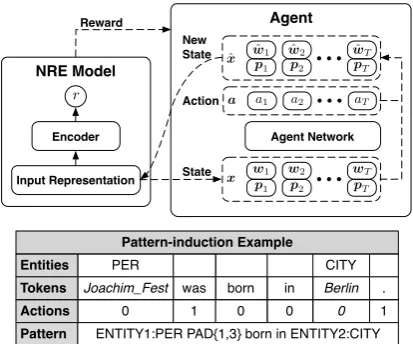
Figure 3: The RL-based pattern-extraction workflow and a typical pattern-induction example, where we in-duce a pattern for theBirthplacerelation via a se-ries of actions (0:retaining,1:erasing).
3.1 NRE Models
Given an instance s with T tokens2, a com-mon input representation of NRE models isx = [x1,x2,· · ·,xT], where xi ∈ Rd
x
denotes the embedding of tokenianddx is the token
embed-ding size. Particularly,xi is the concatenation of
the word embedding,wi ∈Rd
x
, and position em-bedding, pi ∈ Rd
p
, as [wi;pi], to be aware of
both semantics and entity positions, wheredx =
dw +dp. Given the relation typer, NRE models
perform different types of tensor manipulations on
xand obtain the predicting probability ofr given the instancesasPφ(r|x), whereφdenotes model
parameters except for the input embedding tables.
3.2 Pattern Extraction
In this stage, we build a pattern-extraction agent to distill relation-specific patterns from NRE mod-els with the aforementioned input-output schema. The basic idea is to erase irrelevant tokens and preserve the raw target prediction simultaneously, which can be modeled as a token-erasing decision process and optimized by RL. Figure3shows this RL-based workflow in a general way together with an intuitive pattern-induction example. Next, we elaborate details of this workflow.
Action. The agent takes an actionai, retaining
(0) or erasing(1), for each token of the instance
sand transforms the input representation from x
into xˆ. During this process, the column i ofx,
2In this paper, we refer to a sentence together with an
xi = [wi;pi], corresponding to the token i of
raw instances, is transformed intoxˆi = [ ˆwi;pi],
where the position vectors are left untouched and the new word vector wˆi is adjusted based on the
action taken by the agent. For theretainingaction, we retain the raw word vector aswˆi =wi. While
for erasing, we setwˆi to be all zeros to remove
the semantic meaning. After taking a sequence of actions, a = [a1;a2;· · · ;aT], we get the
trans-formed representationxˆwithTˆtokens retained.
Reward. Our purpose is to find the most
sim-plified sequence that preserves the raw prediction confidence. Therefore, given the raw input repre-sentationxand the corresponding action vectora, we define the reward as follows:
R(a|x) = log
Pφ(r|xˆ)
Pφ(r|x)
| {z }
Prediction Confidence
+η·(1−T /Tˆ )
| {z }
Sparsity
,
where the total reward is composed of two parts: one is the log-likelihood term to pursue the high prediction confidence and the other is the sparse ratio term to induce sparsity in terms of retained tokens. We balance these two parts through a hyper-parameterη.
State. To be general, the state provided to the
agent should be independent of NRE architectures. Moreover, the state needs to incorporate complete information of the current instance. Therefore, in our design, the agent directly employs the input representationxas the state.
Agent. We employ policy-based RL to train a
neural-network-based agent that can predict a se-quence of actions for an instance to maximize the reward. Our agent network directly esti-mates πΘ(a|x) = Qi=1T πΘ(ai|x) in a
non-autoregressive manner by calculatingπΘ(ai|x)in
parallel, where Θ denotes the parameters of the agent network. To enrich the contextual infor-mation when deciding the action for each token, we employ the forward and backward LSTM net-works to encodexintohas
− →
h = [−→h1,
− →
h2,· · · ,
− →
hT] =Forward-LSTM(x),
←−
h = [←−h1,
←−
h2,· · · ,
←−
hT] =Backward-LSTM(x),
h= [h1, h2,· · · , hT] =Concatenate(
− →
h,←h−),
where−→hi ∈ Rd
h
,←−hi ∈ Rd
h
, hi = [
− →
hi;
←−
hi] ∈
R2×d
h
, anddh denotes the size of LSTM’s
hid-den state. Then, we employ an attention-based
strategy (Bahdanau et al.,2015) to aggregate the contextual information as c = [c1, c2,· · ·, cT].
For each tokeni, we compute the context vector
ci ∈R2d
h
as follows:
ci=
T
X
j=1
αjihj,
where each scalar weight αi
j is calculated by
ei j/(
PT
k=1eik). Here eij is computed by a small
network asei
j =vα>tanh(Wxxi+Whhj), where
Wx ∈ R2dh×dx, W
h ∈ R2dh×2dh and v
α ∈
R2dh are network parameters. Next, we
com-pute the final representation to infer actions as
z = [z1, z2,· · · , zT], where for each token i,
zi = [xi;ci] ∈ Rd
x+2dh
incorporates semantic, positional and contextual information. Finally, we estimate the probability of taking actionai for
to-kenias
πΘ(ai|x) =oaii·(1−oi)(1−ai),
whereoi =sigmoid(Wo>zi+bo),Wo∈Rd
x+2dh andbo∈R1 are network parameters.
Optimization. We employ the REINFORCE
al-gorithm (Williams, 1992) and policy gradient methods (Sutton et al., 2000) to optimize param-eters of the agent network, where the key step is to rewrite the gradient formulation and then apply the back-propagation algorithm (Rumelhart et al.,
1986) to update network parameters. Specifically, we define our objective as:
L(Θ) =Es
EπΘ(a|x)R(a|x)
,
wherexdenotes the input representation of the in-stances. By taking the derivative ofJ(Θ)with re-spect toΘ, we can obtain the gradient∇ΘL(Θ)as
Es[EπΘ(a|x)[R(a|x)∇ΘlogπΘ(a|x)]]. Besides,
we utilize the-greedy trick to balance exploration and exploitation.
Pattern Induction. Given instances and
Human Annotation
Ground Truth Instances
✔ Instance P1-2
✔ Instance P1-1
✖ Instance P2-1
Relation Typer
Pattern Hierarchy
Pattern 2
Pattern 2.1
Pattern 2.1.1 Pattern 1
Pattern 1.1 Pattern 1.2
G
e
t
Pa
tte
rn
-m
a
tc
h
e
d
I
n
s
ta
n
c
e
[image:5.595.78.284.62.181.2]s
Figure 4: The human-in-the-loop pattern refinement.
medium (4-9 tokens) and long (10 or more tokens) distance. For instance, Figure 3 shows a typical pattern-induction example. Patterns with such for-mats can incorporate multiple kinds of crucial in-formation, such as entity types, key tokens and the relative distance among them.
3.3 Pattern Refinement
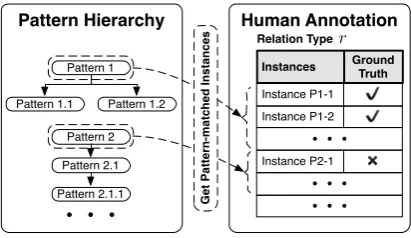
The above pattern-extraction stage operates at the instance level by producing a pattern for each eval-uated instance. However, after aggregating avail-able patterns at the dataset level, there inevitably exist redundant ones. Therefore, we design a pat-tern hierarchy to merge redundant patpat-terns. Af-terward, we can introduce human experts into the workflow by asking them to annotate a small num-ber of actively selected examples. Figure4shows the general workflow of this stage.
Pattern Hierarchy. To identify redundant
pat-terns, we group multiple instances with the same pattern and build a pattern hierarchy by the match-ing statistics. In this hierarchy, the parent pat-tern should cover all instances matched by the child pattern. As the parent pattern already has sufficient relation-supporting signals, we can omit child patterns for human annotation. Moreover, the number of instances from which the pattern can be induced is closely related to the pattern rep-resentativeness. Therefore, we follow the decreas-ing order of this number to select topnrmost
rep-resentative patterns for human annotation.
Human Annotation. To quantitatively
evalu-ate the pattern quality, we adopt an approximevalu-ate method by randomly selectingnapattern-matched
instances and annotating them manually. Thus, for each relation type, we end up withnr∗na
human-annotated instances. We assign patterns with the accuracy higher thanphand lower thanplinto the
positive pattern set and the negative pattern set,
re-spectively, to serve the WLF stage. In practice, users can tune these hyper-parameters (nr,na,ph
andpl) accordingly for different applications, such
as increasingph to prefer precision. While in this
paper, to show the wide applicability and robust-ness of DIAG-NRE, we demonstrate that a single configuration can handle all 14 relation types.
3.4 Weak Label Fusion
The WLF model aims to fuse weak labels from multiple labeling sources, including both DS and patterns, to produce denoised labels. In this paper, we adopt data programming (DP) (Ratner et al.,
2016) at our WLF model. The input unit of DP is calledlabeling function(LF), which takes one in-stance and emits a label (+1:positive, -1: negative
or 0: unknown). In our case, the LF of DS gen-erates +1 or -1, LFs of positive patterns generate +1 or 0, and LFs of negative patterns generate -1 or 0. We estimate parameters of DP on the small set of human-annotated labels with a closed-form solution (see the appendix for detailed formutions). With the help of DP, we get denoised la-bels to retrain a better model. Note that designing better generic WLF models is still a hot research topic (Varma et al., 2016; Bach et al., 2017; Liu et al., 2017a) but outside the scope of this work, which is automatically generating patters to ease human’s work.
4 Experiments
In this section, we present experimental results and comprehensive analyses to demonstrate the ef-fectiveness of DIAG-NRE.
4.1 Experimental Setup
Evaluation. To clearly show the different noise
behaviours for various relation types, we treat each relation prediction task as a single binary classifi-cation problem, that is predicting the existing or not of that relation for a given instance. Different from previous studies, we report relation-specific metrics (Precision, Recall and F1 scores, all in the percentage format) and macro-averaged ones at the dataset level, because the distribution of rela-tion types is extremely imbalanced and the micro-averaged evaluation inevitably overlooks noisy-labeling issues of many relation types. Moreover, we only utilize human-annotated test data to eval-uate models trained on noise labels, asRatner et al.
TID Relation Abbreviation Train Test
NYT
R0 Bus./Company 5.3k 186
R1 Loc./Admin. Div. 4.9k 180
R2 Loc./Capital 5.3k 20
R3 Loc./Contains 44.6k 263
R4 Loc./Country 4.9k 89
R5 Loc./Neighbor. 5.6k 55
R6 Peo./National. 7.5k 84
R7 Peo./Place Lived 6.7k 230
R8 Peo./Birthplace 3.1k 16
R9 Peo./Deathplace 1.9k 19
UW
Ru6 Peo./National. 107k 1.8k
Ru7 Peo./Place Lived 20.9k 3.8k
Ru8 Peo./Birthplace 15.3k 458
[image:6.595.77.287.63.228.2]Ru9 Peo./Deathplace 5.7k 1.3k
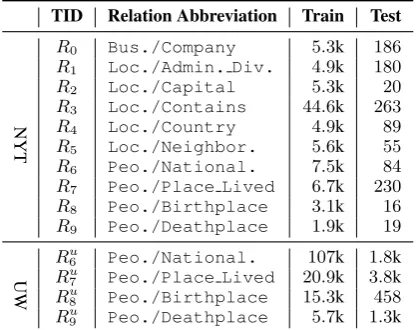
Table 1: The total14relation prediction tasks with cor-responding task IDs (TIDs), relation abbreviations and the number of positive labels in the train and test sets. The train set, generated by DS, contains452,223and 395,738instances for NYT and UW, respectively. The test set, annotated by the human, contains1,027 and 15,622instances for NYT and UW, respectively.
severe labeling noises of many relation types heav-ily weaken the reliability of the DS-based held-out evaluation(Mintz et al.,2009), which cannot judge the performance accurately.
Data & Tasks. We select top ten relation types
with enough coverage (over1,000instances) from the NYT dataset (Riedel et al., 2010)3 and all four relation types from the UW dataset (Liu et al., 2016)4. Originally, the NYT dataset con-tains a train set and a test set both generated by DS with522,611and172,448instances, respec-tively; the UW dataset contains a train set gener-ated by DS, a crowd-annotgener-ated set and a minimal human-annotated test set with 676,882, 18,128
and164instances, respectively. To enable the re-liable evaluation based on human annotations, for the NYT dataset, we randomly select up to 100
instances per relation (including the special un-known relation NA) from the test set and manu-ally annotate them; while for the UW dataset, we directly utilize the crowd-annotated set (disjoint from the train set) with the broad coverage and very high quality as the ground truth. Table1 sum-maries detailed statistics of these14tasks.
Hyper-parameters. We implement DIAG-NRE
based on Pytorch5 and directly utilize its default
3http://iesl.cs.umass.edu/riedel/ecml/ 4
https://www.cs.washington.edu/ai/ gated_instructions/naacl_data.zip
5https://pytorch.org/
initialization for neural networks. For the NRE model, we adopt a simple yet effective LSTM-based architecture described inZhou et al.(2016) and adopt widely-used hyper-parameters (see the appendix for details). As for DIAG-NRE, we use the following configuration for all 14 tasks. For the agent network, the LSTM hidden size is
200, the optimizer is Adam with a learning rate of 0.001, the batch size is 5, and the training epoch is 10. At the pattern-extraction stage, we use= 0.1and alterηin{0.05,0.1,0.5,1.0,1.5} to train multiple agents that tend to squeeze pat-terns with different granularities and combine out-puts of all agents to serve the pattern-refinement stage. To speed up the agent training, we use fil-tered instances by taking the top10,000ones with the highest prediction probabilities. At the pattern-refinement stage, hyper-parameters includenr =
20, na = 10,ph = 0.8andpl = 0.1. Thus, for
each task, we get200human-annotated instances (about0.05%of the entire train set) and at most20
patterns for the WLF stage.
4.2 Performance Comparisons
Based on the above hyper-parameters, DIAG-NRE together with the WLF model can produce de-noised labels to retrain a better NRE model. Next, we present the overall performance comparisons of NRE models trained with different labels.
Baselines. We adopt the following baselines:
1) Distant Supervision, the vanilla DS described
in Mintz et al. (2009), 2) Gold Label Mix (Liu et al., 2016), mixing human-annotated high-quality labels with DS-generated noise labels, and 3)RLRE(Feng et al.,2018), building an instance-selection agent to select correct-labeled ones by only interacting with NRE models trained on noise labels. Specifically, for Gold Label Mix, we use the same 200 labels obtained at the pattern-refinement stage as the high-quality labels. To fo-cus on the impact of training labels produced with different methods, besides for fixing all hyper-parameters exactly same, we run the NRE model with five random seeds, ranging from 0 to 4, for each case and present the averaged scores.
Overall Results. Table 2 shows the overall
re-sults with precision (P.), recall (R.) and F1 scores. For a majority of tasks suffering large labeling noises, includingR1,R4,R5,R8,R9andRu8, we
TID Distant Supervision Gold Label Mix RLRE DIAG-NRE
P. R. F1 P. R. F1 P. R. F1 P. R. F1 Inc-DS Inc-Best
R0 95.1 41.5 57.8 95.7 40.8 57.2 97.7 32.4 48.6 95.7 42.8 59.1 +1.4 +1.4
R1 91.9 9.1 16.4 90.2 11.7 20.2 92.6 4.2 8.0 94.5 44.8 60.7 +44.3 +40.4
R2 37.0 83.0 50.8 40.0 85.0 54.0 64.8 68.0 66.1 42.4 85.0 56.0 +5.2 -10.1
R3 87.5 79.2 83.2 87.1 80.2 83.5 87.5 79.2 83.2 87.0 79.8 83.2 +0.0 -0.3
R4 95.3 50.1 64.7 94.1 49.0 63.9 98.2 47.9 64.0 94.5 57.5 71.5 +6.7 +6.7
R5 82.7 29.1 42.9 84.7 29.5 43.6 82.7 29.1 42.9 84.5 37.5 51.8 +8.9 +8.3
R6 82.0 83.8 82.8 81.6 84.0 82.7 82.0 83.8 82.8 81.5 83.3 82.3 -0.5 -0.5
R7 82.3 22.3 35.1 82.0 22.6 35.4 83.5 21.8 34.5 82.0 25.6 39.0 +3.8 +3.6
R8 66.2 32.5 39.8 70.5 47.5 55.8 66.2 32.5 39.8 73.4 61.3 65.5 +25.7 +9.7
R9 85.4 73.7 77.9 85.9 80.0 81.5 85.4 73.7 77.9 89.0 87.4 87.1 +9.2 +5.6
Avg. 80.5 50.4 55.1 81.2 53.0 57.8 84.1 47.3 54.8 82.5 60.5 65.6 +10.5 +6.5
Ru6 35.9 75.7 48.7 35.8 75.0 48.5 36.0 75.3 48.7 36.2 74.5 48.7 +0.0 -0.0
Ru7 57.8 18.5 28.0 59.3 19.1 28.8 57.8 18.5 28.0 56.3 23.5 33.1 +5.1 +4.3
Ru8 37.3 64.0 46.9 40.0 64.9 49.1 37.3 64.0 46.9 48.1 71.9 57.5 +10.6 +8.3
Ru9 77.1 71.3 74.0 77.5 70.3 73.5 77.1 71.3 74.0 80.7 71.1 75.4 +1.5 +1.5
Avg. 52.0 57.4 49.4 53.1 57.3 50.0 52.0 57.3 49.4 55.3 60.2 53.7 +4.3 +3.5
Table 2: Overall results for14tasks, where we present relation-specific scores, the macro-averaged ones (Avg.), the F1 improvement of DIAG-NRE over the vanilla DS (Inc-DS) and the best baseline (Inc-Best), and we highlight the best F1 for each task and the significant improvements.
TID Prec. Recall Acc. #Pos. #Neg.
R0 100.0 81.8 82.0 20 0
R1 93.9 33.5 36.2 18 0
R2 75.7 88.0 76.5 9 5
R3 100.0 91.4 92.0 20 0
R4 93.3 72.4 80.9 10 2
R5 93.8 77.3 86.5 15 0
R6 88.3 76.9 75.1 14 0
R7 91.9 64.6 64.0 20 0
R8 29.3 30.4 60.0 4 10
R9 66.7 38.1 74.4 6 11
Ru6 81.8 90.7 81.0 7 0
Ru7 93.5 70.7 68.3 17 1
Ru8 35.0 70.0 60.0 4 15
[image:7.595.86.276.329.489.2]Ru9 87.5 59.2 67.7 12 5
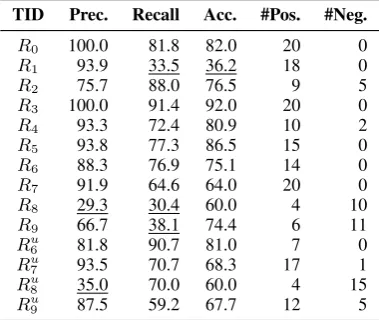
Table 3: Total diagnostic results, where columns con-tain the precision, recall and accuracy of DS-generated labels evaluated on 200 human-annotated labels as well as the number of positive and negative patterns pre-served after the pattern-refinement stage, and we un-derline some cases in which DS performs poorly.
reached40. For some tasks with fewer noises, in-cludingR0,R7,Ru7 andRu9, our method can
ob-tain small improvements. For a few tasks, such asR3, R6 andRu6, only using DS is sufficient to
train competitive models. In such cases, fusing other weak labels may have negative effects, but these side effects are small. The detailed reasons for these improvements will be elaborated together with the diagnostic results in Section 4.3. An-other interesting observation is that RLRE yields the best result on tasksR2 andRu6 but gets worse
results than the vanilla DS on tasks R0, R1, R4
andR7. Since the instance selector used in RLRE
is difficult to be interpreted, we can hardly figure out the specific reason. We conjecture that this be-havior is due to the gap between maximizing the likelihood of the NRE model and the ground-truth instance selection. In contrast, DIAG-NRE can contribute both stable and interpretable improve-ments with the help of human-readable patterns.
4.3 Pattern-based Diagnostic Results
Besides for improving the extraction performance, DIAG-NRE can interpret different noise effects caused by DS via refined patterns, as Table 3
shows. Next, we elaborate these diagnostic results and the corresponding performance degradation of NRE models from two perspectives: false nega-tives (FN) and false posinega-tives (FP).
FN. A typical example of FN is task R1
(Administrative Division), where the precision of DS-generated labels is fairly good but the recall is too low. The underlying reason is that the relational facts stored in the KB cover too few real facts actually contained by the corpus. This low-recall issue introduces too many neg-ative instances with common relation-supporting patterns and thus confuses the NRE model in cap-turing correct features. This issue also explains results of R1 in Table 2 that the NRE model
im-TID Patterns & Matched Examples DS RLRE DIAG-NRE
R1
Pos. Pattern:in ENTITY2:CITY PAD{1,3} ENTITY1:COUNTRY (DS Label:382 / 2072) Example:He will , however , perform this month inRotterdam, the
Netherlands, and Prague . 0 None 0.81
R8
Pos. Pattern:ENTITY1:PER PAD{1,3} born PAD{1,3} ENTITY2:CITY (DS Label:44 / 82)
Example:Marjorie Kelloggwas born inSanta Barbara. 0 0 1.0
Neg. Pattern:mayor ENTITY1:PER PAD{1,3} ENTITY2:CITY (DS Label:21 / 62)
Example:MayorLetizia MorattiofMilandisdainfully dismissed it . 1 1 0.0
Ru9
Pos. Pattern:ENTITY1:PER died PAD{4,9} ENTITY2:CITY (DS Label:66 / 108)
Example:Dahmdied Thursday at an assisted living center inHuntsville... 0 0 1.0 Neg. Pattern:ENTITY1:PER PAD{4,9} rally PAD{1,3} ENTITY2:CITY (DS Label:40 / 87)
[image:8.595.319.511.285.417.2]Example:Bhuttovowed to hold a rally inRawalpindion Friday ... 1 1 0.0
Table 4: Positive (Pos.), negative (Neg.) patterns and associated examples with labels produced by different methods. For each pattern, we present “DS Label” as the number of DS-generated positive labels over the number of pattern-matched instances. For RLRE,Nonemeans the instance is removed. For DIAG-NRE, we present the soft label produced by the WLF model.
provements due to much higher recall. For tasks
R8 (Birthplace) andR9(Deathplace), we
observe the similar low-recall issues.
FP. The FP errors are mainly caused by the as-sumption of DS described in the introduction. For example, the precision of DS-generated labels for tasks R8 and Ru8 is too low. This low precision
means that a large portion of DS-generated posi-tive labels do not indicate the target relation. Thus, this issue inevitably causes the NRE model to ab-sorb some irrelevant patterns. This explanation also corresponds to the fact that we have obtained some negative patterns. By reducing labels with FP errors through negative patterns, DIAG-NRE can achieve large precision improvements.
For other tasks, DS-generated labels are rela-tively good, but the noise issue still exists, major or minor, except for taskR3 (Contains), where
labels automatically generated by DS are incred-ibly accurate. We conjecture the reason for such high-quality labeling is that for task R3, the DS
assumption is consistent with the written language convention: when mentioning two locations with the containing relation in one sentence, people get used to declaring this relation explicitly.
4.4 Incremental Diagnosis
In addition to the performance comparisons based on 200 human-annotated instances, we show the incremental diagnosis ability of DIAG-NRE by gradually increasing the number of human anno-tations from10to200. As Figure5shows, where we pick those tasks (three from NYT and two from UW) suffering large labeling noises, most tasks experience a rapid improvement phase with the
10 50 100 150 200
# of human annotations 1
5 10 20 40
F1 improvements over DS
R1 R8 R9
Ru7 Ru8
Figure 5: The F1 improvements of DIAG-NRE over DS with the increased number of human annotations.
help of high-quality patterns automatically gen-erated by DIAG-NRE and then enter a saturate phase where adding annotations does not con-tribute much. This saturation accords with the in-tuition that high-quality relational patterns are of-ten limited. The only exception is task R9 that
drops first and then increases again, the reason is that the fully automatic pattern refinement of DIAG-NRE produces one incorrect pattern acci-dentally, while later patterns alleviate this mistake. Actually, in practice, users can further curate pat-terns generated by DIAG-NRE to get even better results, which can also be much easier and quicker than writing patterns from scratch.
4.5 Case Studies
Table 4 shows five pattern examples from three tasks. For task R1, the positive pattern can
rem-edy the extremely low coverage caused by DS. For tasksR8andRu9, besides for the help of the
FP labels caused by DS. These cases intuitively il-lustrate the ability of DIAG-NRE to diagnose and denoise DS-generated labels.
5 Conclusion and Future Work
In this paper, we propose a neural pattern diag-nosis framework, DIAG-NRE, to diagnose and improve NRE models trained on DS-generated data. DIAG-NRE not only eases the hard pattern-writing work of human experts by generating pat-terns automatically, but also enables the quick gen-eralization to new relation types by only requiring a small number of human annotations. Coupled with the WLF model, DIAG-NRE can produce de-noised labels to retrain a better NRE model. Ex-tensive experiments with comprehensive analyses demonstrate that DIAG-NRE can contribute both significant and interpretable improvements.
For the future work, we plan to extend DIAG-NRE to other DS-based applications, such as ques-tion answering (Lin et al., 2018), event extrac-tion (Chen et al.,2017), etc.
Acknowledgements
This work is supported in part by the National Nat-ural Science Foundation of China (NSFC) Grant 61532001, 61572273, 61532010, Tsinghua Initia-tive Research Program Grant 20151080475, and gift funds from Ant Financial and Nanjing Turing AI Institute. Xu Han is also supported by 2018 Tencent Rhino-Bird Elite Training Program.
References
Gabor Angeli, Julie Tibshirani, Jean Wu, and Christo-pher D Manning. 2014. Combining distant and par-tial supervision for relation extraction. InEMNLP. Stephen H. Bach, Bryan He, Alexander Ratner, and
Christopher R´e. 2017. Learning the structure of gen-erative models withut labeled data. InICML. Dzmitry Bahdanau, Kyunghyun Cho, and Yoshua
Ben-gio. 2015. Neural machine translation by jointly learning to align and translate. InICLR.
Mary Elaine Califf and Raymond J. Mooney. 1999. Re-lational learning of pattern-match rules for informa-tion extracinforma-tion. InAAAI.
Andrew Carlson, Justin Betteridge, Bryan Kisiel, Burr Settles, Estevam R Hruschka Jr, and Tom M Mitchell. 2010. Toward an architecture for never-ending language learning. InAAAI.
Yubo Chen, Shulin Liu, Xiang Zhang, Kang Liu, and Jun Zhao. 2017. Automatically labeled data genera-tion for large scale event extracgenera-tion. InACL. Mark Craven, Johan Kumlien, et al. 1999.
Construct-ing biological knowledge bases by extractConstruct-ing infor-mation from text sources. InISMB.
Jun Feng, Minlie Huang, Li Zhao, Yang Yang, and Xi-aoyan Zhu. 2018. Reinforcement learning for rela-tion classificarela-tion from noisy data. InAAAI. Sepp Hochreiter and J¨urgen Schmidhuber. 1997. Long
short-term memory.Neural computation.
Raphael Hoffmann, Congle Zhang, Xiao Ling, Luke Zettlemoyer, and Daniel S Weld. 2011. Knowledge-based weak supervision for information extraction of overlapping relations. InACL.
Meng Jiang, Jingbo Shang, Taylor Cassidy, Xiang Ren, Lance M Kaplan, Timothy P Hanratty, and Jiawei Han. 2017. Metapad: meta pattern discovery from massive text corpora. InKDD.
Diederik P Kingma and Jimmy Ba. 2014. Adam: A method for stochastic optimization. arXiv preprint arXiv:1412.6980.
Jiwei Li, Will Monroe, and Dan Jurafsky. 2016. Un-derstanding neural networks through representation erasure. arXiv preprint arXiv:1612.08220.
Yankai Lin, Haozhe Ji, Zhiyuan Liu, and Maosong Sun. 2018. Denoising distantly supervised open-domain question answering. InACL.
Yankai Lin, Shiqi Shen, Zhiyuan Liu, Huanbo Luan, and Maosong Sun. 2016. Neural relation extraction with selective attention over instances. InACL. Angli Liu, Stephen Soderland, Jonathan Bragg,
Christopher H Lin, Xiao Ling, and Daniel S Weld. 2016. Effective crowd annotation for relation ex-traction. InNAACL-HLT.
Liyuan Liu, Xiang Ren, Qi Zhu, Shi Zhi, Huan Gui, Heng Ji, and Jiawei Han. 2017a. Heterogeneous supervision for relation extraction: a representation learning approach. InEMNLP.
Tianyu Liu, Kexiang Wang, Baobao Chang, and Zhi-fang Sui. 2017b. A soft-label method for noise-tolerant distantly supervised relation extraction. In EMNLP.
Bingfeng Luo, Yansong Feng, Zheng Wang, Zhanxing Zhu, Songfang Huang, Rui Yan, and Dongyan Zhao. 2017. Learning with noise: enhance distantly su-pervised relation extraction with dynamic transition matrix. InACL.
Ndapandula Nakashole, Gerhard Weikum, and Fabian Suchanek. 2012. Patty: a taxonomy of relational patterns with semantic types. InEMNLP.
Jeffrey Pennington, Richard Socher, and Christopher Manning. 2014. Glove: global vectors for word rep-resentation. InEMNLP.
Maria Pershina, Bonan Min, Wei Xu, and Ralph Gr-ishman. 2014. Infusion of labeled data into distant supervision for relation extraction. InACL.
Pengda Qin, Weiran Xu, and William Yang Wang. 2018. Robust distant supervision relation extraction via deep reinforcement learning. InACL.
Alexander J Ratner, Christopher M De Sa, Sen Wu, Daniel Selsam, and Christopher R´e. 2016. Data pro-gramming: creating large training sets, quickly. In NIPS.
Sebastian Riedel, Limin Yao, and Andrew McCallum. 2010. Modeling relations and their mentions with-out labeled text. InECML.
David E Rumelhart, Geoffrey E Hinton, and Ronald J Williams. 1986. Learning representations by back-propagating errors.Nature.
Cicero dos Santos, Bing Xiang, and Bowen Zhou. 2015. Classifying relations by ranking with convo-lutional neural networks. InACL.
Mihai Surdeanu, Julie Tibshirani, Ramesh Nallapati, and Christopher D Manning. 2012. Multi-instance multi-label learning for relation extraction. In EMNLP.
Richard S Sutton, David A McAllester, Satinder P Singh, and Yishay Mansour. 2000. Policy gradi-ent methods for reinforcemgradi-ent learning with func-tion approximafunc-tion. InNIPS.
Shingo Takamatsu, Issei Sato, and Hiroshi Nakagawa. 2012. Reducing wrong labels in distant supervision for relation extraction. InACL.
Paroma Varma, Bryan He, Dan Iter, Peng Xu, Rose Yu, Christopher De Sa, and Christopher R´e. 2016. Socratic learning: augmenting generative models to incorporate latent subsets in training data. arXiv preprint arXiv:1610.08123.
Ronald J Williams. 1992. Simple statistical gradient-following algorithms for connectionist reinforce-ment learning. Machine learning.
Yi Wu, David Bamman, and Stuart Russell. 2017. Ad-versarial training for relation extraction. InEMNLP. Dmitry Zelenko, Chinatsu Aone, and Anthony Richardella. 2003. Kernel methods for relation ex-traction. JMLR.
Daojian Zeng, Kang Liu, Yubo Chen, and Jun Zhao. 2015. Distant supervision for relation extraction via piecewise convolutional neural networks. In EMNLP.
Daojian Zeng, Kang Liu, Siwei Lai, Guangyou Zhou, Jun Zhao, et al. 2014. Relation classification via convolutional deep neural network. InCOLING. Ce Zhang, Feng Niu, Christopher R´e, and Jude
Shav-lik. 2012. Big data versus the crowd: looking for relationships in all the right places. InACL. Tianyang Zhang, Minlie Huang, and Li Zhao. 2018.
Learning structured representation for text classifi-cation via reinforcement learning. InAAAI. Guodong Zhou, Jian Su, Jie Zhang, and Min Zhang.
2005. Exploring various knowledge in relation ex-traction. InACL.
A Appendices
In the appendices, we introduce formulation de-tails of the weak-label-fusion (WLF) model and the hyper-parameters for our neural relation ex-traction (NRE) model.
A.1 Weak Label Fusion
As mentioned in the main body, we employ the
data programming (DP) (Ratner et al., 2016) as
our WLF model. DP proposed an abstraction of the weak label generator, named as the labeling
function(LF), which can incorporate both DS and
pattern-based heuristics. Typically, for a binary classification task, an LF is supposed to produce one label (+1: positive, -1: negative or 0: un-known) for each input instance. In our case, the LF of DS generates +1 or -1, LFs of positive patterns generate +1 or 0, and LFs of negative patterns gen-erate -1 or 0.
Given m labeling functions, we can write the joint probability of weak labelsLsand the true
la-belYs ∈ {−1,+1}for instances,P
α,β(Ls, Ys),
as
1 2
m
Y
i=1
(βiαi1{Ls
i=Ys}+βi(1−αi)1{Lsi=−Ys}
+ (1−βi)1{Ls i=0}), where eachLs
i ∈ {−1,0,+1} denotes the weak
label generated for instancesby the ith labeling
function, andαandβare model parameters to be estimated.
Originally, Ratner et al. (2016) conducted the unsupervised parameter estimation based on unla-beled data by solving
max
α,β
X
s∈S
log X
Ys
Pα,β(Ls, Ys))
!
.
Different from the general DP that treats each LF with the equal prior, we have strong priors that patterns produced by DIAG-NRE are either sup-portive or unsupsup-portive of the target relation with high probabilities. Therefore, in our case, we di-rectly employ the small labeled setSLobtained at
the pattern-refinement stage to estimate(α,β)by solving
max
α,β
X
s∈SL
logPα,β(Ls, Ys),
where the closed-form solutions are
αi=
P
s∈SL1{Lsi=Ys}
P
s∈SL
h
1{Ls
i=Ys}+1{Lsi=−Ys}
i,
βi=
P
s∈SL
h
1{Ls
i=Ys}+1{Lsi=−Ys}
i
|SL|
,
for each i ∈ {1,· · · , m}. After estimating these parameters, we can infer the true label distribu-tion by the posteriorPα,β(Ys|Ls)and use the
de-noised soft label to train a better NRE model, just asRatner et al.(2016) did.
A.2 Hyper-parameters of the NRE model
For the NRE model, we implement a simple yet effective LSTM-based architecture described in (Zhou et al., 2016). We conduct the hyper-parameter search via cross-validation and adopt the following configurations that can produce pretty good results for all 14 tasks. First, the word embedding table (dw = 100) is initialized
with Glove vectors (Pennington et al.,2014), the size of the position vector (dp) is 5, the
maxi-mum length of the encoded relative distance is
60, and we follow (Zeng et al., 2015;Lin et al.,
2016) to randomly initialize these position vec-tors. Besides, the LSTM hidden size is 200, and the dropout probabilities at the embedding layer, the LSTM layer and the last layer are 0.3, 0.3 and 0.5, respectively. During training, we employ the Adam (Kingma and Ba,2014) optimizer with the learning rate of 0.001 and the batch size of 50. Moreover, we select the best epoch according to the score on the validation set.