3190
MAAM: A Morphology-Aware Alignment Model for Unsupervised
Bilingual Lexicon Induction
Pengcheng Yang1,2, Fuli Luo2, Peng Chen2, Tianyu Liu2, Xu Sun1,2
1Deep Learning Lab, Beijing Institute of Big Data Research, Peking University
2MOE Key Lab of Computational Linguistics, School of EECS, Peking University
{yang pc, luofuli, chen.peng, tianyu0421, xusun}@pku.edu.cn
Abstract
The task of unsupervised bilingual lexicon in-duction (UBLI) aims to induce word transla-tions from monolingual corpora in two lan-guages. Previous work has shown that mor-phological variation is an intractable challenge for the UBLI task, where the induced transla-tion in failure case is usually morphologically related to the correct translation. To tackle this challenge, we propose a morphology-aware alignment model for the UBLI task. The pro-posed model aims to alleviate the adverse ef-fect of morphological variation by introduc-ing grammatical information learned by the pre-trained denoising language model. Results show that our approach can substantially out-perform several state-of-the-art unsupervised systems, and even achieves competitive per-formance compared to supervised methods.
1 Introduction
The task of unsupervised bilingual lexicon induc-tion aims at identifying translainduc-tional equivalents across two languages (Kementchedjhieva et al., 2018). It can be applied in plenty of real-scenarios, such as machine translation (Artetxe et al.,2018b), transfer learning (Zhou et al.,2016), and so on.
Based on the observation that embedding spaces of different languages exhibit similar structures, a prominent approach is to align monolingual em-bedding spaces of two languages with a simple lin-ear mapping (Zhang et al., 2017a;Lample et al., 2018). However, previous work (Artetxe et al., 2018a;Søgaard et al.,2018) has shown that mor-phological variation is an intractable challenge for the UBLI task. The induced translations in failure cases are usually morphologically related words. Due to similar semantics, these words can easily confuse the system to make the incorrect align-ment. Table 1 presents three randomly selected failure examples of MUSE (Lample et al., 2018)
Source word Top-3 of retrieved nearest neighbors
mangez eats eat buttered
suspendit suspending suspend suspended
diffusant broadcasts broadcast broadcasting
Table 1: Three randomly selected failure examples of MUSE on FR-EN language pair.Redwords are correct translations, which are all not the nearest translations.
on the FR-EN language pair, showing that all failures can be attributed to morphological vari-ation. For instance, for the French source word “mangez”, MUSE translates it to morphologically related word “eats”, instead of the correct English translation “eat”.
However, we find that additional grammatical information can help alleviate the adverse effect of morphological variation. In detail, since lexi-con induction (word alignment) can be regarded as word-to-word translation, the fluency of the translated sentence can reflect the quality of word alignment. If the model can retrieve the correct translation for each word in a source sentence, the translated sentence is more likely to be flu-ent and grammatically correct. Considering some problems (e.g. word order) of the naive word-to-word translation can also lead to poor fluency, we pre-train a denoising auto-encoder (DAE) to clean noise in the original translated sentence. Fig-ure1visually shows an example. For the French source word “mangez”, if the model translates it to “eats” instead of the correct English translation “eat”, the denoised translated sentence “you eats meat” is grammatically unreasonable. Therefore, by considering the fluency of the denoised trans-lated sentence, these morphologically retrans-lated er-roneous translations can be reasonably punished.
ad-Word-to-Word Translation
Denoising vous mangez da la viande
you eat of the meat
you eat meat
Word-to-Word Translation
Denoising vous mangez da la viande
you eats of the meat
[image:2.595.74.287.64.165.2]you eats meat Wrong Translation Correct Translation
Figure 1: Alleviate the adverse effect of morphological variation via grammatical information.
ditional grammatical information. The proposed model consists of a learnable linear transformation W between two languages and a parameter-fixed denoising evaluatorE. W is responsible for per-forming word-to-word translation on sentences in the source monolingual corpus. E first applies a DAE to clean noise in the original translated sen-tence, and then evaluates the fluency of the de-noised translated sentence via a language model pre-trained on the target monolingual corpus to guide the training ofW. Due to the discrete oper-ation of word-to-word transloper-ation, we employ RE-INFORCE algorithm (Williams,1992) to estimate the corresponding gradient. With the grammatical information contained inE, the adverse effect of morphological differences can be alleviated.
Our main contributions are listed as follows:
• We propose a morphology-aware alignment model for unsupervised bilingual lexicon in-duction, which aims to alleviate the ad-verse effect of morphological variation by introducing grammatical information learned from pre-trained language model.
• Extensive experimental results show that our approach achieves better performance than several state-of-the-art unsupervised systems, and even achieves competitive performance compared to supervised methods.
2 Proposed Model
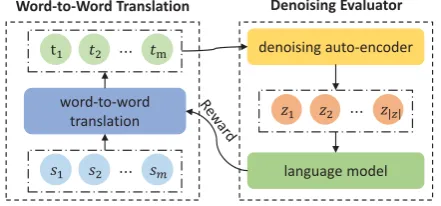
We useX ={xi}n1i=1 andY ={yi}n2i=1to denote the source and target monolingual embeddings, re-spectively. The task aims to find a linear transfor-mationWso that for any source word embedding x,Wxlies close to the embeddingyof its transla-tion. Figure2presents the sketch of our proposed morphology-aware alignment model, which con-sists of a learnable linear transformationWand a parameter-fixed denoising evaluatorE.
Word-to-Word Translation
word-to-word translation
Denoising Evaluator
denoising auto-encoder
language model
ݖଵ ݖଶ ڮ ݖ௭
ݏଵ ݏଶ ڮ ݏ ଵ ݐଶ ڮ ݐ୫
Figure 2: The sketch of the proposed model.
2.1 Word-to-Word Translation
The word-to-word translation is accomplished by linear transformation W. Specifically, for each wordsi in a source sentences= (s1,· · · , sm), it is translated by retrieving the nearest target word tibased on cosine1similarity.
ti = argmax
t cos(Wxsi, yt) (1)
wherexsi andytrepresent the pre-trained mono-lingual embedding of the source wordsiand target wordt, respectively.
2.2 Denoising Evaluator
The denoising evaluatorEaims to utilize learned grammar information to guild the training ofW. It contains two crucial components: a denoising auto-encoder (DAE) and a language model. Both components are pre-trained on the target monolin-gual corpus and remain fixed during training.
Denoising Auto-Encoder
Considering some ingrained problems (e.g. word order) of the naive word-to-word translation, the original translation t can be regarded as a noisy version of the ground-truth translation. Therefore, we adopt a DAE (Vincent et al., 2008) to clean noise int = (t1,· · · , tm) so thatE can provide a more accurate supervisory signal. Here we im-plement the DAE as an encoder-decoder frame-work (Bahdanau et al., 2015). The input is the noisy versionN(c)and the output is the cleaned sentence c, wherec is a sentence sampled from the target monolingual corpus. Following Kim et al. (2018), we construct N(c) by designing three noises: insertion, deletion, and reordering. Readers can refer to Kim et al. (2018) for more technical explanations.
1
[image:2.595.305.526.65.168.2]Language Model
For a source sentences, ifW is of high quality, the denoised translated sentence should keep flu-ent and grammatically correct. Otherwise, if W retrieves a morphologically related but erroneous word, the denoised translated sentence tends to be grammatically incorrect, leading to poor flu-ency. Therefore, a language model is used to eval-uate the fluency of translation to guide the training ofW. We implement the language model as an LSTM (Hochreiter and Schmidhuber,1997) struc-ture with weight tying. Since this part is not the focus of our work, readers can refer toPress and Wolf(2017) for the details. With the grammatical information learned by the pre-trained language model, erroneous word alignment due to morpho-logical variation is penalized. Therefore,Wis en-couraged to retrieve correct word translation with appropriate morphology.
2.3 Training and Testing
We encourageW to perform correct word align-ment so that the denoised translated sentences are fluent and grammatically correct. Therefore, the training objective is to minimize the negative ex-pected reward, which is formulated as follows:
L(s) =−Et
R(zt)logp(t|s)
(2)
wherezt is the output of denoising auto-encoder withtas the input,R(zt)is the reward evaluating the fluency ofzt, andp(t|s) is the probability of Woutputstby performing word-to-word transla-tion ons. We introduce them in detail as follows.
For thei-th wordsiin the source sentences, the probability ofW retrieving the target translation tican be characterized by the cosine similarity of both embeddingWxsiandyti. Formally,
p(ti|si) = exp
cos(Wxsi, yti)
texp
cos(Wxsi, yt)
(3)
Therefore,p(t|s)can be defined as the product of the probability corresponding to each position:
p(t|s) =m i=1
p(ti|si) (4)
The rewardR(zt) aims at evaluating the fluency of the denoised translated sentenceztto guide the training ofW, which is defined as follows:
R(zt) = exp
1 |zt|
|zt|
i=1
logq(zi|z<i)
(5)
wherezi is the i-th word inzt = (z1,· · ·, z|z|),
z<i refers to the sequence (z1,· · · , zi−1), and q(zi|z<i) is the probability that the pre-trained
language model outputs the word zi conditioned on z<i. If zt is fluent and grammatically cor-rect, the corresponding rewardR(zt)is relatively large. Therefore, the rewardR(zt)can be used as feedback to guide the training ofW. Since op-eration of word-to-word translation is discrete, we use REINFORCE algorithm (Williams, 1992) to estimate the gradient of Eq. (2) as follows:
∇WL(s)≈ −R(zt)−b∇Wlogp(t|s) (6)
wherebis the baseline that is responsible for re-ducing the variance of gradient estimate.
3 Experiments
3.1 Experiment Settings
We conduct experiments on the 300-dimfastText embeddings trained on Wikipedia. All words are lower-cased and only the frequent 200K words are used. We utilize approach inArtetxe et al.(2018a) to provide the initial linear transformation and lex-icon constructed by Lample et al.(2018) is used for evaluation. Here we report accuracy with near-est neighbor retrievalbased on cosine similarity. The parameters of the DAE and language model are provided in the Appendix. We set the batch size to 64 and the optimizer is SGD. The learn-ing rate is initialized to10−5 and it is halved af-ter every training epoch. The unsupervised crite-rion proposed inLample et al. (2018) is adopted as both a stopping criterion and a model selection criterion.
3.2 Experimental Results
Methods DE-EN EN-DE ES-EN EN-ES FR-EN EN-FR IT-EN EN-IT
Supervised:
Mikolov et al.(2013a) 61.93 73.07 74.00 80.73 71.33 82.20 68.93 77.60 Xing et al.(2015) 67.73 69.53 77.20 78.60 76.33 78.67 72.00 73.33 Shigeto et al.(2015) 71.07 63.73 81.07 74.53 79.93 73.13 76.47 68.13 Artetxe et al.(2016) 69.13 72.13 78.27 80.07 77.73 79.20 73.60 74.47 Artetxe et al.(2017) 68.07 69.20 75.60 78.20 74.47 77.67 70.53 71.67
Unsupervised:
Zhang et al.(2017a) 40.13 41.27 58.80 60.93 - 57.60 43.60 44.53 Zhang et al.(2017b) - 55.20 70.87 71.40 - - 64.87 65.27 Lample et al.(2018) 69.73 71.33 79.07 78.80 77.87 78.13 74.47 75.33 Xu et al.(2018) 67.00 69.33 77.80 79.53 75.47 77.93 72.60 73.47 Artetxe et al.(2018a) 72.27 73.60 81.60 80.67 80.20 80.40 76.33 77.13
[image:4.595.81.522.63.220.2]Ours 73.13 74.47 82.13 81.87 81.53 81.27 77.60 78.33
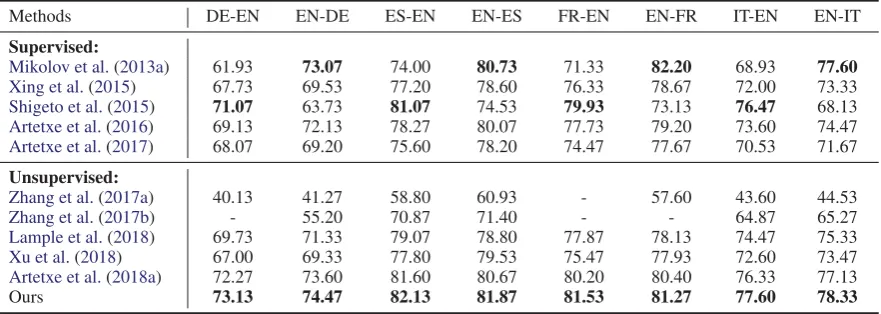
Table 2: The accuracy of different methods in various language pairs. Bold indicates the best supervised and unsupervised results, respectively. “-” means that the model fails to converge and hence the result is omitted.
Models EN-ES EN-FR EN-DE EN-IT
Full model 81.87 81.27 74.47 78.33
w/o Evaluator 80.67 80.40 73.60 77.13
[image:4.595.79.285.271.329.2]w/o DAE 81.33 80.93 74.20 77.73
Table 3: Results of ablation study.
3.3 Ablation Study
Here we perform an ablation study to under-stand the importance of different components. Ta-ble 3 presents the performance of different ab-lated versions, showing that our denoising evalua-tor can bring stable improvements in performance. This illustrates that introducing grammatical infor-mation learned by the pre-trained denoising lan-guage model is of great help to perform accu-rate word alignment. By imposing the penalty to the retrieved morphologically related but erro-neous translations, this additional grammatical in-formation can alleviate the adverse effects of mor-phological variation. In addition, we can find that the DAE plays an active role in improving results. By cleaning the noise in the original translated sentence, the DAE makes the reward provided by evaluator more accurate, leading to the improve-ments in model performance.
3.4 The Validity of Cleaning Noise
By cleaning the noise in the original word-to-word translation, the denoising auto-encoder (DAE) can benefit the evaluatorEto feedback more accurate evaluation signals. Here Table4 presents several examples output by the DAE on the FR-EN lan-guage pair. The results show that there exist some obvious grammatical errors in the naive word-to-word translation. For instance, the word-to-word “to” is
Input: ˆEtre adulte, c’est ˆetre seul.
Noisy translation:Be adult, it’s be alone.
Cleaned translation:To be an adult is to be alone.
Ground truth:To be an adult is to be alone.
Input:L’histoire se r´ep`ete.
Noisy translation:History itself repeats.
Cleaned translation:History repeats itself.
Ground truth:History repeats itself.
Table 4: Several examples output by the denoising auto-encoder on the FR-EN language pair.
missing in the first example and the words in the second example are not organized in a grammat-ical order. However, our pre-trained DAE is able to correct these errors by inserting or deleting ap-propriate words or adjusting the word order. This intuitively demonstrates the effectiveness of our DAE in cleaning noise contained in the original translated sentence.
3.5 Case Study
Source word MUSE Vecmap Ours
suspendit suspending suspend suspended
diffusant broadcasts broadcast broadcasting
[image:5.595.310.525.62.154.2]atteint reaching reach reached
Table 5: Translations of various systems on the FR-EN language pair.Redwords are correct translations.
4 Related Work
This paper is mainly related to the following two lines of work.
Supervised cross-lingual embedding. Inspired by the isometric observation between monolin-gual word embeddings of two different lan-guages, Mikolov et al. (2013b) propose to learn cross-lingual word mapping by minimizing mean squared error. Latter,Dinu and Baroni (2015) in-vestigate the hubness problem and Faruqui and Dyer(2014) incorporates the semantics of a word in multiple languages into its embedding. Fur-thermore, Xing et al. (2015) propose to impose the orthogonal constraint to the linear mapping andArtetxe et al.(2016) present a series of tech-niques, including length normalization and mean centering, to improve bilingual results. There also exist some other representative researches. For instance, Smith et al. (2017) present inverse-softmax which normalizes the inverse-softmax probabil-ity over source words rather than target words and
Artetxe et al.(2017) present a self-learning frame-work to perform iterative refinement, which is also adopted in some unsupervised settings and plays a crucial role in improving performance.
Unsupervised cross-lingual embedding. The endeavors to explore unsupervised cross-lingual embedding are mainly divided into two categories. One line focuses on designing heuristics or utiliz-ing the structural similarity of monolutiliz-ingual em-beddings. For instance,Hoshen and Wolf (2018) present a non-adversarial method based on the principal component analysis. Both Aldarmaki et al. (2018) and Artetxe et al. (2018a) take ad-vantage of geometric properties across languages to perform word retrieval to learn the initial word mapping. Cao and Zhao (2018) formulate this problem as point set registration to adopt a point set registration method. However, these methods usually require plenty of random restarts or addi-tional skills to achieve satisfactory performance. Another line strives to learn unsupervised word
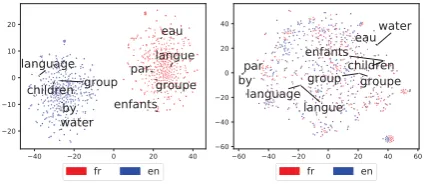
Figure 3: Visualization of two monolingual embedding spaces (left) and aligned embedding space (right).
mapping by direct distribution-matching. For ex-ample, Lample et al. (2018) and Zhang et al.
(2017a) completely eliminate the need for any su-pervision signal by aligning the distribution of transferred embedding and target embedding with GAN. Furthermore,Zhang et al.(2017b) and Xu et al. (2018) adopt the Earth Mover’s distance and Sinkhorn distance as the optimized distance metrics, respectively. There are also some at-tempts on distant language pairs. For instance,
Kementchedjhieva et al. (2018) generalize Pro-crustes analysis by projecting the two languages into a latent space andNakashole(2018) propose to learn neighborhood sensitive mapping by train-ing non-linear functions. As for the hubness prob-lem,Ruder et al. (2018) propose a latent-variable model learned with Viterbi EM algorithm. Re-cently,Alaux et al.(2018) work on the problem of aligning more than two languages simultaneously by a formulation ensuring composable mappings.
5 Conclusion
In this work, we present a morphology-aware alignment model for unsupervised bilingual lexi-con induction. The proposed model is able to alle-viate the adverse effect of morphological variation by introducing grammatical information learned from pre-trained denoising language model. The results show that our approach can achieve better performance than several state-of-the-art unsuvised systems, and even achieves competitive per-formance compared to supervised methods.
Acknowledgement
References
Jean Alaux, Edouard Grave, Marco Cuturi, and Ar-mand Joulin. 2018. Unsupervised hyperalignment for multilingual word embeddings. arXiv preprint arXiv:1811.01124.
Hanan Aldarmaki, Mahesh Mohan, and Mona T. Diab. 2018. Unsupervised word mapping using structural similarities in monolingual embeddings. TACL, 6:185–196.
Mikel Artetxe, Gorka Labaka, and Eneko Agirre. 2016. Learning principled bilingual mappings of word em-beddings while preserving monolingual invariance. In Proceedings of the 2016 Conference on Empiri-cal Methods in Natural Language Processing, pages 2289–2294.
Mikel Artetxe, Gorka Labaka, and Eneko Agirre. 2017. Learning bilingual word embeddings with (almost) no bilingual data. In Proceedings of the 55th An-nual Meeting of the Association for Computational Linguistics, Volume 1: Long Papers, pages 451–462.
Mikel Artetxe, Gorka Labaka, and Eneko Agirre. 2018a. A robust self-learning method for fully un-supervised cross-lingual mappings of word embed-dings. InProceedings of the 56th Annual Meeting of the Association for Computational Linguistics, Vol-ume 1: Long Papers, pages 789–798.
Mikel Artetxe, Gorka Labaka, Eneko Agirre, and Kyunghyun Cho. 2018b. Unsupervised neural ma-chine translation. In 6th International Conference on Learning Representations.
Dzmitry Bahdanau, Kyunghyun Cho, and Yoshua Ben-gio. 2015. Neural machine translation by jointly learning to align and translate. In3rd International Conference on Learning Representations.
Hailong Cao and Tiejun Zhao. 2018. Point set reg-istration for unsupervised bilingual lexicon induc-tion. In Proceedings of the Twenty-Seventh Inter-national Joint Conference on Artificial Intelligence, pages 3991–3997.
Georgiana Dinu and Marco Baroni. 2015. Improving zero-shot learning by mitigating the hubness prob-lem. In 3rd International Conference on Learning Representations.
Manaal Faruqui and Chris Dyer. 2014. Improving vec-tor space word representations using multilingual correlation. InProceedings of the 14th Conference of the European Chapter of the Association for Com-putational Linguistics, pages 462–471.
Sepp Hochreiter and J¨urgen Schmidhuber. 1997. Long short-term memory. Neural Computation, 9(8):1735–1780.
Yedid Hoshen and Lior Wolf. 2018. An iterative clos-est point method for unsupervised word translation.
arXiv preprint arXiv:1801.06126v1.
Yova Kementchedjhieva, Sebastian Ruder, Ryan Cot-terell, and Anders Søgaard. 2018. Generalizing pro-crustes analysis for better bilingual dictionary induc-tion. In Proceedings of the 22nd Conference on Computational Natural Language Learning, pages 211–220.
Yunsu Kim, Jiahui Geng, and Hermann Ney. 2018. Improving unsupervised word-by-word translation with language model and denoising autoencoder. In Proceedings of the 2018 Conference on Empiri-cal Methods in Natural Language Processing, pages 862–868.
Guillaume Lample, Alexis Conneau, Marc’Aurelio Ranzato, Ludovic Denoyer, and Herv´e J´egou. 2018. Word translation without parallel data. In6th Inter-national Conference on Learning Representations.
Fuli Luo, Peng Li, Jie Zhou, Pengcheng Yang, Baobao Chang, Zhifang Sui, and Xu Sun. 2019. A dual rein-forcement learning framework for unsupervised text style transfer. arXiv preprint arXiv:1905.10060.
Laurens van der Maaten and Geoffrey Hinton. 2008. Visualizing data using t-sne. Journal of machine learning research, 9(Nov):2579–2605.
Tomas Mikolov, Kai Chen, Greg Corrado, and Jef-frey Dean. 2013a. Efficient estimation of word representations in vector space. arXiv preprint arXiv:1301.3781.
Tomas Mikolov, Quoc V Le, and Ilya Sutskever. 2013b. Exploiting similarities among languages for ma-chine translation.arXiv preprint arXiv:1309.4168.
Ndapa Nakashole. 2018. NORMA: neighborhood sen-sitive maps for multilingual word embeddings. In
Proceedings of the 2018 Conference on Empirical Methods in Natural Language Processing, pages 512–522.
Ofir Press and Lior Wolf. 2017. Using the output em-bedding to improve language models. In Proceed-ings of the 15th Conference of the European Chap-ter of the Association for Computational Linguistics, Volume 2: Short Papers, pages 157–163.
Sebastian Ruder, Ryan Cotterell, Yova Kementched-jhieva, and Anders Søgaard. 2018. A discrimina-tive latent-variable model for bilingual lexicon in-duction. InProceedings of the 2018 Conference on Empirical Methods in Natural Language Process-ing, pages 458–468.
Yutaro Shigeto, Ikumi Suzuki, Kazuo Hara, Masashi Shimbo, and Yuji Matsumoto. 2015. Ridge regres-sion, hubness, and zero-shot learning. InMachine Learning and Knowledge Discovery in Databases -European Conference, pages 135–151.
Anders Søgaard, Sebastian Ruder, and Ivan Vulic. 2018. On the limitations of unsupervised bilingual dictionary induction. InProceedings of the 56th An-nual Meeting of the Association for Computational Linguistics, Volume 1: Long Papers, pages 778–788.
Pascal Vincent, Hugo Larochelle, Yoshua Bengio, and Pierre-Antoine Manzagol. 2008. Extracting and composing robust features with denoising autoen-coders. In Machine Learning, Proceedings of the Twenty-Fifth International Conference, pages 1096– 1103.
Ronald J. Williams. 1992. Simple statistical gradient-following algorithms for connectionist reinforce-ment learning. Machine Learning, 8:229–256.
Chao Xing, Dong Wang, Chao Liu, and Yiye Lin. 2015. Normalized word embedding and orthogonal trans-form for bilingual word translation. In The 2015 Conference of the North American Chapter of the Association for Computational Linguistics: Human Language Technologies, pages 1006–1011.
Ruochen Xu, Yiming Yang, Naoki Otani, and Yuexin Wu. 2018. Unsupervised cross-lingual transfer of word embedding spaces. InProceedings of the 2018 Conference on Empirical Methods in Natural Lan-guage Processing, pages 2465–2474.
Pengcheng Yang, Fuli Luo, Shuangzhi Wu, Jingjing Xu, Dongdong Zhang, and Xu Sun. 2018. Learning unsupervised word mapping by maximizing mean discrepancy. arXiv preprint arXiv:1811.00275.
Meng Zhang, Yang Liu, Huanbo Luan, and Maosong Sun. 2017a. Adversarial training for unsupervised bilingual lexicon induction. In Proceedings of the 55th Annual Meeting of the Association for Compu-tational Linguistics, Volume 1: Long Papers, pages 1959–1970.
Meng Zhang, Yang Liu, Huanbo Luan, and Maosong Sun. 2017b. Earth mover’s distance minimization for unsupervised bilingual lexicon induction. In
Proceedings of the 2017 Conference on Empirical Methods in Natural Language Processing, pages 1934–1945.
Yi Zhang, Jingjing Xu, Pengcheng Yang, and Xu Sun. 2018. Learning sentiment memories for sentiment modification without parallel data. InProceedings of the 2018 Conference on Empirical Methods in Natural Language Processing, pages 1103–1108.