ORIGINAL RESEARCH
Quantitative Estimation of Permeability
Surface-Area Product in Astroglial Brain Tumors Using
Perfusion CT and Correlation with Histopathologic
Grade
R. Jain S.K. Ellika L. Scarpace L.R. Schultz J.P. Rock J. Gutierrez S.C. Patel J. Ewing T. Mikkelsen
BACKGROUND AND PURPOSE: Glioma angiogenesis and its different hemodynamic features, which can be evaluated by using perfusion CT (PCT) imaging of the brain, have been correlated with the grade and the aggressiveness of gliomas. Our hypothesis was that quantitative estimation of permeability surface area product (PS), cerebral blood volume (CBV), cerebral blood flow (CBF), and mean transit time (MTT) in astroglial brain tumors by using PCT will correlate with glioma grade. High-grade gliomas will show higher PS and CBV as compared with low-grade gliomas.
MATERIALS AND METHODS:PCT was performed in 32 patients with previously untreated astroglial tumors (24 high-grade gliomas and 8 low-grade gliomas) by using a total acquisition time of 170 seconds. World Health Organization (WHO) glioma grades were compared with PCT parameter absolute values by using Student or nonparametric Wilcoxon 2-sample tests. Receiver operating characteristic (ROC) analyses were also done for each of the parameters.
RESULTS: The differences in PS, CBV, and CBF between the low- and high-grade tumor groups were statistically significant, with the low-grade group showing lower mean values than the high-grade group. ROC analyses showed that both CBV (C-statistic 0.930) and PS (C-statistic 0.927) were very similar to each other in differentiating low- and high-grade gliomas and had higher predictability compared with CBF and MTT. Within the high-grade group, differentiation of WHO grade III and IV gliomas was also possible by using PCT parameters, and PS showed the highest C-statistic value (0.926) for the ROC analyses in this regard.
CONCLUSIONS:Both PS and CBV showed strong association with glioma grading, high-grade gliomas showing higher PS and CBV as compared with low-grade gliomas. Perfusion parameters, especially PS, can also be used to differentiate WHO grade III from grade IV in the high-grade tumor group.
Q
uantifying tumor neoangiogenesis and neovascularity is important in predicting tumor grade, treatment options, treatment response, and prognosis because it appears to play a central role in the growth and spread of tumors. However, it has been difficult to assess tumor angiogenesis primarily be-cause of the complexity of the microvascular environment of the tumors as well as because of limited resolution of the avail-able clinical imaging tools. Microvascular density has been used as the gold standard to assess this because of its direct association with angiogenic growth factor expression, tumor growth, and occurrence of metastases.1,2Increased vascular permeability has also been associated with malignant tumor microvessels and has been evolving as a surrogate marker of tumor angiogenesis and thus tumor grade.3Higher perme-ability has been associated with higher tumor grade4-8and has also been shown to decrease in response to antiangiogenic therapy due to decreased tumor growth predicting tumor re-sponse.9Noninvasive measurement of vascular permeability has been done by using various MR perfusion techniques, which also have been correlated with glioma grading andtreatment response.6,7,10-13Perfusion CT (PCT) has been used for assessment of brain tumors14-17and has a number of ad-vantages over MR imaging techniques, the most important of which may be the linearity of signal-intensity change to tissue concentration of contrast agent, which may not be the case with MR perfusion.18-21With PCT, multiple perfusion param-eters such as permeability surface-area product (PS), cerebral blood volume (CBV), cerebral blood flow (CBF), and mean transit time (MTT) can be obtained with a single acquisition, which may be difficult with a single MR perfusion technique. Hence, in the present study, PCT was used to measure PS, CBV, CBF, and MTT in 32 patients with previously untreated gliomas; we hypothesized that glioma grade would be corre-lated with various perfusion parameters and high-grade gliomas would show higher PS and CBV as compared with low-grade gliomas.
Materials and Methods
Patient Population
Our Health Insurance Portability and Accountability Act– compliant study was approved by the institutional review board, and an in-formed consent was obtained from each participant before the study. Between January 2006 and February 2007, 40 patients with previously untreated or treatment-naı¨ve gliomas underwent PCT. Eight patients with oligodendrogliomas were excluded from this analysis because oligodendrogliomas are known to have higher blood volume as com-pared with the astroglial tumors.22Of 32 patients included in this
study, 8 patients had low-grade gliomas (World Health Organization
Received August 10, 2007; accepted after revision October 17.
From the Division of Neuroradiology, Departments of Radiology (R.J., S.K.E., S.C.P.), Neurosurgery (L.S., J.P.R., T.M.), Biostatistics and Research Epidemiology (L.R.S.), Pathol-ogy (J.G.), and NeurolPathol-ogy (J.E.), Henry Ford Hospital, Detroit, Mich.
Please address correspondence to Rajan Jain, MD, Division of Neuroradiology, Department of Radiology, Henry Ford Health System, 2799 West Grand Blvd, Detroit MI 48202; e-mail: [email protected]
Indicates article with supplemental on-line table.
[WHO] grades I and II) and 24 patients had high-grade gliomas (WHO grades III and IV). In the high-grade group, 18 patients had glioblastoma multiforme and 6 patients had anaplastic astrocytomas (On-line Table). Twenty-seven patients underwent cytoreductive surgery (subtotal resection, 25; gross total resection, 2), and 5 patients had biopsies obtained from the tumor. All the histopathologic speci-mens were examined by a board-certified pathologist (J.G.) and were graded as per WHO guidelines. Ages of the patients ranged from 25 to 70 years (mean, 47.78 years), and there were 20 men and 12 women. All patients underwent PCT before any treatment except 13 patients who were on a stable dose of corticosteroids at the time of PCT ex-amination. Tumor contrast enhancement was recorded on preoper-ative MR imaging for all patients (On-line Table). Tumor area was also measured on postcontrast T1-weighted images on the axial sec-tion showing the largest tumor dimensions and ranged from 4.24 to 35.37 cm2(mean, 14.35 cm2).
Perfusion CT Technique
Perfusion studies were performed by using 16-section (LightSpeed; GE Healthcare, Milwaukee, Wis) and 64-section (VCT, GE Healthcare) mul-tidetector-row CT scanners in 11 and 21 patients, respectively. A non-contrast CT head study was done to localize the region of interest before obtaining a perfusion scan. For the perfusion scan, 50 mL of nonionic contrast (ioversol; Optiray 300 mg/mL, Mallinckrodt, St. Louis, Mo) was injected at a rate of 4 mL/s through a 20-gauge intravenous line by using an automatic power injector. At 5 seconds into the injection, a cine (con-tinuous) scanning was initiated with the following technique: 80 kVp, 190 –200 mA, and 1 second per rotation for a duration of 50 seconds. After the initial 50-second cine scanning, 8 more axial images were ac-quired, 1 image every 15 seconds for an additional 2 minutes, thus giving a total acquisition time of 170 seconds. Four 5-mm-thick axial sections were acquired with the 16-section CT scanner, which were reformatted into two 10-mm-thick sections, whereas for the 64-section CT scanner, eight 5-mm-thick axial sections were acquired, resulting in a total cover-age area of 4 cm instead of 2 cm with the 16-section scanner. Perfusion maps of CBV, CBF, MTT, and PS were generated at an Advantage Win-dows workstation by using CT perfusion 3.0 software (GE Healthcare) and a 2-compartment model in all patients. We used the superior sagittal sinus as the venous output function in all patients and the artery with the greatest peak and slope on time-attenuation curves as the arterial input function. A region of interest was drawn within the confines of a large vessel, and the automatic function of the software picked the pixels with the greatest peak and slope on the time-attenuation curve for analysis. The anterior cerebral artery was used as the arterial input function for the generation of perfusion maps in 28 patients, the middle cerebral artery was used in 3 patients, and the basilar artery was used in 1 patient.
Permeability Surface-Area Product (PS)
PS characterizes the diffusion of some of the contrast agent from the blood vessels into the interstitial space due to deficient or leaky blood-brain barrier (BBB). Permeability is related to the diffusion coefficient
of the contrast agent in the assumed water-filled pores of the capillary endothelium. The diffusion flux of contrast agent across the capillary endothelium is dependent on both the diffusion coefficient and the total surface area of the pores. PS is computed from the impulse res-idue function (IRF). Contrast agent diffusion appears in the IRF as a residual enhancement that occurs after the initial impulse response and that decreases exponentially with time. The IRF is used to esti-mate the first-pass fraction of contrast agent that remains in the tissue, the extraction fraction, E.23The extraction fraction is related to the
rate at which contrast leaks out of the vasculature via the following relationship:
E⫽1⫺e
⫺PS
F ,
wherePSis the permeability surface-area product andFis flow. The PSproduct has the same dimensions as flow, and thus the ratioPS
F is
dimensionless. In physiologic terms,PSis the rate at which contrast agent flows into the extravascular tissues; it is related to another com-monly stated parameter of vascular leakage, the transfer constant by, the following:
Ktrans⫽EF,
whereKtransis the transfer constant with, again, the same dimensions as flow. It is easily demonstrated that ifPS
F ⬍1, thenK
trans⬇PS. In
normal cerebral vasculature,PSis negligible for all contrast agents presently in use.
Perfusion CT Map Analysis
Regions of interest were drawn on the PCT maps by 2 authors (R.J., S.K.E.) by consensus in all cases. MR images obtained before the PCT examination were evaluated for the size and the extent of the tumor on the basis of enhancing or nonehancing solid and necrotic/cystic parts, and this observation was used to help guide drawing the regions of interest on PCT maps. Regions of interest were manually drawn to include the solid portions of the tumor, taking care not to include necrotic/cystic parts of the tumor, especially in higher grade tumors, and also by avoiding any major cortical vessels on each axial CT sec-tion. Absolute values and SDs of various perfusion parameters, such as PS (milliliters per 100 grams per minute), CBV (milliliters per 100 grams), CBF (milliliters per 100 grams per minute), and MTT (sec-onds) within the tumoral region of interest were recorded. We ob-tained means of these parameters from all the regions of interest placed on each CT section, trying to cover as much of the tumor as possible (ie, 2-cm coverage with the 16-section CT scanner and 4-cm coverage with the 64-section CT scanner).
Statistical Analysis
[image:2.594.52.535.654.720.2]Descriptive statistics (means and SDs) for each parameter were puted for the different tumor groups. The tumor groups were com-pared by using Student or nonparametric Wilcoxon 2-sample tests. In addition, receiver operating characteristic (ROC) analyses were done
Table 1: Perfusion parameters and ROC analysis for low- and high-grade gliomas
Group (No. of patients)
PS (mL/100 g/min) Mean (SD)
CBV (mL/100 g) Mean (SD)
CBF (mL/100 g/min) Mean (SD)
MTT (s) Mean (SD)
Low grade (8) 0.52 (0.15) 0.95 (0.22) 27.0 (8.3) 4.24 (1.42)
High grade (24) 2.37 (1.40) 2.79 (1.20) 82.0 (73.7) 4.67 (1.37)
Pvalue ⬍.001 ⬍.001 .0024 .564
C-statistic 0.927 0.930 0.849 0.573
ROC indicates receiver operating characteristic; PS, permeability surface-area product; CBV, cerebral blood volume; CBF, cerebral blood flow; MTT, mean transit time.
BRAIN
ORIGINAL
to compute the area under the curve (C-statistic) for each of the parameters. This statistic can help assess which parameter is the best in differentiating between different grades of glioma; the higher the C-statistic, the better is the predictability of the parameter.
Results
[image:3.594.53.530.43.231.2]Low-Grade Versus High-Grade Gliomas
Table 1 contains the results for the 2 groups (Fig 1). The differ-ences in PS, CBV, and CBF between the 2 groups were statistically significant, with the low-grade tumor group showing a lower mean value for all parameters than the high-grade group (Figs 2
and 3). However, the difference in MTT between the 2 groups was not statistically significant. ROC analyses showed that both CBV (C-statistic 0.930) and PS (C-statistic 0.927) were very similar to each other in differentiating low- and high-grade gliomas and had higher predictability compared with CBF (C-statistic 0.849) and MTT (C-statistic 0.573).
Grade III Versus Grade IV Gliomas
Within the high-grade group differentiation into grade III and grade IV gliomas also could be done by using the perfusion pa-rameters. PS showed the highest C-statistic value (0.926) for the Fig 1.Box and whisker graph showing PS (A) and CBV (B) for low-versus-high-grade astroglial tumors.
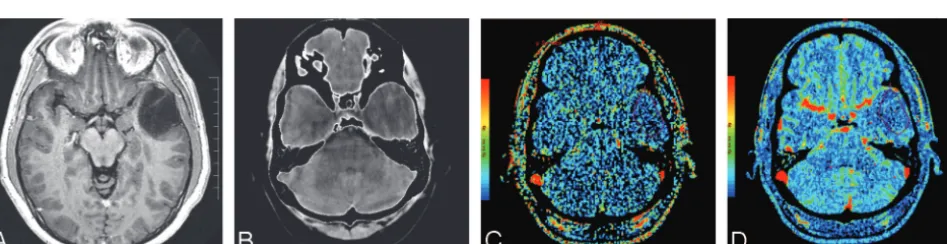
Fig 2.AandB, Postcontrast T1-weighted (TR/TE, 3059/6.35 ms) axial image (A) and base image from perfusion CT study (B) in 32-year-old woman with WHO grade II astrocytoma showing a nonenhancing right frontal tumor with no surrounding perilesional edema.CandD, PS (C) and CBV (D) perfusion CT maps showing low permeability (PS⫽0.7 mL/100 g per minute) and low blood volume (CBV⫽1.01 mL/100 g) within the tumor.
[image:3.594.57.533.251.371.2] [image:3.594.57.535.415.534.2]ROC analyses, suggesting the highest predictability in differenti-ating grade III from grade IV as compared with other parameters (Table 2).
Nonenhancing Versus Enhancing Grade III, Nonenhancing Grade III Versus Low Grade, and Enhancing Grade III Versus Grade IV Gliomas
Out of 6 grade III gliomas, images of 3 patients showed con-trast enhancement on MR imaging, and those of 3 patients did not show any contrast enhancement. Enhancing grade III
[image:4.594.54.535.141.262.2]gli-omas (Fig 4 and Table 3) had a higher mean PS (1.61 versus 0.46; Pvalue, .011), mean CBV (2.77 versus 0.88;Pvalue, .029), mean CBF (51.7 versus 26.1;Pvalue, .055), and also a higher mean MTT (5.96 versus 3.23;Pvalue, .012) as com-pared with nonenhancing grade III gliomas (Fig 5 and Table 3). However, no statistically significant differences were seen as far as differentiating low-grade gliomas, none of which showed any contrast enhancement (On-line Table), from nonenhancing grade III gliomas on the basis of PCT parame-ters. Similarly in differentiating enhancing grade III from Table 2: Perfusion parameters and ROC analysis for WHO grades III and grade IV
Group (No. of patients)
PS (mL/100 g/min) Mean (SD)
CBV (mL/100 g) Mean (SD)
CBF (mL/100 g/min) Mean (SD)
MTT (s) Mean (SD)
WHO grade III (6) 1.04 (0.73) 1.82 (1.41) 38.9 (19.3) 4.60 (1.62)
WHO grade IV (18) 2.81 (1.28) 3.12 (0.97) 96.3 (79.8) 4.69 (1.32)
Pvalue ⬍.001 .039 .014 .922
C-statistic 0.926 0.787 0.833 0.509
ROC indicates receiver operating characteristic; PS, permeability surface-area product; CBV, cerebral blood volume; CBF, cerebral blood flow; MIT, mean transit time.
Fig 4.AandB, Postcontrast T1-weighted (TR/TE, 650/13 ms) axial image (A) and base image from perfusion CT study (B) in a 46-year-old man with a heterogeneously enhancing mass lesion predominantly involving the right frontal lobe with extension across the genu of the corpus callosum.CandD, Perfusion CT PS (C) and CBV (D) maps showing high permeability (PS⫽2.04 mL/100 g per minute) and tumor blood volume (CBV⫽2.21 mL/100 g). Histopathology revealed a grade III anaplastic astrocytoma.
Table 3: Perfusion parameters andPvalues for nonenhancing versus enhancing grade III, nonenhancing grade III versus low grade, and enhancing grade III versus grade IV gliomas
PS (mL/100 g/min) Mean (SD)
CBV (mL/100 g) Mean (SD)
CBF (mL/100 g/min) Mean (SD)
MTT (s) Mean (SD)
Low grade (8) 0.52 (0.15) 0.95 (0.22) 27.0 (8.3) 4.24 (1.42)
Nonenhancing grade III (3) 0.46 (0.13) 0.88 (0.16) 26.1 (3.4) 3.23 (0.64)
Enhancing grade III (3) 1.61 (0.57) 2.77 (1.52) 51.7 (20.8) 5.96 (0.75)
WHO grade IV (18) 2.81 (1.28) 3.12 (0.97) 96.3 (79.8) 4.69 (1.32)
Pvalues for nonenhancing vs. enhancing grade III .011 .029 .055 .012
Pvalues for low grade vs. nonenhancing grade III .623 .699 .971 .330
Pvalues for enhancing grade III vs. grade IV .052 .438 .322 .128
PS indicates permeability surface-area product; CBV, cerebral blood volume; CBF, cerebral blood flow; MTT, mean transit time.
[image:4.594.55.537.332.426.2] [image:4.594.60.534.446.568.2]grade IV gliomas, all of which showed contrast enhancement, only PS showed borderline statistical significance (Pvalue, .052), and the rest of the perfusion parameters did not show any statistically significant difference (Table 3).
Discussion
Tumor Vascular Permeability: Common Facts and Their Importance
It is a common fact that tumor blood vessels have defective and leaky endothelium. Hypoxia or hypoglycemia that occurs in rapidly growing tumors increases the expression of vascular endothelial growth factor (VEGF), which is not only a potent angiogenic factor but also a potent permeability factor.24,25 VEGF leads to the development of neoangiogenic vessels, which are immature and tortuous26,27and also have increased permeability to macromolecules due to large endothelial cell gaps, incomplete basement membrane, and absent smooth muscle.28These abnormal tumor vessels can be used as poten-tial markers to assess the tumor grade. Grading of gliomas is important from the perspective of treatment and patient prog-nosis. The current standard for tumor grading is histopatho-logic assessment of tissue, which has inherent limitations, such as sampling error, interobserver variation, and a wide variety of classification systems that are available, of which the most commonly used is the WHO grading system.29,30Thus in vivo measurement of tumor-vessel permeability is important for various reasons: 1) It can be used for grading of tumors be-cause increased permeability is associated with immature blood vessels, which is seen with neoangiogenesis; 2) it can be used to study the response of tumors to various therapies, especially antiangiogenic therapy31; 3) understanding the con-cept of permeability can help in understanding the mechanism of entry of therapeutic agents into the central nervous system; and 4) it can be used for development of methods to alter selectively the BBB to enhance drug delivery.32
In Vivo Permeability Measurement: Imaging Techniques, Limitations, and Controversies
Various noninvasive imaging techniques have been increasingly used to characterize and grade brain tumors because histologic tumor grade alone can be an unreliable predictor of patient out-come and there is a shift in the role of imaging to provide physi-ologic information in addition to morphphysi-ologic characteristics. Perfusion imaging can provide information about flow dynamics of tumor vessels, particularly blood volume and permeability measurements that can be complementary to conventional im-aging for preoperative grading of gliomas,6,33-35and can also help us understand biologic differences between tumors of the same grade and response of tumors to therapy. MR and CT perfusion have been used for in vivo characterization of tumor angiogenesis in various animal and human studies.36-40
One of the major limitations of clinically used imaging techniques has been low spatial resolution, which limits as-sessment of the complex and heterogeneous vascular micro-environment in detail.41,42Another limitation has been the current use of low-molecular-weight contrast agents for hu-man subjects. Because permeability measurements depend on the leakage of particles from the blood to the interstitial space, it is hypothesized that low-molecular-weight contrast agents
leak relatively easily from the blood into the interstitium. This might also lead to overestimation of the permeability, which will be influenced by and will approximate tumor blood flow.43High-molecular-weight contrast agents leak from the vessels and move through the interstitium with relative diffi-culty and are flow-independent. Thus macromolecular per-meability and vascular volumes may be best measured by high-molecular-weight contrast agents.43However, currently used CT or MR imaging contrast agents are of low molecular weight (⬃0.5– 0.9 kDa), which might limit the accurate differ-entiation of vascular permeability and blood volume.44Even though CT and MR imaging contrast agents do not differ much in their molecular weight, different charges of nonionic CT contrast as compared with ionic MR imaging contrast may also be responsible for the differences in permeability mea-sured with these 2 modalities.
Another controversial aspect of measuring permeability with various perfusion imaging techniques has been the scanning time. Delayed permeability due to slow leakage of contrast from a leaky blood vessel may not be accurately measured with the first pass of the contrast agent by using a 45- or 60-second scanning time10,45and can be measured only with longer acquisition times; however, there is no real consensus about the optimal acquisition time. The permeability values we obtained are higher than the values reported in the literature, and this could be explained by the mathematic model that is used with PCT. In the present study, the acquisition time of 170 seconds could also explain the higher values that we obtained because this scanning sequence was optimized to include delayed permeability as also described previously. Gliomas, particularly high-grade gliomas, can have extremely variable and heterogeneous blood flow due to the com-plex tumor vasculature, which can influence permeability.42,43,46 Other factors that can also influence permeability include lumi-nal surface area and interstitial, hydrostatic, and osmotic pressure across the endothelium. Slow blood flow or low osmotic gradi-ents, which can occur in high-grade tumor with a lot of vasogenic edema and also in the central parts of large tumors, can lead to a larger component of delayed permeability, requiring longer ac-quisition times. In the present study, we used an acac-quisition time of 170 seconds to measure delayed permeability.
with T2- or T2*-weighting. In the latter case, if the contrast agent remains intravascular, the method is widely accepted as a relative estimate of CBF and CBV, though there is a possibil-ity for artifacts because of difficulties in assessing the shape and timing of the arterial input function.51-57
In the event that substantial leakage of contrast agent from intra- to extravascular space takes place, a strong and competing T1 contrast effect is often noticed in areas of pathology because of the necessity of short (approximately 1 second) repetition times needed to estimate CBF. As a first-order tactic to minimize the competing T1 contrast, preloading with contrast agent has been proposed,49with some success. However, this approach does not allow an estimate of Ktrans. An alternative has also been pro-posed.58To decrease the T1 effect, this approach used a slower TR, lengthening the TR of the experiment and undermining the estimation of CBF, thus yielding only estimates of CBV and Ktrans. A further refinement, allowing the estimate of blood volume and producing an index of transfer constant, has been suggested,49 and a dual-echo gradient-echo sequence48also shows some po-tential for an index of blood volume and transfer constant. De-spite the partial success of these rapid imaging studies, in contrast to CT perfusion, there does not appear to be an MR imaging technique that will reliably quantify CBF, CBV, and Ktransin 1 experiment. Another major disadvantage of MR perfusion is sus-ceptibility artifacts due to hemorrhage and various mineral dep-ositions, which can be a major issue in posttreatment tumor pa-tients.
Relationship Between Glioma Grade and Perfusion CT Parameters
In the present study, we could differentiate the high-grade tumor group into grade III and grade IV on the basis of perfusion pa-rameters (Table 2), and especially PS showed a stronger associa-tion (Pvalue⬍.001) with glioma grade than CBV, CBF, or MTT. This is in keeping with the current WHO guidelines of including microvascular proliferation as a diagnostic criterion of grade IV but not for grade III astrocytic tumors. Increased angiogenesis in grade IV tumors is characterized by an increased number and density of vessels as compared with grade III astrocytic tumors.59 Grade IV tumor vessels are especially characterized by dispropor-tionate lengthening, increased pliability, and irregular shape,59 which can explain the difference in perfusion parameters for grade IV as compared with grade III tumors.
Within the WHO grade III group, 3 patients had nonenhanc-ing infiltrative tumors, whereas 3 patients showed contrast en-hancement on MR imaging. Nonenhancing grade III tumors showed lower mean PS, CBV, and CBF as compared with the enhancing grade III group (Table 3). This difference is probably due to more microvascular density and proliferation seen in en-hancing tumors as compared with the nonenen-hancing group. This could have prognostic implications because the enhancing grade III tumors that show higher PS, CBV, and CBF may be more aggressive, with a higher recurrence rate and shorter survival pe-riods as compared with the nonenhancing grade III, which re-mains to be determined. The present study is limited because the number of patients in these 2 subgroups is small, and it also does not have survival or follow-up data.
It is possible to underestimate the grade of nonenhancing tumors solely on the basis of morphologic imaging features. The perfusion parameters, which are primarily based on
esti-mation of microvascular proliferation and tumor neoangio-genesis, also may not help in such a scenario. In the present study, we did not find any statistically significant difference of any of the perfusion parameters for differentiating nonen-hancing grade III gliomas from low-grade gliomas (WHO grades I and II), all of which did not show any contrast en-hancement. This could be explained by the fact that the only difference between these groups was presence or absence of mitosis by WHO grading criteria, and most of these nonen-hancing grade III gliomas showed very little microvascular proliferation. For differentiating enhancing grade III gliomas from grade IV, only PS showed a borderline statistical signifi-cance; however, the present analysis is also limited by the small number of enhancing grade III gliomas. This potential role of PS in differentiating these 2 groups is probably based on the difference and complexity of angioarchitecture.59
Limitations of the Study
Limitations of the study include: 1) a relatively small sam-ple size, 2) questionable reproducibility of absolute perfu-sion CT parameters by using different arterial input and venous output functions, 3) surgical sampling error could be another potential limitation particularly in cases in which the histologic specimen was obtained with biopsy only, and 4) steroids can also influence the perfusion pa-rameters, particularly PS, and only 13 out of 32 patients in the present study were on a stable dose of corticosteroids at the time of PCT examination.
Conclusions
Perfusion CT can be used with a longer acquisition time to mea-sure PS, including delayed permeability in gliomas. Both PS and CBV have shown strong association with glioma grading. These 2 perfusion parameters may be measuring 2 slightly different as-pects of tumor microvasculature and may also provide different information about tumor biology. Further long-term and larger studies will be required to investigate which perfusion parameter correlates better with treatment outcome and prognosis. Perfu-sion parameters can also be used to differentiate grade III from grade IV in the high-grade tumor group, with PS showing slightly stronger association as compared with CBV and CBF in the present study. CT perfusion parameters provide physiologic in-formation, which may supplement conventional morphologic imaging in predicting glioma grade and may also be useful in assessing response to various therapies in the future.
References
1. Phongkitkarun S, Kobayashi S, Kan Z, et al.Quantification of angiogenesis by functional computed tomography in Matrigel model in rats.Acad Radiol
2004;11:573– 82
2. Weidner N.Intratumor microvessel density as a prognostic factor in cancer.
Am J Pathol1995;147:9 –19
3. van Dijke CF, Brasch RC, Roberts TP, et al.Mammary carcinoma model: cor-relation of macromolecular contrast-enhanced MR imaging characteriza-tions of tumor microvasculature and histologic capillary density.Radiology
1996;198:813–18
4. Gossmann A, Okuhata Y, Shames DM, et al.Prostrate cancer tumor grade differentiation by dynamic contrast-enhanced MR imaging in the cat: com-parison of macromolecular and small-molecular contrast media—prelimi-nary experience.Radiology1999;213:265–72
mi-crovascular permeability in human brain tumors achieved using dynamic contrast-enhanced MR imaging: correlation with histologic grade.AJNR Am J Neuroradiol2000;21:891–99
7. Roberts HC, Roberts TP, Bollen AW, et al.Correlation of microvascular per-meability derived from dynamic contrast enhanced MR imaging with histo-logic grade and tumor labeling index: a study in human brain tumors.Acad Radiol2001;8:384 –91
8. Yuan F, Salehi HA, Boucher Y, et al.Vascular permeability and microcircula-tion of gliomas and mammary carcinomas transplanted in rat and mouse cranial windows.Cancer Res1994;54:4564 – 68
9. Pham CD, Roberts TP, van Bruggen N, et al.Magnetic resonance imaging detects suppression of tumor vascular permeability after administration of antibody to vascular endothelial growth factor.Cancer Invest1998;16:225–30 10. Law M, Yang S, Babb JS, et al.Comparison of cerebral blood volume and vascular permeability from dynamic susceptibility contrast-enhanced perfu-sion MR imaging with glioma grade.AJNR Am J Neuroradiol2004;25:746 –55 11. Law M, Oh S, Johnson G, et al.Perfusion magnetic resonance imaging predicts patient outcome as an adjunct to histopathology: a second reference standard in the surgical and nonsurgical treatment of low grade gliomas.Neurosurgery
2006;58:1099 –107
12. Gossmann A, Helbich TH, Kuriyama N, et al.Dynamic contrast-enhanced magnetic resonance imaging as a surrogate marker of tumor response to anti-angiogenic therapy in a xenograft model of glioblastoma multiforme.J Magn Reson Imaging2002;15:233– 40
13. Cao Y, Shen Z, Chenevert TL, et al.Estimate of vascular permeability and cerebral blood volume using Gd-DTPA contrast enhancement and dynamic T2*-weighted MRI.J Magn Reson Imaging2006;24:288 –96
14. Jain R, Scarpace L, Ellika SK, et al.First pass perfusion computed tomography: initial experience in differentiating recurrent tumors from radiation effects and radiation necrosis.Neurosurgery. 2007;61:778 – 86
15. Ellika SK, Jain R, Patel SC, et al.Role of perfusion CT in glioma grading and comparison with conventional MR imaging features.AJNR Am J Neuroradiol
2007;28:1981– 87
16. Roberts HC, Roberts TP, Lee TY, et al.Dynamic, contrast-enhanced CT of human brain tumors: quantitative assessment of blood volume, blood flow, and microvascular permeability—report of two cases.AJNR Am J Neuroradiol
2002;23:828 –32
17. Ding B, Ling HW, Chen KM, et al.Comparison of cerebral blood volume and permeability in preoperative grading of intracranial glioma using CT perfu-sion imaging.Neuroradiology2006;48:773– 81
18. Yankeelov TE, Rooney WD, Huang W, et al.Evidence for shutter-speed varia-tion in CR bolus-tracking studies of human pathology. NMR Biomed
2005;18:173– 85
19. Li X, Rooney WD, Springer CS.A unified magnetic resonance imaging phar-macokinetic theory: intravascular and extracellular contrast reagents.Magn Reson Med2005; 54:1351–59
20. Yankeelov TE, Rooney WD, Li X, et al.Variation of the relaxographic “shutter-speed” for transcytolemmal water exchange affects the CR bolus-tracking curve shape.Magn Reson Med2003;50:1151– 69
21. Landis CS, Li X, Telang FW, et al.Determination of the MRI contrast agent concentration time course in vivo following bolus injection: effect of equilib-rium transcytolemmal water exchange.Magn Reson Med2000;44:563–74 22. Lev MH, Ozsunar Y, Henson JW, et al.Glial tumor grading and outcome
pre-diction using dynamic spin-echo MR susceptibility mapping compared with conventional contrast-enhanced MR: confounding effect of elevated rCBV of oligodendrogliomas.AJNR Am J Neuroradiol2004;25:214 –21
23. Purdie TG, Henderson E, Lee TY.Functional CT imaging of angiogenesis in rabbit VX2 soft-tissue tumor.Phys Med Biol2001;46:3161–75
24. Shweiki D, Itin A, Soffer D, et al.Vascular endothelial growth factor induced by hypoxia may mediate hypoxia-initiated angiogenesis. Nature
1992;359:843– 45
25. Plate KH, Breier G, Weich HA, et al.Vascular endothelial growth factor is a potential tumor angiogenesis factor in human gliomas in vivo.Nature
1992;359:845– 48
26. Jain RK. Determinants of tumor blood flow: a review. Cancer Res
1988;48:2641–58
27. Jain RK, Munn LL, Fukumura D.Dissecting tumor pathophysiology using intravital microscopy.Nat Rev Cancer2002;2:266 –76
28. Hashizume H, Baluk P, Morikawa S, et al.Openings between defective endo-thelial cells explain tumor vessel leakiness.Am J Pathol2000;156:1363– 80 29. Cha S.Update on brain tumor imaging: from anatomy to physiology.AJNR
Am J Neuroradiol2006;27:475– 87
30. Louis DN, Ohgaki H, Wiestler OD, et al.WHO Classification of Tumors of the Central Nervous System.Lyon, France: WHO; 2007
31. Bhujwalla ZM, Artemov D, Natarajan K, et al.Reduction of vascular and per-meable regions in solid tumors detected by macromolecular contrast mag-netic resonance imaging after treatment with antiangiogenic agent TNP-470.
Clin Cancer Res2003;9:355– 62
32. Provenzale JM, Mukundan S, Dewhirst M.The role of blood-brain-barrier
permeability in brain tumor imaging and therapeutics.AJR Am J Roentgenol
2005;185:763– 67
33. Lev MH, Rosen BR.Clinical applications of intracranial perfusion MR imag-ing.Neuroimaging Clin N Am1999;9:309 –31
34. Provenzale JM, Wang GR, Brenner T, et al.Comparison of permeability in high-grade and low-grade brain tumors using dynamic susceptibility contrast MR imaging.AJR Am J Roentgenol2002;178:711–16
35. Jackson A, Kassner A, Annesley-Williams D, et al.Abnormalities in the recir-culation phase of contrast agent bolus passage in cerebral gliomas: compari-son with relative blood volume and tumor grade.AJNR Am J Neuroradiol
2002;23:7–14
36. Lupo JM, Cha S, Chang SM, et al.Dynamic susceptibility-weighted perfusion imaging of high-grade gliomas: characterization of spatial heterogeneity.
AJNR Am J Neuroradiol2005;26:1446 –54
37. Cha S, Knopp EA, Johnson G, et al.Intracranial mass lesions: dynamic con-trast-enhanced susceptibility-weighted echo-planar perfusion MR imaging.
Radiology2002;223:11–29
38. Maia AC, Malheiros SM, da Rocha AJ, et al.MR cerebral blood volume maps correlated with vascular endothelial growth factor expression and tumor grade in nonenhancing gliomas.AJNR Am J Neuroradiol2005;26:777– 83 39. Cenic A, Nabavi DG, Craen RA, et al.A CT method to measure hemodynamics
in brain tumors: validation and application of cerebral blood flow maps.
AJNR Am J Neuroradiol2000;21:462–70
40. Eastwood JD, Provenzale JM.Cerebral blood flow, blood volume, and vascular permeability of cerebral glioma assessed with dynamic CT perfusion imaging.
Neuroradiology2003;45:373–76
41. Vajkoczy P, Menger MD.Vascular microenvironment in gliomas.J Neurooncol
2000;50:99 –108
42. McDonald DM, Choyke PL.Imaging of angiogenesis: from microscope to clinic.Nat Med2003;9:713–25
43. de Lussanet QG, Langereis S, Beets-Tan RG, et al.Dynamic contrast enhanced MR imaging kinetic parameters and molecular weight of dendritic contrast agents in tumor angiogenesis in mice.Radiology2005;235:65–72
44. Choyke PL.Contrast agents for imaging tumor angiogenesis: is bigger better?
Radiology2005;235:1–2
45. Goh V, Halligan S, Hugill JA, et al.Quantitative colorectal cancer perfusion measurement using dynamic contrast-enhanced multidetector-row com-puted tomography: effect of acquisition time and implications for protocols.
J Comput Assist Tomogr2005;29:59 – 63
46. Montermini D, Winlove CP, Michel C.Effects of perfusion rate on permeabil-ity of frog and rat mesenteric microvessels to sodium fluorescein.J Physiol
2002;543(Pt 3):959 –75
47. Tofts PS, Brix G, Buckley DL, et al.Estimating kinetic parameters from dy-namic contrast-enhanced T1-weighted MRI of a diffusible tracer: standard-ized quantities and symbols.J Magn Reson Imaging1999;10:223–32 48. Uematsu H, Maeda M.Double-echo perfusion-weighted MR imaging: basic
concepts and application in brain tumors for the assessment of tumor blood volume and vascular permeability.Eur Radiol2006;16:180 – 86
49. Boxerman JL, Schmainda KM, Weisskoff RM.Relative cerebral blood volume maps corrected for contrast agent extravasation significantly correlate with glioma tumor grade, whereas uncorrected maps do not.AJNR Am J Neurora-diol2006;27:859 – 67
50. Landis CS, Li X, Telang FW, et al.Equilibrium transcytolemmal water-ex-change kinetics in skeletal muscle in vivo.Magn Reson Med1999;42:467–78 51. Akbudak E, Norberg RE, Conturo TE.Contrast-agent phase effects: an
exper-imental system for analysis of susceptibility, concentration, and bolus input function kinetics.Magn Reson Med1997;38:990 –1002
52. Conturo TE, Akbudak E, Kotys MS, et al.Arterial input functions for dynamic susceptibility contrast MRI: requirements and signal options.J Magn Reson Imaging2005;22:697–703
53. Akbudak E, Conturo TE.Arterial input functions from MR phase imaging.
Magn Reson Med1996;36:809 –15
54. Conturo TE, Barker PB, Mathews VP, et al.MR imaging of cerebral perfusion by phase-angle reconstruction of bolus paramagnetic-induced frequency shifts.Magn Reson Med1992;27:375–90
55. Calamante F, Gadian DG, Connelly A.Delay and dispersion effects in dynamic susceptibility contrast MRI: simulations using singular value decomposition.
Magn Reson Med2000;44:466 –73
56. Calamante F, Gadian DG, Connelly A.Quantification of bolus-tracking MRI: improved characterization of the tissue residue function using Tikhonov reg-ularization.Magn Reson Med2003;50:1237– 47
57. Calamante F, Morup M, Hansen LK.Defining a local arterial input function for perfusion MRI using independent component analysis.Magn Reson Med
2004;52:789 –97
58. Johnson G, Wetzel SG, Cha S, et al.Measuring blood volume and vascular transfer constant from dynamic T(2)*-weighted contrast-enhanced MRI.
Magn Reson Med2004;51:961– 68