Efficient Methods for Inferring Large Sparse Topic Hierarchies
Doug Downey, Chandra Sekhar Bhagavatula, Yi Yang
Electrical Engineering and Computer Science Northwestern University
[email protected],{csb,yiyang}@u.northwestern.edu
Abstract
Latent variable topic models such as La-tent Dirichlet Allocation (LDA) can dis-cover topics from text in an unsupervised fashion. However, scaling the models up to the many distinct topics exhibited in modern corpora is challenging. “Flat” topic models like LDA have difficulty modeling sparsely expressed topics, and richer hierarchical models become compu-tationally intractable as the number of top-ics increases.
In this paper, we introduce efficient meth-ods for inferring large topic hierarchies. Our approach is built upon the Sparse Backoff Tree (SBT), a new prior for la-tent topic distributions that organizes the latent topics as leaves in a tree. We show how a document model based on SBTs can effectively infer accurate topic spaces of over a million topics. We introduce a collapsed sampler for the model that ex-ploits sparsity and the tree structure in or-der to make inference efficient. In exper-iments with multiple data sets, we show that scaling to large topic spaces results in much more accurate models, and that SBT document models make use of large topic spaces more effectively than flat LDA. 1 Introduction
Latent variable topic models, such as Latent Dirichlet Allocation (Blei et al., 2003), are popu-lar approaches for automatically discovering top-ics in document collections. However, learning models that capture the large numbers of distinct topics expressed in today’s corpora is challenging. While efficient methods for learning large topic models have been developed (Li et al., 2014; Yao et al., 2009; Porteous et al., 2008), these methods
have focused on “flat” topic models such as LDA. Flat topic models over large topic spaces are prone to overfitting: even in a Web-scale corpus, some words are expressed rarely, and many documents are brief. Inferring a large topic distribution for each word and document given such sparse data is challenging. As a result, LDA models in prac-tice tend to consider a few thousand topics at most, even when training on billions of words (Mimno et al., 2012).
A promising alternative to flat topic models is found in recenthierarchicaltopic models (Paisley et al., 2015; Blei et al., 2010; Li and McCallum, 2006; Wang et al., 2013; Kim et al., 2013; Ahmed et al., 2013). Topics of words and documents can be naturally arranged into hierarchies. For exam-ple, an article on the topic of theChicago Bullsis also relevant to the more general topics of NBA, Basketball, and Sports. Hierarchies can combat data sparsity: if data is too sparse to place the term “Pau Gasol” within the Chicago Bulls topic, perhaps it can be appropriately modeled at some-what less precision within the Basketball topic. A hierarchical model can make fine-grained distinc-tions where data is plentiful, and back-off to more coarse-grained distinctions where data is sparse. However, current hierarchical models are hindered by computational complexity. The existing infer-ence methods for the models have runtimes that increase at least linearly with the number of top-ics, making them intractable on large corpora with large numbers of topics.
In this paper, we present a hierarchical topic model that can scale to large numbers of dis-tinct topics. Our approach is built upon a new prior for latent topic distributions called a Sparse Backoff Tree (SBT). SBTs organize the latent top-ics as leaves in a tree, and smooth the distribu-tions for each topic with those of similar top-ics nearby in the tree. SBT priors use absolute discounting and learned backoff distributions for
smoothing sparse observation counts, rather than the fixed additive discounting utilized in Dirichlet and Chinese Restaurant Process models. We show how the SBT’s characteristics enable a novel col-lapsed sampler that exploits the tree structure for efficiency, allowing SBT-based document models (SBTDMs) that scale to hierarchies of over a mil-lion topics.
We perform experiments in text modeling and hyperlink prediction, and find that SBTDM is more accurate compared to LDA and the re-cent nested Hierarchical Dirichlet Process (nHDP) (Paisley et al., 2015). For example, SBTDMs with a hundred thousand topics achieve perplex-ities 28-52% lower when compared with a stan-dard LDA configuration using 1,000 topics. We verify that the empirical time complexity of in-ference in SBTDM increases sub-linearly in the number of topics, and show that for large topic spaces SBTDM is more than an order of magni-tude more efficient than the hierarchical Pachinko Allocation Model (Mimno et al., 2007) and nHDP. Lastly, we release an implementation of SBTDM as open-source software.1
2 Previous Work
The intuition in SBTDM that topics are naturally arranged in hierarchies also underlies several other models from previous work. Paisley et al. (2015) introduce the nested Hierarchical Dirichlet Pro-cess (nHDP), which is a tree-structured generative model of text that generalizes the nested Chinese Restaurant Process (nCRP) (Blei et al., 2010). Both the nCRP and nHDP model the tree struc-ture as a random variable, defined over a flexi-ble (potentially infinite in number) topic space. However, in practice the infinite models are trun-cated to a maximal size. We show in our experi-ments that SBTDM can scale to larger topic spaces and achieve greater accuracy than nHDP. To our knowledge, our work is the first to demonstrate a hierarchical topic model that scales to more than one million topics, and to show that the larger models are often much more accurate than smaller models. Similarly, compared to other recent hi-erarchical models of text and other data (Petinot et al., 2011; Wang et al., 2013; Kim et al., 2013; Ahmed et al., 2013; Ho et al., 2010), our focus is on scaling to larger data sets and topic spaces.
1http://websail.cs.northwestern.edu/
projects/sbts/
The Pachinko Allocation Model (PAM) intro-duced by Li & McCallum (Li and McCallum, 2006) is a general approach for modeling corre-lations among topic variables in latent variable models. Hierarchical organizations of topics, as in SBT, can be considered as a special case of a PAM, in which inference is particularly efficient. We show that our model is much more efficient than an existing PAM topic modeling implemen-tation in Section 5.
Hu and Boyd-Graber (2012) present a method for augmenting a topic model with known hier-archical correlations between words (taken from e.g. WordNet synsets). By contrast, our focus is on automatically learning a hierarchical orga-nization of topics from data, and we demonstrate that this technique improves accuracy over LDA. Lastly, SparseLDA (Yao et al., 2009) is a method that improves the efficiency of inference in LDA by only generating portions of the sampling distri-bution when necessary. Our collapsed sampler for SBTDM utilizes a related intuition at each level of the tree in order to enable fast inference.
3 Sparse Backoff Trees
In this section, we introduce the Sparse Backoff Tree, which is a prior for a multinomial distribu-tion over a latent variable. We begin with an ex-ample showing how an SBT transforms a set of observation counts into a probability distribution. Consider a latent variable topic model of text doc-uments, similar to LDA (Blei et al., 2003) or pLSI (Hofmann, 1999). In the model, each token in a document is generated by first sampling a discrete latent topic variable Z from a document-specific topic distribution, and then sampling the token’s word type from a multinomial conditioned onZ.
We will focus on the document’s distribution over topics, ignoring the details of the word types for illustration. We consider a model with 12 latent topics, denoted as integers from the set
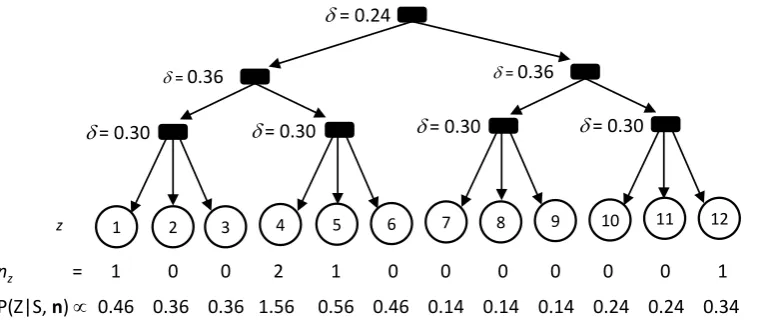
{1, . . . ,12}. Assume we have assigned latent topic values to five tokens in the document, specif-ically the topics {1,4,4,5,12}. We indicate the number of times topic valuezhas been selected as nz(Figure 1).
2 4 5 6 7 8 9 10 11 12
nz = 1 0 0 2 1 0 0 0 0 0 0 1
P(Z|S, n) 0.46 0.36 0.36 1.56 0.56 0.46 0.14 0.14 0.14 0.24 0.24 0.34
= 0.24
3 1
z
= 0.36
= 0.30 = 0.30 = 0.30 = 0.30
[image:3.595.113.493.60.220.2] = 0.36
Figure 1: An example Sparse Backoff Tree over 12 latent variable values.
that the sixth topic variable has valuezis propor-tional tonz+α, whereαis a hyperparameter of
the model.
SBT differs from LDA in that it organizes the topics into a tree structure in which the topics are leaves (see Figure 1). In this paper, we assume the tree structure, like the number of latent top-ics, is manually selected in advance. With an SBT prior, the estimate of the probability of a topicz is increased when nearby topics in the tree have positive counts. Each interior node aof the SBT has a discount δa associated with it. The SBT
transforms the observation countsnzinto
pseudo-counts (shown in the last row in the figure) by subtractingδa from each non-zero descendent of
each interior node a, and re-distributing the sub-tracted value uniformly among the descendants of a. For example, the first state has a total of0.90 subtracted from its initial countn1 = 1, and then receives 0.30/3 from its parent, 1.08/6 from its grandparent, and0.96/12 from the root node for a total pseudo-count of0.46. The document’s dis-tribution over a sixth topic variable is then propor-tional to these pseudo-counts.
When each document tends to discuss a set of related topics, the SBT prior will assign a higher likelihood to the data when related topics are lo-cated nearby in the tree. Thus, by inferring latent variable values to maximize likelihood, nearby leaves in the tree will come to represent related topics. SBT, unlike LDA, encodes the intuition that a topic becomes more likely in a document that also discusses other, related topics. In the example, the pseudo-count the SBT produces for topic six (which is related to other topics that oc-cur in the document) is almost three times larger than that of topic eight, even though the
observa-tion counts are zero in each case. In LDA, top-ics six and eight would have equal pseudo-counts (proportional toα).
3.1 Definitions
LetZbe a discrete random variable that takes inte-ger values in the set{1, . . . , L}.Zis drawn from a multinomial parameterized by a vectorθof length L.
Definition 1 A Sparse Backoff Tree
SBT(T, δθ, Q(z)) for the discrete random
variableZ consists of a rooted tree T containing
L leaves, one for each value of Z; a coefficient
δa > 0 for each interior node a of T; and a
backoff distributionQ(z).
Figure 1 shows an example SBT. The example includes simplifications we also utilize in our ex-periments, namely that all nodes at a given depth in the tree have the same number of children and the same δ value. However, the inference tech-niques we present in Section 4 are applicable to any treeT and set of coefficients{δa}.
For a given SBTS, let∆S(z)indicate the sum
of allδavalues for all ancestorsaof leaf nodez
(i.e., all interior nodes on the path from the root to z). For example, in the figure,∆S(z) = 0.90for
all z. This amount is the total absolute discount that the SBT applies to the random variable value z.
We define the SBT prior implicitly in terms of the posterior distribution it induces on a random variable Z drawn from a multinomial θ with an SBT prior, afterθis integrated out. Let the vector n = [n1, . . . , nL] denote the sufficient statistics
for any given observations drawn fromθ, wherenz
given SBT prior S and observations n is defined as:
P(Z =z|S,n)≡ (1)
max(nz−∆S(z),0) +B(S, z,n)Q(z) K(S,Pini)
whereK(S,Pini)is a normalizing constant that
ensures the distribution sums to one for any fixed number of observationsPini, andB(S, z,n)and Q(z)are defined as below.
The quantityB(S, z,n)expresses how much of the discounts from all other leavesz0 contribute to the probability of z. For an interior nodea, let desc(a)indicate the number of leaves that are de-scendants ofa, and letdesc+(a)indicate the num-ber of leaf descendantsz ofathat have non-zero values nz. Then the contribution of the discount δa of node a to each of its descendent leaves is b(a,n) = δadesc+(a)/desc(a). We then define B(S, z,n) to be the sum ofb(a,n) over all inte-rior nodesaon the path from the root toz.
The function Q(z) is abackoff distribution. It allows the portion of the discount probability mass that is allocated tozto vary with a proposed dis-tributionQ(z). This is useful because in practice the SBT is used as a prior for a conditional distri-bution, for example the distributionP(Z|w)over topicZgiven a wordwin a topic model of text. In that case, an estimate ofP(Z|w) for a rare word wmay be improved by “mixing in” the marginal topic distributionQ(z) = P(Z = z), analogous to backoff techniques in language modeling. Our document model described in the following sec-tion utilizes two different Q functions, one uni-form (Q(z) = 1/T) and another related to the marginal topic distributionP(z).
4 The SBT Document Model
We now present the SBT document model, a prob-abilistic latent variable model of text documents that utilizes SBT priors. We then provide a col-lapsed sampler for the model that exploits the tree structure to make inference more efficient.
Our document model follows the Latent Dirich-let Allocation (LDA) Model (Blei et al., 2003), il-lustrated graphically in Figure 2 (left). In LDA, a corpus of documents is generated by sampling a topic distribution θd for each document d, and
also a distribution over words φz for each topic.
Then, in document d each token w is generated by first sampling a topicz from the multinomial
P(Z|θd), and then samplingwfrom the
multino-mialP(W|Z, φz).
The SBTDM is the same as LDA, with one significant difference. In LDA, the parametersθ andφare sampled from two Dirichlet priors, with
separate hyperparameters α andβ. In SBTDM,
the parameters are instead sampled from particu-lar SBT priors. Specifically, the generative model is:
θ ∼ SBT(T, δθ, Q
θ(z) = 1/T) φ0 ∼ SBT(T, δφ, Q
φ(z) =P∗(z)) λ ∼ Dirichlet(α0)
Z|θ ∼ Discrete(θ)
W|z, φ0, λ ∼ Discrete(λφ0.,z/P(z|φ0)) The variable φ0 represents the distribution of topics given words,P(Z|W). The SBTDM sam-ples a distribution φ0
w over topics for each word
typewin the vocabulary (of sizeV). In SBTDM, the random variable φ0
w has dimension L, rather
than V for φz as in LDA. We also draw a prior
word frequency distribution, λ = {λw} for each
word w. 2 We then apply Bayes Rule to obtain the conditional distributionsP(W|Z, φ0)required for inference. The expression λφ0
.,z/P(z|φ0)
de-notes the normalized element-wise product of two vectors of lengthV: the prior distributionλover words, and the vector of probabilities P(z|w) = φ0
w,zover wordswfor the given topicz.
The SBT priors forφ0andθshare the same tree structureT, which is fixed in advance. The SBTs have different discount factors, denoted by the hy-perparametersδθandδφ. Finally, the backoff
dis-tribution forθis uniform, whereasφ’s backoff dis-tributionP∗is defined below.
4.1 Backoff distributionP∗(z)
SBTDM requires choosing a backoff distribution P∗(z) for φ0. As we now show, it is possible to select a natural backoff distributionP∗(z)that en-ables scalable inference.
Given a set of observationsn, we will setP∗(z) proportional to P(z|Sφ,n). This is a recursive
definition, becauseP(z|Sφ,n)depends onP∗(z). Thus, we define:
P∗(z)≡
P
wmax(nwz −∆S(z),0) C−PwBw(Sφ, z,n) (2)
2The word frequency distribution does not impact the
in-ferred topics (because words are always observed), and in our experiments we simply use maximum likelihood estimates forλw (i.e., setting α0 to be negligibly small). Exploring
𝜃
𝑊
𝑍 𝛼
𝛽
𝐷 𝑁 𝐿
𝜃
′
𝛿𝜃
𝐷 𝑁
𝛿
𝑊 𝑍
[image:5.595.121.498.62.208.2]𝑉 𝛼′ 𝜆
Figure 2: The Latent Dirichlet Allocation Model (left) and our SBT Document Model (right).
whereC > PwBw(Sφ, z,n) is a
hyperparame-ter, nw
z is the number of observations of topic z
for word w in n, and Bw indicates the function B(Sφ, z,n)defined in Section 3.1, for the
partic-ular wordw. That is,PwBw(Sφ, z,n)is the total
quantity of smoothing distributed to topiczacross all words,beforethe backoff distributionP∗(z)is applied.
The form of P∗(z) has two key advantages. The first is that setting P∗(z) proportional to the marginal topic probability allows SBTDM to back-off toward marginal estimates, a success-ful technique in language modeling (Katz, 1987) (where it has been utilized for word probabilities, rather than topic probabilities). Secondly, setting the backoff distribution in this way allows us to simplify inference, as described below.
4.2 Inference with Collapsed Sampling
Given a corpus of documentsD, we infer the val-ues of the hidden variablesZ using the collapsed Gibbs sampler popular in Latent Dirichlet Alloca-tion models (Griffiths and Steyvers, 2004). Each variable Zi is sampled given the settings of all
other variables (denoted asn−i):
P(Zi=z|n−i, D)∝P(z|n−i,T, δθ)·
P(wi|z,n−i,T, δφ) (3)
The first term on the right-hand side is given by Equation 1. The second can be rewritten as:
P(wi|z,n−i,T, δφ) = P(z, wi|n−i,T, δ φ) P(z|n−i,T, δφ) (4) 4.3 Efficient Inference Implementation
The primary computational cost when scaling to large topic spaces involves constructing the pling distribution. Both LDA with collapsed sam-pling and SBTDM share an advantage in space
Algorithm 1 Compute the sampling distribution
for a product of two multinomials with SBT priors withQ(z) = 1
functionINTERSECT(SBT Nodear, SBT Nodeal)
ifar, alare leavesthen τ(i)←τ(ar)τ(al)
returni end if i.r←ar
r(i)←b(al)∗τ(ar) i.l←al;b(i.l)←0
l(i)←b(ar)∗τ(al)−b(ar)b(al)desc(ar) τ(i)+ =r(i) +l(i)
for allchildcnon-zero forarandaldo ic←INTERSECT(ar.c,al.c) i.children +=ic
τ(i)+=τ(ic)
end for returni end function
complexity: the model parameters are specified by a sparse set of non-zero counts denoting how of-ten tokens of each word or document are assigned to each topic. However, in general the sampling distribution for SBTDM has non-uniform proba-bilities for each ofLdifferent latent variable val-ues. Thus, even if many parameters are zero, a naive approach that computes the complete sam-pling distribution will still take time linear inL.
However, in SBTs the sampling distribution can be constructed efficiently using a simple recursive algorithm that exploits the structure of the tree. The result is an inference algorithm that often re-quires far less than linear time inL, as we verify in our experiments.
First, we note that P(z, wi|n−i,T, δφ) is
pro-portional to the sum of two quantities: the dis-counted countmax(nz−∆S,0)and the
distri-bution cancels through the normalization. This means we can normalize the SBT for φ0 in ad-vance by scaling the non-zero counts by a factor of 1/P∗(z), and then at inference time we need only multiply pointwise two multinomials with SBT priors anduniformbackoff distributions.
The intersection of two multinomials drawn from SBT priors with uniform backoff distribu-tions can be performed efficiently for sparse trees. The algorithm relies on two quantities defined for each node of each tree. The first,b(a,n), was de-fined in Section 3. It denotes the smoothing that the interior nodeadistributes (uniformly) to each of its descendent leaves. We denoteb(a,n)asb(a) in this section for brevity. The second quantity, τ(a), expresses the total count mass of all leaf de-scendants ofa,excludingthe smoothing from an-cestors ofa.
With the quantitiesb(a) andτ(a) for alla, we can efficiently compute the sampling distribution of the product of two SBT-governed multinomi-als (which we refer to as an SBTI). The method is shown in Algorithm 1. It takes two SBT nodes as arguments; these are corresponding nodes from two SBT priors that share the same tree structure
T. It returns an SBTI, a data structure representing the sampling distribution.
The efficiency of Algorithm 1 is reflected in the fact that the algorithm only recurses for child nodes c with non-zero τ(c) for both of the SBT node arguments. Because such cases will be rare for sparse trees, often Algorithm 1 only needs to traverse a small portion of the original SBTs in or-der to compute the sampling distribution exactly. Our experiments illustrate the efficiency of this al-gorithm in practice.
Finally, we can efficiently sample from either an SBTI or a single SBT-governed multinomial. The sampling methods are straightforward recur-sive methods, supplied in Algorithms 2 and 3.
Algorithm 2Sample(SBT Nodea)
procedureSAMPLE(SBT Nodea) ifais a leafthen returna end if
Sample from{b(a)desc(a), τ(a)−b(a)desc(a)}. ifback-off distributionb(a)desc(a)selectedthen
returnUniform[a’s descendents] else
Samplea’s childc∼τ(c) returnSAMPLE(c) end if
end procedure
Algorithm 3Sampling from an SBTI
functionSAMPLE(SBTI Nodei) ifiis a leafthen returni end if
Sample from{r(i), l(i), τ(i)−r(i)−l(i)} ifright distributionr(i)selectedthen
returnSAMPLE(i.r) else
ifleft distributionl(i)selectedthen returnSAMPLE(i.l)
else
Samplei’s childc∼τ(c) returnSAMPLE(c) end if
end if end function
4.4 Expansion
Much of the computational expense encountered in inference with SBTDM occurs shortly after ini-tialization. After a slow first several sampling passes, the conditional distributions over topics for each word and document become concentrated on a sparse set of paths through the SBT. From that point forward, sampling is faster and requires much less memory.
We utilize the hierarchical organization of the topic space in SBTs to side-step this computa-tional complexity by adding new leaves to the SBTs of a trained SBTDM. This is a “coarse-to-fine” (Petrov and Charniak, 2011) training ap-proach that we refer to as expansion. Using ex-pansion, the initial sampling passes of the larger model can be much more time and space efficient, because they leverage the already-sparse structure of the smaller trained SBTDM.
Our expansion method takes as input an inferred sampling distribution n for a given tree T. The algorithm addsknew branches to each leaf ofT
to obtain a larger treeT0. We then transform the sampling state by replacing eachni ∈nwith one
of its children in T0. For example, in Figure 1, expanding withk = 3would result in a new tree containing36topics, and the single observation of topic 4 inT would be re-assigned randomly to one of the topics{10,11,12}inT0.
5 Experiments
training set (RCV1).
We compare the accuracy and efficiency of SBTDM against flat LDA and two existing hier-archical models, the Pachinko Allocation Model (PAM) and nested Hierarchical Dirichlet Process (nHDP).
To explore how the SBT structure impacts mod-eling performance, we experiment with two
dif-ferent SBTDM configurations. SBTDM-wide is
a shallow tree in which the branching factor in-creases from the root downward in the sequence 3,6,6,9,9,12,12. Thus, the largest model we consider has3·6·6·9·9·12·12 =1,259,712 dis-tinct latent topics.SBTDM-tallhas lower branch-ing factors of either 2 or 3 (so in our evaluation its depth ranges from 3 to 15). As in SBTDM-wide, in SBTDM-tall the lower branching factors occur toward the root of the tree. We vary the number of topics by considering balanced subtrees of each model. For nHDP, we use the same tree structures as in SBT-wide. In preliminary experiments, using the tall structure in nHDP yielded similar accuracy but was somewhat slower.
Similar to our LDA implementation, SBTDM optimizes hyperparameter settings as sampling proceeds. We use local beam search to choose new hyperparameters that maximize leave-one-out likelihood for the distributions P(Z|d) and P(Z|w) on the training data, evaluating the pa-rameters against the current state of the sampler.
We trained all models by performing 100 sam-pling passes through the full training corpus (i.e., approximately 10 billion samples for RCV1, and 8 billion samples for WPL). We evaluate perfor-mance on held-out test sets of 998 documents for RCV1 (122,646 tokens), and 200 documents for WPL (84,610 tokens). We use the left-to-right al-gorithm (Wallach et al., 2009) over a randomized word order with 20 particles to compute perplex-ity. We re-optimize the LDA hyperparameters at regular intervals during sampling.
5.1 Small Corpus Experiments
We begin with experiments over a small corpus to highlight the efficiency advantages of SBTDM.
Data Set Tokens Vocabulary Documents RCV1s 2,669,093 46,130 22,149 RCV1 101,184,494 283,911 781,262 WPL 82,154,551 1,141,670 199,000 Table 1: Statistics of the three training corpora.
As argued above, existing hierarchical models re-quire inference that becomes expensive as the topic space increases in size. We illustrate this by comparing our model with PAM and nHDP. We also compare against a fast “flat” LDA implemen-tation, SparseLDA, from the MALLET software package (McCallum, 2002).
For SBTDM we utilize a parallel inference ap-proach, sampling all variables using a fixed esti-mate of the countsn, and then updating the counts after each full sampling pass (as in (Wang et al., 2009)). The SparseLDA and nHDP implementa-tions are also parallel. All parallel methods use 15 threads. The PAM implementation provided in MALLET is single-threaded.
Our efficiency measurements are shown in Fig-ure 3. We plot the mean wall-clock time to per-form 100 sampling passes over the RCV1s corpus, starting from randomly initialized models (i.e. without expansion in SBTDM). For the largest plotted topic sizes for PAM and nHDP, we esti-mate total runtime using a small number of iter-ations. The results show that SBTDM’s time to sample increases well below linear in the number of topics. Both SBTDM methods have runtimes that increase at a rate substantially below that of the square root of the number of topics (plotted as a blue line in the figure for reference). For the largest numbers of topics in the plot, when we in-crease the number of topics by a factor of 12, the time to sample increases by less than a factor of 1.7 for both SBT configurations.
We also evaluate the accuracy of the mod-els on the small corpus. We do not compare against PAM, as the MALLET implementation lacks a method for computing perplexity for a PAM model. The results are shown in Table 3. The SBT models tend to achieve lower perplexity than LDA, and SBTDM-tall performs slightly bet-ter than SBTDM-wide for most topic sizes. The best model, SBT-wide with 8,748 topics, achieves perplexity 14% lower than the best LDA model and 2% lower than the best SBTDM-tall model. The LDA model overfits for the largest topic con-figuration, whereas at that size both SBT models remain at least as accurate as any of the LDA mod-els in Table 3.
Follow-Figure 3: Time (in seconds) to perform a sampling pass over the RCV1s corpus as number of topics varies, plotted on a log-log scale. The SBT models scale sub-linearly in the number of topics.
ing recent experiments with the measure (Stevens
et al., 2012), we use = 10−12
pseudo-co-occurrences of each word pair and we evaluate the average coherence using the top 10 words for each topic. Table 2 shows the results. PAM, LDA, and nHDP have better coherence at smaller topic sizes, but SBT maintains higher coherence as the num-ber of topics increases.
Topics LDA PAM nHDP SBTDM SBTDM
-wide -tall 18 -420.8 -421.2 -422.9 -444.3 -440.2 108 -434.8 -430.9 -554.3 -445.4 -445.8 972 -451.2 - -548.1 -443.3 -443.8
[image:8.595.69.286.61.244.2]8748 -615.3 - - -444.3 -444.1
Table 2: Average topic coherence on the small RCV1s corpus.
5.1.1 Evaluating Expansion
The results discussed above do not utilize ex-pansion in SBTDM. To evaluate exex-pansion, we performed separate experiments in which we ex-panded a 972-topic model trained on RCV1s to initialize a 8,748-topic model. Compared to ran-dom initialization, expansion improved efficiency and accuracy. Inference in the expanded model executed approximately 30% faster and used 70% less memory, and the final 8,748-topic models had approximately 10% lower perplexity.
5.2 Large Corpus Results
Our large corpus experiments are reported in Ta-ble 4. Here, we compare the test set perplexity
of a single model for each topic size and model type. We focus on SBTDM-tall for the large corpora. We utilize expansion (see Section 4.4) for SBTDM-tall models with more than a thou-sand topics on each data set. The results show that on both data sets, SBTDM-tall utilizes larger numbers of topics more effectively. On RCV1, LDA improves only marginally between 972 and 8,748 topics, whereas SBTDM-tall improves dra-matically. For 8,748 topics, SBTDM-tall achieves a perplexity score 17% lower than LDA model on RCV1, and 29% lower on WPL. SBT im-proves even further in larger topic configurations. Training and testing LDA with our implementa-tion using over a hundred thousand topics was not tractable on our data sets due to space complexity (the MALLET implementation exceeded our max-imum 250G of heap space). As discussed above, expansion enables SBTDM to dramatically reduce space complexity for large topic spaces.
The results highlight the accuracy improve-ments found from utilizing larger numbers of top-ics than are typically used in practice. For exam-ple, an SBTDM with 104,976 topics achieves per-plexity 28-52% lower when compared with a stan-dard LDA configuration using only 1,000 topics.
RCV1 WPL
# Topics LDA SBTDM-tall LDA SBTDM-tall
108 1,121 1,148 7,049 7,750
972 820 841 2,598 2,095
8,748 772 637 1,730 1,236
104,976 - 593 - 1,242
1,259,712 - 626 -
-Table 4: Model accuracy on large corpora (cor-pus perplexity measure). The SBT model utilizes larger numbers of topics more effectively.
5.3 Exploring the Learned Topics
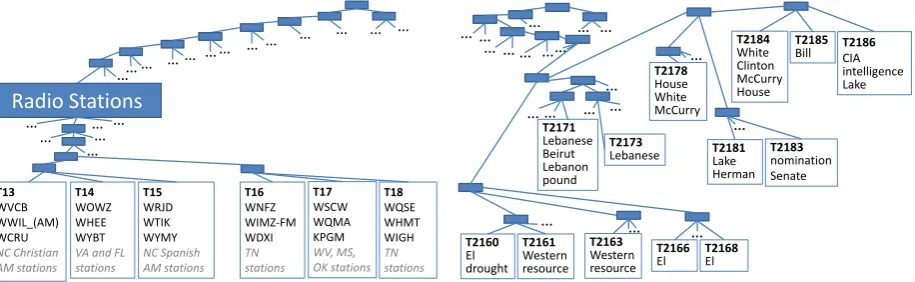
Lastly, we qualitatively examine whether the SBTDM’s learned topics reflect meaningful hi-erarchical relationships. From an SBTDM of 104,976 topics trained on the Wikipedia links data set, we examined the first 108 leaves (these are contained in a single subtree of depth 5). 760 unique terms (i.e. Wikipedia pages) had positive counts for the topics, and 500 of these terms were related to radio stations.
[image:8.595.301.533.426.503.2] [image:8.595.66.295.442.508.2]Number of Topics
Model 18 108 972 8,748 104,976
[image:9.595.135.464.61.127.2]LDA 1420(16.3) 1016(9.8) 844 (1.8) 845 (3.3) 1058 (4.1) nHDP 1433 (19.6) 1446 (53.3) 1583 (157.7) - -SBTDM-wide 1510 (31.5) 1091 (31.8) 797 (3.5) 723(18.2) 844 (60.1) SBTDM-tall 1480 (13.5) 1051 (9.1) 787(10.5) 736 (3.2) 776(14.1)
Table 3: Small training corpus (RCV1s) performance. Shown is perplexity averaged over three runs for each method and number of topics, with standard deviation in parens. Both SBTDM models achieve lower perplexity than LDA and nHDP for the larger numbers of topics.
Radio Stations T16 WNFZ WIMZ-FM WDXI TN stations T17 WSCW WQMA KPGM WV, MS, OK stations T18 WQSE WHMT WIGH TN stations T13 WVCB WWIL_(AM) WCRU NC Christian AM stations T14 WOWZ WHEE WYBT
VA and FL stations T15 WRJD WTIK WYMY NC Spanish AM stations … … … … … … … … … … … … … … … … … … …
Figure 4: An example of topics from a 104,976-topic SBTDM defined over Wikipedia pages.
terms w (ranked by symmetric conditional prob-ability,P(w|t)P(t|w)), and a specific categoriza-tion that applies to the three terms. Interestingly, as shown in the figure, the top terms for the six topics we examined were all four-character “call letters” for particular radio stations. Stations with similar content or in nearby locations tend to clus-ter together in the tree. For example, the two topics focused on radio stations in Tennessee (TN) share the same parent, as do the topics focused on North Carolina (NC) AM stations. More generally, all six topics focus on radio stations in the southern US.
Figure 5 shows a different example, from a model trained on the RCV1 corpus. In this ex-ample, we first select only those terms that oc-cur at least 2,000 times in the corpus and have a statistical association with their topic that ex-ceeds a threshold, and we again rank terms by symmetric conditional probability. The 27-topic subtree detailed in the figure appears to focus on terms from major storylines in United States pol-itics in early 1997, including El Ni˜no, Lebanon, White House Press Secretary Mike McCarry, and the Senate confirmation hearings of CIA Director nominee Tony Lake.
… T2166 El T2171 Lebanese Beirut Lebanon pound T2173 Lebanese T2160 El drought T2161 Western resource T2163 Western resource … … … … … … … … … … T2178 House White McCurry T2181 Lake Herman T2183 nomination Senate T2184 White Clinton McCurry House T2185
Bill T2186CIA
intelligence Lake T2168 El … … … … … … … … …
Figure 5: An example of topics from an 8,748-topic SBTDM defined over the RCV1 corpus.
6 Conclusion and Future Work
We introduced the Sparse Backoff Tree (SBT), a prior for latent topic distributions that organizes the latent topics as leaves in a tree. We pre-sented and experimentally analyzed a document model based on the SBT, called an SBTDM. The SBTDM was shown to utilize large topic spaces more effectively than previous techniques.
There are several directions of future work. One limitation of the current work is that the SBT is defined only implicitly. We plan to investigate explicit representations of the SBT prior or re-lated variants. Other directions include developing methods to learn the SBT structure from data, as well as applying the SBT prior to other tasks, such as sequential language modeling.
Acknowledgments
[image:9.595.74.532.194.335.2]References
[Ahmed et al.2013] Amr Ahmed, Liangjie Hong, and Alexander Smola. 2013. Nested chinese restau-rant franchise process: Applications to user track-ing and document modeltrack-ing. InProceedings of the 30th International Conference on Machine Learning
(ICML-13), pages 1426–1434.
[Blei et al.2003] David M Blei, Andrew Y Ng, and Michael I Jordan. 2003. Latent dirichlet allocation.
the Journal of machine Learning research, 3:993–
1022.
[Blei et al.2010] David M Blei, Thomas L Griffiths, and Michael I Jordan. 2010. The nested chinese restau-rant process and bayesian nonparametric inference of topic hierarchies. Journal of the ACM (JACM), 57(2):7.
[Griffiths and Steyvers2004] Thomas L Griffiths and Mark Steyvers. 2004. Finding scientific topics.
Proceedings of the National academy of Sciences of
the United States of America, 101(Suppl 1):5228–
5235.
[Ho et al.2010] Qirong Ho, Ankur P Parikh, Le Song, and Eric P Xing. 2010. Infinite hierarchical mmsb model for nested communities/groups in social net-works. arXiv preprint arXiv:1010.1868.
[Hofmann1999] Thomas Hofmann. 1999. Probabilis-tic latent semanProbabilis-tic indexing. InProceedings of the 22nd annual international ACM SIGIR conference on Research and development in information
re-trieval, pages 50–57. ACM.
[Hu and Boyd-Graber2012] Yuening Hu and Jordan Boyd-Graber. 2012. Efficient tree-based topic mod-eling. InProceedings of the 50th Annual Meeting of the Association for Computational Linguistics:
Short Papers-Volume 2, pages 275–279. Association
for Computational Linguistics.
[Katz1987] Slava Katz. 1987. Estimation of prob-abilities from sparse data for the language model component of a speech recognizer. Acoustics, Speech and Signal Processing, IEEE Transactions on, 35(3):400–401.
[Kim et al.2013] Suin Kim, Jianwen Zhang, Zheng Chen, Alice Oh, and Shixia Liu. 2013. A hierarchi-cal aspect-sentiment model for online reviews. In
Proceedings of AAAI.
[Lewis et al.2004] David D Lewis, Yiming Yang, Tony G Rose, and Fan Li. 2004. Rcv1: A new benchmark collection for text categorization re-search. The Journal of Machine Learning Research, 5:361–397.
[Li and McCallum2006] Wei Li and Andrew McCal-lum. 2006. Pachinko allocation: Dag-structured mixture models of topic correlations. In Proceed-ings of the 23rd International Conference on
Ma-chine Learning, ICML ’06, pages 577–584, New
York, NY, USA. ACM.
[Li et al.2014] Aaron Q Li, Amr Ahmed, Sujith Ravi, and Alexander J Smola. 2014. Reducing the sam-pling complexity of topic models. InProceedings of the 20th ACM SIGKDD international conference on
Knowledge discovery and data mining, pages 891–
900. ACM.
[McCallum2002] Andrew Kachites McCallum. 2002. Mallet: A machine learning for language toolkit. http://mallet.cs.umass.edu.
[Mimno et al.2007] David Mimno, Wei Li, and Andrew McCallum. 2007. Mixtures of hierarchical top-ics with pachinko allocation. InProceedings of the
24th international conference on Machine learning,
pages 633–640. ACM.
[Mimno et al.2011] David Mimno, Hanna M Wallach, Edmund Talley, Miriam Leenders, and Andrew Mc-Callum. 2011. Optimizing semantic coherence in topic models. InProceedings of the Conference on Empirical Methods in Natural Language Process-ing, pages 262–272. Association for Computational Linguistics.
[Mimno et al.2012] David Mimno, Matt Hoffman, and David Blei. 2012. Sparse stochastic infer-ence for latent dirichlet allocation. arXiv preprint
arXiv:1206.6425.
[Paisley et al.2015] J. Paisley, C. Wang, D.M. Blei, and M.I. Jordan. 2015. Nested hierarchical dirichlet processes. Pattern Analysis and Machine
Intelli-gence, IEEE Transactions on, 37(2):256–270, Feb.
[Petinot et al.2011] Yves Petinot, Kathleen McKeown, and Kapil Thadani. 2011. A hierarchical model of web summaries. InProceedings of the 49th An-nual Meeting of the Association for Computational Linguistics: Human Language Technologies: short
papers-Volume 2, pages 670–675. Association for
Computational Linguistics.
[Petrov and Charniak2011] Slav Petrov and Eugene Charniak. 2011. Coarse-to-fine natural language
processing. Springer Science & Business Media.
[Porteous et al.2008] Ian Porteous, Arthur Asuncion, David Newman, Padhraic Smyth, Alexander Ihler, and Max Welling. 2008. Fast collapsed gibbs sam-pling for latent dirichlet allocation. InIn Proceed-ings of the 14th ACM SIGKDD International
Con-ference on Knowledge Discovery and Data Mining,
pages 569–577.
[Stevens et al.2012] Keith Stevens, Philip Kegelmeyer, David Andrzejewski, and David Buttler. 2012. Ex-ploring topic coherence over many models and many topics. In Proceedings of the 2012 Joint Confer-ence on Empirical Methods in Natural Language Processing and Computational Natural Language
Learning, pages 952–961. Association for
[Wallach et al.2009] Hanna M Wallach, Iain Murray, Ruslan Salakhutdinov, and David Mimno. 2009. Evaluation methods for topic models. In Proceed-ings of the 26th Annual International Conference on
Machine Learning, pages 1105–1112. ACM.
[Wang et al.2009] Yi Wang, Hongjie Bai, Matt Stanton, Wen-Yen Chen, and Edward Y Chang. 2009. Plda: Parallel latent dirichlet allocation for large-scale ap-plications. In Algorithmic Aspects in Information
and Management, pages 301–314. Springer.
[Wang et al.2013] Chi Wang, Marina Danilevsky, Nihit Desai, Yinan Zhang, Phuong Nguyen, Thrivikrama Taula, and Jiawei Han. 2013. A phrase mining framework for recursive construction of a topical hi-erarchy. InProceedings of the 19th ACM SIGKDD International Conference on Knowledge Discovery
and Data Mining, KDD ’13, pages 437–445, New
York, NY, USA. ACM.
[Yao et al.2009] Limin Yao, David Mimno, and An-drew McCallum. 2009. Efficient methods for topic model inference on streaming document collections.
In Proceedings of the 15th ACM SIGKDD
interna-tional conference on Knowledge discovery and data